About TN Cooperative Bank Assistant 2027 Exam Series
📖 Table of Contents
- What TN Cooperative Bank Assistant 2027 is
- The 2,513 posts, district by district
- Who can apply
- The written test, section by section
- Cooperative management: the 50-mark section that decides ranks
- Cooperative banking and credit: the second 50
- The four smaller sections
- The interview: 15 percent that still matters
- Pay: what an Assistant actually earns
- Dates from the 2025 cycle, and what they teach
- How to apply on the district portal
- A 90-day plan that fits around a job or college
- Mistakes that cost candidates a year
- TN Cooperative Bank Assistant next to other bank exams
- What to check before the 2027 notice comes out
TN Cooperative Bank Assistant 2027: Pattern, Salary, Dates
What TN Cooperative Bank Assistant 2027 is
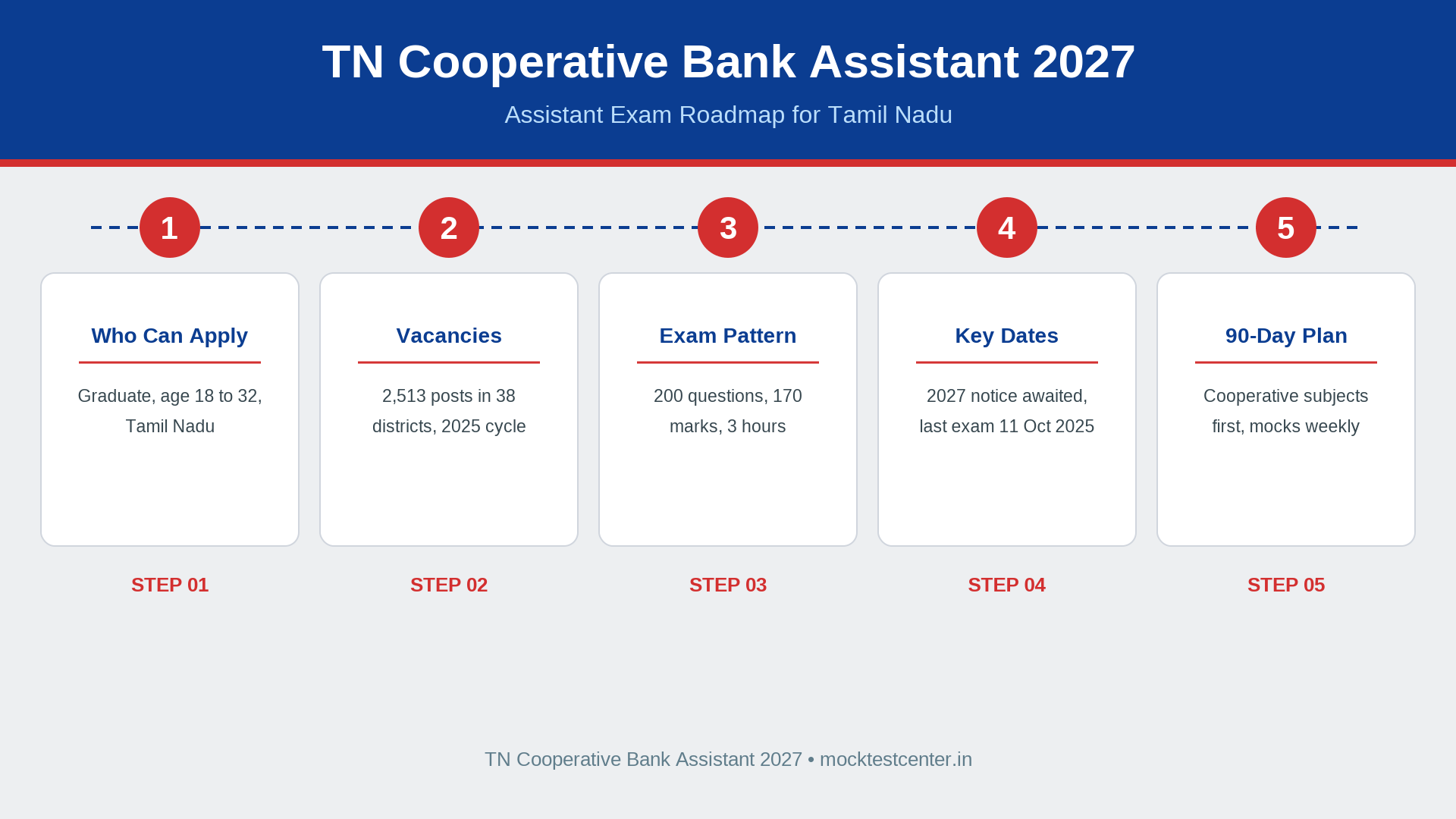
TN Cooperative Bank Assistant 2027 is the next round of hiring for Assistant posts in the cooperative banks of Tamil Nadu. The last round, Advertisement Number 01/2025, offered 2,513 Assistant and Junior Assistant posts across 38 districts. Applications ran from 6 August to 29 August 2025, and the written test took place on 11 October 2025. The 2027 notice has not come out yet, so this page works from that 2025 cycle, which is the most recent full round and the best guide to what comes next.
The hiring body is not one bank. Each district has its own District Recruitment Bureau, working under the Registrar of Cooperative Societies, Tamil Nadu. The bureaus hire for the District Central Cooperative Banks and the cooperative institutions in their districts. A candidate applies to one district, writes the test for that district, and joins a bank in that district.
The official portal for the state is tncoopsrb.in, and the department site is rcs.tn.gov.in. Check both when the notice comes out, because the district bureau site carries the form.
Two facts set this exam apart from the national bank exams. First, half the paper tests cooperative subjects. Reasoning and maths alone will not cover it. A candidate who prepares only for IBPS style tests will walk into 100 marks of cooperative management and cooperative banking with no base.
Second, the test is one paper of 200 questions for 170 marks, followed by an interview that carries 15 percent of the final score. There is no prelims and mains split. One day decides the written score.
The post itself is a steady state government job in your home district. Assistants handle deposits and loans at the counter, and they keep member accounts in order in the District Central Cooperative Bank branches and the primary societies they serve. The work stays close to farming and rural credit, which is what the cooperative banks were built for. Tamil Nadu runs a three tier cooperative credit structure: the Tamil Nadu State Apex Cooperative Bank at the top, 23 District Central Cooperative Banks in the middle, and more than 4,400 Primary Agricultural Cooperative Credit Societies at the village level.
An Assistant joins the middle of that structure.
The 2,513 posts, district by district
The 2025 cycle offered 2,513 posts in one advertisement, and the district split shows where the seats sat. Chennai led with 157 Assistant posts. Namakkal followed with 75. Tiruvallur and Tuticorin had 47 each.
Tiruchy had 42. Chengalpattu had 41. Vellore had 41. Coimbatore had 39.
Madurai had 35. Thanjavur had 33. Cuddalore had 31. Dindigul had 32.
Tirupattur had 25. At the other end sit the small districts. Ariyalur had 7 posts. Perambalur had 8.
Nagapattinam had 8. Mayiladuthurai had 9. The full list covers 38 districts, and the sum of the district figures is 2,513.
District choice is the first real decision in this exam, and it matters more than most candidates think. You apply to one district bureau, and you compete only with candidates who picked the same district. A district with 157 posts and heavy applicants can be harder to crack than a district with 25 posts and fewer applicants. Nobody publishes district wise applicant counts, so you cannot calculate the odds exactly.
But the pattern is clear. Chennai draws the biggest crowd because it has the most posts and the most graduates. Smaller districts draw fewer applicants, and a candidate from that district knows the local paper better.
Pick the district where you live, or where you hold the certificates the notice asks for. Some district notices ask for proof of residence or local study, and the rules differ by bureau. Read the district notice, not the state summary, before you pay the fee. The fee is 500 rupees for General candidates and 250 rupees for SC, ST, persons with disabilities, and destitute widows, and the board does not refund it.
A separate Chennai notice came later in the same season. Notification Number 02/2025, dated 11 December 2025, offered 50 more Assistant posts in the Chennai District Central Cooperative Bank, with applications from 14 to 31 December 2025 and a test on 24 January 2026. That second notice shows the pattern of this recruitment. Districts add posts through the year, and a candidate who watches the board site catches rounds that others miss.
Who can apply
The age rule in the 2025 cycle was simple at the bottom and generous at the top. The minimum age was 18 years as on 1 July 2025. For Other Classes, the maximum was 32 years. For differently abled candidates from Other Classes, the maximum was 42 years.
For ex-servicemen from Other Classes, it was 50 years. For candidates from Adi Dravida, Arundhathiyar, Scheduled Tribe, Most Backward Classes, Backward Classes, and Backward Classes (Muslim) groups, there was no maximum age limit. Expect the 2027 notice to set its own cut off date, so check your age against the date printed in the new notice, not against the date in this article.
The degree rule asks for a graduation degree in the 10+2+3 pattern from a recognised university. Any subject works. The notice gives preference to degrees in Commerce and Cooperation, with Accounting, Banking, and Auditing close behind. A Diploma in Cooperative Management counts as an added advantage.
That preference is only a preference, and it tells you what the interview panel values. A commerce graduate who also holds a cooperative diploma walks into the interview with two ticks already.
Cooperative training needs a closer look, because the notices treat it in two ways. The application form asks candidates to upload a Cooperative Diploma Training Certificate, or a bonafide certificate if they are still doing the course. Candidates with a B.Com in Cooperation can claim exemption from cooperative training by uploading the mark list for Book Keeping, Banking, Cooperation, and Auditing. Some district notices make the training a condition for joining, while others treat it as an advantage at selection.
The safe move is to start the cooperative diploma course early, or to hold a B.Com with Cooperation, so that no reading of the rule can shut you out.
There is no limit on attempts in the notice. You can apply in every cycle as long as you meet the age rule for your group. That matters here, because the recruitment is not annual on a fixed date. The 2025 round came in August, the Chennai top up came in December, and the next round may come at any time.
Candidates who keep their cooperative notes ready can apply the week a notice drops, while others start from zero.
The written test, section by section
The written test runs for three hours, from 10 AM to 1 PM in the 2025 cycle. It has 200 objective questions for 170 marks. Every wrong answer costs 0.25 marks. The paper has six sections, and two of them carry 100 of the 170 marks between them.
That split is the whole strategy of the exam.
| Section | Questions | Marks share |
|---|---|---|
| Principles and Practices of Cooperative Management | 50 | Part of 170 |
| Cooperative Banking and Credit Systems | 50 | Part of 170 |
| Fundamentals of Cooperative Accounting | 25 | Part of 170 |
| Basics of Computer | 25 | Part of 170 |
| General Knowledge and Current Affairs | 25 | Part of 170 |
| Tamil Language Proficiency | 25 | Part of 170 |
| Total | 200 | 170 |
The notice does not print a section wise mark split beyond the total of 170 marks for 200 questions, so the table above gives questions per section and the total only. Do not trust any site that prints exact marks per section, because the official notice does not give them. The two 50 question sections are the heavy ones by count, and a candidate should give them the most study time for that reason alone.
Three hours for 200 questions means 54 seconds per question on average. That is a fair pace, and it is slower than the IBPS Clerk pace. The paper rewards steady knowledge more than speed. A candidate who knows the cooperative syllabus can finish with time to spare.
A candidate who guesses through the cooperative sections will burn the same three hours and score far less, because guessing at 0.25 negative marking punishes random answers.
The test is a computer based test, and the questions are objective only. The Tamil Language Proficiency section tests Tamil, while the other sections run in English and Tamil as per the district notice. Read the medium of the paper in your district notice before the test, so the language of the question paper holds no surprise on the day.
Compare this with the national clerk exams before you choose where to put your effort. The SBI Clerk 2027 exam and the IBPS Clerk 2027 exam test reasoning and maths. They also test English and general awareness, with no cooperative paper at all. A candidate who prepares for those two exams still needs 100 marks of cooperative study for this one.
The overlap is real, but it covers only half the paper.
Cooperative management: the 50-mark section that decides ranks
Principles and Practices of Cooperative Management carries 50 questions, and it is the section where toppers build their lead. The syllabus runs wide. It starts with the concept of cooperation and the ICA definition, then the seven principles and the cooperative values of self help, self responsibility, democracy, equality, equity, and solidarity. Abroad, the pioneers include Robert Owen of Wales and Charles Fourier of France.
Dr William King worked in England, while Schulze and Raiffeisen worked in Germany. The Rochdale Pioneers of 1844 in Manchester close the list. On the Indian side it names P T Theagaraya of Chennai and P S Kumarasamy Raja of Rajapalayam. Dr P Natesan of Salem and K S Subramania Gounder of Salem stand beside them.
The history part of the syllabus is long, and it pays to learn it as a timeline rather than a list. The Nicholson Report of 1895 and 1897, the Edward Law Committee of 1901, the Cooperative Credit Societies Act of 1904, the Cooperative Societies Act of 1912, the Maclagan Committee of 1914, the Royal Commission on Agriculture of 1928, and the Cooperative Planning Committee of 1946 mark the pre Independence road. After Independence come the Five Year Plans, the National Council for Cooperative Training in 1962, the National Cooperative Development Corporation in 1963, the All India Rural Credit Review Committee of 1969, and the Agriculture Credit Review Committee of 1989. The Vaidyanathan Task Force of 2005 and the Narsimham Committee of 1998 belong to the reform years.
Cooperative law is the second half of this section. The Tamil Nadu Cooperative Societies Act of 1983 and its Rules of 1988 carry the most questions, because the Act governs the very banks you want to join. Learn the key sections by number: registration under sections 8 to 10, bylaws under section 11, membership under section 21, management under section 32, board meetings under section 33, disposal of net profits under section 72, inquiry under section 81, inspection under section 82, surcharge under section 87, supersession under section 88, settlement of disputes under section 90, winding up under section 137, and the provisions for appeal and revision, with review in sections 152 to 154. The Constitution (97th Amendment) Act of 2011, which gave cooperatives constitutional status, shows up too.
Management topics close the section: functions of management and levels of management, with the difference between cooperative management and private management. Leadership and communication get their own questions. Motivation and decision making do too. Office management gets its own questions: file and record upkeep and official letters.
Discipline and time management get questions too. Cooperative education and training, cooperative administration, the role of the Registrar, the duties of the Secretary and Manager, and election rules for the management committee all sit in this syllabus. It is a lot, but it is fixed. The same topics return every cycle, so notes made once serve for years.
Cooperative banking and credit: the second 50
Cooperative Banking and Credit Systems carries the other 50 questions, and it is the most job linked section in the paper. It asks what credit is, how credit is classified, why farmers need institutional credit, and how the cooperative credit structure works. The structure is three tier: Primary Agricultural Cooperative Credit Societies at the village level, District Central Cooperative Banks at the district level, and the Tamil Nadu State Apex Cooperative Bank at the state level. The apex bank was registered on 23 November 1905 as the Madras Central Urban Bank, and it is described as the first central cooperative bank in India.
Know the numbers that describe the structure. Tamil Nadu has 23 Central Cooperative Banks with 933 branches, and more than 4,400 Primary Agricultural Cooperative Credit Societies. The apex bank sits in Chennai and refinance comes from NABARD. The District Central Cooperative Banks raise funds from public deposits, borrowings, and refinance from the apex bank and NABARD.
They lend to farmers and self help groups. Rural artisans and weaker sections borrow too, along with joint liability groups. Priority sector lending, the Kisan Credit Card, the Service Area Approach, the Business Development Plan, and the Development Action Plan all appear in the syllabus.
Banking operations take a large share of the questions. Types of deposits and account opening for different kinds of customers matter. Loan documents matter too. Fund management covers cost and yield on assets, with gross margin and net margin beside them.
The break even point and the prime lending rate matter. The principles of good lending matter too. Overdues get detailed treatment: causes of overdues, remedies, and recovery ethics. Non performing assets lead to questions on asset classification and income recognition.
Provisioning norms and capital adequacy norms follow. The SARFAESI Act of 2002 and the Debt Recovery Tribunal appear here, along with the Negotiable Instruments Act of 1881 and the Banking Regulation Act of 1949 as it applies to cooperative societies.
Banking services close the section: ATM and credit cards, debit cards and collection, remittance and agency services. Clearing house, RTGS, and NEFT sit beside ECS and cheque truncation. The IFSC code closes the list. Candidates who work in a bank or have cleared JAIIB will find this section familiar.
The CAIIB Rural Banking 2027 material overlaps with it, because rural credit is the same subject from the banker side. A candidate who reads the cooperative banking syllabus with a banker eye will see the same ideas in both places.
The four smaller sections
Fundamentals of Cooperative Accounting carries 25 questions, and it starts with plain commerce and accounting before it turns cooperative. Double entry, journal entries, ledger posting, trial balance, trading account, profit and loss account, and balance sheet all appear. Then the syllabus turns to cooperative accounting itself: rough cash chita and day book, cash book and ledgers, statement of receipts and disbursement, and final accounts. Distribution of net profits and creation of reserves follow, with the difference between cooperative accounting and the double entry system.
Cooperative audit sits nearby: meaning and aims of audit, types of audit, duties of the auditor, internal control, verification of assets, and the audit report.
Basics of Computer carries 25 questions, and it is the easiest scoring section in the paper for a graduate who uses a computer daily. Hardware and software come first. Then input and output devices, with memory types from RAM and ROM to cache. Generations of computers and operating systems follow, plus computer viruses and trojan horses, with worms in the same chapter.
Management information systems form the second part: data and information, enterprise resource planning, customer relationship management, supply chain management, and decision support systems. The third part is practical: MS Word and MS Excel come first, then MS PowerPoint. Mail merge and formulas matter. Charts and sorting come next, with slide shows after them.
The last part covers networks: LAN, MAN, and WAN, with email after them. Payment gateways and electronic payment systems come first. RTGS and NEFT follow, with core banking after them. Cyber crime and cyber security close the list.
General Knowledge and Current Affairs carries 25 questions, and it follows the Tamil Nadu public service style. General science opens the list, with current affairs from Tamil Nadu and India, plus world news. Eminent persons and sports come first. Books and authors follow, with awards and welfare schemes after them.
Geography and history of India and Tamil Nadu follow, with the Dravidian movement beside them. The Constitution and panchayat raj come next, with the Indian economy after them. The national movement closes the list. Aptitude and mental ability sit in the same syllabus.
It is wide, but the current affairs part rewards daily reading. Six months of Tamil Nadu and national news, read every morning, covers most of it.
Tamil Language Proficiency carries 25 questions, and it tests the language you will use at the counter every day. Candidates who studied in Tamil medium have a clear edge here, and the notice gives a certificate route for Tamil medium degree holders. Do not leave this section to chance. Twenty five questions is one eighth of the paper, and a candidate who scores low in Tamil while scoring high in cooperative subjects still loses the same marks.
Read Tamil newspapers, practise Tamil grammar from school books, and take mocks that include this section, because most national test series skip it entirely.
The interview: 15 percent that still matters
The selection has two stages. The written test carries 85 percent of the final score, and the interview carries 15 percent. That split means the written test decides most of the result, but the interview decides the close calls. With 2,513 posts and thousands of candidates, the merit list has many ties near the cut off, and the interview is what breaks them.
The interview panel asks about your degree and your district. It asks about cooperative banking too, and why you want this job. Know your district bank by name. Know the apex bank, the 23 Central Cooperative Banks, and the role of the Primary Agricultural Cooperative Credit Societies.
Know one crop loan product and one deposit product. Panels ask what an Assistant does all day, and a candidate who describes cash work and loan files, with member service in plain words, sounds ready for the counter.
Prepare for the interview from the day you clear the test, not a week before it. Keep one page of notes on your degree subject and one project or paper from it. Keep one page on cooperative banking in your district: the name of your District Central Cooperative Bank and its branches, plus the societies it serves. And keep one plain reason you want this job, stated in your own words.
Panels hear the same rehearsed lines all day, and a plain answer in your own words stands out more than a polished speech.
Documents decide the interview as much as answers do. The notice asks for the degree certificate, the cooperative training certificate or exemption proof, the caste certificate where it applies, and the Tamil medium certificate where it is claimed. Keep originals and copies ready before the test, because the call for the interview can come fast. A candidate who clears the written test and then hunts for a missing certificate loses days that the interview preparation needs.
Pay: what an Assistant actually earns
Pay in this recruitment varies by district and by post, because each District Central Cooperative Bank has its own pay scale. The 2025 trackers report a range rather than one figure. Assistant posts are reported in bands such as 11,000 to 45,100 rupees, 11,900 to 32,450 rupees, and 15,000 to 47,600 rupees a month, depending on the district and the bank. Junior Assistant posts are reported around 10,000 to 42,500 rupees a month.
The Chennai top up notice of December 2025 gave a higher band of 32,020 to 96,210 rupees a month for its 50 Assistant posts, which shows how wide the district spread runs.
Read the pay scale in your district notice before you apply, because the state summary cannot give you the figure for your district. The scale is only part of the package. Cooperative bank staff get dearness allowance, house rent allowance, and the usual state government linked benefits of their bank, and the job carries the security of a regular state post. That security is the real draw for most candidates, more than the starting figure.
Put the money next to the national clerk exams before you decide. The IBPS RRB Clerk 2027 exam leads to a rural bank clerk post with a starting basic pay of 24,050 rupees, and the RBI Assistant 2027 exam starts at 20,700 rupees basic. The Tamil Nadu cooperative Assistant starts lower in many districts, but the posting stays in your home district, the work stays in Tamil, and the competition stays local. That trade is worth it for candidates who want to live where they grew up.
Growth exists, but it runs on the cooperative ladder, not the national bank ladder. An Assistant can move up to senior assistant, then to manager grades in the District Central Cooperative Bank, and the cooperative diploma and JAIIB style qualifications help at each step. The JAIIB RBWM 2027 material on retail banking and wealth management is useful reading for an Assistant who wants to move up, because the same products sit on the counter. Plan for promotion from the first year, and keep studying after you join.
Dates from the 2025 cycle, and what they teach
The TN Cooperative Bank Assistant 2027 notice has not been released. No dates for 2027 exist yet, and any site that prints them is guessing. What exists is the 2025 cycle, and it is worth reading closely.
| Event | Date |
|---|---|
| Advertisement 01/2025 released | 6 August 2025 |
| Applications open | 6 August 2025 |
| Applications close | 29 August 2025, 5.45 PM |
| Written examination | 11 October 2025, 10 AM to 1 PM |
| Chennai top up notice 02/2025 | 11 December 2025 |
| Chennai top up applications close | 31 December 2025, 5.45 PM |
| Chennai top up examination | 24 January 2026, 10 AM to 1 PM |
The apply window lasted 24 days. The gap between the last date and the test was 43 days. That is a short runway, and it punishes late starters. A candidate who starts studying when the notice drops gets 43 days to cover a syllabus that needs three months.
A candidate who starts now gets the notice period as revision time. The Chennai top up gave 18 days to apply and 24 days from the last date to the test, which is shorter still.
Watch tncoopsrb.in and your district bureau site every week. The 2025 notice came in August, so late summer is the season to watch, but the Chennai top up proves that a round can come in December too. Check the board site twice a week from July onward. The window is short, and the fee payment closes with the form, so a candidate who finds the notice on the last day still has to arrange the certificates and the payment in hours.
How to apply on the district portal
Go to the District Recruitment Bureau site for your district, or start at tncoopsrb.in and follow the link for your district. The Chennai bureau site is drbchn.in, and each district has its own bureau site on the same pattern. Open the link for Assistant in Cooperative Institutions. Read the full district notice before you touch the form, because the district notice carries the post list, the pay scale, and the certificate rules for that district.
Keep a working email ID and mobile number ready, because the bureau sends the application number and the test alerts there. Fill the form with your personal details and your education details. Upload a photograph of not more than 50 KB in JPEG or JPG format, and a signature of not more than 50 KB. Upload the caste certificate where it applies, the Cooperative Diploma Training Certificate or the bonafide certificate if you are still doing the course, and the degree certificate, each within the size the notice asks for.
Candidates who claim exemption from cooperative training upload the consolidated mark list that shows Book Keeping and Banking, with Cooperation and Auditing in it.
Pay the fee online and save the receipt. In the 2025 cycle the fee was 500 rupees for General candidates and 250 rupees for SC, ST, persons with disabilities, and destitute widows. Take a print of the final form and keep the application number safe. The admit card comes on the district bureau site before the test, and it tells you the centre and the reporting time.
Reach the centre early. Late entry is refused, and the test runs from 10 AM sharp.
Candidates who also track the national exams will find the form familiar. The IBPS PO 2027 exam and the SBI PO 2027 exam use the same online form pattern, and once you have filled one carefully, the rest feel familiar. The difference here is the district. You apply to one district, and you cannot change it after submission, so choose before you pay.
A 90-day plan that fits around a job or college
Days 1 to 30 are for the base. Study two hours a day if you work or attend college, four hours if you are free. Give the first hour to cooperative management and the second hour to cooperative banking. Read the news every morning and write five lines in your current affairs notebook.
Take one mock at the end of week two and one at the end of week four. Do not worry about the score. The first mocks only show you where you stand.
Days 31 to 60 are for speed and for the smaller sections. Your TN Cooperative Bank Assistant 2027 score will move most in this phase, because the cooperative sections are now familiar and the smaller sections are still fresh. Take two mocks a week now. After each mock, spend as much time on analysis as you spent on the test.
Write down every question you got wrong and why. Was it a concept gap, a silly mistake, or a time problem? Concept gaps go back into your study list. Silly mistakes need a checklist before you submit each section.
Time problems need easier questions first and hard ones last.
Days 61 to 90 are for the real thing. Take three mocks a week. Revise your error notebook every second day. Cover accounting and computers in rotation, with Tamil on its own day, so none of them goes cold.
Stop learning new topics in the last ten days. New topics in the last week add stress and no marks. In the last three days, take one full mock at 10 AM, the same time as the real test, then rest. Sleep matters more than one more chapter in the final week.
If you have less than ninety days, cut the base phase, not the mocks. Ten mocks with full analysis beat thirty days of reading without a single test. The paper rewards candidates who have sat through the three hour sitting many times. It punishes candidates who know the syllabus and have never felt the clock run out.
And if the notice drops while you are mid plan, freeze the plan and switch to revision at once. The 43 day gap from the last date to the test is revision time, not learning time.
Mistakes that cost candidates a year
The first mistake TN Cooperative Bank Assistant 2027 candidates make is preparing for it like an IBPS exam. Reasoning and maths books will not cover 100 questions of cooperative management and cooperative banking. A candidate who scores full marks in general knowledge and zero in cooperative subjects fails the paper by a wide margin. Give the cooperative syllabus half your study time from day one.
The second mistake is ignoring Tamil. Twenty five questions is one eighth of the paper, and candidates who studied in English medium often leave it to luck. Luck is a poor plan for 25 questions. Read Tamil every day, even if it is only the newspaper, and practise Tamil grammar from school books.
A candidate who reads Tamil daily will pick up marks that others leave on the table.
The third mistake is guessing too much. Four wrong answers erase one right answer at 0.25 negative marking. In a section where you know thirty answers for sure, ten wild guesses can pull your score down by two and a half marks. That is often the gap between selection and rejection in a district with few posts.
Guess only when you can rule out two options.
The fourth mistake is applying to the wrong district. Candidates pick Chennai for the 157 posts and ignore their home district with 25 posts, then face the biggest crowd in the state. Or they pick a district without reading its notice, and find at document verification that they lack a certificate that district asks for. Read the district notice twice, check the certificate list, and then pay the fee.
The fifth mistake is skipping mocks. Reading feels like preparation, but the test measures knowledge under a three hour clock. Candidates who take fewer than ten mocks before the real test are gambling. Take twenty if you can.
Analyse every one. The mock habit is the cheapest marks in this exam, and it costs nothing but time.
TN Cooperative Bank Assistant next to other bank exams
Put this exam beside the big ones and the trade off becomes clear. The IBPS Clerk 2027 exam and the SBI Clerk 2027 exam lead to clerk posts with many more seats across the country, but the posting can land anywhere, and the paper tests no cooperative subject. The IBPS PO 2027 exam and the SBI PO 2027 exam lead to officer posts with higher pay, but they draw lakhs of candidates for a national merit list. This exam keeps the contest inside one district, and the paper rewards local knowledge.
Against officer exams in the cooperative world, the comparison is about the entry bar. The MSC Bank Trainee Junior Officer 2027 exam in Maharashtra asks for two years of banking experience as an officer, so fresh graduates cannot apply for it. The TN Assistant exam asks only for a degree, so a fresh graduate can walk in. The NABARD Grade A 2027 exam pays far more and works at the national level for rural credit, but it needs a specialist degree and draws a national crowd.
The TN exam is the open door. The others are the later doors, after you have the experience.
The way to choose is to ask one question. Do you want a steady job in your home district, in Tamil, with a paper that rewards cooperative study? If yes, this exam deserves your main effort. If you want a national posting and higher starting pay, the IBPS and SBI exams fit better.
Many candidates apply for both kinds and decide when the offers come. That is a sound plan, because the general knowledge and computer preparation serves both, with Tamil on top, and only the cooperative half is extra.
What to check before the 2027 notice comes out
Keep three things ready. First, your degree certificate and the cooperative training certificate, or the exemption mark list, so you can apply the day the notice drops. Second, a mock test routine with the full 200 question paper at 10 AM, so the three hour sitting feels normal by the time the notice comes out. Third, a habit of checking tncoopsrb.in and your district bureau site twice a week from July onward.
Start with one TN Cooperative Bank Assistant 2027 mock this week, cooperative sections included. Score it, list your weak section, and give that section thirty minutes a day. That single habit, repeated for ninety days, is what turns a graduate into an Assistant in the cooperative bank of their own district.