
About CAIIB Rural Banking 2027 Exam Series
📖 Table of Contents
- The paper in one page
- Why candidates pick Rural Banking over the other four electives
- Module A: Rural India
- The people of rural India
- Agriculture economy and infrastructure
- Policies and the problems they try to fix
- Module B: financing rural development
- Who gives rural credit and who watches them
- Crop loans and the Kisan Credit Card
- Non farm sector, MSMEs and bankable projects
- Module C: priority sector and government initiatives
- The priority sector targets
- Government schemes and financial inclusion
- Module D: problems and prospects in rural banking
- The problems a rural banker sees every day
- Technology in the village
- Microcredit and the SHG bank linkage programme
- The CAIIB Rural Banking 2027 90 day plan
- Mistakes that cost marks in Rural Banking
- Before you register, check these things on the IIBF site
- Where Rural Banking fits in a banking career
- Sources
CAIIB Rural Banking 2027: Elective Paper Guide
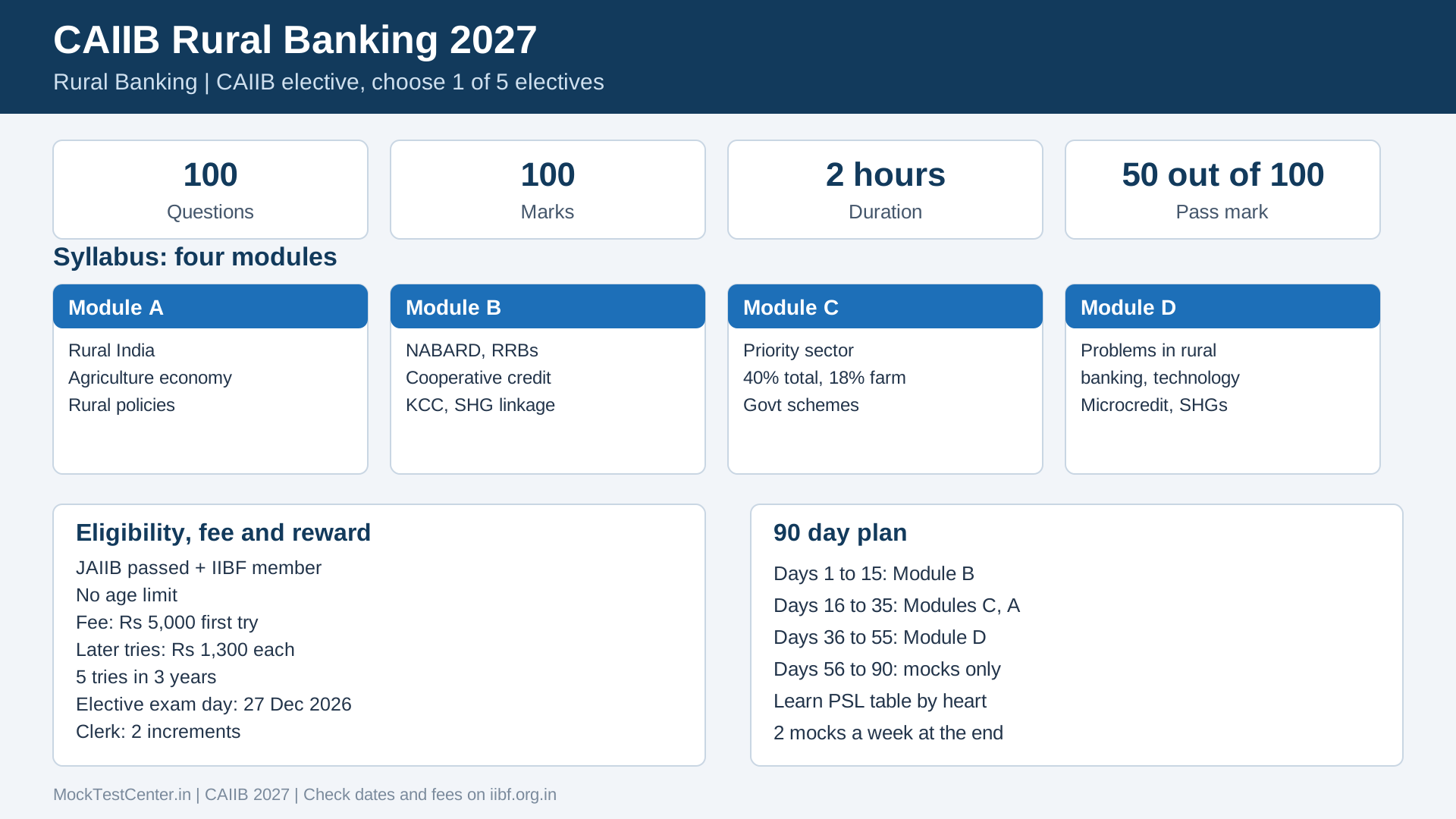
Rural Banking is one of the five elective papers of CAIIB, and it is the elective that most closely matches the daily work of a banker posted in a rural or semi urban branch. The Indian Institute of Banking and Finance, IIBF, runs the CAIIB elective paper on 27 December 2026, along with the other four electives. The CAIIB Rural Banking 2027 cycle has no announced dates yet as of 19 November 2026, so this guide uses the latest real cycle and the current syllabus. That is the honest starting point for any plan.
The paper carries 100 objective questions for 100 marks and runs for 2 hours. There is negative marking of 25 percent of the marks allotted to the question, so a wrong answer costs a quarter mark and a blank answer scores nothing. You pass with 50 marks out of 100 in the paper.
IIBF also allows a second route to pass, which is 45 marks in each paper with an aggregate of 50 percent across all papers in a single attempt. The second route only helps if you clear every paper in that one sitting, so plan for 50 in Rural Banking and treat the aggregate route as a safety net.
You pick only one elective out of five. The five are Rural Banking; Human Resources Management; Information Technology and Digital Banking; Risk Management; Central Banking. Your choice stays with you for the attempt, and you can change it in a later attempt if the rules allow it.
This guide explains the CAIIB Rural Banking elective in depth, module by module, shows why candidates pick it, and gives a 90 day plan that fits around a full time bank job. Every date and fee here comes from the IIBF notification as reported by trackers, and the sources sit at the end of the page. Check the IIBF official website before you pay any fee, because IIBF can change a date or a fee between cycles.
The paper in one page
| Item | Detail |
|---|---|
| Paper | Rural Banking, CAIIB elective paper, choose 1 of 5 electives |
| Questions | 100 objective questions |
| Marks | 100 marks, 1 mark per question |
| Duration | 2 hours |
| Negative marking | 25 percent of the marks of the question |
| Pass mark | 50 out of 100, or 45 in each paper with 50 percent aggregate in one attempt |
| Mode | Online, objective type |
| Medium | English and Hindi |
| Last paper date | 27 December 2026, elective paper day |
| Next cycle | 2027 dates not announced as of 19 November 2026 |
Rural Banking is a concept paper, not a formula paper. About 60 to 70 percent of the questions test concepts and schemes, according to tracker guides, and the rest test facts about institutions and targets. That split shapes how you study.
You do not need to memorise long tables of numbers. You need to understand how rural credit flows, who gives it, who regulates it, and where it gets stuck. A banker who has handled crop loans and Kisan Credit Cards will find much of the paper familiar.
The syllabus has four modules: A, B, C, D. Module A covers Rural India. Module B covers Financing Rural Development. Module C covers Priority Sector Financing and Government Initiatives.
Module D covers Problems and Prospects in Rural Banking. Module B carries the most exam weight in practice, because it covers NABARD, regional rural banks, cooperative credit, the Kisan Credit Card and the SHG bank linkage programme. Start there if your time is short, but do not skip Module A, because its facts feed into every other module.
Why candidates pick Rural Banking over the other four electives
Five electives sit on the table and you can pick only one, so the choice deserves a clear head. Rural Banking suits bankers who work in rural branches, regional rural banks and cooperative banks, because the syllabus matches their daily work. It also suits bankers in public sector banks who handle priority sector lending, because Module C is the rule book for their targets. If your branch deals with crop loans, SHGs, government schemes every week, this elective gives you marks for knowledge you already use.
Compare it with the other four before you decide. Human Resources Management suits bankers who want HR roles and it has five modules, which is more reading. Information Technology and Digital Banking suits bankers who like technology and it tests security and audit in depth.
Risk Management suits bankers in credit and treasury, and it has six modules, the heaviest load of the five. Central Banking suits bankers who love monetary policy and the RBI, and it also has six modules. Rural Banking has four modules and a syllabus that stays close to the branch, which is why many candidates call it the most scoring elective.
Scoring is a claim you should test, not just accept. Tracker guides call Rural Banking one of the most scoring electives, and they base that on the concept heavy nature of the paper and the overlap with JAIIB and with daily branch work. But scoring depends on the candidate.
A banker in a city branch who has never handled a crop loan may score better in IT and Digital Banking. A banker in a treasury desk may score better in Risk Management. Pick the elective that matches your work and your interest, not the one that a stranger on the internet calls easy.
One practical point decides many choices. The elective exam for all five electives happens on the same day, 27 December 2026 in the latest cycle, so you cannot sit for two electives in one cycle. Your preparation for the four compulsory papers also runs in the same months, so the elective must fit into a crowded calendar. Rural Banking fits well because its topics overlap with the priority sector and NABARD parts of the compulsory papers, and with the JAIIB papers you already cleared.
Module A: Rural India
Module A explains the place where rural banking happens. It covers demographic features, the character of rural society, the economic features of the rural economy, infrastructure, the agriculture economy, rural development policies, and the issues that concern rural areas. This module is mostly facts and ideas, and it rewards steady reading rather than last minute cramming. The facts here return in Modules B, C, D, so learn them properly the first time.
The people of rural India
Rural India is home to a large share of the population, and agriculture still employs a large share of workers even as its share of GDP has fallen. The syllabus asks you to know the demographic features, which include population, literacy, health, nutrition, education, rural urban migration. It also asks you to know the economic features, which include agriculture and non farm activities, GDP, gross value added. They also cover rural money markets in formal and informal forms, rural indebtedness, rural poverty, the methods of measuring the poverty line.
Social structure matters for a banker because it shapes who borrows and how. The syllabus covers social stratification and local institutions, plus the role of the National Institute of Rural Development and Panchayati Raj. Panchayati Raj institutions run local government in villages, and banks work with them on many schemes. A question may ask about the role of a gram panchayat in a scheme, or about the institutions that support rural development, so learn the names and the one line job of each institution.
Agriculture economy and infrastructure
The agriculture economy section covers the structure and character of Indian agriculture, its role in economic development, the link between agriculture and industry, the issues and constraints in farm growth, technical change, emerging issues such as the National Mission for Sustainable Agriculture. Indian agriculture is mostly small farms, and that fact drives everything in rural credit. Small farms need small loans, quick decisions, simple procedures, and that is why the Kisan Credit Card and the SHG model exist.
Infrastructure decides whether a rural branch can do its job. The syllabus lists transport, markets, rural electrification, other services. A village with a road and power can support a cold storage, a dairy unit or a small workshop, and each of those needs bank finance.
A village without them can support only crop loans. Learn to connect infrastructure to credit demand, because the exam tests that link in Module D as well as in Module A.
Policies and the problems they try to fix
Rural development policies fill the last part of Module A. The syllabus names rural development schemes, skill development and entrepreneurship, the Shyama Prasad Mukherji Rurban Mission, programmes for backward areas, dryland farming, conservation of soil and water, the Rural Infrastructure Development Fund. The Rural Infrastructure Development Fund, or RIDF, is run by NABARD, and banks that miss their priority sector targets deposit the shortfall amount in RIDF and similar funds. That link between targets and RIDF appears in Module C too.
The module closes with issues concerning rural areas, which include the components and approaches to rural development since independence, sustainable rural development, rural management issues, marketing management, the importance of agricultural prices. Agricultural prices matter because they decide farm income, and farm income decides whether a crop loan gets repaid. A banker who understands price risk understands why farm lending needs insurance and why the exam asks about it.
Module B: financing rural development
Module B is the heart of the paper. It covers the regulation of rural financial services, the rural credit institutions, financing of agriculture and allied activities, financing of the rural non farm sector, SME finance, project concepts with model bankable projects. If you master Module B, you have covered the largest share of the marks. Give it the most days in your plan.
Who gives rural credit and who watches them
Rural credit flows through a set of institutions that the syllabus calls rural financial institutions. The set includes the cooperative credit system, regional rural banks, commercial banks, other institutions that serve rural areas. The Reserve Bank of India sets the policy and NABARD supports and supervises much of the rural credit system. The Lead Bank Scheme gives one bank the lead role in each district, and that bank prepares the district credit plan and coordinates the other banks.
Cooperative credit has three tiers in most states, which are the state cooperative bank at the top, the district central cooperative bank in the middle, and the primary agricultural credit society at the village level. Regional rural banks were set up to serve rural areas with a local feel and a commercial structure, and they are sponsored by public sector banks. Commercial banks serve rural areas through their rural branches and through business correspondents. Learn the structure of each tier and the role of each institution, because the exam asks you to match an institution to its job.
NABARD deserves a section of its own in your notes. The National Bank for Agriculture and Rural Development was set up in 1982 as the apex institution for rural credit. It refinances cooperative banks and regional rural banks, runs the Rural Infrastructure Development Fund, supports microfinance through the SHG bank linkage programme, and promotes rural development projects.
NABARD does not take deposits from the public in the way a commercial bank does, and it does not lend directly to individual farmers in the normal course. Learn what NABARD does and what it does not do, because both kinds of questions appear.
Crop loans and the Kisan Credit Card
Financing agriculture starts with crop loans, which give production credit for a crop season. The Kisan Credit Card scheme gives a farmer a single card with a credit limit that covers crop production, allied activities, some consumption needs, and the farmer can draw and repay within the limit as the season demands. Learn the features of the card, which are the limit, the validity, the interest subvention that the government gives on prompt repayment, and the coverage for allied activities such as dairy and fisheries.
NABARD refinance supports cooperative banks and regional rural banks for crop production, and the syllabus asks you to know the basic features of that refinance. Banks also have a role in giving relief in areas hit by natural calamities, which includes restructuring of loans and fresh finance for the next season. Term loans cover allied activities such as dairy, poultry, plantation, horticulture, fisheries, farm mechanisation, and the syllabus lists the major sectors where banks give term credit. Learn two or three features of each sector rather than trying to memorise every line.
Advances against gold ornaments form a small but steady part of rural lending. Farmers pledge gold for a quick loan, often for a short term need such as a wedding or a medical cost. The bank must check the purity, keep the ornaments safe, and follow the loan to value rules that the RBI sets. The exam tests the practical points, such as the need for appraisal and the risk when the price of gold falls.
Non farm sector, MSMEs and bankable projects
The rural non farm sector covers all the work that is not farming, from village industry and handicrafts to transport, trade, services. The syllabus covers its importance, structure, growth, issues, traditional industries, raw material supply, marketing, institutional finance, technology development, training. The non farm sector matters because it gives work when farming gives none, and it gives the rural economy a second income stream.
SME finance sits inside this module too. It covers the definition of an MSME, the importance of the sector, the arrangements for credit, the appraisal of loan proposals, the role of SIDBI, the policies of the RBI and the government, the problems that MSMEs face, delayed payments under the MSMED Act, 2006. The performance and credit rating scheme and the framework for revival and rehabilitation of stressed MSMEs also sit in this module.
SIDBI is the apex institution for MSME finance, in the same way that NABARD is the apex institution for rural credit. Learn that parallel, because the exam uses it.
The module closes with project concepts and model bankable projects. A bankable project is one that a bank can finance with confidence, because the project is technically sound, the market exists, and the cash flow can repay the loan. The syllabus lists minor irrigation, lift irrigation, micro irrigation, land development, farm mechanisation, plantation, horticulture, dairy, poultry, sheep breeding, goat rearing, pisciculture, bee keeping, rural godowns, sericulture, mushroom cultivation.
You do not need the full detail of every project. You need the project cycle, the points a banker checks in appraisal, and two or three features of the most common projects such as dairy and minor irrigation.
Module C: priority sector and government initiatives
Module C covers priority sector lending, poverty alleviation programmes, rural housing loans, education loans, financial inclusion and financial education, other government initiatives. This module is the rule book for directed lending, and it is the module where exact numbers matter most. Learn the targets as a table, because the exam asks for them directly.
The priority sector targets
Priority sector lending is the RBI rule that forces banks to send a fixed share of their credit to sectors that employ many people but find it hard to borrow. The rules in force now are the Reserve Bank of India Priority Sector Lending Targets and Classification Directions, 2025, issued on 24 March 2025 and effective from 1 April 2025, which replaced the 2020 Directions. Every domestic commercial bank must lend 40 percent of its adjusted net bank credit to the priority sector. Regional rural banks must lend 75 percent, and small finance banks must lend 75 percent as well under the 2025 Directions, though later amendments have changed the small finance bank figure and you should confirm the current figure on the RBI site before your exam.
| Target | Domestic commercial banks | Regional rural banks |
|---|---|---|
| Total priority sector | 40 percent of ANBC | 75 percent of ANBC |
| Agriculture | 18 percent of ANBC | 18 percent of ANBC |
| Small and marginal farmers, within agriculture | 10 percent of ANBC | 10 percent of ANBC |
| Micro enterprises | 7.5 percent of ANBC | 7.5 percent of ANBC |
| Weaker sections | 12 percent of ANBC | 15 percent of ANBC |
The eight categories of the priority sector are agriculture, MSMEs, export credit, education, housing, social infrastructure, renewable energy, others. Agriculture itself splits into farm credit, agriculture infrastructure, ancillary activities. Within the 18 percent agriculture target, 10 percent must go to small and marginal farmers. Weaker sections is an overlapping head, not a ninth category, and it covers small and marginal farmers, artisans, beneficiaries of government schemes, Scheduled Castes, Scheduled Tribes, self help groups, individual women up to Rs 2 lakh, persons with disabilities, other notified groups.
A bank that misses its target faces no fine in the usual sense. The bank must deposit the shortfall amount in funds such as the Rural Infrastructure Development Fund with NABARD, at a rate below the market rate. That deposit is the penalty in practice, and it is also the reason banks take the targets seriously. Learn the shortfall rule, because it appears in the exam almost every cycle.
Government schemes and financial inclusion
Poverty alleviation programmes form the second part of Module C. The syllabus covers the assessment of poverty, the initiatives of the government, the features of the schemes, and the welfare programmes that banks help to run. Learn the schemes by their job, not by their launch date.
One set of schemes gives work and income, another set gives housing, another set gives credit, and another set gives insurance and pension. A question usually names a scheme and asks what it does, so the job is the fact to learn.
Rural housing and education loans come next. The Pradhan Mantri Awas Yojana Gramin gives help for rural housing, and the education loan schemes of the RBI give help for study. Financial inclusion and financial education cover the RBI initiatives, the national strategy for financial inclusion, the national strategy for financial education, direct benefit transfer, the guidelines under the National Rural Livelihoods Mission and the National Urban Livelihoods Mission, relief in natural calamities, credit facilities for Scheduled Castes, Scheduled Tribes, minority communities.
Direct benefit transfer deserves a clear line in your notes. It sends government benefits straight to the bank account of the beneficiary, which cuts leakage and gives banks a reason to open and service accounts in villages. The National Rural Livelihoods Mission builds self help groups of rural poor women and links them to banks, and that link is the SHG bank linkage programme that Module D covers in full.
Module D: problems and prospects in rural banking
Module D looks at what is wrong with rural banking and what can fix it. It covers the role of banking in rural development, the role of technology in financial inclusion and rural development, the financing of the poor as a bankable opportunity through microcredit and self help groups. This module is the most forward looking part of the syllabus, and it is also the part where the exam asks for opinions that rest on facts.
The problems a rural banker sees every day
Rural banking faces problems that city banking does not. The cost of serving a small account in a far village is high, the income from that account is low, and the staff who serve it change often. Recovery is hard when the borrower has no regular cash flow and the security is weak.
Staff in rural branches often lack training in agriculture, so they judge a farm loan by the rules of a city loan and get it wrong. These problems are the present scenario that the syllabus asks you to know, and they are the reason the module asks about areas of concern and the actions pursued.
Inclusive banking is the answer the syllabus proposes. It means the bank reaches the people who have no bank account, gives them products they can use, and keeps the service running even when the account is small. Business correspondents play a large part here.
A business correspondent is a person or an entity that a bank appoints to give banking services in a village where the bank has no branch, using a handheld device and a biometric check. Business facilitators help with the paperwork and the follow up but do not handle cash. Learn the difference, because the exam tests it.
Technology in the village
Technology is changing rural banking faster than any other part of the syllabus. The module covers the transformational role of digital technologies, technology for better farm practice, digital tools for growth in agriculture, modern management of agriculture, the benefits of technology for society and the nation, the Internet of Things in agriculture, technology in value chain operations, and financial technology in the financial inclusion space. Aadhaar based payment, mobile banking, the unified payments interface have cut the cost of a small transaction to almost nothing, and that change is what makes a small rural account viable for a bank.
The Internet of Things in agriculture means sensors and devices that watch soil moisture, weather, crop health and send the data to the farmer and the bank. A bank that can see the crop data can judge a loan better than a bank that only sees the land papers. The exam asks what the technology does for the farmer, the bank, the village, rather than technical detail on sensors, so learn the benefits in plain words.
Microcredit and the SHG bank linkage programme
Financing the poor as a bankable opportunity is the last big idea of the paper. Microcredit gives small loans to people who have no collateral and no credit history, and it works because the loans are small, the groups watch each other, and the repayment record is public inside the group. The SHG bank linkage programme, started by NABARD, links a self help group of 10 to 20 rural women to a bank, which opens a savings account for the group and then gives a loan to the group. The group lends to its members and collects the repayment.
NABARD acts as the facilitator of microfinance in India, and it supports the SHG bank linkage programme through training, refinance, promotion. Microfinance institutions also give microcredit, and SIDBI supports microcredit as well. The RBI and the government have issued guidelines for the sector, including the rules for microfinance institutions and the code of conduct for lending to the poor. Learn the delivery models, which are the SHG model, the microfinance institution model and the joint liability group model, and learn one line for each.
Why does this model work when ordinary lending to the poor fails. The group replaces collateral with peer pressure and shared knowledge. The members know each other, they know who can repay and who cannot, and they meet every week to collect and to talk.
The bank lends to the group, not to 20 separate borrowers, so the cost of lending falls. That is the whole idea in one paragraph, and it is the idea that the exam tests again and again.
The CAIIB Rural Banking 2027 90 day plan
Ninety days is enough for the CAIIB Rural Banking 2027 paper if you study every day and keep the plan simple. The plan below assumes one hour on working days and three hours on holidays, which adds up to about 90 hours. If you have more time, add mock tests rather than more reading.
Reading the same chapter twice rarely adds marks. Answering questions on it does.
Days 1 to 15 cover Module B first, because it carries the most marks. Read the chapters on rural credit institutions, NABARD, crop loans, the Kisan Credit Card and the SHG bank linkage programme. Make a one page note per chapter, and write the names of the institutions and their jobs on that page. Do 20 questions per day from a question bank, and mark every wrong answer with the reason you got it wrong.
Days 16 to 35 cover Module C and Module A together. Learn the priority sector targets as a table and revise that table every day for a week, because the numbers fade fast. Read the government schemes by their job, and read Module A for the facts about rural society and the agriculture economy. End each week with 50 questions on the two modules you just read.
Days 36 to 55 cover Module D and the parts of Module B that remain, which are the non farm sector, MSME finance, the model bankable projects. This is the phase where the paper starts to feel like one story instead of four modules, because the problems in Module D explain the institutions in Module B and the targets in Module C. Use that feeling. When a topic in Module D reminds you of a topic in Module B, write the link in your notes.
Days 56 to 90 are for revision and mock tests only. No new book, no new chapter. Revise the one page notes, redo the questions you got wrong, and take two mock tests per week under exam conditions, which means 100 questions in 2 hours with no break.
In the last week, revise the priority sector table, the NABARD facts, the KCC features and the SHG model, because those are the facts that fade first. Sleep well the night before the exam. A tired mind confuses 18 percent and 10 percent, and that confusion costs marks.
Mistakes that cost marks in Rural Banking
The first mistake is picking this elective for the wrong reason. Candidates pick it because someone called it easy, and then they find that the syllabus is wide and the facts are many. Pick it because your work matches it, or because you enjoy the subject, and the reading will feel lighter.
The second mistake is learning the schemes by their launch dates instead of by their job. The exam rarely asks for a launch year. It asks what a scheme does, who it covers, and which bank or agency runs it. Learn the job first and the year second, if at all.
The third mistake is mixing up the targets. The total priority sector target is 40 percent. Agriculture is 18 percent.
Small and marginal farmers get 10 percent. Micro enterprises get 7.5 percent. Weaker sections get 12 percent for domestic banks.
Candidates swap 18 and 10, or they treat weaker sections as a separate category instead of an overlapping head. Write the table on a card and keep the card in your pocket for a week.
The fourth mistake is ignoring the institutions. NABARD, SIDBI, the RBI, the regional rural banks and the cooperative banks each have a distinct job, and the exam asks you to match the job to the institution. A question that asks who runs the Rural Infrastructure Development Fund has one answer, which is NABARD.
A question that asks who is the apex institution for MSME finance has one answer, which is SIDBI. Learn the pairs.
Before you register, check these things on the IIBF site
First, confirm the exam dates for your cycle on the IIBF official website. The 2027 schedule was not announced as of 19 November 2026. Do not plan leave or book travel on the basis of a tracker page alone. Second, confirm the fee for your attempt.
The first attempt fee for CAIIB is Rs 5,000 plus taxes, and the second to fifth attempts cost Rs 1,300 each plus taxes, as per the IIBF rules. Third, confirm your membership status, because your subscription must not be in arrears. Fourth, confirm the time limit rule, which is 5 attempts within 3 years from the date of first registration, whichever ends first, with passed paper credits kept until the limit ends. Fifth, confirm that you have passed JAIIB, because CAIIB needs JAIIB first, and confirm that you have picked only one elective.
There is no age limit for CAIIB. The exam runs online, and you register online through the IIBF site. The elective paper for all five electives happens on the same day, so your choice of Rural Banking is also a choice to skip the other four in that cycle. Keep your registration receipt and your admit card safe, and check the admit card details as soon as it is available, because a wrong centre or a wrong paper on the card is easier to fix early.
The reward for clearing CAIIB is real and it lasts. A clerk who clears CAIIB gets two increments in basic pay, and an officer gets one increment, under the bipartite settlement rules that banks follow. JAIIB gives one increment to both clerks and officers.
So a clerk who clears both exams gains three increments in total, and an officer gains two. The exact amount of each increment depends on the pay scale in force, so confirm the figure with your own bank HR. The increments are permanent, which is why bankers call JAIIB and CAIIB the cheapest pay rise in banking.
Where Rural Banking fits in a banking career
Rural Banking is the elective that matches the posting, and the posting often decides the elective. An officer who joined a regional rural bank through IBPS RRB PO 2027 works with crop loans, SHGs, priority sector targets every day, so the syllabus reads like a manual for the job. A clerk who joined through IBPS RRB Clerk 2027 meets the same customers at the counter, and the elective turns that counter experience into exam marks. A banker who aims for NABARD Grade B 2027 will meet the same institutions again, because NABARD is the apex body for the whole rural credit system.
The elective also fits bankers who work with small business and development finance. The MSME and SIDBI parts of Module B overlap with the work of SIDBI Grade A 2027, and the pension and social security parts of the government schemes overlap with the work of PFRDA Grade A 2027. The agriculture economy in Module A matches the core of UGC NET Economics 2027, so a banker with an economics background will find the first module easy. A rural posting also builds the patience and the local knowledge that no book can teach, and the exam rewards that knowledge.
Some bankers come to rural banking from outside the banking system, and the elective still fits them. A constable who joined through UP Police Constable 2027 or through Bihar Police Constable 2027 and later moved into a bank brings a practical sense of how villages work, which helps in Module A and Module D. A clerk who joined through RBI Assistant 2027 and later moved to a commercial bank will find the priority sector targets familiar, because the RBI sets them. An officer from AFCAT 2027 who joined a bank after service will find the discipline of the 90 day plan familiar, because the plan is built on the same habit of daily work in small blocks.
Sources
IIBF official website, iibf.org.in, checked 19 November 2026. Oliveboard CAIIB syllabus 2026, module wise syllabus for Rural Banking, exam pattern, pass rule, December 2026 dates. Oliveboard CAIIB Rural Banking syllabus, four modules, 100 questions, 100 marks, 2 hours, 25 percent negative marking, with the elective exam on 27 December 2026. MyOnlinePrep CAIIB notification 2026, fee Rs 5,000 first attempt and Rs 1,300 later attempts, 5 attempts in 3 years, pass rule, elective change rule.
Guidely CAIIB Rural Banking syllabus 2026, four modules and exam pattern. CareerPower JAIIB CAIIB 2026, JAIIB November 2026 dates and CAIIB December 2026 dates. IIBF Store increment guide, clerk 1 increment for JAIIB and 2 for CAIIB, officer 1 each. GK24 priority sector lending, PSL Directions 2025 effective 1 April 2025, targets 40, 18, 10, 7.5 and 12 percent, RRB 75 percent, RIDF shortfall rule.