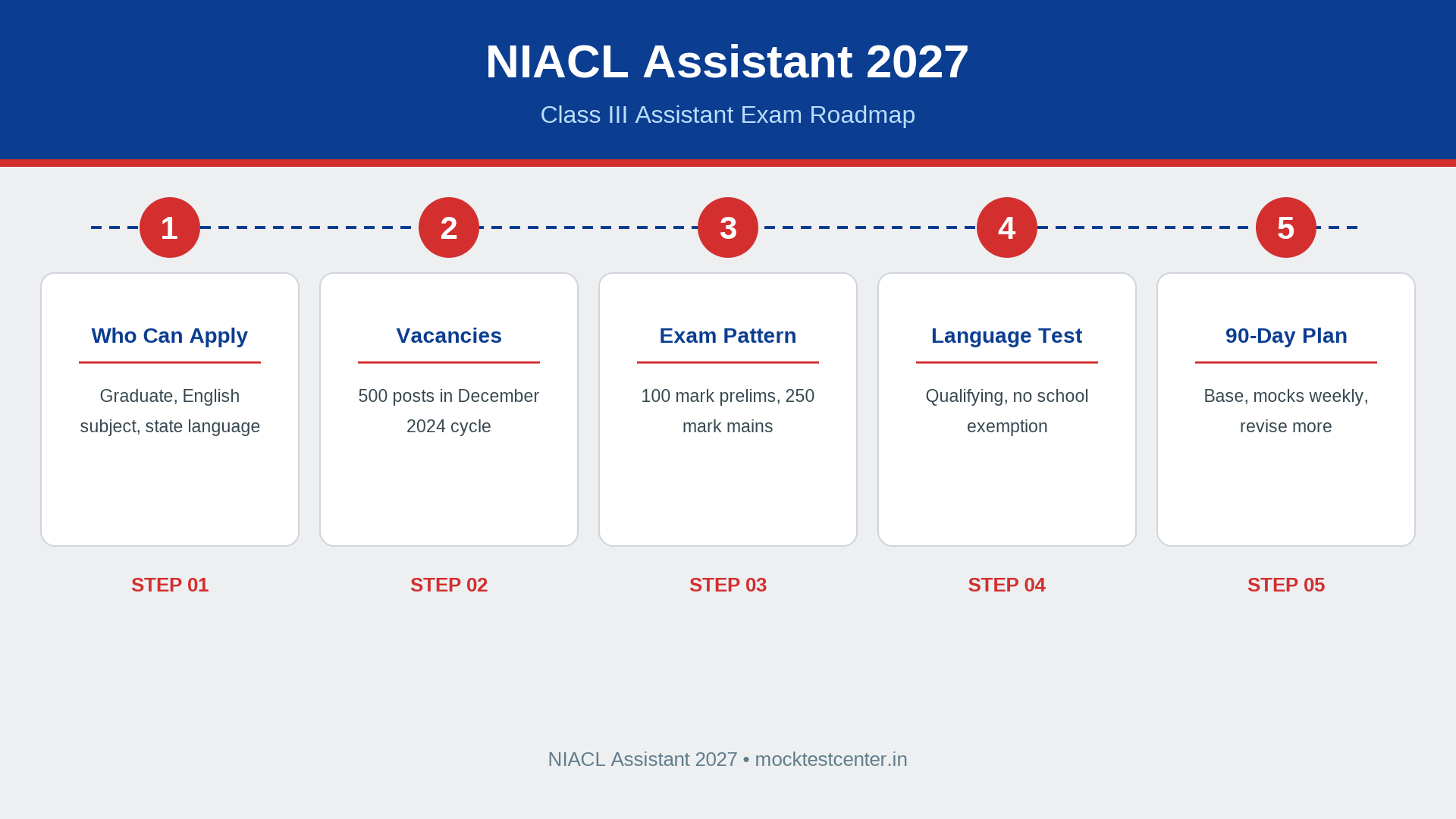
About NIACL Assistant 2027 Exam Series
📖 Table of Contents
- What NIACL Assistant 2027 is
- Two Assistant cycles in two years, and why sites mix them up
- Who can apply: age, degree and the English condition
- Pick your state first: the vacancy map decides your odds
- Tier I: the preliminary test is a speed test
- Tier II: the main exam, and the 1.25 mark question
- The regional language test ends more runs than people expect
- Fee, pay and probation in plain numbers
- How the December 2024 exercise actually ran
- NIACL Assistant next to the other insurance and bank clerk exams
- What to study for each section
- A 90 day plan that fits around a job
- Mistakes that cost candidates this exam
- What to check first when the next notice comes
- Sources
NIACL Assistant 2027: Pattern, Salary, Dates and How to Prepare
What NIACL Assistant 2027 is
NIACL Assistant 2027 is the expected recruitment of Assistants in Class III cadre by the New India Assurance Company Limited. An Assistant in NIACL does clerical work in branch and divisional offices: policy data entry, premium collection records, claim file movement, customer service counters and the daily paperwork that keeps an insurance branch running. It is a state wise recruitment, which means you apply for one state, take the test for that state, and work in that state if selected.
One fact must come first. NIACL has not released an Assistant notification for 2027, and no Assistant notification appeared in 2026 either. The latest notice on record is the advertisement of 16 December 2024, Ref. No. CORP.HRM/ASST/2024, for 500 Assistants. That exercise ran from December 2024 to the middle of 2025 and is now complete. This page builds the whole guide from that notice and from the cycle before it, and it says plainly wherever a figure belongs to a past cycle. Check the official recruitment page at newindia.co.in before you act on any date or vacancy number, because only the next notice is final.
NIACL is a public sector general insurer owned by the Government of India, and it is the largest general insurer in the country. Its head office is in Mumbai. The Assistant post is its clerical entry, and it is the post most graduates in this field aim for first, because it asks for a plain graduation degree and no work experience. The officer post in the same company, Administrative Officer Scale I, asks for 60 percent marks and runs a separate exam with an interview. The Assistant exam has no interview at all. Three stages decide it: a preliminary online test, a main online test and a regional language test.
Two Assistant cycles in two years, and why sites mix them up
Most pages about this exam mix up two different recruitments, so fix the timeline in your head before you read anything else. NIACL ran an Assistant exercise that opened on 1 February 2024 with 300 posts, under advertisement CORP.HRM/ASST/2023. It called that exercise the Assistant Recruitment Exercise 2023, even though the forms opened in 2024. Then, before that year was out, it opened a second exercise on 17 December 2024 with 500 posts, under advertisement CORP.HRM/ASST/2024. The two exercises look alike, and many tracker pages quote the 300 figure next to the December 2024 dates, or the 500 figure next to the February 2024 dates. Both pairings are wrong.
The January 2024 exercise ran like this. Applications opened on 1 February 2024 and closed on 15 February 2024. The Phase I exam took place on 2 March 2024. The Tier II result came out on 7 June 2024, and the final result on 16 July 2024. The fee was 850 rupees for most candidates and 100 rupees for SC, ST and persons with disabilities. The age limit was 21 to 30 years as on 1 January 2024. The vacancy split was SC 68, ST 43, OBC 10, EWS 30 and UR 149, adding to 300.
The December 2024 exercise, the one this guide uses as its base, ran like this. The advertisement came out on 16 December 2024. Online registration and fee payment ran from 17 December 2024 to 1 January 2025. The Tier I preliminary exam took place on 27 January 2025. The Tier I result, a list of roll numbers shortlisted for Tier II, came out on 20 February 2025. The Tier II main exam took place on 2 March 2025. The Tier II result, a list of roll numbers shortlisted for the regional language test, came out on 15 April 2025. After that came pre employment medical lists, a main list followed by four contingency lists. From registration to the language test shortlist took about four months.
Those contingency lists matter more than they look. They show that seats left by candidates who did not join were filled from further down the merit list. A candidate who narrowly misses the first list can still get in, which is worth remembering on result day. It also shows that NIACL runs this recruitment cleanly and to the end, with published roll number lists at every stage, and it publishes mark sheets for past exercises on its recruitment page. You can look at real sectional scores there instead of guessing what a safe score is.
Two exercises in two years is a good sign for 2027, but it is not a promise. NIACL does not publish a recruitment calendar. The company hires Assistants when its branches need them, and the gap between exercises has varied. Treat the December 2024 pattern as your preparation base, and treat every 2027 date as unknown until the notice prints it.
Who can apply: age, degree and the English condition
The December 2024 advertisement set the age at 21 to 30 years as on 1 December 2024. That means born not earlier than 2 December 1994 and not later than 1 December 2003. The next notice will print a new cut off date, and the window will move with it, so do not fix the 1994 and 2003 years in your mind. What stays stable is the range itself: 21 to 30, with relaxation for reserved categories.
The relaxation table in the December 2024 notice gave five years to SC and ST candidates, three years to OBC candidates in the non creamy layer, and ten years to persons with benchmark disabilities. Ex servicemen and disabled ex servicemen got their service period plus three years, up to the age of 45. Widows, divorced women and women judicially separated who have not remarried got five years. Existing employees of NIACL got five years. One rule in the notice is easy to miss: the SC, ST and OBC relaxation can be combined with only one of the other categories. If you claim two relaxations, check that rule before you apply, because a wrong age claim at the form stage can end the run at the document check.
Education is simple on the surface. Graduation in any discipline from a recognised university, or an equivalent qualification recognised by the Central Government. There is no minimum percentage for the Assistant post, which is a real difference from the AO post in the same company, where Generalists need 60 percent. There is one extra condition many readers miss: you should have passed in English as one of the subjects at SSC, HSC, Intermediate or Graduation level. Almost every graduate meets it, but check your own mark sheets, because the document check at the language test stage will ask for proof.
Language is the third condition, and it is not a formality. Reading, writing and speaking the regional language of the state you apply for is essential, and a language test is held before final selection. The advertisement does not exempt candidates who studied the language at school, so assume you will sit the test. That is different from some bank exams, where a Class 10 mark sheet in the local language saves you a test. Here, no exemption is printed, so prepare as if the test is certain.
Pick your state first: the vacancy map decides your odds
The 500 posts in the December 2024 exercise were split by state, and each state came with a named language. Maharashtra took the largest share with 105 posts, in Marathi. Gujarat took 50 posts in Gujarati, and Karnataka took 50 in Kannada. Kerala took 40 in Malayalam, Madhya Pradesh took 40 in Hindi, and Tamil Nadu took 40 in Tamil. Uttar Pradesh took 24 in Hindi, Chhattisgarh took 20 in Hindi, Rajasthan took 15 in Hindi, Punjab took 14 in Punjabi, Delhi took 12 in Hindi, and Andhra Pradesh, Telangana, Odisha and West Bengal took 10 each in Telugu, Telugu or Urdu, Odia and Bengali. Several states and union territories had one or two posts.
The category split for the same exercise was SC 91, ST 51, OBC 48, EWS 50 and UR 260, adding to 500. The OBC figure looks low next to the others: in this exercise the OBC share was 48 posts out of 500, while SC took 91. State tables decide the real odds, because selection is state wise and category wise. A UR candidate in Maharashtra faced a different contest from a UR candidate in a state with two posts, and the state table is where you should start, not the all India total.
You can apply for one state or union territory only. You must take the exam at a centre in that state, or as allotted, and you would be considered for employment in that state only. That rule shapes the whole decision. Pick the state whose language you can read, write and speak, because the language test at the end will check exactly that. A state with more posts is tempting, but a language test you cannot pass makes those posts worthless. Home state is the right choice for most candidates, even when it has fewer posts.
Think about the numbers before you choose. Maharashtra had 105 posts, which is more than a fifth of the whole recruitment. Gujarat and Karnataka had 50 each. If your home state had 10 posts and you speak its language well, your odds there may still beat a big state whose language you speak badly. The language test is qualifying and a fail there disqualifies you, whatever your Tier II score. Choose the language first and the vacancy count second.
Tier I: the preliminary test is a speed test
Tier I is a one hour online test with 100 questions for 100 marks. Three sections share the hour, each with its own timer of 20 minutes. English Language gives 30 questions for 30 marks. Reasoning gives 35 questions for 35 marks. Numerical Ability gives 35 questions for 35 marks. Each section is separately timed, which means you cannot borrow minutes from English to finish Reasoning. When the 20 minutes end, that section closes.
Each section has its own passing marks, decided by the company, and the advertisement does not print them. An adequate number of candidates, state wise and category wise, go on to Tier II. The notice does not print a multiple for the shortlist, unlike some insurers that say 15 times the vacancies. Tier I marks do not enter the final merit at all. The preliminary test is a gate. You need to clear it, and then it stops mattering.
That changes how you should treat the hour. A candidate who scores very high in Tier I gains nothing extra in the final list. The job of Tier I is to get you into Tier II with the least effort, so that your energy stays fresh for the main exam five weeks later. In the December 2024 exercise the gap between the two tiers was about five weeks, from 27 January to 2 March. Use the Tier I weeks to build speed, and keep the deep study for Tier II.
The English section is in English only. Reasoning and Numerical Ability are in English and Hindi. The Tier I handout says each question has five options with one correct answer. Five options with a one fourth penalty means a blind guess is worth zero on average, while a guess after ruling out even one option is worth something. That arithmetic is covered in detail in the mains section below, because it matters more there, where each question carries 1.25 marks.
Speed is the whole game in Tier I. Twenty minutes for 35 reasoning questions leaves about 34 seconds per question. Twenty minutes for 35 numerical ability questions leaves the same. There is no room for a long puzzle. Practise in sets of 35 with a timer, and learn to skip a question in five seconds when it does not open up. A skipped question costs nothing. A stuck question costs the next three.
Tier II: the main exam, and the 1.25 mark question
Tier II is the exam that decides everything. It is a two hour online test with 200 questions for 250 marks. Five sections share the two hours, each with its own timer. English Language gives 40 questions for 50 marks in 30 minutes. Reasoning gives 40 questions for 50 marks in 30 minutes. Numerical Ability gives 40 questions for 50 marks in 30 minutes. Computer Knowledge gives 40 questions for 50 marks in 15 minutes. General Awareness gives 40 questions for 50 marks in 15 minutes.
| Section, Tier II | Questions | Marks | Minutes |
|---|---|---|---|
| English Language | 40 | 50 | 30 |
| Reasoning | 40 | 50 | 30 |
| Numerical Ability | 40 | 50 | 30 |
| Computer Knowledge | 40 | 50 | 15 |
| General Awareness | 40 | 50 | 15 |
| Total | 200 | 250 | 120 |
Read that table again, because the marking is the part many pages get wrong. Forty questions carry 50 marks in every section, so each question is worth 1.25 marks. A wrong answer costs one fourth of the marks assigned to that question, which is 0.3125 marks in Tier II, against 0.25 in Tier I where each question is worth one mark. Unanswered questions carry no penalty. With five options per question, a blind guess in Tier II is worth zero on average: a one in five chance of 1.25 marks against a four in five chance of losing 0.3125. Four correct answers and four wrong answers net 5 minus 1.25, which is 3.75 marks. Never guess blind, and do guess once you have ruled out an option or two.
The two 15 minute sections deserve a different method from the three 30 minute sections. Computer Knowledge and General Awareness give 40 questions in 15 minutes each, which is about 22 seconds per question. These are recall sections. You either know the answer or you do not, and staring at a question you do not know burns time that the next question needs. Prepare them with short daily revision. Long reading sessions waste the time these sections need. For an insurer, insurance awareness is the obvious extra: types of general insurance, the regulator, basic terms like premium, sum insured, claim and third party cover. For computers, the basics carry the section: hardware, software, internet, MS Office, shortcuts and security terms.
English, Reasoning and Numerical Ability give 30 minutes each for 40 questions, which is 45 seconds per question. English is in English only in both tiers. Reasoning and Numerical Ability are in English and Hindi. The final merit list is drawn up state wise and category wise in descending order of Tier II marks, for candidates who also qualify the language test. You need a minimum total score in Tier II, decided by the company. If the exam is held in more than one session, the advertisement says scores across sessions are equated to adjust for differences in difficulty, though it does not publish the method.
The regional language test ends more runs than people expect
The regional language test comes after Tier II, and it is qualifying only. No score is allotted. Candidates not found proficient are disqualified, whatever their Tier II marks. If you apply for a state other than your domicile, you must appear and qualify in that state's language. Certificates for category, age and qualification are produced at this stage, so the language test is also your document check.
This stage is where the state choice made at the form stage comes back to bite. A candidate who picked Maharashtra for its 105 posts and cannot write Marathi will fail here after clearing both online tests. A candidate who picked a small state and speaks its language at home will pass without thinking about it. The test checks reading, writing and speaking, so speaking the language at home is not quite enough on its own. You need to read it and write it too.
Start the language work early if you need it. Read one page of a local newspaper a day in that language. Write five lines a day in that language. Speak it with family and colleagues. A month of daily practice is enough to pass a qualifying test if you already speak the language at home. If you do not speak it at all, no amount of last minute study will save you, so do not apply for that state. And remember the document check that rides along with this stage: keep your graduation certificate, your English subject proof, your caste or category certificate and your age proof ready, because a missing paper at this stage ends the run as surely as a failed language test.
Fee, pay and probation in plain numbers
The fee in the December 2024 exercise was 850 rupees including GST for most candidates, and 100 rupees including GST for SC, ST, persons with benchmark disabilities and ex servicemen. The 100 rupees covers intimation charges only. The January 2024 exercise charged the same figures, 850 and 100. The fee is paid online only, with the registration, and it is not refunded.
The pay scale printed in the December 2024 advertisement is 22,405 to 62,265 rupees. The full scale reads 22,405, then 1,305 once to 23,710, then 1,425 twice to 26,560, then 1,605 five times to 34,585, then 1,855 twice to 38,295, then 2,260 three times to 45,075, then 2,345 twice to 49,765, then 2,500 five times to 62,265. The starting basic pay is 22,405 rupees. The advertisement put total emoluments at about 40,000 rupees a month in the initial stage in a metro city, with other allowances varying by posting. On top of the pay come domiciliary medical benefit, group mediclaim, leave travel subsidy and staff welfare schemes.
That 40,000 figure is the one some sites inflate. A few pages quote 37,000 a month in metros from the January 2024 cycle, and a few quote higher figures with no source. The December 2024 advertisement says about 40,000, and that is the figure this guide uses. A new advertisement may print a revised scale, because pay scales in this industry are revised by settlement from time to time. Use whatever the newest advertisement says.
Probation is at least six months, extendable. Anyone who resigns or is terminated during probation must pay back an amount equal to the salary paid plus 25,000 rupees towards partial cost of training. Appointment is also subject to being found medically fit. Read that probation clause before you apply, because it means the first six months are a real trial, not a formality. The company trains you, and it expects you to stay.
Put the pay beside the officer post in the same company and the trade off is clear. An Administrative Officer starts at a basic pay of 50,925 rupees, more than twice the Assistant starting basic, and the gross emoluments run to about 90,000 rupees a month in metro centres. The Assistant post pays less and asks for much less: a plain degree, no minimum percentage, no interview, and a shorter exam. For a graduate who wants a stable government insurer job this year, the Assistant post is the faster door. For a graduate with 60 percent marks and time to prepare for an interview, the officer post pays for the extra effort.
How the December 2024 exercise actually ran
The dates tell you how NIACL runs this recruitment, and the pattern is useful for planning the next one. Registration ran for sixteen days, from 17 December 2024 to 1 January 2025. The Tier I exam came about four weeks later, on 27 January 2025. The Tier I result came about three weeks after that, on 20 February 2025. The Tier II exam came ten days after the result, on 2 March 2025. The Tier II result came about six weeks later, on 15 April 2025. The whole exercise, from the first form to the language test shortlist, took about four months.
Two things stand out. First, the gap between the Tier I result and the Tier II exam was only ten days. A candidate who waited for the Tier I result before starting Tier II preparation lost the race. Prepare for both tiers together from the start, and treat Tier I as a speed drill inside a Tier II plan. Second, the company publishes roll number lists at each stage, and it publishes mark sheets for past exercises. That is more transparent than most recruiters, and it gives you real data. Look at the published mark sheets before you set your target score, because a target built on a coaching site guess is worth nothing.
Pre examination training is worth a mention too. NIACL, like other public sector insurers, runs pre examination training for SC, ST, OBC and minority candidates in the run up to the exam. The December 2024 notice carried the training in its schedule, and eligible candidates should take it when the next notice offers it. It is free, it is run by the company itself, and it shows you the exam interface before the real day.
NIACL Assistant next to the other insurance and bank clerk exams
The Assistant exam sits in a family of clerical exams with the same syllabus and nearly the same pattern, and the smart move is to prepare once and apply everywhere you are eligible. The officer cousin in the same company is the NIACL AO 2027 exam, which hired 550 Administrative Officers in 2025 at a starting basic of 50,925 rupees, with an interview at the end. The other close cousins are the RBI Assistant 2027 exam, the best paid clerical post in the country, and the LIC ADO 2027 exam, the other big insurance entry, though its work is sales and field work rather than office work.
Outside insurance, the RBI Assistant exam is the best paid clerical post in the country, and its preliminary test uses the same three sections as NIACL Tier I. The LIC ADO exam is the other big insurance entry, though its work is sales and field work rather than office work, so it suits a different kind of candidate. The bank clerk exams cover the same syllabus too: the IBPS Clerk 2027 exam, the IBPS RRB Clerk 2027 exam and the SBI Clerk 2027 exam all test English, reasoning and numerical ability in the same shape. The ECGC PO 2027 exam is an officer post in export credit insurance, for graduates who want an officer chair and can clear a tougher paper. Apply for every exam you are eligible for, and decide when the offers come.
The way to choose between the Assistant exams is the state table and the pay scale. NIACL's 500 posts in December 2024 and NICL's 500 posts in July 2026 are the two live models, and NICL pays more at the start. OICL is the waiting game: no notice since 2015, a 500 post expectation, and the same pay scale NIACL printed. If you are eligible for all three, prepare once, apply to all three, and take the first offer. The work is nearly the same in all three companies, and the syllabus overlaps so much that one preparation serves them all.
What to study for each section
English appears in both tiers, and it is in English only, so it deserves a fixed daily slot. Reading comprehension, cloze tests, error spotting, sentence improvement, vocabulary and para jumbles carry the section. Read one editorial a day and mark the sentence structures you would have written differently. That habit alone lifts the score, because comprehension questions reward readers, not memorisers. Keep a notebook of new words with one example sentence each, and revise it every Sunday. Thirty questions in Tier I and forty in Tier II is a large share of the paper, and it is the section where a weak candidate loses the most marks without noticing.
Reasoning is the section where speed is built. Puzzles, seating arrangements, inequality, syllogism, coding decoding, blood relations, direction sense and order ranking make up most of it. Learn the standard types first, then practise them in timed sets of 35. A puzzle that takes four minutes is a puzzle you should have skipped. The rule is simple: if a question does not open up in five seconds, move on and come back if time is left. Time is never left, which is the point. The questions you skip cost nothing, and the questions you finish correctly pay 1 mark in Tier I and 1.25 marks in Tier II.
Numerical Ability rewards the same discipline. Simplification, approximation, number series, quadratic equations and arithmetic word problems carry the section, with data interpretation in the mains. Learn tables, squares and cubes up to 30, and practise simplification until it is automatic. Arithmetic word problems take the longest, so do them last inside the section. A candidate who finishes the quick questions first and then takes the word problems with the remaining minutes scores more than a candidate who starts with the longest question on the page.
General Awareness splits into two halves. Half is current affairs from the last six months: government schemes, the Union Budget, RBI monetary policy, major appointments and sports events. The other half is static awareness, and for an insurer that means insurance awareness first. Read the business page every morning and keep a notebook of one line per story. Six months of one line a day is about 180 lines, and that notebook covers most of the section. Add insurance basics: what general insurance covers, the difference between life and general insurance, the role of the Insurance Regulatory and Development Authority of India, and the main government insurance schemes. Those topics appear because the company hiring you is an insurer, and it wants staff who know what it sells.
Computer Knowledge is the smallest section by time and the easiest to prepare badly. Forty questions in 15 minutes means you must answer from memory. Working things out on the spot is too slow for this pace. Hardware, software, operating systems, internet basics, MS Office, keyboard shortcuts and cyber security terms carry it. Make flashcards and drill them in five minute bursts. Do not spend a week on computers. Two weeks of short daily drills is enough, and the time you save belongs to English and reasoning.
A 90 day plan that fits around a job
Ninety days is enough for this exam if you study every day, and most candidates for this post are graduates with a job or a family to look after, so the plan below assumes two hours a day, not eight. The first thirty days build the base. One hour on reasoning and numerical ability, thirty minutes on English, thirty minutes on general awareness and computers. Learn the standard question types, build the vocabulary notebook, and start the current affairs notebook. Take one Tier I mock a week, timed, and mark every wrong answer to see whether it was a knowledge gap or a speed gap.
The next thirty days switch to mocks. Two full Tier I mocks a week and one full Tier II mock a week, all timed, all reviewed the same day. Review matters more than the mock itself. For every wrong answer, write one line: what the right method was. For every skipped question, write one line: why you skipped it. Patterns appear fast. Most candidates find one section eating their time, and fixing that one section lifts the total more than studying everything a little harder.
The last thirty days are revision and speed. Cut new study to one hour a day and spend the other hour on mocks and revision of your notebooks. Take a Tier II mock every three days in the last two weeks, at the same time of day as the real exam. Revise the current affairs notebook every morning, because the general awareness section rewards fresh memory. In the last week, revise the computer flashcards, the vocabulary notebook and the formula sheet, and stop learning new topics. A new topic in the last week costs revision time and adds nothing on exam day.
One more rule for the whole ninety days: practise on a computer. Paper practice hides the interface you will face on the day. The exam is online, with a timer on the screen and separately timed sections. A candidate who practises on paper is surprised by the interface on the day. Use the free mocks on this site in the same format, with the same section timers, so the real exam feels like the tenth mock, not the first.
Mistakes that cost candidates this exam
The first mistake is applying for the wrong state. Candidates see Maharashtra with 105 posts and apply there, then fail the Marathi language test after clearing both online tests. The state choice is made at the form stage and it cannot be fixed later. Pick the state whose language you can read, write and speak, and check the language column of the state table before you choose.
The second mistake is treating Tier I as the real exam. Tier I marks do not count in the final merit. Candidates who spend three months on Tier I speed and start Tier II preparation after the Tier I result get ten days for a 250 mark paper. That is how the December 2024 schedule worked, and it will work the same way next time. Prepare both tiers together from the first day.
The third mistake is blind guessing in Tier II. Each question carries 1.25 marks and a wrong answer costs 0.3125. Four blind guesses cost more than one correct answer pays. Guess only after ruling out at least one option. And the fourth mistake is the opposite: leaving questions blank that you could have answered. The two 15 minute sections are recall sections, and a candidate who spends a minute on one unknown computer question loses two questions he knew. Answer what you know fast, skip what you do not know fast, and let the marks add up.
The fifth mistake is ignoring the document check. The language test stage asks for certificates, and a candidate with a missing caste certificate or a degree certificate that does not show English as a subject can be stopped there. Keep every paper ready before you apply, not after the Tier II result. The last mistake is believing a tracker page that prints a 2027 date or vacancy number. No 2027 notice exists. Any site that prints one today is guessing, and a plan built on a guessed date falls apart when the real notice prints different numbers.
What to check first when the next notice comes
When NIACL releases the next Assistant advertisement, read it in this order. First, the vacancy table, state by state, with the language column. That decides where you apply. Second, the age cut off date, because the 21 to 30 window moves with it. Third, the fee, because the 850 and 100 figures may change. Fourth, the exam pattern table, because the section split and the 1.25 mark question may change. Fifth, the pay scale, because a revised scale changes the starting basic.
Everything else in this guide stays useful, because the shape of the exam has been stable across the last two exercises. The numbers change. The shape does not, until a notice says otherwise.
Start preparing now, with the December 2024 pattern as your base. The notice, when it comes, will give you about two weeks to apply and about four weeks to the first exam. That leaves too little time to start from zero. It is enough time to sharpen what you already built. Two hours a day, ninety days, one mock a week at first and one every three days at the end, and a state choice where language comes first. That is the whole plan, and it is enough.
Sources
New India Assurance, detailed advertisement Ref. No. CORP.HRM/ASST/2024 dated 16 December 2024, Recruitment of 500 Assistants, on newindia.co.in. NIACL recruitment page, list of exercises, checked November 2026, on newindia.co.in. NIACL information handout for the Tier II main exam, Assistant Recruitment Exercise 2024, on newindia.co.in. NIACL list of roll numbers shortlisted for Tier II, dated 20 February 2025, and list shortlisted for the regional language test, dated 15 April 2025, on newindia.co.in. NIACL Assistant Recruitment Exercise 2023, advertisement CORP.HRM/ASST/2023, 300 posts, apply 1 to 15 February 2024, Phase I 2 March 2024, final result 16 July 2024, as reported from the official notice.