
About LIC ADO 2027 Exam Series
📖 Table of Contents
- What an ADO does all day
- LIC ADO 2027 notification status
- Who can apply: three doors into the same job
- Age and degree rules, and the fee
- 9,394 posts, zone by zone
- Prelims: 100 questions, only 70 marks count
- Mains: the 160 mark paper that decides the merit list
- Interview and medical
- Pay: stipend first, salary after confirmation
- Syllabus, subject by subject
- A 90 day plan that fits around a job
- How ADO compares with the other insurance exams
- Five checks before you fill the form
LIC ADO 2027
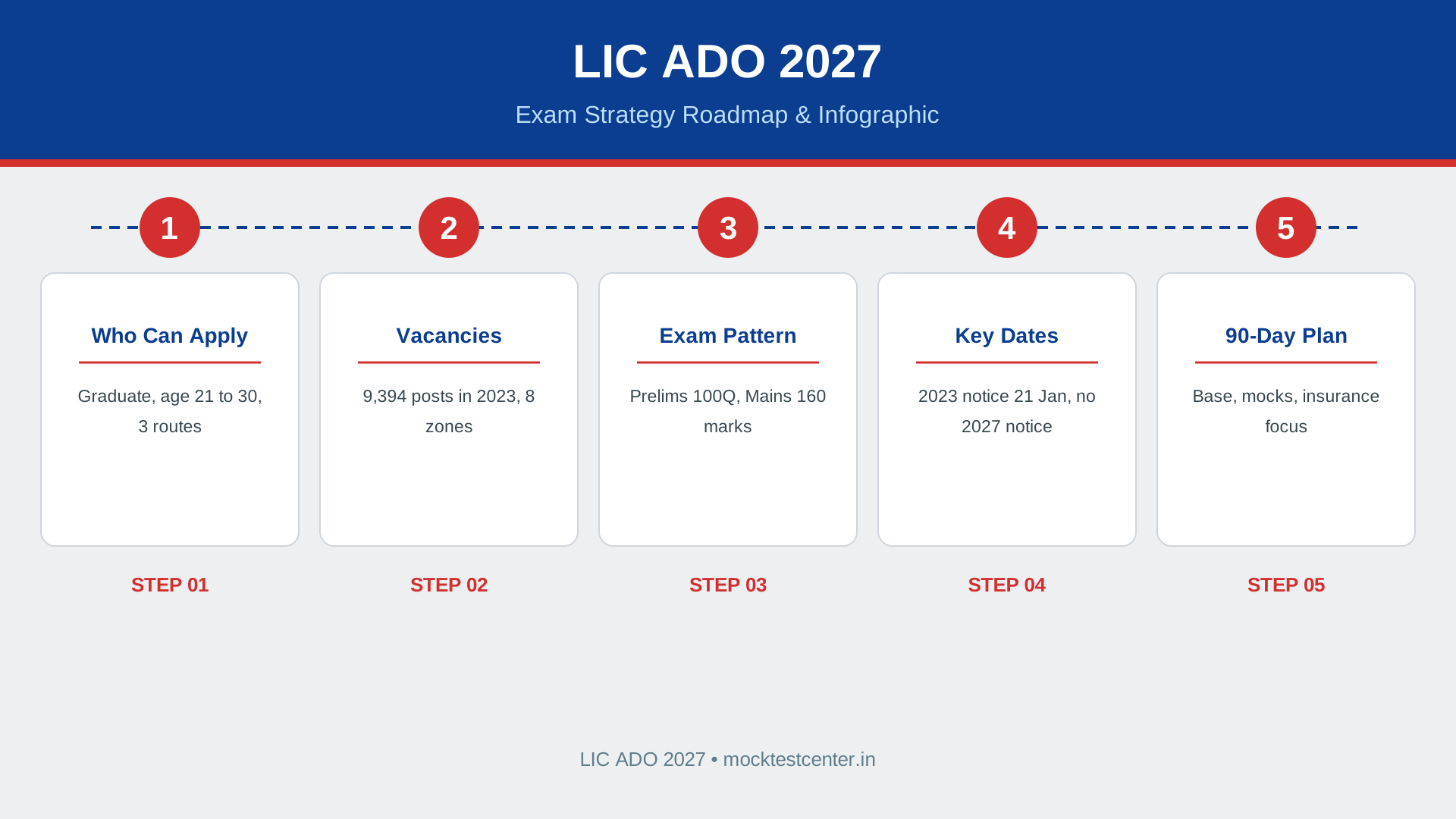
LIC ADO 2027 has no notification yet. The Life Insurance Corporation of India has not announced dates, vacancies or an application link for the next Apprentice Development Officer cycle, and the last cycle ran in 2023. That single fact shapes everything in this guide.
We use the 2023 notification as the base, because it is the latest official record, and we mark every place where the next notice can change the numbers. If you plan to apply, start from the 2023 pattern and keep one eye on the LIC careers page.
An ADO is a field officer. You recruit agents, you train them, you push them to sell policies, and your own growth depends on the business your team brings in. It is a sales job inside a government owned insurer, and it suits people who like meeting strangers and talking them into decisions.
It does not suit people who want a desk and a fixed routine. Read this guide with that in mind.
The exam is only the door. The job after it is the real test.
What an ADO does all day
LIC sells most of its policies through agents. An ADO builds and runs a team of those agents in one area. You find new agents, you help them pass the licensing test, you teach them how to talk to a family about a policy, and you keep them selling month after month.
When an agent stops selling, you find out why. When a good agent needs a push, you give it. Your office is your area, and your area is made of houses and shops.
The work has a target. Every ADO carries a business target for the year, measured in new policies and premium collected. You meet it by keeping your agents active.
A Development Officer who loses agents loses business, so the job rewards people who can keep a team together. It also rewards local knowledge. You need to know which streets have new houses, which shops have cash flow, and which families just had a child.
That sounds simple. Doing it every day for years is the hard part.
LIC runs the ADO job through its zonal offices, and each zone recruits its own ADOs. In the 2023 cycle, all eight zones issued their own employment notices on the same day, 21 January 2023. You applied to one zone only, and your posting stayed inside that zone.
That matters when you choose. A zone with more posts gives you a better chance, but a zone far from home means years of living away from family. Pick the zone you can actually live in, not the one with the biggest number.
After selection you join as an apprentice. The apprenticeship runs for a fixed period on a stipend, and LIC confirms you as a Probationary Development Officer only if you meet the targets set for the training period. The targets are real.
Some apprentices fail to meet them and leave. So count the stipend as your pay for the first year or so, and treat confirmation as something you earn in the field, not something the appointment letter gives you.
LIC ADO 2027 notification status
As of November 2026, LIC has issued no ADO notification for 2026 or 2027. The careers page at licindia.in lists other recruitments, such as the AAO 2025 cycle, but nothing for ADO. Anyone who gives you a 2027 exam date or a vacancy figure today is guessing.
LIC does not run ADO recruitment on a fixed yearly calendar. The two recent cycles came in 2019 and 2023, four years apart. That gap tells you not to plan your year around a date that does not exist.
So what should you do while you wait? Prepare from the 2023 pattern, because LIC rarely changes the shape of this exam. The prelims had the same three sections in 2019 and 2023.
The mains kept the same 160 mark paper. The interview stayed at 40 marks. When the new notice arrives, the dates will be new.
The vacancy count will be new too. But the paper you sit for will look a lot like the 2023 paper. That is the best use of the waiting time.
Check the LIC careers page once a week. The notice will appear there first, and the application window in 2023 lasted only about three weeks. In 2023 the notices came out on 21 January and the last date to apply was 10 February.
A short window punishes people who learn about it late. Keep your documents ready now. Keep your degree certificate and caste certificate ready if it applies.
Keep a photo and a signature scan in the sizes LIC asks for. The notice will repeat those sizes, but a candidate who has them ready files the form on day one.
One more honest point. A long gap between cycles means a large number of graduates will apply when the notice finally comes. The 2023 cycle drew a huge crowd for 9,394 posts.
The next cycle may draw more. That is not a reason to panic. Use it as a reason to start the reasoning and numerical practice now, while the exam is still months away, instead of starting after the notice when everyone else starts too.
Who can apply: three doors into the same job
LIC opens ADO recruitment through three separate categories, and each category has its own rules. Open Market is for fresh graduates with no link to LIC. LIC Agents is for people who already sell LIC policies as agents.
LIC Employees is for people already working in LIC in Class III posts. All three end at the same job, but the road differs, so read the category that fits you and ignore the rest.
Open Market candidates take two written papers. First the prelims, then the mains, then the interview. This is the route most readers of this page will take.
You need a bachelor degree in any subject from a recognised university, and you need to be 21 to 30 years old on the date the notice fixes. In 2023 that date was 1 January 2023, which meant candidates born between 2 January 1993 and 1 January 2002 could apply. The new notice will fix its own date, and your age will be counted on that date, not on the date you read this guide.
LIC Agents take only the mains paper and the interview. They skip the prelims. To use this route in 2023, an agent needed at least five years of experience as an LIC agent.
The age limit was higher too: 40 years for general category agents, 43 for OBC agents, and 45 for SC and ST agents. If you are an agent with five years behind you, this route saves you one paper and gives you a higher age ceiling. But you still face the same mains paper and the same interview as everyone else.
LIC Employees also take only the mains paper and the interview. In 2023 an employee needed at least three years of service after confirmation in a Class III post. The age ceiling was higher still: 42 years for general category employees, 45 for OBC employees, and 47 for SC and ST employees.
Employees keep their service benefits during the process, and the stipend rule works differently for them, since they already draw a salary. If you work in LIC now, check the notice for the exact service rule, because it changes the arithmetic of your career.
Two points apply to all three categories. First, you need Indian citizenship. Second, LIC asks for a degree result declared on or before the date fixed in the notice.
Final year students waiting for a result cannot apply unless the result date falls inside the rule. Read that clause in the notice with care. It has ended many applications.
Age and degree rules, and the fee
The degree rule is simple. A bachelor degree in any discipline from a recognised Indian university works. LIC also accepts the Fellowship of the Insurance Institute of India, Mumbai, in place of a degree.
Your subject does not matter. A history graduate and an engineering graduate sit the same paper. What matters is that the university is recognised and the result was declared by the date in the notice.
The age rule has more layers. For Open Market candidates the band was 21 to 30 years. OBC candidates got three extra years, so their ceiling was 33.
SC and ST candidates got five extra years, so their ceiling was 35. Ex-servicemen got their service years added to the 30 year base, with a cap of 42 for general category, 45 for OBC and 47 for SC and ST.
PwBD candidates got the relaxations that apply under government rules. The new notice will repeat this table with its own reference date, so compute your age on that date before you pay the fee.
LIC also says two years of work in life insurance or financial marketing is preferred for Open Market candidates. Preferred, not required. A fresh graduate can still apply, and the preference only tells you what kind of background LIC likes.
If you have sold insurance or worked in a bank, say so in the form. If you have not, leave that box alone and focus on the paper.
The 2023 fee was 750 rupees for most candidates and 100 rupees for SC and ST candidates, plus transaction charges, as reported by several sources that read the notification. One source reported 600 rupees and 50 rupees instead, so treat the fee as a figure to confirm from the new notice rather than a fixed fact. Pay online only, through debit card, credit card, net banking, UPI, IMPS, cash card or a mobile wallet.
Keep the payment receipt until the final result. LIC does not refund the fee if you fill the form wrong.
9,394 posts, zone by zone
The 2023 cycle offered 9,394 Apprentice Development Officer posts across eight zones. The Western zone, run from Mumbai, had the most at 1,942. The Southern zone had 1,516.
South Central had 1,408. Northern, run from New Delhi, had 1,216. Eastern, run from Kolkata, had 1,049.
North Central had 1,033. East Central, run from Patna, had 669.
Central, run from Bhopal, had the fewest at 561. Add those eight numbers and you get 9,394.
The category split across all zones was 3,994 for unreserved, 1,648 for SC, 1,025 for ST, 1,897 for OBC and 830 for EWS. That split included 1,945 backlog vacancies carried from earlier cycles. Backlog posts matter because they show which categories had unfilled seats before, and they often sit in zones where fewer candidates applied.
Do not read too much into that. Zones change, and the new notice will publish a fresh split.
Vacancies in LIC are provisional. The notice says so in plain words. LIC can raise or lower the number before the final result, and it can keep some posts unfilled if enough candidates do not clear the interview.
So use the 2023 number to judge the scale of the exam, not to predict your rank. A 9,394 post cycle is a big cycle.
It is one of the largest single recruitments LIC runs. That size is why so many graduates watch for it.
When the new notice comes, compare zones before you apply. Look at the posts in the zone you live in, look at the posts in the zone next to it, and apply where your chance is best and your life still works. You cannot apply to two zones.
One form, one zone, one chance per cycle. Choose it like it matters, because it does.
Prelims: 100 questions, only 70 marks count
Open Market candidates start with the prelims, a one hour online paper of 100 questions. Reasoning Ability carries 35 questions for 35 marks in 20 minutes. Numerical Ability carries 35 questions for 35 marks in 20 minutes.
English Language carries 30 questions for 30 marks in 20 minutes. Each section has its own timer, so you cannot borrow time from English to finish Reasoning. When a section ends, it ends.
Here is the part most first timers miss. English is qualifying only. Its 30 marks do not count for ranking.
Only Reasoning and Numerical Ability, 70 marks in all, decide who moves to the mains. LIC says this in a footnote to its own handout: the English test will be of qualifying nature and the marks in English will not be counted for ranking.
So a candidate who scores high in English and low in Reasoning loses to a candidate who does the opposite. Spend your practice time where the marks live.
You still need to clear English. LIC fixes a minimum qualifying mark for each section, and the notice sets it. A zero in English ends your run even if your Reasoning score is strong.
So treat English as a gate, not as a scoring section. Clear it with a safe margin, then put your energy into the two sections that count.
LIC called about 20 times the number of vacancies for the mains in 2023. With 9,394 posts, that meant roughly 1.9 lakh candidates moved past the prelims. That sounds generous until you count the applicants.
The prelims is a speed test as much as a knowledge test. One hundred questions in 60 minutes gives you 36 seconds per question, and the sectional timers make it tighter.
Practice with a timer from the first week, not the last week. Speed in this paper comes from pattern recognition, and pattern recognition comes from repetition.
On negative marking, the sources disagree. Most sources that covered the 2023 cycle say LIC applied no negative marking in either stage. One source reports a penalty of 0.25 marks per wrong answer.
The official handouts quoted by the majority say nothing about a penalty, so we go with no negative marking and note the conflict for the reader. When the new notice arrives, read its marking rule first.
If there is no penalty, attempt every question. If there is one, change your plan and leave the guesses you cannot defend.
Mains: the 160 mark paper that decides the merit list
The mains is a single sitting of two hours with 160 questions for 160 marks. LIC Agents and LIC Employees start here. Open Market candidates reach here after clearing the prelims.
The paper has three parts. Reasoning and Numerical Ability together carry 50 questions for 50 marks. The second block mixes General Knowledge and Current Affairs, along with English, for 50 questions and 50 marks.
Insurance and Financial Marketing Awareness carries 60 questions for 60 marks. In 2023 the mains had one composite timer, so you could move time between sections as you liked.
The third part is where this exam separates from bank exams. Sixty questions on insurance and financial marketing is the largest block in the paper, and it is the block most bank exam candidates have never studied. It covers how life insurance works, what the main policy types do, how LIC is organised, what IRDAI regulates, and how financial products reach customers.
A candidate who treats this as general knowledge and skims it gives away the biggest section. Study it like a subject. Keep notes and revise them, and it becomes your edge.
The first part mixes Reasoning and Numerical Ability into one block of 50. The questions look like the prelims sections but run deeper, with more multi step problems and fewer free marks. The second part mixes General Knowledge and Current Affairs with English.
That mix punishes candidates who prepare only one of the two. Current affairs from the last six months before the exam carry the most weight, and the static GK questions reward steady reading rather than last minute cramming.
Your mains score decides your place in the merit list together with the interview. The prelims score plays no part after shortlisting. That is good news for a candidate who scraped through the prelims and then found form in the mains.
It also means the mains deserves most of your preparation time. Roughly two thirds of your study hours should go to mains topics, and one third to prelims speed work. The LIC AAO 2027 mock test page covers a related LIC officer exam with a different pattern, and comparing the two helps you see why ADO rewards insurance knowledge more than office work.
Interview and medical
Candidates who clear the mains face an interview worth 40 marks. The final merit list adds your mains score and your interview score, out of 200. The interview panel asks about your degree, your hometown, why you want a field sales job, and what you know about LIC.
They also test whether you can talk to people. An ADO spends the day talking, so a candidate who cannot hold a conversation in the interview raises a fair doubt.
Prepare three answers before you walk in. First, ask why LIC and why ADO, in your own words, without the lines every coaching site repeats. Second, what you know about LIC in your own district: how many branches, where the main office sits, what people buy.
Third, what you would do in your first month as an ADO: how you would find agents, how you would train them, how you would track them. Panels remember candidates who answer with a plan, not with praise for the company.
After the interview comes a pre recruitment medical examination. LIC checks that you are fit for field work. The notice lists the medical standards, and candidates who fail the medical do not join even with a good merit rank. Keep your health records in order and do not hide a condition that the medical will find anyway.
One practical note on documents. LIC verifies your degree, your caste certificate, your age proof and your agent or employee record if you applied through those routes. A mismatch between your form and your certificate can end a selection at the last step.
Check every spelling now. Your name on the form must match your name on your degree exactly. Check initials and surname order too.
Pay: stipend first, salary after confirmation
LIC pays an apprentice a fixed stipend during the training period, not a salary. In 2023 the stipend was about 51,500 rupees a month, equal to the minimum basic pay plus dearness allowance of the Development Officer scale. Candidates from the LIC Employee category are the exception, since they keep drawing their existing pay. Everyone else lives on the stipend until confirmation.
On confirmation you become a Probationary Development Officer on the scale of 35,650 to 90,205 rupees. The scale runs as 35,650, then two increments of 2,200 to reach 40,050, then two increments of 2,595 to reach 45,240, then seventeen increments of 2,645 to reach 90,205. Your basic pay on appointment is 35,650 rupees a month, plus allowances as per the rules in force. LIC put total emoluments at the minimum of the scale at about 56,000 rupees in an A class city, including house rent allowance and city compensatory allowance where they apply.
After confirmation, Development Officers also earn performance linked incentives on the business their team generates. That is the part of the pay that no other government job quite matches. A strong team can push your earnings well above the scale.
A weak team leaves you at the scale. The incentives reward the same skill the job needs, which is keeping agents selling.
If that sentence excites you, this job fits. If it worries you, read it again before you apply.
Compare this with bank officer pay before you decide. A probationary officer in a public sector bank starts near 48,480 rupees basic under the latest settlement, and the SBI PO 2027 mock test page and the IBPS PO 2027 mock test page both describe office based officer roles with a fixed salary path. ADO pay starts lower on paper and grows through incentives instead. The choice is between a fixed ladder and a ladder with a bonus for field results.
Syllabus, subject by subject
Reasoning Ability in the prelims covers puzzles and seating arrangement. It also tests syllogisms and blood relations. Coding and decoding and direction sense come next.
Series and inequalities close the list. The prelims gives you 35 questions in 20 minutes, so the easy questions are the ones that pay. Learn to spot a question you can solve in 30 seconds and skip one that will eat two minutes.
In the mains, reasoning joins numerical ability in a 50 question block, and the questions grow longer. Practice mixed sets rather than single topic sets, because the real paper mixes them.
Numerical Ability covers simplification and number series. Percentage and ratio come first. Average and profit and loss follow.
Time and work and time speed and distance test your speed with numbers. Simple and compound interest and mensuration close the list. Data interpretation carries the most weight in both stages, so build speed in reading tables and charts.
A candidate who reads a table slowly loses the whole set. Do one data interpretation set every day.
Keep it timed. Track your accuracy apart from your speed.
English in the prelims is qualifying, but the mains mixes English with GK and current affairs, so you cannot ignore it. Reading comprehension and cloze test form the core. Error spotting and sentence improvement test your grammar.
Fillers and vocabulary test your word knowledge. The grammar questions reward rules, and the comprehension questions reward reading speed.
Read one English newspaper editorial a day. It builds both the vocabulary and the reading speed at once, and it feeds your current affairs notes too.
General Knowledge and Current Affairs need a split plan. Static GK covers Indian history and geography. Polity and economy come next, with important days to round it off.
Current affairs covers the last six months before the exam. Government schemes and LIC and insurance news carry weight. RBI decisions carry weight too, and so do budgets and awards.
Keep a one page note per week of current affairs. At revision time you will read 24 pages, not 24 newspapers. That is the difference between revising and drowning.
Insurance and Financial Marketing Awareness is the section that wins this exam, so give it its own notebook. Study life insurance basics: term plans and endowment plans. Money back plans and ULIPs come next.
Annuities and riders come after them. Study how LIC works: its zones, its agent network, its claim process. Study IRDAI and what it regulates.
Study financial marketing: how products are sold, what a premium means, what persistency means, and why agents matter to an insurer. The NIACL AO 2027 mock test page covers a general insurer with a different exam, and its insurance awareness notes overlap with this section in useful ways.
A 90 day plan that fits around a job
Most ADO aspirants are graduates who already work or study, so the plan below assumes two to three hours a day, not eight. Ninety days is enough if you use them in order. Days 1 to 30 build the base for LIC ADO 2027.
Learn the reasoning types and the numerical formulas, and start the insurance notebook. Do one prelims style mock each week, untimed at first, so you learn the question types without panic.
Days 31 to 60 add speed and mains depth. Move to timed mocks twice a week: one prelims paper and one mains paper. Start current affairs notes in earnest and finish the static GK revision.
The insurance section should be half done by day 60. If it is not, cut time from English practice and give it to insurance, because insurance carries 60 marks and English carries zero for ranking in the prelims.
Days 61 to 90 are mock tests and revision only. Take a full mock every second day and spend the next day analysing it. Analysis matters more than the score.
For each wrong answer, write down why you got it wrong: concept gap, silly mistake, or time pressure. Concept gaps need a chapter revisit.
Silly mistakes need a checklist you read before each mock. Time pressure needs more timed sets, not more theory.
Keep Sundays for revision and rest. A tired brain learns nothing, and this exam rewards steady work over bursts. If you miss a day, do not double the next day to catch up.
Just continue. The plan works because it repeats, not because any single day is heroic. Candidates who prepare for bank exams alongside ADO should note the overlap: Reasoning and numerical ability are common to both, and so is English, so a SBI Clerk 2027 mock test or an IBPS Clerk 2027 mock test can double as prelims practice, while the insurance section stays ADO only.
How ADO compares with the other insurance exams
LIC ADO is a field job, and that single fact separates it from every other insurance officer exam. LIC AAO is an office job in the same company. You get a desk and files and underwriting work.
NIACL AO and NICL AO are officer jobs in general insurance companies, with office work and a fixed salary path. If you want field work and incentive pay, ADO is the only one of the four that gives it. If you want a desk, pick one of the others.
The exam shapes differ too. ADO prelims has no general awareness section. IBPS and SBI prelims test general awareness in the mains instead.
ADO mains has the 60 mark insurance block, which no bank exam has. That makes ADO preparation partly shared and partly unique.
The shared part is reasoning and numerical ability, with English alongside. The unique part is insurance awareness and the field mindset the interview tests.
Age and degree rules are close across these exams, so many candidates apply to several in the same year. The IBPS RRB PO 2027 mock test page and the IBPS RRB Clerk 2027 mock test page describe rural bank roles that share the same prelims subjects, and the IBPS SO 2027 mock test page and the RBI Assistant 2027 mock test page cover two more office based options. Apply to the ones whose job you would actually accept, not to every form you see. A form you would refuse after selection wastes your preparation time and a seat someone else wanted.
Five checks before you fill the form
First, check the notification date for age and degree. Your age and your result date are both counted on the date the notice fixes, and that date changes every cycle. Compute both before you pay.
Second, check the zone list. You apply to one zone only, so read the vacancy table for all eight zones and pick with your head, not with habit.
Third, read the marking rule. The 2023 cycle carried no negative marking according to most sources, but one source reports a penalty, so the new notice is the only final word. Your attempt strategy flips completely on this one line.
Fourth, check the medical standards and the document list. A certificate mismatch at verification ends a selection that the exam gave you.
Fifth, keep the official careers page as your only source for dates. The page is at licindia.in/careers, and LIC posts every ADO notice there. Coaching sites will publish dates before LIC does, and those dates will be guesses dressed as news.
When the LIC ADO 2027 notice appears, download the PDF, read it end to end, and then fill the form. The PDF is the exam. Everything else, including this guide, is preparation for it.
Sources: LIC ADO 2022-23 employment notices and Phase I and Phase II information handouts, via the LIC careers page at licindia.in.







