About RBI Assistant 2027 Exam Series
📖 Table of Contents
- What the RBI Assistant 2027 exam is
- RBI Assistant 2027: where the cycle stands now
- Vacancies: 650 posts across 17 offices
- Who can apply for RBI Assistant 2027
- RBI Assistant 2027 exam pattern: prelims first
- Mains: 200 marks decide everything
- The Language Proficiency Test: the stage that surprises candidates
- No interview: what that changes
- Fee, salary and the job after selection
- Syllabus: what to study, section by section
- Cut offs: what the last cycle tells you
- A 90 day plan that fits the real pattern
- Mistakes that cost candidates a year
- What to do this week
RBI Assistant 2027: Exam Pattern, Eligibility, Vacancies and Dates
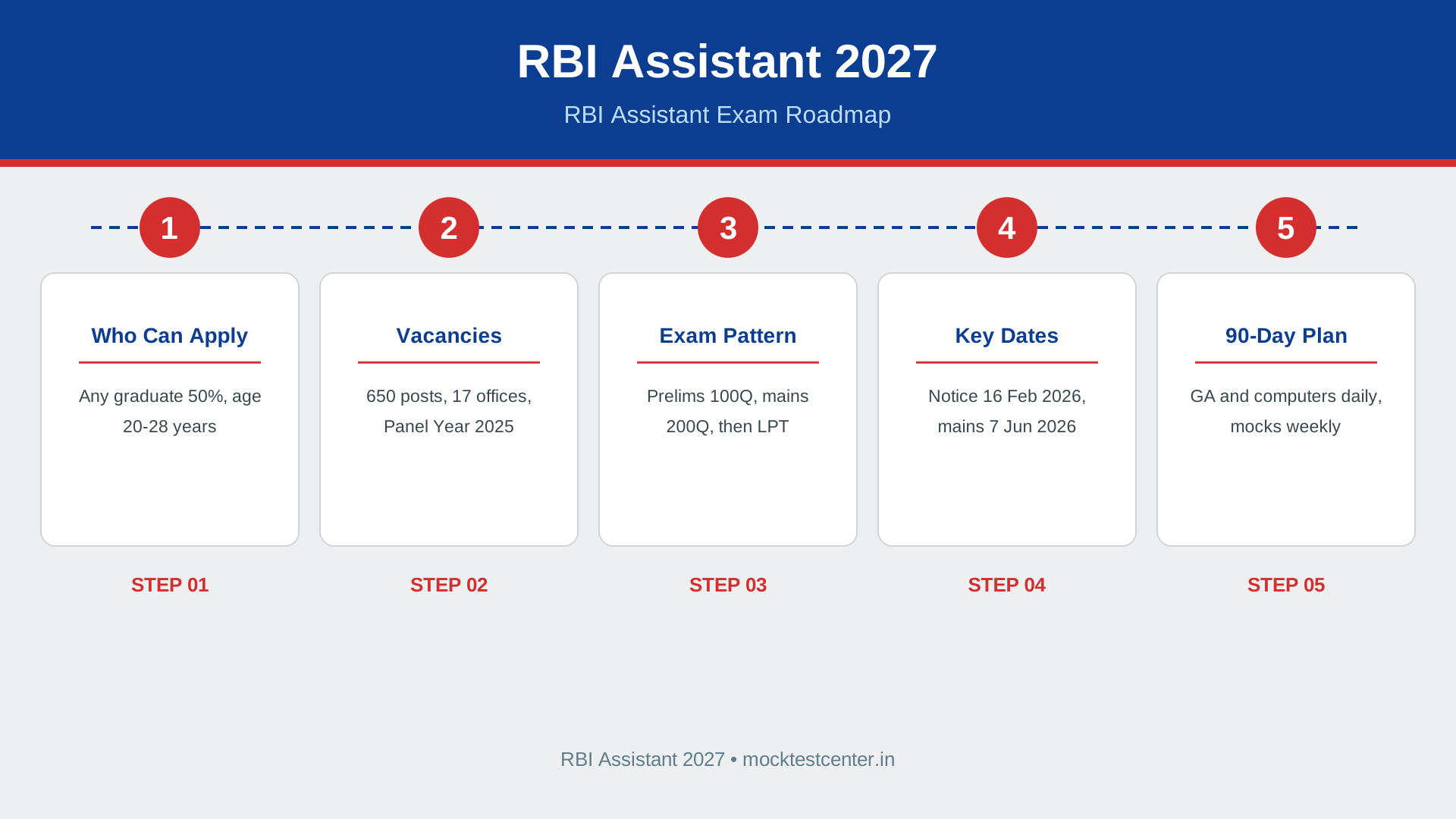
RBI Assistant 2027 is the next recruitment for Assistant posts in the Reserve Bank of India. No notification for the next cycle has come out yet. The latest notified cycle is Panel Year 2025, which offered 650 posts across 17 offices, with a notification on 16 February 2026, prelims on 11 April 2026 and mains on 7 June 2026.
This page uses that cycle as the guide for 2027, because the pattern, the eligibility and the pay have stayed the same across cycles. Three stages decide the result: prelims, mains and a Language Proficiency Test. There is no interview.
That last line is the reason many candidates pick this exam. Most bank exams end with an interview, and an interview can undo a good written score. RBI Assistant has no interview at all. The mains marks alone decide the merit list.
If you can score high in a 200 mark objective paper, the job is yours. The catch is the Language Proficiency Test at the end. It is qualifying, but it is not a formality, and it has ended the run of candidates who cleared both written papers.
What the RBI Assistant 2027 exam is
The Reserve Bank of India is the central bank of the country. It issues currency, sets monetary policy, regulates banks and manages the government accounts. Its offices sit in state capitals and major cities, and each office needs Assistants for clerical work.
The Assistant handles currency work, accounts, data entry, record keeping, customer service at the counters, clearing work and the daily paperwork that keeps an RBI office running. It is a clerical cadre post, not an officer post, and it is the entry point into the central bank.
RBI recruits Assistants for itself. The online tests run through IBPS, and the notification, results and allotment come from RBI through its Opportunities portal. You apply to one office only, and you must know the language of the state where that office sits. That single rule shapes the whole exam.
A candidate from Bihar who applies for the Mumbai office must clear a Language Proficiency Test in Marathi. A candidate who applies for the Patna office faces the test in Hindi. Pick the office whose language you actually know, not the office with the most posts.
The selection has three stages. First comes an online prelims exam of 100 questions for 100 marks in 60 minutes. It only shortlists candidates for the mains exam. Then comes an online mains exam of 200 questions for 200 marks in 135 minutes.
Its marks decide the final merit list. Then comes the Language Proficiency Test, which is qualifying. Pass all three and the job is yours, subject to document checks and a medical test. Check every date and rule on the RBI website and the Opportunities at RBI portal before you apply, because the notification is the only final source.
RBI Assistant 2027: where the cycle stands now
No notification for the next cycle has come out yet. RBI has announced no date for the next Assistant recruitment, and the careers portal still shows the Panel Year 2025 cycle as the latest. Anyone who gives you 2027 dates today is guessing.
The honest position is simple. The last cycle is the best guide, and the next notification will most likely follow the same shape, because RBI has used the same three stage pattern for years.
Here is the Panel Year 2025 timeline, so you can see the pace of a real cycle. RBI released the notification on 16 February 2026. Applications ran from 16 February to 8 March 2026. The prelims exam took place on 11 April 2026, with papers also held on 13 and 30 April 2026 as reported by some sources.
The mains exam took place on 7 June 2026. On 24 September 2026 RBI published the roll numbers of candidates shortlisted after the mains exam, subject to the Language Proficiency Test, which each Regional Office arranges. The final list follows the language test.
Note the naming. The notification came in February 2026 and the exams ran in 2026, but RBI calls the recruitment Panel Year 2025. The panel year is the year the panel is formed for, not the year of the exam.
Do not let the name confuse you when you search for the notification. Search for the panel year, and check the date on the notice itself.
RBI holds this exam when its offices need staff. There is no fixed yearly calendar, so the gap between cycles can stretch, and a candidate who waits for the notification before starting preparation loses the months that matter. The syllabus is stable, the pattern is stable, and the books are the same. Start now, and the notification will only fix your exam date.
Vacancies: 650 posts across 17 offices
The Panel Year 2025 notification offered 650 Assistant posts across 17 RBI offices. The category split was 346 for General, 99 for OBC, 110 for SC, 37 for ST and 58 for EWS. Those figures are the official distribution in the notification, and RBI reserves the right to increase or decrease the vacancies or to fill none of them, as the notification states. The numbers are indicative, not a promise.
The offices include Mumbai, New Delhi, Chennai, Kolkata, Kanpur and Lucknow, along with the other regional offices. Each office has its own vacancy count, and you apply to one office only. That choice matters more than most candidates think. Mumbai has the most posts in most cycles, and it also draws the most applicants.
A smaller office has fewer posts, but it also has fewer applicants, and the cut off can be lower. There is no public table that ranks offices by competition, so the honest advice is to pick the office whose language you know best. A high score in a small office beats a failed language test in a big one.
| Category | Vacancies in Panel Year 2025 |
|---|---|
| General | 346 |
| OBC | 99 |
| SC | 110 |
| ST | 37 |
| EWS | 58 |
| Total | 650 |
Compare the scale with the other bank exams to see where this exam sits. The IBPS Clerk exam fills thousands of posts every year across public sector banks. The IBPS Clerk 2027 page covers that exam in full.
RBI Assistant fills 650 posts in the central bank. The vacancy count is small, but the post carries the name of the Reserve Bank, a fixed work culture and a clear promotion path to the officer grade. That is why 650 posts draw lakhs of applications.
How many candidates reach the mains exam? RBI shortlists about ten candidates per vacancy for the mains stage, as reported. That means roughly 6,500 candidates from lakhs of applicants move past prelims.
The exact shortlist comes out with the prelims result. Your job is to land inside it, and the prelims paper is the only gate.
Who can apply for RBI Assistant 2027
The age limit for RBI Assistant is 20 to 28 years. RBI counts the age as on 1 February of the notification year, so for the Panel Year 2025 cycle the date was 1 February 2026. A candidate must have been born on or after 2 February 1998 and on or before 1 February 2006 to meet the limit in that cycle, before relaxation.
Relaxation follows government rules: 5 years for SC and ST, 3 years for OBC, 10 years for PwBD in the general and EWS groups, with higher limits for PwBD candidates from reserved groups, and further relaxation for ex-servicemen, widows, divorced women and other groups named in the notification. Read the relaxation table in the notification itself, because the exact years differ by group.
The education rule is simple and strict. You need a Bachelor degree in any discipline from a recognised university, with at least 50 percent marks in aggregate. SC, ST and PwBD candidates need only a pass class. The result must be declared on or before the reference date, which was 1 February 2026 in the last cycle.
Final year students whose result comes after that date cannot apply. You also need knowledge of word processing on a PC. That is a stated requirement in the notification, not a suggestion. The job involves daily computer work, and RBI says so upfront.
The language rule is the one candidates overlook. You must know the language of the state where the office you apply to sits. You need to read, write, speak and understand it. The Language Proficiency Test checks all four skills after the mains exam.
Check the notification for the exemption rule for candidates who studied the language at school level, because RBI has given such exemptions in past cycles. Do not assume the exemption applies to you. Read the clause.
- Education: Bachelor degree in any discipline, 50 percent marks, pass class for SC, ST and PwBD
- Age: 20 to 28 years as on 1 February of the notification year
- Computer: knowledge of word processing on a PC
- Language: read, write, speak and understand the language of the applied office
- Choice: apply to one office only
- Attempts: no fixed limit within the age limit
There is no limit on attempts beyond the age limit. A candidate can apply in every cycle while the age fits. That sounds generous, and it is, but it also means the competition includes candidates on their second and third attempts who know the paper well. Your first attempt needs the same depth they built over years.
RBI Assistant 2027 exam pattern: prelims first
The RBI Assistant exam pattern has two written stages and a language test. The prelims exam is online and objective. It has 100 questions for 100 marks, and the time is 60 minutes. Each section has its own time, and you cannot carry unused time from one section to another. Each wrong answer cuts 0.25 marks.
The prelims exam only shortlists candidates for the mains exam. Its marks stay out of the final merit list. That single fact should shape your whole approach to prelims. The RBI Assistant exam pattern below follows the Panel Year 2025 paper, so what you read here is the real shape: you need enough marks to clear the cut off, and every extra hour after that belongs to mains preparation.
The prelims paper has three sections. English Language has 30 questions for 30 marks in 20 minutes. Numerical Ability has 35 questions for 35 marks in 20 minutes.
Reasoning Ability has 35 questions for 35 marks in 20 minutes. The total is 100 questions for 100 marks in 60 minutes. Every question carries one mark, and every section has its own cut off along with the overall cut off.
| Prelims section | Questions | Marks | Time |
|---|---|---|---|
| English Language | 30 | 30 | 20 minutes |
| Numerical Ability | 35 | 35 | 20 minutes |
| Reasoning Ability | 35 | 35 | 20 minutes |
| Total | 100 | 100 | 60 minutes |
Sixty minutes for 100 questions means 36 seconds per question on average. Thirty six seconds. That is the whole prelims exam in one number. You cannot read every question slowly and finish the paper. English needs 20 minutes for 30 questions, and the reading comprehension passage eats half of it.
Numerical Ability needs 20 minutes for 35 questions, and the data interpretation sets decide the score. Reasoning needs 20 minutes for 35 questions, and the puzzles decide the score. Speed is not a bonus in this paper. Speed is the paper.
English carries 30 marks, and it is the section where strong quant and reasoning candidates fail. The questions cover reading comprehension, cloze test, error spotting, sentence improvement and vocabulary. The passage is long, and the questions test inference more than memory. Practice English under the clock from the first week, not in the last month.
Numerical Ability covers simplification, number series, quadratic equations, arithmetic and data interpretation. Arithmetic covers percentage, ratio, profit and loss, time and work, time speed and distance, simple and compound interest, averages and mixtures. Data interpretation sets carry the most marks per minute when you know the calculation shortcuts. Learn squares, cubes and percentage conversions by heart, because the paper gives you no calculator and 20 minutes for 35 questions.
Reasoning covers puzzles, seating arrangement, syllogism, coding decoding, blood relations, direction sense and inequalities. Puzzles and seating carry the most questions, and they need speed. Solve one puzzle set a day under a timer. Time yourself from the first week, because untimed practice builds knowledge without speed, and this exam pays for speed.
Mains: 200 marks decide everything
The mains exam is the whole selection in RBI Assistant 2027. It is online and objective, with 200 questions for 200 marks in 135 minutes. Each section has its own time. Each wrong answer cuts 0.25 marks. The mains marks alone decide the final merit list, after the language test.
The RBI Assistant exam pattern puts the whole weight on this one paper. Prelims marks play no part, and there is no interview to rescue a weak mains score. A candidate who scores 150 in mains will rank above a candidate who scores 140, whatever their prelims scores were. That is the deal, and it is the fairest deal in bank exams.
The mains paper has five sections, each worth 40 marks. Reasoning has 40 questions for 40 marks in 30 minutes. English Language has 40 questions for 40 marks in 30 minutes. Numerical Ability has 40 questions for 40 marks in 30 minutes.
General Awareness has 40 questions for 40 marks in 25 minutes. Computer Knowledge has 40 questions for 40 marks in 20 minutes. The total is 200 questions for 200 marks in 135 minutes. Every section carries the same weight, so no section can be ignored.
| Mains section | Questions | Marks | Time |
|---|---|---|---|
| Reasoning | 40 | 40 | 30 minutes |
| English Language | 40 | 40 | 30 minutes |
| Numerical Ability | 40 | 40 | 30 minutes |
| General Awareness | 40 | 40 | 25 minutes |
| Computer Knowledge | 40 | 40 | 20 minutes |
| Total | 200 | 200 | 135 minutes |
General Awareness and Computer Knowledge appear only in mains, and they are the two sections that separate the selected candidates from the rest. Reasoning, English and Numerical Ability test the same skills as prelims, only harder. General Awareness tests banking, finance, RBI functions, government schemes and current affairs of the last six months. Computer Knowledge tests hardware, software, networks, internet, MS Office and basic security.
Together they carry 80 marks out of 200, and most candidates give them the least time. That is the gap to exploit. Give General Awareness and Computer Knowledge a fixed slot every day from the start, and they will add twenty marks that others leave on the table. The RBI Assistant exam pattern rewards daily General Awareness work more than last minute reading.
The mains paper is harder than prelims in every section. Reasoning puzzles get longer. Quant questions get more calculation heavy. English passages get denser.
The candidates who clear prelims with a narrow margin and then study mains at the same level will fall short. Mains needs a higher level of the same subjects, plus two new subjects. Plan for that jump from day one, and treat prelims as a rehearsal for mains, not as the main event.
Negative marking deserves a line of its own. Each wrong answer cuts 0.25 marks in both stages. With 200 questions in mains, blind guessing on twenty questions costs five marks, and five marks can move a candidate hundreds of ranks.
Leave a question blank when you have no idea. Attempt it when you can remove two wrong options. That rule alone saves four to five marks in most papers.
The Language Proficiency Test: the stage that surprises candidates
The Language Proficiency Test, or LPT, is the third stage. It is qualifying, and its marks stay out of the merit list. The test checks whether you can read, write, speak and understand the official language of the state where your applied office sits.
The test runs after the mains exam, and each Regional Office arranges its own LPT, so the exact format, the date and the venue all depend on the office you applied to. A candidate who clears mains but fails the LPT loses the job. That has happened to candidates who scored high in mains and treated the language test as a formality.
What does the LPT look like? RBI does not publish a fixed paper pattern for it, and the format can differ by office. In practice it involves reading a passage, writing a short piece, speaking on a topic and answering questions in the language. The level is school level, not literature level.
A candidate who studied the language at school and uses it at home will clear it without special preparation. A candidate who applied for an office whose language they barely speak will struggle. The test is short, but it is real.
The choice of office decides the language test. Apply for the office in the state whose language you know best. That advice sounds obvious, and candidates ignore it every year because they chase the office with the most posts. Mumbai has the most posts, and its language is Marathi. A Hindi speaking candidate from Uttar Pradesh who applies for Mumbai must clear a Marathi test.
The Patna office tests Hindi. The Lucknow office tests Hindi. Pick the language first, and the office second. Your mains score cannot save you from a language you do not know.
Start the language work early if you need it. Read a newspaper in the language every day. Write a few lines every day. Speak it at home.
That is enough for a school level test, and it takes weeks, not months. Do not leave it for the week after the mains result. The LPT can come within weeks of the result, and a week is not enough to learn a language.
No interview: what that changes
RBI Assistant has no interview. That single fact changes the preparation in a plain way. In exams with an interview, a candidate can recover a weak written score with a strong interview.
Here there is no recovery. The mains score is the final score. Every mark you add in mains is a mark in the merit list, and every mark you lose is lost for good.
It also changes who should apply. Candidates who fear interviews often avoid bank exams. This exam removes that fear entirely. Your result depends on an objective paper, not on a panel judgment. If you test well on paper, this is your exam.
If you rely on talking your way through, pick another exam. The IBPS PO 2027 exam has an interview, and the SBI PO 2027 exam has an interview and a group exercise. Both reward a candidate who speaks well. RBI Assistant rewards a candidate who scores well.
The absence of an interview also makes the result more predictable. Mock test scores track the real result closely, because the real exam is the same kind of paper. Take mocks seriously, and your mock score is your likely score. That is rare in bank exams, and it is worth using.
Fee, salary and the job after selection
The application fee for RBI Assistant is 450 rupees for general, OBC and EWS candidates, and 50 rupees for SC, ST and PwBD candidates. You pay online only. The fee does not come back once paid. Check your office, your category and your eligibility before you pay, because a wrong office choice cannot be fixed after the form is submitted.
The salary is the part candidates ask about first, so here it is in plain figures. An RBI Assistant starts on a basic pay of 20,700 rupees per month, in the scale of 20,700 to 41,580 rupees. Dearness allowance, house rent allowance, transport allowance and other allowances sit on top of the basic pay. The gross salary in a metro city falls roughly between 44,000 and 50,000 rupees a month, as reported, and the figure moves with the city of posting, the allowances in force at the time, and the rules that apply to that office, so treat that band as a guide and the basic pay of 20,700 rupees as the fixed fact.
Compare that with the officer posts before you decide. An IBPS Specialist Officer starts on a basic pay of 48,480 rupees, and the IBPS SO 2027 page gives the full picture of that exam. A LIC AAO starts on a basic pay of 88,635 rupees, and the LIC AAO 2027 page covers that exam in full. Both pay more than RBI Assistant, and both need a harder exam with an interview.
RBI Assistant pays less, but it is a central bank job with fixed hours, a clear promotion path and a work culture that many candidates prefer. Pay is one factor. The work, the hours and the growth path are the others.
After selection, an Assistant joins the clerical cadre in the allotted office. The bank gives training first, then a posting in the office. Promotion to the officer grade follows through internal exams and seniority, and many Assistants become officers within a few years.
The post is a starting point, not a ceiling. Candidates who join young and clear the internal exams grow fast inside the bank.
Syllabus: what to study, section by section
The RBI Assistant 2027 syllabus has two parts: the three prelims subjects and the two extra mains subjects. The prelims subjects are the same as other bank clerk exams, so standard books and mock tests cover them well. The mains subjects need a plan of their own, and General Awareness is the one that needs daily work.
English Language covers reading comprehension, cloze test, error spotting, sentence improvement, para jumbles, fill in the blanks and vocabulary. The passages are long and the questions test inference more than memory. Read one English editorial every day and solve ten questions a day from a standard book. That daily habit beats a weekend crash course.
Numerical Ability covers simplification, number series, quadratic equations, arithmetic, data interpretation and data sufficiency. Arithmetic covers percentage, ratio, profit and loss, time and work, time speed and distance, simple and compound interest, averages and mixtures. Data interpretation sets carry the most marks, and they reward fast calculation. Learn squares, cubes and percentage conversions by heart, because the paper gives you 20 minutes for 35 questions in prelims and 30 minutes for 40 questions in mains, with no calculator.
Reasoning covers puzzles, seating arrangement, syllogism, coding decoding, blood relations, direction sense, inequalities and input output. Puzzles and seating carry the most questions, and they need speed. Solve one puzzle set a day under a timer. Time yourself from the first week, because untimed practice builds knowledge without speed, and this exam pays for speed.
General Awareness covers banking terms, RBI and its functions, monetary policy, bank schemes, financial news, government schemes, static facts and current affairs of the last six months. Read a banking awareness capsule every month and revise it twice. The section is wide, and revision matters more than first reading.
A candidate who reads six months of news in the last month cannot retain it. A candidate who reads a little every day can.
Computer Knowledge covers computer basics, hardware and software, operating systems, MS Office, internet, networks, data security and computer abbreviations. The level is basic, and a standard computer awareness book covers it in full. Solve previous year questions to see the pattern, because the same topics repeat every year. Twenty minutes for 40 questions means 30 seconds per question, so the section rewards a candidate who knows the facts cold.
Candidates often ask whether the IBPS RRB PO 2027 preparation covers the RBI Assistant prelims. It covers the common subjects, and the RRB PO paper is close in level. Use RRB mocks for speed and RBI mocks for the real shape.
The IBPS RRB Clerk 2027 paper is a useful early mock, though it is easier than the RBI paper. Move to RBI level mocks at least two months before the exam.
Cut offs: what the last cycle tells you
RBI publishes cut offs with the results, and the cut offs differ by office, category and stage. This page gives no cut off numbers, because no verified cut off table for the Panel Year 2025 cycle was available at the time of writing. A page that prints cut off figures without a source is guessing, and a wrong cut off figure misleads a candidate more than no figure at all.
What you can know is the shape. The prelims cut off is the score that separates the shortlisted candidates from the rest, and it moves with the difficulty of the paper and the number of vacancies in the office. The mains cut off matters more, because the mains marks decide the merit. Each section has its own cut off too, so a high total with a failed section does not help. The RBI Assistant 2027 cut offs will follow the same shape.
Use the previous cycle cut offs as a rough guide when RBI publishes them on the Opportunities at RBI portal, and check them office by office. A cut off for Mumbai says nothing about the cut off for Patna, because the applicants and the vacancies differ. Compare your mock scores with the cut off of your own office only. That is the comparison that tells you whether you are ready.
A 90 day plan that fits the real pattern
Ninety days is enough to prepare for RBI Assistant 2027 if you use the days in the right ratio. The ratio is the plan. Spend about a third of your study time on Reasoning and Quant, a quarter on English, a quarter on General Awareness and Computer Knowledge, and the rest on mocks and revision. General Awareness and Computer Knowledge together carry 80 marks in mains, so they deserve a real slot every day, not a weekend slot.
Days 1 to 30 build the base. Finish the standard books for Reasoning, Quant and English once, chapter by chapter, and make short notes. Start a notebook for banking news and add five lines a day. Start the Computer Knowledge book and finish half of it.
Take one mock test at the end of the month to find your weak sections. Do not take a mock every day in the first month. You need knowledge first, and mocks measure knowledge you do not have yet.
Days 31 to 60 build speed. Solve previous year papers for RBI Assistant and for IBPS Clerk. Take one full mock every week and review every wrong answer the same day. Finish the Computer Knowledge book.
Revise your banking news notebook twice. Start solving General Awareness quizzes every day. The SBI Clerk 2027 paper is a useful extra mock for speed, because its prelims pattern is close to the RBI paper.
Days 61 to 90 are for mocks and revision. Take two mocks a week. Revise your notes a third time. Solve only your weak topics in Quant and Reasoning, and stop learning new theory.
In the last ten days, revise your notes, your error log, your banking awareness capsules and your computer notes. Sleep well the night before the exam. A tired candidate loses more marks to slow reading than to hard questions.
If your office language needs work, add fifteen minutes of language reading and writing to every day from day one. That small daily slot is enough for a school level test, and it is the slot candidates forget until the mains result comes out. By then it is too late.
Mistakes that cost candidates a year
The first mistake is picking the wrong office. A candidate who applies for an office whose language they do not know will clear mains and fail the language test. Pick the office whose language you know best. The vacancy count matters less than the language test.
The second mistake is treating prelims as the main exam. Candidates spend three months on prelims subjects and two weeks on mains subjects, then wonder why a 200 mark paper decided their fate. Flip the ratio.
Mains is the main exam. Prelims is a gate. General Awareness and Computer Knowledge deserve daily time from the first week.
The third mistake is ignoring English. English carries 30 marks in prelims and 40 marks in mains, and it has a sectional cut off in both stages. Thirty minutes of English a day from the start is enough. Zero minutes is not.
The fourth mistake is skipping mock tests, or taking mocks without review. A mock you do not review is entertainment. Review every wrong answer, write the reason in an error log, and revise the log every week. The log is where your score actually grows.
The fifth mistake is applying for only one exam. The banking calendar has many exams with overlapping syllabi, and a candidate who prepares for RBI Assistant 2027 can also sit the IBPS Clerk exam and the NIACL AO 2027 exam with little extra study. The LIC ADO 2027 exam also shares large parts of the syllabus. More exams mean more chances in the same year, and the same preparation serves all of them.
What to do this week
Start with three actions. First, open the Panel Year 2025 notification on the Opportunities at RBI portal and read the eligibility and office list word by word. Note the office whose language you know best and the vacancy count for your category. Second, buy or borrow the standard books for Reasoning, Quant, English, General Awareness and Computer Knowledge, and read the first chapter of each.
Third, take one timed prelims mock to see where you stand in English, Numerical Ability and Reasoning. Write the three section scores in a notebook. That notebook is your baseline, and every later mock should beat it.
Then set a fixed daily routine and keep it for ninety days. One hour for Reasoning and Quant, thirty minutes for English, thirty minutes for General Awareness and Computer Knowledge, and fifteen minutes for banking news. That is under three hours a day, and it is enough if you keep it every day.
The RBI Assistant 2027 notification will come when it comes. Your preparation should be half done by then.