About NABARD Development Assistant 2027 Exam Series
📖 Table of Contents
- What NABARD Development Assistant 2027 is
- The 2022 cycle, the model for 2027
- Who can apply: the 50 percent rule
- Development Assistant Hindi: the four post twin
- Prelims: 100 marks in 60 minutes
- Mains: where the exam is won
- The descriptive English paper: 50 marks most candidates ignore
- Pay: 32,000 rupees gross and what it means
- What a Development Assistant actually does
- Development Assistant next to Grade A and Grade B
- What to study for each section
- A 90 day plan that fits around a job or college
- Mistakes that cost candidates a year
- What to check before the next notice comes out
- Sources
NABARD Development Assistant 2027: Pattern, Pay, Dates
What NABARD Development Assistant 2027 is
NABARD Development Assistant 2027 is the next recruitment of Development Assistants by the National Bank for Agriculture and Rural Development. A Development Assistant is a Group B clerical post in the apex bank for agriculture and rural development in India. The work sits in a NABARD regional office: files on farm credit, rural schemes, self help groups and refinance, plus the daily correspondence and data work that keeps those schemes moving. The entry bar is a graduation degree with 50 percent marks. No banking experience is needed. No interview is part of the selection in the last cycle, which is rare among bank exams and worth knowing before you plan.
No 2027 notice exists yet. The latest real cycle is the 2022 recruitment, Advertisement Number 3/DA/2022-23, for 177 posts: 173 Development Assistants and 4 Development Assistant (Hindi) posts. Applications ran from 15 September to 10 October 2022. The preliminary exam took place on 6 November 2022, and the main exam took place on 24 December 2022. That cycle is complete. No Development Assistant notice has come out since, as of 23 November 2026. This page works from the 2022 advertisement because it is the freshest official text available. Check nabard.org for the new notice, because only the official notice is final. Nothing in this article invents a 2027 date, a 2027 vacancy count, or a 2027 fee.
One warning belongs in this first section. A set of auto generated job pages dated November 2026 claims a Development Assistant recruitment for 162 posts, with no advertisement number, no dates, and no link to a NABARD notice. Those pages carry no verifiable detail and match no official source. This article does not use the 162 figure anywhere. If a new notice does appear, it will appear on nabard.org first, with an advertisement number and a date. Until then, the 2022 cycle is the model.
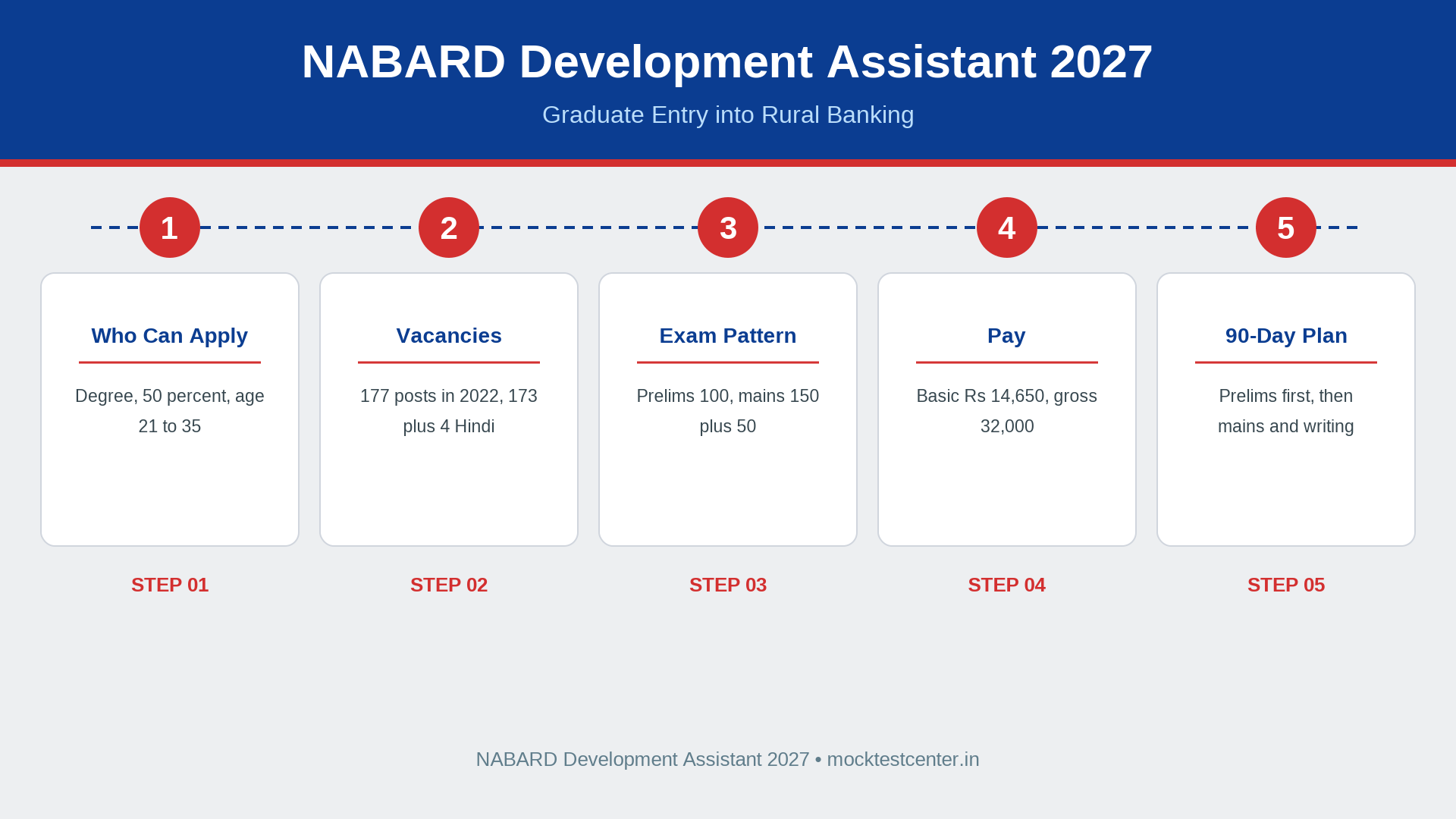
Who should aim for it? A graduate with 50 percent marks in any discipline, aged 21 to 35, who wants a central government bank job without an interview and without leaving the state where the regional office sits. The post is office based and state based at once: you apply for a regional office, and you work in that state. The pay is modest next to an officer post, with a starting basic of 14,650 rupees a month and gross emoluments of about 32,000 rupees a month, but the job is permanent, the hours are regular, and the employer is the bank that funds rural India.
The 2022 cycle, the model for 2027
NABARD released the short advertisement for Development Assistant and Development Assistant (Hindi) in September 2022, and the detailed advertisement followed on 15 September 2022, the same day applications opened. Applications closed on 10 October 2022. The preliminary exam took place on 6 November 2022, less than a month after the last date. The main exam took place on 24 December 2022. The whole cycle, from advertisement to mains, ran about three and a half months. That speed is the first lesson for the next cycle. When the notice comes, the gap between the last date and the prelims will be short, and a candidate who starts preparing on the day of the notice will have about four weeks.
The vacancy split shows how small this exam is. Of the 173 Development Assistant posts, 80 were unreserved, 46 were OBC, 21 were SC, 15 were EWS, and 11 were ST. The 4 Hindi posts split into 3 unreserved and 1 ST. State wise, the largest shares went to the big regional offices, with Maharashtra, Uttar Pradesh, and West Bengal among the states with the most posts, while small states took one or two each. The exact state table changes with each cycle, so this article does not print the 2022 state table as a guide to the next one. The point that carries over is the scale: under 200 posts for the whole country, which makes the competition sharp even though the paper is not the hardest bank paper.
| Detail | 2022 cycle |
|---|---|
| Advertisement | 3/DA/2022-23 |
| Posts | 177: 173 Development Assistant, 4 Development Assistant (Hindi) |
| Apply window | 15 Sep to 10 Oct 2022 |
| Preliminary exam | 6 Nov 2022 |
| Main exam | 24 Dec 2022 |
| Age as on 1 Sep 2022 | 21 to 35 years |
| Fee, others | Rs 450 |
| Fee, SC and ST and PwBD and ex servicemen | Rs 50 |
| Starting basic pay | Rs 14,650, including two advance increments |
| Gross emoluments | About Rs 32,000 a month |
Three things stand out in that table. First, the age window is wide: 21 to 35 years, which is ten years wider at the top than most clerk exams. A graduate of 33 can still apply, and a graduate of 21 can apply too. That wide window is one reason the applicant count runs high for so few posts. Second, the fee is the standard bank exam fee, 450 rupees for most candidates and 50 rupees for SC, ST, PwBD and ex servicemen. Third, the pay is the lowest starting basic among the bank exams in this set, and the article says so plainly in the pay section rather than dressing it up.
The 2022 cycle was not the first Development Assistant recruitment. NABARD ran earlier cycles in 2018 and 2019, and the 2022 pattern follows them closely. The prelims shape, the mains shape, and the descriptive paper all stayed the same across those cycles, which is why the 2022 advertisement is a safe model for the next one. A pattern that has held for three cycles is unlikely to change without warning, though the notice can always change it, and the notice is the final word.
Who can apply: the 50 percent rule
The education rule for Development Assistant is a graduation degree in any discipline with a minimum of 50 percent marks in the aggregate, from a recognised university. Candidates from SC, ST, PwBD and ex serviceman categories need only a pass class. The cut off date in the 2022 cycle was 1 September 2022, and the marks had to be in hand by that date. A final year student who had not yet received the degree result could not apply.
The 50 percent line is the rule that ends the most applications, and it is easy to misread. It is 50 percent in the aggregate across the degree, not 50 percent in each year and not 50 percent in the main subject. A candidate with 49 percent cannot apply, even with a strong score in the final year. A candidate with 51 percent can apply, even with a weak first year. Check the aggregate on your mark sheets before you apply, because the Bank will check it at document verification, and a candidate who clears both exams and fails the marks check loses the seat.
There is no experience requirement. A fresh graduate can apply on the day the degree result comes out, provided the marks cross 50 percent. There is no subject requirement either. A BA, BCom, BSc, BTech or any other degree counts, as long as it comes from a recognised university. That open door is the reason the applicant pool is so large. Every graduate in the country with 50 percent marks is eligible, and the 177 posts go to the top of that pool.
Age runs from 21 to 35 years as on the cut off date. In the 2022 cycle the cut off was 1 September 2022, and candidates had to be born not earlier than 2 September 1987 and not later than 1 September 2001, both days included. Relaxation follows government rules for reserved categories, persons with benchmark disabilities, and ex servicemen, with the exact slabs printed in the new notice. This article does not print the relaxation slabs from memory, because the slabs differ by category and the notice is the only safe source for them.
One more condition sits in the advertisement and is easy to miss. A candidate applies for a regional office, and the application is tied to that office. The prelims and mains centres follow the office, and the posting follows the office. Pick the state where you live or where you studied, because the posting will be there for years. A candidate who applies for a far off office with more posts gets a posting far from home and a language of daily work that may not be his own.
Development Assistant Hindi: the four post twin
The Development Assistant (Hindi) post is a twin of the main post with one change: the work is in Hindi, and the paper tests it. In the 2022 cycle there were 4 Hindi posts, 3 unreserved and 1 ST. The pay scale, the age window, and the fee are the same as the main post. The difference is the education rule and the prelims paper.
For the Hindi post, the degree must be from a recognised university in English or Hindi medium, with Hindi and English as a compulsory or elective subject, with a minimum of 50 percent marks in the aggregate. The other route is a degree with Hindi and English as the main subject, with the same 50 percent minimum. Pass class applies for SC, ST, PwBD and ex serviceman candidates, as in the main post. A candidate who studied Hindi and English through the degree qualifies. A candidate who studied only one of the two languages does not.
The prelims paper for the Hindi post swaps Numerical Ability for Professional Knowledge in Hindi. The paper is still 100 questions for 100 marks in 60 minutes: English Language 40, Professional Knowledge (Hindi) 30, and Reasoning 30. The Professional Knowledge section tests Hindi language and literature, official language rules, and translation, at a level a Hindi graduate will find fair and a non Hindi graduate will find hard. The mains pattern for the Hindi post follows the same shape as the main post, with the descriptive paper in English as well, so the Hindi post is not an escape from English. It is a post for a candidate who knows both languages well.
Four posts is a small number, and the competition for them is fierce in its own way, because the eligible pool is small and the candidates in it are strong in Hindi. A Hindi graduate should apply for both posts if eligible, because the prelims papers differ only in one section and the preparation overlaps almost fully. A candidate who is not a Hindi graduate should not apply for the Hindi post at all. The Professional Knowledge section will end the run in the prelims.
Prelims: 100 marks in 60 minutes
The preliminary exam is an online objective test of 100 questions for 100 marks in 60 minutes, with a composite time for the whole paper. Three sections make up the paper: English Language 40 questions, Numerical Ability 30 questions, and Reasoning 30 questions. Every question carries one mark. Every wrong answer costs a quarter of a mark. The prelims is qualifying in nature: its marks do not count in the final merit, but you must clear its cut off to reach the mains. That last line shapes the whole strategy. The prelims asks for speed and safety, not for a high score.
| Section, prelims | Questions | Marks |
|---|---|---|
| English Language | 40 | 40 |
| Numerical Ability | 30 | 30 |
| Reasoning | 30 | 30 |
| Total, composite time 60 minutes | 100 | 100 |
English carries the most weight in the prelims, with 40 of the 100 marks. Reading comprehension, cloze tests, error spotting, fill in the blanks, and vocabulary make up the section. The level is the standard bank clerk level, which is to say it is easy for a candidate who reads English daily and hard for one who does not. A graduate who reads one editorial a day will find the section fair. A graduate who has not read English since college will lose marks here, and the loss matters because English is the largest section in the paper.
Numerical Ability gives thirty questions at the level of a school arithmetic paper: simplification, number series, percentages, ratio and proportion, averages, profit and loss, and simple interest. The questions are not hard. The clock is the hard part. Sixty minutes for 100 questions is 36 seconds per question across the paper, and the arithmetic questions eat time if you work them out in full. Learn the tables up to 20, the squares up to 30, and the short cuts for percentages. A question you cannot solve in 40 seconds is a question to skip.
Reasoning gives thirty questions: series, coding and decoding, odd one out, blood relations, direction sense, ranking, and simple puzzles. The same rule applies. A puzzle that takes three minutes is four other questions. Drop it, finish the paper, and come back only if time is left. The prelims cut off is the only target, and the cut off rewards a balanced paper with few wrong answers, not a brave paper with many guesses. Four wrong answers erase one right answer, so guess only when you can rule out two options.
One practical point about the prelims: there is no sectional timing, only a composite 60 minutes. You can give English 25 minutes and Reasoning 15 if that suits you, or the reverse. Use the mocks to find your split, and fix it before the real day. Candidates who walk in without a time split lose the first ten minutes deciding what to do, and ten minutes is a sixth of the paper.
Mains: where the exam is won
The main exam is an online test in two parts: an objective test of 150 questions for 150 marks in 90 minutes, and a descriptive test of English for 50 marks in 30 minutes. The total is 200 marks, and the final merit rests on the mains alone, because the prelims is qualifying only. That makes the mains the whole exam in effect. A candidate who clears the prelims by one mark and tops the mains gets the post. A candidate who tops the prelims and slips in the mains does not.
| Section, mains objective | Questions | Marks |
|---|---|---|
| Reasoning | 30 | 30 |
| Quantitative Aptitude | 30 | 30 |
| General Awareness, with special reference to agriculture, rural development and banking | 50 | 50 |
| Computer Knowledge | 40 | 40 |
| Total objective, composite time 90 minutes | 150 | 150 |
| Descriptive English, 30 minutes | Essay, precis, report or letter writing | 50 |
| Mains total | 200 |
General Awareness is the largest section in the mains, with 50 of the 150 objective marks, and it is the section that makes this exam different from every other clerk exam. The advertisement names its focus in full: general awareness with special reference to agriculture, rural development and banking. That means the questions run toward crops and seasons, irrigation, farm credit, the priority sector, rural schemes, NABARD itself, and the Reserve Bank. A candidate who prepares only current affairs will score half the section. A candidate who adds agriculture and rural development will score the other half, and that half is where the merit list is decided.
Computer Knowledge gives forty questions, the second largest section, and it is the easiest forty marks in the paper for a graduate who uses a computer daily. Hardware and software basics, the internet, email, MS Office, file types, and computer security cover most of it. The level is basic. A week of reading a computer awareness book covers it, and the marks per hour of study are higher here than in any other section. Do not leave it to the last week.
Reasoning and Quantitative Aptitude repeat the prelims subjects at a slightly higher level, with thirty questions each. Puzzles get longer, data interpretation appears, and the arithmetic adds time and work, time speed and distance, and compound interest. The same pace rule applies: ninety minutes for 150 objective questions is 36 seconds per question, and the negative marking of a quarter mark per wrong answer punishes guessing. The candidates who top the mains are the ones who attempt 130 questions with 120 right, not the ones who attempt all 150 with 100 right.
Negative marking applies in both phases, at a quarter mark per wrong answer in the objective tests. The descriptive paper has no negative marking, because it is written, not multiple choice. The mains objective and descriptive papers run in one sitting, with 90 minutes for the objective part and 30 minutes for the descriptive part, for a total of two hours.
The descriptive English paper: 50 marks most candidates ignore
The descriptive test of English carries 50 marks in 30 minutes, and it is the most ignored part of this exam. It asks for an essay, a precis, and a report or letter, written on a computer in English. Fifty marks out of a 200 mark mains is a quarter of the final merit. A candidate who scores 30 out of 50 here and a candidate who scores 15 out of 50 here differ by 15 marks in the merit list, which is more than the gap between selection and rejection in most states. Yet most candidates spend no time on it, because it cannot be practised with multiple choice mocks.
The fix is simple and cheap. Write one essay a week for ten weeks, on a topic from agriculture or rural development, in 250 words. Write one precis a week, cutting a newspaper editorial to a third of its length without losing its point. Write one formal letter a week, to a bank manager or a district officer, in the standard format. That is thirty pieces of writing before the mains, and each one takes half an hour. A candidate who does this walks into the descriptive paper with a plan. A candidate who does not walks in and writes whatever comes to mind, and the marks show it.
Three rules govern the descriptive paper. First, answer the question asked, not the question you prepared. An essay on farm credit that drifts into general banking will lose marks for relevance. Second, keep the language plain. Short sentences, correct grammar, and a clear structure beat long sentences with errors. Third, watch the clock. Thirty minutes for three tasks means ten minutes each, and a candidate who spends twenty minutes on the essay will leave the letter half done. Practise with a timer, every time.
Pay: 32,000 rupees gross and what it means
A Development Assistant selected in the 2022 cycle draws a starting basic pay of 14,650 rupees a month, including two advance increments. The pay scale runs from 13,150 rupees to 34,990 rupees over twenty years, with increments of 750 rupees three times, then 900 rupees four times, then 1,200 rupees six times, then 1,300 rupees twice, then 1,480 rupees three times, then 1,750 rupees once. On top of the basic pay come dearness allowance, house rent allowance, city compensatory allowance, transport allowance and other allowances as admissible from time to time. At present, the initial monthly gross emoluments are about 32,000 rupees a month.
That is the lowest starting basic among the bank exams in this set, and the article says so plainly rather than dressing it up. The NABARD Grade A 2027 exam leads to an Assistant Manager post in the same bank with a starting basic pay of 44,500 rupees and a gross of about 1,00,000 rupees a month. The IBPS RRB PO 2027 exam offers a Scale I officer post with a starting basic of 48,480 rupees. The RBI Office Attendant 2027 exam, which needs only Class 10, pays a starting basic of 24,250 rupees, which is higher than the Development Assistant basic. Those comparisons look bad for this post until you see the rest of the story.
The rest of the story is the career and the conditions. A Development Assistant works in a NABARD regional office, with regular hours, a permanent post, and promotion exams that lead up the clerical cadre and, for the best candidates, into the officer stream. The gross of 32,000 rupees is the starting figure, not the ceiling, and the allowances rise with the basic pay over the years. The job is also one of the few bank jobs where the posting is in your own state by design, because you apply for a regional office and work there. For a graduate who wants to stay near home, that is worth more than a higher basic pay in a far off city.
Compare the pay with the other clerk exams and the gap narrows. The SBI CBO 2027 exam and the ESIC UDC 2027 exam both need a degree and pay more, but both need an interview or a skill test as well, and both post you where the employer needs you. The Development Assistant exam has no interview in the 2022 pattern, which is a real saving of time and risk. A candidate who fears the interview stage should weigh that in the balance.
What a Development Assistant actually does
A Development Assistant works in a NABARD regional office or at the head office in Mumbai, doing the clerical work behind the bank's development programmes. The files cover farm credit, refinance to cooperative banks and regional rural banks, self help group lending, watershed projects, and rural infrastructure. The daily work is correspondence, data entry, record keeping, and the preparation of notes and statements. It is office work, at a desk, with a computer, and the hours follow the office.
The job suits a graduate who likes steady work and knows the rural economy of his own state. A Development Assistant in the Bihar office deals with paddy, floods, and self help groups. One in the Punjab office deals with wheat, dairy, and cooperative banks. One in the Maharashtra office deals with sugarcane, horticulture, and farmer producer organisations. The schemes differ by state, and the local knowledge you bring is a real asset in the office. That is why the post is state based, and why you should apply for the state you know.
Promotion runs through the clerical cadre, with exams and seniority carrying a Development Assistant upward over the years. The advertisement does not print a promotion chart, so this article does not invent one. What the advertisement does show is the entry point: Group B, with a pay scale that runs for twenty years and a starting basic that already includes two advance increments. A graduate who joins at 22 and stays the course will see the basic pay more than double over the scale, and the allowances rise with it.
Development Assistant next to Grade A and Grade B
NABARD runs three doors into its offices, and the right door depends on your degree and your marks. The Development Assistant door needs a degree with 50 percent marks and no interview. The NABARD Grade A 2027 exam needs a degree with 60 percent marks in most disciplines, runs prelims and mains with descriptive papers, adds a psychometric test and an interview, and pays a starting basic of 44,500 rupees. The NABARD Grade B 2027 exam needs a degree with 60 percent marks and a higher age band, and its last cycle in 2021 offered only 7 posts with a starting basic of 35,150 rupees. The three posts share an employer and almost nothing else.
A graduate with 60 percent marks should take the Grade A exam as the main target and the Development Assistant exam as a second shot, because the syllabuses overlap enough that one preparation serves both. The Grade A prelims tests reasoning, English, computer knowledge, quantitative aptitude, decision making, general awareness, economic and social issues, and agriculture and rural development. The Development Assistant mains tests general awareness with special reference to agriculture, rural development and banking. The agriculture half of the Grade A paper and the agriculture half of the Development Assistant mains are the same study. Prepare once, sit for both.
A graduate with 50 to 60 percent marks cannot apply for Grade A in most disciplines, and the Development Assistant exam is the only NABARD door open. That is the candidate this post is built for. The EPFO Assistant 2027 exam and the FCI Manager 2027 exam are other graduate routes with higher pay, but both need a degree and a tougher paper, and the EPFO Assistant post has not been notified since 2019. The TN Cooperative Bank Assistant 2027 exam and the MSC Bank Trainee Junior Officer 2027 exam are cooperative bank routes with thousands of posts between them, and the same preparation covers most of their syllabus too. Apply for every exam you are eligible for, and decide when the offers come.
The way to choose is to ask one question. Do you want to work in rural development, in your own state, in a permanent clerical post with no interview? If yes, Development Assistant is your post, and it deserves your main effort when the notice comes. If you want the highest pay and the fastest rise, Grade A is your post, and it needs 60 percent marks and an interview. That is the whole decision. Do not spend a year preparing for a posting you do not want.
What to study for each section
English needs daily reading more than grammar rules. Reading comprehension, cloze tests, error spotting, fill in the blanks, and vocabulary make up the prelims section, and the descriptive paper adds essay, precis, and letter writing. Read one editorial a day and note ten new words a week with their meanings. That habit covers the vocabulary half of the prelims and the reading half of the descriptive paper at once. For grammar, work through error spotting sets and learn the twenty most common error patterns: subject verb agreement, tense, articles, prepositions, and pronouns.
Numerical Ability and Quantitative Aptitude need the basics in your head before the test. Simplification, number series, percentages, ratio and proportion, averages, profit and loss, simple and compound interest, time and work, and time speed and distance. That list looks long, and it is the same list as every bank exam, so the books and mocks you already own cover it. The difference is the pace. Both papers give about 36 seconds per question, and a wrong answer costs a quarter mark. Learn the tables up to 20, the squares up to 30, and the cubes up to 15. Guess only when you can rule out two options.
General Awareness with agriculture is the section that decides the mains, and it needs a notebook of its own. Write one line a day about farm news: the monsoon, the minimum support prices, the crop seasons, the big schemes for farmers, and the NABARD programmes in your state. Add one line a week about a static fact: the main crops of each state, the river systems, the types of soil, and the institutions of rural credit. Six months of one line a day is about 180 lines, and that notebook covers most of the fifty marks. Add the banking half too: the Reserve Bank, the repo rate, priority sector lending, and the cooperative banking structure.
Computer Knowledge needs one week, not one month. Hardware and software basics, the internet, email, MS Office, file types, and computer security cover most of the forty questions. A computer awareness book of a hundred pages covers it, and the marks per hour of study are higher here than in any other section. Do it early, revise it the week before the mains, and take the forty marks.
Reasoning needs practice, not theory. Series, coding and decoding, odd one out, blood relations, direction sense, ranking, and simple puzzles cover most of the section in both phases. Work through one set of twenty questions a day and mark the time. The goal is to know in five seconds whether a question is yours or not. A puzzle that takes three minutes is a question you should skip, because three minutes is five other questions.
A 90 day plan that fits around a job or college
Most Development Assistant candidates are either working a small job or finishing a degree. Two hours a day is realistic, and two hours a day for ninety days is 180 hours, which is enough for this paper. Start now, before the notice comes out, because the gap between the last date and the prelims in the 2022 cycle was less than a month. A candidate who starts on the day of the notice has about four weeks to the prelims and seven weeks to the mains. A candidate who starts now has the whole year.
Days 1 to 30 are for the base. Study two hours a day. Cover one Quantitative Aptitude topic and one English topic each day. Read the farm news every morning and write five lines in your agriculture notebook, plus two lines on your own state. Write one essay a week and one precis a week, from the first week itself, because the descriptive paper needs ten weeks of practice, not ten days. Take one prelims mock at the end of week two and one at the end of week four. Do not worry about the score. The first mocks only show you where you stand.
Days 31 to 60 are for speed. Take two prelims mocks a week now, and one mains mock a fortnight. After each mock, spend as much time on analysis as you spent on the test. Write down every question you got wrong and why. Was it a concept gap, a silly mistake, or a time problem? Concept gaps go back into your study list. Silly mistakes need a checklist before you submit each section. Time problems need easier questions first and hard ones last. Your score will move most in this phase, because both papers give about 36 seconds per question and a wrong answer costs a quarter mark, so speed with accuracy is the whole game.
Days 61 to 90 are for the real thing. Take three mocks a week, mixing prelims and mains papers. Revise your error notebook every second day. Stop learning new topics in the last ten days. New topics in the last week add stress and no marks. In the last three days, take one full mock at the same time as your real test slot, then rest. Sleep matters more than one more chapter in the final week. A tired candidate makes the same mistakes a fresh candidate makes, and the difference between selection and rejection in a state with few posts is often two or three marks.
If you have less than ninety days, cut the base phase, not the mocks and not the writing practice. Ten mocks with full analysis beat thirty days of reading without a single test, and ten essays beat ten days of reading about essay writing. The paper rewards candidates who have sat through the sixty minute prelims and the two hour mains many times. It punishes candidates who know the syllabus and have never felt the clock run out.
Mistakes that cost candidates a year
The first mistake is applying with less than 50 percent marks. The aggregate across the degree must cross 50 percent, and the Bank will check it at document verification. A candidate who clears both exams and fails the marks check loses the seat. Check the aggregate on your mark sheets before you apply. If you are below 50 percent, do not apply. Aim at exams without a marks line instead.
The second mistake is ignoring the agriculture half of General Awareness. Fifty marks in the mains carry the words agriculture, rural development and banking in their title, and half of those marks are farm questions. A candidate who prepares only current affairs will score half the section. Read the farm news every day and keep the agriculture notebook. It is the cheapest fifty marks in the paper.
The third mistake is ignoring the descriptive paper. Fifty marks out of 200 is a quarter of the final merit, and most candidates spend no time on it. Write one essay, one precis and one letter a week for ten weeks. That is thirty pieces of writing before the mains, and each one takes half an hour. A candidate who does this gains fifteen marks over one who does not, and fifteen marks is often the gap between selection and rejection.
The fourth mistake is guessing too much. Four wrong answers erase one right answer. In a section where you know twenty answers for sure, ten wild guesses can pull your score down by two and a half marks. That is often the gap between selection and rejection in a state with few posts. Guess only when you can rule out two options.
The fifth mistake is waiting for the notice to start. The gap between the last date and the prelims in the 2022 cycle was less than a month. A candidate who starts on the day of the notice has about four weeks. Start now, with two hours a day, and the notice will find you ready.
What to check before the next notice comes out
Keep four things ready. First, your degree mark sheets, with the aggregate worked out, so you can prove the 50 percent rule the day the notice comes out. Second, a notebook of farm news and rural schemes for your own state, because the agriculture half of the mains is the section that decides the merit list. Third, a writing routine of one essay, one precis and one letter a week, so the descriptive paper feels normal by the time the mains comes. Fourth, a habit of checking nabard.org twice a week, because the next notice will appear there first and the apply window will be short.
Start with one NABARD Development Assistant 2027 prelims mock this week, built on the 2022 pattern: 100 questions, 100 marks, sixty minutes, English 40, Numerical Ability 30, Reasoning 30. Score it, list your weak section, and give that section thirty minutes a day. That single habit, repeated for ninety days, is what turns a graduate with 50 percent marks into a NABARD Development Assistant.
Sources
NABARD, Recruitment of Development Assistant and Development Assistant (Hindi), Advertisement 3/DA/2022-23, reproduced on PracticeMock and Oliveboard from the official advertisement on nabard.org. NABARD, Information Handout for the online examination, Development Assistant 2022, on nabard.org. NABARD Grade A 2027 package on MockTestCenter.in for the Grade A pay and pattern figures. NABARD Grade B 2027 package on MockTestCenter.in for the Grade B vacancy and pay figures. RBI Office Attendant 2027 package on MockTestCenter.in for the Office Attendant pay figure.