
About MPSC Agriculture Services 2027 Exam Series
📖 Table of Contents
- MPSC Agriculture Services 2027 at a glance
- The 258 posts, and the posts they lead to
- Who can apply, and the degree rule that decides it
- The combined Preliminary examination
- The Main examination, and the pattern argument
- The long road from the Main examination to appointment
- Why there is no new notification
- Do not confuse this with the other agriculture recruitments
- How to prepare, in the order that matters
- Mistakes that end attempts
- Pay, posting and the job itself
- Where to check, and what this guide does not claim
- Sources
MPSC Agriculture Services 2027: Complete Exam Guide
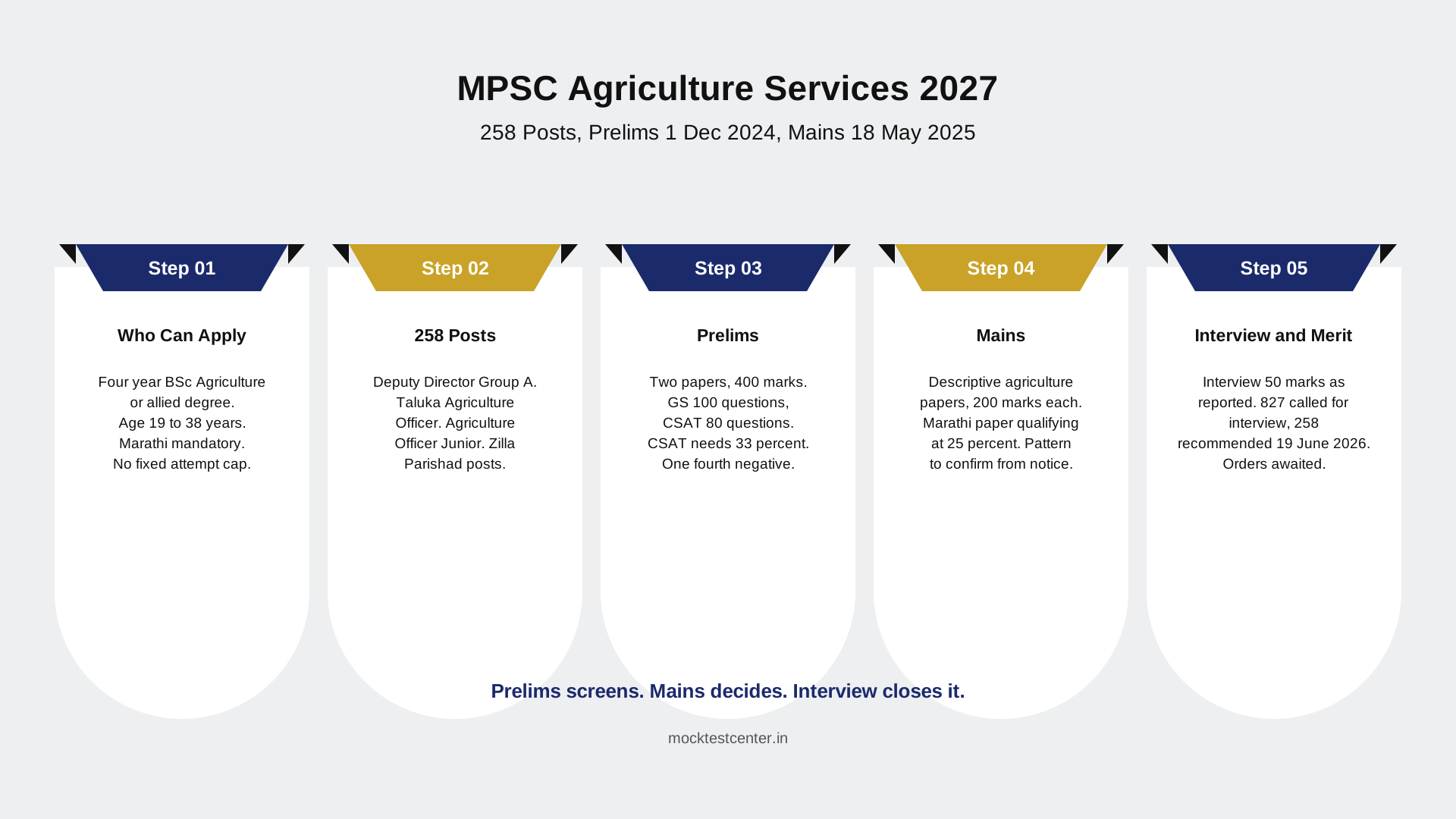
The Maharashtra Public Service Commission notified the Maharashtra Agricultural Services Examination in September 2024 for 258 posts, and that cycle has now run its full course from notification to recommendation. The notification came on 26 September 2024. Applications ran from 27 September to 17 October 2024. MPSC held the Preliminary examination on 1 December 2024. MPSC held the Main examination on 18 May 2025. The Main result came on 24 December 2025, interviews ran from 23 January to 10 February 2026, and the final recommendation list of 258 candidates reached the Agriculture Department on 19 June 2026. Candidates still awaited appointment orders when this guide was researched. MPSC has published no fresh notification for the next cycle as of 22 November 2026, so this guide anchors on the 2024 cycle and says so wherever a 2027 figure would otherwise be guessed.
Agriculture Services is the examination that agriculture graduates in Maharashtra wait years for, because it does not run every year. The Commission notifies it only when the Agriculture Department reports vacancies and the State Finance Department approves the posts, and the gaps between cycles run to one to three years. The 2024 cycle is the most recent full cycle, and the next cycle is already delayed: demand letters for 87 posts for 2025 and 484 posts for 2026 have gone to the Finance Department sub committee for approval, and the notification will come only after that approval lands. A candidate who waits for the notification before starting preparation will have lost the waiting time that other candidates used.
The examination has three stages. A combined Preliminary examination, shared with the other gazetted services, screens candidates. An Agriculture Services Main examination, built around agriculture papers, decides most of the merit. An interview closes the selection. The Preliminary marks count for nothing beyond the shortlist, and the Main examination is descriptive in type, which separates this examination sharply from the objective Preliminary that precedes it. A candidate who prepares only with multiple choice practice will reach the Main examination unprepared for the writing it demands.
One warning belongs at the top of this guide, because it is the mistake that wastes the most preparation time. MPSC Agriculture Services, the gazetted examination described here, is a different examination from the Assistant Agriculture Officer recruitment under the Group C services, and different again from the Krushi Sevak recruitment and from the Agriculture Department drive for 8,953 vacancies reported in October 2025. The Group C post carries 1,203 vacancies under Advertisement Number 017/2026, with applications from 13 to 27 November 2026 and a Preliminary examination on 24 January 2027. Candidates who mix up the two examinations prepare for the wrong pattern, the wrong age limit and the wrong posts. This guide keeps them apart, and a full section below explains the difference.
MPSC Agriculture Services 2027 at a glance
| Detail | MPSC Agriculture Services 2027, as run in the 2024 cycle |
|---|---|
| Conducting body | Maharashtra Public Service Commission (MPSC) |
| Exam | Maharashtra Agricultural Services Examination, Group A and Group B gazetted posts |
| Live cycle | 2024, notification 26 September 2024, 258 posts, applications 27 September to 17 October 2024 |
| Posts in live cycle | 258, Deputy Director of Agriculture, Taluka Agriculture Officer, Agriculture Officer Junior, Zilla Parishad Agriculture Officer and allied posts |
| Preliminary | 1 December 2024, two papers, 400 marks in all, result 8 April 2025 |
| Main | 18 May 2025, descriptive agriculture papers, result 24 December 2025, 827 candidates called for interview |
| Interview | 23 January to 10 February 2026, 50 marks as reported by one tracker, to be confirmed from the notification |
| Final merit | Main examination marks plus interview marks, Preliminary marks count for screening only |
| Recommendation | 258 candidates recommended, list sent to the Agriculture Department on 19 June 2026 |
| Education | Four year Bachelor degree in Agriculture or an allied discipline, working knowledge of Marathi mandatory |
| Age limit | 19 to 38 years for the open category, 19 to 43 years for reserved categories, PwBD up to 45 years |
| Fee in live cycle | Rs 544 for open category, Rs 344 for reserved, EWS and orphan categories |
| Next cycle | Not notified as of 22 November 2026, Finance Department approval pending |
The 258 posts, and the posts they lead to
The 258 posts in the 2024 cycle cover the gazetted officer posts of the Agriculture Department. At the top sits the Deputy Director of Agriculture and Technical Officer post in Group A. Below it sit the Taluka Agriculture Officer and Technical Officer posts, the Agriculture Officer Junior post, the Zilla Parishad Agriculture Officer post and the Assistant Administrative Officer post in Group B. The officers recruited through this examination run agriculture administration at the taluka and district level, supervise extension work, implement schemes, and advise on crop planning, input supply and marketing. It is the senior gazetted route into the department, and it is the only MPSC route that takes an agriculture degree as its core qualification.
The post wise break up of the 258 posts was not published in any tracker report found in this research, and this guide does not invent one. The closest verified break up belongs to the earlier 2022 cycle, which carried 203 posts: Deputy Director Group A 19, Taluka Agriculture Officer Group B 61, and Agriculture Officer Junior and Others Group B 123. The Testbook page for the Maharashtra Agricultural Officer recruitment gives that break up, and this guide presents it here as history for the 2022 cycle only. The tracker pages that follow this examination agree on the 2024 cycle total of 258, and the upload pre check should read the post wise break up from the 2024 notification itself.
One labelling conflict needs a clear flag, because candidates quote it both ways. The 2022 cycle break up and the detailed tracker page for this examination both list the Taluka Agriculture Officer post as a Group B post. The AgroMind guide lists the Taluka Agriculture Officer as a Group A post, alongside the Sub Divisional Agriculture Officer and the Assistant Director of Agriculture. Both cannot be right for the same cycle, and the group determines the pay level. This guide follows the 2022 cycle table and the detailed tracker, which put the Taluka Agriculture Officer in Group B, and flags the AgroMind Group A labelling as a conflicting tracker claim.
The pay levels reported for the two groups are consistent across the tracker pages. Group A posts sit at Level S-20 of the 7th Pay Commission matrix, Rs 56,100 to Rs 1,77,500. Group B posts sit at Level S-15, Rs 41,800 to Rs 1,32,300. Allowances sit on top of the basic pay as per state government rules. The AgroMind guide also quotes approximate in hand starting figures of Rs 75,000 to Rs 85,000 a month for Group A and Rs 55,000 to Rs 65,000 a month for Group B, but this guide does not repeat those as facts, because in hand pay depends on posting, allowances and deductions, and no tracker shows its working. The pay matrix levels are the figures a candidate can trust.
Who can apply, and the degree rule that decides it
The education rule is a four year professional Bachelor degree in Agriculture or an allied discipline from an ICAR or UGC recognised agricultural university. The degrees named by the tracker guides are BSc Honours Agriculture, BSc Honours Horticulture, BTech Agricultural Engineering, BTech Food Technology or Food Science, BSc Honours Agri Business Management, BSc Honours Forestry, BSc Honours Agricultural Biotechnology, and BSc Honours Community Science or Home Science. A general BSc degree without the agriculture specialisation does not qualify. A diploma in agriculture does not qualify either, and the tracker guides direct diploma holders to the separate lower level posts such as Krushi Sevak, which recruit through different processes.
The Group A post of Deputy Director of Agriculture and Technical Officer may call for additional qualification or relevant post qualification experience as specified in the notification for that cycle, and the Assistant Administrative Officer post may accept a general graduate degree along with other specified conditions. The notification carries the post wise qualification, and a candidate should read it post by post rather than assume that one degree qualifies for every post in the examination. Final year students appearing for their final semester can typically apply for the Preliminary examination, with proof of passing the degree to be produced before the Main examination application deadline, as the AgroMind guide states.
Working knowledge of Marathi is mandatory, and the requirement runs deeper than a certificate. Candidates must also clear a qualifying Marathi paper in the Main examination, and the detailed tracker puts the qualifying mark at 25 percent. The work itself is field administration in Marathi speaking talukas, dealing with farmers, gram panchayats and zilla parishad offices, so a candidate who cannot work in Marathi will struggle in the job even if the paper is cleared. Candidates should treat Marathi as part of the preparation from the start.
The tracker guides report the age limit in the 2024 cycle as 19 to 38 years for the open category and 19 to 43 years for reserved categories, with PwBD candidates allowed up to 45 years. That is the figure in the AgroMind guide and in the second tracker page for this examination, and it matches the general MPSC norm. The main tracker page for this examination states the limit as 19 to 45 years as on 1 April 2024 instead, and this guide treats that as a conflicting report, most likely a confusion with the PwBD upper limit. The main figure used here is 19 to 38 for the open category, and the upload pre check should confirm the exact band and the reference date from the 2024 notification. There is no fixed cap on the number of attempts, and a candidate may apply in any cycle as long as the age and qualification criteria of that cycle are met.
The fee for the live cycle is Rs 544 for the open category and Rs 344 for reserved, EWS and orphan candidates, payable online only through mpsconline.gov.in. That is the figure in the detailed tracker page, tied to the combined Preliminary examination notification covering the 2024 cycle. A second tracker page reports historically lower fees of Rs 394 for the open category and Rs 294 for the reserved category, and this guide flags that as a conflicting report from an older cycle. The application itself is online only, and the admit card, answer key and result all come through the candidate login on the same portal.
The combined Preliminary examination
The MPSC Agriculture Services exam pattern starts with the combined Preliminary examination, shared with the other gazetted services, and it is the same combined Preliminary that the Engineering Services candidates sit. Paper 1 is General Studies, with 100 objective questions for 200 marks in 2 hours. Paper 2 is the aptitude test, often called CSAT, with 80 objective questions for 200 marks in 2 hours. The CSAT paper is qualifying in nature, and a candidate must score at least 33 percent in it, which is 66 marks out of 200. Paper 1 marks alone decide the cut off for the Main examination, among candidates who clear the CSAT qualifying mark. The AgroMind guide, the detailed tracker page and the Disha Publication guide to the combined Preliminary all confirm that structure, and all three agree on the question counts, the marks and the 33 percent rule.
Negative marking applies in both papers. The Commission deducts one fourth of a mark for each wrong answer in the Preliminary examination, which is 0.25 marks per wrong answer in the tracker wording. A wrong answer in Paper 1 costs half a mark, since each question carries 2 marks. A wrong answer in the CSAT paper costs 0.625 marks, since each question carries 2.5 marks. There is no negative marking in the descriptive Main examination. The Preliminary marks do not count in the final merit at all, and a candidate who tops the Preliminary starts the Main examination on equal footing with the last candidate who cleared the cut off.
MPSC held the Preliminary for the 2024 cycle on 1 December 2024, jointly with the Maharashtra Gazetted Civil Services Combined Preliminary Examination, and the result came on 8 April 2025. The four month gap between the examination and the result is normal for MPSC, and the Main examination followed about six weeks after the result, on 18 May 2025. That short gap between the Preliminary result and the Main examination is the reason Main preparation cannot wait for the Preliminary result. A candidate who starts agriculture answer writing only in April 2025 has about five weeks for a descriptive Main examination.
The General Studies syllabus for Paper 1 covers history of India and the Indian national movement, current affairs, Indian and Maharashtrian polity, geography of India and Maharashtra, the Indian economy, environmental ecology and biodiversity, science and technology, and general mental ability. The CSAT syllabus covers comprehension, logical reasoning, quantitative aptitude and basic numeracy. Maharashtra specific content carries real weight in Paper 1, and an agriculture graduate who knows crop science but not the geography, rivers, dams and districts of Maharashtra will drop marks that other candidates collect easily.
The Main examination, and the pattern argument
The MPSC Agriculture Services exam pattern turns descriptive at the Main examination, and this is where this guide must be most honest, because the tracker pages disagree with each other about the pattern, and the disagreement is large. The tracker pages report two different Main patterns for this examination, and a candidate who prepares for the wrong one will fail. This section states both, says which one this guide follows and why, and flags the whole question for the upload pre check to settle from the notification.
The first pattern is the two paper agriculture pattern reported by the AgroMind guide. Paper 1 covers Agriculture Science and Technology in two parts, and Paper 2 covers Specialised Agricultural Disciplines and Allied Science. Each paper carries 200 marks and runs for 3 hours, and both are descriptive and written in English or Marathi. The interview that follows carries 50 marks. The total for the Main examination on this pattern is 400 marks, and the final merit is the Main marks plus the interview marks. This pattern matches the shape of the other MPSC technical Main examinations, including the Engineering Services Main with its two papers of 200 marks each, and it fits the single day Main examination date of 18 May 2025, since two papers of 3 hours can be held in one day.
The second pattern is the nine paper pattern reported by the detailed tracker page. It lists a Marathi paper of 300 marks and an English paper of 300 marks, both qualifying, with a minimum of 25 percent required in Marathi, followed by an Essay paper of 250 marks, four General Studies papers of 250 marks each, and two Agriculture papers of 250 marks each. The merit total on this pattern is 1,750 marks across the Essay, the four General Studies papers and the two Agriculture papers, with the interview added on top. This pattern copies the Rajyaseva Main examination scheme and adds two agriculture papers in place of the optional subjects, and the tracker page itself says the pattern reflects the format confirmed under the combined gazetted examination scheme while warning that the exact distribution should be verified against the notification.
The two patterns cannot both describe the same Main examination. A nine paper Main examination of 3 hour papers cannot be held on a single day, and every tracker that gives a date puts the 2024 cycle Main examination on 18 May 2025 as a single date. The two paper pattern fits that date. The nine paper pattern would need four or five days. The tracker page that reports the nine paper pattern also carries an arithmetic error in its own totals table, listing a total of 4,100 marks where its own figures add to 2,350, which weakens confidence in that page on the pattern question even though its cycle dates are detailed and internally consistent. This guide therefore follows the two paper pattern for its mock tests and its preparation advice, and it flags the nine paper pattern as a conflicting tracker claim that the upload pre check must resolve from the official notification and syllabus on mpsc.gov.in before the page goes live.
Whichever pattern the notification confirms, three facts stand firm. The Main examination is descriptive and written, not objective, and the tracker pages agree on that. The Preliminary marks do not count in the final merit, and the tracker pages agree on that too. Marathi carries a qualifying paper with a minimum mark, and the detailed tracker puts that minimum at 25 percent. A candidate should practise descriptive answer writing from the start, with diagrams, flowcharts and point wise technical recommendations, because the Main examination rewards structured written answers in a way that multiple choice practice never builds.
The agriculture syllabus for the Main papers runs across the undergraduate course. The subjects named in the tracker syllabus pages are agronomy and meteorology, including the agro climatic zones of Maharashtra, dryland farming, weed management, organic farming, precision agriculture and climate change adaptation; soil science and water management, including soil fertility, integrated nutrient management, salinity and sodicity reclamation, drip and sprinkler irrigation and watershed development; horticulture, including the production technology of pomegranate, grapes, citrus, mango and banana, protected cultivation and post harvest handling; genetics and plant breeding, including hybridisation, heterosis, seed production technology and seed certification; plant protection, including major crop diseases, insect pests of Maharashtra, integrated pest management and bio control agents; agricultural extension and economics, including transfer of technology, ATMA, KVK networks, agricultural marketing through APMC and e-NAM, farm management, crop insurance under PMFBY and agri credit structures; and agricultural engineering, including farm power and machinery and soil and water conservation structures.
The long road from the Main examination to appointment
The 2024 cycle is a case study in how slowly a selection can move after the written examinations are over, and candidates planning the next cycle should read the dates in full. MPSC held the Main examination on 18 May 2025. The Main result came on 24 December 2025, more than seven months later, and 827 candidates qualified for the interview. Interviews ran from 23 January to 10 February 2026. MPSC published the marks statement on 10 February 2026. The provisional merit list came on 18 March 2026. The final selection and recommendation list of 258 candidates reached the Agriculture Department on 19 June 2026. The department completed document verification on 21 July 2026. Selected candidates still waited on medical examination, police verification and appointment orders when this guide was researched, and they had raised the delay with the Agriculture Ministry.
Two ratios in those figures are worth noting. The Main result called 827 candidates for the interview against 258 posts, which is about 3.2 candidates per post at the interview stage. The recommendation list then carried exactly 258 names, one per post. The interview therefore mattered, but it did not overturn the Main examination on a large scale, and the Main marks carried the selection. A candidate who treats the interview as the deciding stage has the weight of the marks backwards.
The delay between the recommendation list and the appointment orders is the part of the cycle that tracker pages report with the most frustration. Selected candidates complete medical examination and police verification before the appointment order issues, and the process has stretched for months in the 2024 cycle. The tracker page records that candidates and the Agriculture Ministry have pressed for prompt completion of this final step. A candidate who clears the selection should keep every document ready for verification, including the degree certificate, caste and category certificates where applicable, domicile and identity proof, and the Marathi language proof, because a missing certificate at the verification stage has ended attempts that had already cleared the interview.
Why there is no new notification
The next cycle is delayed by a structural problem, not by a missing date on a calendar. MPSC notifies Agriculture Services only after the Agriculture Department reports vacancies and the State Finance Department approves the revised post structure, known as the cadre structure, for the department. That approval has been pending since 2025, and demand letters for 87 posts for 2025 and 484 posts for 2026 await approval in the Finance Department sub committee. MPSC will release the fresh notification once the Finance Department grants approval, and no tracker found in this research gives a date for it.
The delay has a history that predates the 2024 cycle. The Bridge Chronicle reported in August 2024 that MPSC had returned a requisition for 258 Agriculture Department posts after the department failed to comply with the procedures in a 2022 government resolution from the General Administration Department. MPSC explained that it had not received the requisition by 29 December 2023, when the advertisement was released, and aspirants protested in Pune. The Commission postponed the examination scheduled for 25 August following the protests, and the notification eventually came on 26 September 2024. The same pattern of requisition, return and delay is visible in the current wait for the next cycle, and candidates should understand that the bottleneck sits with the Finance Department approval, not with the Commission.
What this means for preparation is simple. The next notification could carry 87 posts, 484 posts, or a combined figure, and no candidate can plan on a number. The demand letters are the only figures in circulation, and they are demands, not notifications. The syllabus, the pattern and the degree rule will change little between cycles, and the previous year papers are available now. A candidate who waits for the notification before opening an agriculture book has already lost the months that decide the result, and a candidate near the upper age limit should watch the approval closely, because a delayed notification can push a candidate over the age limit while they wait.
Do not confuse this with the other agriculture recruitments
Three other recruitments carry agriculture in the name, and each one is a different examination. The first is the Assistant Agriculture Officer post under the Maharashtra Group C Services Combined Preliminary Examination 2026, Advertisement Number 017/2026, with 1,203 posts in the Agriculture, Animal Husbandry, Dairy Development and Fisheries Department. Applications for the option window ran from 13 to 27 November 2026, and the Commission has scheduled the Preliminary examination for 24 January 2027, revising it from 3 January 2027. The corrigendum dated 6 November 2026 raised the total Group C vacancies to 16,717 across 27 cadres. This is a Group C post, not a gazetted Group A and Group B post, and its selection runs through the Group C Preliminary and Main examinations.
The second is the Krushi Sevak recruitment, which is a lower level post in the Agriculture Department for diploma holders and graduates at a different grade, recruited through a separate process with its own merit lists. The third is the Maharashtra Krushi Vibhag recruitment drive reported in October 2025 for 8,953 vacancies across Groups A, B and C, including directors, agricultural officers, agricultural assistants and technical staff, run by the Agriculture Department itself. That drive is a departmental recruitment, not an MPSC gazetted examination, and its vacancy figure covers posts at every level rather than the gazetted officer posts alone.
The confusion matters because the numbers look attractive in the wrong place. A candidate who reads 1,203 posts for the Assistant Agriculture Officer and 8,953 posts for the Krushi Vibhag drive and assumes the gazetted examination carries similar numbers will overestimate the seats by a large factor. The gazetted examination carried 258 posts in its last cycle and 203 posts in the cycle before that. The Group C and departmental figures belong to different examinations with different eligibility, different patterns and different pay, and this guide keeps them separate throughout.
How to prepare, in the order that matters
Preparation should follow the weight of the marks. The Main examination decides the merit, and it is descriptive, so agriculture answer writing deserves the largest share of study time from the start. The Preliminary deserves enough time to clear the cut off safely, and no more. Candidates who spend a full year on general studies and then discover descriptive agriculture writing in the last month usually fail the Main examination, because writing a structured technical answer cannot be learned in a fortnight.
For the agriculture papers, the undergraduate course is the syllabus, and the previous year papers are the map. A candidate should write one answer every day by hand, on a question from a previous year paper, with a timer set to the word limit. Short answers should state the point and stop. Long answers should open with the definition, cover two or three dimensions with a diagram or a flowchart where it helps, and close with one line on the practical recommendation. Diagrams of cropping systems, soil profiles and irrigation layouts earn marks that plain paragraphs do not, and a candidate who practises them will use them without thinking under time pressure.
Maharashtra specific data is the highest value material in the agriculture papers. The agro climatic zones of the state, the major crops district by district, the irrigation statistics, the area under drip and sprinkler systems, and the figures from the Maharashtra Economic Survey and the Agriculture Census should sit in the notes for every subject. A candidate should also know the flagship schemes by name and by purpose, including the Nanaji Deshmukh Krushi Sanjivani Prakalp, the crop insurance scheme under PMFBY, the marketing reforms under e-NAM, and the extension network of ATMA and KVK centres. An answer that cites a Maharashtra figure beats an answer that states a general principle.
For the Preliminary, Maharashtra is the highest value subject in Paper 1, and the CSAT paper deserves a warning of its own. The qualifying mark is 33 percent, which is 66 marks out of 200, and a candidate who scores high in Paper 1 and below 66 in CSAT does not reach the Main examination at all. Two sessions a week on comprehension, reasoning and quantitative aptitude from the start prevents that outcome. The CSAT paper is long, and a candidate who has never practised it under time pressure will leave questions unattempted.
Mock tests for MPSC Agriculture Services 2027 should copy the real conditions. Preliminary mocks should run Paper 1 and Paper 2 in the real time limits, with the one fourth negative marking applied, so that the candidate learns the cost of guessing. Main mocks should run descriptive agriculture papers by hand, with a strict time limit and a word limit, so that handwriting stamina and answer structure are built before the real examination. The last thirty days before the Preliminary should carry no new book and no new topic. They should carry revision of notes, previous year papers, and full length mocks with error analysis.
Mistakes that end attempts
The first mistake is preparing for the wrong examination. The gazetted Agriculture Services examination, the Group C Assistant Agriculture Officer recruitment and the Krushi Sevak recruitment are three different examinations with different patterns, different age limits and different posts. A candidate who follows a Group C plan for a gazetted cycle will prepare for the wrong Main examination, and a candidate who quotes the Group C vacancy figure of 1,203 posts for the gazetted examination will misjudge the competition by a large factor. Check the advertisement number and the conducting body on any guide before following it.
The second mistake is ignoring the CSAT qualifying mark. Every tracker states the 33 percent rule, and it still catches candidates every cycle, because the cut off discussion always focuses on Paper 1 and the CSAT paper is treated as a formality. The CSAT paper is a gate, and a candidate who fails it is out regardless of the Paper 1 score. Two sessions a week from the start prevents that outcome.
The third mistake is preparing for the wrong Main pattern. The tracker pages report two different Main patterns for this examination, a two paper agriculture pattern and a nine paper pattern, and this guide follows the two paper pattern while flagging the conflict. A candidate who prepares for nine papers of general studies and essay writing will arrive at a two paper agriculture Main examination without the technical preparation the marks demand, and the reverse is equally costly. Confirm the pattern from the official notification and syllabus on mpsc.gov.in before choosing a preparation plan, and do not trust a single tracker page on this point.
The fourth mistake is waiting for the notification instead of preparing. The examination does not run on a fixed annual calendar, and the full process from notification to appointment took close to two years in the 2024 cycle, with the appointment orders still awaited after the recommendation list. A candidate who waits for the next notification before opening an agriculture book has already lost the months that decide the result, and a candidate near the upper age limit risks crossing it while waiting for the Finance Department approval.
The fifth mistake is trusting a single tracker site for dates. The detailed tracker pages report the Main examination date for the 2024 cycle as 18 May 2025, and a different tracker page reports a Main examination on 10 November 2024 for what appears to be the same cycle. The official MPSC notices on mpsc.gov.in are the only sources that settle a date, and this guide lists the source for every date it states. Candidates who booked travel for a wrongly reported date would have to change plans, and the cost of checking the official site is a few minutes a week.
Pay, posting and the job itself
The pay for the gazetted agriculture posts sits in the Maharashtra pay matrix at the levels given in the notification. Group A posts sit at Level S-20, Rs 56,100 to Rs 1,77,500. Group B posts sit at Level S-15, Rs 41,800 to Rs 1,32,300. Allowances sit on top of the basic pay as per state government rules, and the exact in hand figure depends on posting and allowances. The Deputy Director post carries the highest profile in the examination, and the Taluka Agriculture Officer post is the one most candidates picture when they say agriculture services, because it is the field officer of the taluka.
The job is field administration as much as office work. A Taluka Agriculture Officer supervises extension workers, implements crop and input schemes, monitors seed and fertiliser supply, advises farmers on crop planning and pest management, and reports to the district agriculture office. A Zilla Parishad Agriculture Officer works with the district council on agriculture planning and budgets. A Deputy Director supervises a larger jurisdiction and coordinates schemes across talukas. The work is transferable across districts, and the first posting is rarely the home district. Candidates who join for a posting near home should understand that the service does not work that way.
Promotion runs through the Agriculture Department hierarchy, from Agriculture Officer to Taluka Agriculture Officer and beyond to Deputy Director and higher posts, and the precise timelines depend on vacancies and seniority. This guide does not publish a promotion timeline because the Commission does not publish one in the advertisement. Candidates should treat any tracker site promotion chart as indicative rather than official.
Where to check, and what this guide does not claim
Every date, post count and fee in this guide comes from the sources listed below. The official website is mpsc.gov.in, and the online application portal is mpsconline.gov.in. The examination calendar, press notes, answer keys and results appear on the MPSC website first, and every other site copies them. A candidate who checks the MPSC website once a week from application to result will never miss a notice.
This guide does not publish a 2027 notification, because none exists as of 22 November 2026. It does not publish a 2027 vacancy count, a 2027 application window, or a 2027 fee. The demand letters for 87 posts for 2025 and 484 posts for 2026 are demands awaiting Finance Department approval, not notifications, and this guide states them as such. When the next notification appears, the figures in this guide will need updating, and the first place to check is the advertisement number on the MPSC website. The mock tests on this page follow the MPSC Agriculture Services exam pattern of the live cycle: two Preliminary papers of 200 marks each with a 33 percent qualifying rule for CSAT, descriptive agriculture Main papers, and one fourth negative marking in the Preliminary.
One more caution belongs here. Several tracker sites label the 2024 cycle by the year of its Main examination or by the year of its recommendation list, and one tracker page reports a Main examination on 10 November 2024 that conflicts with the 18 May 2025 date used here. The notification is dated 26 September 2024, the Preliminary falls on 1 December 2024, the Main falls on 18 May 2025, and the recommendation list reached the department on 19 June 2026. The correct label for the live cycle is the 2024 cycle, and this guide uses that label throughout. The page title carries 2027 because that is the year in which the next cycle is expected and the appointment of the 2024 cycle concludes, and because this site groups its examination pages by that year. The next step for a candidate reading this guide is simple: confirm the Main pattern and the interview marks from the notification on mpsc.gov.in, then start writing agriculture answers by hand.
Candidates preparing for MPSC Agriculture Services 2027 also practise with related mock tests on this site, including the Bihar STET 2027 mock test, the SSC CGL 2027 mock test, the IBPS PO 2027 mock test, the UPPSC PCS 2027 mock test, the Punjab Patwari 2027 mock test, the Bihar Amin 2027 mock test, the RRB NTPC 2027 mock test, the UPSC CSE Prelims 2027 mock test, the KPSC KAS 2027 mock test, and the Goa PSC 2027 mock test.
Sources
A2Z Exam Detail, MPSC Agricultural Services Examination, 258 posts notified September 2024, notification 26 September 2024, applications 27 September to 17 October 2024, Preliminary 1 December 2024, Preliminary result 8 April 2025, Main examination 18 May 2025, Main result 24 December 2025, 827 candidates qualified for interview, interviews 23 January to 10 February 2026, marks statement 10 February 2026, provisional merit list 18 March 2026, recommendation list 19 June 2026, demand letters 87 posts for 2025 and 484 posts for 2026, age 19 to 45 years as on 1 April 2024, fee Rs 544 and Rs 344, Marathi qualifying minimum 25 percent, Main nine papers, Essay 250, General Studies I to IV 250 each, Agriculture Paper I and II 250 each, merit total 1750. AgroMind, MPSC Agriculture Service 2026, Taluka Agriculture Officer Group A and Agriculture Officer Group B, pay Level S-20 Rs 56,100 to Rs 1,77,500 and Level S-15 Rs 41,800 to Rs 1,32,300, age 19 to 38 years open and 19 to 43 years reserved and PwBD up to 45 years, Preliminary Paper 1 100 questions 200 marks and Paper 2 CSAT 80 questions 200 marks qualifying 33 percent, Main two descriptive papers of 200 marks each, interview 50 marks, degrees BSc Honours Agriculture, Horticulture, BTech Agricultural Engineering, Food Technology, Agri Business Management, Forestry, Agricultural Biotechnology and Community Science. Testbook, Maharashtra Agricultural Officer Recruitment, 2022 cycle 203 vacancies, Deputy Director Group A 19, Taluka Agriculture Officer Group B 61, Agriculture Officer Junior and Others Group B 123, interview schedule 28 January 2026 for the Maharashtra Agriculture Services Main Examination 2024, Main examination 10 November 2024 as reported on that page. The Bridge Chronicle, MPSC Returns Requisition for 258 Agriculture Department Posts, requisition returned after failure to comply with a 2022 General Administration Department resolution, examination scheduled for 25 August postponed after protests in Pune. Piyush AI, MPSC Agriculture Officer Recruitment 2026, Assistant Agriculture Officer 1,203 posts, Advertisement Number 017/2026 dated 25 June 2026, corrigendum 6 November 2026, Group C total 16,717 posts, applications 13 to 27 November 2026, Preliminary 24 January 2027 revised from 3 January 2027. Testbook, Maharashtra Krushi Vibhag Bharti 2025, Agriculture Department drive for 8,953 vacancies across Groups A, B and C, notification 23 October 2025. Disha Publication, MPSC 2025, combined Preliminary Paper 1 100 questions 200 marks and Paper 2 80 questions 200 marks, on mpsc.gov.in. Maharashtra Public Service Commission, official website mpsc.gov.in, application portal mpsconline.gov.in.







