About MP Apex Bank 2027 Exam Series
📖 Table of Contents
- What MP Apex Bank 2027 is
- The 2,076 posts, post by post
- Who can apply
- The clerk exam, section by section
- The officer exams: two different papers
- Fee, form and the two deadlines that moved
- Pay: what Level 4 and Level 10 actually mean
- The 2022 cycle, and the 2023 and 2024 drives
- The bank behind the exam
- A 90-day plan that fits the clerk paper
- Mistakes that cost candidates a year
- MP Apex Bank next to other cooperative bank exams
- What to check before the 2027 notice comes out
- Sources
MP Apex Bank 2027: Clerk, Officer Pattern, Salary, Dates
What MP Apex Bank 2027 is
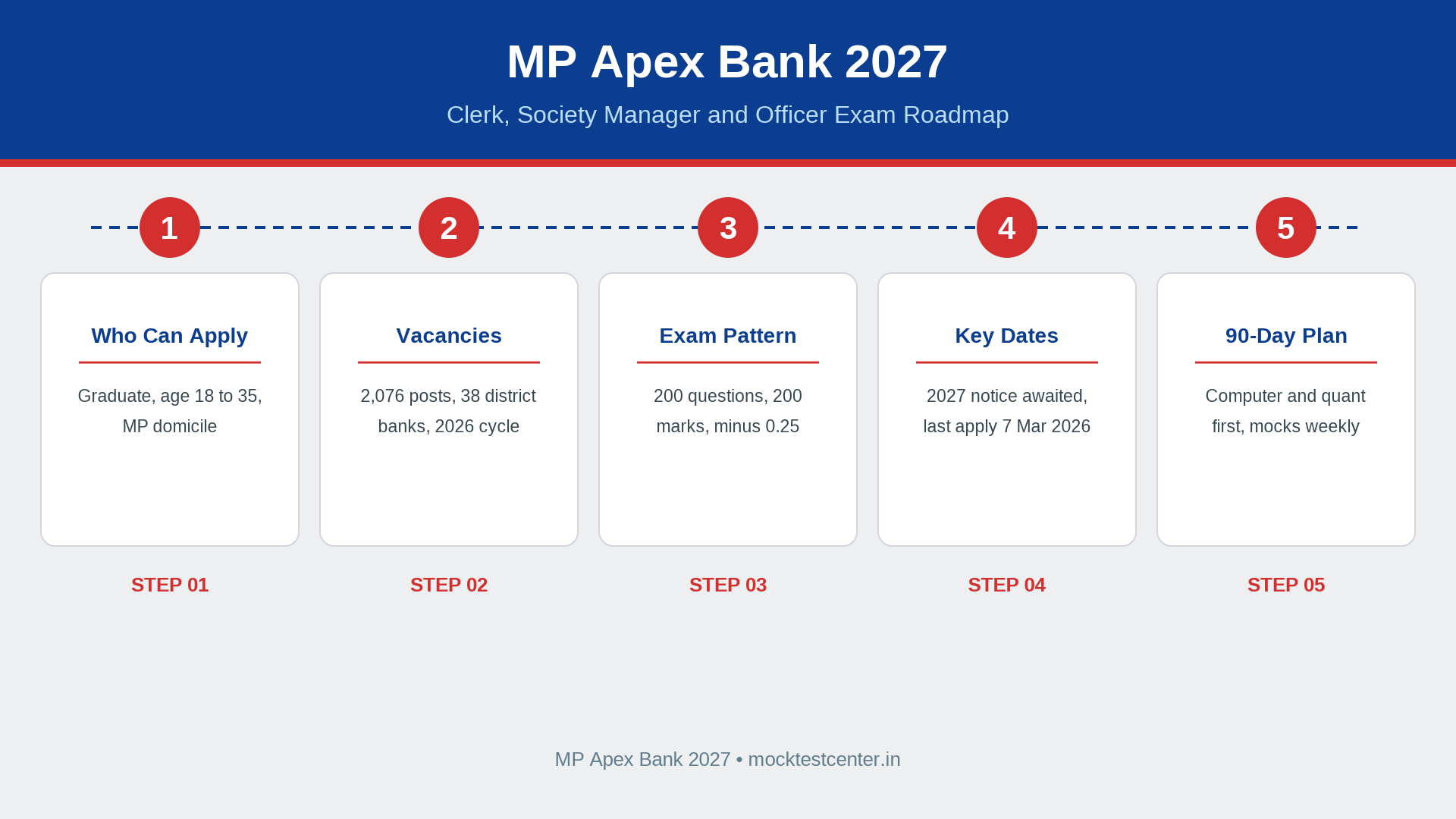
MP Apex Bank 2027 is the next recruitment of clerks, society managers and officers for the District Central Cooperative Banks of Madhya Pradesh, run by the Madhya Pradesh Rajya Sahakari Bank Maryadit, the bank everyone calls MP Apex Bank. The last full cycle ran in 2026 and it was the biggest cooperative bank drive the state had seen in years. It offered 2,076 posts across 38 district banks, and it took applications from 6 January to 7 March 2026. The 2027 notice has not been released as of 23 November 2026. No advertisement number exists for it, no vacancy count exists for it, and no apply dates exist for it. This page says that plainly, then builds the whole guide from the 2026 cycle, because that cycle is the best map of what the next one will look like.
The bank is the apex institution of the cooperative credit structure in Madhya Pradesh. It sits above 38 District Central Cooperative Banks, and those district banks sit above thousands of Primary Agricultural Credit Societies in the villages. When the Apex Bank advertises, it is hiring for the district banks, not only for its own head office in Bhopal. A selected candidate joins a district bank in a district like Khargone, Ujjain, Morena or Jabalpur, and works in branch banking, society accounts or computer operations. That is the first thing to understand, because the pay, the posting and even the pay scale can differ from one district bank to another. Check the official portal at apexbankmp.bank.in for every notice, because only the official notice is final.
The 2026 cycle came in two separate notifications. One covered 1,763 clerical and managerial posts: Computer Operator, Computer Operator on contract, and Society Manager. The other covered 313 officer posts: Branch Manager, Financial Analyst, Accountant, Computer Programmer and Internal Auditor. Candidates had to apply separately for the two groups, and the two groups had different exams. The selection for both groups ran through an online examination conducted by IBPS, the Institute of Banking Personnel Selection. Officers faced an interview after the exam. Clerks and society managers did not. Everything in this guide follows that split, because mixing the two groups up is the most common mistake candidates make.
The 2,076 posts, post by post
The clerical group had 1,763 posts. Computer Operator had 748 posts, Computer Operator on contract had 176 posts, and Society Manager had 839 posts. Society Manager was the single largest post in the whole drive, and it is the post most graduates actually target. A society manager runs a Primary Agricultural Credit Society, keeps its loan and deposit accounts, handles recovery of farm loans, and reports to the district bank. A computer operator works in the district bank branch or office, handles data entry, account work and computer based services, and needs Hindi and English typing. The contract computer operator post is the same work on a contract basis, and the 2026 notice asked for relevant experience in a district bank for it, on top of the same education.
The officer group had 313 posts. Branch Manager had 209 posts, which is two thirds of the officer group. Accountant had 47 posts, Financial Analyst had 34, Computer Programmer had 17, Computer Programmer 2 had 5, and Internal Auditor had 1 post. One post.
The officer group is a different world from the clerical group. Branch Managers need an MBA or a postgraduate degree or a first class graduation. Financial Analysts and Internal Auditors need a CA or ICWA or an MBA in Finance, or a first class graduation or post graduation. Computer Programmers need a BE or BTech in Computer Science or IT, or an MCA, with experience. These are not posts a fresh graduate walks into without the right degree, and the article says so now so that nobody wastes a fee on the wrong form.
The posts were spread across 38 District Central Cooperative Banks, and the spread was very uneven. For Computer Operator, Khargone had the most posts with 67, followed by Ujjain with 56, Dhar with 50 and Jhabua with 45. Indore had only 7 and Jabalpur only 6, while Sehore and Bhind had none at all. For Society Manager, Morena had the most with 59, followed by Datia, Mandla and Ujjain with 38 each, Raisen with 36 and Chhatarpur with 34. Jabalpur, Bhind and Jhabua had no Society Manager posts in this cycle. That uneven spread matters. A candidate from Bhopal who applies for a district with no posts in his category is applying for nothing, so read the district table in the notice before you choose. The notice printed a full district table for each post, with open and reserved seats for every district, and this guide uses those printed numbers only.
Two things about the 2026 cycle deserve attention. First, the total of 2,076 posts is the sum of the two notifications, 1,763 plus 313, and both notifications are real. Some tracker pages print only the clerical total and call it the whole drive, and some print a different total of 2,076 with different dates. The dates that hold up are the ones in the official notification text: applications opened 6 January 2026 and first closed 5 February 2026, then the last date moved twice, first to 20 February and then to 7 March 2026. Second, the exam date was never fixed in the notice. It said "to be announced", and the call letter would come about 10 days before the exam. As of the last check, no exam date had been published in the sources this guide could verify, so the exam section below gives the pattern, not a date.
Who can apply
The age rule is the same for most posts. Candidates had to be between 18 and 35 years old as on 30 November 2025. Reserved groups from Madhya Pradesh got 5 years of relaxation, which took the upper limit to 40 years for SC, ST, OBC, women, persons with disabilities and ex-servicemen with MP domicile. The Samvida computer operator post was different: its maximum age was 55 years, because it was meant for people already working in the district banks on contract. Degrees had to be complete by 30 November 2025. Results declared after that date did not count.
For Computer Operator and Society Manager, the education rule had three parts, and all three had to be met. A graduation degree from a recognised university. Knowledge of Hindi and English typing. And a one year computer diploma such as DCA, PGDCA or COPA, or a degree in IT or computer science such as BE, BSc IT or BCA. Society Manager needed graduation plus basic computer knowledge, and the published pattern pages differ on whether the typing and diploma conditions applied to society managers in the same way as to computer operators. The official notice text lists the diploma condition for the clerical group as a whole, so treat it as required for both posts and be pleasantly surprised if your district asks for less. That is safer than the other way round.
MP domicile is the gate. The 2026 drive was open only to candidates with Madhya Pradesh domicile, and the 2022 cycle said the same in plain words. Candidates from other states could not apply. Keep the domicile certificate ready before the form opens, because the form asks for it and the last date extensions do not help a candidate whose certificate is still stuck in an office. The officer posts added their own degree conditions on top of domicile and age. Branch Manager needed an MBA or postgraduate degree or a first class graduation. Financial Analyst and Internal Auditor needed CA or ICWA or an MBA in Finance, or a first class graduation or post graduation. Computer Programmer needed a BE or BTech in Computer Science or IT, or an MCA, with experience. Accountant sat in the middle management group with the Branch Manager and the second Computer Programmer post.
The clerk exam, section by section
The clerical exam is one online test of 200 questions for 200 marks in 120 minutes. Five sections, each with 40 questions, but the marks are not equal, and that uneven weighting is the first thing a serious candidate should notice. Computer Knowledge has 40 questions for 20 marks in 20 minutes, so each question is worth half a mark. Reasoning has 40 questions for 50 marks in 25 minutes. English Language has 40 questions for 40 marks in 25 minutes. General Awareness has 40 questions for 40 marks in 20 minutes. Quantitative Aptitude has 40 questions for 50 marks in 30 minutes. Reasoning and Quant together are worth 100 of the 200 marks, half the paper. Computer Knowledge, with the same 40 questions, is worth only 20 marks, a tenth of the paper.
That weighting should shape the whole preparation plan. A candidate who spends equal time on all five sections is spending too much time on Computer Knowledge and too little on Reasoning and Quant. Computer Knowledge still matters, because 40 questions can swing a rank, but its ceiling is 20 marks. Reasoning and Quant have a ceiling of 50 marks each, and they also take the most time: 25 minutes for Reasoning and 30 minutes for Quant, against 20 minutes for Computer Knowledge and General Awareness.
English takes 25 minutes for 40 marks. The paper is bilingual in English and Hindi except for the English Language section, and each wrong answer costs 0.25 marks. The questions are objective type with five alternatives per question, according to the published pattern pages.
There is no interview for Computer Operator and Society Manager. Selection rests only on the marks in the online exam, followed by document verification and a medical examination. That is a clean deal. It also means there is no second chance to recover a bad exam day. The merit list is the exam list. The officer group is different, and the next section covers it.
The officer exams: two different papers
Officers took a longer paper: 200 questions for 200 marks in 140 minutes, and the sections depended on the grade. Senior Management Grade 2 officers, which means Computer Programmer, Financial Analyst and Internal Auditor, had Professional Knowledge for 40 questions and 40 marks in 30 minutes, Reasoning for 40 questions and 40 marks in 30 minutes, English Language for 40 questions and 40 marks in 30 minutes, General Awareness for 40 questions and 40 marks in 20 minutes, and Quantitative Aptitude for 40 questions and 40 marks in 30 minutes. Middle Management Grade 1 and 2 officers, which means Branch Manager, Computer Programmer 2 and Accountant, had Computer Knowledge for 40 questions and 40 marks in 25 minutes instead of Professional Knowledge, with the same Reasoning, English, General Awareness and Quantitative Aptitude sections, and General Awareness took 25 minutes instead of 20.
The difference between the two officer papers is small on paper and large in practice. A Financial Analyst who prepares for Professional Knowledge is preparing finance and accounting at a professional level, while a Branch Manager who prepares for Computer Knowledge is preparing the same computer section as the clerical paper, only worth twice the marks. Candidates should check which grade their post falls in before they open a single book. Branch Manager is Middle Management Grade 1. Financial Analyst, Computer Programmer and Internal Auditor are Senior Management Grade 2. Accountant and Computer Programmer 2 are Middle Management Grade 2.
After the exam, officers faced an interview of 20 marks, and the final merit came from the exam plus the interview together. That 20 marks is a tenth of the 200 mark exam, which is small but not nothing. In a tight merit list, 20 interview marks can move a candidate many places. There is no separate skill test or group discussion in the published pattern. The interview is the only second stage, and it is the reason officer candidates should keep some preparation time for spoken answers about banking, their own degree subject and the cooperative sector, not only for objective questions.
Fee, form and the two deadlines that moved
The fee for the clerical group was 850 rupees plus 18 percent GST for General, OBC and EWS candidates, and 650 rupees plus 18 percent GST for SC, ST and PwD candidates. The officer fee was higher: 1,200 rupees plus GST for General, OBC and EWS, and 900 rupees plus GST for SC, ST and PwD. The officer fee figures come from tracker pages that mark them as approximate, so treat them as the best available figure, not as a number printed in the notice text this guide read. The fee was non refundable and had to be paid online only, through debit card, credit card, internet banking, IMPS, cash card or mobile wallet. Bank transaction charges for the online payment fell on the candidate.
The form itself was online only, through the Apex Bank website at apexbankmp.bank.in, which led to the IBPS registration portal. Candidates had to upload a photograph, a signature, a left thumb impression and a handwritten declaration, then fill in their education details and choose their preferred district banks. The published guides say a candidate could select up to four exam centres. That detail comes from the tracker pages, not from the notice text read here, so keep it as a guide, not a guarantee. The printout of the final form and the payment receipt had to be kept, because the notice asked for them at later stages.
The dates moved twice, and the movement is worth remembering for the next cycle. Applications opened 6 January 2026. The first last date was 5 February 2026. A notice extended it to 20 February 2026, and a second notice extended it again to 7 March 2026. The Times of India reported the final closure on 7 March 2026. Candidates who waited for the first deadline and missed it still got in, twice. Candidates who waited for the second extension and missed that got nothing. The lesson is simple: apply in the first week, and treat every extension as a bonus, not as a plan. The exam date was never announced in the notice, and the call letter was promised about 10 days before the exam.
Pay: what Level 4 and Level 10 actually mean
Pay in this drive is a range, not a single number, because the employer is the district bank, not the Apex Bank alone. Clerks and society managers generally fall in Level 4 of the 7th Pay Scale, which runs from 19,500 to 62,000 rupees a month, or in the 6th Pay Scale of 5,200 to 20,200 rupees plus a grade pay of 1,900 rupees, depending on the district bank. One district bank, Khargone, paid Level 7, which runs from 28,700 to 91,300 rupees. So two society managers doing the same work in two districts could sit in different pay levels. Check the pay scale printed against your district in the notice before you apply, because the district table carries that detail.
Officers sit higher. The published pattern pages put officer pay in Levels 8 to 10. Middle Management Level 8 runs from 32,800 to 1,03,600 rupees. Middle Management Level 9 runs from 36,200 to 1,14,800 rupees. Senior Management Level 10 runs from 42,700 to 1,35,100 rupees. On top of the basic pay come dearness allowance, house rent allowance and other benefits under the service rules of the district bank. The exact take home pay depends on the district, the allowances in force and the deductions, so no honest guide can print one in hand figure for all 38 banks. Any site that prints a single salary for this drive is guessing.
The 2022 cycle, and the 2023 and 2024 drives
The 2026 cycle was not the first big drive. The 2022 cycle advertised 2,254 posts: 896 for Clerk and Computer Operator and Samvida together, and 1,358 for Society Manager. The split inside the clerical group was 726 Computer Operators, 170 Samvida operators and 1,358 Society Managers. The regular and backlog split was printed too: 223 regular and 503 backlog Computer Operators, 53 regular and 117 backlog Samvida operators, and 1,189 regular and 169 backlog Society Managers. Applications ran from 26 November to 25 December 2022. The fee then was 500 rupees plus 18 percent GST for General, OBC and EWS, and 250 rupees plus GST for SC, ST and PH candidates. The age limit was 18 to 35 years as on 25 December 2022, and the exam was conducted by IBPS. One tracker prints the total as 2,253 posts, but the post wise figures add to 2,254, so this guide uses 2,254 and notes the one post difference as a tracker error.
The 2022 cycle also shows how the bank's hiring rhythm works. After 2022 came a 638 post drive in 2023, reported by a single tracker page, and then a 2024 drive for the Apex Bank's own cadre: 197 vacancies for Bank Cadre Officers, Banking Assistants and Assistant Managers, reported by Moneycontrol, plus a separate 95 Cadre Officers notification reported by another tracker. The 197 and the 95 may be the same drive counted twice, or two different drives, and the sources this guide read do not settle it. The point that does hold is the rhythm: the bank hires in large waves every year or two, and a candidate who misses one wave usually waits a year for the next. The 2026 wave was the largest of the four, and the 2027 cycle, when it comes, will most likely follow the same two notification pattern, one for clerks and society managers and one for officers.
One more change between 2022 and 2026 is worth noting. The 2022 cycle covered 35 District Central Cooperative Banks, while the 2026 cycle covered 38. The bank's own history says 38 district banks remained with Madhya Pradesh after Chhattisgarh was carved out in November 2000, so the 35 figure from 2022 may reflect the banks that reported vacancies that year rather than the total count. Either way, the 2026 figure of 38 is the one in the official notification, and it is the one to use.
The bank behind the exam
The Madhya Pradesh Rajya Sahakari Bank Maryadit has roots that go back to 2 April 1912, when it was registered at Jabalpur as the Provincial Cooperative Bank under the Cooperative Act of 1912, with an initial capital of 5 lakh rupees for farm finance. Its head office later moved to Nagpur, and after the reorganisation of states in 1956 it took its present form in Madhya Pradesh, with its head office in Bhopal at New Market, T.T. Nagar, Bhopal 462003. One directory page gives 16 January 1958 as the establishment date, which conflicts with the 1912 registration, so this guide uses the 1912 registration and notes the 1958 date as an unresolved directory entry. The bank is the apex bank of the state's three tier cooperative credit structure, and it works with NABARD to pass farm credit down through the district banks and the village societies.
The scale of that structure is large. The bank's own site lists work across 4,519 Primary Agricultural Credit Societies under a computerisation plan, and the cooperative network reaches from Indore and Gwalior to the tribal districts of Mandla and Jhabua. Deposits with the bank are insured up to 5 lakh rupees by the Deposit Insurance and Credit Guarantee Corporation. The bank runs its own mobile banking app, called M.P. Apex Mobile Banking, and offers NEFT, RTGS, IMPS, UPI, CTS and RuPay debit cards. A candidate who joins a district bank is joining the bottom of a very old structure, and the work is rural finance first and branch banking second. That is different from a commercial bank job, and candidates who want city postings and fast transfers should know it before they apply.
A 90-day plan that fits the clerk paper
Ninety days is enough for the clerical paper if the days are used in the right order. The first 30 days should build the base: Reasoning and Quant every day, because they are worth 100 marks together, English reading and grammar on alternate days, and General Awareness in short daily bursts of current affairs and banking awareness. Computer Knowledge needs a different treatment. It is 40 questions but only 20 marks, so it deserves a short daily slot, not a full day. Learn the basics of hardware, software, networks, MS Office and internet banking, and move on.
Days 31 to 60 should shift to practice. Take one full mock every week at first, then two, and time each section separately. The sectional time limits are the real enemy in this paper: 20 minutes for Computer Knowledge and General Awareness, 25 for Reasoning and English, 30 for Quant. A candidate who can solve Quant questions but needs 40 minutes for them will lose marks in the other sections. Practice with a timer on, and practice the 0.25 negative marking rule: skip a question you cannot narrow down, guess only when you can remove two of the five options.
The last 30 days should be revision and mocks. Take two full mocks a week, review every wrong answer, and keep a notebook of the question types that keep going wrong. In the last week, stop learning new topics. Revise the notebook, revise the current affairs of the last six months, and rest the day before the exam. Society Manager candidates should add one more habit: read about the cooperative structure itself, because General Awareness in a cooperative bank exam leans toward agriculture, rural schemes and cooperative institutions, and that reading pays off in the interview too, for officers.
Mistakes that cost candidates a year
The first mistake is applying for the wrong group. The clerical form and the officer form were separate, with separate fees, and a candidate who paid for the officer form without the right degree lost the fee and the chance. The second mistake is the diploma. Graduation alone is not enough for Computer Operator. The one year computer diploma, or an IT degree, is a separate condition, and the form asks for it. The third mistake is the typing condition. Hindi and English typing knowledge is required for Computer Operator, and a candidate who cannot type in both languages will fail at the document stage even with a good exam score.
The fourth mistake is ignoring the half mark computer section. Candidates who treat all 40 questions as equal waste hours on a section worth 20 marks and starve Reasoning and Quant of the time they need. The fifth mistake is waiting for the exam date. The notice said the date would be announced, and the call letter would come 10 days before. A candidate who starts preparing only after the call letter has 10 days for a 200 mark paper. Start when the notice comes out, not when the date does. The sixth mistake is the domicile certificate. MP domicile is mandatory, and a certificate applied for late is the most avoidable reason to miss a cycle.
MP Apex Bank next to other cooperative bank exams
Put the money and the seats beside the other bank exams and the picture is fair. The SBI Clerk 2027 exam leads to a clerk post in the country's largest bank with a starting basic pay of 26,730 rupees, and the IBPS Clerk 2027 exam and the IBPS RRB Clerk 2027 exam offer clerk posts in public sector banks and regional rural banks with many more seats than any single cooperative drive. The preparation overlaps so much that one study plan serves all three, and the same Reasoning, Quant and English work carries over to the MP Apex Bank paper too, with Computer Knowledge and cooperative awareness added on top.
The officer side has its own comparison. The IBPS PO 2027 exam and the SBI PO 2027 exam offer Scale I officer posts with a starting basic pay of 48,480 rupees, which is higher than the starting pay of a district bank officer in Level 8, but the PO exams are all India exams with far more competition and postings anywhere in the country. The RBI Assistant 2027 exam pays a lower basic pay but sits in the central bank, and the NABARD Grade A 2027 exam is the closest cousin of all, because NABARD is the refinancing body above the cooperative banks, and its rural development work is the same world as the Apex Bank's.
The closest comparisons of all are the other cooperative banks. The TN Cooperative Bank Assistant 2027 exam is the biggest cooperative drive in the country, with 2,513 posts in Tamil Nadu, a 200 question paper for 170 marks in 3 hours, and a 15 percent interview. The MSC Bank Trainee Junior Officer 2027 exam is the Maharashtra State Cooperative Bank drive, with 49 Junior Officer posts in a 139 post advertisement, an IBPS exam of 160 questions for 200 marks, and a 30,000 rupee monthly stipend during training. The Bihar State Cooperative Bank 2027 exam is the Bihar drive, with 257 Assistant posts, a prelims and mains pattern, and a pay scale that starts at 24,050 rupees. All three are state domicile exams with the same shape: local graduates, local language, local posting. Apply for every cooperative exam you are eligible for, and decide when the offers come.
What to check before the 2027 notice comes out
Four things, in order. First, keep the domicile certificate, graduation mark sheets, computer diploma certificate and typing proof in one folder, with scanned copies ready. Second, check apexbankmp.bank.in once a week, because the notice will appear there first and the tracker pages will copy it a day later. Third, finish the Reasoning and Quant base before the notice comes, because the window between the notice and the exam is short and the paper is 200 questions long. Fourth, decide now whether you are a clerical candidate or an officer candidate, and do not pay two fees for two groups you cannot both clear. The 2026 cycle gave Madhya Pradesh 2,076 cooperative bank posts. The next cycle will give a similar number, and the candidates who are ready when it opens will be the ones who take them.
Sources
MP Apex Bank clerk recruitment notification 2026, official text, hosted at files.govtjobsalert.in, 28 pages: 1,763 posts in 38 District Central Cooperative Banks, applications 6 January to 5 February 2026, district tables, fee and schedule. MP Apex Bank officer and clerk recruitment 2026, GovtJobsAlert summary of the official notifications: 2,076 posts, officer vacancy split, both exam patterns, pay levels, interview 20 marks, last date extensions to 20 February and 7 March 2026. Times of India, 6 March 2026: registration for 2,076 posts ends 7 March 2026, applications at apexbankmp.bank.in. MP Apex Bank home page, apexbankmp.bank.in, crawled 8 October 2026: head office address, 4,519 PACS computerisation, DICGC cover of 5 lakh rupees, mobile banking app. MP Cooperative Bank Recruitment 2022, JagranJosh and SuccessCDS: 2,254 posts, applications 26 November to 25 December 2022, fee 500 and 250 rupees plus GST, age 18 to 35, IBPS exam. MP Apex Bank history, Reserve Bank of India apex bank profile and Code for Banks: registration 2 April 1912 at Jabalpur, reorganisation 1956, Bhopal head office, 38 district banks after November 2000. 2023 drive of 638 posts and 2024 cadre drives of 197 and 95 posts: tracker pages only, flagged as unverified in this guide.