About IBPS RRB Clerk 2027 Exam Series
📖 Table of Contents
- What an Office Assistant does
- IBPS RRB Clerk 2027: where the cycle stands
- Who can apply
- Vacancies: the 2026 split and the 2025 comparison
- Prelims pattern: 80 questions in 45 minutes
- Mains pattern: 200 questions in 120 minutes
- No interview: what that means for you
- Syllabus topic by topic
- Fee, form, and documents
- Salary and career path
- Cut-offs: what past scores tell you
- 90-day plan that fits around a job or college
- How to use mock tests so they raise your score
IBPS RRB Clerk 2027
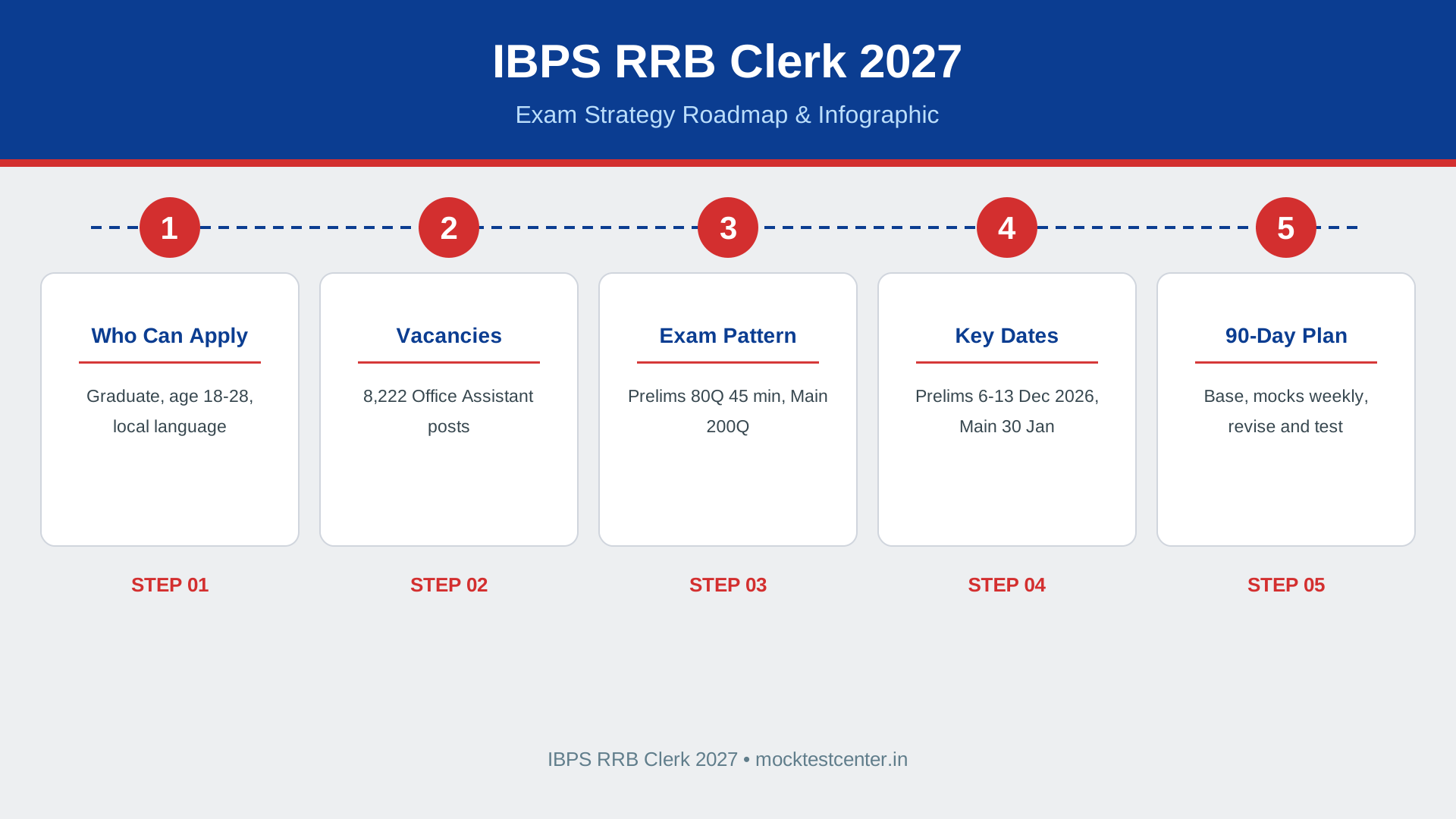
IBPS RRB Clerk 2027 is the name candidates use for the Office Assistant (Multipurpose) recruitment in Regional Rural Banks, run by the Institute of Banking Personnel Selection under CRP RRBs. The cycle that leads into 2027 is CRP RRBs-XV, notified on 1 September 2026 with 8,222 Office Assistant posts. Its Preliminary runs on 6, 12, 13 December 2026, and its Main on 30 January 2027. The next cycle, CRP RRBs-XVI, has no notification yet.
Office Assistant is the clerk post in a Regional Rural Bank. It is the largest single post in the whole RRB recruitment, with more than 8,000 seats in the current cycle, and it is the easiest entry point into rural banking for a graduate. The selection has two stages: Preliminary and Main. There is no interview, so the Main score alone decides allotment.
This page covers the full picture: the current cycle, who can apply, the vacancy split, the exact pattern of both papers, the syllabus, the fee, the salary, and a 90-day plan. Every date and vacancy figure comes from the 2025 and 2026 notifications, and anything about the 2027 cycle is marked as expected, not official.
What an Office Assistant does
An Office Assistant sits at the front counter of a Regional Rural Bank branch. The work is cash, clearing, account opening, passbook updates, and answering the customers who walk in all day. The customers are farmers, small traders, self-help groups, and pensioners, and the branch is often the only bank in the village. The job is close to the ground in a way that a city bank clerk post is not.
The posting is rural by design. Most RRB branches sit outside big cities, in district towns and villages. An Office Assistant can expect to work in such branches for much of the career, with transfers inside one state. Candidates who want a metro posting should look elsewhere. Candidates who are comfortable in a district town will find this post fits well, and the cost of living in such towns is low enough that the salary stretches further than it would in a city.
There are 28 Regional Rural Banks in the current cycle, spread over 26 states and two union territories. The number fell from 43 after the amalgamation that merged RRBs within each state. Each RRB covers a set of districts, and you apply for the RRB of one state only. Your state choice decides your language test, your posting, and your competition, all at once.
The post is Group B, and the officer post above it is Officer Scale I. Office Assistants rise to officer posts through the internal promotion process run by each RRB, and the clerk to officer path is one of the main reasons this exam draws so many graduates. The officer post in the same banks is a different door, and the IBPS RRB PO 2027 page covers its three-stage selection with an interview.
IBPS RRB Clerk 2027: where the cycle stands
CRP RRBs-XV is the cycle running now. IBPS issued the window notification on 31 August 2026 and the revised detailed notification on 1 September 2026. The first Annexure listed 13,706 posts across all RRB posts. A corrigendum on 9 September 2026 raised the total to 13,745, with every added seat going to Office Assistant, which moved from 8,183 to 8,222. A further corrigendum on 25 September 2026 updated Annexure I again. One source puts the 25 September total at 13,757, while the Times of India and other sources hold it at 13,745, so treat the last figure with care and check the latest Annexure on the IBPS website.
Registration for Office Assistant is listed as 9 October 2026, a single day as per the registration portal. That single day window is unusual, and it is reported by one source page only, so check the IBPS notice before quoting it as fact. The IBPS tentative calendar dated 16 January 2026 lists the Office Assistant Preliminary on 6, 12, 13 December 2026 and the Main on 30 January 2027. Provisional allotment follows in February and March 2027.
The 2025 cycle, CRP RRBs-XIV, shows how the process ends. It was notified on 1 September 2025, with 8,022 Office Assistant posts in the updated Annexure of 27 September 2025. The Office Assistant Preliminary ran on 6, 7, 13, 14 December 2025, and the Main on 1 February 2026. There was no interview, and allotment followed on merit. A cycle takes about five to six months from notification to allotment for this post, because the interview stage does not exist.
The next cycle, CRP RRBs-XVI, has no notification. Past notice dates were August 2024 for CRP RRBs-XIII, September 2025 for CRP RRBs-XIV, and September 2026 for CRP RRBs-XV. A notification around August or September 2027 fits that pattern, with Prelims in November and December 2027. That is a guess built on three dates, not an official schedule. Prepare on the XV pattern, because IBPS keeps the pattern stable and prints any change in the notification.
Who can apply
The age limit for Office Assistant is 18 to 28 years, counted as on 1 September 2026 for the current cycle. Age relaxation follows government rules: SC and ST get 5 years, OBC non-creamy layer gets 3 years, persons with benchmark disabilities get 10 years, and ex-servicemen get their actual service plus 3 years, up to age 50. Widows and divorced women get relaxation up to 35 years for General, 38 years for OBC, and 40 years for SC and ST.
The education bar is a bachelor degree in any discipline from a recognised university. There is no minimum percentage, and no preferred subject list for this post, unlike the officer post, where IBPS lists preferred degrees. For the current cycle, the qualification had to be complete as on 21 September 2026. A final year student whose result comes after the cut-off date cannot apply for that cycle, and that date is one of the first things to check in a new notice.
Local language proficiency is a condition, not a preference. You apply for the RRB of one state, and you must be proficient in the local language prescribed by that RRB. The notification tests this for Office Assistants, and a candidate who cannot use the local language will struggle at the document and language checking stage even with a strong Main score. Working knowledge of computers is desirable, and in practice every clerk uses the core banking system daily, so treat computer skill as part of the job, not as a line in the notice.
Nationality follows the standard government rule. An Indian citizen can apply. So can a subject of Nepal or Bhutan, a Tibetan refugee who came to India before 1 January 1962, and a person of Indian origin who migrated from the listed countries, with a certificate of eligibility from the Government of India for the last three groups. If you are also considering the public sector bank clerk exam, the IBPS Clerk 2027 page lays out its own age and education conditions, which differ in the lower age limit and the computer literacy rule.
Vacancies: the 2026 split and the 2025 comparison
IBPS calls every vacancy figure indicative. The RRBs report their needs, IBPS prints the total in Annexure I, and the final allotment follows the actual vacancies the RRBs report at the end. The total moves through corrigenda, and the 2026 cycle moved twice in September alone. Read the latest Annexure, not the first headline.
| Post, CRP RRBs-XV 2026 | Indicative vacancies |
|---|---|
| Office Assistant (Multipurpose) | 8,222 |
| Officer Scale I (Assistant Manager) | 4,256 |
| Officer Scale II (all streams) | 1,047 |
| Officer Scale III (Senior Manager) | 220 |
| Total | 13,745 |
Office Assistant is the largest post in the cycle by a wide margin, with 8,222 seats against 4,256 for Officer Scale I. More than half the posts in the whole RRB recruitment are Office Assistant posts. That size is why this exam draws the largest crowd of any rural bank recruitment, and why its cut-off is often lower than the officer cut-off in the same state.
| Post, CRP RRBs-XIV 2025 | Indicative vacancies |
|---|---|
| Office Assistant (Multipurpose) | 8,022 |
| Officer Scale I (Assistant Manager) | 3,928 |
| Officer Scale II (all streams) | 1,149 |
| Officer Scale III (Senior Manager) | 202 |
| Total | 13,301 |
Office Assistant posts rose from 8,022 in 2025 to 8,222 in 2026, a rise of 200 posts. The total rose from 13,301 to 13,745. A rising vacancy count helps the cut-off, but it helps every candidate at once, so the gain goes to the best prepared, not to the best informed. State totals matter more than the all India total. Uttar Pradesh Gramin Bank had the most Office Assistant posts at 1,200, followed by Andhra Pradesh Grameena Bank at 900. Karnataka Grameena Bank had 279 Office Assistant posts. Your state table in Annexure I is the one to study before you apply, because you compete only within your state for Office Assistant posts.
The 2025 cycle shows the same pattern at a smaller scale. The notification first listed 7,972 Office Assistant posts, and the updated Annexure of 27 September 2025 raised the figure to 8,022. The lesson is the same every year: the first number is a floor, not a ceiling, and the corrigenda are where the real total appears. The public sector bank clerk exam works the same way, and the SBI Clerk 2027 page shows a similar corrigendum history for its own vacancy count.
Prelims pattern: 80 questions in 45 minutes
The Preliminary is an online objective test with two sections, each separately timed. Reasoning gets 25 minutes and Numerical Ability gets 20 minutes, and you cannot move time between them. Forty five minutes for 80 questions allows about 34 seconds per question, which is tighter than the public sector bank clerk Prelims. Speed is the skill being tested here as much as knowledge.
| Section | Questions | Marks | Time |
|---|---|---|---|
| Reasoning | 40 | 40 | 25 minutes |
| Numerical Ability | 40 | 40 | 20 minutes |
| Total | 80 | 80 | 45 minutes |
Each wrong answer costs 0.25 marks. Prelims marks stay out of the final merit list. You must clear both the sectional cut-off and the overall cut-off to reach the Main, and then the Prelims score stops mattering. The shortlist for the Main is drawn in a ratio that IBPS decides per state and category, so the Prelims cut-off moves with the number of applicants in your state.
Reasoning in Prelims is 40 questions in 25 minutes, about 37 seconds per question. Puzzles and seating arrangement take the largest share, and a single puzzle set gives five questions at once. Syllogism, inequality, coding decoding, blood relations, direction sense fill the rest. Numerical Ability is 40 questions in 20 minutes, about 30 seconds per question. Simplification, number series, quadratic equations, data interpretation form the core, with arithmetic word problems behind them. Data interpretation sets are the highest value questions in this section, because one set gives five marks in one place.
The order that works for most candidates is simple. Start with the section you are stronger in, finish it clean, and then give the weaker section your full attention. Do not spend more than 90 seconds on any single question in Prelims. A question that takes two minutes has already cost you three other questions, and the paper has no partial marks. The IBPS PO 2027 page shows a Prelims with an English section added and 60 minutes on the clock, which makes a useful contrast: the RRB Clerk Prelims is shorter, sharper, with no English at all.
Mains pattern: 200 questions in 120 minutes
The Main is an online objective test with five sections, each separately timed. Two hundred questions in 120 minutes allows 36 seconds per question on average, but the sections differ a lot in pace. Computer Knowledge gives 40 questions in 15 minutes, which is the fastest section in the paper. General Awareness gives 40 questions in 15 minutes as well. English or Hindi gives 40 questions in 30 minutes, the slowest pace in the paper.
| Section | Questions | Marks | Time |
|---|---|---|---|
| Reasoning | 40 | 50 | 30 minutes |
| Computer Knowledge | 40 | 20 | 15 minutes |
| General Awareness | 40 | 40 | 15 minutes |
| English or Hindi Language | 40 | 40 | 30 minutes |
| Numerical Ability | 40 | 50 | 30 minutes |
| Total | 200 | 200 | 120 minutes |
Reasoning and Numerical Ability carry 50 marks each, which makes them half the paper between them. Both sections mix 1 mark and 2 mark questions, so a wrong guess on a 2 mark question costs 0.5 marks. Computer Knowledge carries only 20 marks for 40 questions, which means each question is worth half a mark. That section rewards quick recall and punishes slow thinking, because 15 minutes for 40 questions allows about 22 seconds per question.
The language section is the candidate choice. You pick English or Hindi at the time of the exam, and the choice applies to the whole section. Pick the language you read faster in, not the one you think looks better on a form. A candidate who reads Hindi at twice the speed of English gains 15 minutes of effective time in this section, and that time is worth more than any prestige attached to the language. General Awareness is the section where six months of daily current affairs pays off in one sitting, because the questions test recent banking, finance, government news alongside static facts.
Each wrong answer costs 0.25 marks in the Main, the same as Prelims. The Main score decides allotment, because there is no interview after it. The Main is the paper to build your preparation around, because Prelims only opens the door and nothing else adjusts the final order after the Main.
No interview: what that means for you
There is no interview after the Main for Office Assistant. Your Main score alone decides your allotment. That single fact shapes the whole exam. The officer post adds an interview worth 20 percent of the final merit, and the public sector bank clerk exam has no interview either, but the RRB Clerk is the largest no-interview recruitment in banking, with more than 8,000 posts in the current cycle.
A written-only selection rewards a different kind of candidate. It rewards the candidate who can sit for two hours and score, not the candidate who presents well in a room. It also removes the uncertainty of an interview panel. Your result is a number, and the number is set the day you walk out of the Main. That clarity is the reason many first time candidates pick this exam over the officer post, even though the officer post pays more.
The trade is that the Main carries the full weight, so a bad day in the Main cannot be repaired later. There is no interview to lift a borderline Main score, and there is no second paper after it. The preparation has to peak on the Main date, not a month before it. Mock tests in the last fortnight should run at the same time of day as the real Main, with the same section order, so that your body and mind are used to scoring at that hour.
Provisional allotment follows merit and preference within the state. IBPS draws a reserve list to the extent of vacancies, and its validity runs for one year from provisional allotment or until a fresh allotment, as the notification states. The allotment is provisional because the bank checks documents before joining, and the local language condition is checked as part of that process. The RBI Assistant 2027 page shows a different selection chain for comparison, with its own language test after the Main.
Syllabus topic by topic
IBPS prints the syllabus as topics inside each section, and the topics stay stable from cycle to cycle. The weight shifts, but the list barely changes. Here is what each section tests, in the order that matters for preparation.
Reasoning covers puzzles and seating arrangement, syllogism, inequality, coding decoding, blood relations, direction sense, alphanumeric series, input output, data sufficiency in the Main. Puzzles and seating arrangement take the most time and give the most marks, which makes them the section to master first. Syllogism and inequality are rule based and quick once learned. Coding decoding rewards practice more than talent, because the patterns repeat with small changes. Data sufficiency appears in the Main and tests whether the given statements answer the question, which is a different skill from solving, and it needs its own practice.
Numerical Ability covers simplification and approximation, number series, quadratic equations, data interpretation, arithmetic word problems on ratio, percentage, profit and loss, simple and compound interest, time and work, speed and distance, probability, mensuration. Data interpretation is the highest value topic in the Main, because one set gives five questions at once. Simplification and number series are the fastest marks in Prelims, because each question takes under 30 seconds once the methods are set. Arithmetic word problems take the longest, so they belong at the end of your attempt order, not the start.
Computer Knowledge covers computer fundamentals, memory and storage, operating systems, MS Office, internet, networking, keyboard shortcuts, computer abbreviations. The questions are direct recall, and a short daily revision of terms covers most of the section. A graduate who has used a computer daily already knows most of this, and the gap is usually abbreviations and the names of ports, protocols, file extensions.
General Awareness covers current affairs, banking awareness, static general knowledge, with a rural focus that sets this exam apart. Current affairs means the last six months before the Main, with a focus on banking, finance, government schemes, agriculture, rural development. Banking awareness means RBI functions, repo rate, reverse repo rate, CRR, SLR, types of banks, payment systems, priority sector lending. Static general knowledge means capitals, national parks, dams, important days, the states and districts the RRBs cover. The rural focus is the edge here. Questions on crop seasons, irrigation schemes, rural credit appear in this exam more than in the public sector bank exams, and a candidate who reads agriculture news for six months walks in with marks that no amount of last week cramming can match.
English or Hindi Language covers reading comprehension, cloze test, error spotting, sentence improvement, sentence rearrangement, fill in the blanks, vocabulary. Reading comprehension carries the most marks, and it is also the section where speed reading pays off fastest. The Hindi option covers the same skills in Hindi: comprehension, grammar, vocabulary, sentence correction. Pick the language you read faster in, and practice it under a timer from the first week.
Fee, form, and documents
The application fee for Office Assistant is 850 rupees for General, OBC, and EWS candidates, and 175 rupees for SC, ST, PwBD, ex-servicemen, and disabled ex-servicemen candidates. The fee is inclusive of GST, and it is paid online only, inside the registration window. A separate fee applies per post, so a candidate who applies for both Office Assistant and Officer Scale I pays twice.
Registration runs online on the IBPS website. You fill basic details, and the system generates a provisional registration number and password, which also come by email and SMS. Then you upload a photograph, signature, left thumb impression, and a handwritten declaration in the format given in the notification, and you capture a live photograph as the notification specifies. The application is incomplete until the fee is paid. Keep the registration number safe. You need it for the call letter, the result, and every later stage.
The notification gives the exact file sizes for uploads. The photograph is a JPEG of 20 to 50 KB. The signature is a JPEG of 10 to 20 KB, and a signature in capital letters is not accepted. The left thumb impression is a JPEG of 20 to 50 KB. The handwritten declaration is a JPEG of 50 to 100 KB, written by the candidate in the exact wording given in the notification, not typed. Photo and signature errors cause more rejections than any other form mistake, so read the upload instructions twice before you start.
Pre-exam training is run for SC, ST, OBC, minority, ex-servicemen, and PwBD candidates, and the current cycle lists it for November 2026. It is a short coaching window, not a selection stage, and it costs nothing. If you belong to an eligible category, take it. A week of guided practice before Prelims is worth more than a week of unguided study. The specialist officer route has a different form and fee structure, and the IBPS SO 2027 page covers its professional knowledge paper.
Salary and career path
An Office Assistant starts on a basic pay of 24,050 rupees a month under the clerical pay scale, which runs from 24,050 rupees to 64,480 rupees over about 20 years through annual increments. Allowances sit on top of basic pay. Dearness allowance is revised every quarter, and house rent allowance, special allowance, and transport allowance add more. The gross monthly salary comes to about 37,000 rupees, and the in-hand salary is generally around 34,000 to 37,000 rupees a month, depending on the posting place and the DA rate.
One salary page puts the in-hand figure higher, at about 43,713 rupees, based on a starting basic pay of 26,730 rupees after two advance increments for eligible graduates. That figure comes from a representative salary slip, not from the notification, and other sources hold the in-hand range at 34,000 to 37,000 rupees on the 24,050 rupee basic. The article uses the lower range, because it matches the majority of sources and the notified scale. The SBI PO 2027 page gives the State Bank officer scale for comparison, and the gap between a clerk and an officer is the reason many Office Assistants sit for promotion exams after a few years in service.
The job carries the benefits of a public sector bank post. Medical cover, leave, pension through NPS, and loan facilities at staff rates come with the appointment. The work is a five day week in most branches, with fixed hours that make this post popular with candidates who want a steady routine. Transfers happen within the state, and an Office Assistant can rise to Officer Scale I and beyond through internal exams. The first promotion is the one to plan for, because the officer scale changes both the pay and the nature of the work. The insurance officer route is a different career line with its own exam, and the LIC AAO 2027 page shows how its selection and pay compare.
Cut-offs: what past scores tell you
IBPS publishes cut-off marks by state and category after each stage, and those figures are the only cut-off numbers that count. No cut-off figures have been verified for this article, and no target score is given here, because a number from an old cycle misleads more than it helps. A Main score that won a post in a 13,301 vacancy cycle can fall short in a 13,745 vacancy cycle if the paper was easier and the crowd scored higher.
What the process does show is the shape of the competition. Prelims cut-offs differ by state, because each state has its own vacancy count and its own applicant pool. Main cut-offs differ by state and category, because reservation applies at the state level. There is no interview minimum to worry about, because there is no interview. The Main score is the whole merit list, so the candidate who scores highest in the Main wins the post, and the candidate who scores second highest wins the next post.
The practical lesson is simple. Aim for the highest Main score you can reach, not for a cut-off number from last year. A candidate who targets 70 percent in the Main and falls short by a little still lands near the top of most state lists, while a candidate who targets the last cycle cut-off and hits it exactly can still miss out when the next cycle is tighter. Sectional cut-offs apply in Prelims, so a zero in one section ends the attempt even if the total is high. Balance beats brilliance in both papers.
90-day plan that fits around a job or college
Ninety days is enough if the days are used well. The plan below assumes three to four hours a day, and it splits the work into three blocks of one month each. If you have more time, add mocks. If you have less, cut the reading and keep the mocks, because mocks are where the marks come from.
Days 1 to 30 build the base. Learn the methods for simplification, number series, quadratic equations. Learn the rules for syllogism, inequality, coding decoding. Start one puzzle set a day, even if it takes 20 minutes at first. Read one editorial a day and note ten new words. Start banking awareness with RBI functions and the key rates, and revise current affairs weekly. Add one agriculture topic a week: crop seasons, irrigation, rural credit. Take one Prelims mock every Sunday. Spend Monday morning on its analysis.
Days 31 to 60 add speed and the Main. Move to two mocks a week, one Prelims and one Main. Start data interpretation sets daily, five questions at a time. Build a current affairs notebook for the last six months, one page a day, and revise it every Sunday. Start the General Awareness revision with a monthly banking capsule, and test yourself on it the same evening. Puzzles move to two sets a day. Computer Knowledge gets a daily 15 minute slot for terms and abbreviations. The NIACL AO 2027 page is worth a look in this phase too, because its reasoning and quant sections overlap with this exam and give you extra practice material.
Days 61 to 90 are mock and revision only. Take a mock every alternate day. Spend the day after each mock on analysis alone. Analysis means listing every question you got wrong, writing the correct method next to it, and redoing the question the next day. Revise the current affairs notebook twice a week. Stop learning new topics in the last ten days. The last week is for two full mocks, light revision, rest. A tired candidate loses more marks to silly errors than to hard questions, and the last week is for protecting the marks you already have. The ECGC PO 2027 page carries a similar late phase plan, and its general awareness section is a useful cross check for your own revision.
How to use mock tests so they raise your score
Mock tests work when you treat them as practice for the real paper, not as a score to show off. Take them at the same time of day as the real exam, with the same section order and the same timer. Do not pause a mock. Do not look up an answer in the middle of one. The score of a paused mock means nothing, because the real paper does not pause.
Analysis is where the marks live. After every mock, sort the questions into three piles. The first pile is questions you got right and were sure about. The second pile is questions you got wrong. The third pile is questions you skipped. The second pile is your syllabus for the next week. The third pile is your timing problem. If the third pile is large, you are slow. If the second pile is large, you are weak in a topic. Both problems have different fixes, and only the analysis tells you which one you have.
Track three numbers across mocks. Your Prelims sectional time per section, your Main score out of 200, and your accuracy rate. Accuracy matters more than attempts, because each wrong answer costs 0.25 marks, and a 2 mark question in the Main costs 0.5 marks when guessed wrong. A candidate who attempts 160 questions with 90 percent accuracy beats a candidate who attempts 190 with 75 percent accuracy, every time.
Start with the free mock tests on this site for IBPS RRB Clerk 2027, then build a routine of two mocks a week. Keep a notebook of every mistake. The notebook is the most valuable thing you will own on exam day, because it holds the errors you have already paid for. Read it the night before the exam. Sleep well. Walk in with a plan for the first ten minutes of each section. That is the whole method. There is no shortcut past it, and there is no need for one.