About LIC HFL Assistant 2027 Exam Series
📖 Table of Contents
- What LIC HFL Junior Assistant 2027 is
- The 2026 cycle, in one table
- Who can apply
- What changed between 2024 and 2026
- The exam pattern, section by section
- The interview and how the final list is made
- Pay: what the numbers really mean
- What a Junior Assistant actually does all day
- Junior Assistant next to Assistant Manager, AAO and Clerk
- What to study for each section
- The company behind the post
- A 90 day plan that fits around a job or college
- Mistakes that cost candidates a year
- What to check before the next notice comes out
LIC HFL Assistant 2027: Pattern, Salary, Dates
What LIC HFL Junior Assistant 2027 is
LIC HFL Assistant 2027 is the next recruitment of Junior Assistants by LIC Housing Finance Limited, the housing finance arm of LIC of India. A Junior Assistant is the entry level clerical post in the company. The work is branch work: home loan files, documents, data entry, EMI follow up calls, customer service and the cash counter. The post suits a graduate who wants a steady office job in a financial company and is ready to work in one city for years.
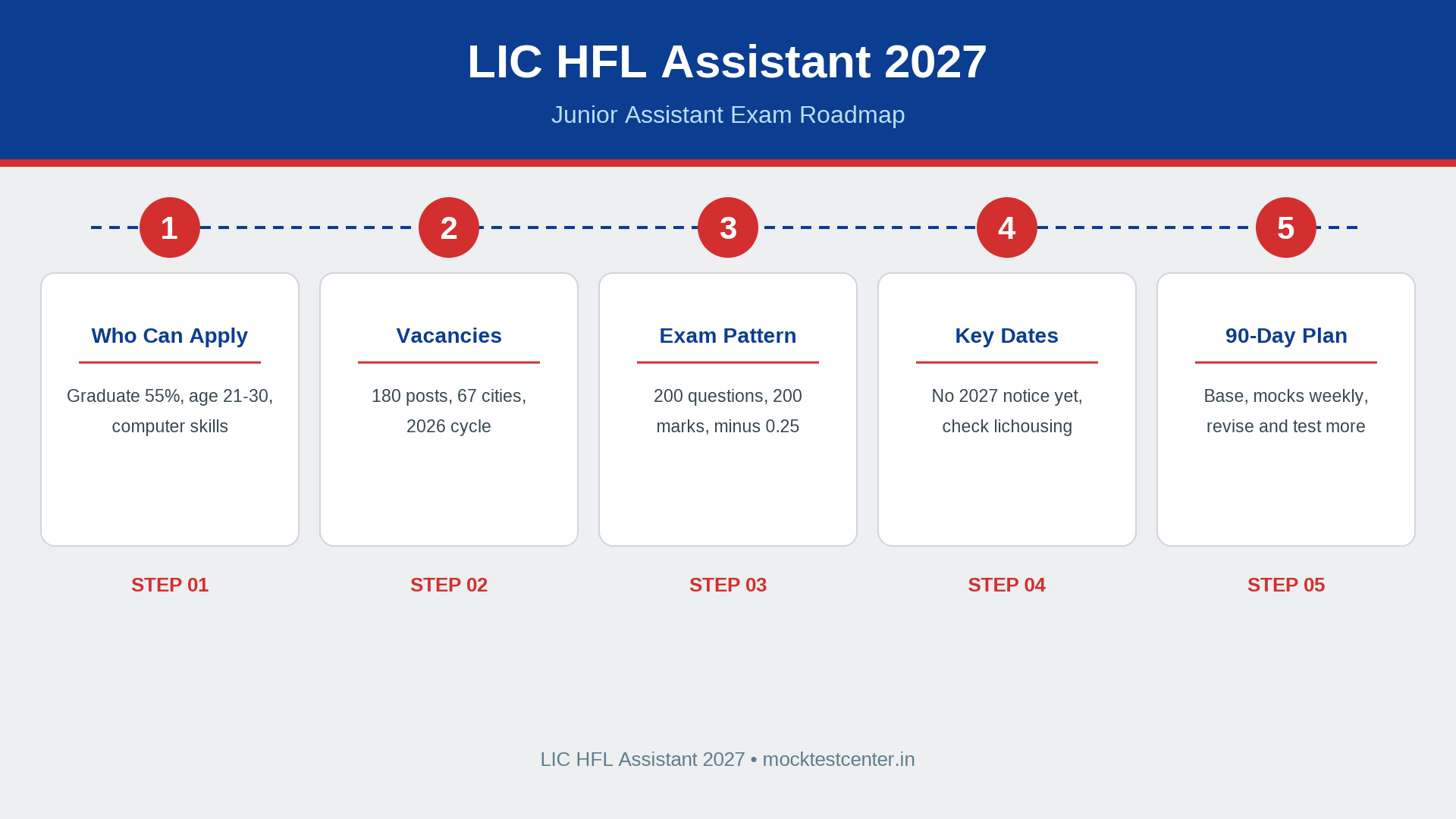
The first fact to state plainly is that no 2027 notice exists yet. As of 23 November 2026, LIC Housing Finance has released no Junior Assistant notification for the 2027 cycle. No advertisement, no vacancy count and no apply dates exist for it. The latest completed cycle is the 2026 cycle, and this guide is built from that cycle. The notification came out on 16 April 2026, applications ran from 16 to 30 April 2026, the online test was held on 6 June 2026, the result came out on 3 July 2026 and interviews were held on 22 July 2026. That cycle offered 180 posts across 67 cities in 20 States and Union Territories.
Check the official careers page at lichousing.com/careers for the next notice, because only the official notice is final. The pattern, eligibility rules and pay figures in this article come from the 2026 and 2024 Junior Assistant notifications. They show what the next notice will most likely look like. They are not the next notice. When the real notice comes out, read it first and treat this page as a starting point, not as the final word.
One point of naming needs clearing up at the start. The official post name is Junior Assistant. Coaching sites and job portals call it LIC HFL Assistant, and this page uses both names for the same post. Do not confuse it with the Assistant Manager post, which is a separate officer post with a different test, different eligibility and much higher pay. The two posts are covered on separate pages because they are separate exams.
The 2026 cycle, in one table
The 2026 cycle is the freshest picture of this exam, and it fits in one table. Keep it in mind while you read the rest of this guide, because every section below refers back to it.
| Event, Junior Assistant 2026 | Date or figure |
|---|---|
| Notification released | 16 April 2026 |
| Online applications | 16 to 30 April 2026 |
| Vacancies | 180 posts, 67 cities, 20 States and Union Territories |
| Online examination | 6 June 2026 |
| Result of online test | 3 July 2026 |
| Interview | 22 July 2026 |
| Age limit | 21 to 30 years as on 1 April 2026 |
| Education | Graduation in any discipline, minimum 55 percent marks, regular course only |
| Application fee | 800 rupees plus 18 percent GST, online only |
| Online test | 200 questions, 200 marks, 120 minutes, five sections of 40 marks |
| Negative marking | 0.25 marks per wrong answer |
| Selection | Online test and interview |
| Basic pay | 20,000 rupees a month |
| Probation | 6 months |
Two things in that table deserve attention. First, the whole cycle ran in about three months, from notification in mid April to interviews in late July. LIC Housing Finance moves fast once the notice is out. The apply window was only fifteen days. A candidate who was not watching the careers page in April would have missed the cycle completely. Second, the vacancies are city wise, not state wise. You apply for one city, and you are posted in that city if selected. Pick the city where you live or where you can live for years, not the city with the most posts.
Who can apply
The 2026 notice set four conditions, and all four must hold on the date the notice names. The age limit was 21 to 30 years as on 1 April 2026, which means born not earlier than 2 April 1996 and not later than 1 April 2005. Age relaxation follows government rules for reserved categories, and the notice prints the exact relaxation for SC, ST, OBC and persons with disabilities. The next notice will name its own cut off date, so do not carry the 1 April 2026 date forward. Check the date in the new notice and count your age on that date.
Education is a graduation degree in any discipline from a government recognised university, with at least 55 percent marks. Two words in that rule end many applications. The first is regular. Only regular courses are accepted. Distance, correspondence and part time degrees are not eligible. If your degree came through open university or distance mode, this post is not open to you, however high your marks. The second word is 55 percent. The 2024 cycle asked for 60 percent. The 2026 cycle lowered it to 55 percent. That change brought in a large group of graduates who were shut out in 2024, and the next notice may keep 55 percent or move it again. Read the number in the new notice.
Computer literacy is a separate condition, not a suggestion. The notice asks for basic working knowledge and operating skill in computer systems. In practice this means you should hold a certificate, diploma or degree in computer operations, or you should have studied Computer or Information Technology as a subject in school or college. The daily work is data entry, document scanning and loan software, so the company checks this at the interview stage. Keep your computer certificate ready with your degree certificate.
Nationality is simple. You must be an Indian citizen. The notice also asks for a set of documents at the time of application: a recent passport size photograph, a signature in black ink on white paper, a left thumb impression, a handwritten declaration in English and a live photograph taken by the system. Keep scanned copies ready in the sizes the notice asks for, because the fifteen day window leaves no time to arrange them.
One more rule shapes the whole application. You can apply for only one city. The 2026 cycle listed 67 cities, and you had to pick one. Your merit list is city wise. A candidate who picks Bangalore competes only with Bangalore applicants for the 23 Bangalore posts. A candidate who picks a one post city competes for that single post. Big city posts look safer because the number is larger, but big cities also draw the most applicants. A small city with one post can be easier or harder, and there is no way to know the applicant count in advance. Pick the city where you can actually live and work, because the posting follows the city you pick.
What changed between 2024 and 2026
The 2024 cycle is worth comparing with 2026, because the changes show where the exam is heading. In 2024 the company offered 200 Junior Assistant posts, state wise. Maharashtra took 53 posts, Karnataka 38, Telangana 31, Uttar Pradesh 17, Andhra Pradesh 12 and Madhya Pradesh 12. The notification came out on 25 July 2024, applications ran from 25 July to 14 August 2024, and the online test was held in September 2024. The age limit was 21 to 28 years as on 1 July 2024, and the education rule asked for graduation with a minimum of 60 percent marks.
By 2026, four things had moved. The post count fell from 200 to 180. The age limit widened from 21 to 28 years to 21 to 30 years. The marks rule eased from 60 percent to 55 percent. And the vacancy system changed from state wise to city wise, with 67 named cities instead of 15 states. The fee stayed at 800 rupees, with 18 percent GST added in the 2026 notice. The test itself did not change at all. Both cycles used the same 200 question, 200 mark, two hour paper with the same five sections.
Read those changes together and a pattern shows. The company widened the door on age and marks, so more graduates can apply, while it narrowed the posting to a named city, so the selected candidate lands exactly where the branch needs staff. That is a sensible way to hire for branch work. It also means the next cycle may keep the wider age and marks rules, because a company rarely tightens a rule it has just eased. Nothing is certain until the notice comes out, but a graduate aged 29 or 30 with 56 percent marks, who was shut out in 2024, should watch the next notice with real hope.
The city wise system also changed how candidates should think about competition. In 2024, a Maharashtra applicant competed for 53 posts across the state. In 2026, a Mumbai applicant competed for 8 posts in Mumbai, Navi Mumbai and Thane, while a Nasik applicant competed for 5 posts in Nasik alone. The state total for Maharashtra was 25 in 2026, down from 53 in 2024, but the fight is now city by city. Karnataka shows the same shape. Bangalore alone took 23 of the 29 Karnataka posts in 2026, with one post each in Belgaum, Gulbarga, Hassan, Mangalore, Mysore and Raichur. Hyderabad took 19 of the 24 Telangana posts. The big city branches take most of the posts, and the small cities take one each. Apply where you live, and do not chase the big number.
The exam pattern, section by section
The online test has 200 questions for 200 marks in two hours. Each question carries one mark. There is no sectional timing, so you can move between sections freely and spend your two hours where they earn the most marks. The paper is in English only. A wrong answer costs 0.25 marks. A skipped question costs nothing. The five sections carry equal weight, which is unusual. Most bank exams give more marks to one section than another. Here every section is 40 marks, so a weak section costs exactly as much as a strong section gains.
| Section | Questions | Marks |
|---|---|---|
| English Language | 40 | 40 |
| Logical Reasoning | 40 | 40 |
| General Awareness | 40 | 40 |
| Numerical Ability | 40 | 40 |
| Computer Knowledge | 40 | 40 |
| Total | 200 | 200 |
| Time | 120 minutes, no sectional timing | |
English gives forty questions in a paper with no sectional timer, so you set your own pace. Reading comprehension, cloze tests, error spotting, sentence improvement, para jumbles, fill in the blanks and vocabulary carry this section. The passages are short and plain, because the job needs a person who can read official letters and mails correctly, not a person who can parse long essays. Read one editorial a day and mark the sentence structures you would have written differently. That habit alone lifts the score, because the paper tests the same structures again and again.
Logical Reasoning gives forty questions, and it is the section where a calm head beats a fast hand. Syllogism, data sufficiency, direction and distance, machine input output, puzzles, seating arrangements, blood relations and coding decoding all appear. The questions are standard bank exam fare, and any good reasoning book covers them. The trap is time. A puzzle that eats eight minutes for five marks is a bad deal when forty questions wait in the next section. Learn to judge a question in five seconds. If it does not open up at once, mark it and move on.
General Awareness gives forty questions, with a special focus on housing finance. That phrase matters. The section asks about banking and the economy like any bank exam, but it also asks about housing finance: home loans, the National Housing Bank, housing schemes, interest rates on home loans and the work of housing finance companies. Read the business page every morning and keep a notebook of one line per story. Government schemes, the Union Budget, RBI monetary policy, major appointments and sports events all appear. Add the housing sector to that list, because it is the one part of this section that other bank exams do not test in the same way.
Numerical Ability gives forty questions, and it is the section most candidates fear most. Number series, data interpretation, simplification, quadratic equations, profit and loss, simple and compound interest, ratio and proportion, time and work, time speed and distance, averages, percentages and probability. The level is the level of a clerical exam, not an officer exam. The numbers are smaller and the steps are shorter than in a PO paper. Speed matters more than depth. Thirty minutes a day on simplification and data interpretation for two months will move this section more than any other habit.
Computer Knowledge gives forty questions, and it is the section candidates ignore until it costs them the list. The syllabus covers computer fundamentals, operating systems, MS Office, the internet, email, computer networks, memory and storage, and basic security. A graduate who uses a computer every day can score well here with a week of revision, because the questions test working knowledge, not theory. The mistake is to skip it. Forty marks is a fifth of the paper. A candidate who scores 30 here and a candidate who scores 15 here are separated by 15 marks, which is often the gap between selection and rejection in a one post city.
Two facts about the paper need emphasis. First, there is no sectional timing. That is a gift. You can give your weak section more time and your strong section less, and you can return to a hard question later. Second, there is a sectional cut off. You must clear the minimum marks in each section to reach the interview, so a high total with a failed section does not save you. The notice does not print the cut off in advance, and the company fixes it after the test. Give your weakest section thirty minutes a day, every day, even when it feels slow.
The interview and how the final list is made
The interview is the second and last stage. Candidates who clear the online test are shortlisted for interview in the ratio the company fixes, based on the number of posts in their city. The interview panel tests knowledge of banking and current affairs, your education and background, situational awareness, the ability to perform under pressure, and leadership ability and behavioural traits. In plain words, the panel wants to know whether you can sit at a counter, talk to a customer, handle a loan file and stay calm when the branch is busy.
The interview carries 100 marks, and you must score at least 40 percent to qualify, or 35 percent if you belong to SC, ST, OBC or PwD categories. That figure comes from the 2024 notification, and the 2026 notice summaries do not repeat it, so treat it as the last printed rule rather than a promise for the next cycle. The final result uses both stages together, with the online test carrying 80 percent weight and the interview carrying 20 percent weight. The online test decides the list. The interview confirms it. Put your energy where the marks are, which is the 200 mark paper.
Document verification runs at the interview, and it is where careless candidates lose a selection they have already earned. You must carry original certificates, and the result of your degree must have been declared on or before the cut off date in the notice. A candidate who wrote a degree on the form and can show the result only after the cut off date is out, whatever the test score. Get the papers right before you apply. If your university is slow with certificates, start the process now, not after the test. Universities take weeks, and the company gives a short window for document upload.
Prepare for the interview with your own city and your own degree. The panel asks why you want to join a housing finance company, what you know about home loans, what is happening in the housing sector, and why you picked this city. A candidate who can talk about the housing market in his own city, the price of a flat, the rate on a home loan and the documents a home loan needs will stand out at once. Read the LIC Housing Finance website before the interview and know what the company does beyond home loans: loans against property, loans to professionals for clinics and offices, and project finance to builders. That knowledge takes one evening to gather and it shows in every answer.
Pay: what the numbers really mean
A Junior Assistant starts with a basic pay of 20,000 rupees a month. On top of the basic pay come house rent allowance and other allowances as per the city category, and after deductions for provident fund, mediclaim and group insurance, the in hand pay comes to about 30,000 rupees a month. The total emoluments per month sit in the range of 32,000 to 35,200 rupees, depending on the place of posting, according to the 2024 notification. The 2026 cycle summaries quote a gross salary of 30,000 to 32,000 rupees a month in one place and up to 35,000 rupees in another, so the exact gross figure for 2026 is not settled in the sources this guide could check. The basic pay of 20,000 rupees is the fixed fact. The rest varies with the city.
That pay is modest next to a bank clerk or a bank PO, and it is honest to say so. The SBI Clerk 2027 exam leads to a clerk post with a starting basic pay of 26,730 rupees. The IBPS PO 2027 exam offers a Scale I basic pay of 48,480 rupees. The SBI PO 2027 exam offers the same Scale I basic pay, and its prelims syllabus overlaps with this paper. The Junior Assistant basic pay of 20,000 rupees is lower than both. The trade is the nature of the work and the place. A Junior Assistant works in one city, in a housing finance company, with fixed hours and a clear path upward inside the company. A bank PO can be posted anywhere in India. Money is one part of what a job gives, and it is a real part, and a candidate should join with eyes open.
Probation lasts six months, and the company can extend it if performance is not satisfactory. Six months is short, and it is a real test. The branch watches how you handle files, customers and the loan software. A candidate who learns the software fast and keeps files in order will confirm easily. The company also pays lunch allowance, provident fund, mediclaim, gratuity, leave travel concession and group insurance as per rules, and it offers a housing loan to staff on terms the company fixes. Those benefits are worth more than they look on a pay slip, because a staff housing loan at a low rate is a large saving over twenty years.
What a Junior Assistant actually does all day
The notification lists the job in plain words, and it is worth reading because most candidates apply without knowing what the work is. A Junior Assistant handles loan processing, file and document movement, document scanning, data entry, calling and following up for EMI payments in regular and default cases, recovery department work, customer service, cash counter management, return of documents, basic marketing, and any other business related activity the company asks for.
Put that list into a day and it looks like this. The morning starts with files. Loan applications come in with income proof, identity proof, property papers and bank statements, and the Junior Assistant checks each paper, scans it into the system and moves the file to the next desk. The middle of the day is the counter. Customers come with EMI queries, document requests and payment problems, and the Junior Assistant answers them, takes cash or cheques, and updates the system. The afternoon is calls. Borrowers whose EMI is due get a reminder call. Borrowers whose EMI is late get a firmer call, and the file moves to the recovery team if the delay grows. The day ends with the files again, because every paper that moved must be recorded before the branch closes.
Two skills decide whether a Junior Assistant does well. The first is care with papers. A missing signature or a wrong scan can hold up a loan for a week, and the customer blames the branch. The second is a calm voice on the phone. An EMI follow up call to a borrower who has lost a job needs firmness without rudeness, and that is a skill no book teaches. A candidate who is organised and patient will do well. A candidate who wants fast excitement will find the work slow. Join for what the job is, not for what the name sounds like.
Junior Assistant next to Assistant Manager, AAO and Clerk
LIC Housing Finance runs two doors, and the right door depends on where you stand today. The Junior Assistant door is for fresh graduates with 55 percent marks and no experience. The LIC HFL Assistant Manager 2027 door is for graduates with 60 percent marks or a postgraduate degree, and it leads to an officer post with a starting basic pay of 32,815 rupees, against the Junior Assistant basic pay of 20,000 rupees. The Assistant Manager test has four sections with sectional timing, while the Junior Assistant test has five sections with no sectional timing. The Assistant Manager post is the better job and the harder exam. A graduate with 60 percent marks should apply for both and prepare once, because the syllabus overlaps so much that one preparation serves both papers.
The LIC family offers two more doors. The LIC AAO 2027 exam is the officer exam of LIC of India, the parent company, with a much larger vacancy count and a three stage selection. The LIC ADO 2027 exam is the sales apprenticeship route into LIC of India, with an interview and a different career path. The Junior Assistant post sits below both in pay, but it sits inside a housing finance company, which is a different business from insurance. A candidate who wants home loans and branch work should pick LIC Housing Finance. A candidate who wants insurance should pick LIC of India. The two are not the same career.
The bank exams are the natural comparison, because the syllabus is nearly the same. The IBPS Clerk 2027 exam offers clerk posts in public sector banks with many more seats and a starting basic pay of 19,900 rupees, close to the Junior Assistant basic pay. The IBPS RRB Clerk 2027 exam offers clerk posts in regional rural banks. The ECGC PO 2027 exam and the RBI Assistant 2027 exam offer other routes into banking and the central bank, and the same preparation covers most of their syllabus as well. Apply for every exam you are eligible for, and decide when the offers come.
The way to choose is to ask one question. Do you want a steady branch job in one city, in a housing finance company, starting at 20,000 rupees basic pay? If yes, the Junior Assistant post deserves your main effort when the notice comes. If you want higher pay and an officer post, aim for the Assistant Manager exam or the bank PO exams, and treat the Junior Assistant exam as a second shot. That is the whole decision. Do not spend a year preparing for a posting you do not want.
What to study for each section
English needs a topic list you can tick off. Reading comprehension; cloze tests; error spotting; sentence improvement; para jumbles; fill in the blanks; vocabulary, including synonyms and antonyms. Read one editorial a day and mark the sentence structures you would have written differently. That habit alone lifts the score, because the paper tests the same structures again and again. Keep a notebook of new words with one sentence each, and revise it every Sunday.
Logical Reasoning needs speed more than depth. This section skips simplification. Puzzles, seating arrangements, syllogism, data sufficiency, direction and distance, machine input output, blood relations, coding decoding and series all appear. That list looks long. It is the same list as every bank exam, so the books and mocks you already own cover it. The difference is the pace. Forty questions with no sectional timer means you can give reasoning the time it needs, but every minute here is a minute taken from another section. Practise with a stopwatch, not with an open book.
General Awareness needs a notebook, not a book. Read the business page every morning and write one line per story. Government schemes, the Union Budget, RBI monetary policy, major appointments and sports events all appear. Six months of one line a day is about 180 lines, and that notebook covers most of the section. Add the housing sector to the notebook, because this paper asks about home loans, the National Housing Bank and housing schemes in a way other bank exams do not. Note the current home loan rates of LIC Housing Finance and its main rivals a week before the test.
Numerical Ability needs thirty minutes a day, every day. Simplification and approximation; number series; quadratic equations; data interpretation; time and work; time speed and distance; profit and loss; simple and compound interest; ratio and proportion; averages; percentages; probability. The level is clerical, not officer, so the steps are short and the numbers are small. The trap is the negative marking of 0.25. Four wrong answers erase one right answer. Guess only when you can rule out two options.
Computer Knowledge needs one week of focused revision, not one month of worry. Computer fundamentals; input and output devices; memory and storage; operating systems; MS Word, Excel and PowerPoint; the internet and email; computer networks; basic security and viruses. A graduate who uses a computer every day already knows most of this. The gap is usually the terms: RAM and ROM, cache, firewall, phishing, URL, HTTP, LAN and WAN. Learn the terms with one line each, and the section is yours.
The company behind the post
LIC Housing Finance Limited was incorporated on 19 June 1989 and promoted by the Life Insurance Corporation of India. It went public in 1994 and is listed on the National Stock Exchange and the Bombay Stock Exchange. It is registered with the National Housing Bank and is the largest housing finance company in India, with a loan book of 3,20,707 crore rupees as at 31 March 2026. The registered office is in Mumbai, and the company works through 10 regional offices, 23 back offices and 303 area offices across India as of 31 March 2026.
The business is simple to describe. The company gives long term finance to people who buy or build a house or flat, finance for repair and renovation, loans against property, loans to professionals for clinics, nursing homes and offices, and project finance to builders. It also runs subsidiaries for care homes for senior citizens, financial services and asset management. The Managing Director and Chief Executive Officer is Tribhuwan Adhikary.
Why does the company matter to a candidate? Because a Junior Assistant joins a company that lends for homes, and the daily work is home loan work. A candidate who knows what a home loan is, how interest is charged, what documents a loan needs and what the National Housing Bank does will answer interview questions better and will learn the branch work faster. It also matters because the company is large and stable. A post in the largest housing finance company in the country is a safe start, with a promotion path inside the company for those who stay and perform.
A 90 day plan that fits around a job or college
Two hours a day is realistic, and two hours a day for ninety days is 180 hours, which is enough. The plan below fits around college or a job, and it treats Computer Knowledge as a real subject, not an afterthought. Start it now, before the notice comes out, because the apply window will be about two weeks and the test will follow about five weeks later.
Days 1 to 30 are for the base. Study two hours a day. Cover one Numerical Ability topic and one English topic each day. Read the news every morning and write five lines in your current affairs notebook, plus two lines on housing finance. Take one mock at the end of week two and one at the end of week four. Do not worry about the score. The first mocks only show you where you stand.
Days 31 to 60 are for speed. Your LIC HFL Assistant 2027 score will move most in this phase, because the paper gives 36 seconds per question on average and a wrong answer costs 0.25 marks, so speed with accuracy is the whole game. Take two mocks a week now. After each mock, spend as much time on analysis as you spent on the test. Write down every question you got wrong and why. Was it a concept gap, a silly mistake, or a time problem? Concept gaps go back into your study list. Silly mistakes need a checklist before you submit each section. Time problems need easier questions first and hard ones last.
Days 61 to 90 are for the real thing. Take three mocks a week. Revise your error notebook every second day. Give Computer Knowledge one full week in this phase, because it is forty marks and most candidates leave it to the last day. Stop learning new topics in the last ten days. New topics in the last week add stress and no marks. In the last three days, take one full mock at the same time as your real test slot, then rest. Sleep matters more than one more chapter in the final week.
If you have less than ninety days, cut the base phase, not the mocks. Ten mocks with full analysis beat thirty days of reading without a single test. The paper rewards candidates who have sat through the two hour sitting many times. It punishes candidates who know the syllabus and have never felt the clock run out.
Mistakes that cost candidates a year
The first mistake is waiting for the notice to start. The apply window in the 2026 cycle was fifteen days, and the test followed five weeks after the last date. A candidate who starts on the day of the notice has about two months. A candidate who starts now has the whole year. The syllabus overlaps with the Clerk and PO exams so much that every hour you spend now counts for those exams too, even if the Junior Assistant notice comes late.
The second mistake is picking the wrong city. A city with more posts looks tempting, but the posting follows the city you pick, and you will live there for years. Apply for the city where you live or where you can live happily, even if it has one post. A single post in your own city beats twenty three posts in a city you cannot move to.
The third mistake is ignoring one section. Sectional cut offs end runs every year. A candidate with 150 marks and a failed section goes home, while a candidate with 130 marks and balanced sections goes to the interview. Give your weakest section thirty minutes a day, every day, even when it feels slow. Computer Knowledge is the section most often ignored, and it is forty marks.
The fourth mistake is guessing too much. Four wrong answers erase one right answer. In a section where you know twenty five answers for sure, fifteen wild guesses can pull your score down by nearly four marks. That is often the gap between selection and rejection in a one post city. Guess only when you can rule out two options.
The fifth mistake is applying with the wrong degree. The notice accepts regular courses only. A distance or correspondence degree does not count, and the company checks it at the interview. A candidate who clears the test and fails document verification loses a year. Check your degree against the notice before you pay the fee.
What to check before the next notice comes out
Keep four things ready. First, your degree certificate and your computer certificate, with the result declared before the cut off date the notice will name. Second, scanned copies of your photograph, signature, left thumb impression and handwritten declaration in the sizes the last notice asked for. Third, a mock test routine with a two hour timer and no sectional breaks, so the sitting feels normal by the time the notice comes out. Fourth, a habit of checking lichousing.com twice a week, because the notice will appear there first and the apply window will be short.
Start with one LIC HFL Assistant 2027 mock this week, built on the 2026 pattern: 200 questions, 200 marks, two hours, five sections of forty. Score it, list your weak section, and give that section thirty minutes a day. That single habit, repeated for ninety days, is what turns a graduate into a Junior Assistant.