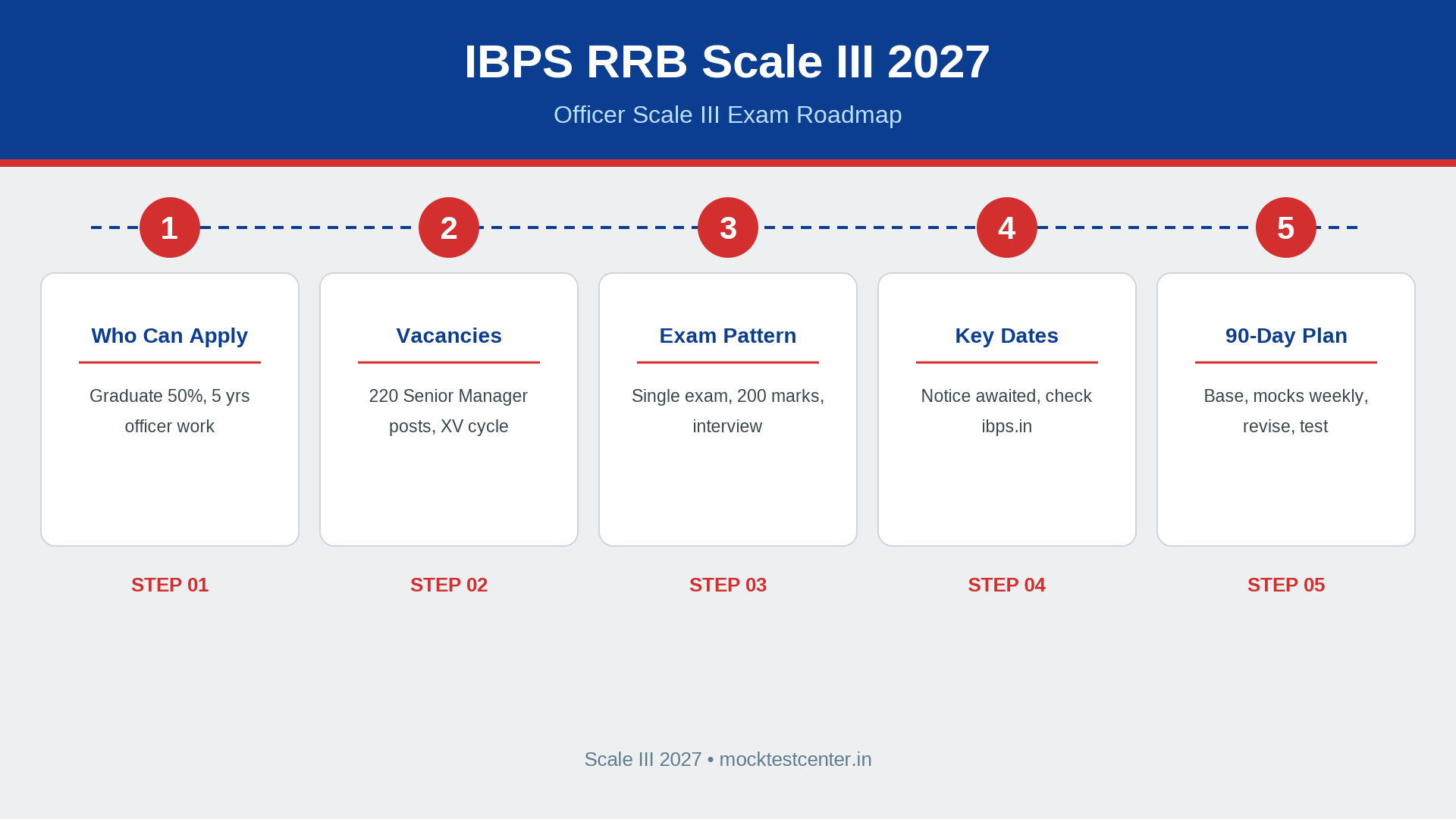
About IBPS RRB Officer Scale III 2027 Exam Series
📖 Table of Contents
- What Officer Scale III is
- A small post with a small field
- Who can apply: degree, marks and five years
- Age 21 to 40, and what the window means
- The single exam, section by section
- The marks per question change how you should play it
- The interview and the 80 to 20 merit
- Pay: what a Senior Manager actually earns
- Scale III next to Scale II, Scale I and RBI Grade B
- What changed from CRP RRBs-XIV to XV
- What to study for each section
- A 90 day plan that fits around a branch
- Mistakes that cost Scale III candidates a year
- What to check before the 2027 notice comes out
IBPS RRB Officer Scale III 2027: Pattern, Salary, Dates
What Officer Scale III is
IBPS RRB Officer Scale III 2027 is the Senior Manager recruitment in Regional Rural Banks. It is the highest officer post in the IBPS RRB ladder that a working banker can enter from outside, and it asks for the most experience: five years as an officer in a bank or a financial institution. The selection has two stages only, a single online exam and an interview. There is no preliminary exam, and the exam score carries 80 percent of the final merit. The interview carries the other 20 percent.
One fact must come first. No 2027 notification exists yet. The latest cycle is CRP RRBs-XV, notified on 1 September 2026, with 220 Officer Scale III posts across 28 Regional Rural Banks. Applications for that cycle ran from 1 to 21 September 2026, and the single exam is set for 20 December 2026 on the tentative calendar. This page builds from that notification, because it is the real rulebook for the post, and it says plainly where the 2027 cycle stands. The 2027 cycle, CRP RRBs-XVI, has not been notified. Past notices came in August 2024, September 2025 and September 2026, so a September 2027 notice is the pattern, not a promise. Any site that prints a 2027 vacancy number or an exam date today is guessing.
Check the official site at ibps.in for every notice, because only the official notice is final. The pattern, eligibility rules and pay figures in this article come from the CRP RRBs-XV notification. They show what the next cycle will most likely look like. They are not the next notification. When the real notice comes out, read it first and treat this page as a starting point, not as the final word.
Scale III is the post for officers who have already run a branch or a desk for years and want the next grade without waiting for a promotion list. The starting basic pay is 85,920 rupees a month, which is the highest starting basic pay of any post in the IBPS RRB recruitment, and higher than the starting basic pay of an RBI Grade B officer. The seat count is small, at 220 in the latest cycle, and the field is small too, because five years of officer experience cuts out most applicants at the door. That is the whole deal: fewer seats, fewer rivals, and a paper that rewards the work you have already done.
A small post with a small field
Two hundred and twenty seats looks like a small number, and it is. The Office Assistant post in the same notification carries 8,222 seats. Officer Scale I carries 4,256. Officer Scale II carries 1,047. Scale III carries 220, which is about 1.6 percent of the whole recruitment. A candidate who reads only the seat count will walk away. A candidate who reads the eligibility rule will stay.
The five year rule does the filtering before the exam starts. Most bank officers with five years of service are between 27 and 38 years old, already posted in a branch or a regional office, and busy enough that many never fill the form. The applicants who do fill it are serious, and the paper is sharper for it, but the crowd is nothing like the crowd for Scale I, where lakhs of fresh graduates apply. In the previous cycle, CRP RRBs-XIV, the Scale III post carried 202 seats. The rise to 220 in the latest cycle is a rise of 18 seats, which is small in absolute terms and large in percentage terms for a post this size. The direction is up.
Scale III is also the only post in the CRP where the age window is wide on purpose. The age runs from above 21 years to below 40 years as on 1 September 2026, which is the widest window in the notification. The window has to be wide, because five years of officer work takes time to build, and the post is meant for officers in mid career, not for fresh graduates. A 35 year old Scale I officer with eight years of service is a normal Scale III applicant. A 28 year old with exactly five years is a young one.
The post itself is a Senior Manager in a Regional Rural Bank. The work is branch leadership, credit decisions, recovery, team management and rural lending. A Senior Manager signs off on loans, runs a branch or a cluster of branches, answers to the regional office, and carries the targets for deposits, advances and recovery. The exam tests the knowledge behind that work, and the interview tests whether the candidate has actually done it.
Who can apply: degree, marks and five years
Officer Scale III asks for three things together: a bachelor degree in any discipline with at least 50 percent marks, five years of experience as an officer in a bank or a financial institution, and an age above 21 years and below 40 years as on 1 September 2026. Miss any one of the three and the form will not save you at document verification, even if you clear the exam and the interview. The rule is short, and every word in it matters.
| Rule, Officer Scale III | What the notification asks |
|---|---|
| Degree | Bachelor degree in any discipline from a recognised university |
| Marks | Minimum 50 percent in aggregate |
| Experience | Minimum 5 years as an officer in a bank or financial institution |
| Age | Above 21 years and below 40 years as on 1 September 2026 |
| Local language | Proficiency in the local language of the state applied for |
The degree rule is the easiest of the three. Any discipline counts. A degree in agriculture, commerce, science, arts or engineering all qualify, as long as the aggregate marks reach 50 percent. The notification gives preference to degrees in Banking, Finance, Marketing, Agriculture, Horticulture, Forestry, Animal Husbandry, Veterinary Science, Agricultural Engineering, Pisciculture, Agricultural Marketing, Information Technology, Management, Law, Economics and Accountancy, but preference is a nudge at the interview, not a bar at the form. A history graduate with five years as a bank officer can apply.
The experience rule is the hard one, and it has four parts. First, the experience must be as an officer. Years as a clerk do not count. Years in a private company do not count. Years in a school or a government office do not count. The notification names the kind of employer and the kind of post, and both must match. Second, the experience must come after the qualification. A year of work done while the degree was still incomplete does not count. The notification asks for post qualification experience, and the panel reads the dates on the degree certificate and the experience certificate side by side. Third, the experience must add up to five years by the last date of online registration, which was 21 September 2026 in the latest cycle. A candidate with four years and eleven months on that date is outside the rule. Fourth, the certificate must say the right things: the post held, the dates, and that the work was as an officer.
Final year students cannot apply. The qualification must be complete by the last date of online registration, and the notification says so in plain words. That rule rarely bites for Scale III, because five years of officer work already means a completed degree years ago, but it is worth stating, because a candidate who joined a bank on a provisional certificate and never collected the final degree can still trip on it.
A candidate can apply for only one officer post in a cycle. Scale I, Scale II or Scale III, pick one. The notification is clear on this, and the form enforces it. An officer with five years of service qualifies for Scale II and Scale III both, and must choose at the form stage. The choice should follow the numbers and the paper: Scale III has fewer seats and fewer rivals, and the same single exam as the General Banking Officer paper of Scale II, so the preparation is the same and the decision is about the grade and the odds, not about the syllabus.
Age 21 to 40, and what the window means
Officer Scale III asks for an age above 21 years and below 40 years as on 1 September 2026 in the latest cycle. That means a candidate must have been born between 2 September 1986 and 1 September 2005, both dates included, for the XV cycle. The age is counted on 1 September of the notification year, not on the exam date and not on the date of joining. A candidate who turns 40 on 2 September 2026 is inside the limit. A candidate who turned 40 on 31 August 2026 is outside it.
Relaxation follows the government rules used in every IBPS notification. Scheduled Caste and Scheduled Tribe candidates get five years. Other Backward Classes in the non creamy layer get three years. Persons with benchmark disabilities get ten years. Ex-servicemen get five years. Relaxation stacks with one other category only, so a candidate cannot add every relaxation together. The exact birth date windows for each relaxed category are printed in the notification, and the article does not reproduce them here, because a wrong date in a table like this would mislead a candidate at the form stage. Read the age table in the notice and match your own birth date against it.
The practical meaning of the window is that Scale III is a mid career exam. The youngest possible applicant is about 26 or 27 years old, with a degree at 21 and five years of officer work behind it. The oldest is just under 40, or older with relaxation. Most applicants sit between 30 and 38, already holding a Scale I or Scale II post, already running a branch, and looking at the next grade. That is the field. It is older, busier and more experienced than the field for any other IBPS post, and the paper is built for it.
One more age point matters. The window closes fast at the top end. An officer at 39 with five years of service has one cycle left, maybe two with relaxation. An officer at 35 has four or five cycles. If you are inside the window now and the experience rule fits, this cycle or the next one is the time to sit for the exam, not the one after. The experience stays valid, but the age window closes.
The single exam, section by section
Scale III has no preliminary exam. Every candidate sits for one online exam of 200 questions and 200 marks in two hours, and that exam decides both the interview shortlist and most of the final merit. The paper is the same paper as the General Banking Officer paper of Scale II, with the same five tests, the same marks and the same time. There is no Professional Knowledge test for Scale III. The table below comes from the CRP RRBs-XV notification, as republished in full by the trackers that mirror the official PDF. The figures are the notification figures, but the source here is a mirror copy, not a direct fetch from ibps.in, so check them against the official PDF when the next notice comes out.
| Test, Officer Scale III | Questions | Marks | Minutes |
|---|---|---|---|
| Reasoning | 40 | 50 | 30 |
| Computer Knowledge | 40 | 20 | 15 |
| Financial Awareness | 40 | 40 | 15 |
| English Language or Hindi Language | 40 | 40 | 30 |
| Quantitative Aptitude and Data Interpretation | 40 | 50 | 30 |
| Total | 200 | 200 | 120 |
Three things in that table decide how the paper should be played. First, the time is composite, but the notification prints a duration against each test, and the screen moves through the tests in order. Treat each printed duration as the time the paper expects you to spend on that test. Second, every test has a minimum cutoff score. A candidate must clear the cutoff in each test, not only in the total. A high total with a failed test does not reach the interview. Third, the interview shortlist takes up to three times the declared vacancies in each category, so with 220 seats the shortlist runs to about 660 candidates across all categories, and the cutoff moves with the number of applicants, so no fixed cutoff number can be promised in advance.
The language test offers a choice. A candidate can opt for English Language or Hindi Language, and the choice is made in the form. Pick the language you read faster in, not the one you think looks better on a form. Forty questions in thirty minutes is a reading speed test as much as a language test, and the wrong choice costs marks in a section that carries 40 marks.
Negative marking applies to every objective test. For each wrong answer, one fourth of the marks assigned to that question is deducted. A wrong Reasoning answer costs 0.3125 marks, because each Reasoning question carries 1.25 marks. A wrong Computer Knowledge answer costs 0.125 marks, because each Computer question carries 0.5 marks. A blank answer costs nothing. The penalty follows the value of the question, which is why the marks per question matter so much in this paper.
One point in the notification deserves a line of its own. The Officer Scale III exam pattern is identical to the General Banking Officer paper, and the two papers run on the same day. That is why a candidate must choose one officer post at the form stage. The papers are the same, but the merit lists are separate, and the experience rule is what separates them.
The marks per question change how you should play it
Every test in this paper has 40 questions. The marks are not equal, and that is the single most useful fact about the paper. A Reasoning question is worth 1.25 marks and a Computer Knowledge question is worth 0.5 marks. One right Reasoning answer equals two and a half right Computer answers. Forty Computer questions together are worth 20 marks. Forty Reasoning questions together are worth 50 marks. The paper prints the same number of questions for both, and a candidate who gives them equal time is giving the 20 mark test the same effort as the 50 mark test.
Put the time where the marks are. Reasoning and Quantitative Aptitude together carry 100 of the 200 marks, and the notification gives them 30 minutes each. Financial Awareness carries 40 marks in 15 minutes, which is the fastest marks per minute in the paper. Computer Knowledge carries 20 marks in 15 minutes, which is the slowest. A working officer who knows banking already should finish Financial Awareness fast and bank the marks, then spend the saved time on the two 50 mark tests.
Two hours for 200 questions is 36 seconds per question on average. That average hides the real shape. Financial Awareness questions take seconds each if you know the fact, and minutes if you do not. A puzzle in Reasoning can take three minutes. The candidates who clear this paper are the ones who skip fast. A skipped question costs nothing. A question that eats three minutes costs the two easier questions after it.
The difficulty of this paper is higher than the Scale I main exam, even though the sections look the same. The notification uses the same section names, but the questions are set for officers with five years of service, and the cutoff moves with a sharper field. The trackers say so plainly, and the logic supports them: a paper taken only by experienced officers will be marked against experienced officers. Prepare for a harder paper than the Scale I main, not an easier one.
The interview and the 80 to 20 merit
The interview carries 100 marks. The minimum qualifying marks are 40 percent for General and EWS candidates, and 35 percent for Scheduled Caste, Scheduled Tribe, Other Backward Classes and Persons with Benchmark Disabilities candidates. The interview is coordinated by the nodal Regional Rural Bank with the help of NABARD and IBPS, and it takes place at select centres. The call letter comes from ibps.in, and no request for a change of date or centre is entertained.
The final merit uses a weight of 80 percent for the online exam and 20 percent for the interview. The interview can close a gap, but it cannot erase one. Work through one example. Candidate A scores 150 out of 200 in the exam and 70 out of 100 in the interview. The exam part of the final score is 80 percent of 75, which is 60. The interview part is 20 percent of 70, which is 14. The final score is 74. Candidate B scores 140 out of 200 in the exam and 90 out of 100 in the interview. The exam part is 80 percent of 70, which is 56. The interview part is 20 percent of 90, which is 18. The final score is also 74. Candidate B closed a 10 mark exam gap with a 20 mark interview gap. That is the full power of the interview. A 10 mark exam gap needs a 40 mark interview gap to close fully, because the interview is worth only a fifth of the total.
The lesson is plain. The exam decides the list. The interview confirms it. A candidate who treats the interview as the main event has the weights backwards. Put the main effort into the 200 mark paper, and treat the interview as the place where a strong paper is protected, not where a weak paper is rescued.
The interview panel for Scale III asks about the work you have already done, and it asks harder than the Scale I panel. A Scale III candidate should expect questions on branch management, credit appraisal, recovery and non performing assets, priority sector lending, rural credit and the schemes that reach farmers, team leadership, and the economy of the home state. The panel can tell at once whether an answer comes from real work or from a guidebook. Prepare with your own stories. One loan file you sanctioned, one recovery you led, one difficult audit finding you closed, one branch target you met. Those stories carry more weight than any rehearsed definition, and for a Senior Manager post they are the point of the interview.
Scores in the online exam are normalised by the equi percentile method when the exam runs in more than one session, and scores are taken to two decimal places. The interview score of a candidate who fails to secure the minimum qualifying marks is not disclosed. The reserve list stays valid for one year from the provisional allotment, or until a fresh allotment, whichever comes first.
Pay: what a Senior Manager actually earns
Officer Scale III sits in Middle Management Grade Scale III. The pay scale under the 12th Bipartite Settlement and the 9th Joint Note, in force from 1 November 2022, runs from 85,920 rupees to 1,05,280 rupees: 85,920 with five increments of 2,680 rupees to 99,320, then two increments of 2,980 rupees to 1,05,280. The starting basic pay is 85,920 rupees a month. That figure is the fixed fact. Everything above it depends on the posting and the dearness allowance on the day.
That starting basic pay is the highest in the IBPS RRB recruitment. It sits above the starting basic pay of an RBI Grade B officer, which is 78,450 rupees, and above the starting basic pay of an SBI Probationary Officer, which is 56,480 rupees with advance increments. A salary comparison published by a preparation portal in October 2026 put RRB Officer Scale III at the top of its list of ten banking posts by starting basic pay, ahead of RBI Grade B, RRB Officer Scale II at 64,820 rupees, and every Scale I post at 48,480 rupees. The comparison is a tracker product, not an official table, but the underlying pay scales are the settlement figures, and the ranking follows from them.
On top of the basic pay come dearness allowance, house rent allowance, special allowance and the usual benefits: provident fund, pension under the National Pension System, leave fare concession and medical benefits. Dearness allowance moves every quarter, in February, May, August and November. For November 2026 to January 2027 it stood at 31.33 percent, as reported by the salary trackers. Special allowance for Scale III is reported at 28.30 percent of basic pay. House rent allowance depends on the city class, so a posting in a metro city pays more in allowance and costs more to live in, while a posting in a small town pays less and costs less.
The in hand figure is where the trackers disagree, so this article gives a range and labels it. Salary trackers report an in hand pay of roughly 78,000 to 90,000 rupees a month for a Scale III officer, while another tracker puts the gross monthly pay at 1,25,000 to 1,35,000 rupees. The gap comes from different allowance assumptions and different cities. Treat any single in hand figure as a guide, not a payslip. The basic pay of 85,920 rupees is the number the settlement fixes, and the dearness allowance rate on the day fixes the rest.
Put that pay beside the other IBPS exams and the step up is clear. The IBPS RRB PO 2027 exam leads to Officer Scale I with a starting basic pay of 48,480 rupees, so Scale III pays 37,440 rupees more at the start. The IBPS RRB Officer Scale II 2027 exam leads to Manager with a starting basic pay of 64,820 rupees, so Scale III pays 21,100 rupees more at the start. The IBPS PO 2027 exam leads to the same Scale I basic pay of 48,480 rupees in a public sector bank. Scale III is the first post in the RRB ladder where the basic pay crosses 80,000 rupees, and that is why officers with five years of service aim for it.
Scale III next to Scale II, Scale I and RBI Grade B
IBPS runs four doors into officer posts that a working banker should know, and the right door depends on the experience already in hand. Officer Scale I is the door for fresh graduates. It asks for no experience, runs a preliminary exam and a main exam, and starts at a basic pay of 48,480 rupees. Officer Scale II is the door for officers with two years of service. It asks for experience, runs a single exam, and starts at 64,820 rupees. Officer Scale III is the door for officers with five years of service. It asks for longer experience, runs the same single exam as the Scale II General Banking Officer paper, and starts at 85,920 rupees. The IBPS RRB Clerk 2027 exam is the clerk door, with no interview and a starting basic pay of 24,050 rupees.
The RBI Grade B 2027 exam is the comparison that flatters Scale III most, and it needs a fair reading. RBI Grade B starts at a basic pay of 78,450 rupees, which is lower than Scale III, but the RBI post sits in the central bank, with a different career path, a different posting pattern and a different exam. RBI Grade B asks for no experience and runs three phases with a descriptive paper. Scale III asks for five years of experience and runs a single exam with an interview. A banker with five years of service should take Scale III as the main target, because the paper is shorter and the experience counts. A fresh graduate cannot take Scale III at all, and should look at RBI Grade B or the IBPS SO 2027 exam instead.
The IBPS Clerk 2027 exam and the SBI PO 2027 exam sit outside the RRB ladder but share most of the syllabus. The Clerk exam has no interview and many more seats. The SBI PO exam has three stages and a descriptive paper, and it posts an officer anywhere in India. The SBI Clerk 2027 exam offers a clerk post with no interview, and the LIC AAO 2027 exam offers an insurance officer post, and the same preparation covers most of their syllabus too.
The way to choose is to ask one question. Do you have five years as an officer in a bank or a financial institution, in the exact form the notice names? If yes, Scale III is your post, and it deserves your main effort. If you have two years, Scale II is your post. If you have none, Scale I is your post, and the five years of officer work you build there become the ticket to Scale III later. That is the whole decision. Do not spend a year preparing for a post whose form you cannot fill.
What changed from CRP RRBs-XIV to XV
The previous cycle, CRP RRBs-XIV, was notified on 1 September 2025, with applications from 1 to 21 September 2025. The Scale III total then was 202 posts, against 220 in the latest cycle, a rise of 18 seats. The rise is small in absolute terms, and it matters, because the post is small and every seat changes the odds. The Scale II total moved the other way in the same cycle, from 1,149 to 1,047, so the two senior posts did not move together. The banks added Senior Managers and cut generalist Managers, which fits the pattern of a rural bank that wants more senior hands and fewer new ones.
One more change between the cycles matters. The total for the whole CRP RRBs-XV was 13,706 posts at notification, and a corrigendum dated 9 September 2026 raised it to 13,745 by adding 39 Office Assistant posts. A further corrigendum dated 25 September 2026 updated the vacancy annexure again. One tracker puts the total after that update at 13,757, which conflicts with the 13,745 figure used here. The Scale II and Scale III figures did not move in any of these updates. The lesson is to read the corrigenda, not only the first notification. IBPS updates the vacancy annexure after the notice, and the final figure is the one in the last corrigendum.
The fee stayed the same between the cycles. Officers pay 850 rupees, and Scheduled Caste, Scheduled Tribe and Persons with Benchmark Disabilities candidates pay 175 rupees, inclusive of goods and services tax. The fee is paid online only, and a separate fee applies for each post. A candidate who applies for one officer post pays one fee. The fee is not refunded if the form is rejected, so check the eligibility rules before paying, not after.
The exam date also moved in a way worth noting. The Scale II and III single exam in the XIV cycle ran in December 2025 to February 2026, and the interviews ran in January and February 2026. In the XV cycle the single exam is set for 20 December 2026 on the tentative calendar, with interviews in January and February 2027 and provisional allotment in February and March 2027. The shape is the same. The dates shift by a year. A candidate planning for the 2027 cycle should expect the same shape again: a September notice, a December exam, and interviews early in the next year.
What to study for each section
Financial Awareness carries 40 marks in 15 minutes, and it is the section where a working officer should score highest. The questions cover the Reserve Bank of India and its functions, repo rate and reverse repo rate, cash reserve ratio and statutory liquidity ratio, types of accounts and deposits, priority sector lending, know your customer norms, digital payment systems such as UPI, NEFT, RTGS and IMPS, and the basics of loans and non performing assets. A candidate who has worked in a branch for five years has seen all of these in real files. The gap is usually the numbers. Repo rate, cash reserve ratio and statutory liquidity ratio change through the year, so note the current figures a week before the test and revise them the night before.
For Scale III, Financial Awareness should go deeper than the Scale I level. Add the rural side: NABARD and its functions, regional rural bank structure and amalgamation, priority sector targets for agriculture and small farmers, crop loans and the Kisan Credit Card, self help groups and microfinance, and the government schemes that reach villages. The paper is set for Senior Managers in rural banks, and the rural questions are the ones that separate a Scale III candidate from a Scale I candidate who happens to know the same formulas.
Reasoning needs speed more than depth. Puzzles, seating arrangements, syllogisms, blood relations, coding and decoding, and inequality questions share the section. Forty questions in thirty minutes means 45 seconds per question, and a puzzle that takes three minutes has already cost two easier questions. Learn to judge a question in five seconds. If it is not moving, mark it and move on. Come back only if time is left after the rest of the section.
Quantitative Aptitude and Data Interpretation needs the same discipline. Simplification and approximation, number series, quadratic equations, data interpretation sets, time and work, time speed and distance, profit and loss, simple and compound interest, ratio and proportion, and averages make up the list. That list looks long. It is the same list as every bank exam, so the books and mocks you already own cover it. The difference is the pace. Forty questions in thirty minutes, with each question worth 1.25 marks, means a wrong guess costs more here than anywhere else in the paper. Guess only when you can rule out two options.
Computer Knowledge is the smallest section by marks, at 20 marks for 40 questions, and it should get the smallest share of preparation time. The questions cover computer basics, hardware and software, operating systems, networking, the internet, MS Office, and cyber security basics. A working officer who uses a core banking system every day knows most of this already. Revise the terms once, take a few sectional tests, and move on. Do not spend a week on a section worth 20 marks while Reasoning, worth 50 marks, waits.
English or Hindi Language needs a choice made early and practised in that language only. Reading comprehension, cloze tests, error spotting, sentence improvement, para jumbles and vocabulary carry the English paper. The Hindi paper tests the same skills in Hindi. Pick the language you read faster in, and take every mock in that language. A last minute switch costs marks, because reading speed is built over weeks, not days.
A 90 day plan that fits around a branch
A Senior Manager candidate has less free time than any other IBPS applicant. The branch runs through the day, the targets run through the month, and the audit can land any week. Two hours a day is realistic, and two hours a day for ninety days is 180 hours, which is enough, because five years of work already cover half the syllabus. The plan below fits around branch hours, and it treats the single exam as one sitting, not five separate tests. Start it now, before the notice comes out, because the apply window will be about three weeks and the test will follow about eleven weeks later.
Days 1 to 30 are for the base. Study two hours a day, one hour before the branch opens or after it closes. Cover one Financial Awareness topic and one Reasoning or Quantitative topic each day. Read the business page every morning and write five lines in a current affairs notebook, with two lines on rural credit and farm schemes. Take one mock at the end of week two and one at the end of week four. Do not worry about the score. The first mocks only show you where you stand.
Days 31 to 60 are for speed. Your score will move most in this phase, because the paper gives 36 seconds per question and a wrong answer costs a fourth of the question value, so speed with accuracy is the whole game. Take two mocks a week now. After each mock, spend as much time on analysis as you spent on the test. Write down every question you got wrong and why. Was it a concept gap, a silly mistake, or a time problem? Concept gaps go back into your study list. Silly mistakes need a checklist before you submit each section. Time problems need easier questions first and hard ones last.
Days 61 to 90 are for the real thing. Take three mocks a week. Revise your error notebook every second day. Stop learning new topics in the last ten days. New topics in the last week add stress and no marks. In the last three days, take one full mock at the same time as your real test slot, then rest. Sleep matters more than one more chapter in the final week. An officer who walks into the test hall tired will make the same mistakes a fresh candidate makes, and the five years of experience will not save the score.
If you have less than ninety days, cut the base phase, not the mocks. Ten mocks with full analysis beat thirty days of reading without a single test. The paper rewards candidates who have sat through the two hour sitting many times. It punishes candidates who know the syllabus and have never felt the clock run out.
Mistakes that cost Scale III candidates a year
The first mistake is waiting for the notice to start. The apply window in the latest cycle was three weeks, and the test followed about eleven weeks after the last date. An officer who starts on the day of the notice has about three months. An officer who starts now has the whole year. The syllabus overlaps with the Scale I and Scale II papers so much that every hour you spend now counts for those exams too, even if the Scale III notice comes late.
The second mistake is assuming the experience speaks for itself in the interview. Five years in a bank is a strong record, but the panel interviews many officers with five years, and the one who can explain a credit decision, a recovery and a team problem in plain words wins the marks. Experience that cannot be told is experience the panel cannot score. Write down five stories from your own work before the interview, and practise telling each one in two minutes.
The third mistake is ignoring one section. Sectional cutoffs end runs every year. A candidate with 150 marks and a failed Computer Knowledge section goes home, while a candidate with 130 marks and balanced sections goes to the interview. Give your weakest section thirty minutes a day, every day, even when it feels slow. Computer Knowledge is worth only 20 marks, but a fail there ends the run just as surely as a fail in Reasoning.
The fourth mistake is guessing too much. Four wrong answers erase one right answer in a section where each question carries one mark, and the maths is worse in Reasoning, where each question carries 1.25 marks. In a section where you know twenty five answers for sure, fifteen wild guesses can pull your score down by nearly five marks. That is often the gap between selection and rejection in a post with 220 seats. Guess only when you can rule out two options.
The fifth mistake is applying without checking the experience rule. The notice asks for five years as an officer in a bank or a financial institution, after the qualification. A candidate who counts years as a clerk, or years in a private company, clears the test and fails document verification. Count only the years the notice names, and get the certificate before you apply. The certificate should state the post held, the dates, and that the work was as an officer, because a certificate that gives only dates is weak at verification.
What to check before the 2027 notice comes out
Keep four things ready. First, your degree certificate and your experience certificate, with the dates matching the appointment letter, so you can prove the five year rule the day the notice comes out. Second, a mock test routine with the real timings, so the two hour sitting feels normal by the time the notice comes out. Third, a habit of checking ibps.in twice a week, because the notice will appear there first and the apply window will be short. Fourth, a clear choice of post, made now, not on the last day of the form. Scale III or Scale II, decided on your experience, your age and the vacancy trend, not on a last minute guess.
Start with one IBPS RRB Officer Scale III 2027 mock this week, built on the latest pattern: 200 questions, 200 marks, two hours, five tests of forty questions each. Score it, list your weak section, and give that section thirty minutes a day. That single habit, repeated for ninety days, is what turns a working officer into a Senior Manager in a Regional Rural Bank.