
About IBPS SO 2027 Exam Series
📖 Table of Contents
- What the IBPS SO 2027 exam is
- IBPS SO 2027: where the cycle stands now
- Vacancies: 1,043 posts and where they sit
- The six streams, one by one
- IT Officer Scale I
- Agriculture Field Officer Scale I
- Law Officer Scale I
- Rajbhasha Adhikari Scale I
- HR and Personnel Officer Scale I
- Marketing Officer Scale I
- Who can apply for IBPS SO 2027: age and education
- IBPS SO 2027 exam pattern: prelims first
- Mains: professional knowledge decides the result
- Interview and the final merit list
- Fee, salary and the job after selection
- Syllabus: what to study, section by section
- Cut offs: what the last cycle tells you
- A 90 day plan that fits the real pattern
- Mistakes that cost candidates a year
- What to do this week
IBPS SO 2027: Specialist Officer Exam, Pattern, Eligibility and Dates
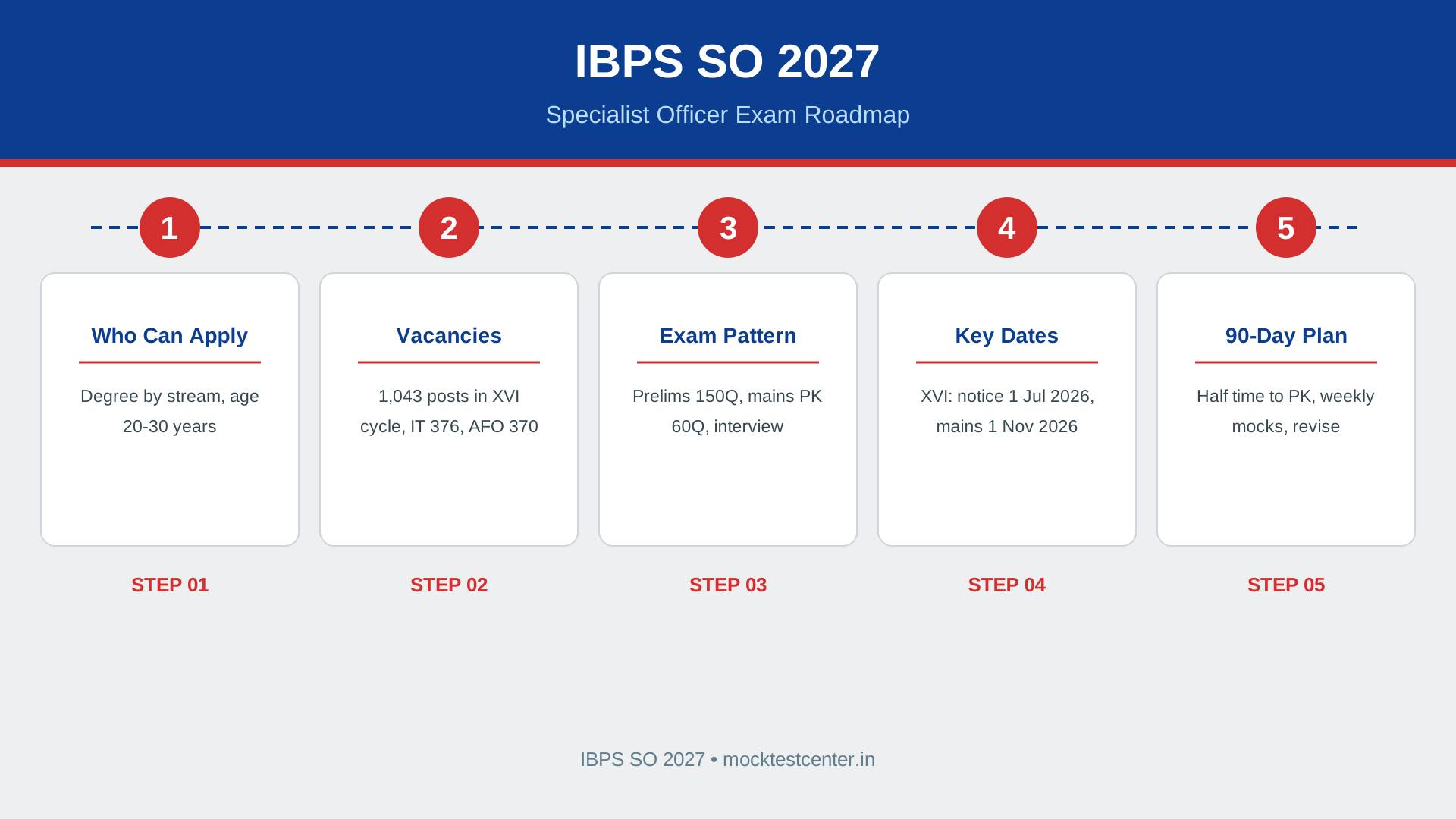
IBPS SO 2027 will fill Specialist Officer Scale I posts in 11 public sector banks. The 2027 cycle has no notification yet. The latest notified cycle is CRP SPL-XVI from 2026, which offered 1,043 posts for the 2027-28 vacancies.
That cycle ran from a 1 July 2026 notification to prelims on 29 August 2026 and mains on 1 November 2026. This page uses that cycle as the guide for 2027, because IBPS has followed the same shape for years. Read it before you pick a stream, because the stream you pick changes the paper you sit.
IBPS SO is a strange exam in one way. Most bank exams test every candidate on the same paper. This one does not. An IT Officer candidate and a Law Officer candidate sit different prelims papers, and their mains papers test different subjects altogether.
Your degree decides your stream, and your stream decides your preparation. Pick the stream first. Then plan.
What the IBPS SO 2027 exam is
The Institute of Banking Personnel Selection runs a Common Recruitment Process for Specialist Officers, called CRP SPL. Public sector banks report their specialist vacancies to IBPS, IBPS holds one common exam, and then IBPS allots selected candidates to the banks. The 2026 cycle covered 11 banks.
Bank of Baroda, Canara Bank, Punjab National Bank, Bank of India, Indian Bank, Central Bank of India, UCO Bank, Bank of Maharashtra, Punjab and Sind Bank, Indian Overseas Bank and Union Bank of India took part. Union Bank of India reported no vacancies in that cycle.
A Specialist Officer is a Scale I officer, the same grade as a Probationary Officer, but with a fixed job family. An IT Officer works on the bank technology systems. An Agriculture Field Officer works with farm loans in rural branches. A Law Officer handles legal work. A Rajbhasha Adhikari handles Hindi work.
An HR Officer handles people work. A Marketing Officer handles business growth. The grade is the same. The daily work is not.
The exam has three stages. First comes an online prelims exam. It only shortlists candidates for the mains exam, and its marks stay out of the final merit list. Then comes an online mains exam. For most streams the mains exam is a single paper on Professional Knowledge, and those marks decide most of the final result.
Then comes an interview of 100 marks. The final merit list gives 80 percent weight to the mains marks and 20 percent to the interview. That split matters. A candidate who tops the prelims and scores average marks in professional knowledge can still lose the seat.
Check every date and rule on the IBPS website before you apply, because the notification is the only final source. This page follows the CRP SPL-XVI notification of 1 July 2026 and the vacancy updates that followed it.
IBPS SO 2027: where the cycle stands now
No notification for the 2027 cycle has come out yet. IBPS has not announced dates, vacancies or an application window for CRP SPL-XVII. Anyone who gives you 2027 dates today is guessing.
The honest position is simple. The last cycle is the best guide, and the next notification will most likely follow the same July pattern, because the last three cycles landed in the same part of the year. CRP SPL-XIV came in January 2024, CRP SPL-XV came in July 2025, and CRP SPL-XVI came in July 2026.
Here is the CRP SPL-XVI timeline, so you can see the pace of a real cycle. IBPS released the detailed notification on 1 July 2026, and the PDF carried the date 30 June 2026. Applications ran from 1 to 21 July 2026. The prelims exam took place on 29 August 2026.
The mains exam took place on 1 November 2026. The notification placed the interview in November and December 2026 and the provisional allotment in January 2027. Those last two dates were tentative, as IBPS marks them in every notification.
If the 2027 cycle follows the same rhythm, the notification should arrive around July 2027, with prelims about eight weeks later and mains about nine weeks after prelims. That is a reading of the pattern, and you should treat it as one. Your preparation does not need the notification. Professional knowledge takes months to build, and the candidates who start after the notification comes out are already late.
One more thing deserves a clear line. The vacancies in the notification are indicative. Banks report numbers, IBPS prints them, and the numbers change.
In the XVI cycle the notification listed 745 posts, a corrigendum on 20 July 2026 raised the figure to 1,035, and a second update on 27 August 2026 raised it again to 1,043. The final allotment depends on the vacancies the banks actually report at the time of allotment. Plan for the post, not for a single number.
Vacancies: 1,043 posts and where they sit
The XVI cycle ended with 1,043 indicative vacancies. That is the number to keep in mind when you judge your chances, because it is the latest real figure IBPS published. The split across the six streams tells you where the seats are. IT Officer had 376 posts. Agriculture Field Officer had 370 posts.
Law Officer had 125 posts. Rajbhasha Adhikari had 102 posts. HR and Personnel Officer had 60 posts. Marketing Officer had 10 posts.
Two streams hold almost three quarters of the seats. IT and Agriculture together account for 746 of the 1,043 posts. That shapes the competition in a plain way.
More seats pull in more applicants, but the ratio of applicants to seats stays friendlier than in the small streams. Marketing Officer had only 10 posts in the whole country. A candidate who picks Marketing needs a near perfect paper, because ten seats leave no room for a weak section.
The category split for the 1,043 posts was 445 for UR, 276 for OBC, 152 for SC, 96 for EWS and 74 for ST. Those figures come from the updated Annexure I of 27 August 2026. IBPS prints no grand total in the annexure itself. The total of 1,043 is the sum of the six post wise tables.
| Post | Vacancies in CRP SPL-XVI |
|---|---|
| IT Officer Scale I | 376 |
| Agriculture Field Officer Scale I | 370 |
| Law Officer Scale I | 125 |
| Rajbhasha Adhikari Scale I | 102 |
| HR and Personnel Officer Scale I | 60 |
| Marketing Officer Scale I | 10 |
| Total | 1,043 |
Compare that with the previous cycle to see the direction. CRP SPL-XV in 2025 offered 1,007 posts. The notification came on 30 June 2025, applications ran from 1 to 21 July 2025 and then stretched to 28 July 2025, prelims took place on 30 August 2025, and mains took place on 9 November 2025. The XVI cycle offered slightly more posts and ran about a month earlier in the calendar than the XV cycle in the previous year.
The numbers move a little each year. They do not swing wildly. Expect the 2027 cycle to sit in the same band, somewhere near a thousand posts, with IT and Agriculture holding the largest shares again. That is a reading of two cycles, and the notification will give the real figure.
Vacancies also differ by bank, and IBPS prints the bank wise split in Annexure I. Some banks report large numbers for IT and Agriculture and nothing for Marketing. Your allotment depends on your rank, your category and the banks you prefer.
You cannot control the bank wise split. You can control your rank. That is the only part of this table that answers to effort.
The six streams, one by one
IBPS SO 2027 will again offer six streams. Each stream has its own eligibility, its own mains paper and its own kind of work after selection. Read all six before you choose, even if your degree points at one of them. A candidate with an agriculture degree and an MBA in marketing can qualify for two streams, and the choice between them changes the odds.
IT Officer Scale I
IT Officer is the largest stream, with 376 posts in the XVI cycle. The officer works on the bank core banking system and the digital channels that run on it. The mains paper tests professional knowledge in computer science and information technology.
That paper carries the whole mains score, so a computer science graduate who knows the core subjects well has a direct edge. The prelims paper for IT Officer has English, Reasoning and Quantitative Aptitude, with no General Awareness section.
The work suits a candidate who likes systems more than counters. You will sit with servers and software more than with customers. Promotions follow the normal officer channel, and IT officers move into senior technology roles over time.
If you hold a BTech in Computer Science or IT, this is the natural stream. If you hold a degree in Electronics, check the eligibility list with care, because IBPS names the accepted branches.
Agriculture Field Officer Scale I
Agriculture Field Officer, or AFO, is the second largest stream, with 370 posts in the XVI cycle. The officer works in rural and semi urban branches and handles farm loans, Kisan Credit Cards, crop loans and government agriculture schemes. The mains paper tests professional knowledge in agriculture and allied subjects. The prelims paper matches the IT stream exactly.
AFO suits a candidate who studied agriculture and wants field work. You will visit villages and meet farmers. You will check crops and process loan files. The job keeps you close to the ground.
A candidate with a four year agriculture degree should look here first, because 370 seats make it the friendliest large stream for that degree. The catch is the mains syllabus. It covers agronomy, horticulture, animal husbandry, soil science, irrigation and farm schemes in depth, and a general degree will not carry you through it.
Law Officer Scale I
Law Officer had 125 posts in the XVI cycle. The officer handles legal opinions, loan documentation, recovery cases and court work for the bank. The mains paper tests professional knowledge in law. The prelims paper differs from the IT and AFO papers: it has General Awareness with special reference to the Banking Industry in place of Quantitative Aptitude.
You need an LLB degree and enrolment as an advocate with a Bar Council. The work suits a candidate who likes drafting and arguing more than selling. Law officers often move into senior legal and compliance roles.
The stream is small, and the competition is sharp, because law graduates from across the country apply for 125 seats. The mains paper rewards depth in banking law, contract law, company law and the recovery laws that banks use every day.
Rajbhasha Adhikari Scale I
Rajbhasha Adhikari had 102 posts in the XVI cycle after the August update raised it from 94. The officer handles Hindi translation, Hindi implementation of official language policy, and Hindi correspondence in the bank. The mains paper has two parts: an objective professional knowledge paper and a descriptive paper with essay and letter writing in Hindi. The prelims paper matches the Law stream exactly.
You need a postgraduate degree in Hindi with English as a subject at the degree level, or a postgraduate degree in Sanskrit with English and Hindi as subjects at the degree level. The stream suits a candidate with strong Hindi and a taste for language work. The descriptive paper makes it different from every other stream.
You cannot clear it on objective practice alone. You have to write, and write well, under time pressure.
HR and Personnel Officer Scale I
HR and Personnel Officer had 60 posts in the XVI cycle. The officer handles recruitment, transfers, promotions, training, staff welfare and industrial relations in the bank. The mains paper tests professional knowledge in HR and personnel management. The prelims paper matches the IT and AFO papers exactly.
You need a postgraduate degree or diploma in Personnel Management, Industrial Relations, HR, HRD, Social Work or Labour Law. The work suits a candidate who likes people problems and rules in equal measure. Sixty seats make it a tight stream. The mains syllabus covers HR theory, labour laws, industrial relations and organisational behaviour, and it rewards a candidate who studied the subject rather than one who picked it as a second choice.
Marketing Officer Scale I
Marketing Officer had 10 posts in the XVI cycle. The officer handles business growth, product promotion, customer acquisition and cross selling in the bank. The mains paper tests professional knowledge in marketing. The prelims paper matches the IT and AFO papers exactly.
You need an MBA or PGDM with specialisation in Marketing, or an equivalent two year full time management qualification. Ten seats make this the hardest stream to enter by numbers alone. A candidate should pick Marketing only if marketing is the subject they know best. Picking it because the prelims paper looks easy is a mistake, because the mains paper and the tiny vacancy count will punish that choice.
Who can apply for IBPS SO 2027: age and education
The age limit for IBPS SO is 20 to 30 years. IBPS counts the age as on 1 July of the notification year, so for the XVI cycle the date was 1 July 2026. A candidate must have been born on or after 2 July 1996 and on or before 1 July 2006 to meet the limit in that cycle, before relaxation.
Relaxation follows government rules: 5 years for SC and ST, 3 years for OBC Non Creamy Layer, 10 years for PwBD, and further relaxation for ex-servicemen and other groups named in the notification. Read the relaxation table in the notification itself, because the exact years differ by group.
Education depends on the stream, and the notification lists the accepted degrees in full. A short summary cannot replace that list, so use this section to find your stream and then check the notification line by line. The degree must come from a university recognised by the government, and the result must be declared on or before the date the notification names.
- IT Officer: a four year engineering degree in Computer Science, Information Technology, Electronics, Electronics and Telecommunication, Electronics and Communication, or Electronics and Instrumentation, or a postgraduate degree in Computer Science, Information Technology, Electronics, or a related field named in the notification.
- Agriculture Field Officer: a four year degree in Agriculture, Horticulture, Animal Husbandry, Veterinary Science, Dairy Science, Fishery Science, Pisciculture, Agri Marketing and Cooperation, Cooperation and Banking, Agro Forestry, Forestry, Agricultural Biotechnology, Food Science, Agriculture Business Management, Food Technology, Dairy Technology, Agricultural Engineering, or Sericulture.
- Law Officer: a Bachelor degree in Law, LLB, and enrolment as an advocate with a Bar Council.
- HR and Personnel Officer: a graduate degree plus a two year full time postgraduate degree or diploma in Personnel Management, Industrial Relations, HR, HRD, Social Work, or Labour Law.
- Marketing Officer: a graduate degree plus a two year full time MMS, MBA, PGDBA, PGDBM, PGPM, or PGDM with specialisation in Marketing.
- Rajbhasha Adhikari: a postgraduate degree in Hindi with English as a subject at the degree level, or a postgraduate degree in Sanskrit with English and Hindi as subjects at the degree level.
Two traps catch candidates every year. The first trap is the branch name. An engineering degree in a branch that the notification does not name will not count, even if the subjects overlap.
The second trap is the result date. A final year student whose result comes after the cut off date cannot apply, even if the degree itself is the right one. Check both points before you pay the fee, because the fee does not come back.
There is no limit on attempts in the IBPS SO exam beyond the age limit. A candidate can apply in every cycle while the age fits. That sounds generous, and it is, but it also means the competition includes candidates on their third or fourth attempt who know the paper well. Your first attempt needs the same depth they built over years.
IBPS SO 2027 exam pattern: prelims first
The IBPS SO exam pattern has two written stages and an interview. The prelims exam is online and objective. It has 150 questions for 125 marks, and the time is 120 minutes. Each section has its own time of 40 minutes, and you cannot carry unused time from one section to another. Each wrong answer cuts 0.25 marks.
The prelims exam only shortlists candidates for the mains exam. Its marks stay out of the final merit list. That single fact should shape your whole approach to prelims: you need enough marks to clear the cut off, and every extra hour after that belongs to professional knowledge. The IBPS SO exam pattern below follows the XVI cycle paper by paper, so what you read here is the real shape, not a guess.
The prelims paper differs by stream, and this is where many candidates go wrong. For IT Officer, Agriculture Field Officer, HR and Personnel Officer, and Marketing Officer, the paper has three sections. English Language has 50 questions for 25 marks.
Reasoning has 50 questions for 50 marks. Quantitative Aptitude has 50 questions for 50 marks. The total is 150 questions for 125 marks in 120 minutes.
For Law Officer and Rajbhasha Adhikari, the paper also has three sections and the same total of 150 questions for 125 marks in 120 minutes. English Language has 50 questions for 25 marks. Reasoning has 50 questions for 50 marks.
General Awareness with special reference to the Banking Industry has 50 questions for 50 marks. Quantitative Aptitude does not appear in this paper at all. A law graduate who spends months on quant and ignores banking awareness is preparing for the wrong paper.
| Prelims section | IT, AFO, HR, Marketing | Law, Rajbhasha |
|---|---|---|
| English Language | 50 questions, 25 marks | 50 questions, 25 marks |
| Reasoning | 50 questions, 50 marks | 50 questions, 50 marks |
| Quantitative Aptitude | 50 questions, 50 marks | Not in this paper |
| General Awareness with Banking | Not in this paper | 50 questions, 50 marks |
| Total | 150 questions, 125 marks, 120 minutes | 150 questions, 125 marks, 120 minutes |
English carries only 25 marks out of 125, but it still has a sectional cut off. IBPS fixes sectional and overall cut offs, and a candidate must clear both. English is the section where strong quant and reasoning candidates fail, because they treat it as a formality.
Fifty questions in 40 minutes means less than a minute per question, and the reading comprehension passages eat time. Practice English under the clock, not at leisure.
Reasoning and Quant carry 50 marks each, so they decide most of the prelims score. Reasoning has puzzles, seating, syllogisms, coding, blood relations and data sufficiency. Quant has arithmetic, data interpretation, number series, quadratic equations and simplification.
Data interpretation sets carry the most marks per minute when you know the calculation shortcuts, and they punish a candidate who calculates every figure by hand. Learn the shortcuts first, then the theory.
For Law and Rajbhasha candidates, General Awareness with special reference to the Banking Industry carries 50 marks. That section covers banking terms, RBI functions, bank schemes, financial news and static banking facts. It rewards daily reading of banking news from the last six months. A candidate who starts banking awareness a month before the exam cannot cover six months of news in four weeks.
How many candidates move from prelims to mains? The IBPS SO exam pattern has no fixed shortlist ratio in the notification. IBPS shortlists enough candidates to fill the mains seats by category and stream, and the ratio varies.
Expect roughly ten to twenty candidates per vacancy at the mains stage, based on past cycles. The exact shortlist comes out with the prelims result. Your job is to land inside it, not to top it.
Mains: professional knowledge decides the result
The mains exam is where the IBPS SO 2027 selection is won. For IT Officer, Agriculture Field Officer, Law Officer, HR and Personnel Officer, and Marketing Officer, the mains exam is a single objective paper on Professional Knowledge. It has 60 questions for 60 marks, and the time is 45 minutes.
Each wrong answer cuts 0.25 marks. That is the whole mains exam for five of the six streams. Sixty questions in 45 minutes, and those 60 marks carry 80 percent of the final result.
Think about what that means. The prelims exam takes 120 minutes and 150 questions, and it counts for nothing in the final merit. The mains exam takes 45 minutes and 60 questions, and it decides four fifths of the result.
A candidate who splits study time evenly between prelims subjects and professional knowledge has the split backwards. Professional knowledge deserves the largest share of your preparation, by far.
Rajbhasha Adhikari is the exception. The mains exam for Rajbhasha has an objective professional knowledge paper of 45 questions plus a descriptive paper of 2 questions, essay and letter writing, in 60 minutes in total. The descriptive paper tests written Hindi directly, and no amount of objective practice can replace it. Rajbhasha candidates must write essays and letters every week from the start, not in the last month.
What does the professional knowledge paper test? It tests the core subjects of your stream at degree level. For IT Officer, that means data structures, DBMS, operating systems, computer networks, software engineering, data communication and cyber security. For AFO, it means agronomy, horticulture, soil science, animal husbandry, agricultural economics, irrigation and farm schemes.
For Law Officer, it means banking law, contract law, company law, negotiable instruments, SARFAESI and recovery law. For HR, it means HR theory, labour laws, industrial relations and organisational behaviour. For Marketing, it means marketing concepts, consumer behaviour, product and brand management, and banking products.
The paper is objective, but it is not shallow. The questions test whether you know the subject or only its outline. A candidate who read the standard books once will score in the middle.
A candidate who read them twice and solved previous papers will score near the top. The gap between those two candidates is often ten marks, and ten marks in a 60 mark paper is a large gap. In the final merit, ten mains marks outweigh a whole interview performance.
One more detail matters. The mains paper has sectional timing and a negative marking of 0.25 per wrong answer. With 60 questions in 45 minutes, you have 45 seconds per question. Guessing on questions you do not know will cost marks.
Leave a question blank when you have no idea. Attempt it when you can remove two wrong options. That rule alone saves three to four marks in most papers.
Interview and the final merit list
Candidates who clear the mains exam are called for an interview. The interview carries 100 marks. The minimum qualifying marks are 40 percent for general candidates and 35 percent for SC, ST, OBC and PwBD candidates. A candidate who scores below the minimum cannot be selected, whatever the mains score.
The interview panel tests your knowledge of your stream, your awareness of banking, and your fitness for an officer role. Expect questions on your degree subject, on why you picked this stream, on current banking news, and on the work of the post. A law candidate should expect questions on recent banking judgments.
An IT candidate should expect questions on digital banking and security. An AFO candidate should expect questions on farm schemes and rural credit. The panel can tell in two minutes whether you studied the subject or only the exam.
The final merit list uses the mains marks and the interview marks in the ratio of 80 to 20. IBPS converts the mains score and the interview score to a common scale and combines them in that ratio. The prelims marks play no part.
A candidate with 45 out of 60 in mains and 70 out of 100 in the interview will rank above a candidate with 40 in mains and 85 in the interview, because the mains marks carry four times the weight of the interview. That is why the mains paper deserves your best months.
After the interview, IBPS publishes a combined result and allots candidates to banks on merit, category and preference. The allotment is provisional. The bank then checks documents and medical fitness before the appointment. Keep your degree certificates, caste certificate, age proof and identity proof ready from the start, because a document problem at the last stage can undo a year of work.
Fee, salary and the job after selection
The application fee for IBPS SO is 850 rupees for general, OBC and EWS candidates, and 175 rupees for SC, ST and PwBD candidates. The fee includes GST. You pay online only, through debit card, credit card, net banking, UPI, IMPS or mobile wallet.
Bank transaction charges sit on top of the fee. The fee does not come back once paid, and it does not move to a later cycle. Check your stream, your category and your eligibility before you pay.
The salary is the same for all six streams, because all six sit in Scale I, the Junior Management Grade Scale I. The starting basic pay is 48,480 rupees per month, in the scale of 48,480 to 85,920 rupees. Dearness allowance, house rent allowance, special allowance and other bank allowances sit on top of the basic pay.
The in hand salary for a new officer falls roughly between 60,000 and 75,000 rupees a month, and the figure moves with the city of posting and the bank. Reports differ on the exact in hand figure, so treat that band as a guide and the basic pay of 48,480 rupees as the fixed fact.
Compare that with the clerical side before you decide where to apply. An RBI Assistant starts on a basic pay of 20,700 rupees, and the RBI Assistant 2027 page gives the full picture of that exam. A Specialist Officer starts at more than double that basic pay, but the RBI post carries the name of the central bank and a different kind of work.
Pay is one factor. The work, the posting and the growth path are the others. Do not pick an exam on pay alone.
The LIC AAO post is the closest rival to IBPS SO on pay, with a starting basic pay of 88,635 rupees a month, and the LIC AAO 2027 page covers that exam in full. LIC AAO is a Class I officer post in insurance, with a different selection process and no negative marking in the generalist papers. A candidate who qualifies for both should prepare for both, because the prelims subjects overlap heavily and the extra effort is small.
After selection, a Specialist Officer joins as a Scale I officer and follows the normal promotion path to Scale II and above. The bank gives training first, then a posting. Specialist officers often stay in their function for the first years, and they move into senior roles in that function later.
An IT Officer can grow into a Chief Technology Office role. A Law Officer can grow into a senior legal role. The specialist tag shapes the career, so pick a stream whose work you can do for years, not one whose paper looks easy.
Syllabus: what to study, section by section
The IBPS SO 2027 syllabus has two parts: the common prelims subjects and the professional knowledge of your stream. The prelims syllabus is the same as other bank exams, so standard books and mock tests cover it well. The professional knowledge syllabus is the part that needs a plan of its own.
English Language covers reading comprehension, cloze test, error spotting, sentence improvement, para jumbles, fill in the blanks and vocabulary. The passages are long and the questions test inference more than memory. Read one English editorial every day and solve ten questions a day from a standard book. That daily habit beats a weekend crash course.
Reasoning covers puzzles, seating arrangement, syllogism, coding decoding, blood relations, direction sense, inequalities, data sufficiency and input output. Puzzles and seating carry the most questions, and they need speed. Solve one puzzle set a day under a timer. Time yourself from the first week, because untimed practice builds knowledge without speed, and this exam pays for speed.
Quantitative Aptitude covers simplification, number series, quadratic equations, arithmetic, data interpretation, data sufficiency and quantity comparison. Arithmetic covers percentage, ratio, profit and loss, time and work, time speed and distance, simple and compound interest, averages, mixtures and probability. Data interpretation sets carry the most marks, and they reward fast calculation. Learn squares, cubes, percentages and fraction conversions by heart, because the paper gives you 40 minutes for 50 questions and no calculator.
General Awareness with special reference to the Banking Industry, for Law and Rajbhasha candidates, covers banking terms, RBI and its functions, monetary policy, bank schemes, financial news, government schemes, static banking facts and current affairs of the last six months. Read a banking awareness capsule every month and revise it twice. The section is wide, and revision matters more than first reading.
Professional Knowledge is the syllabus that decides the result, so give it a plan of its own. Start with the standard books of your stream. For IT, that means the standard texts on data structures, DBMS, operating systems, networks and software engineering. For AFO, it means the standard agriculture texts and the government scheme booklets.
For Law, it means the bare acts and the standard books on banking law. For HR, it means the standard HR and labour law texts. For Marketing, it means the standard marketing texts. For Rajbhasha, it means Hindi grammar, translation practice and the official language rules.
Solve previous year papers for your stream. The IBPS SO mains paper repeats its style every year, and the previous papers show you the depth of the questions. If a topic appears every year, study it twice.
If a topic appears once in five years, study it once. That is how you spend limited time on a wide syllabus.
Candidates often ask whether the IBPS PO 2027 preparation covers the IBPS SO prelims. It covers the common subjects, and the PO prelims paper is close in level, but the SO prelims paper has its own sectional cut offs and its own stream split. Use PO mocks for speed and SO mocks for the real shape.
The IBPS Clerk 2027 paper is easier than the SO paper, so clerk mocks help a beginner build speed, but they will not show you the SO level. Move to SO level mocks at least two months before the exam.
Cut offs: what the last cycle tells you
IBPS publishes cut offs with the results, and the cut offs differ by stream, category and stage. The IBPS SO 2027 cut offs will follow the same shape, but this page gives no cut off numbers, because no verified cut off table for CRP SPL-XVI was available at the time of writing. A page that prints cut off figures without a source is guessing, and a wrong cut off figure misleads a candidate more than no figure at all.
What you can know is the shape. The prelims cut off is the score that separates the shortlisted candidates from the rest, and it moves with the difficulty of the paper and the number of vacancies. The mains cut off matters more, because the mains marks decide the merit. The interview has a fixed minimum: 40 percent for general candidates and 35 percent for SC, ST, OBC and PwBD candidates.
Use the previous cycle cut offs as a rough guide when IBPS publishes them on the IBPS website, and check them stream by stream. A cut off for IT Officer says nothing about the cut off for Marketing Officer, because the papers and the vacancy counts differ. Compare your mock scores with the cut off of your own stream only. That is the comparison that tells you whether you are ready.
A 90 day plan that fits the real pattern
Ninety days is enough to prepare for IBPS SO 2027 if you use the days in the right ratio. The ratio is the plan. Spend about half your study time on professional knowledge, a quarter on Reasoning and Quant, and the rest on English and current affairs.
That ratio looks odd to a candidate who treats prelims as the main exam, but prelims marks do not enter the merit list. Professional knowledge does.
Days 1 to 30 build the base. Finish the standard book of your stream once, chapter by chapter, and make short notes. Solve Reasoning and Quant from a standard book every day. Read one English editorial every day.
Start a notebook for banking news and add five lines a day. Take one mock test at the end of the month to find your weak sections. Do not take a mock every day in the first month. You need knowledge first, and mocks measure knowledge you do not have yet.
Days 31 to 60 build speed. Solve previous year papers for your stream and for prelims. Take one full mock every week and review every wrong answer the same day. Revise your professional knowledge notes twice.
Start General Awareness capsules if your stream needs them. The IBPS RRB PO 2027 paper is a useful extra mock for Reasoning and Quant, because its level is close and its pattern is similar. The IBPS RRB Clerk 2027 paper works for early speed building, though it is easier than the SO paper.
Days 61 to 90 are for mocks and revision. Take two mocks a week. Revise professional knowledge notes a third time. Solve only your weak topics in Quant and Reasoning, and stop learning new theory.
In the last ten days, revise your notes, your error log and your banking awareness capsules. Sleep well the night before the exam. A tired candidate loses more marks to slow reading than to hard questions.
Rajbhasha candidates should add one more habit to this plan. Write one essay and one letter every week from day one. The descriptive paper cannot be prepared by reading alone, and a candidate who writes for the first time in the exam hall will run out of time. Mark your own writing for grammar, structure and word limit, and rewrite the weak parts.
Mistakes that cost candidates a year
The first mistake is picking the wrong stream in IBPS SO 2027. A candidate with an agriculture degree who applies for IT Officer because IT has more posts will fail the eligibility check or the mains paper. Your degree decides your stream. Check the eligibility list before you apply, and apply only where your degree fits.
The second mistake is treating prelims as the main exam. Candidates spend three months on Quant and Reasoning and two weeks on professional knowledge, then wonder why a 60 mark paper decided their fate. Flip the ratio.
Professional knowledge is the main exam. Prelims is a gate.
The third mistake is ignoring English. English carries only 25 marks, but it has a sectional cut off, and candidates fail it every year. Thirty minutes of English a day from the start is enough. Zero minutes is not.
The fourth mistake is skipping mock tests, or taking mocks without review. A mock you do not review is entertainment. Review every wrong answer, write the reason in an error log, and revise the log every week. The log is where your score actually grows.
The fifth mistake is applying for only one exam. The banking calendar has many exams with overlapping syllabi, and a candidate who prepares for IBPS SO can also sit the SBI PO 2027 exam and the SBI Clerk 2027 exam with little extra study. The NIACL AO 2027 exam and the LIC ADO 2027 exam also share large parts of the syllabus. More exams mean more chances in the same year, and the same preparation serves all of them.
What to do this week
Start with three actions. First, open the CRP SPL-XVI notification on the IBPS website and read the eligibility list for your stream word by word. If your degree fits, note the stream and the mains subjects. If it does not fit, find the stream it does fit.
Second, buy or borrow the standard book for your professional knowledge paper and read the first two chapters. Third, take one timed prelims mock to see where you stand in English, Reasoning and Quant. Write the three section scores in a notebook. That notebook is your baseline, and every later mock should beat it.
Then set a fixed daily routine and keep it for ninety days. Two hours for professional knowledge, one hour for Reasoning and Quant, thirty minutes for English, and fifteen minutes for banking news. That is under four hours a day, and it is enough if you keep it every day.
The IBPS SO exam pattern rewards steady work more than sudden bursts. The notification will come in July. Your preparation should be half done by then.







