About UIIC AO 2027 Exam Series
📖 Table of Contents
- What UIIC AO 2027 is
- The 2026 notification at a glance
- Generalist or Hindi Officer: pick one, not both
- Who can apply: the 60 percent rule and the age window
- The 2024 cycle: what happened and what changed
- The preliminary exam, section by section
- The main exam for Generalists, section by section
- The main exam for Hindi Officers
- The descriptive test and the interview
- Pay, bond, probation, and the first posting
- How to apply, what it costs, and what to keep ready
- A 90 day preparation plan that fits this paper
- Other exams worth knowing, and how UIIC AO differs
- Mistakes that end runs in this exam
- Sources
UIIC AO 2027: Administrative Officer Pattern, Salary, Dates
What UIIC AO 2027 is
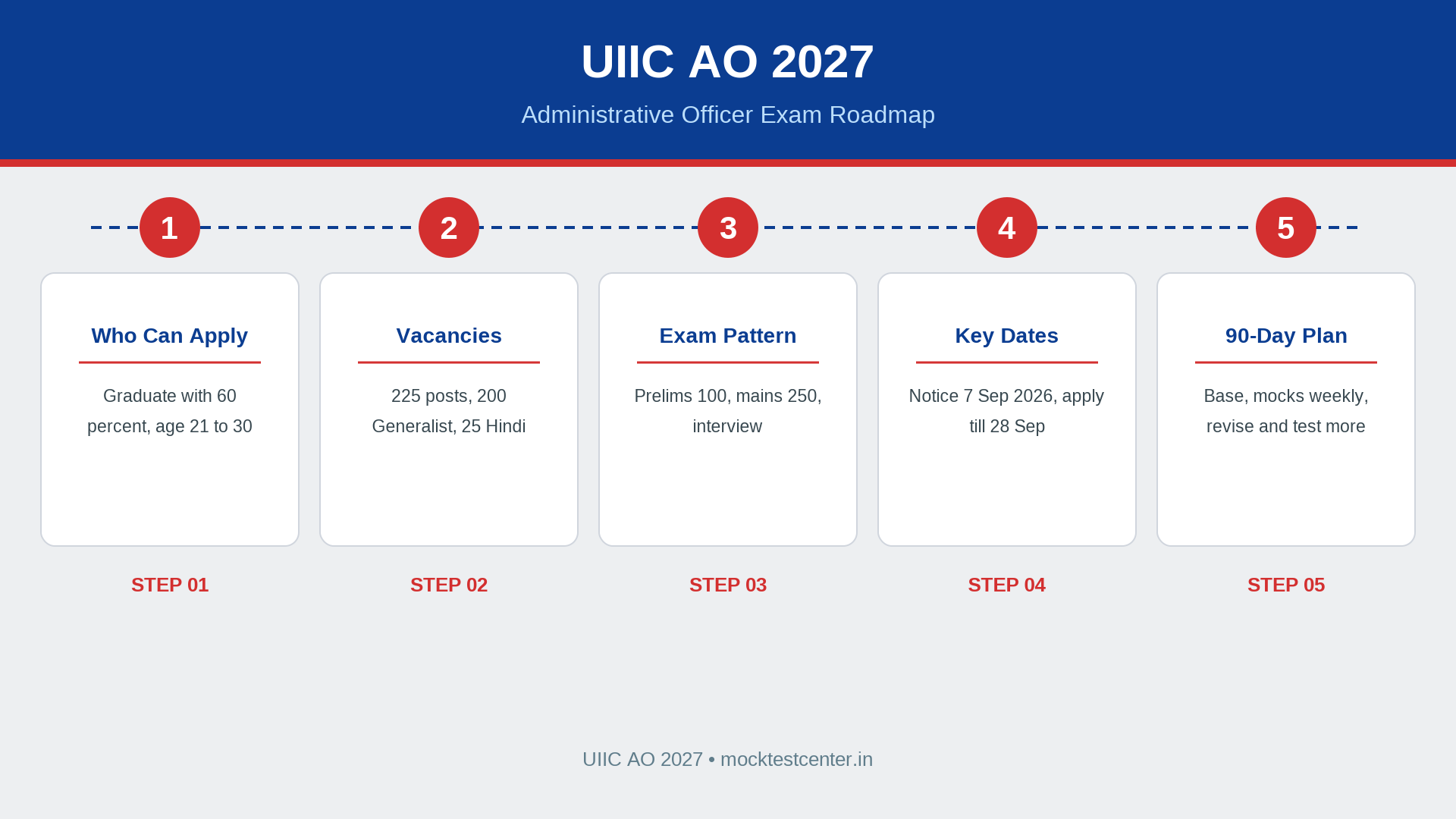
UIIC AO 2027 is the UIIC Administrative Officer recruitment of the United India Insurance Company, a public sector general insurer owned by the Government of India. The latest cycle is the 2026 notification, released on 7 September 2026, for 225 Administrative Officer Scale I posts. Of these, 200 posts are for Generalists and 25 are for Hindi Officers. Applications ran from 8 to 28 September 2026. The selection has four parts: a preliminary exam, a main exam, a descriptive test, and an interview. The preliminary exam was tentatively set for 22 October 2026 and the main exam for 30 November 2026.
That is the short version. The longer version matters more, because this exam changed shape between its two recent cycles. In 2024, UIIC ran a single online test of 200 questions for 250 marks, then a descriptive test and an interview. In 2026, UIIC added a preliminary exam in front of the main exam. Candidates who prepare from old 2024 material without knowing this will walk into a paper they did not expect. This page follows the 2026 notification as the main source and uses the 2024 cycle only where it explains what changed.
An Administrative Officer at UIIC is a Scale I officer, the entry grade for officers in the company. Generalists handle underwriting, claims, marketing, and branch work across motor, health, fire, and marine insurance. Hindi Officers handle official language work, translation, and Hindi implementation across the company. Both start on the same officer scale, but the entry test is different, and a candidate can apply for one discipline only, not both. Picking the wrong one wastes the whole attempt, so the choice gets its own section below.
UIIC itself is one of the four public sector general insurers in India. The company was incorporated on 18 February 1938 in Chennai, nationalised in 1972, and now works under the Ministry of Finance. Its head office stands at 24 Whites Road, Chennai. The company reports 30 regional offices and 1,537 operating offices across the country, with more than 9,000 employees and over 1.38 crore customers. A posting can come anywhere in India, and the notification says so in plain words. Candidates who want a job only in their home city should read the posting rules before they apply, not after they clear the interview.
Check the official careers page at uiic.co.in for every notice, because only the official notice is final. The figures in this article come from the 2026 notification as reported by the Times of India, Oliveboard, Jagran Josh, and Testbook, and from the 2024 notification as carried in the official PDF. Where trackers disagree, this page says so and does not pick a winner by guesswork.
The 2026 notification at a glance
The table below holds the facts a candidate needs before anything else. Read it once, then read the sections that follow for what each line means in practice.
| Detail | UIIC AO 2026 |
|---|---|
| Company | United India Insurance Company Limited |
| Post | Administrative Officer, Scale I |
| Disciplines | Generalist and Hindi Officer |
| Total posts | 225 |
| Generalist posts | 200 |
| Hindi Officer posts | 25 |
| Notification date | 7 September 2026 |
| Apply online | 8 to 28 September 2026 |
| Preliminary exam | 22 October 2026, tentative |
| Main exam | 30 November 2026, tentative |
| Age as on | 21 to 30 years as on 30 June 2026 |
| Fee | 1,000 rupees plus GST; 250 rupees plus GST for SC, ST, PwBD and permanent UIIC employees |
| Starting basic pay | 82,485 rupees a month |
| Gross pay, metro cities | About 1,10,000 rupees a month |
| Selection | Prelims, mains, descriptive test, interview |
Two dates in that table carry the word tentative, and that word is doing real work. UIIC fixed the preliminary exam for 22 October 2026 and the main exam for 30 November 2026 in the notification, but both dates were marked tentative. The 2024 cycle shows why that matters. Its notification first named 14 December 2024 as the exam date, and the exam was later moved to 21 December 2024. Treat every UIIC exam date as fixed only when the call letter arrives, and keep the week around the date free.
The vacancy split inside the 225 posts is worth a close look. Generalists take 200 posts: 68 unreserved, 62 OBC, 30 SC, 22 EWS, and 18 ST. Hindi Officers take 25 posts: 11 unreserved, 7 OBC, 4 SC, 2 EWS, and 1 ST. The notification adds horizontal reservation of 4 percent for persons with benchmark disabilities. All 225 posts are provisional, and UIIC says the numbers can change or be interchanged between categories during the process. A provisional number is still the best planning figure available, but it is not a promise.
The 2026 cycle is the one this page is built around, and the year in the page title needs a word of explanation. The notification came out in September 2026 and the exams were set for October and November 2026, yet candidates search for this exam as UIIC AO 2027. That happens because the selection runs past the new year, with interviews and joining stretching into 2027, and because every exam guide on the internet carries the 2027 label. This page uses the 2027 label to match what candidates search for, but every date and figure in it belongs to the 2026 notification unless the text says otherwise.
Generalist or Hindi Officer: pick one, not both
The first decision in this exam is also the easiest one to get wrong. UIIC allows one application per candidate, for Generalist or Hindi Officer, not both. Two applications mean disqualification. The two disciplines share a preliminary exam, then split completely at the main exam, so the choice shapes the whole preparation.
Generalist is the open door. Any graduate or postgraduate in any discipline can apply, provided the marks rule is met. The main exam for Generalists tests English, reasoning, quantitative aptitude, general awareness with reference to the financial sector, and computer knowledge, then a descriptive test in English. No subject degree is needed. A commerce graduate, an engineering graduate, and an arts graduate all sit the same paper. With 200 posts against 25, Generalist is also where most of the seats sit.
Hindi Officer is the narrow door. It needs a master's degree with Hindi and English in the combination the notification sets out, with 60 percent marks, or 55 percent for SC, ST, and PwBD candidates. The accepted combinations are a master's degree in Hindi with English as a compulsory or elective subject or as the medium of examination, a master's degree in English with Hindi in the same way, or a master's degree in another subject with Hindi and English covered as medium or as compulsory or elective subjects. The main exam for Hindi Officers replaces much of the Generalist paper with a professional knowledge paper worth 100 marks, and the descriptive test runs in both English and Hindi for 50 marks over 60 minutes. Only 25 posts exist, so the contest is small in numbers and sharp in skill.
A practical test settles the choice. If you hold a master's degree in Hindi or English with the marks the notification asks for, and you can translate a newspaper editorial both ways without a dictionary, Hindi Officer is a real option. If you do not hold that degree, the choice is already made for you. Generalist is your exam. If you hold the degree but your Hindi writing is weak, Generalist is still the safer pick, because the Hindi Officer professional knowledge paper is worth half the main exam marks and cannot be carried by the other sections.
One more difference matters after selection. Hindi Officers work in official language departments, while Generalists rotate through underwriting, claims, and branch operations. Both are Scale I officers with the same pay scale. The work differs, the grade does not.
Who can apply: the 60 percent rule and the age window
Eligibility for UIIC AO 2026 rests on three conditions, and all three are measured as on 30 June 2026. The degree must be complete by that date. A candidate whose final result came after 30 June 2026 is not eligible, even if the degree itself is the right one. Working knowledge of computers is also mandatory, which the notification states as a separate condition.
For Generalists, the rule is a graduate or postgraduate degree in any discipline from a recognised university, with 60 percent marks in either the degree or the postgraduate examination. SC, ST, and PwBD candidates need 55 percent. Read that line twice, because it catches people every year. The 60 percent is needed in one of the two examinations, graduation or post graduation, not in both. A candidate with 58 percent in graduation and 65 percent in post graduation clears the rule. A candidate with 59 percent in both does not. Check the marksheets before paying the fee, because the fee is not refunded.
For Hindi Officers, the rule is a master's degree in the Hindi and English combinations described above, with 60 percent marks, or 55 percent for SC, ST, and PwBD candidates. The notification sets out five accepted combinations, and they turn on whether Hindi or English was the medium of examination or a compulsory or elective subject. A candidate with a master's degree in Hindi literature who never studied English at degree level does not meet it. A candidate with a master's degree in history, Hindi medium, with English as a compulsory subject does meet it, if the marks are there.
Age runs from 21 to 30 years as on 30 June 2026. That means a date of birth between 30 June 1996 and 30 June 2005, both days included. Relaxation follows government rules: 5 years for SC and ST, 3 years for OBC in the non creamy layer, 10 years for persons with benchmark disabilities, 5 years for ex-servicemen, 3 years for defence personnel disabled in operations, 9 years for widows, divorced women, and women legally separated and not remarried, and 8 years for confirmed employees of public sector general insurance companies. The relaxation is added to the upper limit only. The lower limit of 21 years does not move.
Nationality follows the usual pattern for public sector recruitment: Indian citizens can apply, and the notification also covers the categories of persons of Indian origin and subjects of Nepal and Bhutan that government rules allow. Candidates in those categories should read the nationality clause in the notification itself, because the conditions differ by category.
One condition in the 2026 notification deserves attention because other officer exams do not have it. A candidate already working as an Administrative Officer Scale I in UIIC cannot apply. The rule blocks serving officers of the same grade from re-entering through the same door. It does not block clerks or assistants of UIIC, who can apply like anyone else.
The 2024 cycle: what happened and what changed
The 2024 cycle is the closest comparison for the 2026 exam, and the differences between the two cycles tell a candidate more than any single table. UIIC released the 2024 notification on 14 October 2024 for 200 Administrative Officer Scale I posts. Applications ran from 15 October to 5 November 2024. The exam was first set for 14 December 2024 and later moved to 21 December 2024. Call letters came about ten days before the exam.
The 2024 split was different from 2026. It offered 100 Generalist posts and 100 Specialist posts. The specialists were Risk Management with 10 posts, Finance and Investment with 20, Automobile Engineers with 20, Chemical Engineers or Mechatronics Engineers with 10, Data Analytics with 20, and Legal with 20. Category wise, each half had 15 SC, 7 or 8 ST, 27 OBC, 10 EWS, and 40 or 41 unreserved posts. The 2026 cycle dropped the specialist disciplines entirely and replaced them with 25 Hindi Officer posts. A candidate with an engineering or law degree who waited for a 2026 specialist notice found no specialist door at all.
The selection shape changed too. The 2024 cycle used a single online test of 200 questions for 250 marks in 150 minutes, followed by a descriptive test of 30 marks in 30 minutes and an interview. The 2026 cycle put a preliminary exam of 100 questions for 100 marks in 60 minutes in front of the main exam, and kept the descriptive test and interview after it. The main exam kept the 200 question, 250 mark, 150 minute shape for Generalists. The preliminary exam is qualifying only. Its marks stay out of the final merit, yet a candidate must clear it to reach the main exam at all.
The pay changed the most. In 2024, the starting basic pay was 50,925 rupees, in the scale of 50,925 to 2,500 for 14 stages to 85,925, then 2,710 for 4 stages to 96,765. The gross pay was about 88,000 rupees a month at metro centres. In 2026, the starting basic pay is 82,485 rupees, in the scale of 82,485 to 4,050 for 14 stages to 1,39,185, then 4,390 for 4 stages to 1,56,745. The gross pay is about 1,10,000 rupees a month at metro centres. That is a jump of more than 60 percent in starting basic pay in two years, which reflects the wage revision for public sector general insurance officers. Candidates comparing UIIC AO with other insurance officer exams should use the 2026 figures. The 2024 pay figures are history now.
The fee did not change. Both cycles charged 1,000 rupees plus GST for most candidates, and 250 rupees plus GST as service charges only for SC, ST, PwBD candidates and permanent employees of the company. The age window stayed at 21 to 30 years in both cycles, with the cut off date moving from 30 September 2024 to 30 June 2026. The 2024 cycle also set the 60 percent marks rule for Generalists, which the 2026 cycle kept.
One detail from the 2024 cycle needs a flag, because tracker pages print two different section tables for it. Oliveboard's 2024 table gives English 50 questions for 60 marks, reasoning 50 for 50, quantitative aptitude 40 for 50, general awareness 40 for 50, and computer knowledge 20 for 40, totalling 200 questions and 250 marks. Other tracker pages give different splits for the same paper, with English at 40 questions and computer knowledge at 20 marks. The totals agree at 200 questions and 250 marks, but the section splits do not. This page prints the 2026 section tables, where the sources agree, and does not print a 2024 section table as fact. Candidates preparing from 2024 papers should check the section marks on the paper itself, not on a tracker page.
The preliminary exam, section by section
The preliminary exam is common to Generalists and Hindi Officers. It has 100 questions for 100 marks in 60 minutes, with a separate timer for each section. English Language gives 30 questions for 30 marks in 20 minutes. Reasoning gives 35 questions for 35 marks in 20 minutes. Quantitative Aptitude gives 35 questions for 35 marks in 20 minutes. Every question carries one mark, and every wrong answer costs one fourth of the marks assigned to that question. Unanswered questions cost nothing. The exam runs in English and Hindi, except for the English Language test, which runs in English only.
The preliminary exam is a filter, not a ranking. A candidate must clear the sectional cut off in each section and the overall cut off that UIIC sets. The final merit ignores these marks. That changes how a candidate should treat the paper. The goal is to clear it with a margin, not to top it. A candidate who scores 90 out of 100 and a candidate who scores 70 both reach the main exam on equal footing, provided both clear the cut offs. The extra twenty marks buy nothing. The time spent chasing them in the preliminary exam is time taken from main exam preparation.
English in the preliminary exam is thirty questions in twenty minutes, which is forty seconds per question. Reading comprehension, cloze tests, error spotting, and vocabulary carry the section. The pace is the problem, not the difficulty. A candidate who reads one editorial a day and marks the sentence structures in it will find the comprehension passages familiar in shape. The grammar questions still need practice, because they test rules that daily reading does not teach on its own.
Reasoning in the preliminary exam is thirty five questions in twenty minutes, which is about thirty four seconds per question. Puzzles, seating arrangements, coding and decoding, blood relations, syllogisms, and inequalities share the section. Puzzles and seating arrangements eat time, so the working rule is simple. Judge a question in five seconds. If the shape is clear, solve it. If it is not, mark it and move on. A skipped question costs nothing. A wrong guess costs a fourth of a mark, and a puzzle that swallows five minutes costs the five questions after it.
Quantitative aptitude in the preliminary exam is thirty five questions in twenty minutes, at the same pace as reasoning. Simplification, number series, data interpretation, arithmetic, and approximation share the section. The arithmetic here is the arithmetic of daily banking work: percentages, ratios, profit and loss, simple and compound interest, time and work. Data interpretation carries the most marks per minute when the candidate is fast at reading tables, and the least when the candidate is not, so practice should start with tables and end with the harder topics.
Sectional timing is the quiet trap in this paper. Each section has its own twenty minutes, and time left in one section does not move to the next. A candidate who finishes English in twelve minutes cannot give the spare eight minutes to reasoning. Practice must follow the same shape, with a timer per section, not a single timer for the whole paper. Mock tests for this exam should be taken in the same three blocks of twenty minutes.
The main exam for Generalists, section by section
The Generalist main exam is the paper that decides the merit list, so it deserves the most preparation time. It has 200 questions for 250 marks in 150 minutes, with a separate timer for each section. English Language gives 40 questions for 50 marks in 30 minutes. Reasoning gives 50 questions for 60 marks in 40 minutes. Quantitative Aptitude gives 50 questions for 60 marks in 40 minutes. General Awareness with special reference to the financial sector gives 40 questions for 60 marks in 30 minutes. Computer Knowledge gives 20 questions for 20 marks in 10 minutes. Negative marking is one fourth of the marks assigned to the question for each wrong answer, and there are sectional and overall cut offs.
| Section, Generalist mains | Questions | Marks | Minutes |
|---|---|---|---|
| English Language | 40 | 50 | 30 |
| Reasoning | 50 | 60 | 40 |
| Quantitative Aptitude | 50 | 60 | 40 |
| General Awareness, financial sector | 40 | 60 | 30 |
| Computer Knowledge | 20 | 20 | 10 |
| Total | 200 | 250 | 150 |
English in the mains gives forty questions in thirty minutes, which is forty five seconds per question. The marks per question are higher than in the preliminary exam, so each question is worth more. Reading comprehension carries long passages, and the cloze test and error spotting reward a candidate who reads regularly. The letter and essay in the descriptive test use the same skills, so English preparation serves two papers at once. A candidate who writes one letter and one essay a week from the start of preparation will find the descriptive test easy on the day.
Reasoning in the mains gives fifty questions in forty minutes, which is forty eight seconds per question. The section is the joint largest in the paper by marks, at 60 out of 250. Puzzles and seating arrangements return at a harder level than in the preliminary exam, along with input and output, data sufficiency, and critical reasoning. The scoring rule here is the same as in the preliminary exam, but the stakes are higher because these marks count in the final merit. A candidate should spend the first minute of the section scanning for the easy questions and clearing them first, then return to the puzzles with the time that remains.
Quantitative aptitude in the mains gives fifty questions in forty minutes, also worth 60 marks. Data interpretation sets carry the most marks in this section, and they reward a candidate who can read a table fast and compute percentages without a calculator. Number series and simplification are the quick marks. Arithmetic from profit and loss, interest, time and work, and probability fills the rest. The section punishes a candidate who solves every question in order, because the hard questions sit mixed with the easy ones. Skip fast, return later, and keep the easy marks safe.
General awareness with special reference to the financial sector gives forty questions for 60 marks in thirty minutes, which makes it the highest value section per question in the paper. Each question is worth one and a half marks on average. The section covers current affairs from the last six months, the Union Budget, RBI monetary policy, repo rate and reverse repo rate, CRR and SLR, insurance regulation, IRDAI, government schemes, and major appointments. A candidate who reads the business page every morning and keeps a notebook of one line per story will cover most of it. The insurance part is where general awareness preparation pays off twice, because the same facts appear in the interview. Know the difference between motor, health, fire, and marine insurance, know what a premium is, and know what IRDAI does.
Computer knowledge gives twenty questions for 20 marks in ten minutes, which is thirty seconds per question. The section covers computer basics, MS Office, the internet, networking, and security. It is the smallest section in the paper, and it is also the easiest to finish. Ten minutes for twenty questions leaves no time to think, so the answers must come from memory. A candidate who uses a computer every day still needs to revise the terms, because the questions ask for names and definitions, not for skill at using a computer.
The main exam for Hindi Officers
The Hindi Officer main exam has a different shape, because it tests professional knowledge instead of the full Generalist paper. It has 150 questions for 200 marks in 120 minutes, with a separate timer for each section. English Language gives 25 questions for 25 marks in 20 minutes. Reasoning gives 25 questions for 25 marks in 30 minutes. Professional Knowledge gives 50 questions for 100 marks in 50 minutes. General Awareness gives 25 questions for 25 marks in 10 minutes. Computer Knowledge gives 25 questions for 25 marks in 10 minutes.
| Section, Hindi Officer mains | Questions | Marks | Minutes |
|---|---|---|---|
| English Language | 25 | 25 | 20 |
| Reasoning | 25 | 25 | 30 |
| Professional Knowledge | 50 | 100 | 50 |
| General Awareness | 25 | 25 | 10 |
| Computer Knowledge | 25 | 25 | 10 |
| Total | 150 | 200 | 120 |
Professional knowledge is half the paper, at 100 out of 200 marks. It tests Hindi and English grammar, official language rules, translation, and the language policy of the Government of India. A candidate with a master's degree in Hindi should find the grammar familiar, but the official language rules need separate study. The Official Languages Act, the rules for Hindi implementation in public sector offices, and the translation of official documents all appear here. This is the section that decides the Hindi Officer merit list, and a candidate who treats it as a language paper like any other will lose marks to candidates who studied the rules.
The other sections are smaller but still carry cut offs. English gives twenty five questions in twenty minutes. Reasoning gives twenty five questions in thirty minutes, which is the most generous pace in either main exam, at more than a minute per question. General awareness gives twenty five questions in ten minutes, which is twenty four seconds per question, the fastest pace in the paper. Computer knowledge gives twenty five questions in ten minutes as well. A Hindi Officer candidate must clear the cut off in every section, so no section can be left to chance, even the small ones.
The descriptive test for Hindi Officers is longer and harder than the Generalist one. It carries 50 marks over 60 minutes, with five tasks of 10 marks each: an English essay, a Hindi essay, Hindi letter writing, English to Hindi translation, and Hindi to English translation. The test runs online, immediately after the objective test, and answers are typed on the computer. A candidate who writes Hindi only by hand will struggle with the keyboard, so typing practice in Hindi is part of the preparation, not an afterthought. The descriptive test is qualifying in nature. Its marks stay out of the final merit, yet a fail in it ends the run.
The descriptive test and the interview
The Generalist descriptive test carries 30 marks over 30 minutes, with two tasks: letter writing for 10 marks and essay writing for 20 marks. It runs in English, online, immediately after the objective main exam. The candidate types the answers on the computer. The test is qualifying in nature, and its marks stay out of shortlisting for the interview and out of the final merit. That last line is often misread. Qualifying does not mean unimportant. A candidate who fails the descriptive test does not reach the interview, whatever the objective score. A candidate who passes it with the minimum score reaches the interview on the same footing as a candidate who scored full marks in it.
Letter writing in this test follows the formal letter shape: address, date, subject, salutation, body, and closing. The topics are usually drawn from insurance, banking, or public life, such as a letter to a newspaper editor on road safety or a letter to a bank manager on a loan query. Essay writing gives one topic from current affairs, the economy, or insurance, and the candidate must write a structured piece with an introduction, a body, and a close. Thirty minutes for two tasks is tight. A candidate should plan five minutes for the letter and twenty five minutes for the essay, including two minutes to read the topics and choose. Practice with a timer, because a good essay that stops halfway scores less than a complete essay that is plain.
The interview is the last stage. UIIC calls candidates for the interview in a number up to three times the vacancies notified for the respective category and discipline. With 225 posts, that means up to about 675 candidates reach the interview, spread across categories and disciplines. The interview panel asks about the candidate, the home state, insurance basics, current affairs, and the reasons for choosing UIIC. A candidate should be able to explain what general insurance is, how it differs from life insurance, what UIIC does, and why an officer post in a public sector insurer fits the candidate. The panel can tell at once whether the answers come from real reading or from a guidebook.
The final merit list uses the main exam objective test and the interview in the ratio of 75 to 25. The preliminary exam marks stay out. The descriptive test marks stay out. That ratio shapes the whole preparation. The main exam objective test carries three times the weight of the interview, so the written paper decides the list and the interview confirms it. A candidate should put the most energy into the 250 mark objective paper, then prepare the interview with real reading rather than rehearsed answers. One loan file handled, one claim seen, one insurance story followed in the news all carry more weight in the interview than any memorised definition.
After the interview comes document verification, medical fitness, and the appointment. The notification asks for a guarantee bond of five years of service, including the probation period. Leaving before that period attracts liquidated damages along with a charge of 35,000 rupees toward onboarding and integration cost. The probation period is one year, extendable at the discretion of the company, and the officer must clear the non life Licentiate Examination of the Insurance Institute of India during probation for confirmation. These are real conditions, not fine print, and a candidate should read them before applying.
Pay, bond, probation, and the first posting
The pay is the strongest reason to take this exam seriously. The starting basic pay for an Administrative Officer Scale I is 82,485 rupees a month, in the scale of 82,485 to 4,050 for 14 stages to 1,39,185, then 4,390 for 4 stages to 1,56,745. The gross pay works out to about 1,10,000 rupees a month at metropolitan centres. The benefits on top of the pay include gratuity, leave travel subsidy, medical benefits, group personal accident insurance, the National Pension System, and leased accommodation as per company rules.
That pay is high when placed next to the other insurance officer exams. The NIACL AO 2027 post carries a starting basic pay of 50,925 rupees, and the NICL AO 2027 post carries the same 50,925 rupees, both with a gross pay near 90,000 rupees a month at metro centres. UIIC AO starts about 31,000 rupees higher in basic pay and about 20,000 rupees higher in gross pay. The gap comes from the wage revision, and it may narrow when the other insurers revise their scales. For now, it is real, and it explains why the UIIC AO 2026 notification drew heavy attention when it came out.
The bond and the posting rules are the other side of the pay. The selected officer must serve a minimum of five years at the initial posting, and requests for a transfer to a place of choice will not be entertained during that period. After five years, transfers run on an all India basis as per the applicable rules. The probation period is one year, extendable at the discretion of the company, and confirmation needs the non life Licentiate Examination of the Insurance Institute of India. The guarantee bond runs for five years including probation, and leaving early attracts liquidated damages plus a charge of 35,000 rupees toward onboarding and integration cost. A candidate who wants a posting in one city and one city only should think hard before applying, because UIIC posts officers anywhere in India.
There is also a practical point about the first five years. An officer posted far from home for five years builds a life in that place, and the transfer after five years is not a right but a process governed by company rules. Candidates who apply for the love of the pay should also accept the posting. Candidates who cannot accept a posting anywhere in India should pick an exam with a home state posting instead.
How to apply, what it costs, and what to keep ready
Applications for the 2026 cycle ran online only, through the recruitment section of the UIIC website, from 8 to 28 September 2026. The fee was 1,000 rupees plus GST for most candidates, and 250 rupees plus GST as service charges only for SC, ST, PwBD candidates and permanent employees of the company. The fee and the service charges are not refunded. The last date for fee payment was the same as the last date to apply, 28 September 2026.
The application asked for a photograph, a signature, a left thumb impression, and a handwritten declaration, uploaded in the formats the notification sets out. The candidate also needed personal details, educational details, and payment details ready before starting. The system generated a provisional registration number and password, which the candidate needed to keep for the call letter. Changes to details such as name, category, date of birth, address, mobile number, email, and examination centre were not permitted after submission, so the preview step mattered. A candidate should check the preview twice, because a wrong centre or a wrong category cannot be fixed later.
The call letters for the online examinations were expected about seven days before each examination date. The preliminary exam call letter and the main exam call letter are separate, and the main exam call letter goes only to candidates who cleared the preliminary exam. The interview call letter follows the main exam result. Candidates should check the email and mobile number given in the application, because UIIC sends the updates there.
For the next cycle, the application window will follow the same shape: an online form, a fee, and document uploads. The dates will be new, and the fee may change. The documents will not change much, so a candidate can keep a photograph, a signature, thumb impression, and a handwritten declaration ready in the right sizes. The marksheets and the degree certificate should be kept ready too, because the 60 percent rule is checked against them, and a candidate who cannot show the marksheet at verification loses the seat.
A 90 day preparation plan that fits this paper
Ninety days is enough for this exam if the days are used in the right order. The plan below splits the time into three blocks of thirty days, and each block has one job. The preliminary exam and the main exam share three subjects, so preparation for one serves the other, but the main exam needs more depth in general awareness and more speed in reasoning and quantitative aptitude.
Days 1 to 30 build the base. Learn the syllabus of each subject from the start, and finish one topic a day. Reasoning gets puzzles, seating arrangements, coding and decoding, and syllogisms. Quantitative aptitude gets simplification, number series, percentages, ratios, and data interpretation. English gets reading comprehension, cloze tests, and error spotting. General awareness gets the last six months of current affairs plus the basics of RBI, IRDAI, and insurance. Computer knowledge gets one hour a week, because it is small. Take one mock test a week in this block, and use it to find the weak subject, not to chase a score.
Days 31 to 60 add speed and mocks. Take two mock tests a week, in the exact pattern of the paper, with a timer per section. Review every wrong answer the same day, and write the reason for the mistake in one line. If a puzzle type keeps failing, drop it for a week and return to it later. If data interpretation is slow, practise one set a day for ten days. Start the descriptive practice now: one letter and one essay a week, written by hand first, then typed. Start the general awareness notebook now, with one line per story, and revise the notebook every Sunday.
Days 61 to 90 are for the main exam. Take three mock tests a week, and take them at the same time of day as the real exam. Revise the general awareness notebook daily, and note the current repo rate, reverse repo rate, CRR, and SLR a week before the test. Revise the insurance basics: types of insurance, what a premium is, what a claim is, and what IRDAI does. Practise the descriptive test twice a week with a timer, because thirty minutes for a letter and an essay needs practice to finish on time. In the last week, stop learning new topics. Revise the notes, take one final mock, and rest the day before the exam.
Mock tests deserve a word of their own. A mock test is useful only if it matches the real paper in questions, marks, and sectional timing. A mock with the wrong pattern teaches the wrong pace. Take mocks that follow the 2026 pattern: 100 questions in 60 minutes for the preliminary exam, and 200 questions in 250 marks and 150 minutes for the Generalist main exam. Review the mock the same day, while the mistakes are still fresh. A mock taken and never reviewed is time spent, not preparation done.
Other exams worth knowing, and how UIIC AO differs
UIIC AO sits in a group of insurance and banking officer exams, and candidates often prepare for two or three of them at once. The LIC AAO 2027 exam is the life insurance equivalent, with a preliminary and main exam and an interview, but life insurance work and a different syllabus. The IRDAI Assistant Manager 2027 exam is the regulator side, with a smaller intake and a harder paper. The SBI PO 2027 exam and the IBPS PO 2027 exam are the banking equivalents, with larger intakes and a transfer policy that moves officers across the country. The ECGC PO 2027 exam is a smaller specialist post in export credit. The RBI Grade B 2027 exam is the top of the group, with a much harder paper and a much smaller intake.
The UIIC Assistant 2027 exam is the closest relative of all, because it is the same company with a different post. The Assistant exam has one online test of 200 questions for 250 marks in 120 minutes, then a regional language test, and no interview. The AO exam has a preliminary exam, a main exam, a descriptive test, and an interview, with a starting basic pay of 82,485 rupees against the Assistant starting basic pay of 22,405 rupees. A graduate can apply for both, but the preparation differs, because the AO main exam tests general awareness with reference to the financial sector at a deeper level and adds a descriptive test. The LIC ADO 2027 exam is the other clerical level post that candidates often compare with UIIC Assistant, but it is a sales and development role, while UIIC Assistant is a back office role.
The honest advice is to pick one officer exam as the main target and one clerical exam as the backup, and to prepare for both from the same base. Reasoning, quantitative aptitude, and English are common to all of them. General awareness and insurance knowledge need separate work for UIIC AO. A candidate who prepares for five exams at once prepares for none of them well.
Mistakes that end runs in this exam
The first mistake is applying for both disciplines. UIIC allows one application only, for Generalist or Hindi Officer, not both. Two applications mean disqualification, and the fee is gone with it. The second mistake is the 60 percent rule. A candidate with 59 percent in graduation and 59 percent in post graduation does not clear the rule, and no amount of preparation fixes that. Check the marksheets before paying the fee.
The third mistake is preparing for the 2024 paper instead of the 2026 paper. The 2024 cycle had one online test. The 2026 cycle has a preliminary exam and a main exam. A candidate who practises only the 200 question paper will find the preliminary exam unfamiliar in pace, and the sectional timing will catch them out. Practise both papers, in their own shapes, with their own timers.
The fourth mistake is ignoring the descriptive test. It is qualifying, so candidates treat it as unimportant, and then fail it. Thirty minutes for a letter and an essay needs practice. A candidate who has never typed an essay in thirty minutes should not meet that task for the first time on exam day.
The fifth mistake is ignoring the bond and the posting rule. Five years at the first posting, with no transfer to a place of choice, is a long time. A candidate who joins and then tries to leave faces liquidated damages and a 35,000 rupee charge. Read the conditions before applying, not after joining.
The sixth mistake is waiting for the notification to start preparation. The 2026 notification gave twenty days to apply and about six weeks to the preliminary exam. That is not enough time to learn reasoning, quantitative aptitude, and English from zero. Preparation should start now, on the 2026 pattern, so that the next notification finds the candidate ready.
Sources
uiic.co.in, the official website of the United India Insurance Company, for all notifications and the recruitment section. The Times of India report on the UIIC AO recruitment 2026, 7 September 2026, for the 225 vacancies, the dates, and the eligibility conditions. Oliveboard, UIIC AO Notification 2026, for the vacancy split, the fee, the preliminary and main exam patterns, and the descriptive test. Jagran Josh, UIIC AO Notification 2026, for the notification date, the application window, and the fee. Testbook, UIIC AO Exam Date 2026, for the preliminary and main exam dates and the basic pay of 82,485 rupees. BankersAdda, UIIC AO vs NIACL AO, for the pay scale of 82,485 to 1,56,745, the gross pay of about 1,10,000 rupees, the 75 to 25 final merit ratio, and the five year bond. RightGuruji, UIIC AO Recruitment 2026, for the probation period, the Licentiate Examination, and the 35,000 rupee onboarding charge. The official UIIC AO 2024 notification PDF, for the 200 posts, the specialist split, the application window, the exam date, and the pay scale of 50,925 rupees. Wikipedia, United India Insurance Company, for the incorporation date of 18 February 1938, the Chennai head office, and the 1,537 operating offices.