About SBI CBO 2027 Exam Series
📖 Table of Contents
- What SBI CBO 2027 is
- Who can apply: the two year rule that catches everyone out
- The 2,273 posts: what the January 2026 cycle offered
- The January 2026 cycle, date by date
- The online test, section by section
- The descriptive test: letter and essay in 30 minutes
- Screening: the stage with no marks and real power
- The interview and how the final list is made
- The local language test
- Pay: what a CBO actually takes home
- CBO next to PO and Clerk: pick the right door
- A 90 day plan that fits around a bank job
- Mistakes that cost experienced bankers this exam
SBI CBO 2027: Circle Based Officer Pattern, Salary, Dates
What SBI CBO 2027 is
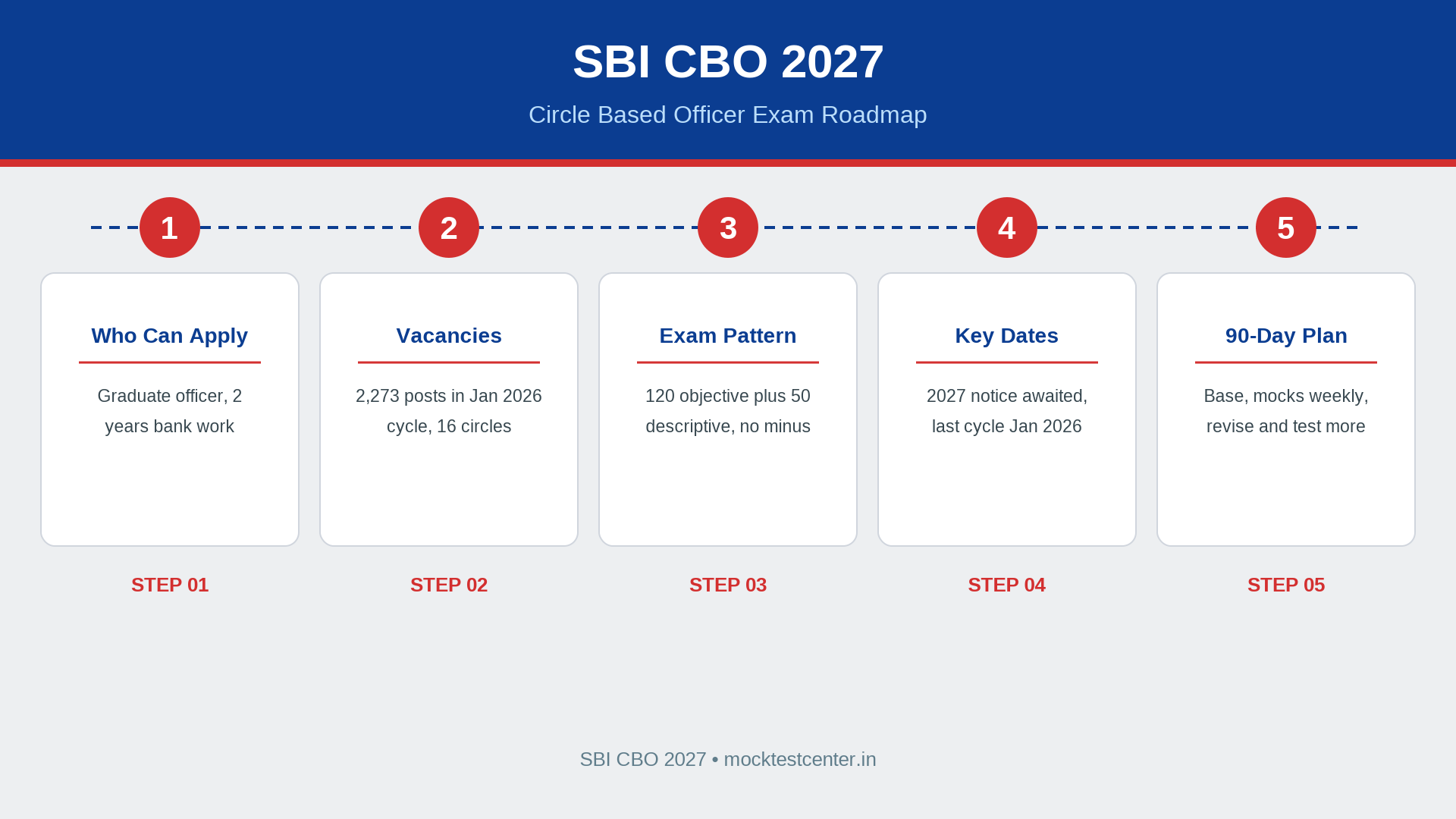
SBI CBO 2027 is the next recruitment of Circle Based Officers by the State Bank of India. It is an officer post in Junior Management Grade Scale I, and it is open only to bankers who already work as officers. A fresh graduate cannot apply. The bank wants people who have spent at least two years as an officer in a Scheduled Commercial Bank or a Regional Rural Bank, and it posts them in the circle they apply for. That single rule shapes the whole exam.
The latest cycle ran under Advertisement Number CRPD/CBO/2025-26/18. SBI released it on 29 January 2026 for 2,273 Circle Based Officer posts, with 2,050 regular vacancies and 223 backlog vacancies across 16 circles. Applications ran from 29 January to 18 February 2026, and a corrigendum dated 11 February 2026 pushed the last date to 25 February 2026. The online test was set for March 2026. No 2027 notice has come out yet, so this page works from the January 2026 cycle and the cycle before it, and it says clearly where the facts end and the guesswork starts.
Check the official careers page at sbi.co.in for every notice, because only the official notice is final. The dates, vacancy counts and pay figures in this article come from the January 2026 advertisement and the reports that followed it. The next notice can change any of them. The pattern, the two year rule and the shape of the job have stayed the same across recent cycles, so they are the safest things to plan around.
SBI is the largest bank in India, with 22,000 branches and a circle structure that divides the country into 16 circles. A Circle Based Officer works in one circle, in branches and offices inside that circle, and handles the same work as any other Scale I officer: deposits, loans, account opening, customer service and branch operations. The difference from a Probationary Officer is the route in. A Probationary Officer enters fresh from college. A Circle Based Officer enters with experience, and the bank expects that experience to show from the first week.
Who can apply: the two year rule that catches everyone out
Three conditions decide whether you can apply for SBI CBO. First, a graduation degree in any discipline from a recognised university. Second, at least two years of experience as an officer in any Scheduled Commercial Bank or any Regional Rural Bank, counted as on 31 December 2025 in the January 2026 cycle. Third, age between 21 and 30 years as on 31 December 2025, which meant birth between 1 January 1996 and 31 December 2004. Miss any one of the three and the application fails, however strong your test score is.
The experience rule is where most applications die. Clerical experience does not count. Work as an officer in a cooperative bank does not count, because a cooperative bank is not a Scheduled Commercial Bank unless it holds that status. Work in a private bank counts only if the bank is a Scheduled Commercial Bank, and the experience must be as an officer, not as a clerk or a sales executive. SBI checks this at the screening stage, after the online test, by reading your experience certificates. A candidate who clears the test and fails screening loses the whole cycle.
One change in the January 2026 cycle helped private bank officers. Earlier CBO notices asked private bank applicants to show a minimum salary, reported as 9.50 lakh rupees a year, as proof of officer level work. The corrigendum of 11 February 2026 removed that salary condition. Private bank officers no longer need to meet any salary figure to apply. If you work in a private bank and held back in earlier cycles because of that clause, it is gone now.
Age relaxation follows government rules. SC and ST candidates get five years, OBC candidates get three years, and persons with benchmark disabilities get ten to fifteen years depending on category. The relaxation applies to the upper age limit only. There is no relaxation on the two year experience rule and no relaxation on the graduation rule. Keep your experience certificates, appointment letter and relieving letter ready before you apply, because SBI asks for them in a short window after the test.
One more point about the circle. You apply for one circle, and the local language of that circle matters. SBI tests local language skill at the end of the process, and the test is covered in its own section below. Pick the circle where you can read, write and speak the local language with ease. A circle with more vacancies looks tempting, but a language test you cannot pass makes those vacancies useless.
The 2,273 posts: what the January 2026 cycle offered
The January 2026 cycle offered 2,273 posts. Of these, 2,050 were regular vacancies and 223 were backlog vacancies. Backlog vacancies are posts kept aside for reserved categories from earlier cycles, and they are filled in the same recruitment. The total sat below the previous cycle, which had offered 2,964 posts under Advertisement Number CRPD/CBO/2025-26/03, with 2,600 regular and 364 backlog vacancies. Two cycles in a row above 2,000 posts tell you this is now a large annual recruitment, not a one off drive.
The posts spread across 16 circles, which cover every state and union territory in the country. The circle wise split changes with each notice, because it follows retirements and branch growth in each circle. The January 2026 notice gave the full circle wise table, with the local language listed against each circle. This article does not reprint that table, because the next notice will print a new one. What matters for planning is the size. With 2,273 posts and a test that only experienced bankers can sit, the field is far smaller than the Probationary Officer exam, where lakhs of fresh graduates apply.
That smaller field is the real attraction of CBO. The SBI PO 2027 exam draws lakhs of candidates for 1,500 posts. The CBO exam draws a much smaller pool, because the two year rule keeps fresh graduates out. The competition is still sharp, because every candidate in the room already works in a bank and knows the syllabus from daily work. But the ratio of candidates to seats is far kinder.
Expect the next notice to sit near the same size. SBI has run CBO recruitment every year since 2020, when the first cycle offered 3,858 posts, and the counts since then have stayed in the thousands. That is a reading of the trend. The notice will give the real number, and any site that prints a 2027 vacancy figure before the notice is guessing.
The January 2026 cycle, date by date
The January 2026 cycle moved fast. SBI released the advertisement on 29 January 2026 and opened applications the same day. The first last date was 18 February 2026. A corrigendum on 11 February 2026 extended it to 25 February 2026 and removed the minimum salary condition for private bank officers. The online test was set for March 2026, as a tentative date in the notice. The full outcome of that cycle, including the test date and the result, was not verified in this pass, so this article does not print them as fact.
| Event | Date |
|---|---|
| Advertisement CRPD/CBO/2025-26/18 released | 29 January 2026 |
| Applications open | 29 January 2026 |
| First last date to apply | 18 February 2026 |
| Corrigendum: last date extended, salary clause removed | 11 February 2026 |
| Extended last date to apply and pay fee | 25 February 2026 |
| Online test | March 2026, tentative |
The cycle before it ran in mid 2025 and shows the same pace. Advertisement Number CRPD/CBO/2025-26/03 came out on 9 May 2025 for 2,964 posts. Applications ran from 9 May to 29 May 2025. SBI reopened the window from 21 June to 30 June 2025 for candidates from Nagaland and Arunachal Pradesh, after adding English as an accepted local language for those states. The online test took place on 20 July 2025. From notice to test took about ten weeks, which is the timeline to expect next time.
Two habits follow from these dates. First, the apply window is short, about three weeks, and it can close early in your mind if you wait for the extension. Apply in the first week. Second, the test follows about six to ten weeks after the last date, so the real preparation must be done before the notice comes out. A banker who starts studying on the day of the notice has about two months. A banker who starts now has the whole year.
The online test, section by section
The online test has two parts that run back to back. The objective test carries 120 marks and takes two hours. The descriptive test carries 50 marks and takes thirty minutes. The total is 170 marks in two and a half hours, with separate timing for each section. You cannot carry time from one section to the next, so the clock matters as much as the questions.
| Section, objective test | Questions | Marks | Minutes |
|---|---|---|---|
| English Language | 30 | 30 | 30 |
| Banking Knowledge | 40 | 40 | 40 |
| General Awareness and Economy | 30 | 30 | 30 |
| Computer Aptitude | 20 | 20 | 20 |
| Total | 120 | 120 | 120 |
English gives thirty questions in thirty minutes. That is one minute per question. Reading comprehension, cloze tests, error spotting and vocabulary carry this section. A working banker reads official letters and mails all day, which helps with comprehension, but the grammar questions still need practice. Read one editorial a day and mark the sentence structures you would have written differently. That habit alone lifts the score.
Banking Knowledge is the biggest section, forty questions in forty minutes, and it is where your job helps most. The questions cover the Reserve Bank of India and its functions, repo rate and reverse repo rate, CRR and SLR, types of accounts and deposits, priority sector lending, KYC norms, digital payment systems such as UPI, NEFT and RTGS, and the basics of loans and NPAs. A candidate who has worked in a branch for two years has seen most of these in real files. The gap is usually the numbers. Repo rate, CRR and SLR change through the year, so note the current figures a week before the test and revise them the night before.
General Awareness and Economy gives thirty questions in thirty minutes. Half of it is current affairs from the last six months, and half is static economy and banking awareness. Government schemes, the Union Budget, RBI monetary policy, major appointments and sports events all appear. Read the business page every morning and keep a notebook of one line per story. Six months of one line a day is about 180 lines, and that notebook covers most of the section.
Computer Aptitude gives twenty questions in twenty minutes. The questions cover hardware and software basics, operating systems, MS Office, the internet, cyber security and banking software. Twenty marks in twenty minutes is the fastest return in the paper, because the questions are direct. A banker who uses the core banking system daily knows more than the syllabus asks. Give this section its place in every mock. It is the easiest twenty marks on the paper.
Two features of this test surprise first time candidates. There is no negative marking in the objective test, so a guess costs nothing and a blank answer gains nothing. And there are no sectional marks in the online examination, which means a weak section cannot fail you on its own. Both facts come from the notification. They change how you should play the paper. Attempt every question, and spend your time where the marks are thickest, which is Banking Knowledge.
The descriptive test: letter and essay in 30 minutes
The descriptive test runs at once after the objective test ends. It carries 50 marks and takes thirty minutes. It has two questions in English: letter writing and essay writing. You type both answers on the computer. Fifty marks out of 170 is close to a third of the written score, so this half hour decides more of the merit list than most candidates expect.
Thirty minutes for two written answers is tight. That is fifteen minutes per answer, and the typing itself takes time. A letter needs a proper format: sender address, date, receiver address, subject line, salutation, body in two or three short paragraphs, and a closing line with your name. An essay needs a clear opening line, two points with one fact each, and a closing line that says what should happen next. Candidates who type slowly lose marks here without knowing it. Practice typing your letters and essays on a keyboard with a timer. If you write 200 words in fifteen minutes with clean grammar, you are ready.
What should the essay say? The topics in past cycles have covered the economy, digital banking, financial inclusion, rural credit and current affairs. A good essay has a clear opening line, two points with one fact each, and a closing line. Do not memorise essays. Memorised essays read stiff and miss the topic. Instead, read the news every day and keep one line of opinion on each big story. That line becomes your essay.
A banker has an edge here, because you have seen financial inclusion and digital payments work in real branches. Use one real detail from your branch, such as a PMJDY account opening drive or a UPI fraud case, and the essay stops sounding like a textbook.
The letter is usually a formal letter to a bank manager, a government officer or an editor. The format carries marks on its own, so learn it by heart. Write the subject line in one line. Keep the body short. End with a clear request. A letter that runs past 150 words wastes time you need for the essay. Practise one letter a week, in fifteen minutes, on a keyboard. After a month you will have four letters to compare, and the format will feel automatic.
Most CBO candidates ignore the descriptive test until the last week, because their job leaves little study time and the objective test feels more urgent. That is a mistake. The objective test has no negative marking, so scores bunch together at the top. The descriptive test is where the merit list spreads out. Give it one hour a week from the start of your preparation. One hour a week for ten weeks is ten hours, and ten hours of writing practice is the difference between a letter that scores 15 and one that scores 30.
Screening: the stage with no marks and real power
After the online test, SBI screens the experience documents of the candidates who cleared it. Screening carries no marks. It decides who goes to the interview and who goes home. The bank reads your appointment letter, your experience certificate and your salary slips, and checks them against the two year rule. A candidate who wrote two years on the form and can prove only twenty months is out, whatever the test score.
Get the papers right before you apply. You need an experience certificate from each bank you worked in, showing your date of joining, your date of leaving, and your designation as an officer. A relieving letter helps. Salary slips for the full period help. If your bank gives experience certificates only after a written request, make that request now, not after the test. HR departments in banks take weeks, and SBI gives a short window for document upload.
Three traps catch candidates here. The first is the designation. A letter that says "Assistant" or "Clerk" does not prove officer experience, even if you did officer work. Ask your HR for a letter that states your officer grade plainly. The second is the gap. A break between two banks is fine, but the total officer experience across all banks must still reach two years. The third is the bank type. Work in a cooperative bank, a NBFC or a fintech does not count. The rule names Scheduled Commercial Banks and Regional Rural Banks only.
Screening also covers the local language. The notification lists a local language for each circle, and the bank checks that you can read, write and speak it. Candidates who studied the local language in Class 10 or 12 and can show a mark sheet or certificate are exempt from the language test in most cycles. Candidates who cannot show that proof take a language proficiency test after selection. Keep your Class 10 mark sheet safe. It is the paper that saves you a test.
The interview and how the final list is made
Candidates who clear screening are called for an interview of 50 marks. The interview panel asks about your banking experience, your current bank, the circle you applied for, basic economics and why you want to join SBI. A banker who has worked for two years should find this easy, but the panel can tell at once whether your answers come from real work or from a guidebook. Prepare with your own stories. One loan file you handled, one difficult customer you managed, one audit finding you fixed. Those stories carry more weight than any rehearsed definition.
The final merit list uses the online test and the interview with a weight of 75 to 25. The online test score out of 170 marks is scaled to 75, and the interview score out of 50 marks is scaled to 25. The written test carries three times the weight of the interview. A strong written score can survive an average interview. A weak written score cannot be rescued by a great interview. Put your energy where the marks are, which is the 170 mark online test.
Work out what that means in practice. A candidate who scores 120 out of 170 in the online test gets about 53 out of 75. A candidate who scores 100 gets about 44. That nine mark gap is larger than the whole interview spread for most candidates, because interview scores bunch between 30 and 40 out of 50, which is 15 to 20 out of 25. The interview matters, but it rarely overturns the written order. The test decides the list. The interview confirms it.
There are no sectional cut offs in the online test, but the interview has minimum qualifying marks. Candidates who score below that line are out, whatever their written score. The exact qualifying marks come in the notification, so check them when it arrives. Treat the interview as a pass or fail gate, not as a place to make up marks, and prepare accordingly. Know your bank, your circle, one recent RBI policy change with a number, and one plain reason you want this job, stated in your own words.
The local language test
The local language test comes at the end, after selection, and it decides whether you can actually work in the circle you applied for. SBI runs it in the local language of the circle. The test checks reading, writing and speaking, and it is qualifying in nature. Candidates who studied the local language in Class 10 or 12 and can show a mark sheet or certificate are exempt in most cycles. Everyone else takes the test.
This matters more than candidates think. A banker from Uttar Pradesh who applies for the Karnataka circle because it has more posts will face a Kannada test. A banker from West Bengal who applies for the Gujarat circle will face a Gujarati test. The circle choice is a language choice first and a vacancy choice second. Pick the circle where the language is yours, even if it has fewer posts. Fewer posts you can actually take beat more posts you cannot.
Two special cases appeared in the 2025 cycle and are worth knowing. For Nagaland and Arunachal Pradesh, SBI accepted English as the local language, provided the candidate had studied English in Class 10 or 12 and could show proof. That change came through a corrigendum that also reopened the apply window from 21 June to 30 June 2025 for those states. Rules like this change with each notice, so read the language column of the circle table in the new notice before you choose.
Start the language work early if you need the test. Read one page of a local newspaper a day, in the local language. Write five lines a day in that language. Speak it with family and colleagues. A month of daily practice is enough to pass a qualifying test if you already speak the language at home. If you do not speak it at all, no amount of last minute study will save you, so do not apply for that circle.
Pay: what a CBO actually takes home
A Circle Based Officer starts in Junior Management Grade Scale I with a basic pay of 48,480 rupees a month, plus two advance increments. The pay scale runs from 48,480 to 85,920 rupees: 48,480 with annual increments of 2,000 rupees seven times to 62,480, then 2,340 rupees twice to 67,160, then 2,680 rupees seven times to 85,920. On top of the basic pay come dearness allowance, house rent allowance, city compensatory allowance, provident fund, pension under NPS, leave fare concession and medical benefits.
The gross monthly pay at the start is reported in the range of 52,000 to 58,000 rupees, depending on the place of posting. A posting in a metro city pays more in house rent allowance and costs more to live in. A posting in a small town pays less and costs less. That range is a reported figure, not a number printed in the notification, so treat it as a guide only. The basic pay of 48,480 rupees is the fixed fact.
Put that pay beside the other officer exams and the picture is fair. The SBI Clerk 2027 exam leads to a clerk post with a starting basic pay of 26,730 rupees, so CBO pays almost twice as much at the start. The IBPS PO 2027 exam and the IBPS RRB PO 2027 exam offer the same Scale I basic pay of 48,480 rupees, so the money is the same and the difference is the route in. The RBI Assistant 2027 exam pays a lower basic pay but sits in the central bank. The LIC AAO 2027 exam and the NIACL AO 2027 exam start higher, at 88,635 and 50,925 rupees, but they take fresh graduates and draw far larger fields.
Two things about the job are worth more than the pay slip. First, a CBO stays in one circle, which means a stable posting near home for most of a career. A Probationary Officer can be posted anywhere in India. Second, the two years you already served count as real banking experience, so you start as an officer who knows the work, not as a trainee. That head start shows in the first promotion cycle, where experience and performance both count.
CBO next to PO and Clerk: pick the right door
SBI runs three doors into officer and clerk posts, and the right door depends on where you stand today. The Probationary Officer door is for fresh graduates with no experience. The Clerk door is for graduates who want a safe entry with many seats and no interview. The Circle Based Officer door is for bankers who already hold an officer post elsewhere and want to move into SBI at the same grade. Each door has its own test, and each test rewards a different kind of candidate.
The PO exam is the hardest of the three to crack, because it has three stages, a mains paper with a descriptive section, a psychometric test, and a group exercise with an interview. It also has the most seats in SBI and the widest career path, because a PO can rise to the top of the bank. The Clerk exam is the easiest to enter, with a prelims and a mains and no interview, but the pay is lower and the promotion path is longer. The CBO exam sits between them. It has a shorter written test with no negative marking, a screening of your experience, and a 50 mark interview. The test is kinder than the PO mains, but the two year rule keeps most graduates out.
A banker with two years of officer experience should take the CBO exam as the main target and the PO exam as a second shot. The syllabus overlaps so much that one preparation serves both. The IBPS SO 2027 exam is a different case, because it needs a specialist degree in IT, law, agriculture, HR or marketing, so it suits a smaller group. The IDBI Executive 2027 exam and the ECGC PO 2027 exam offer other routes into banking and insurance, and the same preparation covers most of their syllabus too. Apply for every exam you are eligible for, and decide when the offers come.
The way to choose is to ask one question. Do you already work as an officer in a bank? If yes, CBO is your shortest path into SBI, and it deserves your main effort. If no, the PO and Clerk exams are your doors, and CBO will wait until you have two years of officer experience. That is the whole decision. Do not spend a year preparing for an exam you cannot apply for.
A 90 day plan that fits around a bank job
A working banker cannot study eight hours a day. Two hours a day is realistic, and two hours a day for ninety days is 180 hours, which is enough. The plan below fits around branch hours, and it treats the descriptive test as a real subject, not an afterthought.
Days 1 to 30 are for the base. Study two hours a day, one hour before the branch opens or after it closes. Cover one Banking Knowledge topic and one English topic each day. Read the news every morning and write five lines in your current affairs notebook. Write one letter and one essay each week, in thirty minutes, on a keyboard. Take one mock at the end of week two and one at the end of week four. Do not worry about the score. The first mocks only show you where you stand.
Days 31 to 60 are for speed. Your SBI CBO 2027 score will move most in this phase, because the paper gives one minute per question and no negative marking, so speed is the whole game. Take two mocks a week now, with the descriptive test included. After each mock, spend as much time on analysis as you spent on the test. Write down every question you got wrong and why. Was it a concept gap, a silly mistake, or a time problem? Concept gaps go back into your study list. Silly mistakes need a checklist before you submit each section. Time problems need easier questions first and hard ones last.
Days 61 to 90 are for the real thing. Take three mocks a week. Revise your error notebook every second day. Stop learning new topics in the last ten days. New topics in the last week add stress and no marks. In the last three days, take one full mock at the same time as your real test slot, then rest. Sleep matters more than one more chapter in the final week. A banker who walks into the test hall tired will make the same mistakes a fresh candidate makes, and the two years of experience will not save the score.
If you have less than ninety days, cut the base phase, not the mocks. Ten mocks with full analysis beat thirty days of reading without a single test. The paper rewards candidates who have sat through the two and a half hour sitting many times. It punishes candidates who know the syllabus and have never felt the sectional timer run out.
Mistakes that cost experienced bankers this exam
The first mistake SBI CBO candidates make is applying without checking the experience rule. A candidate who counts clerical years, or years in a cooperative bank, or years as a sales executive, clears the test and fails screening. The cycle ends there. Count only officer years in Scheduled Commercial Banks and Regional Rural Banks, as on the cut off date in the notice, and get the certificate before you apply.
The second mistake is ignoring the descriptive test. Fifty marks out of 170 is close to a third of the written score. In an exam with no negative marking, objective scores bunch together at the top, and the letter and essay decide the merit list. Give the descriptive test one hour a week from the start. One hour a week for ten weeks is ten hours, and ten hours of writing practice is the difference between a letter that scores 15 and one that scores 30.
The third mistake is picking the wrong circle. A circle with more posts looks tempting, but the local language test at the end is real. Apply for the circle whose language you can read, write and speak. Keep your Class 10 mark sheet ready, because it exempts you from the language test in most cycles.
The fourth mistake is skipping mocks. Reading feels like preparation, but the test measures speed under a timer. Candidates who take fewer than ten mocks before the real test are gambling. Take twenty if you can. Analyse every one. A banker who analyses ten mocks knows the paper better than a banker who reads ten books.
The fifth mistake is waiting for the notice to start. The apply window is about three weeks and the test follows six to ten weeks later. A banker who starts on the day of the notice has about two months. A banker who starts now has the whole year. Start with one SBI CBO 2027 mock this week, letter and essay included. Score it, list your weak section, and give that section thirty minutes a day. That single habit, repeated for ninety days, is what turns a working banker into a Circle Based Officer.