About SBI Apprentice 2027 Exam Series
📖 Table of Contents
- What SBI Apprentice 2027 is
- What an SBI Apprentice actually is
- The 2026 cycle, in full
- Who can apply: the rules, without the fine print hidden
- The exam: 100 questions in 60 minutes
- The local language test: the stage that ends runs
- What Rs 15,000 a month really means
- Where the seats are, and how to pick your state
- Cut-offs: what score you actually need
- SBI Apprentice next to PO, Clerk and CBO
- How to study for each section
- A 60 day plan that fits around a job or a degree
- Mistakes that cost candidates a year
- What to keep ready before the notice comes out
SBI Apprentice 2027: Stipend, Pattern, Seats, Dates
What SBI Apprentice 2027 is
SBI Apprentice 2027 is the next engagement of apprentices by the State Bank of India under the Apprentices Act, 1961. An apprentice trains in an SBI branch for one year, learns branch banking from the inside, and takes home a stipend of Rs 15,000 a month. It is the cheapest ticket into the State Bank of India, and it is also the most misunderstood one, because most candidates treat it like a job. It is not a job. The official notice says so in plain words, and this page starts there so no one builds a year of hope on the wrong idea.
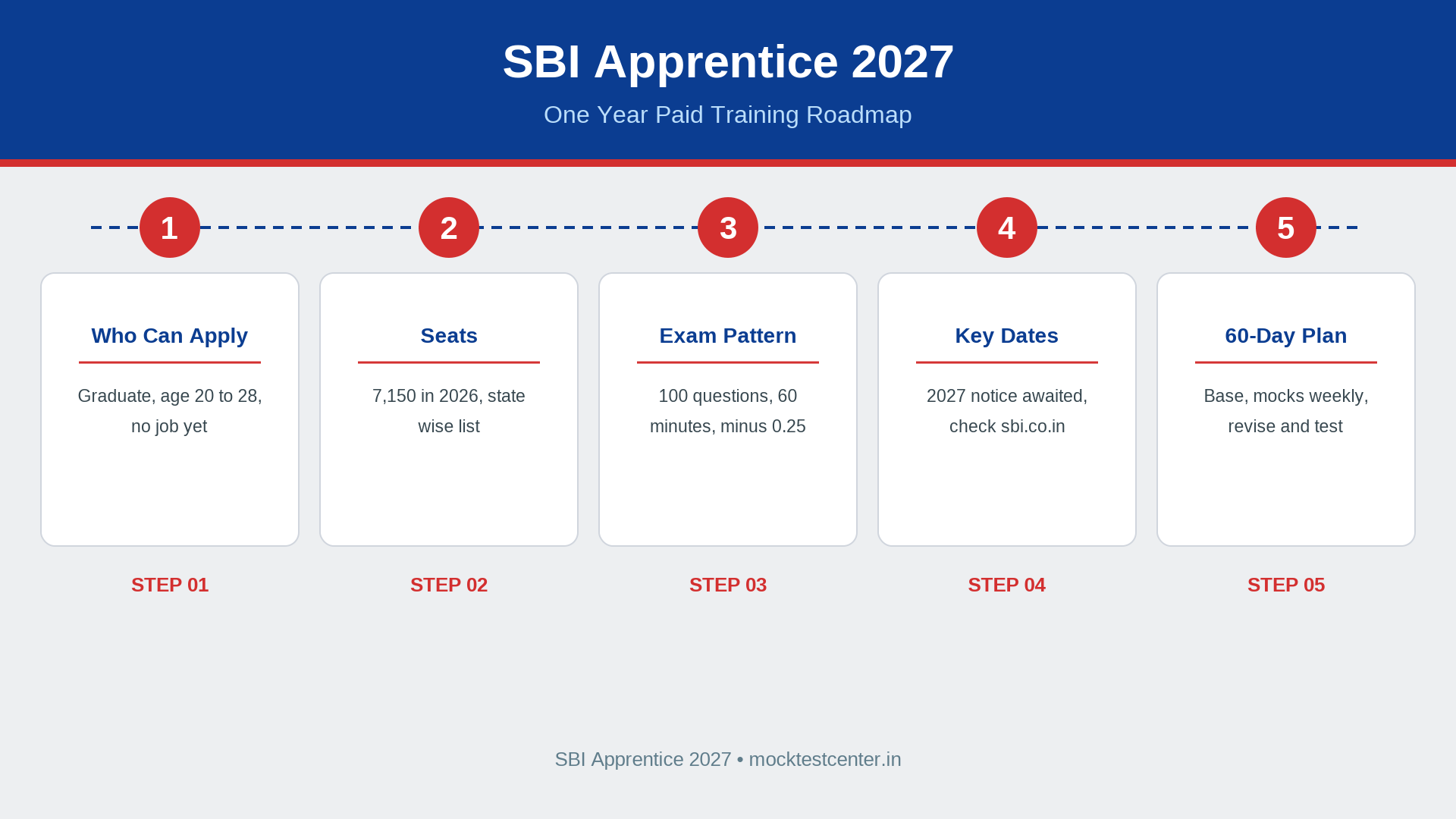
Here is the first fact, before any pattern or pay figure. SBI has not released an Apprentice notification for 2027 as of 23 November 2026. No advertisement number exists, no vacancy count exists, and no apply dates exist for the 2027 cycle. The last cycle ran in 2026, with 7,150 training seats under Advertisement Number CRPD/APPR/2026-27/07, released on 19 May 2026. The cycle before that ran in 2023, with 6,160 seats. This page builds everything from those two real cycles, and it marks every 2027 figure as expected, because no 2027 figure exists yet. Any site that prints an SBI Apprentice 2027 vacancy number or exam date today is guessing.
Check the official careers page at sbi.co.in for every notice, because only the official notice is final. The pattern, eligibility rules, stipend and selection stages in this article come from the official SBI Apprentice advertisements of 2023 and 2026. They show what an SBI Apprentice notice looks like. They are not the 2027 notice. When the real notice comes out, read it first and treat this page as a starting point, not as the final word.
Why does this exam draw lakhs of graduates every cycle if it is not a job? Because one year inside SBI changes a resume. An apprentice handles real customers, real cash, real loan files and real digital banking tools. A graduate who has done that walks into the next bank exam with answers that come from work, not from a guidebook. And the notice itself promises weightage in SBI Junior Associate recruitment for apprentices who finish the training well. That promise is real, but it has conditions, and this article covers them in full later.
What an SBI Apprentice actually is
An apprentice is a trainee, not an employee. The official 2023 advertisement states this twice, in two different places, which tells you how often candidates get it wrong. The job profile section says the engagement is not an employment in the bank, and it is not a contract employment either. Apprentices are not treated as employees of SBI and are not entitled to any benefit that bank employees get. The general information section adds that SBI has no obligation to offer regular employment during or after the apprenticeship, and that candidates are relieved from their work area when the training period ends.
The money follows the same logic. An apprentice gets a stipend of Rs 15,000 a month for the one year of engagement, and the notice says apprentices are not eligible for any other allowances or benefits. There is no dearness allowance, no house rent allowance, no provident fund, no pension and no medical benefit. Rs 15,000 is the whole pay. A candidate who joins expecting a clerk salary will be disappointed in the first month, so decide with open eyes. The stipend was Rs 15,000 in the 2023 cycle and it was still Rs 15,000 in the 2026 cycle, which means three years passed with no rise. Do not plan on a rise in 2027 either.
The training lasts one year, and it follows Government of India guidelines for leave, working conditions and holidays. The apprentice works in the branch or office where SBI posts him or her, and the bank can allot the training seat in any district of the selected state. You choose three preferred districts when you apply, but the notice is clear that this choice gives you no right to that district. SBI allots as per administrative need. A candidate from Lucknow who applies for Uttar Pradesh can be posted in Gorakhpur or Jhansi, and the notice gives no appeal against it.
There is one more rule that surprises people, and it is the rule that decides more applications than any other. A candidate who has already done an apprenticeship, in SBI or in any other organisation, cannot apply. And a candidate who has one year or more of job or training experience after finishing the qualifying degree cannot apply either. Read that again. This exam is for fresh graduates. A graduate who has worked for a year in a shop, a school, a private company or a bank is not eligible. The rule exists because the Apprentices Act is meant to train freshers, not to hire experienced workers on a stipend. Many guides skip this rule entirely. It sits in the general information section of the official notice, and it ends runs before they start.
Two more exclusions matter. No ex-serviceman and no disabled ex-serviceman can be engaged as an apprentice, and there is no reservation for them in this engagement. And every candidate except those from the north eastern states must produce an Aadhaar number before engagement, when the apprenticeship contract is signed. Keep your Aadhaar card and your degree certificate ready, because SBI checks eligibility only at document verification, after the test. Admission to the test is provisional. A candidate can clear the written test and still go home at verification if the papers do not match the form.
The 2026 cycle, in full
The last SBI Apprentice cycle is the best guide to the next one, because it is fresh and complete, from notification to result. SBI released Advertisement Number CRPD/APPR/2026-27/07 on 19 May 2026 for 7,150 apprentice seats across the country. Online registration ran from 19 May to 8 June 2026, and SBI extended the last date to 15 June 2026. The online examination took place on 11 July 2026. Admit cards came out on 30 June 2026, and the result was declared on 25 August 2026. The whole cycle, from notice to result, took just over three months. That speed is normal for SBI Apprentice. The apply window is short, the test follows fast, and a candidate who waits for the notice to start preparing has about seven weeks between the last date and the test.
The 7,150 seats were spread across states and union territories, with the biggest shares going to the states where SBI has the most branches. Andhra Pradesh took the largest share with 709 seats. Uttar Pradesh followed with 561, Maharashtra with 504, Telangana with 491, West Bengal with 460, Kerala with 403, Tamil Nadu with 396, Assam with 368, Rajasthan with 350, Madhya Pradesh with 285 and Karnataka with 276. Gujarat took 217 seats, Delhi 105, Bihar 58, Jharkhand 27, Goa 16, Meghalaya 8 and Manipur 6. The pattern is simple. SBI puts apprentices where its branches need hands, and the southern and western states with dense branch networks take the most seats. A candidate should read this table before choosing a state, because the state with more seats is not always the state with less competition. Andhra Pradesh had 709 seats and also drew the most applicants.
| State, SBI Apprentice 2026 | Seats | Local language |
|---|---|---|
| Andhra Pradesh | 709 | Telugu, Urdu |
| Uttar Pradesh | 561 | Hindi, Urdu |
| Maharashtra | 504 | Marathi |
| Telangana | 491 | Telugu, Urdu |
| West Bengal | 460 | Bengali, Nepali |
| Kerala | 403 | Malayalam |
| Tamil Nadu | 396 | Tamil |
| Assam | 368 | Assamese, Bengali, Bodo |
| Rajasthan | 350 | Hindi |
| Madhya Pradesh | 285 | Hindi |
| Karnataka | 276 | Kannada |
| Gujarat | 217 | Gujarati |
The category split in 2026 was 3,086 seats for Unreserved candidates, 1,672 for OBC, 1,107 for SC, 699 for EWS and 586 for ST. Persons with benchmark disabilities had 304 seats across the four disability groups. Every seat is provisional, and the notice warns that the number can change as per the actual need of the bank. That warning matters, because SBI has changed seat numbers in past cycles, and the final merit list follows the final seat count, not the first one printed.
Compare 2026 with 2023 and one trend stands out. The 2023 cycle had 6,160 seats, and the 2026 cycle had 7,150, which is a rise of 990 seats in three years. The stipend did not rise in the same period, and the pattern did not change either. SBI is hiring more apprentices on the same terms. That is good news for candidates, because more seats mean a lower cut-off in most states, and it is also a warning, because a bigger drive draws more applicants, which pushes the cut-off back up. The 2023 cycle came out on 31 August 2023 with applications from 1 to 21 September 2023 and the test in October or November 2023. The 2026 cycle came out in May. Two cycles do not make a pattern, so no one can say with confidence which month the 2027 notice will come in. One tracker guesses around May 2027 with about 5,000 seats, but that is a guess, not a fact, and this page does not repeat it as one.
Who can apply: the rules, without the fine print hidden
The eligibility rules for SBI Apprentice are short, and that is why candidates get them wrong. There are only three real conditions, plus the experience bar that this article already covered. The first is age. A candidate must be between 20 and 28 years old. The 2023 notice fixed the age as on 1 August 2023, which meant a birth date between 2 August 1995 and 1 August 2003. The 2026 notice also set the age at 20 to 28 years, but the trackers disagree on the cut-off date. Two of them print 1 April 2026, and two print 30 April 2026. This page states the conflict plainly instead of picking one, because the official 2026 notice text was not fetched in full in this pass. When the 2027 notice comes out, read the age cut-off date first. A candidate who is 28 years and one day old on that date is out, and no appeal will help.
Age relaxation follows Government of India rules. SC and ST candidates get five years, OBC candidates get three years, and persons with benchmark disabilities get ten years, with further relaxation as per the rules for their category. The maximum age printed in the notice is for Unreserved and EWS candidates. A reserved candidate should add the relaxation to 28 and check the birth date window in the notice, not in a guide, because the window moves with the cut-off date every cycle.
The second condition is education. Graduation in any discipline from a recognised university, or an equivalent qualification recognised by the Central Government. That is the whole rule. There is no minimum percentage, no stream requirement and no honours condition. A BA graduate, a BCom graduate, a BSc graduate and a BTech graduate all stand equal. Final year students should be careful. The notice fixes the education qualification as on a date printed in the advertisement, and a candidate who has not finished the degree by that date cannot apply. If you are in the final semester, wait for the notice and check the date before you fill the form.
The third condition is the state choice. A candidate can apply for engagement in one state only, and can appear for the examination only once under the engagement project. You pick one state, you pick one of its local languages, and you take the language test in that language if you cannot show a Class 10 or 12 mark sheet for it. Apply for the state whose language is yours. A candidate from Bihar who applies for Tamil Nadu because it has 396 seats will face a Tamil language test at the end, and that test is a fail, not a formality. The state with more seats is worthless if you cannot pass its language test.
Two more conditions sit in the fine print and deserve a line each. The candidate must not have done an apprenticeship before, in SBI or anywhere else. And the candidate must not have one year or more of work or training experience after graduation. These two rules together mean the exam is built for fresh graduates. A graduate who finished college in 2024 and has been preparing for bank exams at home since then is eligible. A graduate who finished in 2024 and has worked in a private company since then cannot apply. That distinction is the single most common reason for rejection at document verification, and it is the reason this article repeats it. Do not spend six months preparing for an exam you cannot join.
The exam: 100 questions in 60 minutes
The SBI Apprentice written test is short, fast and unforgiving. One hundred questions, one hundred marks, sixty minutes. Four sections, twenty-five questions each, fifteen minutes each. Each section has its own timer, and you cannot carry time from one section to another. When the fifteen minutes for English end, the English section closes, whether you finished it or not. That single rule shapes the whole preparation, because it turns the test into four small sprints instead of one long paper. A candidate who is slow in Reasoning cannot borrow time from English. Every section needs its own pace.
| Section | Questions | Marks | Minutes |
|---|---|---|---|
| General and Financial Awareness | 25 | 25 | 15 |
| General English | 25 | 25 | 15 |
| Quantitative Aptitude | 25 | 25 | 15 |
| Reasoning Ability and Computer Aptitude | 25 | 25 | 15 |
| Total | 100 | 100 | 60 |
General and Financial Awareness gives twenty-five questions in fifteen minutes. That is thirty-six seconds per question, which is fast for a section that mixes current affairs, banking awareness, static GK, government schemes, the Budget, RBI policy, awards and important days. The questions are short and the answers are either known or not known, so this section rewards a daily newspaper habit more than any book. Read the business page every morning, note one line per story, and revise the last six months before the test. Banking awareness carries the most weight here, because the test is set by a bank. Repo rate, CRR, SLR, types of accounts, priority sector lending, KYC norms, UPI, NEFT and RTGS all appear, and the current figures matter more than the definitions.
General English gives twenty-five questions in fifteen minutes, and it is the only section set in English alone. Every other section is set in English, Hindi and thirteen regional languages, but English is English only. The questions cover reading comprehension, cloze tests, error spotting, sentence improvement, para jumbles, fill in the blanks and vocabulary. A graduate who reads one editorial a day will find this section the easiest of the four. A graduate who has not read English since college will find it the hardest. There is no shortcut. Read daily, mark the sentence structures you would have written differently, and that habit alone lifts the score.
Quantitative Aptitude gives twenty-five questions in fifteen minutes, which is the tightest pace in the paper. Simplification, number series, quadratic equations, data interpretation, time and work, time speed and distance, profit and loss, simple and compound interest, ratio and proportion and averages share the section. The list looks long, but it is the same list as every bank exam, so the books and mocks you already own cover it. The difference is the pace. Thirty-six seconds per question means you must judge a question in five seconds and skip it if it will take a minute. A skipped question costs nothing. A wrong guess costs a quarter mark.
Reasoning Ability and Computer Aptitude gives twenty-five questions in fifteen minutes, and it mixes two subjects that most candidates prepare separately. Puzzles, seating arrangements, syllogisms, blood relations, coding and decoding and direction sense sit beside basic computer questions on hardware, software, operating systems, the internet and MS Office. The computer questions are the cheapest marks in the paper, because they test facts, not speed. Learn the basic terms once and they stay with you. The puzzles are the costliest, because one hard puzzle can eat five minutes and give nothing back. Skip the puzzle that does not open in thirty seconds and come back only if time is left.
Negative marking is one fourth of a mark per wrong answer. Four wrong answers erase one right answer. There is no sectional cut-off, which is good news for candidates with one weak section. The official notice says candidates must score a minimum percentage on aggregate, with five percent relaxation for SC, ST, OBC and PwBD candidates, and the minimum qualifying marks on aggregate are decided by the bank. Trackers report the 2026 qualifying marks as 60 for General and EWS, 55 for OBC and 50 for SC, ST and PwBD, but those figures come from tracker pages, not from the official notice text fetched in this pass, so treat them as reported, not confirmed. The merit list is drawn state wise and category wise, in descending order of aggregate marks. If two candidates score the same marks at the cut-off, the older candidate ranks higher. Age, which is usually a disadvantage in bank exams, breaks the tie here.
The local language test: the stage that ends runs
The local language test is the second stage of selection, and it is the stage that ends the most runs. It comes after the written test, and only candidates who qualify in the written test take it. The test checks reading, writing, speaking and understanding in the local language you opted for when you applied. It is qualifying in nature. You do not need a high score. You need to pass, and a fail here ends the selection, whatever your written test score. The official notice says it plainly. Candidates who fail to qualify this test will not be engaged as apprentices.
There is one clean way out of this test. Candidates who produce a Class 10 or 12 mark sheet or certificate showing they studied the specified local language skip the language test entirely. That one paper saves you a whole stage. Find your Class 10 mark sheet now and keep a scanned copy ready. If you studied Hindi in Class 10 and you apply for Uttar Pradesh, you are exempt. If you studied English in Class 10 and you apply for Karnataka, you are not exempt, and you will take the Kannada test. The exemption follows the mark sheet, not the language you speak at home.
The test is held at a centre in the state you applied for, at your own expense. SBI does not pay travel costs for it, just as it does not pay travel costs for the written test. A candidate from a small town should budget for two trips, one for the written test and one for the language test, because the centres are not always in the same city. The notice also says the language test is conducted as part of the selection process, after the written test, which means there is a gap of weeks between the two. Use that gap. Read one page of a local newspaper a day in the local language, write five lines a day in it, and speak it with family. A month of daily practice is enough to pass a qualifying test if you already speak the language at home. If you do not speak it at all, no amount of last minute study will save you, so do not apply for that state.
The third stage is the medical examination. Engagement of selected apprentices is subject to being declared medically fit as per the requirement of the bank. It is not a formality for everyone. A candidate with a medical condition that the bank's standards do not allow can be held back at this stage. Get a basic health check done before you apply, so a surprise does not come after you have cleared two stages. After the medical examination comes document verification, where SBI checks the age, the degree, the category certificate and the experience rule. The final selection needs all four: eligibility verified, language test passed where applicable, and medical fitness cleared.
SBI also keeps a wait list, state wise and category wise, for one year from the date of the result, or until the next engagement exercise, whichever comes first. Candidates on the wait list are released only once, against non-joining, and only if qualified candidates are available. The wait list is a safety net for the bank, not a second result. Only a few candidates ever get called from it. Do not count on it. Aim for the main list.
What Rs 15,000 a month really means
Rs 15,000 a month is the number every candidate should sit with before applying. In a metro city, it covers rent in a shared room, food, travel and little else. In a small town, it covers a decent life. The stipend is the same in Mumbai and in Muzaffarpur, because the notice fixes one figure for all states. A candidate who joins in a metro city should plan the money before the first day, because the bank will not top it up. There is no allowance, no bonus and no overtime pay. One year at Rs 15,000 is Rs 1,80,000 in total, and that is the whole financial deal.
So why do lakhs of graduates apply? The answer is the weightage in Junior Associate recruitment. The official notice says weightage and relaxation in the recruitment of Junior Associates will be given to apprentices who successfully complete the training in SBI, subject to satisfactory conduct and performance during the whole training period. Successful completion means passing the skill evaluation test, called the trade test, and getting the joint National Apprenticeship Certificate issued by SBI with NSDC or BFSI-SSC. The weightage follows the bank's recruitment policy as amended from time to time, which means the exact weightage is set in the Clerk notice, not in the Apprentice notice. This page does not print a weightage figure, because no figure was confirmed in the sources fetched for this pass. Any site that prints a fixed weightage number for the next Clerk cycle is guessing.
The honest way to value this exam is to compare it with the alternatives. A graduate who spends a year preparing for bank exams at home earns nothing and learns nothing about real banking. A graduate who spends that year as an SBI Apprentice earns Rs 15,000 a month, learns branch banking from the inside, and walks into the SBI Clerk 2027 exam with a certificate and a weightage. The year is not wasted even if the Clerk weightage is small, because the experience changes the interview answers. A candidate who has handled a loan file can talk about it. A candidate who has only read about it cannot. That is the real return on the year, and it is worth more than the stipend.
There is one more return that no guide mentions, and it is the simplest one. An apprentice works inside SBI, which is the largest bank in the country, with about 22,000 branches. The apprentice sees how a branch runs, how customers behave, how targets are set and how audits work. That knowledge is useful in every bank exam, because the General Awareness and Banking Knowledge sections test exactly those things. A year inside the bank is a year of live current affairs. A candidate preparing at home reads about priority sector lending. An apprentice sees it in a file. The exam rewards the second kind of knowledge.
Where the seats are, and how to pick your state
The state table is the most useful page in the official notice, and most candidates read it last. Read it first. Your state decides your competition, your language test and your posting. Andhra Pradesh had 709 seats in 2026, which looks like the best deal, until you count the applicants. The states with the most seats also draw the most applicants, because every candidate can read the same table. The states with fewer seats sometimes have a lower cut-off, because fewer candidates apply there. There is no free lunch in the table. The right state is the one whose language you speak, not the one with the biggest number.
The language column matters more than the seat column. Every state in the table names one or two local languages, and you must pick one when you apply. Uttar Pradesh offers Hindi and Urdu. Maharashtra offers Marathi. Kerala offers Malayalam. Tamil Nadu offers Tamil. West Bengal offers Bengali and Nepali. The north eastern states are the exception. Arunachal Pradesh and Nagaland offer English as the local language, which means a candidate from anywhere can apply there without learning a new language. That sounds like a shortcut, and it is, but the seats are few. Arunachal Pradesh had 26 seats in 2026 and Nagaland had 20, and the competition for those seats is sharp precisely because everyone sees the same shortcut.
Three districts deserve a note, because they show how SBI spreads the seats. In the 2023 cycle, Jaipur district in Rajasthan took 175 seats, Chennai took 86, and Khurda in Odisha took 40. District seats follow the branch network, not the population, so a district with many branches takes many apprentices. When you pick your three preferred districts, pick the district where you live first, then the nearest big city, then the district with the most branches. And remember that the choice is only a preference. SBI can post you in any district of the state, and the notice gives you no right to your first choice.
One more fact from the table is worth knowing. The 2026 cycle covered 29 states and 5 union territories according to one tracker, while another tracker counts 28 states and union territories in total. The two counts disagree, and this page states the disagreement instead of hiding it, because the official state list was not fetched in full in this pass. The total of 7,150 seats is not in doubt. The exact count of states is a small detail, but a page that hides small disagreements cannot be trusted on big ones.
Cut-offs: what score you actually need
The cut-off is state wise and category wise, which means there is no single SBI Apprentice cut-off. Every state has five cut-offs, one for each category, and the cut-off in Madhya Pradesh has nothing to do with the cut-off in Kerala. A General candidate in Madhya Pradesh needed 77.50 marks out of 100 in the 2023 cycle, as reported by trackers, while a General candidate in Rajasthan needed 68.50. West Bengal needed 74.50, Telangana 71.25 and Haryana 70.00. Those figures come from tracker pages, not from an official SBI cut-off list fetched in this pass, so treat them as reported, and note one more problem. Two trackers label the same table differently, one as the 2023-24 cut-off and one as the 2024 cut-off. The numbers match, but the year label differs. This page uses the 2023-24 label, because the figures sit beside the 2023 cycle, but the disagreement is recorded here so no one is misled.
The pattern in those numbers is clear enough to plan around. The cut-off for General candidates sits between 68 and 78 in most big states, which means a candidate needs about 70 marks out of 100 to be safe. The OBC cut-off sits about five marks lower, the SC cut-off about ten marks lower, and the ST cut-off lower still. Madhya Pradesh is the hardest state in the reported table, with a General cut-off of 77.50 and an OBC cut-off of 75.50. That is a state where even a good score can fail. Rajasthan is kinder, with a General cut-off of 68.50 and an ST cut-off of 48.00, which is the lowest figure in the table.
The qualifying marks are a different thing from the cut-off, and candidates mix them up every year. The qualifying marks are the minimum you need to be considered at all. Trackers report them as 60 for General and EWS, 55 for OBC and 50 for SC, ST and PwBD in the 2026 cycle. The cut-off is the minimum you need to actually get a seat, and it is always higher than the qualifying marks, because there are more qualified candidates than seats. A General candidate who scores 62 has qualified, but has not been selected, because the cut-off in his state is 70. Aim for the cut-off, not for the qualifying marks. Aim for 75 in a big state and 70 in a small one, and treat 60 as the floor, not the target.
The official 2026 cut-off list was not out at the time this page was written, even though the result came out on 25 August 2026. SBI releases the cut-off with the result or after it, and the trackers were still calling their figures expected three months later. That delay is normal. Do not trust any site that prints a 2026 official cut-off table with a date on it, because the official list had not been published when this page was checked. The 2023 figures above are the latest reported cut-offs available, and they are the best guide to the 2027 cycle.
SBI Apprentice next to PO, Clerk and CBO
SBI runs four doors into its workforce, and the right door depends on where you stand today. The Probationary Officer door is for fresh graduates with no experience who want the fastest career path in the bank. The Clerk door is for graduates who want a safe entry with many seats and no interview. The Circle Based Officer door is for bankers who already hold an officer post elsewhere and want to move into SBI at the same grade. The Apprentice door is for fresh graduates who want a year inside the bank before they fight for a permanent post. It asks for the least and it gives the least, and that is a fair trade, not a trap. A fifth door exists in other banks. The Bank of Baroda LBO 2027 exam is the same Local Bank Officer idea in another public sector bank, which ran the largest LBO drive of 2025 with 2,500 posts.
The SBI PO 2027 exam is the hardest of the four to crack, because it has three stages, a mains paper with a descriptive section, a psychometric test, and a group exercise with an interview. It also has the widest career path, because a PO can rise to the top of the bank, and the pay starts at a Scale I basic of Rs 48,480. The Apprentice exam is the easiest to enter, with one written test of 60 minutes and a language test, but the pay is a stipend of Rs 15,000 and there is no job at the end. A graduate who can clear the PO prelims should take the PO exam as the main target and the Apprentice exam as a second shot. The syllabus overlaps so much that one preparation serves both. The SBI SO 2027 exam is a different case, because it needs a specialist degree, so it suits a smaller group of graduates.
The Clerk exam is the closest cousin to the Apprentice exam, and the two belong together in a plan. The Clerk exam has a prelims and a mains and no interview, and it leads to a permanent post with a starting basic pay of Rs 26,730. The Apprentice exam leads to a year of training and a weightage in the Clerk recruitment. A graduate who takes both exams in the same year doubles the chances, because the Apprentice test in July and the Clerk test later in the year use almost the same syllabus. The IBPS PO 2027 exam and the IBPS Clerk 2027 exam offer the same posts in other public sector banks, and the same preparation covers most of their syllabus too. The IBPS RRB PO 2027 exam offers the same Scale I post in regional rural banks. The RBI Assistant 2027 exam pays a lower basic pay but sits in the central bank. The LIC AAO 2027 exam and the IDBI Junior Assistant Manager 2027 exam offer other routes into banking and insurance, and the same preparation covers most of their syllabus as well. Apply for every exam you are eligible for, and decide when the offers come.
The way to choose is to ask one question. Do you want a permanent post now, or a year of training first? If you want a permanent post now, take the PO and Clerk exams and treat the Apprentice exam as a backup. If you are a fresh graduate with no job and no income, take the Apprentice exam as the main target, because it pays Rs 15,000 a month while you prepare for the Clerk exam, and it gives you a certificate and a weightage for it. That is the whole decision. Do not spend a year preparing for a posting you do not want, and do not dismiss a stipend of Rs 15,000 when the alternative is a year at home with no income.
How to study for each section
General and Financial Awareness needs a notebook, not a book. Read the business page every morning and write one line per story. Government schemes, the Union Budget, RBI monetary policy, major appointments and sports events all appear. Six months of one line a day is about 180 lines, and that notebook covers most of the section. Add the economy of your own state, because the paper can ask about local crops, local industries and state schemes. Note the current repo rate, CRR and SLR a week before the test and revise them the night before, because the paper tests the numbers as they stand today, not as they stood in your book.
General English needs a topic list you can tick off. Reading comprehension, cloze tests, error spotting, sentence improvement, para jumbles, fill in the blanks, vocabulary including synonyms and antonyms. Read one editorial a day and mark the sentence structures you would have written differently. That habit alone lifts the score, because the paper tests the same structures again and again. Learn the common error patterns, such as subject verb agreement, prepositions and tenses, because error spotting is the cheapest section in English. It tests rules, not reading speed.
Quantitative Aptitude needs speed more than depth. Simplification and approximation, number series, quadratic equations, data interpretation, time and work, time speed and distance, profit and loss, simple and compound interest, ratio and proportion, averages. That list looks long, but it is the same list as every bank exam, so the books and mocks you already own cover it. The difference is the pace. Twenty-five questions in fifteen minutes means thirty-six seconds per question, and the negative marking of 0.25 means a wild guess costs you. Guess only when you can rule out two options, and learn to judge a question in five seconds. A skipped question costs nothing.
Reasoning and Computer Aptitude needs two different habits. For Reasoning, practise puzzles and seating arrangements daily, because they are the questions that eat time. Set a timer of fifteen minutes and do twenty-five questions, so the sectional timer feels normal. For Computer Aptitude, learn the basic terms once and they stay with you. Hardware, software, operating systems, the internet, MS Office, memory units, input and output devices, networking basics. Ten days of one hour a day covers the whole computer syllabus, and those questions are the cheapest marks in the paper, because they test facts, not speed.
A 60 day plan that fits around a job or a degree
Sixty days is enough for this exam, because the paper is only sixty minutes long and the syllabus is the same as every bank exam. Two hours a day for sixty days is 120 hours, which is enough if the hours go to mocks and analysis, not to reading alone. The plan below fits around a job or a final year degree, and it treats the local language as a real subject, not an afterthought. Start it now, before the notice comes out, because the apply window will be about three weeks and the test will follow about seven weeks after the last date.
Days 1 to 20 are for the base. Study two hours a day. Cover one Banking Awareness topic and one English topic each day. Read the news every morning and write five lines in your current affairs notebook, plus two lines on your own state. Read one page of a local newspaper a day, in the local language. Take one mock at the end of week one and one at the end of week three. Do not worry about the score. The first mocks only show you where you stand.
Days 21 to 40 are for speed. Your score will move most in this phase, because the paper gives thirty-six seconds per question and a wrong answer costs 0.25 marks, so speed with accuracy is the whole game. Take two mocks a week now. After each mock, spend as much time on analysis as you spent on the test. Write down every question you got wrong and why. Was it a concept gap, a silly mistake, or a time problem? Concept gaps go back into your study list. Silly mistakes need a checklist before you submit each section. Time problems need easier questions first and hard ones last.
Days 41 to 60 are for the real thing. Take three mocks a week. Revise your error notebook every second day. Stop learning new topics in the last ten days. New topics in the last week add stress and no marks. In the last three days, take one full mock at the same time as your real test slot, then rest. Sleep matters more than one more chapter in the final week. A candidate who walks into the test hall tired will make the same mistakes a fresh candidate makes, and no amount of reading will save the score.
If you have less than sixty days, cut the base phase, not the mocks. Ten mocks with full analysis beat thirty days of reading without a single test. The paper rewards candidates who have sat through the sixty minute sitting many times. It punishes candidates who know the syllabus and have never felt the sectional timer run out. Take one SBI Apprentice mock test this week, on the real pattern, one hundred questions in sixty minutes, four sections of fifteen minutes each. Score it, list your weak section, and give that section thirty minutes a day. That single habit, repeated for sixty days, is what turns a fresh graduate into an SBI Apprentice.
Mistakes that cost candidates a year
The first mistake is waiting for the notice to start. The apply window in the 2026 cycle was about three weeks, and the test followed about seven weeks after the last date. A candidate who starts on the day of the notice has about two months. A candidate who starts now has the whole year. The syllabus overlaps with the PO and Clerk exams so much that every hour you spend now counts for those exams too, even if the Apprentice notice comes late.
The second mistake is applying with one year of work experience and finding out at verification. The notice bars candidates with one year or more of job or training experience after graduation. A graduate who worked in a private company for a year after college is not eligible, and SBI checks this at document verification, after the test. Count your experience carefully before you apply. If you have a year of work behind you, take the PO and Clerk exams instead, where experience is not a bar.
The third mistake is picking the wrong state. A state with more posts looks tempting, but the local language test at the end is real. Apply for the state whose language you can read, write and speak. Keep your Class 10 mark sheet ready, because it exempts you from the language test in most cases, and a mark sheet is easier to find now than in the week before the test.
The fourth mistake is guessing too much. Four wrong answers erase one right answer. In a section where you know twenty answers for sure, ten wild guesses can pull your score down by two and a half marks. That is often the gap between selection and rejection in a state with few posts. Guess only when you can rule out two options, and leave the rest blank. A blank answer costs nothing.
The fifth mistake is treating the stipend as a salary and the apprenticeship as a job. An apprentice is a trainee, not an employee, and the bank has no obligation to offer a permanent post after the year. A candidate who joins expecting a job will be angry in the twelfth month. A candidate who joins expecting a year of training, a certificate and a weightage in the Clerk exam will use the year well. The difference sits in the expectation you carry into it, not in the notice.
What to keep ready before the notice comes out
Keep four things ready. First, your degree certificate, with the date matching the qualification date the notice will print, so you can prove you finished before the cut-off. Second, your Class 10 mark sheet, because it proves your local language skill and can exempt you from the language test. Third, your Aadhaar card, because the bank asks for it before engagement. Fourth, a mock test routine with sectional timers, so the sixty minute sitting feels normal by the time the notice comes out.
Check the SBI careers page at bank.sbi/careers twice a week, because the Apprentice notice will appear there first and the apply window will be short. When it comes, read the age cut-off date first, then the state table, then the fee. Apply in the first week, not the last, because the last day brings server load and payment failures, and the notice gives no extension unless SBI announces one. Take one mock this week, on the real pattern, and start the sixty day plan from the score it gives you.