About RBI Office Attendant 2027 Exam Series
📖 Table of Contents
- What RBI Office Attendant 2027 is
- The last two cycles, side by side
- Who can apply: the undergraduate rule
- Age limits and relaxation
- The online test, section by section
- The language test has no exemption
- Pay: the 2025 revision changed everything
- What an Office Attendant actually does
- Office Attendant next to RBI Assistant and Clerk
- What to study for each section
- A 90 day plan that fits around work or study
- Mistakes that cost candidates a year
- What to check before the next notice comes out
- Sources
RBI Office Attendant 2027: Pattern, Pay, Dates, Eligibility
What RBI Office Attendant 2027 is
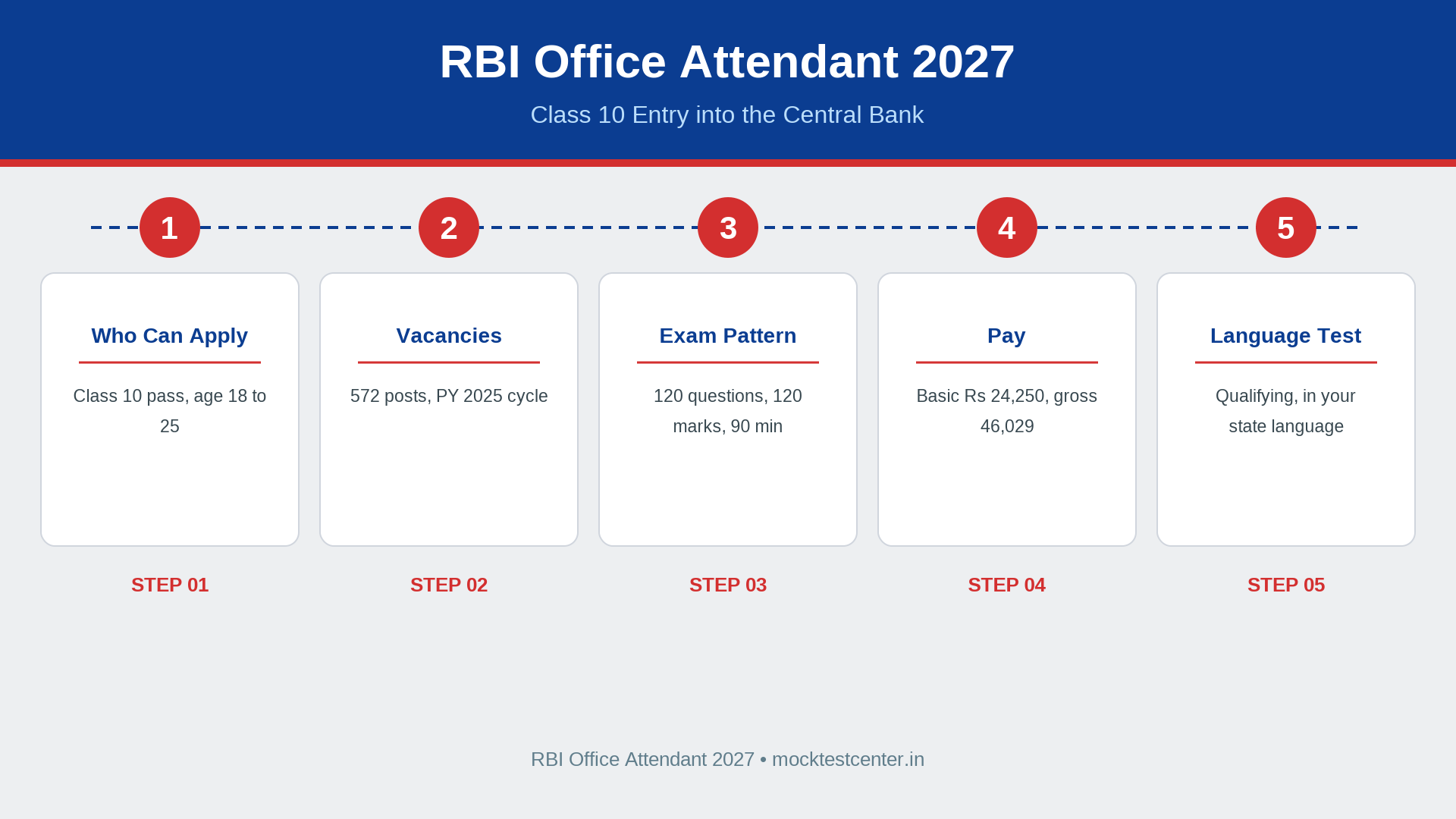
RBI Office Attendant 2027 is the next recruitment of Office Attendants by the Reserve Bank of India. An Office Attendant is a Class IV post in the central bank. The work is physical and routine: moving files, delivering dak, opening and closing sections, photocopying, and helping with non clerical work in an RBI office. The entry bar is the lowest of any RBI post. A Class 10 pass can apply. No degree is needed. In fact a degree disqualifies you, which is the one rule most candidates get wrong, and this article starts there because it decides who should even read further.
No 2027 notice exists yet. The latest cycle is the Panel Year 2025 recruitment, notified on 15 January 2026 for 572 posts. Applications ran from 15 January to 4 February 2026, and the online test took place on 28 February and 1 March 2026. That cycle is complete. The next notice will come when RBI opens the next panel year, and this page works from the Panel Year 2025 notice because it is the freshest official text available. Check rbi.org.in for the new notice, because only the official notice is final. Nothing in this article invents a 2027 date, a 2027 vacancy count, or a 2027 fee.
The post matters because of the employer. RBI is the central bank. Its offices run the currency, the payment systems, and the supervision of banks. An Office Attendant works inside that building, with a government pay scale, bank accommodation subject to availability, medical facilities, and a pension under the New Pension Scheme. The starting basic pay in the latest cycle is 24,250 rupees a month, with gross emoluments of about 46,029 rupees a month without house rent allowance. That is more than double the basic pay of the 2021 cycle, and the jump is the biggest change in this exam in years.
Who should aim for it? A Class 10 pass candidate who is 18 to 25 years old, who has not graduated, and who can read, write and speak the language of the state where the RBI office sits. If you have a degree, stop. You cannot apply. If you are in the final year of a degree, you cannot apply either. The notice is blunt on this point, and it is the first thing to check before you spend a day preparing.
The last two cycles, side by side
RBI ran two Office Attendant cycles in the last five years, and they look like different exams on paper. The 2021 cycle, advertised as Recruitment for the post of Office Attendants 2020, offered 841 posts across 17 offices. Applications ran from 24 February to 15 March 2021, and the online test took place on 9 and 10 April 2021. The starting basic pay was 10,940 rupees a month, and the gross emoluments were about 26,508 rupees a month. Mumbai took the largest share with 202 posts. The fee was 450 rupees for General, OBC and EWS candidates and 50 rupees for SC, ST, PwBD and ex servicemen.
The Panel Year 2025 cycle offered 572 posts across 14 offices. Applications ran from 15 January to 4 February 2026, and the online test took place on 28 February and 1 March 2026. The starting basic pay is 24,250 rupees a month, and the gross emoluments are about 46,029 rupees a month without house rent allowance. Kanpur and Lucknow together took the largest share with 125 posts, followed by Kolkata with 90 and Guwahati with 52. The fee is 450 rupees plus 18 percent GST for General, OBC and EWS candidates and 50 rupees plus 18 percent GST for SC, ST, PwBD and ex servicemen. Staff candidates of the Bank pay nothing.
| Detail | 2021 cycle | Panel Year 2025 cycle |
|---|---|---|
| Posts | 841 | 572 |
| Offices | 17 | 14 |
| Apply window | 24 Feb to 15 Mar 2021 | 15 Jan to 4 Feb 2026 |
| Online test | 9 and 10 Apr 2021 | 28 Feb and 1 Mar 2026 |
| Starting basic pay | Rs 10,940 | Rs 24,250 |
| Gross emoluments | About Rs 26,508 | About Rs 46,029, without HRA |
| Fee, General and OBC and EWS | Rs 450 | Rs 450 plus 18 percent GST |
| Fee, SC and ST and PwBD and ex servicemen | Rs 50 | Rs 50 plus 18 percent GST |
| Largest office share | Mumbai, 202 posts | Kanpur and Lucknow, 125 posts |
Three things stand out in that table. First, the pay more than doubled. The 2021 basic of 10,940 rupees belonged to an old pay scale. The Panel Year 2025 basic of 24,250 rupees sits in a new scale that runs to 53,550 rupees. A candidate who reads an old guide and plans on 26,000 rupees a month is working with a dead number.
Second, the post count fell from 841 to 572, and the number of offices fell from 17 to 14. Jammu, Nagpur and Thiruvananthapuram had posts in 2021 and none in the Panel Year 2025 cycle. Office shares move with each cycle, so do not pick your office from the 2021 table.
Third, the shape of the exam did not change at all. Both cycles used the same 120 question online test and the same language proficiency test after it. The pattern is stable. The numbers around it move.
One more change is easy to miss. The Panel Year 2025 notice adds 18 percent GST on the fee, which the 2021 notice did not mention. It also brings DigiLocker into the application form, so a candidate can pull Aadhaar and education documents into the form on a voluntary basis. And it spells out biometric verification in detail: thumb impression, iris scan and photograph captured at the online test and checked again at the language test and at joining. A mismatch means rejection. These are small details, but they show the direction. Each new cycle tightens the process a little.
Who can apply: the undergraduate rule
The education rule for this post is the opposite of every other bank exam. You must have passed Class 10 from a recognised board of the state or union territory that falls under the regional jurisdiction of the recruiting office you apply to. And you must be an undergraduate as on the cut off date. In the Panel Year 2025 cycle the cut off date was 1 January 2026. Graduates and candidates with a higher qualification cannot apply. That sentence is printed in the notice without any softening, and it is the rule that ends the most applications.
Think about what that means in practice. A candidate who finished Class 10 and then did a diploma, an ITI course, or a Class 12 pass is fine, because none of those is a degree. A candidate who finished a BA, BCom, BSc or any other degree is out, even if the degree is incomplete in the sense that results are awaited. A candidate who enrolled in a degree but never finished it is an undergraduate and can apply, but the notice will ask for proof of status as on the cut off date, so keep your records straight. Do not guess. Read the exact words of the new notice when it comes.
Ex servicemen get a separate line. An ex serviceman must have passed Class 10 and rendered at least 15 years of defence service, provided he has not graduated outside the Armed Forces. A graduate degree earned while in service through the Armed Forces route is treated differently. A degree earned outside the Armed Forces still blocks the application. This is a narrow rule, and ex servicemen should read the definition in the notice rather than rely on a summary.
There is also a language condition that sits beside the education rule. A candidate applying to a recruiting office should be proficient in the language of the state or union territory falling under that office. Proficient means able to read, write, speak and understand the language. This is not a formality. The language proficiency test after the online test checks exactly this, and it has no exemption. More on that in its own section.
One office only. A candidate can apply for a vacancy in one office only, and must take the online test from a centre within the same state or union territory under the regional jurisdiction of that office. Pick the office where you passed Class 10, because the board rule ties you to it anyway. Candidates who passed Class 10 from a board in one state and now live in another should check the regional jurisdiction table in the notice before they apply. The wrong office choice cannot be fixed after submission.
Age limits and relaxation
The age window in the Panel Year 2025 cycle was 18 to 25 years as on 1 January 2026. Candidates had to be born not earlier than 2 January 2001 and not later than 1 January 2008, both days included. That is a narrow window, eight years wide, and it is the second rule that ends applications. A candidate who turns 26 before the cut off date is out, whatever the marks.
Relaxation follows government rules. SC and ST candidates get 5 years, so up to 30 years. OBC candidates get 3 years, so up to 28 years. Persons with benchmark disabilities get 10 years for General and EWS, 13 years for OBC, and 15 years for SC and ST. Ex servicemen get relaxation equal to the service rendered in the Armed Forces plus an extra 3 years, subject to a maximum of 50 years. Widows, divorced women and women judicially separated who have not remarried get relaxation up to 35 years, and up to 40 years for SC and ST. Candidates with work experience in RBI get relaxation equal to the number of years of such experience, subject to a maximum of 3 years.
One line in the notice deserves attention. Cumulative age relaxation is not available, either under the items listed or in combination with any other items. A candidate who qualifies under two heads cannot add them together. Take the single largest relaxation that applies to you and plan on that. The notice also says the reservation will follow the government guidelines in force at the time the result is finalised, which is a reminder that the rules can shift between the notice and the result.
The disability rules are specific. Only certain categories of persons with benchmark disabilities can apply: blindness and low vision, deaf and hard of hearing, locomotor disability including cerebral palsy, leprosy cured, dwarfism, acid attack victims and muscular dystrophy, autism and related conditions, and multiple disabilities among these. The degree of disability must be at least 40 percent, and the certificate must be a permanent one issued by a competent authority before the closing date of applications. A temporary certificate that only says temporary disability, without saying whether the condition is likely to improve or is progressive, non progressive or not likely to improve, will not do. The Panel Year 2025 notice added this clarification after a department clarification of December 2025, so candidates with a disability certificate should read the exact wording of the new notice before they apply.
The online test, section by section
The online test has 120 questions for 120 marks in 90 minutes, with a composite time for the whole paper. There is no sectional timer. You can move between sections as you like inside the 90 minutes, which is a freedom the 2021 cycle also gave. Four sections of 30 marks each make up the paper: Reasoning, General English, General Awareness, and Numerical Ability. Every question carries one mark. Every wrong answer costs a quarter of a mark. And you must qualify in each part of the test separately, which means a strong total with a failed section does not save you.
| Section | Questions | Marks |
|---|---|---|
| Reasoning | 30 | 30 |
| General English | 30 | 30 |
| General Awareness | 30 | 30 |
| Numerical Ability | 30 | 30 |
| Total, composite time 90 minutes | 120 | 120 |
Reasoning gives thirty questions. Expect the usual set at Class 10 level: series, coding and decoding, odd one out, blood relations, direction sense, ranking, and simple puzzles. The questions are not hard. The trap is time. Ninety minutes for 120 questions is 45 seconds per question, and Reasoning questions eat time if you sit on them. Learn to drop a puzzle after a minute and come back to it only if time is left. A dropped question costs nothing. A wrong guess costs a quarter mark, and four wrong guesses erase one right answer.
General English gives thirty questions, and it is the only section that is not offered in regional languages. The rest of the paper is available in English, Hindi and certain other regional languages. English is in English only. Expect reading comprehension, error spotting, fill in the blanks, synonyms and antonyms, and simple grammar. The level is Class 10, which sounds easy until you sit with it. Candidates who left school years ago lose marks here not because the questions are hard but because they have not read English in years. Read one page of an English newspaper a day for a month and the section starts to feel normal again.
General Awareness gives thirty questions. The notice does not print a syllabus for it, so the safe way to read it is as current affairs plus static facts about India: the Constitution, the states, the rivers, the national schemes, the big sports events, and the Reserve Bank itself. A question about RBI is the most likely static question in the paper, because the employer writes it. Know what RBI does, who the Governor is, what the repo rate is, and what CRR and SLR stand for. Those five facts are worth more than a month of random general knowledge.
Numerical Ability gives thirty questions at Class 10 level: simplification, number series, percentages, ratio and proportion, averages, profit and loss, simple and compound interest, time and work, and time speed and distance. The arithmetic is school level. The skill is speed. Thirty questions in the time you can spare after the other sections means you need the tables, the squares up to 30, and the cubes up to 15 in your head before the test. Do not learn them in the hall.
Two mechanics of the test deserve a line each. First, if the test runs in more than one session, scores across sessions are equated using the equi percentile method, which adjusts for slight differences in difficulty between sessions. You cannot control that, so ignore it. Second, only candidates who stand high enough in merit on the aggregate marks of the online test are called for the language test. The Bank decides the number against the vacancies. There is no fixed cut off printed in the notice, and no cut off from the Panel Year 2025 cycle has been published on the RBI site in this pass, so this article prints none. Any site that prints a Panel Year 2025 cut off without a source is guessing.
The language test has no exemption
The language proficiency test is the second and last stage, and it is the stage that surprises candidates the most. It is qualifying in nature. It is conducted in the official or local language of the state concerned. Candidates who are not proficient in that language are disqualified, whatever their online test score. And it is mandatory. The Panel Year 2025 notice says so in plain words: no exemption of any sort will be given to any candidate from appearing in the language test, which will be conducted at the respective Regional Offices of the Bank.
That last line matters because other exams do exempt candidates. In several bank exams, a candidate who studied the local language in Class 10 or 12 and can show a mark sheet skips the language test. RBI Office Attendant does not work that way. Everyone who clears the online test takes the language test. Your Class 10 mark sheet proves you studied in that state, but it does not excuse you from the test. Do not plan on an exemption that does not exist.
What does the test check? The notice does not print the format, so the safe reading is that it checks reading, writing and speaking in the local language of the state, at a level a person who grew up speaking it will pass without effort. A candidate who applies for an office in a state whose language he cannot read will fail here, and the failure is final. The fix is simple and it comes before the application, not after it. Apply only for the office in the state whose language is yours. The office with more posts in a state whose language you do not speak is a trap, not an opportunity.
Final selection rests on performance in the online examination, in order of merit, plus qualifying in the language test, plus medical fitness and verification of certificates to the satisfaction of the Bank. The decision of the Bank is final. There is no interview. There is no skill test. Two stages, and the second one only asks whether you can use the language of the place you will work in.
Pay: the 2025 revision changed everything
An Office Attendant selected in the Panel Year 2025 cycle draws a starting basic pay of 24,250 rupees a month. The pay scale runs from 24,250 rupees to 53,550 rupees, with increments of 840 rupees four times, then 980 rupees three times, then 1,200 rupees three times, then 1,620 rupees twice, then 1,990 rupees four times, then 2,700 rupees twice, then 2,800 rupees once. On top of the basic pay come dearness allowance, house rent allowance, city compensatory allowance, grade allowance and other allowances as admissible from time to time. At present, the initial monthly gross emoluments without house rent allowance are about 46,029 rupees a month. House rent allowance of 15 percent of pay is also paid if the attendant is not staying in bank accommodation.
Put that beside the 2021 cycle and the change is stark. The 2021 basic was 10,940 rupees and the gross was about 26,508 rupees. The new basic is more than double, and the new gross is about 20,000 rupees a month higher. The reason is a pay revision for RBI subordinate staff that took effect between the two cycles. A candidate who reads an old coaching page and plans on 26,000 rupees a month is reading dead information. The 24,250 rupee basic and the 46,029 rupee gross are the live numbers, printed in the Panel Year 2025 notice itself.
The perquisites add real value on top of the pay. Bank accommodation subject to availability, medical facilities, reimbursement of education expenses, reimbursement of the cost of spectacles and lens, knowledge updation allowance, furnishing of residence, group term life insurance, vehicle insurance, conveyance allowance, and leave fare concession, as per eligibility. The recruits are governed by the Defined Contribution New Pension Scheme, in addition to the benefit of gratuity. None of these is a number you can put in a monthly budget, but together they are worth thousands a month, and the accommodation alone can be the difference between saving and just getting by in a city like Mumbai.
Compare the pay with the other entry level bank exams and the picture is fair. The RBI Assistant 2027 exam leads to a clerk grade post in the same bank with a starting basic pay of 20,700 rupees, which is lower than the Office Attendant basic of 24,250 rupees. That looks odd until you see the rest of the story. The Assistant post has a faster promotion path, a mains exam, and a career that can reach officer grades. The Office Attendant post pays more at the start and less later. The IBPS Clerk 2027 exam offers a starting basic pay of 24,050 rupees in public sector banks, close to the Office Attendant figure, but the clerk post needs a degree and the Office Attendant post needs only Class 10. For a Class 10 pass candidate, there is no better paying government job in banking.
What an Office Attendant actually does
The notice describes the post as a Class IV post, and it lists the duties in one paragraph. They generally include physical movement and dispensation of files, records, office articles and utility items, delivery of dak, opening and closing of sections, divisions and departments, photocopying, assisting in other non clerical and routine works, and any other work as assigned by seniors, as per requirement. That is the whole job description, and it is honest. This is not a desk job with a computer. It is a support job that keeps an office running.
Candidates should read that paragraph twice before they apply, because the job is the reason some people leave in the first year. The work is physical. You will be on your feet, carrying files between departments, delivering letters, and opening sections before the officers arrive. The hours follow the office. If you want a desk, a computer, and a chair of your own, this is the wrong post, and the SBI Clerk 2027 exam or the SBI CBO 2027 exam is the right target, once you have the degree those posts need.
What the job does offer is stability and a ladder. RBI runs promotion exams for subordinate staff, and an Office Attendant who studies can move up over the years. The notice does not print a promotion chart. The route exists in the Bank all the same, and older attendants have used it. The more certain gain is the employer itself. A job inside the central bank, with a pension, medical cover, and leave fare concession, is a rare thing for a Class 10 pass candidate. Most government jobs at this education level pay far less and offer far less security.
Pre examination training is one more detail worth knowing. The Bank may arrange combined pre examination online training for a limited number of SC, ST, OBC and PwBD candidates, in line with government guidelines. Candidates who want it write by email to the Regional Office they are applying to, by the closing date of applications. It costs nothing and it shows the shape of the test before the real day. If you belong to one of these categories, ask for it. It is a free rehearsal.
Office Attendant next to RBI Assistant and Clerk
Three RBI and bank exams sit near this post, and the right one depends on your education. The Office Attendant exam needs Class 10 only and bars graduates. The RBI Assistant exam needs a degree, runs prelims and mains, and pays a starting basic of 20,700 rupees. The SBI PO exam needs a degree and pays a Scale I basic of 48,480 rupees. The FCI Assistant Grade III 2027 exam is another graduate route, with a post in the Food Corporation of India and a pay scale that starts at 28,200 rupees. A graduate cannot go back to Office Attendant, and a Class 10 pass candidate cannot go forward to Assistant. The two posts are doors for different people, and the degree line between them is absolute.
That line creates a decision for candidates who are studying for a degree right now. If you are in the first year of a degree and you want a government job fast, the Office Attendant exam is open to you today, while you are still an undergraduate. If you finish the degree first, the door closes and the Assistant and Clerk exams open instead. There is no right answer, only a trade. The Office Attendant post pays from the first month and needs no degree. The Assistant post pays less at the start, needs a degree, and leads further. A candidate who needs income now should take the Office Attendant shot while it is open. A candidate who can wait two years for the degree should finish it and aim at the Clerk and Assistant exams, where the career runs longer.
The ESIC MTS 2027 exam is the closest cousin among the central government exams, with a Class 10 pass entry and the same prelims and mains shape, and the EPFO SSA 2027 exam offers a Level 5 post in the provident fund organisation for graduates. The first is open to the same candidates as this post. The second is not, which is the point. For a candidate without a degree, the RBI Office Attendant exam stands nearly alone among the big banking recruiters. The NABARD Development Assistant 2027 exam, by contrast, needs a degree with 50 percent marks and runs prelims and mains, so it belongs to the graduate side of the line. The SBI LBO 2027 exam is another state based officer route, but it asks for a year of banking experience and a degree, so it sits on the graduate side of the line too. The ESIC UDC 2027 exam offers a clerk grade post with a degree requirement and a mains paper, and it pays a Level 4 salary, so it is a graduate option with a different employer. The comparison is useful only to show where the line sits, not to suggest you can cross it.
One more comparison is worth making, because it confuses candidates every cycle. RBI Grade B is the officer exam of the central bank, with a starting basic pay far above the Office Attendant scale and a selection that runs through three phases and an interview. It needs a degree with 60 percent marks. It has nothing to do with the Office Attendant exam except the employer. Do not prepare for both at once. The syllabuses share almost nothing, and the preparation for one will not help the other.
What to study for each section
Reasoning needs practice, not theory. Series, coding and decoding, odd one out, blood relations, direction sense, ranking, and simple puzzles cover most of the section. Work through one set of twenty questions a day and mark the time. The goal is not to finish every question. The goal is to know in five seconds whether a question is yours or not. A puzzle that takes three minutes is a question you should skip, because three minutes is four other questions. Come back to it only when the rest of the paper is done.
General English needs daily reading more than grammar rules. Comprehension, error spotting, fill in the blanks, synonyms and antonyms, and one word substitution make up the section. Read one page of an English newspaper a day and note ten new words a week with their meanings. That habit alone covers the vocabulary half of the section. For grammar, work through error spotting sets and learn the twenty most common error patterns: subject verb agreement, tense, articles, prepositions, and pronouns. The paper repeats the same patterns every cycle.
General Awareness needs a notebook, not a book. Write one line a day about the news, and one line a week about a static fact. Government schemes, the Union Budget, RBI monetary policy, major appointments, and sports events all appear. Six months of one line a day is about 180 lines, and that notebook covers most of the section. Add five RBI facts to the front page of the notebook and revise them the night before the test: what RBI does, who the Governor is, the repo rate, what CRR stands for, and what SLR stands for. A question about the employer is the most likely question in the paper.
Numerical Ability needs the basics in your head before the test. Simplification and approximation, number series, percentages, ratio and proportion, averages, profit and loss, simple and compound interest, time and work, and time speed and distance. That list looks long, and it is the same list as every bank exam, so the books and mocks you already own cover it. The difference is the pace. Ninety minutes for 120 questions means 45 seconds per question across the paper, and a wrong answer costs a quarter mark. Learn the tables up to 20, the squares up to 30, and the cubes up to 15. Guess only when you can rule out two options.
A 90 day plan that fits around work or study
Most Office Attendant candidates are either working a small job or studying for Class 12 or a diploma. Two hours a day is realistic, and two hours a day for ninety days is 180 hours, which is enough for a Class 10 level paper. Start now, before the notice comes out, because the apply window in the last cycle was about three weeks and the test followed about seven weeks after the last date. A candidate who starts on the day of the notice has about two months. A candidate who starts now has the whole year.
Days 1 to 30 are for the base. Study two hours a day. Cover one Numerical Ability topic and one English topic each day. Read the news every morning and write five lines in your current affairs notebook. Read one page of a local newspaper a day in your state language, because the language test at the end is real and it has no exemption. Take one mock at the end of week two and one at the end of week four. Do not worry about the score. The first mocks only show you where you stand.
Days 31 to 60 are for speed. Take two mocks a week now. After each mock, spend as much time on analysis as you spent on the test. Write down every question you got wrong and why. Was it a concept gap, a silly mistake, or a time problem? Concept gaps go back into your study list. Silly mistakes need a checklist before you submit each section. Time problems need easier questions first and hard ones last. Your score will move most in this phase, because the paper gives 45 seconds per question and a wrong answer costs a quarter mark, so speed with accuracy is the whole game.
Days 61 to 90 are for the real thing. Take three mocks a week. Revise your error notebook every second day. Stop learning new topics in the last ten days. New topics in the last week add stress and no marks. In the last three days, take one full mock at the same time as your real test slot, then rest. Sleep matters more than one more chapter in the final week. A tired candidate makes the same mistakes a fresh candidate makes, and the difference between selection and rejection in a state with few posts is often two or three marks.
If you have less than ninety days, cut the base phase, not the mocks. Ten mocks with full analysis beat thirty days of reading without a single test. The paper rewards candidates who have sat through the ninety minute sitting many times. It punishes candidates who know the syllabus and have never felt the clock run out.
Mistakes that cost candidates a year
The first mistake is applying with a degree. Graduates are not eligible, and the notice says so without any softening. A candidate who hides a degree clears the test and fails document verification, which wastes a year and a seat. Check your status as on the cut off date before you apply. If you have graduated, do not apply. Aim at the Assistant and Clerk exams instead.
The second mistake is picking the wrong office. A state with more posts looks tempting, but the language test at the end is real and it has no exemption. Apply for the office in the state where you passed Class 10 and whose language you can read, write and speak. Keep your Class 10 mark sheet and certificate ready, because the board must be the board of that state.
The third mistake is ignoring one section. You must qualify in each part of the online test separately. A candidate with 100 marks and a failed section goes home, while a candidate with 85 marks and balanced sections goes to the language test. Give your weakest section thirty minutes a day, every day, even when it feels slow. English is the section most candidates ignore, and it is the only section not offered in regional languages.
The fourth mistake is guessing too much. Four wrong answers erase one right answer. In a section where you know twenty answers for sure, ten wild guesses can pull your score down by two and a half marks. That is often the gap between selection and rejection in an office with few posts. Guess only when you can rule out two options.
The fifth mistake is waiting for the notice to start. The apply window in the Panel Year 2025 cycle was about three weeks, and the test followed about seven weeks after the last date. A candidate who starts on the day of the notice has about two months. The syllabus is Class 10 level, so two months is enough if you study every day, but it is not enough if you start from zero. Start now, with two hours a day, and the notice will find you ready.
What to check before the next notice comes out
Keep four things ready. First, your Class 10 mark sheet and certificate from the board of your state, because the board rule ties you to one office. Second, proof that you are an undergraduate as on the cut off date, because graduates cannot apply and the Bank will check. Third, a mock test routine with a ninety minute timer, so the sitting feels normal by the time the notice comes out. Fourth, a habit of checking rbi.org.in twice a week, because the next notice will appear there first and the apply window will be short.
Start with one RBI Office Attendant 2027 mock this week, built on the Panel Year 2025 pattern: 120 questions, 120 marks, ninety minutes, four sections of thirty. Score it, list your weak section, and give that section thirty minutes a day. That single habit, repeated for ninety days, is what turns a Class 10 pass candidate into an RBI Office Attendant.
Sources
Reserve Bank of India, Recruitment for the post of Office Attendant, Panel Year 2025, official advertisement on rbi.org.in. Reserve Bank of India, Recruitment for the post of Office Attendants 2020, official advertisement on rbi.org.in. RBI Assistant 2027 package on MockTestCenter.in for the Assistant pay and pattern figures. IBPS Clerk 2027 package on MockTestCenter.in for the clerk basic pay figure. SBI Clerk 2027 package on MockTestCenter.in for the SBI clerk vacancy figure.