
About Punjab Staff Nurse 2027 Exam Series
📖 Table of Contents
- Punjab Staff Nurse 2027 at a glance
- Why so many nurses chase this one post
- The 2026 cycle in full: 672 posts under BFU-26/06
- The 2025 cycle: 406 posts under BFU-25/20
- Who can apply for Punjab Staff Nurse
- Punjab Staff Nurse exam pattern
- Syllabus, subject by subject
- Experience marks: the 10 marks that split ties
- Fee, form and the application portal
- Pay, posting and the job itself
- ANM: the related post every staff nurse candidate should know
- What changed between the 2025 and 2026 cycles
- A 90 day plan that fits the real pattern
- Mistakes that cost seats every year
- Documents to keep ready before the notice lands
- What to watch before the 2027 notice
- Sources
Punjab Staff Nurse 2027: Complete Exam Guide
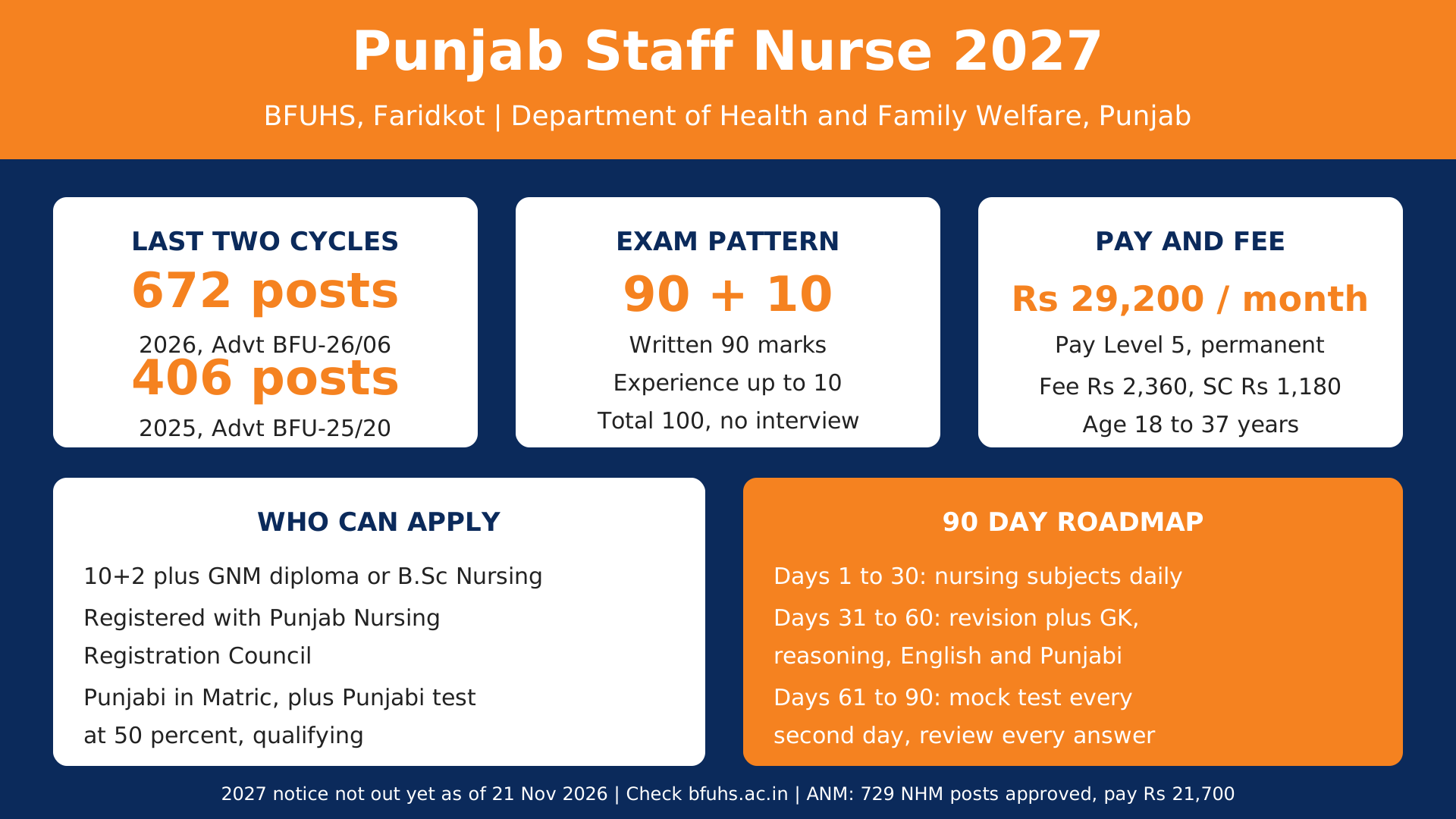
The Punjab Staff Nurse 2027 cycle has a simple starting point. No 2027 notice has appeared yet. The last two cycles give the full picture instead. Baba Farid University of Health Sciences, Faridkot, known as BFUHS, ran a 406 post drive in 2025 under advertisement number BFU-25/20 and followed it with a 672 post drive in 2026 under advertisement number BFU-26/06. Both drives filled permanent Group C Staff Nurse posts in the Department of Health and Family Welfare, Punjab. Both used the same shape of selection, a written test worth 90 marks plus experience marks worth 10, for a total of 100. This guide anchors on those two cycles and marks every 2027 figure as awaited, because the 2027 advertisement, dates and fee have yet to be published as of 21 November 2026.
That anchor matters more than it sounds. Nursing recruitments in Punjab move fast once the notice lands. The 2026 window stayed open for only 21 days, from 13 March to 2 April 2026. The 2025 window lasted 21 days too, from 7 August to 27 August 2025. A candidate who waits for the notice to start preparing has already lost three weeks. A candidate who knows the pattern, the fee, the eligibility and the syllabus can file the form on day one and spend the waiting time on revision instead of reading the advertisement for the first time.
The post itself is the draw. A Staff Nurse in a Punjab government hospital starts at Rs 29,200 a month on Pay Level 5 under the 7th Pay Commission, with allowances on top under Punjab government rules. The job is permanent, not a contract post. It sits in government hospitals and health institutions across the state, and the work is ward nursing, the work a GNM or B.Sc Nursing graduate trained for. For a nurse working on contract pay or in a private hospital, the difference in security alone explains why thousands apply every time BFUHS opens the portal.
Punjab Staff Nurse 2027 at a glance
| Detail | Punjab Staff Nurse 2027, as last run |
|---|---|
| Conducting body | Baba Farid University of Health Sciences (BFUHS), Faridkot, for the Department of Health and Family Welfare, Punjab |
| Post | Staff Nurse, Group C, permanent |
| Last cycle | 2026, 672 posts, advertisement BFU-26/06, applications 13 March to 2 April 2026, exam 19 April 2026 |
| Cycle before that | 2025, 406 posts, advertisement BFU-25/20, applications 7 August to 27 August 2025, exam 5 October 2025 |
| Advertisement for 2027 cycle | Not published as of 21 November 2026 |
| Education | Senior Secondary Part 2 (10+2) plus GNM diploma, or B.Sc Nursing, with registration with the Punjab Nursing Registration Council |
| Age limit | 18 to 37 years as on 1 January of the recruitment year, with relaxation under Punjab government rules |
| Fee in last cycles | Rs 2,360 for all categories except SC; Rs 1,180 for SC candidates, including 18 percent GST, paid online |
| Selection | Written test 90 marks plus experience marks up to 10, total 100; Punjabi language test qualifying |
| Pay | Rs 29,200 a month starting pay on Pay Level 5, plus allowances under Punjab government rules |
| Official website | bfuhs.ac.in, applications through the BFUHS recruitment portal |
| Related post | ANM, 729 posts approved under NHM in December 2025, pay Rs 21,700 a month, advertisement awaited |
Why so many nurses chase this one post
Punjab trains a large number of nurses every year. GNM schools and B.Sc Nursing colleges across the state turn out graduates who then face a narrow set of government openings. Private hospitals pay less and offer little security. Contract work under the National Health Mission pays Rs 29,700 a month for a Staff Nurse and Rs 21,700 for an ANM, which helps, and it still leaves the nurse outside the permanent cadre. A permanent Group C post changes the maths completely, with a pay scale, annual increments, allowances and a pension path. That is why a 672 post notice draws applicants in the tens of thousands.
The second reason is the exam itself. The Punjab Staff Nurse exam pattern rewards subject knowledge over speed tricks. Nursing subjects carry the bulk of the 90 marks. A nurse who spent three years on medical surgical nursing, community health, paediatrics and midwifery already holds most of the syllabus in her notes. The general part is small, a handful of marks for general knowledge, reasoning, numerical ability and language. Compare that with a general competitive exam where the core subject is a minor share, and the appeal is plain. This exam lets a nurse compete on nursing.
The third reason is trust in the process. BFUHS runs the written test and publishes the result, and the selection rests on a written score plus documented experience, with no interview in the mix. Candidates can see exactly where they stand. The 2025 cycle went from notification on 7 August to exam on 5 October, and the 2026 cycle went from notification on 13 March to exam on 19 April, both inside two months. Quick cycles keep hope alive and keep preparation fresh.
None of this makes the exam easy. The 2025 drive split its 406 posts into 167 fresh posts and 239 backlog posts, and the 2026 drive listed 672 posts with a male and female split in most categories. The number of applicants far exceeds the seats in every category, and the written test decides nearly everything, since experience marks add at most 10 and many fresh graduates score zero there. The plan in this guide treats the written test as the whole battle.
The 2026 cycle in full: 672 posts under BFU-26/06
The 2026 drive is the freshest map for the 2027 cycle. BFUHS released advertisement BFU-26/06 on 13 March 2026 for 672 Staff Nurse posts under the Department of Health and Family Welfare, Punjab. Applications ran online from 13 March to 2 April 2026 through the BFUHS recruitment portal. Adda247 and PW Live both report the written exam on 19 April 2026, which left candidates about two and a half weeks between the last date and the exam. One tracker page gives a different exam date, 12 April 2026, with the result on 19 April, and this guide flags that clash in the open flags section rather than picking a side without proof.
The 2026 vacancy table shows how Punjab reserves these posts. General category held 261 posts, SC (M&B) 68, SC (R&O) 67, BC 68, General EWS 67, ESM and LDESM (General) 48, ESM and LDESM (SC M&B) 13, ESM and LDESM (SC R&O) 13, ESM and LDESM (BC) 13, Sports (General) 13, Sports (SC M&B) 4, Sports (SC R&O) 3, Freedom Fighter 7 and Physically Disabled 27, adding to 672. The table also split many categories by sex, with 566 male posts and 213 female posts in the Dailyhunt reproduction of the notice, a split that adds to 779 rather than 672 and points to a reporting slip in that reproduction. The category totals themselves add cleanly to 672 across several independent trackers, so this guide uses the category totals and flags the sex split as unverified.
Three Staff Nurse advertisements ran side by side in early 2026, and mixing them up is the easiest mistake a candidate can make. Advertisement BFU-26/06 covered the 672 posts in the Health Department, with applications from 13 March to 2 April 2026. Advertisement BFU-26/04 covered 200 Staff Nurse posts at Dr B R Ambedkar State Institute of Medical Sciences, Mohali, with applications from 27 February to 19 March 2026. Advertisement BFU-26/02 covered 59 Staff Nurse posts in BFUHS affiliated hospitals and institutes, with applications from 13 February to 5 March 2026. Each drive needed its own application and its own fee, and one application never covered another drive. The 2027 cycle may repeat this pattern of parallel drives, so candidates should read the advertisement number on every form they file.
Eligibility in 2026 stayed close to the 2025 rules. Candidates needed Senior Secondary Part 2 or its equivalent, plus a GNM diploma or a B.Sc Nursing degree from a recognised university or institution, and registration as a Nurse and Midwife with the Punjab Nursing Registration Council. Age ran from 18 to 37 years as on 1 January 2026. The fee stayed at Rs 2,360 for all categories except SC and Rs 1,180 for SC candidates, with the fee made of a base amount plus 18 percent GST, paid online and non refundable.
The 2025 cycle: 406 posts under BFU-25/20
The 2025 drive is the cycle with the most complete public record, and it is the one this guide leans on for pattern and syllabus detail. BFUHS released advertisement BFU-25/20 on 7 August 2025 for 406 Staff Nurse posts. Applications ran from 7 August to 27 August 2025, with the last date for fee payment on 29 August 2025. Admit cards came out on 27 September 2025, and the written exam took place on 5 October 2025. The whole cycle, from notice to exam, took under two months.
The vacancy split in 2025 tells a story about Punjab nursing recruitment. Only 167 of the 406 posts were fresh. The other 239 were backlog posts, seats left unfilled from earlier drives and carried forward. General category held 65 fresh posts and no backlog. SC (M&B) held 17 fresh and 21 backlog. SC (R&O) held 17 fresh and 20 backlog. BC held 17 fresh and 42 backlog. EWS held 16 fresh and no backlog. ESM and LDESM (General) held 13 fresh and 41 backlog. ESM and LDESM (SC M&B) held 3 fresh and 12 backlog. ESM and LDESM (SC R&O) held 3 fresh and 11 backlog. ESM and LDESM (BC) held 3 fresh and 11 backlog. Sports (General) held 3 fresh and 24 backlog. Sports (SC M&B) held 1 fresh and 6 backlog. Sports (SC R&O) held 1 fresh and 6 backlog. Freedom Fighter held 2 fresh and 28 backlog. Physically Handicapped held 6 fresh and 17 backlog. The backlog share matters for cutoffs, because reserved categories with large backlogs behave differently from the general category, where every seat was fresh.
One detail from the 2025 cycle deserves attention. The advertisement listed the post as permanent, and the department as Health and Family Welfare, Punjab. The conducting body was BFUHS, Faridkot, and the university published the notice on its own website and ran applications through its recruitment portal at recruitment.ggsmch.org. Candidates who search for the notice should look for the advertisement number BFU-25/20, since BFUHS runs many recruitments in a year and the staff nurse notices share similar titles.
Who can apply for Punjab Staff Nurse
Eligibility has three parts, and all three must hold on the date the notice fixes. First, schooling. A candidate must have passed the Senior Secondary Part 2 examination, which is 10+2, or its equivalent from a recognised university or institute. Second, nursing qualification. The candidate must hold a diploma in General Nursing and Midwifery, known as GNM, from a recognised institution or university, or a B.Sc Nursing degree. Post Basic B.Sc Nursing and M.Sc Nursing holders can also apply, and PW Live lists 10+2 with Science and English among the qualifications in its eligibility summary, though the core notification text quoted by Adda247 lists Senior Secondary Part 2 plus the GNM diploma. Third, registration. The candidate must be registered with the Punjab Nursing Registration Council, set up under the Punjab Nurses Registration Act, 1932, as a Nurse and Midwife. Registration is the line that separates a nursing graduate from an eligible applicant, and a candidate whose registration is pending should finish it before the form opens.
Age runs from 18 to 37 years as on 1 January of the recruitment year, so 1 January 2025 for the 2025 cycle and 1 January 2026 for the 2026 cycle. Relaxation follows Punjab government rules. IndiaExamAlert lists 5 years for SC and BC candidates, 10 years for persons with disabilities, service period plus 3 years for ex servicemen, up to 45 years for government and public sector employees, and up to 40 years for widows and divorcees. These relaxation figures come from tracker summaries of the notice, and candidates should confirm the exact table in the 2027 advertisement before relying on any single figure.
Language is a separate gate, and it catches candidates who skip the fine print. A candidate must have passed Punjabi as a subject in Matric or its equivalent, and must pass a Punjabi language test with at least 50 percent marks. The Punjabi test is qualifying, which means it adds no marks to the merit total and still blocks a candidate who fails it. A nurse who studied outside Punjab and never took Punjabi in school should plan for this test from the first week of preparation, because it is the one paper that has nothing to do with nursing and everything to do with eligibility.
Nationality follows the usual Punjab government pattern. Indian citizens can apply, and so can citizens of Nepal, subjects of Bhutan, Tibetan refugees who came to India before 1 January 1962 with the intention of settling here permanently, and persons of Indian origin who migrated from Pakistan, Burma, Sri Lanka and the East African countries listed in the notice with the same intention. The domicile and reservation rules for the 2027 cycle will sit in the advertisement, and candidates claiming a reserved category should keep caste, domicile and EWS certificates ready in the exact format the notice asks for, since a certificate in the wrong format can cost a seat even after a good written score.
Punjab Staff Nurse exam pattern
The Punjab Staff Nurse exam pattern is short to state and easy to misread. Selection rests on two parts. The written test carries 90 marks. Experience marks carry up to 10. The total is 100. The merit list follows that total. There is no interview. Document verification follows for shortlisted candidates, and a medical fitness check sits at the end of the process in the 2026 tracker summaries.
| Stage | Marks | What it tests |
|---|---|---|
| Written test | 90 | Objective questions on nursing subjects, general English, reasoning, general knowledge and numerical ability |
| Experience marks | Up to 10 | Relevant work experience in the Punjab Health Department or UT Administration Chandigarh |
| Total | 100 | Merit follows this total |
| Punjabi language test | Qualifying | Pass with at least 50 percent marks; adds no marks to merit |
| Minimum qualifying marks | 33 percent | Reported by tracker summaries of the notice; confirm in the 2027 advertisement |
Three parts of the pattern stay unverified, and this guide says so plainly instead of printing a tidy table built on guesswork. First, the number of questions. One tracker page says the 2025 written test held 140 multiple choice questions over 150 minutes, with each question worth one mark and no negative marking. That figure clashes with the written total of 90 marks reported by Adda247, PW Live, GovernmentDailyJobs and IndiaExamAlert in their pattern tables, so the 140 question figure looks like a slip, and this guide does not use it as fact. Second, the duration. GovernmentDailyJobs gives 2 hours for the 2026 test, while the 140 question claim implies 150 minutes, and no tracker quotes a duration from the official notification itself. Third, negative marking. PW Live says no negative marking is expected, one 2026 tracker page says a quarter mark cut is likely, and the official pattern tables in the trackers list no negative marking rule at all. A candidate should read the 2027 advertisement for these three points and should never build a mock test strategy on a guessed marking rule.
What the sources agree on is the shape. The written test is objective, with multiple choice questions. Nursing subjects dominate. General English, reasoning, general knowledge and numerical ability fill the rest. One 2026 tracker page breaks the 90 marks into 70 to 75 for nursing subjects, 5 to 8 for general knowledge and current affairs, 5 to 7 for reasoning and numerical ability, and 5 for English or Punjabi language, while another breaks the same 90 into 50 for nursing, 20 for general knowledge and 20 for reasoning. Both splits are tracker estimates, not notification text, and they disagree with each other. The safe reading is that nursing carries roughly three quarters of the paper, and the general part is small enough that a nurse who masters nursing and keeps the general part steady will clear most cutoffs.
The minimum qualifying mark of 33 percent appears in IndiaExamAlert and in other tracker summaries, and it fits the pattern of Punjab government recruitments. Treat it as reported rather than confirmed. The Punjabi qualifying test at 50 percent is better attested, appearing in the eligibility sections of several trackers. Either way, the message for preparation is the same. The written test decides the rank, the Punjabi test decides eligibility, and experience marks decide close calls between candidates with similar written scores.
Syllabus, subject by subject
The syllabus follows the GNM and B.Sc Nursing course, and a candidate who studied the course well already owns the backbone. Medical surgical nursing leads the list. It covers the care of adult patients across body systems, pre operative and post operative care, and the common conditions a ward nurse meets every day, from diabetes and hypertension to respiratory illness and post surgical recovery. Anatomy and physiology sit underneath it, because a question on fluid balance or on the signs of shock makes little sense without the body systems behind it. Microbiology follows, with infection control, sterilisation, common pathogens and the precautions that keep a ward safe.
Community health nursing carries real weight in a Punjab government exam, because the post serves public health institutions. It covers immunisation schedules, national health programmes, family welfare, nutrition, sanitation, epidemiology and the work of health workers at sub centre, primary health centre and community health centre level. A candidate should know the National Health Mission, the Aam Aadmi Clinic model in Punjab, and the immunisation programme by name and by purpose, since current health programme questions appear in the general knowledge part too.
Paediatric nursing, also called child health nursing, covers growth and development, common childhood illness, immunisation, neonatal care and the care of a sick child. Midwifery and obstetrical nursing cover pregnancy, labour, delivery, postnatal care, complications and family planning. Mental health nursing covers common psychiatric conditions, their signs, and the nursing care around them. Nursing management and nursing education cover the organisation of a ward, records, supervision and the principles of teaching patients and junior staff. Pharmacology runs through all of it, with drug names, doses, routes and side effects that a ward nurse must know by heart.
The general part needs a different kind of work. General English covers antonyms and synonyms, sentence completion, error correction and idioms. Reasoning covers verbal and non verbal logic, puzzles, coding and decoding, analogies and data interpretation. General knowledge covers Indian history, politics, culture, economy, science and current affairs, with Punjab specific questions on the state, its districts, its rivers, its government and its health schemes. Numerical ability covers time and work, ratio, profit and loss, probability and mensuration at a school level. None of this needs deep study. It needs steady daily practice, because these marks are the easiest to lose through neglect and the easiest to gain through a short daily drill.
One more syllabus point matters. The exam has no separate paper for computer knowledge or for Punjabi literature. Punjabi appears only as the qualifying language test. Candidates who see coaching notes advertising a large Punjabi section in the main paper should treat that claim with care, since the tracker pattern tables put language at about 5 marks inside the 90, and the Punjabi qualifying test stands apart from the merit total.
Experience marks: the 10 marks that split ties
Experience marks can move a candidate past a rival with the same written score, and they follow strict rules. The notice awards 1 mark for each completed year of relevant experience, up to a maximum of 10 marks. Service during the COVID-19 period from March 2020 to June 2021 earns 1.5 marks per year instead of 1, still capped at 10 in total. The experience must be as a contract or outsource employee in the same post in the Department of Health and Family Welfare, Punjab, or in the UT Administration of Chandigarh, without a break in service. Experience in other posts or on unrelated duties does not count. Asha workers and Anganwadi workers who still hold those posts get no experience marks under this rule.
The rule has two edges. A nurse with years of contract service in a Punjab government hospital starts the merit race with marks a fresh graduate cannot match. A fresh graduate starts at zero and must make up the gap in the written test, which needs about 10 more marks out of 90, a real but beatable gap. The lesson is practical. Fresh graduates should treat the written test as a 90 mark paper where they need a clear lead, and experienced nurses should never treat the 10 marks as a cushion, since a weak written score still sinks the total.
Proof matters as much as service. Experience claims need certificates from the employer showing the post, the period and the nature of employment, and the notice counts only service without a break. A candidate with gaps in service, or with service in a private hospital, or with service in a different post, should not count those years. The document verification stage checks these papers, and a wrong claim can remove a candidate after selection.
Fee, form and the application portal
The fee stayed the same in both recent cycles. All categories except SC paid Rs 2,360, made of a base fee of Rs 2,000 plus Rs 360 as 18 percent GST. SC candidates paid Rs 1,180, made of a base fee of Rs 1,000 plus Rs 180 as GST. Payment runs online through the BFUHS portal, by debit card, credit card or net banking, and the fee is non refundable. Only applications with completed fee payment count as valid, and the last date for fee payment can sit a day or two after the form closing date, as it did in 2025, when forms closed on 27 August and fee payment ran to 29 August.
The application runs online only, and the steps stay the same across cycles. The candidate visits bfuhs.ac.in, opens the recruitment section, and picks the link for the right advertisement number, such as BFU-26/06 for the 672 post drive. Registration needs a valid email and mobile number. The form asks for personal details, date of birth, address, education and experience. The candidate uploads a scanned photograph, signature, marksheets and certificates, including the GNM or B.Sc Nursing certificate and the Punjab Nursing Registration Council registration. The fee follows, then a full review, then submission, then a download and print of the submitted form and the fee receipt for the record.
Four form mistakes repeat every cycle. The first is picking the wrong advertisement, since BFUHS runs parallel staff nurse drives with different numbers and different portals. The second is uploading a photograph or signature in the wrong size or format, which the portal rejects late. The third is entering the registration number wrong, which document verification catches later. The fourth is paying the fee but never submitting the form, or submitting the form but never paying. A candidate should finish the form at least two days before the last date, keep the receipt, and check the portal once after submission to confirm the application number.
Pay, posting and the job itself
A selected Staff Nurse starts at Rs 29,200 a month as basic pay on Pay Level 5 of the 7th Pay Commission pay matrix, with allowances under Punjab government rules on top. Some trackers give a wider range up to Rs 92,300 a month, which is the top of the pay scale, not the starting pay, and this guide uses the starting figure of Rs 29,200 that Adda247, PW Live, GovernmentDailyJobs and IndiaExamAlert all agree on. The post is Group C and permanent, which brings annual increments, leave, medical benefits and pension under the rules that apply to Punjab government employees.
Posting runs across government hospitals and health institutions in Punjab under the Department of Health and Family Welfare. The department decides the posting after selection, and a candidate should expect a posting anywhere in the state rather than a chosen district. The work is ward nursing, outpatient care, immunisation, maternal and child health, and the daily running of a government health facility. It is shift work, and it includes night duty and emergency duty, which is the normal shape of a staff nurse post.
Promotion follows the Punjab government nursing cadre rules, and a Staff Nurse with years of service can move to senior nursing posts. The guide does not print a promotion timeline, since no verified source in this research gives one, and a guessed timeline would mislead more than it helps. What is certain is the starting point, permanent service at Rs 29,200 a month, and the security that comes with it.
ANM: the related post every staff nurse candidate should know
The ANM post sits next to Staff Nurse in Punjab health recruitment, and the two often move together. ANM stands for Auxiliary Nurse Midwife. An ANM works at the community level, in sub centres and health and wellness centres, on immunisation, maternal and child health, family welfare and village level health work. The qualification is a two year ANM course from a recognised institution, with registration with the Punjab Nursing Registration Council. It is a shorter course than GNM, and it leads to a different post with different pay and a different exam.
In December 2025 the Punjab Finance Minister, Harpal Singh Cheema, announced that the Finance Department had approved the Health and Family Welfare Department proposal to fill 1,568 vacant posts under the National Health Mission, 729 ANM posts against 2,000 sanctioned posts and 839 Staff Nurse posts against 1,896 sanctioned posts. The monthly pay for these NHM posts was fixed at Rs 21,700 for ANMs and Rs 29,700 for Staff Nurses, with a total annual cost of Rs 48.88 crore. The minister said the recruitment would run through a written examination conducted by BFUHS. As of 21 November 2026, no advertisement number, application dates or exam date for this NHM drive had appeared in the sources checked for this guide, so the ANM part of that drive stays at the approval stage in this article.
The distinction matters. The 672 post BFU-26/06 drive and the 406 post BFU-25/20 drive filled permanent Group C Staff Nurse posts. The NHM drive covers contract posts under the National Health Mission, with different pay and different terms. A candidate who sees the figure of 839 Staff Nurse posts should not add it to the 672, since the two drives belong to different cadres. A candidate who holds only an ANM certificate cannot apply for the Staff Nurse post, since Staff Nurse needs GNM or B.Sc Nursing, and a GNM holder can apply for Staff Nurse but would be overqualified for ANM. Each post has its own lane, and the form must match the certificate.
ANM candidates should still watch BFUHS, since the December 2025 approval names BFUHS as the examining body for the NHM drive. When the ANM advertisement appears, it should carry its own number, its own vacancy table, its own fee and its own pattern, and this guide will need a fresh update. Until then, ANM preparation should follow the ANM course syllabus, with community health, midwifery and child health at the centre, plus Punjabi and general subjects in the same shape as the Staff Nurse pattern.
What changed between the 2025 and 2026 cycles
The jump from 406 posts in 2025 to 672 posts in 2026 is the headline change, and it says something useful about demand. The Health Department needed more nurses in 2026 than in 2025, and the backlog share fell, since the 2026 table lists fresh category totals without the heavy backlog split that shaped 2025. A bigger intake usually means a slightly lower cutoff, though the number of applicants also rises when the notice is bigger, so no candidate should count on an easy paper.
The 2026 cycle also split posts by sex in a way the 2025 table did not, listing male and female posts inside most categories. That split changes how a candidate reads the vacancy table, since a male candidate and a female candidate face different seat counts in the same category. The sex split figures in one tracker reproduction do not add to 672, so this guide flags them and uses only the category totals, which add cleanly. The 2027 advertisement should settle the split, and candidates should read the sex wise columns before choosing a category.
The fee, the age limit, the pay and the selection shape stayed the same across both cycles. That stability is good news for 2027 preparation, since the pattern a candidate prepares for today is very likely the pattern the next notice will use. The exam date pattern also stayed fast, with both cycles holding the written test within two months of the notice. A 2027 notice that follows the same rhythm would give candidates about three weeks to apply and about two to three weeks after that to sit the test.
A 90 day plan that fits the real pattern
Ninety days is enough to cover this syllabus twice if the plan respects the weight of each part. The first 30 days belong to nursing subjects. Medical surgical nursing takes the largest share, with community health next, then paediatrics, midwifery, mental health and pharmacology. A candidate should work from GNM notes and standard nursing textbooks, writing short notes for each topic in her own words. Reading without writing leaves little behind, and the written test rewards recall under time pressure, not recognition while reading.
Days 31 to 60 belong to revision plus the general part. Each day should hold one hour of nursing revision and one hour of general practice, split between English, reasoning, numerical ability and general knowledge. Current affairs need a daily habit, with Punjab news and national health news at the top of the list. A candidate should also start the Punjabi qualifying test preparation in this phase, with daily reading and writing practice, since Punjabi is the paper most likely to be left till the end and the one that can block selection outright.
The last 30 days belong to mock tests. One full mock test every second day, followed by a full review of every wrong answer, builds exam temper. A mock test without review teaches nothing, and a review without a note of the weak topic wastes the lesson. Each mock should run under timed conditions, with no phone and no breaks, and each review should end with a short list of topics to revise the next morning. The final week should hold two full mocks, light revision of short notes, and no new topics, since a new topic in the last week adds stress without adding marks.
Three habits run through all 90 days. First, a daily half hour of Punjabi reading and writing, because the qualifying test has no second chance. Second, a daily 20 questions of numerical ability and reasoning, because speed in the general part frees time for nursing questions. Third, a weekly check of bfuhs.ac.in for notices, because the 2027 advertisement can land at any time and the application window will be short.
Mistakes that cost seats every year
The first mistake is applying under the wrong advertisement. BFUHS ran three staff nurse drives in early 2026, BFU-26/02 for 59 posts, BFU-26/04 for 200 posts and BFU-26/06 for 672 posts, each with its own dates, its own portal link and its own fee. A candidate who files under one number while preparing for another wastes the fee and the chance. The fix is simple. Read the advertisement number on the form, match it to the notice, and keep a print of the right advertisement.
The second mistake is trusting a tracker page for the pattern instead of the notice. The trackers disagree on the number of questions, the duration and negative marking, and at least one tracker prints a written total of 140 marks that clashes with the 90 plus 10 shape every other source reports. A candidate who builds a time plan on 140 questions will run the wrong race. The fix is to read the pattern in the official advertisement when it lands and to treat tracker pattern tables as a guide, not as the notice.
The third mistake is ignoring the Punjabi test. Nurses who studied in English medium schools, or outside Punjab, often learn about the Punjabi qualifying test late. The test needs only 50 percent, and it adds nothing to merit, which makes it easy to dismiss and easy to fail. A daily half hour from the first week removes the risk entirely.
The fourth mistake is counting experience that does not qualify. Only contract or outsource service in the same post in the Punjab Health Department or UT Administration Chandigarh counts, without a break, and only up to 10 marks. Private hospital service, service in another post, and service with gaps do not count. A candidate who claims the wrong years loses them at verification and may lose the seat.
The fifth mistake is leaving the form to the last day. Portals slow down, payment gateways fail, and a photograph in the wrong format can take an hour to fix. The 2025 and 2026 windows lasted 21 days each, and the fee deadline sometimes ran past the form deadline, which tempts candidates to wait. File early, keep the receipt, and check the application number on the portal a day later.
Documents to keep ready before the notice lands
A candidate who gathers documents now will file in an hour when the notice lands. The list starts with 10+2 marksheet and certificate, GNM diploma or B.Sc Nursing degree, and the Punjab Nursing Registration Council registration certificate. Next come the identity and category papers, Aadhaar card, domicile certificate, caste certificate for SC or BC, EWS certificate where claimed, and the certificates for ex serviceman, sports, freedom fighter or disability quotas where claimed. Experience certificates come next, showing the post, the period and the employer, for candidates claiming experience marks. A recent passport photograph and a scanned signature in the format the portal asks for complete the set.
Two checks save trouble later. First, the name and date of birth must match across the 10+2 certificate, the nursing certificate and the registration, since a mismatch triggers queries at verification. Second, the caste and EWS certificates must be in the format and the validity period the Punjab government asks for, since an old format certificate can fail even when the claim is genuine. A candidate should also keep a working email and mobile number that will stay active through the whole cycle, since admit cards and result notices travel through them.
What to watch before the 2027 notice
Five things will signal the 2027 cycle. First, a BFUHS advertisement with a new number in the BFU-27 series on bfuhs.ac.in, carrying the vacancy total, the dates and the fee. Second, the vacancy split, which will show whether the intake stays near 672, falls back toward 406, or grows with the NHM posts folded in. Third, the pattern paragraph in the advertisement, which will settle the number of questions, the duration and negative marking, the three points this guide flags as unverified. Fourth, the NHM drive for 729 ANM and 839 Staff Nurse posts approved in December 2025, which may appear as a separate advertisement with contract terms. Fifth, the result and joining timeline of the 2026 cycle, which will show how fast BFUHS moves from exam to appointment.
Until the notice lands, the work is the same. Nursing subjects every day, general practice every day, Punjabi every day, and a mock test every week. The 672 posts of 2026 and the 406 posts of 2025 show that Punjab hires nurses in large numbers and hires them often. The 2027 notice will reward the candidate who treated the waiting time as preparation time, not as a holiday.
More mock tests for government exams on this site: Bihar Staff Nurse 2027, Bihar ANM 2027, Goa Medical College Staff Nurse 2027, UPPSC Staff Nurse 2027, UPPSC Medical Officer 2027, JKSSB Female Supervisor 2027, SSC GD 2027, IBPS Clerk 2027, RRB NTPC 2027, UPSC CSE Prelims 2027.
Sources
Adda247, BFUHS Staff Nurse Exam Date 2025 Out, Check Exam Pattern, advertisement B.F.U.-25/20, 406 posts, applications 7 August to 27 August 2025, exam 5 October 2025, fee Rs 2,360 and Rs 1,180, category table 167 fresh and 239 backlog, age 18 to 37 years as on 1 January 2025, written test 90 marks plus experience up to 10. Adda247, BFUHS Staff Nurse Vacancy 2026 Out for 672 Posts, advertisement BFU-26/06, applications 13 March to 2 April 2026, exam 19 April 2026, category totals adding to 672. PW Live, BFUHS Staff Nurse Recruitment 2025, 406 posts, admit card 27 September 2025, exam 5 October 2025, written 90 marks plus experience 10, pay Rs 29,200 a month on Level 5. PW Live, BFUHS Staff Nurse Recruitment 2026, advertisements BFU-26/06 for 672 posts, BFU-26/04 for 200 posts and BFU-26/02 for 59 posts, with exam dates 19 April 2026, 12 April 2026 and 29 March 2026. GovernmentDailyJobs, BFUHS Staff Nurse Recruitment 2025, fee Rs 2,360 and Rs 1,180, written 90 marks, experience up to 10, 1 mark per year and 1.5 marks per year for COVID-19 service from March 2020 to June 2021. GovernmentDailyJobs, BFUHS Staff Nurse Recruitment 2026, 672 vacancies, exam 19 April 2026, 90 questions for 90 marks with no negative marking and duration 2 hours. IndiaExamAlert, BFUHS Staff Nurse Recruitment 2025, 406 posts, fee Rs 2,360 and Rs 1,180, written 90 marks plus experience 10, minimum qualifying marks 33 percent, Punjabi language test mandatory with 50 percent, age relaxation 5 years for SC and BC, 10 years for disability, pay Rs 29,200 on Level 5. DailyJobAlert, Punjab Staff Nurse Recruitment 2026, advertisement BFU-26/06, 672 posts, applications 13 March to 2 April 2026, age 18 to 37 years as on 1 January 2026, pay Rs 29,200 a month on Pay Level 5. Dailyhunt, BFUHS Vacancy 2026, 672 Staff Nurse posts, fee Rs 2,360 and Rs 1,180, category table with male and female split. Testbook, BFUHS Staff Nurse Recruitment 2025, 406 vacancies, fee Rs 1,180 for SC, salary Rs 29,200 a month, age up to 37 years. The Fact News, Mann Government approves recruitment for 1,568 ANM and Staff Nurse posts, 16 December 2025, 729 ANM posts and 839 Staff Nurse posts under NHM, pay Rs 21,700 for ANM and Rs 29,700 for Staff Nurse, written examination by BFUHS. Babushahi, Punjab Govt approves filling of 1,568 vacant posts of ANMs and Staff Nurses, 16 December 2025. Baba Farid University of Health Sciences, official website bfuhs.ac.in and recruitment portal recruitment.ggsmch.org.







