
About JKSSB Female Supervisor 2027 Exam Series
📖 Table of Contents
- JKSSB Female Supervisor 2027 and the live cycles in numbers
- The written exam pattern
- Who can apply for JKSSB Female Supervisor
- What a Female Supervisor does, day to day
- Fee, salary and what the job pays
- The 2023 cycle and the 1,03,118 candidates
- The specialisation section, the 60 mark heart of the paper
- General Awareness with Jammu and Kashmir reference, the 20 mark section
- English, Reasoning, Science and Computer, the 40 mark block
- After selection, training, probation and the first posting
- How the selection runs from form to final list
- A 90 day plan that fits this paper
- Poshan Abhiyaan and the Anganwadi system
- Mistakes that cost candidates this exam
- Sources
JKSSB Female Supervisor 2027: Complete Exam Guide
The Jammu and Kashmir Services Selection Board, JKSSB, has opened a fresh round of Supervisor (Female) posts in the Social Welfare Department, under the Mission Director, Poshan Abhiyaan, and the number of women who appeared for the last round tells you how much this post is wanted. JKSSB Female Supervisor 2027 has no notification yet as of 20 November 2026, so every fact in this guide comes from the two live cycles, Advertisement Number 02 of 2023 and Advertisement Number 13 of 2025, and the JKSSB notices that followed them. If you plan to sit for the 2027 cycle, those two cycles are the closest picture you have of the posts, the pattern, the age limits, the specialisation marks and the fees. The Jammu and Kashmir Services Selection Board conducts the exam, and the Social Welfare Department is the department you join.
A Female Supervisor supervises Anganwadi centres, monitors the Integrated Child Development Services and Poshan Abhiyaan, checks the delivery of nutrition, health and education services to children under six and to pregnant and lactating women, and reports to the Child Development Project Officer. The post is women only, it needs a graduate degree, and it carries a preference for Home Science, Child Development and Sociology. The written paper is 120 questions in 120 minutes, with 60 of the marks in a specialisation section on society, community, gender and nutrition, and the selection runs on 100 points, with 95 from the written exam and 5 from the specialisation preference.
JKSSB Female Supervisor 2027 and the live cycles in numbers
| Item | Advt 02 of 2023 | Advt 13 of 2025 |
|---|---|---|
| Posts | 201, revised to 186 | 36 Supervisor (Female) |
| Notification date | 8 December 2023 | 26 December 2025 |
| Application window | 15 December 2023 to 14 January 2024 | 27 January 2026 to 25 February 2026 |
| Written exam | 23 June 2024 | Not announced as of 20 November 2026 |
| Appeared | 1,03,118 | Not yet held |
| Age limit | Open Merit 40 years, reserved 43, PwD 42 | Not separately verified |
| Qualification | Female graduate, any discipline | Female graduate, any discipline |
| Pay | Level 4, Rs 25,500 to Rs 81,100 | Not separately verified |
| Application fee | Rs 500 and Rs 400 | Rs 600 and Rs 500 |
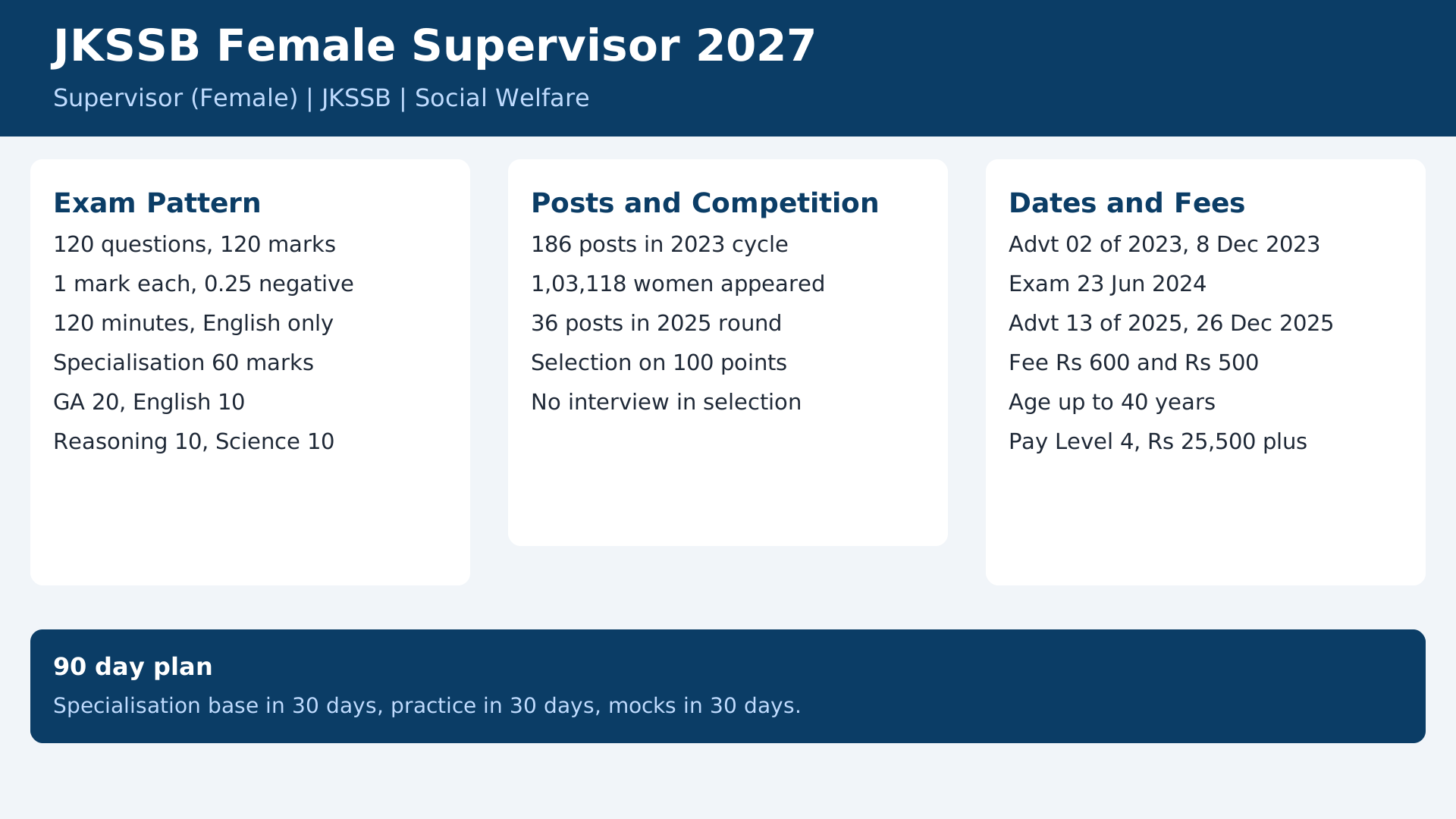
The 2023 cycle was the largest Supervisor recruitment in Jammu and Kashmir in a decade. The notification of 8 December 2023 advertised 201 Supervisor posts, which were revised to 186, and 1,03,118 women appeared for the written exam on 23 June 2024. That is more than 500 candidates for every post, and it is the number to remember when you plan your preparation. The new round, Advertisement Number 13 of 2025, dated 26 December 2025, advertises 36 Supervisor (Female) posts under Poshan Abhiyaan, spread across 8 districts, with applications from 27 January to 25 February 2026. The exam date for the 2026 round has not been announced as of 20 November 2026.
The two cycles show the same post under two different authorities. The 2023 cycle was advertised by JKSSB for the Social Welfare Department, and the 2025 cycle was advertised by JKSSB under the Mission Director, Poshan Abhiyaan. The post, the qualification, and the pattern are the same, but the fee changed: the 2023 fee was Rs 500 for Open Merit, RBA, OSC, ALC, IB, PSP and ESM candidates and Rs 400 for SC, ST, EWS and PwD candidates, while the 2025 fee is Rs 600 for Open Merit and Rs 500 for SC, ST, EWS and PwBD candidates. Use the fee in the notification you apply under, because the fee changes between cycles.
The written exam pattern
The written exam is an objective paper of 120 questions for 120 marks, with each question carrying 1 mark and a duration of 120 minutes. The questions are set in English only. Negative marking is 0.25 marks per wrong answer. The section split is General Awareness with Jammu and Kashmir reference 20 marks, General English 10 marks, Reasoning 10 marks, General Science 10 marks, Computer 10 marks, and Specialisation, Society, Community, Gender and Nutrition, 60 marks. The specialisation section carries half the paper, and it is the section that decides the merit list.
| Section | Marks |
|---|---|
| General Awareness with Jammu and Kashmir reference | 20 |
| General English | 10 |
| Reasoning | 10 |
| General Science | 10 |
| Computer | 10 |
| Specialisation: Society, Community, Gender and Nutrition | 60 |
| Total | 120 |
Selection runs on 100 points: 95 points from the written examination and 5 points from the specialisation preference. Candidates who studied Home Science, Child Development or Sociology as a subject in their graduation get 5 marks, and candidates who studied one of those subjects as a main subject get 5 marks in the same way. The presentation of the 95 plus 5 against a 120 mark paper is an ambiguity in the notification, and it is flagged here: the 95 points are a scaled weight for the written exam, not the raw marks, and the 5 points are the specialisation weight. There is no interview in this recruitment.
The section split above comes from the syllabus notice for Advertisement Number 02 of 2023, and it is consistent across the tracker pages that report it. The pattern for the 2025 round, Advertisement Number 13 of 2025, was not separately verified, and the upload check should confirm that the pattern is unchanged before anyone builds a study plan on it. What is certain is the shape, 120 questions in 120 minutes, 0.25 negative marking, and the specialisation weight, because those figures appear consistently.
Who can apply for JKSSB Female Supervisor
You must be a woman, and you must hold a graduate degree in any discipline from a recognised university. The post is women only, and male candidates cannot apply. The notification gives a preference of 5 marks to candidates who studied Home Science, Child Development or Sociology as a subject in their graduation, and the preference is the reason the specialisation section carries 60 marks. If you hold a degree in Home Science, Child Development, Sociology, or Social Work, this post is made for you, and the specialisation section will be your strongest section.
The age limit is counted as on 1 January 2023 for the live cycle. Open Merit candidates must be not more than 40 years. Reserved categories run to 43 years, and physically challenged candidates to 42 years, under the Jammu and Kashmir reservation rules. You must hold a domicile certificate of the Union Territory of Jammu and Kashmir. Only domiciles of Jammu and Kashmir can apply. There is no physical standard test for this post, and there is no walk test, because the job is supervisory and office based.
What a Female Supervisor does, day to day
A Female Supervisor supervises a group of Anganwadi centres, usually 20 to 25 centres, in a project area, and is responsible for the delivery of the Integrated Child Development Services and Poshan Abhiyaan at the ground level. The daily work includes visiting Anganwadi centres, checking the attendance of children and the supply of supplementary nutrition, monitoring the growth of children under six, checking the health and nutrition services for pregnant and lactating women, and reporting to the Child Development Project Officer. Supervisors maintain records of beneficiaries, verify the distribution of take home rations, and assist in the immunisation and health check up drives.
The posting is usually a project area in a district, with a Child Development Project Office as the base, and the work is field based, with daily visits to Anganwadi centres across villages. The work is social, not physical, and it needs communication skills, record keeping, and the ability to work with village communities. The department runs training for Supervisors at the Social Welfare training institutes, and the training covers child development, nutrition, health, and the ICDS and Poshan Abhiyaan schemes, so a background in Home Science, Child Development or Sociology is not just a preference, it is the base the training builds on.
Fee, salary and what the job pays
The application fee for the 2023 cycle was Rs 500 for Open Merit, RBA, OSC, ALC, IB, PSP and ESM candidates, and Rs 400 for SC, ST, EWS and PwD candidates. The application fee for the 2025 round is Rs 600 for Open Merit candidates and Rs 500 for SC, ST, EWS and PwBD candidates. Pay online only, through net banking, credit card or debit card, on the JKSSB portal. The fee is non refundable, and an application without the fee is rejected without consideration.
The pay is Level 4 in the pay matrix, Rs 25,500 to Rs 81,100 per month, plus the allowances that apply to Social Welfare Department personnel. During the probation period the Jammu and Kashmir Probationer Rules 2020 apply to pay and allowances. The career path from Supervisor runs upward to Child Development Project Officer, through promotion and departmental examination, and Supervisors who hold a degree in Home Science or Child Development often move faster. The post is also a route into the social welfare services for candidates who qualify in the civil services examination, because the field experience is exactly what the service looks for. A Supervisor who works hard in the field builds the record that promotion boards look for, so the first posting shapes the long career that follows.
The 2023 cycle and the 1,03,118 candidates
The 2023 cycle is the largest Supervisor recruitment in Jammu and Kashmir in a decade, and the number of candidates who appeared is the number to remember. The notification of 8 December 2023 advertised 201 Supervisor posts, which were revised to 186, and 1,03,118 women appeared for the written exam on 23 June 2024. That is more than 500 candidates for every post, and it means the cut off marks are high, and the specialisation section decides the merit list. A candidate who scores well in the specialisation section, 60 marks on society, community, gender and nutrition, starts the paper with half the marks in hand, and that is often the difference between selection and rejection.
The 2023 cycle also shows how slow the JKSSB process can be. The notification came in December 2023, the written exam was held in June 2024, and the result and selection process ran into 2025 and 2026. The new round, Advertisement Number 13 of 2025, dated 26 December 2025, advertises 36 Supervisor (Female) posts under Poshan Abhiyaan, spread across 8 districts, with applications from 27 January to 25 February 2026. The exam date for the 2026 round has not been announced as of 20 November 2026. If you are preparing for the next cycle, do not plan around a fast process. Plan around a slow one, keep your documents valid, and keep your preparation going through the whole wait. The post is wanted because it is a government job for women graduates with a stable salary and a clear promotion path, and because the work serves children and mothers in the villages, which is the reason many women choose it over a desk job.
The specialisation section, the 60 mark heart of the paper
The specialisation section carries 60 of the 120 marks, and it is the section that decides the merit list more than any other. The topics are society, community, gender and nutrition, and the questions are set at graduation level, with a focus on the schemes and the ground reality. The topics include the Integrated Child Development Services, the Poshan Abhiyaan, the National Food Security Act, the Protection of Women from Domestic Violence Act, the Dowry Prohibition Act, the Maternity Benefit Act, and the schemes for women and children in Jammu and Kashmir. The questions also cover child development, nutrition, health, and the role of the Anganwadi worker and the Supervisor in the delivery of services.
The 60 marks are the most predictable marks in the paper, because the topics are fixed and the level is graduation, and a candidate who holds a degree in Home Science, Child Development or Sociology will find the section straightforward. A candidate who does not hold that background should study the ICDS and Poshan Abhiyaan schemes from the official websites, and the child development and nutrition chapters from the Home Science textbooks, because the section is half the paper and it cannot be left to chance. The 5 mark preference for Home Science, Child Development and Sociology is separate from the 60 mark section, and it is the reason the selection runs on 100 points, with 95 from the written exam and 5 from the preference.
General Awareness with Jammu and Kashmir reference, the 20 mark section
General Awareness with Jammu and Kashmir reference carries 20 of the 120 marks, and it is the section that rewards a candidate who follows the news of the Union Territory. The topics include the history and geography of Jammu and Kashmir, the districts and the administrative structure, the rivers and the mountains, the art and culture, the festivals and the languages, and the current affairs of the Union Territory. The questions also cover the Indian Constitution, the Parliament, the judiciary, and the national schemes, with a focus on the schemes for women and children.
The best way to prepare for this section is to read one newspaper a day, and to keep a notebook of Jammu and Kashmir facts: the districts and their headquarters, the rivers and their tributaries, the national parks and the sanctuaries, the languages and the festivals, and the schemes for women and children. The section is 20 marks, and it is the section that separates a candidate who prepares from a candidate who guesses. The 20 marks are the most predictable marks in the paper after the specialisation section, because the topics are fixed and the level is graduation.
English, Reasoning, Science and Computer, the 40 mark block
General English, Reasoning, General Science and Computer carry 10 marks each, and together they are 40 marks, a third of the paper. General English tests grammar, vocabulary, comprehension, synonyms and antonyms, error detection, and sentence correction at school level. Reasoning tests analogy, series, coding and decoding, blood relations, direction sense, and non verbal reasoning. General Science tests Physics, Chemistry and Biology at Class 10 level, with a focus on everyday science. Computer tests the basics of computers, the internet, MS Office, and the digital schemes of the government.
The 40 marks are the section to practise by mock test, because the questions are straightforward and the level is school, and a candidate who practises 50 questions a day under a timer will score well. The computer section is the one to study from a book, because the questions are factual and the topics are fixed: the parts of a computer, the operating system, the internet, email, and MS Office. The science section is the one to revise from Class 10 NCERT, because the questions are set at school level and the NCERT text is the source. The English section is the one to build by reading, because a candidate who reads English daily will score well without studying grammar.
After selection, training, probation and the first posting
After the final selection list, the Social Welfare Department issues the appointment order, and the selected candidate joins as a Supervisor on probation. The probation period follows the Jammu and Kashmir Probationer Rules 2020, and during probation the pay and allowances follow the probation rules. The department runs training for Supervisors at the Social Welfare training institutes, and the training covers child development, nutrition, health, and the ICDS and Poshan Abhiyaan schemes, so a background in Home Science, Child Development or Sociology is the base the training builds on.
The first posting is usually a project area in a district, with a Child Development Project Office as the base, and the work is field based, with daily visits to Anganwadi centres across villages. The Supervisor supervises a group of Anganwadi centres, usually 20 to 25 centres, and is responsible for the delivery of the Integrated Child Development Services and Poshan Abhiyaan at the ground level. The career path from Supervisor runs upward to Child Development Project Officer, through promotion and departmental examination, and Supervisors who hold a degree in Home Science or Child Development often move faster.
How the selection runs from form to final list
The selection has three stages, and they run in a fixed order. First comes the online application on the JKSSB portal, with the fee paid online and the documents uploaded in the prescribed format. Then comes the written examination, which is the only stage that carries marks. Candidates who clear the written exam move to document verification, where JKSSB checks your graduation certificate, your domicile certificate, your date of birth, and your category certificate against the cut off dates in the notification. Medical examination follows selection under the department rules. There is no interview in this recruitment, and there is no physical test, because the job is supervisory and office based.
One point in the sequence deserves care. The selection runs on 100 points, with 95 points from the written examination and 5 points from the specialisation preference, and the written exam itself is 120 marks. The 95 points are a scaled weight for the written exam, not the raw marks, and the 5 points are the specialisation weight. This guide follows that reading, and flags the ambiguity, because the notification does not explain the scaling in plain language. Your job is to score as high as you can in the written exam, and to claim the 5 mark preference if you hold Home Science, Child Development or Sociology as a subject.
A 90 day plan that fits this paper
Days 1 to 30 are for the base. The specialisation section carries 60 marks, so give it two hours a day, from the Home Science and Child Development textbooks and the official ICDS and Poshan Abhiyaan websites, covering society, community, gender and nutrition. Give one hour a day to General Awareness with Jammu and Kashmir reference, and one hour to General English, Reasoning, General Science and Computer together, because those five sections carry 60 marks between them. Read one English newspaper a day, even for twenty minutes, and the comprehension and vocabulary questions will take care of themselves.
Days 31 to 60 are for practice. The paper is 120 questions in 120 minutes, so speed is a skill of its own. Do 50 questions a day under a timer, and keep an error log of every question you get wrong. Revise the error log every Sunday. Take your first full mock test at the end of week six, under exam conditions, with negative marking applied. Score it and count every mark lost to a guess, then find your weak subject before the last month. The specialisation section is the section to prioritise in this block, because it is half the paper and it is the section you can raise fastest.
Days 61 to 90 are for mocks and revision. Take two mocks a week, and spend the day after each mock only on the questions you got wrong. Revise the specialisation chapters, the Jammu and Kashmir facts, the English grammar rules, and the computer basics in the final two weeks. In the last three days, stop learning new topics. Sleep properly, and revise your error log. The candidates who fail this exam usually fail on the specialisation section or on time management, not on knowledge, and both are fixed in the 90 days before the exam, not in the exam hall.
Poshan Abhiyaan and the Anganwadi system
Poshan Abhiyaan, the National Nutrition Mission, is the scheme that the Supervisor post serves, and a Supervisor needs to know it. The scheme was launched in March 2018, and it aims to reduce stunting, undernutrition, anaemia and low birth weight in children, and to improve the nutritional status of pregnant and lactating women. The Anganwadi centre is the unit of delivery, and the Supervisor is the officer who monitors a group of centres, checks the supply of supplementary nutrition, and reports to the Child Development Project Officer. The Supervisor also assists in the immunisation and health check up drives, and in the distribution of take home rations.
The Anganwadi system in Jammu and Kashmir covers thousands of centres across the districts, and the Supervisor is the link between the centre and the project office. The work is social, not physical, and it needs communication skills, record keeping, and the ability to work with village communities. The department runs training for Supervisors at the Social Welfare training institutes, and the training covers child development, nutrition, health, and the ICDS and Poshan Abhiyaan schemes. If you live near an Anganwadi centre, visit it, learn how it works, and talk to the Supervisor who monitors it. That knowledge will not appear in the written exam, but it will decide whether you last in the job. The growth monitoring work is the heart of the post, because the Supervisor checks the weight and height of every child under six, records the data, and follows up with the families of children who are undernourished, so the job is measured in the health of the children it serves.
Mistakes that cost candidates this exam
The first mistake is ignoring the specialisation section. It carries 60 of the 120 marks, so a candidate who revises only General Awareness is preparing for a different exam. The second mistake is not claiming the 5 mark preference. If you hold Home Science, Child Development or Sociology as a subject in your graduation, claim it, because 5 marks in a selection with 500 candidates per post is the difference between selection and rejection. The third mistake is applying without a domicile certificate in hand, or with a category certificate issued after the last date. JKSSB is strict on cut off dates, and no representation after the fact has ever helped. The fourth mistake is male candidates applying for a women only post, which wastes the fee and the time.
JKSSB Female Supervisor aspirants often prepare for other JKSSB and graduate exams alongside this one. The UPPSC Staff Nurse 2027, UPPSC Lecturer GIC 2027, UPPSC TGT 2027, UPPSC Assistant Professor 2027, UGC NET Paper 1 2027, UGC NET Commerce 2027, IBPS Clerk 2027, SBI Clerk 2027, SSC GD 2027 and RBI Assistant 2027 pages on this site carry the same style of mock test guide, and the pattern habit you build here transfers directly to them.
Sources
JKSSB Advertisement Number 02 of 2023 dated 8 December 2023, for the 201 Supervisor posts revised to 186, the application window of 15 December 2023 to 14 January 2024, the written exam of 23 June 2024, the 1,03,118 candidates who appeared, the fee of Rs 500 and Rs 400, the age limits of 40, 43 and 42 years, and the pay of Level 4, Rs 25,500 to Rs 81,100, from the notification copies on Testbook, Harshya, and the JKSSB notice. JKSSB Advertisement Number 13 of 2025 dated 26 December 2025, for the 36 Supervisor (Female) posts under Poshan Abhiyaan, spread across 8 districts, with applications from 27 January to 25 February 2026, and the fee of Rs 600 and Rs 500, from the notification copies on Testbook and Make It Easy Hub. The written examination pattern of 120 questions, 120 marks, 120 minutes, 0.25 negative marking, and the section split of General Awareness 20, General English 10, Reasoning 10, General Science 10, Computer 10, and Specialisation 60, from the syllabus notice for Advertisement Number 02 of 2023 and the tracker pages that report it. The selection on 100 points, with 95 from the written exam and 5 from the specialisation preference for Home Science, Child Development and Sociology, from the notification summary. The official JKSSB site at jkssb.nic.in, which could not be reached directly by curl during preparation on 20 November 2026, though its PDF notices were readable through search, so the facts above rest on the notification copies and tracker pages listed here and should be checked against the official notification before you apply.







