About UPPSC Medical Officer 2027 Exam Series
📖 Table of Contents
- What a Medical Officer does in Uttar Pradesh
- Where the 2027 cycle stands right now
- The two recruitments, kept separate
- Screening test in detail: the D-6 pattern
- Screening test in detail: the Allopathy Grade 2 pattern
- Who can apply: the eligibility rules by stream
- Age limit and relaxations
- The D-6 cycle: what actually happened
- Fee and salary: the numbers stream by stream
- The syllabus by stream
- Books that cover the syllabus without waste
- A 90 day plan that fits real life
- Mock test strategy: how to use mocks without wasting them
- Mistakes that cost good candidates marks
- What to check the day the 2027 notice arrives
- Sources
UPPSC Medical Officer 2027: Pattern, Eligibility, Syllabus and Cut Off
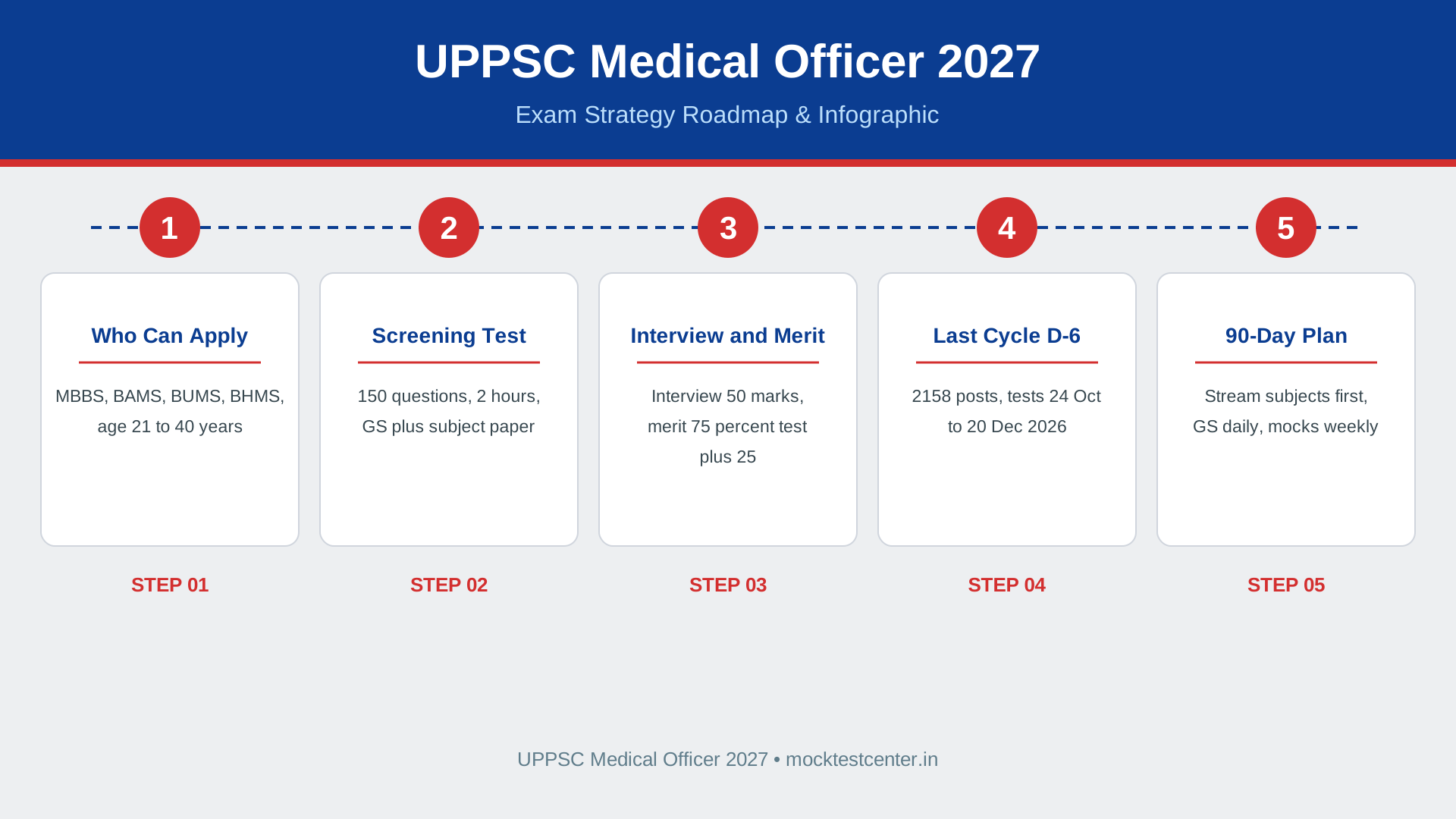
UPPSC Medical Officer 2027 will open Medical Officer posts in Uttar Pradesh for MBBS, BAMS, BUMS, and BHMS graduates. The UPPSC Medical Officer 2027 selection runs in two stages. A screening test carries 150 objective questions in two hours. An interview carries 50 marks. The final merit list takes 75 percent of the screening marks and 25 percent of the interview marks.
The 2027 notification has not come out yet, as of 19 November 2026. This guide rests on the last cycle, advertisement D-6/E-1/2025, and on the separate Allopathy Grade 2 recruitment, and it says clearly where the facts end and the waiting begins. Any website that gives you a fixed 2027 exam date today is guessing.
One warning belongs at the start, because it affects everything else in this guide. Many tracker pages mix two different recruitments into one. They take the 2,158 posts of advertisement D-6/E-1/2025, which covers Ayurveda, Unani, Homoeopathy, Veterinary, Dental, and other posts, and they present the whole 2,158 as Allopathy Medical Officer posts. That is wrong. This guide separates the two recruitments, and it flags every place where the trackers mix them.
What a Medical Officer does in Uttar Pradesh
A Medical Officer in Uttar Pradesh works in a primary health centre, a community health centre, or a district hospital. The day starts with the outpatient clinic, where patients arrive with fever, cough, injuries, skin problems, and the long list of complaints that a general clinic sees. The officer examines, prescribes, and refers the cases that need a specialist.
An Ayurvedic Medical Officer, called a Chikitsa Adhikari in the Ayurved service, works in an Ayurvedic hospital or dispensary, and treats patients with Ayurvedic medicine. A Unani Medical Officer does the same work with Unani medicine. A Homoeopathic Medical Officer works in a Homoeopathic hospital or dispensary. An Allopathy Medical Officer works in the general health service, in primary health centres, community health centres, and district hospitals.
The work also covers national health programmes. A Medical Officer runs immunisation sessions, supervises the staff nurse and the pharmacist, keeps the records that the district health office asks for, and visits villages during health campaigns. The post carries responsibility from the first month, because the signature on a prescription and on a medical certificate is a legal record.
The post is a Group B gazetted post in most streams, and the Allopathy Grade 2 post is a Group A gazetted post in the specialist service. Promotion runs up a clear ladder, from Medical Officer to Senior Medical Officer and then to Chief Medical Officer grades, subject to vacancies and the service rules of the department. The starting pay differs by stream, and the salary section of this guide gives the figures stream by stream.
Many candidates prepare for this exam alongside the UPPSC Staff Nurse 2027 exam in the same family, because the health service posts share the same departments, though the two exams test different subjects and should not be confused.
Where the 2027 cycle stands right now
No 2027 notification exists yet. UPPSC releases its notifications on the official portal, uppsc.up.nic.in, and the Medical Officer 2027 notice will appear there first. As of 19 November 2026, no 2027 dates, no 2027 vacancy count, and no 2027 fee exist in any official notice.
The last cycle is still running. Advertisement D-6/E-1/2025 opened applications on 22 December 2025, and the screening tests run from 24 October to 20 December 2026, post by post. The interviews will follow each screening result, and the final result will come after that. The 2027 notification will come only after the 2025 cycle moves further, so candidates should expect a wait.
The honest way to use the waiting time is to start with the pattern and the syllabus from the last cycle. The pattern has stayed stable, and the syllabus for each stream changes little from one cycle to the next. Preparation that starts now will still count when the notice arrives. Only the dates, the fee, and the vacancy count will change with the new advertisement.
The two recruitments, kept separate
This guide covers two recruitments, and the reader should keep them apart. The first is advertisement D-6/E-1/2025, with 2,158 posts across ten departments. It covers Medical Officer Community Health in Ayurveda and Unani, Veterinary Officer, Homoeopathic Medical Officer, Swasthya Shiksha Adhikari, Dental Surgeon, Chikitsa Adhikari in Ayurveda, Unani, and Homoeopathy, Inspector of Drugs, and Vetting Officer. Its screening test carries 150 questions of three marks each, 450 marks in all.
The second is the Allopathy Medical Officer Grade 2 recruitment, run under separate advertisements. The last fully verified advertisement for it is number 01/2021-2022, with 3,620 posts, which asked for an MBBS degree plus a postgraduate degree or diploma in the concerned speciality. Its screening test, held only when the number of applicants is large, carries 150 questions of one mark each, 150 marks in all.
The confusion starts here. Several tracker pages take the 2,158 figure from the D-6 advertisement and attach it to the Allopathy Grade 2 post, with an MBBS only qualification and a Level 10 pay scale. That mix is wrong on all three points. The 2,158 posts belong to D-6 across all its streams, not to Allopathy alone. The Allopathy Grade 2 post asked for a postgraduate qualification in its last verified advertisement. And the pay scale for the Allopathy post in that advertisement was Level 11, not Level 10.
A candidate who prepares from the mixed pages will prepare for the wrong pattern and the wrong qualification. An MBBS graduate who wants the Allopathy post should read the Allopathy advertisement. A BAMS, BUMS, or BHMS graduate should read the D-6 advertisement. This guide gives both patterns, in separate sections, so that each candidate can follow the right one.
Candidates who also track UPPSC PCS 2027 should note that the PCS exam has nothing in common with the medical selection except the General Studies portion, and the two preparations should not be mixed. Candidates who prepare for UPPSC PCS J 2027 should note the same, because the judicial service follows a Prelims, Mains, and interview of its own, with no link to the medical screening test.
Screening test in detail: the D-6 pattern
The UPPSC Medical Officer 2027 screening test for D-6 posts has 150 objective questions, each carrying three marks, for 450 marks in all. The paper runs for two hours, in one session from 9.30 to 11.30 in the morning, for the posts whose admit cards have come out so far. A wrong answer costs one third of the marks of the question, which is one mark.
General Studies carries 50 questions for 150 marks. The subject of the post carries 100 questions for 300 marks. The subject paper tests the stream itself, Ayurveda for the Ayurvedic posts, Unani for the Unani posts, Homoeopathy for the Homoeopathic posts, and the professional subject for the other posts in the advertisement.
The interview carries 50 marks. The final merit list takes 75 percent of the screening marks and 25 percent of the interview marks. That weight means the screening test decides most of the result, and a candidate who scores high in screening can afford an average interview, while a candidate who scores low in screening needs a very strong interview to recover.
The screening test is held only when the number of applicants is large, and for D-6 the numbers are large, so every post in the advertisement has a screening test on its own date. The admit card comes three days before the screening test of that post, and the district information slip comes a few days before that.
Screening test in detail: the Allopathy Grade 2 pattern
The Allopathy Grade 2 screening test has 150 objective questions, each carrying one mark, for 150 marks in all. The paper runs for two hours. General Studies carries 30 questions for 30 marks. The clinical subject carries 120 questions for 120 marks. A wrong answer costs 0.33 marks.
The clinical portion covers Medicine, Surgery, Obstetrics and Gynaecology, Preventive and Social Medicine, Paediatrics, Pathology, Pharmacology, Forensic Medicine and Toxicology, Ophthalmology, and ENT. The General Studies portion covers Uttar Pradesh geography and history, state health schemes, Indian polity, and current affairs.
One tracker page says the Allopathy screening test carries 150 questions of three marks each, 450 marks, with 50 General Studies questions and 100 subject questions. That is the D-6 pattern, not the Allopathy pattern, and the page has mixed the two recruitments. This guide uses the 150 mark pattern for Allopathy, because it matches the Allopathy syllabus pages and the previous year paper records, and it flags the mixed figure.
The Allopathy screening test is held only when the number of applicants is very large. When it is held, it shortlists candidates for the interview, and the final merit follows the interview. A candidate who prepares for Allopathy should practise clinical questions from the MBBS subjects, and should give General Studies about a fifth of the study time, because it carries a fifth of the marks.
Candidates who prepare for UPPSC APO 2027 face a different test altogether, because the law papers are descriptive, while the medical screening is objective, and the two need different practice.
Who can apply: the eligibility rules by stream
The qualification changes with the stream, and each stream has its own registration rule. A candidate should read the stream that matches the degree, and should not assume that one medical degree opens every post.
Medical Officer Community Health, in Ayurveda and Unani, needs a degree in Ayurveda or Unani Tib, registration as a Vaidya or Hakeem with the Board of Indian Medicine in Uttar Pradesh, and at least six months of professional experience. The experience rule matters, because a fresh graduate without six months of experience cannot claim the post, even with the degree and the registration.
Chikitsa Adhikari in Ayurveda needs a degree or a five year diploma in Ayurveda, registration as a Vaidya, and at least six months of professional experience. Chikitsa Adhikari in Unani needs a degree or a five year diploma in Unani Tib, registration as a Hakeem, and at least six months of professional experience. Chikitsa Adhikari in Homoeopathy needs a recognised degree or a four year diploma in Homoeopathy, and registration with the Homoeopathy Medicine Board in Uttar Pradesh.
Homoeopathic Medical Officer needs a degree in Homoeopathy of at least five years, or a diploma in Homoeopathy of at least four years, and registration with the Homoeopathy Medicine Board in Uttar Pradesh. The degree and the diploma both count, and the registration is the document that the commission checks at verification.
Allopathy Medical Officer Grade 2 needs an MBBS degree from an institution recognised by the National Medical Commission, and permanent registration with the Uttar Pradesh Medical Council. The last verified advertisement also asked for a postgraduate degree of three years in the concerned speciality, or a postgraduate diploma of two years in the speciality, with at least one year of experience in the speciality after registration of the diploma. That postgraduate rule comes from the 2021 advertisement, and the new advertisement may change it, so MBBS graduates should read the new notice with care.
Veterinary Officer needs a Bachelor of Veterinary Science and Animal Husbandry degree, and registration with the Uttar Pradesh Veterinary Council. Dental Surgeon needs a Bachelor of Dental Surgery degree, and registration with the Uttar Pradesh Dental Council. Inspector of Drugs needs a degree in Pharmacy, Pharmaceutical Sciences, or Medicine with a specialisation in Clinical Pharmacology or Microbiology, with 18 to 36 months of relevant experience, under the revised qualification of 19 September 2026.
Indian citizenship is required. The commission also applies the domicile rules of Uttar Pradesh for reservation benefits, so a candidate from another state can apply, but the reservation benefit goes only to Uttar Pradesh domicile candidates in the reserved categories.
Age limit and relaxations
The age limit for the D-6 advertisement ran from 21 years to 40 years, counted as on 1 July 2025. That means a general category candidate needed to be born between 2 July 1985 and 1 July 2005. The new advertisement will name its own cut off date, and the new date will shift the birth window by the same number of years.
One tracker records the age limit for the Allopathy post as 18 to 40 years. That figure conflicts with the 21 to 40 limit in the D-6 advertisement and in the 2021 Allopathy advertisement, and this guide uses 21 to 40 while flagging the 18 year claim.
Relaxation in the upper age limit follows the rules of the Uttar Pradesh government. Reserved category candidates from Uttar Pradesh get extra years, and the exact relaxation differs by category. One tracker records five years for SC, ST, and OBC candidates, and fifteen years for persons with disabilities. Those figures come from a single source, and candidates should confirm the relaxation table in the new advertisement, because a wrong age calculation can waste a whole application.
Age counts from the date the advertisement names, not from the exam date. A candidate who turns 41 a month after the cut off date still qualifies, and a candidate who turns 21 a month after the cut off date does not. Read the date in the advertisement first, and count from there.
The D-6 cycle: what actually happened
Advertisement D-6/E-1/2025 opened with its notification on 22 December 2025. Applications ran from 22 December 2025 to 22 January 2026. The last date for correction and fee reconciliation was 29 January 2026. The advertisement carried 2,158 posts. One source records 2,157 posts, and this guide uses 2,158, the majority figure, while flagging the 2,157 claim.
The vacancy table shows where the posts lie. Medical Officer Community Health, in Ayurveda and Unani, took 884 posts, the largest share by far. Veterinary Officer took 404 posts. Homoeopathic Medical Officer took 265 posts, and Swasthya Shiksha Adhikari took 221 posts, though one tracker swaps these two figures, recording 265 for Swasthya Shiksha Adhikari and 221 for Homoeopathic Medical Officer. This guide uses the majority figures and flags the swap. Chikitsa Adhikari in Ayurveda took 26 posts, Chikitsa Adhikari in Unani took 25 posts, and Chikitsa Adhikari in Homoeopathy took 7 posts. The counts for Dental Surgeon, Inspector of Drugs, and Vetting Officer were not verified in this pass, and the article does not state them.
The screening tests run post by post, from 24 October to 20 December 2026. Homoeopathic Medical Officer and Chikitsa Adhikari in Homoeopathy held their screening test on 24 October 2026. Vetting Officer followed on 26 October 2026. Dental Surgeon was first set for 25 October and then moved to 28 October 2026, for unavoidable reasons, as the commission put it. Inspector of Drugs is proposed for 16 December 2026. Chikitsa Adhikari in Unani is proposed for 18 December 2026. Medical Officer Community Health is set for 19 December 2026. Chikitsa Adhikari in Ayurveda is set for 20 December 2026. The dates for Veterinary Officer and Swasthya Shiksha Adhikari have not come out yet.
One correction belongs here. The brief for this package recorded the screening date as 18 December 2026 for Ayurveda, Unani, and Homoeopathy together. That is not right. Homoeopathy held its screening test on 24 October 2026. Unani is proposed for 18 December 2026. Ayurveda is set for 20 December 2026. The three streams have three different dates, and a candidate who trusts the single date will miss the exam.
The Inspector of Drugs post carries its own story. Its qualification was revised on 19 September 2026, after a Supreme Court order of 10 April 2026, to a degree in Pharmacy, Pharmaceutical Sciences, or Medicine with Clinical Pharmacology or Microbiology. Applications reopened from 21 September to 21 October 2026 for candidates who held the revised qualification by 22 January 2026.
Candidates who prepare for UPPSC RO ARO 2027 will see a different rhythm there, because the RO and ARO selection runs on a Prelims and a Mains of a different shape, and the two exams should not be confused.
Fee and salary: the numbers stream by stream
The fee for the D-6 advertisement was not verified in this pass. No tracker page in this pass gave a clear fee table for D-6, and this guide does not state a fee figure. Candidates should read the fee table in the new advertisement before they pay, because the fee differs by category and the figures change between cycles.
The salary for the D-6 posts runs from Level 7 to Level 10 of the pay matrix, post by post, from 44,900 rupees to 1,77,500 rupees a month in basic pay. The exact level depends on the post, and the advertisement names the level for each post. Dearness allowance, house rent allowance, and travel allowance add to the basic pay as per government rules.
The Allopathy Grade 2 salary carries a conflict. One tracker records Level 10, with a starting basic pay of 56,100 rupees, running up to 1,77,500 rupees, plus 20 percent non practising allowance, dearness allowance, and house rent allowance, with a gross of about 85,000 to 95,000 rupees a month. The 2021 advertisement records Level 11, with a pay scale of 67,700 to 2,08,700 rupees plus an academic allowance of 6,600 rupees. This guide records both figures and flags the conflict, because the two figures come from different advertisements, and the new advertisement will settle the level.
A new Medical Officer should expect a comfortable starting salary, and the real value of the post lies in the career ladder, the job security, and the non practising allowance for Allopathy officers, not in the first month's pay alone.
The syllabus by stream
The UPPSC Medical Officer syllabus divides by stream, and each stream has its own paper. A candidate should study the stream named in the post, and should not waste time on the syllabus of another stream.
The Ayurveda subject paper covers the classical texts, the principles of Ayurveda, diagnosis, and treatment. It covers anatomy and physiology in Ayurvedic terms, the study of drugs, the practice of medicine, surgery in the Ayurvedic tradition, and the care of women and children. The paper also covers the national health programmes from the Ayurvedic side, and the role of Ayurveda in public health.
The Unani subject paper covers the principles of Unani medicine, the study of temperament, diagnosis, and treatment with Unani drugs. It covers the classical Unani texts, the practice of medicine, surgery in the Unani tradition, and the care of women and children. The paper also covers the national health programmes from the Unani side.
The Homoeopathy subject paper covers the principles of Homoeopathy, the study of the materia medica, the repertory, and the practice of medicine. It covers the Organon of Medicine, the philosophy of Homoeopathy, case taking, and the selection of the remedy. The paper also covers the national health programmes from the Homoeopathic side.
The Allopathy clinical paper covers Medicine, Surgery, Obstetrics and Gynaecology, Preventive and Social Medicine, Paediatrics, Pathology, Pharmacology, Forensic Medicine and Toxicology, Ophthalmology, and ENT. Each subject carries a share of the 120 clinical questions, and the paper tests the MBBS subjects in the way a general practitioner uses them, with diagnosis, investigation, and treatment in each case.
General Studies needs a separate notebook, with Indian history, geography, polity, economy, science, current events, and Uttar Pradesh. The Uttar Pradesh portion deserves special care, with the districts, the rivers, the state health schemes, and the recent decisions that affect health in the state. Give General Studies one hour a day from the start, because it carries 150 marks in the D-6 screening test and 30 marks in the Allopathy screening test.
Candidates who track UPPSC Lecturer GIC 2027 should note that the lecturer post tests a postgraduate subject in depth, while the medical screening tests the whole degree at once, so the two need different revision methods.
Books that cover the syllabus without waste
Medical candidates should start with the books of their own degree, because the screening test follows the degree syllabus closely. An Ayurveda candidate should revise from the classical texts and the standard textbooks of the BAMS course, with a notebook for the formulations and the classical references that keep coming back in previous year papers. A Unani candidate should do the same with the BUMS textbooks. A Homoeopathy candidate should revise from the Organon, the materia medica, and the repertory books of the BHMS course.
An Allopathy candidate should revise from the standard MBBS textbooks, subject by subject, with a notebook for the doses, the diagnostic criteria, and the management steps that the screening test asks about. A short book of multiple choice questions in each subject will help, because the screening test is objective, and the habit of answering in the objective format needs practice.
General Studies needs one book, Objective General Knowledge by Lucent Publications, plus a daily newspaper and a monthly current events magazine. The Uttar Pradesh portion needs a separate notebook, with the state health schemes by name, the districts, and the recent health decisions of the state government.
Previous year papers deserve a special place. Solve the screening papers of the last cycles, and read the questions with the syllabus open beside you, so that each question maps to a topic in the syllabus. A shelf full of unread books helps no one. One book read twice beats three books read once.
Candidates who also prepare for UPPSC Assistant Professor 2027 can share the General Studies books with this exam, because the general portion overlaps, and one set of books can serve both preparations.
A 90 day plan that fits real life
Ninety days divide into three parts, and each part has one job. Days 1 to 30 build the base. Read the syllabus subject by subject, two subjects a week, and make short notes as you read. Give the clinical or stream subject three hours a day and General Studies one hour a day. End each week with a previous year paper, solved without a time limit, and mark the questions you got wrong.
Days 31 to 60 build speed. Start timed practice, one full screening paper every third day, in two hours, with a timer. Revise your notes every Sunday, and rewrite the notes that feel thin. This is the phase where weak subjects show themselves, and the honest move is to give the weakest subject the most hours, even when the strongest subject feels better to study.
Days 61 to 90 build exam fitness. Sit for a full mock every second day, in exam conditions, with a timer and no phone. Analyse each mock the same evening, and write down three things, the subjects that cost marks, the question types that ate time, and the silly errors. Revise only from your notes and your error list in the last ten days, and stop learning new material five days before the exam.
Working candidates can follow the same plan with smaller daily hours. Two hours a day for ninety days beats six hours a day for thirty days, because the syllabus needs repetition more than it needs long sittings. Keep a simple daily log, date, hours, subjects covered, questions solved, and the log itself will keep you honest when motivation dips.
Candidates who prepare for UPPSC ACF RFO 2027 will find the same log useful, because the habit of a daily record works for every exam, and one log can serve both preparations, even when the subjects differ.
Mock test strategy: how to use mocks without wasting them
A mock test measures, and the analysis after it teaches. Sit for the mock in exam conditions, two hours, one sitting, no break, no phone, no notes. Medical mocks test recall and the speed of applying knowledge to a case, so practise those two skills in every mock.
Analyse the mock the same day, while the questions still feel fresh. Sort every wrong answer into three piles, concept gap, silly error, and time pressure. Concept gaps need a return to the textbook. Silly errors need a slower reading habit. Time pressure needs more timed sets. A mock without this sorting wastes hours, because the score alone teaches nothing.
Use the negative marking rule in the last fifteen minutes of every paper. In the D-6 test, a wrong answer costs one mark, so a blind guess costs marks. In the Allopathy test, a wrong answer costs 0.33 marks. Mark an answer only when you can remove at least one wrong option. Guess with sense, remove the options you know are wrong, and pick from what remains. A mock is the place to practise this, so that the habit feels natural on exam day.
Take mocks from the full syllabus of your own stream, and mix streams only for General Studies. Your subject mocks should stay inside your own stream, because a mixed mock hides your weak subjects. Keep a running table of your mock scores, and watch the trend across weeks, because a rising trend tells you the plan works and a flat trend tells you to change the plan.
Mistakes that cost good candidates marks
The first mistake is preparing for the wrong pattern. Candidates read the D-6 pattern and prepare for 450 marks, when their post follows the Allopathy pattern of 150 marks, or the other way round. Read the advertisement for your own post first, and match the pattern to the post before you start.
The second mistake is trusting the mixed tracker pages. Some pages present the 2,158 D-6 posts as Allopathy posts, with an MBBS only qualification. A BAMS graduate who trusts those pages will apply for the wrong post, and an MBBS graduate who trusts them will miss the postgraduate rule. Trust only the official portal, and read the advertisement for your own stream.
The third mistake is reading General Studies last. General Studies carries 150 marks in the D-6 screening test, a third of the paper, and candidates who leave it to the final month score far below their subject level. One hour a day from day one keeps General Studies level with the subject, and a level General Studies score saves many borderline results.
The fourth mistake is taking mocks and skipping the analysis. A mock score without analysis is a number without a lesson, and a candidate who repeats the same errors in ten mocks learns nothing from any of them. Analyse every mock, write the error list, and fix one error type before the next mock.
The fifth mistake is trusting unofficial dates. Websites guess the 2027 dates every year, and candidates who plan around a guessed date lose weeks. The D-6 screening dates already show how dates move, with Dental Surgeon moved from 25 to 28 October 2026. Trust only the official portal, and plan around the syllabus until the notice arrives. Candidates who prepare for UPPSC TGT 2027 face the same guessing game, and the same rule applies there, trust the portal, not the rumour.
What to check the day the 2027 notice arrives
Read the UPPSC Medical Officer 2027 notice on the official portal, uppsc.up.nic.in, and check six things in order. First, the application window and the last date for fee payment. Second, the vacancy table by post and stream, to confirm that your stream has posts. Third, the age cut off date, to confirm that you fall inside the 21 to 40 window.
Fourth, the fee for your category. Fifth, the exam pattern and the syllabus link, to confirm whether your post follows the D-6 pattern of 450 marks or the Allopathy pattern of 150 marks, and to confirm that the UPPSC Medical Officer syllabus for your stream has stayed the same. Sixth, the correction window dates.
Apply early in the window, and keep a copy of the filled form, the fee receipt, and the application number. Check your photo, your signature, your category, and your stream before you submit, because the correction window fixes small errors and never fixes a wrong stream. Then return to your plan, and let the notice change your dates, not your study.
Your preparation starts before the notice, and the notice only sets the dates. A candidate who has covered the syllabus, solved the previous year papers, and taken the mocks will meet the notice with calm, and a candidate who waits for the notice will meet it with panic. Start now, and let UPPSC Medical Officer 2027 find you ready. Candidates who also watch UPPSC Polytechnic Lecturer 2027 can use the same checklist on the day its notice arrives, because the six checks work for every UPPSC advertisement.
Sources
The facts in this guide come from the UPPSC official portal, uppsc.up.nic.in, and from tracker pages that quote the official advertisement D-6/E-1/2025 and the UPPSC exam calendar 2026, including MintAffairs, Testbook, India Exam Alert, Sarkari Result Now, Dr Manthan, and SkillAlert. The D-6 cycle dates, the vacancy table, the screening dates, and the pattern rest on those trackers, because the official advertisement PDF could not be fetched directly in this pass. Re-check every date and every figure against the official notice when the 2027 advertisement arrives.