About Punjab and Sind Bank LBO 2027 Exam Series
📖 Table of Contents
- What Punjab and Sind Bank LBO 2027 is
- Why banks are hiring Local Bank Officers in this wave
- Who can apply: the rules from the three notices
- The vacancies: 110, then 750, then 1,000
- The exam pattern, section by section
- The local language test: the heart of this post
- Selection stages: test, screening, interview, language test
- Pay: what a Local Bank Officer actually takes home
- Punjab and Sind Bank LBO next to PO, Clerk and other LBOs
- What to study for each section
- A 90 day plan that fits around a bank job
- Mistakes that cost LBO candidates a year
- What to check before the next Punjab and Sind Bank notice comes out
- Sources
Punjab and Sind Bank LBO 2027: Local Bank Officer Pattern, Salary, Dates
What Punjab and Sind Bank LBO 2027 is
Punjab and Sind Bank LBO 2027 is the next recruitment of Local Bank Officers by Punjab and Sind Bank. A Local Bank Officer is a Junior Management Grade Scale I officer who works in one state, serves customers in the local language, and handles branch banking in the area he or she knows best. The post sits at the same grade as a Probationary Officer, with the same starting basic pay of 48,480 rupees. The difference is the route in and the place of work.
One fact must come first, before any pattern or pay figure. Punjab and Sind Bank has not released a Local Bank Officer notification for 2027 as of 23 November 2026. No advertisement number exists, no vacancy count exists, and no apply dates exist for Punjab and Sind Bank LBO 2027. This page says so plainly, and it builds the rest of the guide from the three LBO recruitments the bank did run, in February 2025, August 2025 and 2026. When the real 2027 notice comes out, read it first and treat this page as a starting point, not as the final word.
Three cycles in about fifteen months is unusual, and it is the first thing to understand about this bank. The first cycle, in February 2025, offered 110 posts. The second cycle, in August 2025, offered 750 posts. The third cycle, in 2026, offered 1,000 posts. The bank went from a small lateral drive to one of the largest LBO drives in the country in just over a year. A candidate who missed the first cycle had two more chances within fifteen months, and a candidate preparing now should expect the bank to come back again.
Check the official careers page at punjabandsindbank.co.in for every notice, because only the official notice is final. The pattern, eligibility rules and pay figures in this article come from the three Punjab and Sind Bank LBO notices of 2025 and 2026, as reported by the trackers that summarise them. They show what a Punjab and Sind Bank LBO notice looks like. They are not the 2027 notice.
The LBO idea is simple. A bank with branches in every district needs officers who speak the local language, know the local crops and trades, and stay in one area long enough to build trust. A Probationary Officer can be posted anywhere in India. A Local Bank Officer applies for one state, proves skill in that state's language, and works in that state. That is the whole deal, and it is why the local language test sits at the centre of this exam.
Punjab and Sind Bank is a good example of why the LBO post exists. The bank has its head office in New Delhi and was founded in Amritsar in 1908, and its branches serve customers across the north and west in particular. Its first LBO list covered six states, from Punjab and Arunachal Pradesh to Gujarat and Maharashtra. Its second list covered thirteen states. An officer who speaks Punjabi serves a branch in Punjab. An officer who speaks Gujarati serves a branch in Gujarat. The bank gets an officer who can talk to the customer on day one, and the officer gets a posting near home.
Why banks are hiring Local Bank Officers in this wave
Public sector banks hired Local Bank Officers at a scale in 2025 that had not been seen before. Bank of Baroda led with 2,500 LBO posts across 18 states. Union Bank of India followed with 1,500 posts. Indian Overseas Bank announced 400 posts, UCO Bank 250 posts, and Punjab and Sind Bank 110 posts in its first cycle. Punjab National Bank joined the wave later, with 750 posts in November 2025, and Indian Bank had already run its own LBO drive in 2024 with 300 posts. Punjab and Sind Bank then ran the two biggest follow up drives of any bank in this set: 750 posts in August 2025 and 1,000 posts in 2026. The LBO wave is real, and this bank rode it harder than most.
Three forces sit behind this wave. First, retirements. Public sector banks are losing officers hired in the 1980s and 1990s, and the gap shows up first in small town and rural branches. Second, the push for banking in the local language. A customer in a village branch wants to be served in Punjabi, Gujarati, Marathi or Kannada, not in English. An officer who grew up speaking that language serves the customer better and sells more products. Third, the cost of transfers. Moving a Probationary Officer across the country every three years is costly for the bank and hard on the officer. A Local Bank Officer stays put, which suits both sides.
That stay put feature is the best reason to want this post and the worst reason to pick it carelessly. An LBO posting is stable, near home, and in a language you speak. It is also a posting with fewer transfer options if you later want a metro city. Candidates who apply for the state where they grew up get the best of this deal. Candidates who apply for a far off state with more posts get a language test they may fail and a posting far from home. Pick your home state, even if it has fewer posts.
The three cycles also show how fast this bank moves. The first cycle opened on 7 February 2025 and closed on 28 February 2025, and the exam was held on 12 April 2025. The second cycle opened on 20 August 2025 and closed on 11 September 2025 after an extension, and the exam was held on 5 October 2025, with the result out on 8 December 2025. The third cycle opened on 31 March 2026 and closed on 20 April 2026, and the exam was held on 10 May 2026. From notice to exam took about two months in each cycle. A candidate who checks the careers page once a month can miss the whole cycle. Check twice a week.
Who can apply: the rules from the three notices
The Punjab and Sind Bank LBO notices set the eligibility rules, and the 2027 notice will most likely repeat them with new dates. The rules are clear, and one of them is strict: this is a lateral recruitment, which means it is aimed at candidates who already work in a bank. Graduation in any discipline from a university recognised by the Government of India is the education rule. The candidate must hold a valid mark sheet or degree certificate.
The age rule is 20 to 30 years. In the first cycle the age was counted as on 1 February 2025. In the second cycle the age was counted as on 1 August 2025. The 2027 notice will print its own cut off date, so check it the day the notice comes out. Relaxation follows the government rules: 5 years for SC and ST candidates, 3 years for OBC non creamy layer candidates, and 10 years for persons with benchmark disabilities.
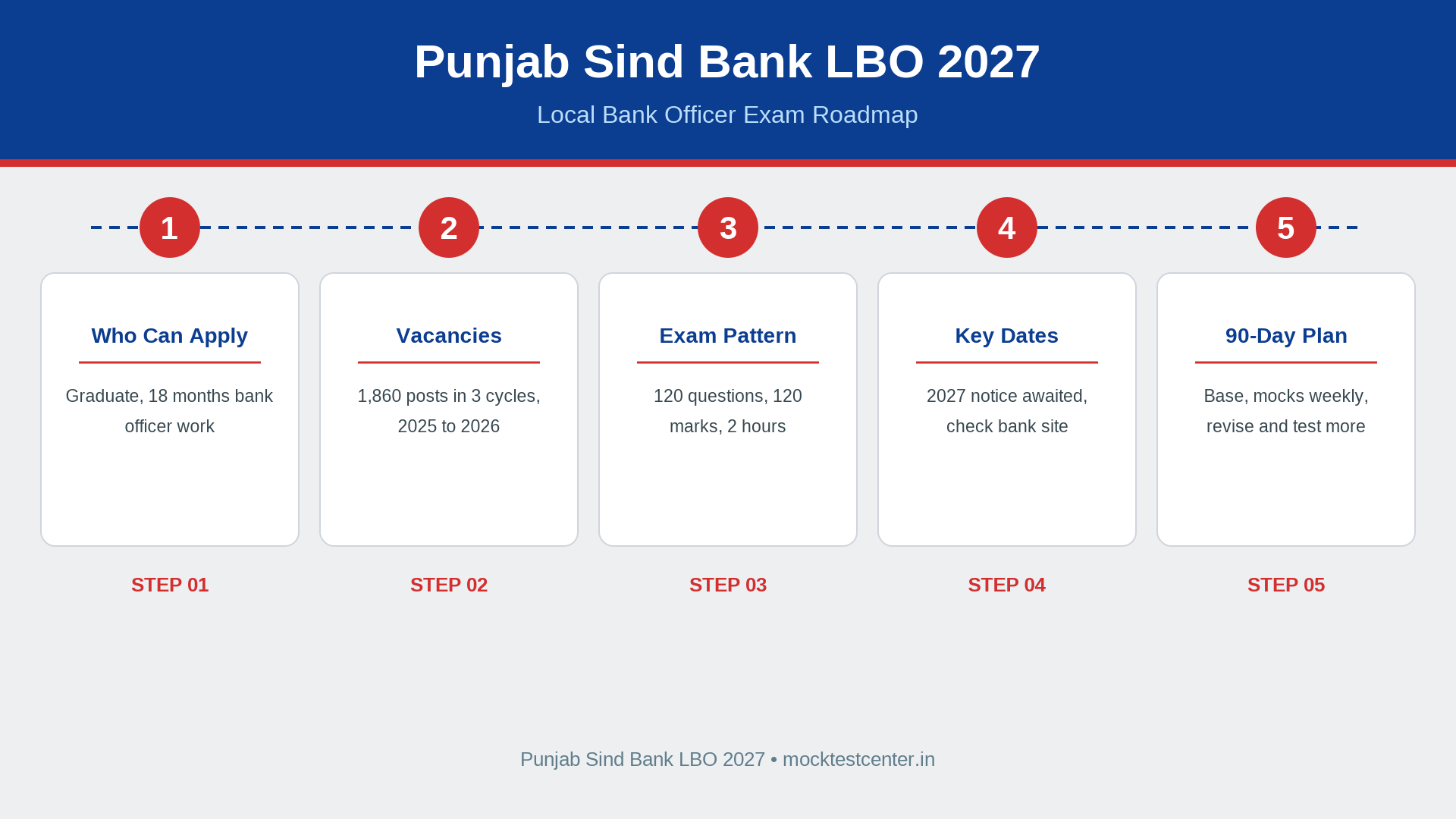
Work experience is the rule that decides most applications here. The first cycle asked for a minimum of 18 months of experience in the officer cadre in a Public Sector Bank or a Regional Rural Bank. That is one and a half years, which is longer than the one year that Bank of Baroda and Punjab National Bank ask for. A candidate who has worked as a clerk in a bank for a year does not meet it. A candidate who has worked as an officer in a public sector bank or a regional rural bank for 18 months does. The later cycles kept graduation plus experience plus local language as the broad shape, and the exact experience clause for the 750 and 1,000 post cycles was not re verified clause by clause for this guide, so read the 2027 notice carefully on this point.
The local language rule is the one rule that can end an application before it starts. The candidate must be proficient in reading, writing and speaking the specified local language of the state applied for. The candidate applies for the vacancy of one state only. The 2025 notices listed a language against each state: Punjabi for Punjab, Marathi for Maharashtra, Gujarati for Gujarat, Kannada for Karnataka, Assamese for Assam, and English for Arunachal Pradesh. The language proficiency test checks this skill, and it is qualifying in nature.
Nationality follows the standard bank rule. The candidate must be a citizen of India, or a subject of Nepal or Bhutan, or a Tibetan refugee who came to India before January 1962 with the aim of settling here permanently, or a person of Indian origin who migrated from Pakistan, Burma, Sri Lanka or the East African countries listed in the notice with the aim of settling in India permanently. Candidates in the last three groups need a certificate of eligibility issued by the Government of India.
The vacancies: 110, then 750, then 1,000
The first cycle, in February 2025, offered 110 Local Bank Officer posts across six states. Maharashtra had 30 posts, Gujarat had 30 posts, Punjab had 25 posts, Karnataka had 10 posts, Assam had 10 posts, and Arunachal Pradesh had 5 posts. The category split was 51 posts for unreserved candidates, 27 for OBC, 14 for SC, 8 for ST and 10 for EWS. The total came to 110 posts.
The second cycle, in August 2025, offered 750 posts across thirteen states. The category split was 322 posts for unreserved candidates, 197 for OBC, 108 for SC, 51 for ST and 72 for EWS. Punjab had 60 posts in this cycle. The notice was released on 19 August 2025, applications ran from 20 August to 4 September 2025 and were extended to 11 September 2025, the admit card came on 26 September 2025, the exam was held on 5 October 2025, and the result was released on 8 December 2025. The whole cycle took under four months.
The third cycle, in 2026, offered 1,000 posts. Applications ran from 31 March to 20 April 2026, and the exam was held on 10 May 2026. The pattern stayed the same, and the scale stayed the same. Three cycles, 1,860 posts in total, in about fifteen months. No other bank in this set hired LBOs at that pace.
The growth tells a candidate two things. First, the bank is serious about the LBO route, and a 2027 cycle is likely, though no notice exists yet. Second, the competition changes with the size. In the 110 post cycle, a single state had 5 to 30 posts, and every seat mattered. In the 1,000 post cycle, the pools are deep, and a prepared candidate has a real chance. But the experience rule still filters the crowd. The 1,000 posts are open to working bankers with 18 months in the officer cadre, not to fresh graduates.
No 2027 state table exists yet. The 2027 notice will print its own state list, and the list may change. The 2025 and 2026 tables are the best guide to what the 2027 table will look like, and the smart move is to prepare for the state you live in and speak, not to chase the state with the most posts.
The exam pattern, section by section
The Punjab Sind Bank Local Bank Officer online exam is a two hour test with 120 questions for 120 marks. It has four sections, and the candidate can move between sections, because there is no sectional timing in the sense of a locked clock per section: the table prints a time against each section, and the total is 120 minutes. Each question carries one mark. The medium is English and Hindi, except for the English Language section, which is in English only.
English Language has 30 questions for 30 marks and 30 minutes. The topics cover reading comprehension, grammar, vocabulary, idioms and phrases, tenses, one word substitution, sentence improvement, paraphrase, cloze test, jumbling of paragraphs, fill in the blanks, and match ups. English is the only section with no Hindi version, so a candidate weak in English cannot hide. The good news is that English is also the most predictable section: the question types repeat every year, and thirty minutes of reading a day lifts the score more than any crash course.
Banking Knowledge has 40 questions for 40 marks and 40 minutes. It is the biggest section by marks, and it is the section that separates a working banker from a general candidate. The topics cover banking products, recent banking developments, mergers of banks, banking technology and digital banking, the functions of RBI and monetary policy, financial institutions such as NABARD, SIDBI and EXIM Bank, loans, deposits, priority sector lending, NPAs, and the basics of banking law and regulation. A candidate who already works in a bank has seen most of this in daily work. A candidate who does not work in a bank must learn it from a book, which is why the experience rule and the pattern fit together.
General Awareness and Economy has 30 questions for 30 marks and 30 minutes. The topics cover current affairs of the last six to twelve months, economy news, government schemes, sports, awards, important days, static general knowledge, countries, capitals and currencies, and science and technology updates. This section is the easiest place to add marks quickly, because a fact either known is a mark in under a minute or it is not, and the candidate moves on.
Computer Aptitude has 20 questions for 20 marks and 20 minutes. It is the smallest section, and it is the most scoring. The topics cover hardware, software, networks, the internet, MS Office, databases, and basic security. A week of revision covers it. Do not spend a month on computer aptitude. Spend the month on Banking Knowledge.
Negative marking is the one point where the trackers disagree. PracticeMock and BankersAdda report negative marking of 0.25 marks per wrong answer. RankersChoice reports no negative marking for the 110 post cycle. The article states the conflict plainly: most trackers say 0.25, one says none, and the notice is the final word. Until the 2027 notice prints the rule, the safe plan is to prepare as if negative marking of 0.25 applies, and to guess only when two options can be ruled out.
The qualifying marks are clear and they matter. The minimum qualifying marks in each section are 40 percent for unreserved and EWS candidates and 35 percent for reserved categories. A candidate who fails even one section is out, no matter how high the total score. That is different from the UCO Bank paper, where the trackers report no sectional cut off. In this exam, every section must be cleared. A candidate who is strong in Banking Knowledge and weak in English can lose the whole exam in the English section.
Compare this with the Bank of Baroda LBO model, which many guides quote as the standard LBO pattern. Bank of Baroda also ran 120 questions for 120 marks in 120 minutes, with four sections, and the section split was the same shape: English 30, Banking Knowledge 30, General Awareness and Economy 30, and Reasoning with Quantitative Aptitude 30. Punjab and Sind Bank swaps Reasoning and Quantitative Aptitude for Computer Aptitude and gives Banking Knowledge 40 questions instead of 30. The two papers look alike on the surface and test different skills underneath. Do not prepare for the Bank of Baroda paper if you are targeting Punjab and Sind Bank. Prepare for the 120 mark paper with Banking Knowledge at its centre.
The local language test: the heart of this post
The local language test is the stage that makes the LBO post different from every other bank officer post. The online exam tests what a candidate knows. The language test tests where a candidate belongs. Punjab and Sind Bank runs it as a qualifying stage: a candidate who fails it is not offered an appointment, no matter how high the online exam score.
The test checks reading, writing and speaking in the local language of the state applied for. Candidates are called state by state, and the test is held in the language of that state. A Punjab candidate faces Punjabi. A Maharashtra candidate faces Marathi. A Gujarat candidate faces Gujarati. An Arunachal Pradesh candidate faces English, because the notice names English as the local language for that state.
Most LBO recruitments exempt candidates who studied the local language in Class 10 or 12 and can show a mark sheet or certificate. The Punjab and Sind Bank notice does not spell out an exemption clause in the text fetched for this guide, so do not count on an exemption. Keep the Class 10 mark sheet ready, because it is the document that proves language study, but prepare for the test itself. The safe plan is to assume the test will happen and to be ready for it.
Preparation for the language test is simple and most candidates skip it, which is why it catches people out. Read a newspaper in the local language for fifteen minutes a day. Write a short paragraph in the local language every day, by hand, because the test may ask for handwriting, not typing. Practise reading a passage aloud, because speaking clearly in the language matters as much as writing it. A candidate who speaks the language at home but has never written it formally is the candidate most at risk. The home speaker reads fluently and writes slowly, with spelling slips. A month of daily writing fixes that.
The language test also shapes the state choice. Apply for the state whose language you speak best, not the state with the most posts. A candidate who grew up speaking Punjabi and applies for Punjab has a language test that feels like a conversation. The same candidate applying for Gujarat faces a Gujarati test that feels like an exam. The online exam score does not rescue a failed language test, so the state choice is also a language choice.
Selection stages: test, screening, interview, language test
Punjab and Sind Bank selects Local Bank Officers in five phases: the online written test, screening of applications, the personal interview, the local language proficiency test, and the final merit list. The written test carries 70 percent weight in the final merit, and the interview carries 30 percent. The written score out of 120 is converted to a score out of 70, and the interview score out of 50 is converted to a score out of 30. The two converted scores are added for the final merit.
The interview is where the working banker has an edge. The panel checks communication skill, subject knowledge, general awareness, and suitability for the post. A candidate who can talk about real branch work, real customers, and real banking problems scores better than a candidate who talks only from a book. The panel also checks the documents: the degree certificate, the experience certificate in the prescribed format from the current or previous employer, the age proof, the caste certificate where applicable, and the language proof. A mismatch in the documents ends the process, so keep every certificate ready before the notice comes out. The experience certificate matters most here, because the 18 month rule is checked at this stage.
The screening stage is the one candidates forget. The bank shortlists candidates based on performance in the written test and on eligibility. A candidate who clears the written test but fails the eligibility check at screening does not reach the interview. That is why the experience rule must be counted with care before applying: 18 months in the officer cadre in a Public Sector Bank or a Regional Rural Bank, counted up to the closing date of registration.
The application process itself is online only, through the bank website and the IBPS online portal, with the fee paid online. The fee is the one point where the trackers disagree for this bank. One tracker reports 850 rupees plus taxes for General, EWS and OBC candidates and 100 rupees plus taxes for other categories. Another tracker reports 1,000 rupees for General, OBC and EWS and 100 rupees for SC, ST and PwD. The article states the conflict and does not settle it. The 2027 notice will print the fee, and the fee once paid is not refunded.
Pay: what a Local Bank Officer actually takes home
A Punjab and Sind Bank Local Bank Officer starts in Junior Management Grade Scale I, with a basic pay of 48,480 rupees a month. The full scale runs from 48,480 rupees to 85,920 rupees, with increments of 2,000 rupees for seven stages, then 2,340 rupees for two stages, then 2,680 rupees for seven stages. That scale is printed in the LBO notices, and it is the same scale that Bank of Baroda, Punjab National Bank, UCO Bank and Indian Bank print in their LBO notices. The LBO post pays the same basic as a Probationary Officer in every public sector bank.
Basic pay is only part of the salary. On top of the basic, an officer gets dearness allowance, house rent allowance or leased accommodation, city compensatory allowance where applicable, medical benefits, leave fare concession, provident fund and the National Pension System, and gratuity. The gross monthly pay for a Scale I officer in a city is reported in the range of 52,000 to 58,000 rupees, though that range is a reported figure, not a number printed in the LBO notification. The in hand pay depends on the place of posting and the allowances claimed, so treat the reported range as a guide, not a promise.
Compare the pay with the nearest alternatives. The SBI PO 2027 post pays the same starting basic of 48,480 rupees, and the IBPS PO 2027 post pays the same scale as well. The LBO post pays the same, with a home state posting. That is the trade that makes it attractive: same money, less transfer, more language. For a working banker, the LBO post is also a step up in grade without leaving the state where the family lives.
Punjab and Sind Bank LBO next to PO, Clerk and other LBOs
The LBO post sits between the Probationary Officer post and the Clerk post, and it helps to see the three side by side before choosing. The SBI PO 2027 exam is for fresh graduates with no experience, has three stages including mains, a psychometric test and a group exercise, and posts officers anywhere in India. The SBI Clerk 2027 exam is a clerical post with a lower pay scale and a local language test of its own, but no officer grade. The Punjab and Sind Bank LBO post needs 18 months of officer experience, has a single online test plus screening, an interview and a language test, pays the officer scale, and posts the officer in the home state. For a working banker who already has the experience, the LBO post is the shortest road to the officer scale in the home state.
The IBPS Clerk 2027 exam is the clerical cousin: lower pay, no interview in recent cycles, and a state wise posting. The IBPS RRB PO 2027 exam and the IBPS RRB Clerk 2027 exam are the rural bank cousins: local postings, local language, and a scale that starts lower than the LBO officer scale. The RBI Assistant 2027 exam is a different world: a central bank post, a clerical grade, and a much tougher competition for fewer seats. The LBO post beats them all on one point: officer pay with a home posting and a paper a working banker can clear in one attempt.
Inside the LBO family, the differences are about experience and paper shape. The UCO Bank LBO 2027 exam runs the long paper, 155 questions for 200 marks in 180 minutes, and asks for no experience, so a fresh graduate can apply. The Punjab National Bank LBO 2027 exam runs a 150 question paper for 150 marks in 180 minutes and asks for one year of bank work. The Indian Bank LBO 2027 exam runs the same 155 question and 200 mark paper as UCO Bank, and like UCO Bank it asks for no experience. Punjab and Sind Bank asks for the most experience in this family at 18 months, and runs the shortest paper at 120 questions in 120 minutes. A working banker with 18 months in the officer cadre has all four doors open. A fresh graduate has two doors: UCO Bank and Indian Bank.
The Bank of Baroda LBO model is the paper many guides quote, and it is worth knowing how Punjab and Sind Bank differs from it. Bank of Baroda ran 120 questions for 120 marks in 120 minutes, with four sections of 30 marks each, and asked for one year of experience. Punjab and Sind Bank runs the same 120 questions for 120 marks in 120 minutes, but gives Banking Knowledge 40 questions and Computer Aptitude 20 questions, and asks for 18 months of experience. The two papers look alike on the surface and test different skills underneath. The Punjab and Sind Bank paper rewards the working banker twice: once in the experience rule, and once in the Banking Knowledge section.
What to study for each section
Banking Knowledge needs the most time, because it carries 40 of the 120 marks and it is the section where a working banker should score highest. Revise banking products, recent banking developments, mergers of banks, banking technology and digital banking, the functions of RBI and monetary policy, financial institutions such as NABARD, SIDBI and EXIM Bank, loans, deposits, priority sector lending, NPAs, and the basics of banking law and regulation. A working banker should revise from the circulars and the daily work, not from a guide alone. A candidate who does not work in a bank must learn the terms from a book and then test them with mocks.
English Language needs reading more than rules. Read an English editorial every day and note five new words with their meanings. Practise one reading comprehension passage a day, and time it: five minutes to read, five minutes to answer. Grammar rules help, but the cloze test and the paragraph jumble reward a candidate who reads a lot. English is also the section with a sectional cut off of 40 percent for unreserved candidates, so a weak English score can end the exam even if Banking Knowledge is strong.
General Awareness and Economy needs a daily habit, not a book. Read a business newspaper or a good current affairs summary every morning for thirty minutes. Keep a notebook with three columns: banking news, economy news, and general news. Write one line per item, with the date. Revise the notebook every Sunday. In the last month before the exam, read the last six months of banking news twice: once fast, once slow. The section has 30 questions in 30 minutes, so the candidate who knows the fact answers in seconds, and the candidate who does not know it must move on in seconds.
Computer Aptitude needs one week. Hardware, software, networks, the internet, MS Office, databases, and basic security questions are fact based, and a week of revision covers them. Do not spend a month on computer aptitude. Spend the month on Banking Knowledge and English, the two sections with sectional cut offs that can end the exam.
Mock tests tie the four sections together. Take one full mock a week for the first month, then two a week. Always take the mock with the sectional cut off in mind: a mock score is not a pass unless every section clears 40 percent for unreserved candidates or 35 percent for reserved categories. After each mock, write down the three sections in order of marks lost, and give the worst section thirty minutes a day until the next mock. The mock score is not the goal. The list of weak topics after the mock is the goal.
A 90 day plan that fits around a bank job
Days 1 to 30 are for the base. Cover the syllabus of all four sections once, with no mock tests yet. Two hours a day is enough for a working banker: forty minutes of Banking Knowledge, thirty minutes of reading current affairs, thirty minutes of English reading, and twenty minutes of computer aptitude. On Sundays, revise the week and write one paragraph in the local language by hand. By day 30 the candidate should have seen every topic once and know which sections feel easy and which feel hard.
Days 31 to 60 are for mocks and repair. Take two full mocks a week. After each mock, spend the next two days on the weakest section only. If English is weak, do reading and grammar for two days. If Banking Knowledge is weak, revise the banking terms notebook for two days. Keep the daily current affairs reading going. Check the sectional scores after every mock, not just the total, because a section below 40 percent is a fail even with a high total. By day 60 the mock score should be climbing, and every section should clear the cut off.
Days 61 to 90 are for speed and revision. Take three mocks a week. Practise the sections in the exam order, with the same breaks the real exam allows, which is none. Revise the current affairs notebook twice. Read the last six months of banking news once more. In the last week, stop learning new topics. Revise the banking terms notebook, the formula sheet for computer aptitude, and the vocabulary list. Sleep well the night before the exam. A tired candidate loses more marks in Banking Knowledge than a candidate who skipped a week of study.
The local language needs thirty minutes a week across all ninety days, not a crash course in the last week. Read the local newspaper, write a paragraph, read a passage aloud. A candidate who does this for ninety days walks into the language test calm. A candidate who starts in the last week walks in worried, and worry shows in handwriting and in speech.
Mistakes that cost LBO candidates a year
The first mistake is counting the wrong experience. The first cycle asked for 18 months in the officer cadre in a Public Sector Bank or a Regional Rural Bank. A candidate who counts 18 months as a clerk, or 18 months in a private bank, or 18 months in a shop, clears the test and fails document verification. Count only the months the notice names, in the cadre the notice names, in the banks the notice names, and get the certificate in the prescribed format before you apply.
The second mistake is failing one section. The qualifying marks are 40 percent per section for unreserved and EWS candidates and 35 percent for reserved categories. A candidate who scores 100 out of 120 in total but 11 out of 30 in English has failed the exam. The total score does not save a failed section. Give English and Computer Aptitude the same respect as Banking Knowledge, because the cut off applies to all four sections alike.
The third mistake is applying for the wrong state. A candidate sees 60 posts in Punjab in the second cycle and applies there, although he or she speaks the language of another state better. The online exam goes well, the language test fails, and the year is lost. Apply for the state whose language you speak at home, every day, without thinking. The post count matters less than the language test.
The fourth mistake is preparing for the wrong paper. Many guides print the Bank of Baroda pattern of four sections of 30 marks each and call it the LBO pattern. Punjab and Sind Bank gives Banking Knowledge 40 questions and Computer Aptitude 20 questions. A candidate who practises only the Bank of Baroda paper walks into the exam and finds a paper that rewards banking knowledge more and reasoning less. Check the pattern in the Punjab and Sind Bank notice, not in a generic guide.
The fifth mistake is waiting for the notice to start preparing. The 2026 window ran from 31 March to 20 April, which is 21 days. A candidate who starts preparing on the day the notice comes out has three weeks to cover a two hour paper. A candidate who starts now has three months. The notice will come. The only question is whether the candidate is ready when it does.
The sixth mistake is skipping the documents. The interview checks the degree certificate, the experience certificate in the prescribed format, the age proof, and the caste certificate where applicable. A candidate who cleared the online exam and the language test can still lose the post over an experience certificate that does not match the format or the dates. Keep the degree certificate, the Class 10 mark sheet, the age proof, the experience certificate, and the caste certificate in one folder, and check the names and dates on each one this week.
What to check before the next Punjab and Sind Bank notice comes out
Keep four things ready. First, your degree certificate, with the result declared and the mark sheet in hand, so you can prove graduation the day the notice comes out. Second, your experience certificate in the prescribed format, with the dates matching the appointment letter, so you can prove the 18 month rule the day the notice comes out. Third, your Class 10 mark sheet, because it proves your local language study and your date of birth in one document. Fourth, a mock test routine that checks sectional scores, so the two hour sitting feels normal by the time the notice comes out.
Start with one Punjab and Sind Bank LBO 2027 mock this week, built on the 2025 pattern: 120 questions, 120 marks, two hours, four sections with the marks split 30, 40, 30 and 20. Score it, check every section against the 40 percent cut off, list your weak section, and give that section thirty minutes a day. That single habit, repeated for ninety days, is what turns a working banker into a Local Bank Officer.
Sources
The facts in this guide come from the Punjab and Sind Bank LBO notices of 2025 and 2026, as summarised by the trackers that quote them, and from the official bank website at punjabandsindbank.co.in. The 110 post cycle of February 2025, the 750 post cycle of August 2025, and the 1,000 post cycle of 2026, with their dates, state tables, and exam pattern of 120 questions for 120 marks in 120 minutes, come from IndGovtJobs, Oliveboard, PracticeMock, Adda247, BankersAdda and the other trackers, which agree with each other on the vacancy counts, the dates, and the section split. The final merit formula of written test 70 percent plus interview 30 percent, with the interview scored out of 50, comes from PracticeMock. The Bank of Baroda LBO model, advertisement BOB/HRM/REC/ADVT/2025/05, with 2,500 posts and a 120 question paper, is the reference for the wider LBO wave. Check the official notice when the 2027 cycle opens, because the notice is the only final source.