About MSC Bank Trainee Junior Officer 2027 Exam Series
📖 Table of Contents
- What MSC Bank Trainee Junior Officer 2027 is
- The bank behind the post: 1911 to now
- The 139 posts: four trainee jobs, one notice
- Who can apply for Junior Officer
- The other three posts in brief
- The online test, section by section
- Professional Knowledge: the 80-mark section
- The three supporting sections
- The interview in Mumbai, and how the final list is made
- Stipend, salary, and the bond
- Dates from the 2026 cycle, and what they teach
- How to apply on msc.bank.in
- A 90-day plan that fits around a job
- Mistakes that cost candidates a year
- MSC Bank Junior Officer next to other bank exams
- What to check before the 2027 notice comes out
MSC Bank Trainee Junior Officer 2027: Pattern, Salary, Dates
What MSC Bank Trainee Junior Officer 2027 is
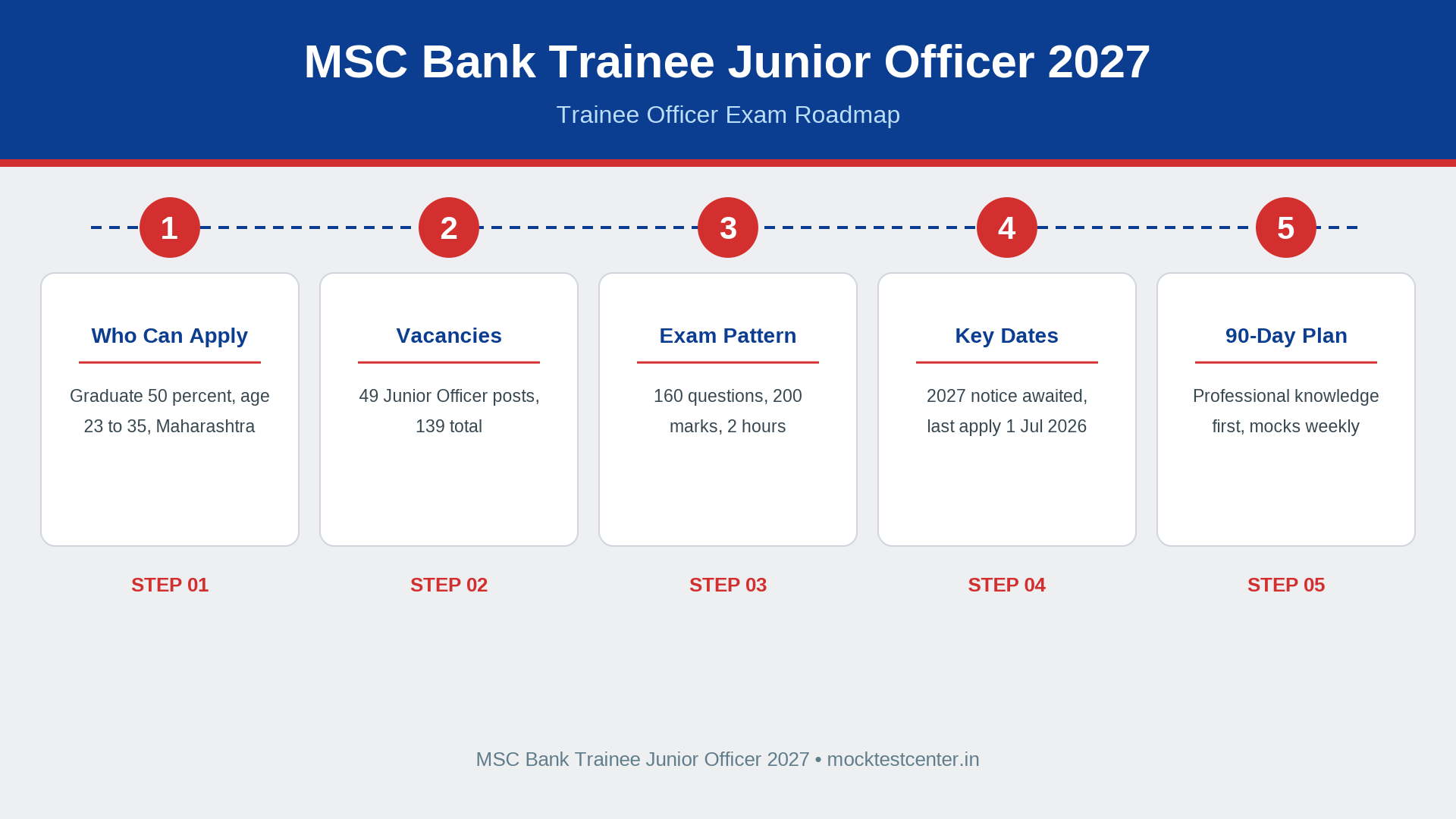
MSC Bank Trainee Junior Officer 2027 is the next round of hiring for Trainee Junior Officers by the Maharashtra State Co-operative Bank, known as MSC Bank. The last round, Advertisement Number 03/MSC Bank/2026-27, offered 139 trainee posts across four jobs, and 49 of those posts were for Trainee Junior Officers. Applications ran from 11 June to 1 July 2026 through the bank career portal at msc.bank.in. The 2027 notice has not come out yet, so this page works from that 2026 cycle, which is the most recent full round and the best guide to what comes next.
The post is a trainee officer job in the Junior Officer Grade of the apex cooperative bank of Maharashtra. A trainee spends 12 months in training on a stipend of 30,000 rupees a month. After training comes 6 months of probation in the regular cadre, and then confirmation. The salary after training is about 52,100 rupees a month.
The selection has two stages: an online test run by IBPS, followed by a personal interview in Mumbai.
One fact shapes this whole exam. The Junior Officer post asks for two years of banking experience as an officer. Fresh graduates cannot apply for it. That single rule cuts the crowd down hard, and it is the reason this page also covers the Trainee Associate post, which needs no experience and had 81 posts in the same notice.
A graduate with no experience should read both posts and pick the one that fits.
MSC Bank is a large bank with a state wide mandate. It is the apex cooperative bank of Maharashtra, set up in 1911, and it sits at the top of a three tier credit structure with 31 District Central Cooperative Banks below it and more than 21,000 Primary Agricultural Credit Societies at the village level. A Junior Officer here works in the bank that funds the district banks, not in a branch that serves walk in customers. That difference shapes the whole job.
The bank behind the post: 1911 to now
MSC Bank began in 1911 as the Bombay Central Co-operative Bank. It took its present name, the Maharashtra State Co-operative Bank, on 1 May 1961. The head office stands at Sir Vithaldas Thackersey Smruti Bhavan, 9 Maharashtra Chamber of Commerce Lane, Fort, Mumbai. The bank runs 6 regional offices and 57 branches across Maharashtra.
It is a scheduled bank, and it calls itself the leading apex cooperative bank in the state.
The apex role is the key to the job. The bank lends to the District Central Cooperative Banks, which lend to the primary societies, which lend to farmers. It also acts as a balancing centre for the surplus funds of the cooperatives in the state. A Junior Officer learns treasury and refinance, with cooperative credit beside them, at the state level, which is work that few bankers ever see.
Officers who stay build knowledge of the cooperative credit system that no commercial bank teaches.
The bank is the biggest cooperative bank in the country by the size of its business, and it has figured among the top 1000 banks in the world on financial soundness in The Banker survey from London. That scale is why the bank runs its own training centre, with centres at Vashi and Nagpur that NABARD has accredited. Trainees get formal training before they take up regular duties, which is rare in cooperative banks.
Check the official site msc.bank.in for every notice, because only the official notice is final. Dates and vacancy counts in this article come from the 2026 advertisement, with pay figures from the same source and the reports that followed it. They will change for 2027. The pattern, the eligibility rules, and the shape of the job have stayed the same across recent cycles, so they are the safest things to plan around.
The 139 posts: four trainee jobs, one notice
Advertisement 03/MSC Bank/2026-27 offered 139 posts in four trainee jobs. The split is the first thing to learn, because the four jobs have different bars and different pay.
| Post | Posts | Stipend per month | Pay after training |
|---|---|---|---|
| Trainee Junior Officer | 49 | 30,000 rupees | About 52,100 rupees |
| Trainee Associate | 81 | 25,000 rupees | About 34,400 rupees |
| Trainee Typist, Associate Grade | 4 | 25,000 rupees | About 34,400 rupees plus 650 typist allowance |
| Trainee Driver, Driver Grade | 5 | 22,000 rupees | About 27,700 rupees |
| Total | 139 |
The Associate post is the big one, with 81 of the 139 posts. It is the clerk grade job of this bank, and it needs no experience. The Junior Officer post is the officer job, with 49 posts and the experience bar. The Typist post has 4 seats.
The Driver post has 5. Both have their own skill tests.
The bank says it can increase or decrease the number of posts at any stage, so the 2027 notice may show a different split.
Only candidates domiciled in Maharashtra can apply, and a Maharashtra State Domicile Certificate is mandatory. Services are liable to transfer to the head office, the regional offices, or any branch in Maharashtra, so only candidates willing to work anywhere in the state should apply. That domicile rule keeps the contest inside Maharashtra, which is good news for local candidates and a closed door for everyone else.
Every selected candidate signs a bond. The undertaking runs on a 500 rupee stamp paper, and it binds the candidate to serve the bank for at least 4 years from the date of joining. Early exit attracts a penalty of 10 lakh rupees as liquidated damages. Read that clause before you apply, because it is a real commitment, not a formality.
Who can apply for Junior Officer
The Junior Officer bar has three parts. A degree comes first, then Marathi, then experience. The degree must be a graduation in any discipline with at least 50 percent marks from a recognised university. Marathi must appear as a subject in matriculation.
The experience bar is the hard one: at least 2 years in banking as an officer in an Urban Cooperative Bank or a District Central Cooperative Bank.
Preference goes to candidates with Law, JAIIB, CAIIB, or MSCIT, or with experience in the Treasury or International Banking Division.
The age rule for Junior Officers is 23 to 35 years as on 1 June 2026. That is older than the usual bank officer window, and it fits the experience rule. A candidate who finished graduation at 21 and worked two years as an officer is 23 at the earliest, so the lower age bar and the experience bar fit together. Expect the 2027 notice to set its own cut off date, so check your age against the date printed in the new notice, not against the date in this article.
The fee for Junior Officers is 1,770 rupees, including GST. The fee for the other three posts is 1,180 rupees, including GST. The fee is paid online only, and it is not refundable in any case. Candidates who apply for more than one post pay the fee for each, and only the latest application stays valid, with the earlier fees forfeited.
Pick one post and apply once.
Two traps catch Junior Officer applicants every cycle. The first is the 50 percent marks rule. A graduate with 49 percent cannot apply, even with ten years of experience. The second is the experience proof.
The experience must be as an officer in an Urban Cooperative Bank or a District Central Cooperative Bank, and the bank checks it at document verification. Experience as a clerk does not meet the rule, and experience in a commercial bank does not meet it either. Keep the experience certificate from your bank ready before you apply.
The other three posts in brief
Trainee Associate is the post most graduates should look at first. It needs a graduation in any discipline with at least 50 percent marks, with Marathi in matriculation, and computer proficiency. No experience is mandatory, though the bank prefers candidates who worked as a Co-operative Intern in a State Cooperative Bank or a District Central Cooperative Bank. Preference also goes to candidates with a Government Commercial Certificate in Marathi or English typing.
The age bar is 21 to 32 years as on 1 June 2026. The selection is an online test plus a personal interview.
Trainee Typist sits in the Associate Grade, and it needs typing speed as a hard bar. The candidate must be a graduate with Marathi in matriculation, and must have passed the Government Commercial Certificate Examination with Marathi typing at 30 words per minute and English typing at 40 words per minute. Computer proficiency in Word and Spreadsheet is mandatory. Preference goes to Marathi and English stenography, and to DTP Operator experience.
The age bar is 21 to 28 years. The selection is a Phase I online test plus a Phase II typing skill test, and the final merit rests on the skill test.
Trainee Driver needs the least education and the most specific skill. The candidate must have passed SSC, matriculation, with Marathi as a subject, and must hold a valid LMV driving licence. No experience is mandatory. The age bar is 18 to 30 years.
Children of MSC Bank employees get a 5 year relaxation on the upper age limit for the Driver post alone. The selection is an online written test plus a personal interview and a driving test.
Read the four posts together and the design of the notice becomes clear. The bank hires one officer batch that needs experience, one large clerk batch that needs only a degree, and two small specialist batches that need a tested skill. A candidate who fits two posts should still pick one, because the fee for the earlier application is lost when a second application goes in. Pick the post where your profile is strongest, not the post with the highest pay.
The online test, section by section
The online test for Trainee Junior Officer runs for 2 hours and carries 200 marks. It has 160 questions, and the paper runs in English only. The minimum qualifying mark is 50 percent, which is 100 marks out of 200. Candidates who score below 100 do not reach the interview, whatever their section scores.
The bank says it can raise or lower the cut off, so 100 is the floor in the notice, not a promise.
| Section, Junior Officer test | Questions | Marks | Minutes |
|---|---|---|---|
| Professional Knowledge | 40 | 80 | 30 |
| English | 40 | 40 | 30 |
| Banking and General Awareness | 40 | 40 | 25 |
| Quantitative and Numerical Ability | 40 | 40 | 35 |
| Total | 160 | 200 | 120 |
Negative marking follows the number of options. For a question with five options, the penalty is 0.25 marks. For a question with four options, the penalty is 0.33 marks, which is one third. That is a steeper penalty than the IBPS 0.25 flat rate, and it changes the guessing maths.
A guess on a four option question costs a third of a mark, so guessing needs better odds here than in other bank tests.
The Associate test uses the same shape with a different first section. It has 160 questions for 200 marks in 120 minutes: Reasoning Ability and Computer Aptitude for 40 questions and 80 marks in 40 minutes, English takes 40 questions and 40 marks in 25 minutes. Banking and General Awareness takes 40 questions and 40 marks in 20 minutes. Quantitative and Numerical Ability takes 40 questions and 40 marks in 35 minutes.
The same 50 percent floor of 100 marks applies. The Typist Phase I test has Marathi Language and Comprehension for 40 questions and 80 marks in 25 minutes, with Reasoning, General Awareness including Computer Awareness, and Quant after it.
The Driver test has 120 questions for 120 marks in 90 minutes.
IBPS runs the online test for all four posts. That matters, because the test follows the IBPS style of sectional timing. Each section has its own clock, and the clock does not carry over. A candidate who finishes English early cannot give the spare minutes to Professional Knowledge.
Practise with sectional timers, not with one long clock, or the real test will feel strange.
Compare the shape with the national officer exams before you plan. The IBPS PO 2027 exam has 100 questions for 100 marks in the prelims, and the SBI PO 2027 exam has the same shape. The MSC test has 160 questions for 200 marks, with Professional Knowledge worth 80 marks on its own. That weight makes the MSC test a different exam, even though the English and maths sections look familiar.
Professional Knowledge: the 80-mark section
Professional Knowledge carries 40 questions for 80 marks in 30 minutes. That is 2 marks per question, and 40 percent of the whole paper. It is the section that decides the merit list, because the other three sections carry 40 marks each. A candidate who scores 60 in Professional Knowledge and 90 in the rest has 150.
A candidate who scores 30 in Professional Knowledge and 110 in the rest has 140. The first candidate wins, even though the second candidate scored more outside the section.
Thirty minutes for 40 questions means 45 seconds per question. That is fast for a knowledge section, and it rewards candidates who have worked in a cooperative bank. The questions cover banking law and cooperative banking. Credit and treasury follow, with international banking after them.
That is why the notice gives preference to Law and JAIIB, with CAIIB and Treasury experience after them. A candidate who has done JAIIB will find much of this section familiar.
The JAIIB RBWM 2027 material on retail banking overlaps with it, and the CAIIB Rural Banking 2027 material overlaps with the rural credit part.
Study for this section from the work you do, not from a generic book. Read the Banking Regulation Act as it applies to cooperative societies, the Maharashtra Cooperative Societies Act, and the RBI directions for cooperative banks. Read about priority sector lending, the Kisan Credit Card, refinance from NABARD, and the three tier structure that MSC Bank tops. Read the bank annual report if you can find it, because it shows what the bank actually lends to.
A candidate who works in a District Central Cooperative Bank already knows half this syllabus from the job.
Do not try to cover this section in a week. Give it an hour a day for two months, and keep a notebook of one page per topic. Each page should hold the rule and one example, with one number beside them. After two months you will have sixty pages, and those pages cover most of what the paper can ask.
On test day you will not be recalling a book. You will be recalling your own notes, and that is a different feeling entirely.
The three supporting sections
English carries 40 questions for 40 marks in 30 minutes. That is 45 seconds per question. Reading comprehension takes the most time here. Read the passage once, answer the direct questions first, and leave inference questions for the end if time is left.
Cloze tests and error spotting reward daily reading more than last minute grammar rules. Read one English editorial every day and note ten new words a week. That habit alone covers vocabulary and comprehension together.
Banking and General Awareness carries 40 questions for 40 marks in 25 minutes. That is 37 seconds per question, the fastest pace after Professional Knowledge. You either know the answer or you do not. Banking awareness and economy news carry the most weight, with current affairs from the last six months beside them.
Maharashtra cooperative news matters more here than in other bank exams, because MSC Bank works in the cooperative sector. Read the commerce pages, not just the front page. Know the repo rate and the reverse repo rate. Know CRR and SLR too, with the names of the RBI Governor and the MSC Bank Chairman beside them.
Update them every month.
Quantitative and Numerical Ability carries 40 questions for 40 marks in 35 minutes. That is 52 seconds per question, the most generous pace in the paper. Data interpretation sets give several questions from one table, so they pay better per minute than a single puzzle. Simplification and number series are the fastest marks in this section.
Fifty questions in fifty minutes would be a kinder pace, but 40 in 35 is still workable if you skip the hard ones first and come back to them.
The three sections together carry 120 marks, and they decide whether you clear the 100 mark floor. A candidate who scores 70 in Professional Knowledge needs only 30 more from these three sections to reach the interview. A candidate who scores 30 in Professional Knowledge needs 70 from these three, which is a hard ask. Put your energy where the marks are, and let the smaller sections support the big one.
The interview in Mumbai, and how the final list is made
Candidates who score at least 100 marks in the online test are shortlisted for the personal interview. The interview takes place in Mumbai, and the bank runs it under its own policy. The final merit list is prepared in descending order on the basis of scores in the online examination and the interview together. That is the rule in the notice, in plain words.
The notice prints no interview marks. It gives no weight for the interview, and no interview qualifying mark. Do not trust any site that prints a figure for it, because the official notice does not give one. What the notice does say is that the bank can raise or lower the written cut off, and that the shortlist for interview rests on the written score plus validation of education and experience.
Treat the interview as important but unquantified, and put your main effort into the written score, which you can measure.
The interview panel asks about your degree and your banking experience. It asks about cooperative banking too, and why you want this job. Know MSC Bank before the interview. Know that it is the apex bank of Maharashtra, set up in 1911, with 6 regional offices and 57 branches.
Know what an apex bank does, who it lends to, and why a government linked cooperative bank exists.
Panels ask that question in some form every year, and candidates who answer it well stand out at once.
Prepare for the interview from the day you clear the test, not a week before it. Know your degree subject and one project or paper from it. Know your current bank: its branches, its deposits, its loan book, and one story from your work as an officer. And know one plain reason you want this job, stated in your own words.
Panels hear the same rehearsed lines all day. A plain answer in your own words stands out more than a polished speech.
Stipend, salary, and the bond
The money in this recruitment comes in two steps. During the 12 month training period, a Trainee Junior Officer gets a stipend of 30,000 rupees a month. A Trainee Associate and a Trainee Typist get 25,000 rupees a month. A Trainee Driver gets 22,000 rupees a month.
After training and confirmation, the pay rises to about 52,100 rupees a month for Junior Officers, about 34,400 rupees a month for Associates and Typists, plus a 650 rupee typist allowance for Typists, and about 27,700 rupees a month for Drivers.
Put the money next to the national exams before you decide. The IBPS SO 2027 exam leads to a Specialist Officer post with a starting basic pay of 48,480 rupees, and the LIC AAO 2027 exam starts at 88,635 rupees basic. The MSC Junior Officer starts lower, at about 52,100 rupees a month after training, but the posting stays in Maharashtra, the work stays in cooperative banking, and the contest stays inside the state. That trade is worth it for candidates who want to build a career in the cooperative sector of their own state.
The bond is the part candidates skip over, and it is the part they should read twice. Four years from the date of joining, on a 500 rupee stamp paper, with a 10 lakh rupee penalty for early exit. Four years is a long time in a banking career, and 10 lakh rupees is a large sum. Do not apply if you plan to leave in a year for another exam.
Apply if you want to stay in cooperative banking and grow in it. The bank trains you for a year, and it wants that training to stay in the bank.
Growth runs on the cooperative ladder. A Junior Officer can move up to officer grades and then to branch manager roles in the bank. The bank ran a separate drive for Specialised Branch Managers in Officer Grade II in 2026, under Advertisement 01/MSC Bank/2026-27, which shows the next rung on the same ladder. JAIIB and CAIIB help at each step, and the bank training centre at Vashi and Nagpur runs the courses.
Plan for promotion from the first year, and keep studying after you join.
Dates from the 2026 cycle, and what they teach
The MSC Bank Trainee Junior Officer 2027 notice has not been released. No dates for 2027 exist yet, and any site that prints them is guessing. What exists is the 2026 cycle, and it is worth reading closely.
| Event | Date |
|---|---|
| Advertisement 03/MSC Bank/2026-27 released | 11 June 2026 |
| Applications open | 11 June 2026 |
| Applications close | 1 July 2026 |
| Online examination | To be announced |
The apply window lasted 21 days. That is short, and it punishes late starters. A candidate who finds the notice in the last week still has to arrange the domicile certificate, the experience certificate, the photo and signature in the asked sizes, and the fee payment. Arrange the domicile certificate and the experience certificate now.
Get the photo and signature in the asked sizes too, with the fee payment after them. Then the window is only about filling the form.
The test date was not announced in the notice. The notice says only that candidates should check the bank website regularly for updates. One tracker site prints a tentative test date of 15 December 2026, but no official source backs it, and the official notice says the date is to be announced. Do not plan around the tracker date.
Plan around the official site, and check msc.bank.in twice a week until the test date comes out.
Watch the career page from May onward. The 2026 notice came in June, so late spring is the season to watch. The bank also hires through the year: the Branch Manager drive came under Advertisement 01/MSC Bank/2026-27, before the trainee notice. A candidate who watches the career page catches rounds that others miss.
How to apply on msc.bank.in
Go to the career page at msc.bank.in and click Apply Online. Click New Registration and enter your name and contact details, with your email ID beside them. Note down the provisional registration number and password sent to your email and mobile. Log in and fill the form carefully, because no changes are possible after final submission.
Keep the documents ready before you start. A scanned passport size photograph of 4.5 cm by 3.5 cm. Keep it between 20 and 50 KB, on a light background. A signature in black ink on white paper.
A left thumb impression.
A handwritten declaration in English on white paper with black ink. A valid personal email ID and an active mobile number, kept active until the recruitment ends. If you work in a government or public sector organisation, you must inform your employer in writing before you submit the form.
Pay the fee online and wait for server confirmation. Do not press Back or Refresh while the payment runs. In the 2026 cycle the fee was 1,770 rupees for Junior Officers and 1,180 rupees for the other three posts, including GST, paid through debit cards, credit cards, internet banking, IMPS, cash cards, or mobile wallets. Download the e-receipt and take a print of the completed form.
The admit card comes on the bank site before the test, and it tells you the centre and the reporting time. Reach the centre early. Late entry is refused.
Candidates who also track the national exams will find the form familiar. The IBPS RRB PO 2027 exam uses the same IBPS form pattern, and once you have filled one carefully, the rest feel familiar. The difference here is the domicile and experience proof. Keep both certificates ready, because the bank checks them before the interview.
A 90-day plan that fits around a job
Days 1 to 30 are for the base. Study two hours a day after work, four hours if you are free. Give the first hour to Professional Knowledge and the second hour to Banking and General Awareness. Read the news every morning and write five lines in your current affairs notebook.
Take one mock at the end of week two and one at the end of week four. Do not worry about the score. The first mocks only show you where you stand.
Days 31 to 60 are for speed. Your MSC Bank Trainee Junior Officer 2027 score will move most in this phase, because speed under sectional timers is what the paper actually tests. Take two mocks a week now, with sectional timers on. After each mock, spend as much time on analysis as you spent on the test.
Write down every question you got wrong and why. Was it a concept gap, a silly mistake, or a time problem? Concept gaps go back into your study list. Silly mistakes need a checklist before you submit each section.
Time problems need easier questions first and hard ones last.
Days 61 to 90 are for the real thing. Take three mocks a week. Revise your error notebook every second day. Cover English and Quant in rotation, one section a day, so none of them goes cold.
Stop learning new topics in the last ten days. New topics in the last week add stress and no marks. In the last three days, take one full mock at the same time as your real test slot, then rest. Sleep matters more than one more chapter in the final week.
If you have less than ninety days, cut the base phase, not the mocks. Ten mocks with full analysis beat thirty days of reading without a single test. The paper rewards candidates who have sat through the two hour sitting many times. It punishes candidates who know the syllabus and have never felt the sectional timer run out.
And if the notice drops while you are mid plan, freeze the plan and switch to revision at once. The 21 day apply window is form time, not learning time.
Mistakes that cost candidates a year
The first mistake MSC Bank Trainee Junior Officer 2027 candidates make is applying without the experience proof. A candidate with two years as a clerk in a District Central Cooperative Bank is not eligible, because the rule asks for officer experience. A candidate with two years as an officer in a commercial bank is not eligible either, because the rule asks for an Urban Cooperative Bank or a District Central Cooperative Bank. Read the experience rule twice before you pay the fee.
The second mistake is ignoring Professional Knowledge. Eighty marks out of 200 is two fifths of the paper. A candidate who prepares English and Quant and skips the professional section fails the 100 mark floor. Give Professional Knowledge an hour a day from the start.
The third mistake is guessing too much. Four wrong answers on four option questions cost more than one mark, because the penalty is 0.33. In a section where you know thirty answers for sure, ten wild guesses can pull your score down by more than three marks. That is often the gap between the interview list and rejection.
Guess only when you can rule out two options.
The fourth mistake is applying for two posts. The bank keeps only the latest application, and the earlier fee is forfeited. A candidate who applies for Junior Officer and Associate pays twice and keeps one. Pick the post where your profile is strongest, and apply once.
The fifth mistake is forgetting the bond. Four years and 10 lakh rupees is a commitment, not a formality. A candidate who joins and leaves in a year for another exam pays the penalty and loses the year. Decide before you apply that cooperative banking is where you want to stay.
MSC Bank Junior Officer next to other bank exams
Put this exam beside the big ones and the trade off becomes clear. The IBPS PO 2027 exam and the SBI PO 2027 exam lead to Probationary Officer posts with no experience bar, but they draw lakhs of candidates for a national merit list. The MSC exam asks for two years of officer experience, and that bar keeps the crowd small. The IBPS SO 2027 exam needs a specialist degree, so it suits a smaller group too, but it has no cooperative angle.
Against the regulator exams, the comparison is about the entry bar and the pay. The RBI Grade B 2027 exam pays far more and works at the national level, but it needs no experience and draws a national crowd with a hard paper. The NABARD Grade A 2027 exam pays far more and works in rural credit, which is close to cooperative banking, but it needs a specialist degree. The MSC exam is the middle door: state level, cooperative sector, experience based.
Against the other cooperative exam, the comparison is about who can apply. The TN Cooperative Bank Assistant 2027 exam in Tamil Nadu asks only for a degree, so a fresh graduate can walk in, and it has 2,513 posts. The MSC Junior Officer exam asks for two years of officer experience and has 49 posts. A fresh graduate in Maharashtra should look at the MSC Associate post instead, which needs no experience and had 81 posts.
A working officer should look at the Junior Officer post, where the experience bar is an advantage, not a hurdle.
The way to choose is to ask one question. Do you have two years as an officer in a cooperative bank, and do you want to stay in cooperative banking in Maharashtra? If yes, this exam deserves your main effort. If no, the Associate post or the national PO exams fit better.
Many candidates apply for both kinds and decide when the offers come. That is a sound plan, because the English and Quant preparation serves both, with banking awareness on top, and only the Professional Knowledge half is extra.
What to check before the 2027 notice comes out
Keep three things ready. First, your degree certificate with 50 percent marks, your Marathi matriculation proof, and your two year officer experience certificate, so you can apply the day the notice drops. Second, a mock test routine with sectional timers and the Professional Knowledge section included, so the two hour sitting feels normal by the time the notice comes out. Third, a habit of checking msc.bank.in twice a week from May onward.
Start with one MSC Bank Trainee Junior Officer 2027 mock this week, Professional Knowledge included. Score it, list your weak section, and give that section thirty minutes a day. That single habit, repeated for ninety days, is what turns a working cooperative bank officer into a Trainee Junior Officer at the apex bank of Maharashtra.