About ESIC MTS 2027 Exam Series
📖 Table of Contents
- What ESIC MTS 2027 is
- Who can apply for ESIC MTS
- The pay, and what Level 1 means in hand
- Two stages, and which marks count
- The prelims paper, section by section
- The mains paper, and the qualifying marks
- The work of an MTS: what the job looks like day to day
- Dates from the 2022 cycle, and what they tell you
- Why there is no 2026 MTS notice yet
- How to apply for ESIC MTS
- What to study for each section of ESIC MTS 2027
- A 90 day plan that fits around a job or school
- Mistakes that cost candidates a year
- ESIC MTS next to other Class 10 pass exams
- What to check before the 2027 notice comes out
ESIC MTS 2027: Multi Tasking Staff Pattern, Salary, Dates
What ESIC MTS 2027 is
ESIC MTS 2027 is the next recruitment of Multi Tasking Staff by the Employees State Insurance Corporation, known as ESIC. An MTS in ESIC is a Group C support post. The work sits in regional offices, hospitals and dispensaries of ESIC across India. MTS staff handle files, records, dispatch, photocopying, cleaning, watch and ward duties, and the small daily tasks that keep an office running. The post suits Class 10 pass candidates who want a central government job with steady hours and a clear path to promotion.
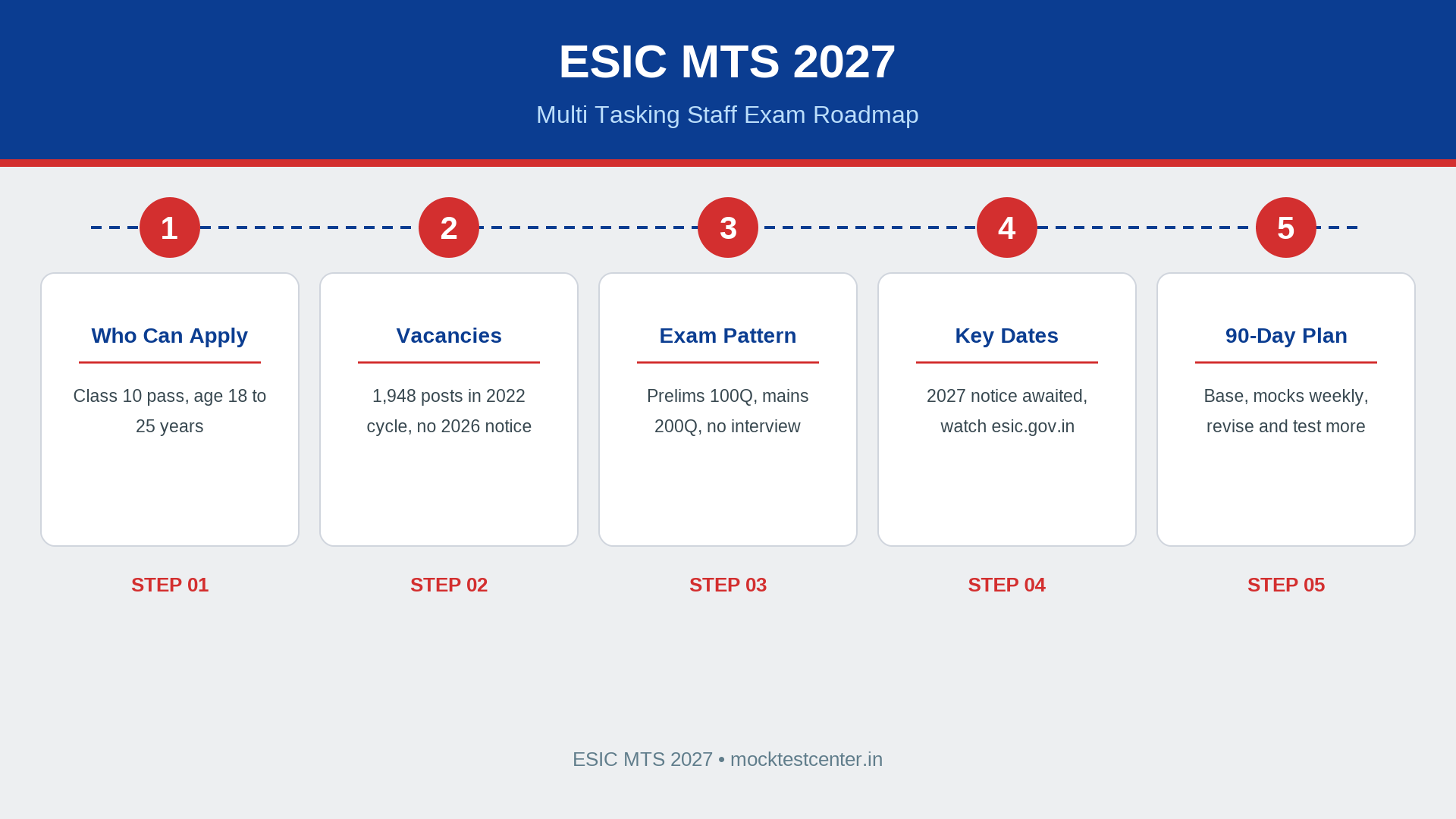
The 2027 notice has not come out yet. No dates for 2027 exist, and any site that prints them is guessing. This page works from the last full cycle, which ran in 2022 with 1,948 MTS posts. No new ESIC MTS notification has come out since then. As of 4 October 2026, no MTS notification for 2026 had been released either. The 2025 AIIMS Common Recruitment Examination, called CRE, carried MTS posts for AIIMS hospitals, not for ESIC, so it does not count as an ESIC MTS cycle. Candidates should prepare from the 2022 pattern and watch the official site for the next notice.
ESIC itself is a statutory body under the Ministry of Labour and Employment. It runs the Employees State Insurance scheme under the ESI Act of 1948, and the scheme gives medical care and cash benefits to insured workers. ESIC runs hospitals, dispensaries and regional offices in almost every state. An MTS works in that network, in offices and hospitals, close to the staff who run the scheme.
Check the official site esic.gov.in for every notice, because only the official notice is final. Dates, vacancy counts and pay figures in this article come from the 2022 ESIC notification and the result lists that followed it. They will change for 2027. The pattern, the eligibility rules and the shape of the job have stayed the same across recent cycles, so they are the safest things to plan around.
Who can apply for ESIC MTS
The door is open to Class 10 pass candidates. A pass in Matriculation from a recognised board, or an equivalent qualification, meets the education rule. There is no need for a degree, no need for a diploma, and no need for computer knowledge in the notice. That low entry bar is the reason this exam draws lakhs of candidates. A candidate who finished school and wants a government job can apply.
The age limit in the 2022 cycle was 18 to 25 years as on the closing date for applications, 15 February 2022. Age relaxation follows government rules: five years for SC and ST, three years for OBC, ten years for persons with benchmark disabilities, and five years for ex-servicemen, with extra relaxation for ESIC and government employees as the notice spells out. Expect the 2027 notice to set its own cut off date. Check your age against the date printed in the new notice, not against the date in this article.
There is no limit on attempts in the notice. You can apply in every cycle as long as you meet the age limit. That matters here, because ESIC does not run this exam every year. The last cycle came in 2022, and the next one has not been announced as of late 2026. A candidate who misses one cycle may wait years for the next, so each cycle deserves full effort.
One more point about the region. MTS posts are region wise. A candidate applies for one region and the merit list is region wise too. The cut off in a big region with hundreds of posts differs from the cut off in a small region with a handful of posts. In 2022, Delhi had 292 MTS posts and Maharashtra had 258, while smaller regions had far fewer. Pick your region with care. Home state comfort is real, but a region with more posts gives a better chance. The notice lists every region and its posts, so read that table before you fill the form.
The pay, and what Level 1 means in hand
The pay scale for Multi Tasking Staff in the 2022 cycle was Level 1 of the 7th Central Pay Commission, Rs. 18,000 to Rs. 56,900 a month. The starting basic pay is Rs. 18,000. On top of the basic pay come dearness allowance, house rent allowance and transport allowance, as per the rules in force at the time of joining. An MTS in a metro city takes home roughly Rs. 25,000 to Rs. 30,000 a month after the usual allowances, and an MTS in a smaller town takes home less in allowances but spends less on rent too.
Level 1 is the lowest rung of central government pay, and candidates should know that before they apply. The SSC GD 2027 exam pays a similar starting basic for constable posts and draws far more candidates. ESIC MTS pays less than the SBI Clerk 2027 exam, which needs a degree and pays Level 4. Nobody should expect clerk pay from an MTS post. What the post offers instead is a government job with Class 10 as the entry bar, fixed hours, medical facilities through the ESI network, and promotion.
Promotion is the part candidates underrate. An MTS can move up to Lower Division Clerk and then to Upper Division Clerk through departmental exams and seniority. The ladder is slow, but it is real, and staff who join young can climb a long way before retirement. A candidate who joins at 20 and serves thirty years will not stay an MTS. That long view is the right way to judge this post, and it is the reason so many school pass candidates aim for it.
Put the money in order. Basic pay Rs. 18,000 a month at the start. Pay scale Rs. 18,000 to Rs. 56,900. Allowances on top, as per central government rules. The 8th Pay Commission report is expected around mid 2027, so the pay figures may change after that, but the Level 1 grade is the fact to remember. Check the new notice for the pay it prints.
Two stages, and which marks count
ESIC MTS selection has two stages. Phase 1 is the preliminary examination. Phase 2 is the main examination. There is no interview, and there is no skill test. Only the main examination marks count for the final merit list. The preliminary examination is qualifying in nature. That single fact should shape the whole preparation plan.
The preliminary examination is a speed test. It has 100 questions for 200 marks in 60 minutes. Every question carries 2 marks. Candidates who clear it move to the mains in a ratio of about 1 to 10, which means about ten times the number of vacancies in each category. In 2022, 22,529 candidates moved to the mains from the prelims. The prelims marks do not count for the final list, so a candidate should aim to clear it with a safe margin and save peak energy for the mains.
The main examination is the real test. It has 200 questions for 200 marks in 120 minutes. Every question carries 1 mark. The marks from this stage decide the final merit list. Candidates who clear the mains move to document verification. There is no third test to clear, which makes the mains the whole game.
Negative marking applies in both stages. Every wrong answer costs one fourth of the marks assigned to that question. In the prelims that means 0.5 marks per wrong answer, since each question carries 2 marks. In the mains it means 0.25 marks per wrong answer. Guess only when you can rule out at least two options. A candidate who guesses wildly in the mains can lose the marks that took an hour to earn.
One more point about the pattern. The prelims and the mains have the same four sections, with the same topics, and the only change is the number of questions and the marks per question. That makes preparation simple. One syllabus, two papers, and the mains paper is the one that counts.
The prelims paper, section by section
The prelims paper has four sections, each with 25 questions for 50 marks, and the whole paper runs for 60 minutes. The four sections are General Intelligence and Reasoning, General Awareness, Quantitative Aptitude, and English Comprehension. The paper is bilingual in Hindi and English, except for the English section, which is in English only. There are no separate section timings in the prelims, so a candidate can move between sections as time allows.
| Section, prelims | Questions | Marks |
|---|---|---|
| General Intelligence and Reasoning | 25 | 50 |
| General Awareness | 25 | 50 |
| Quantitative Aptitude | 25 | 50 |
| English Comprehension | 25 | 50 |
| Total | 100 | 200 |
Sixty minutes for 100 questions means 36 seconds per question. That pace is the whole game. Reasoning puzzles and quant questions eat time, so learn to judge a question in five seconds. A skipped question costs nothing. A wrong guess costs half a mark. Start with your strongest section, bank the easy marks, and leave the long puzzles for the end if time is left.
General Awareness in the prelims rewards daily reading. The questions cover current affairs, banking awareness, economy, and static facts about India. ESIC questions also touch labour, health and social security, because that is the world this body works in. Read the news every morning and keep a notebook with one line per big story. Six months of notes beats six days of cramming.
Quantitative Aptitude in the prelims is about speed on easy topics. Simplification, number series, percentages, ratio and proportion, averages, and data interpretation sets carry the marks. Data interpretation sets look long but give several questions from one table, so they pay better per minute than a single puzzle. Practise with a timer from the first week, not the last.
English Comprehension in the prelims covers reading comprehension, cloze test, error spotting, and vocabulary. Read one English editorial every day and note ten new words a week. That habit alone covers vocabulary and comprehension together. Grammar rules help with error spotting, but only if you apply them on questions, not by reading rules alone. The English section is in English only, so candidates who studied in Hindi medium should give it extra time.
The prelims in 2022 ran on 7 May 2022, and the result came on 24 May 2022. The paper stayed easy to moderate across shifts, and candidates who attempted 80 or more questions with good accuracy moved on. The exact cut offs varied by region, and ESIC published them region wise with the result. A candidate should target 150 marks out of 200 in mocks to feel safe.
The mains paper, and the qualifying marks
The mains paper has the same four sections, but each section now has 50 questions for 50 marks, and the whole paper runs for 120 minutes. The total is 200 questions for 200 marks. Each question carries 1 mark. The paper is bilingual in Hindi and English, except for the English section. There are no separate section timings in the mains either.
| Section, mains | Questions | Marks |
|---|---|---|
| General Intelligence and Reasoning | 50 | 50 |
| General Awareness | 50 | 50 |
| Quantitative Aptitude | 50 | 50 |
| English Comprehension | 50 | 50 |
| Total | 200 | 200 |
Two hours for 200 questions means 36 seconds per question again, the same pace as the prelims, but now every question carries only 1 mark. The mains rewards accuracy more than speed, because the marks from this paper decide the final list. A candidate who gets 150 right and skips 50 scores 150. A candidate who gets 160 right and 40 wrong scores 150 too, because the wrong answers eat 10 marks. Accuracy is the edge.
The minimum qualifying marks follow the same scale as the UDC mains in the same cycle: 45 percent for UR, which is 90 marks out of 200; 40 percent for OBC and EWS, which is 80 marks; 35 percent for SC, ST and ex-servicemen, which is 70 marks; and 30 percent for PwD, which is 60 marks. This article states these figures as the scale used in the 2022 cycle for the same notification, and the new notice will print its own scale. Qualifying is only the floor. The real cut offs for the final list ran far above the floor, and they varied by region.
General Awareness carries the same weight as the other sections in the mains, and it is the section where a prepared candidate gains the most. Fifty questions in a paper where you either know the answer or you do not. Banking awareness, economy news, government schemes, and current affairs from the last six months carry the most weight. ESIC and labour related news shows up more here than in other MTS exams, because the body works in social security. Read the labour and health pages, not just the front page.
Reasoning in the mains needs the same topics as the prelims, with harder puzzles. Seating arrangements, box puzzles, syllogisms, coding decoding, blood relations, direction sense, and data interpretation all appear. Puzzles carry the most marks, so give them the most practice time. Start with linear seating and box puzzles. Move to floor puzzles only after the easy types feel fast.
The work of an MTS: what the job looks like day to day
An MTS does the support work of an office. The day starts with opening files, sorting dak, and delivering papers to the right desks. Then come photocopying, scanning, filing, and record keeping. An MTS in a hospital may help with patient records, ward supplies, and the movement of files between departments. An MTS in a regional office may handle dispatch, diary, and the upkeep of registers.
The work is physical as well as clerical. Carrying files, moving records, and keeping the office in order are part of the job. Candidates who expect a desk job with no movement will be surprised. The post suits people who like steady work, clear duties, and a fixed day. It does not suit people who want fast decisions or public dealing all day.
The hours follow central government office timings, and the leave, medical and pension benefits follow central government rules. An MTS gets the same medical facilities as other ESIC staff, through the ESI network and central government health services. That matters for a family, because medical care through the network costs far less than private care.
The promotion path runs through departmental exams. An MTS with the needed service and education can sit for the Lower Division Clerk exam, and from there the path runs to Upper Division Clerk and beyond. The exams are competitive, but the syllabus overlaps with the MTS syllabus, so a candidate who keeps studying after joining has a real chance. Many senior clerks in ESIC started as MTS.
One more point about the posting. MTS posts are region wise, and the posting stays within the region. A candidate from Uttar Pradesh who applies for the Uttar Pradesh region will work in that region. Transfers across regions are rare. Pick the region you want to live in, not just the region with the most posts.
Dates from the 2022 cycle, and what they tell you
The 2027 notice has not come out yet, so the honest picture is the 2022 cycle. It moved fast, and it is worth reading closely.
| Event, 2022 cycle | Date |
|---|---|
| Notification released | 28 December 2021 |
| Applications open | 15 January 2022 |
| Applications close | 15 February 2022 |
| Prelims, Phase 1 | 7 May 2022 |
| Prelims result | 24 May 2022 |
| Mains, Phase 2 | 5 June 2022 |
| Mains result | 28 June 2022 |
| Final merit list, document verification stage | 5 July 2022 |
| Final select list | 28 July 2022 |
The 2022 cycle moved faster than the UDC cycle from the same notice. The apply window lasted one month. The gap between the last date and the prelims was about twelve weeks. The gap between the prelims and the mains was four weeks. The gap between the mains and the result was three weeks. The whole cycle, from notice to final select list, took about seven months. That is a quick cycle for a big central government recruitment.
The vacancy count in 2022 needs a careful note. The first notices spoke of 3,847 posts in total across UDC, MTS and Stenographer, with 1,947 MTS posts. The revised count stood at 3,882 posts in total, with 1,948 MTS posts, 1,769 UDC posts and 165 Stenographer posts. This article uses the revised count of 1,948 MTS posts, because the later notices and the result lists use it. The difference comes from revisions during the cycle, and a candidate should know that vacancy counts can move after the first notice.
The prelims result list shows the scale of the competition. A total of 22,529 candidates moved to the mains from the prelims, for 1,948 posts. That is about eleven candidates per post at the mains stage. The mains result came on 28 June 2022, and the final merit list for document verification came on 5 July 2022, with the final select list on 28 July 2022. A candidate who clears the mains should keep documents ready, because verification follows within days.
Why there is no 2026 MTS notice yet
Candidates keep asking why no new MTS notice has come out since 2022. The plain answer is that ESIC has not announced one. As of 4 October 2026, no MTS recruitment notification for 2026 had been released, and no official date had been announced. Some sites print expected vacancy counts for 2026, with figures above 3,000 or even 20,000 posts, but those counts have no official source. This article prints none of them.
The CRE route adds to the confusion. In the CRE 2025 cycle, the AIIMS Common Recruitment Examination carried 24 MTS posts and 48 MTS and Nursing Attendant posts, but those posts belonged to AIIMS hospitals, not to ESIC. In the CRE-5 cycle of 2026, MTS posts again appeared for hospitals and institutes, but no ESIC MTS posts were confirmed in the lists this research could verify. A candidate who sees CRE MTS posts should check the institute column before assuming they are ESIC posts.
What should a candidate do while waiting? Prepare from the 2022 pattern, because the next ESIC notice will use the same four sections and the same two stage shape, whether it comes from ESIC itself or through the CRE route. Keep documents ready: Class 10 certificate, date of birth proof, caste certificate if it applies, and a photo and signature in the size the last notice asked for. And check esic.gov.in twice a week. The notice will appear there first, and the apply window in past cycles lasted about a month, so a late starter loses the cycle before the test even starts.
The wait is also a chance. A candidate who starts now and studies for six months will sit the next test far ahead of a candidate who starts when the notice comes out. The syllabus is small: four sections, fixed topics, and a paper that rewards speed and accuracy. Six months of steady work is enough to cover it twice.
How to apply for ESIC MTS
Go to the recruitments section of esic.gov.in and open the link for the Multi Tasking Staff recruitment. In a CRE cycle, the application runs on the AIIMS exams portal instead, and the ESIC site links to it. Read the full notice before you touch the form. Then register with a working email and mobile number. You will get a registration number and password. Keep them safe. You need them for the admit card later.
Fill the form in one sitting if you can. Keep your Class 10 certificate, your date of birth as on your Class 10 certificate, and your category certificate number ready. Pick your region with care, because the merit list is region wise and the region cannot be changed later. Upload a photo and signature in the size the notice asks for. A photo that is too large or a signature that is too small gets the form rejected, and ESIC does not chase you to fix it.
Pay the fee online and save the receipt. In the 2022 cycle, the fee was 500 rupees for all other categories, and 250 rupees for SC, ST, PwD, departmental candidates, female candidates and ex-servicemen. The 250 rupee fee was refunded, after deducting bank charges, to candidates who appeared in the Phase 1 examination. Take a print of the final form. Then wait for the admit card, which ESIC releases on its site before the test. The admit card tells you the centre and the reporting time. Reach the centre early. Late entry is refused.
Candidates who also track the IBPS Clerk 2027 exam will find the application steps nearly the same. Government recruitment forms follow one pattern, and once you have filled one carefully, the rest feel familiar. The RBI Assistant 2027 exam follows the same shape too, with its own fee and dates.
What to study for each section of ESIC MTS 2027
Reasoning first. The fifty questions in the mains cover puzzles; seating arrangements; syllogisms; coding decoding; blood relations; direction sense; and data interpretation. Puzzles carry the most marks, so give them the most practice time. Start with linear seating and box puzzles. Move to floor puzzles only after the easy types feel fast. Data interpretation sets look long but give several questions from one table, so they pay better per minute than a single puzzle.
English next. The questions cover reading comprehension; cloze test; error spotting; sentence improvement; and vocabulary. Read one English editorial every day and note ten new words a week. That habit alone covers vocabulary and comprehension together. Grammar rules help with error spotting, but only if you apply them on questions. The English section is in English only, so candidates who studied in Hindi medium should give it extra time.
General awareness needs two notebooks. One for banking and economy, one for current affairs, with a third page for labour, health and social security. In the banking notebook, write the repo rate, reverse repo rate, CRR, SLR, bank rate, and the names of the RBI governor and the ESIC Director General, and update them every month. Add the full forms of ESI, EPFO, ESIC, NPA, CBS, KYC, NEFT, RTGS, IMPS, and UPI. In the labour notebook, write the key facts of the ESI Act, the Code on Social Security, and the big labour schemes. ESIC works in social security, so those questions show up more here than in other MTS exams.
Quantitative aptitude needs a topic list you can tick off. Simplification and approximation; number series; quadratic equations; data interpretation; time and work; time speed and distance; profit and loss; simple and compound interest; ratio and proportion; averages; and mensuration. That list looks long. It is the same list as every MTS exam, so the books and mocks you already own cover it. The difference is speed. Thirty six seconds per question means accuracy matters more than speed here. A candidate who gets forty right and ten wrong in the mains scores 37.5. A candidate who gets forty five right and skips five scores 45.
One more point about the level. The MTS paper stays at Class 10 level in quant and reasoning, and the questions are simpler than the clerk papers. That does not make the exam easy. The paper is easy, the cut off is high, and the competition is huge. The edge comes from accuracy and speed, not from hard topics.
A 90 day plan that fits around a job or school
Days 1 to 30 are for the base. Study two hours a day if you work or attend school, four hours if you are free. Cover one reasoning topic and one quant topic each day. Read the news every morning and write five lines in your current affairs notebook, plus two lines on labour and social security. Take one mock at the end of week two and one at the end of week four. Do not worry about the score. The first mocks only show you where you stand.
Days 31 to 60 are for speed. Your ESIC MTS 2027 score will move most in this phase, because speed under a timer is what the paper actually tests. Take two mocks a week now. After each mock, spend as much time on analysis as you spent on the test. Write down every question you got wrong and why. Was it a concept gap, a silly mistake, or a time problem? Concept gaps go back into your study list. Silly mistakes need a checklist before you submit each section. Time problems need easier questions first and hard ones last.
Days 61 to 90 are for the real thing. Take three mocks a week. Revise your error notebook every second day. Stop learning new topics in the last ten days. New topics in the last week add stress and no marks. In the last three days, take one full mock at the same time as your real test slot, then rest. Sleep matters more than one more chapter in the final week.
If you have less than ninety days, cut the base phase, not the mocks. Ten mocks with full analysis beat thirty days of reading without a single test. The paper rewards candidates who have sat through the two hour sitting many times. It punishes candidates who know the syllabus and have never felt the timer run out. The same rule holds for the UP Police Constable 2027 exam and the Karnataka Police Constable 2027 exam, where the pace is just as tight.
Mistakes that cost candidates a year
The first mistake ESIC MTS 2027 candidates make is treating the paper as easy. The questions are Class 10 level, but the cut off is high because lakhs of candidates apply for under two thousand posts. Easy paper plus huge crowd means a small mistake costs a rank. Give the paper the same respect you would give a hard one.
The second mistake is ignoring one section. The mains has no sectional cut off printed in the notice, but the minimum qualifying marks apply to the total, and a weak section drags the total down. A candidate with 150 marks and balanced sections moves on, while a candidate who scores zero in English must make up fifty marks in the other three sections, which is a hard climb. Give your weakest section thirty minutes a day, every day, even when it feels slow.
The third mistake is guessing too much. Four wrong answers erase one right answer in the mains. In a section where you know thirty answers for sure, ten wild guesses can pull your score down by two and a half marks. That is often the gap between selection and rejection in a region with few posts. Guess only when you can rule out two options.
The fourth mistake is skipping mocks. Reading feels like preparation, but the test measures speed under a timer. Candidates who take fewer than ten mocks before the real test are gambling. Take twenty if you can. Analyse every one.
The fifth mistake is picking the wrong region. The merit list is region wise, and the cut off in a big region with hundreds of posts differs from the cut off in a small region with a handful of posts. A candidate who applies to a small region because it is home, without checking the post count, fights for very few seats. Read the region table in the notice before you choose. The LIC ADO 2027 exam has the same region trap, with zonal lists that differ widely.
ESIC MTS next to other Class 10 pass exams
Put ESIC MTS beside the other Class 10 pass exams and the trade off becomes clear. The SSC GD 2027 exam leads to constable posts with many more seats, but the work is uniformed duty with physical tests. The UP Police Constable 2027 exam and the Karnataka Police Constable 2027 exam also need physical tests and uniformed duty. ESIC MTS needs no physical test and no interview, only two written papers. That is the deal for candidates who want office work.
Against clerk exams, the comparison is about the entry bar. The IBPS RRB Clerk 2027 exam and the SBI Clerk 2027 exam need a degree and pay more, but they test harder and draw graduates. The IBPS PO 2027 exam and the IDBI Executive 2027 exam sit higher still, with interviews at the end. ESIC MTS asks for the least: a Class 10 pass, two papers, and no interview. That is why the crowd is so big.
The way to choose is to ask one question. Do you want a central government support post with fixed hours, medical facilities, and a promotion path to clerk, and can you accept Level 1 pay at the start? If yes, ESIC MTS deserves your main effort. If no, the police and paramilitary exams with more seats fit better, if you can clear the physical tests. Many candidates apply for both kinds and decide when the offers come. That is a sound plan, because the syllabus overlaps so much that one preparation serves all of them.
What to check before the 2027 notice comes out
Keep three things ready. First, your Class 10 certificate and the age calculation as on the closing date of the last cycle, so you can redo it at once when the new cut off date comes out. Second, a mock test routine with a timer, so the two hour sitting feels normal by the time the notice comes out. Third, a habit of checking esic.gov.in twice a week, since the last notice came in December and the CRE cycles came in July.
Start with one ESIC MTS 2027 mock this week. Score it, list your weak section, and give that section thirty minutes a day. That single habit, repeated for ninety days, is what turns a Class 10 pass candidate into a Multi Tasking Staff member.