
About CSIR SO ASO 2027 Exam Series
📖 Table of Contents
- What the CSIR SO ASO exam is
- CSIR CASE 2027: the honest status
- The posts and the 444 vacancies
- Who can apply
- Age relaxation
- Application fee
- How to apply
- Exam pattern at a glance
- Paper 1 syllabus: general awareness and English
- Paper 2 syllabus: reasoning and mental ability
- Paper 3: the descriptive paper
- Interview for SO and computer test for ASO
- How the final merit is made
- Answer keys, normalisation and tie rules
- Salary and the job itself
- CSIR as an organisation
- How to prepare with mock tests
- Mistakes that cost candidates a year
- What to do next
- Sources
CSIR SO ASO 2027
What the CSIR SO ASO exam is
The CSIR SO ASO exam is the Combined Administrative Services Examination, or CASE, of the Council of Scientific and Industrial Research. It fills two posts, Section Officer and Assistant Section Officer, in CSIR laboratories and offices across India. The two posts are often written together as SO and ASO. Some websites get the full form of SO wrong and call it Scientific Officer.
The official notification is clear. SO means Section Officer, and the posts are in General, Finance and Accounts, and Stores and Purchase. There is no science paper in this exam. It is an administrative exam for a science organisation, and that is exactly what makes it different from other government exams.
CSIR runs some of the best known research laboratories in India. Its scientists work on drugs, aerospace materials, ocean science, food technology and many other fields. Behind every laboratory there is an office that handles files, budgets, purchases, staff matters and grants. The Section Officer and the Assistant Section Officer run that office work.
A Section Officer supervises a section, checks drafts, puts up files and makes sure rules are followed. An Assistant Section Officer does the groundwork of noting, drafting, record keeping and correspondence, and reports to the Section Officer. The work is desk work, but it sits next to research that matters, and the posting can be in a laboratory in your own region or in the headquarters in Delhi.
The exam has three written papers and then one last stage. Paper 1 tests general awareness and English. Paper 2 tests reasoning, arithmetic, science and management.
Paper 3 is a descriptive paper with an essay, a precis and a letter. After the three papers, Section Officer candidates face an interview, and Assistant Section Officer candidates take a computer proficiency test. The whole scheme is set out in the official notification, and this page follows that notification line by line.
One thing should be said at the start, because many pages on the internet hide it. The last full CASE cycle was CASE 2023, advertised on 8 December 2023 for 444 posts. That cycle is still finishing in 2025 and 2026, with results and joining formalities under way.
No new CASE notification for 2027 has been released as of 23 November 2026. This page therefore gives the pattern, syllabus, fee, age limit and salary from the CASE 2023 notification, which is the last official word, and it says plainly where the 2027 dates are still unknown. Any page that prints 2027 dates or 2027 vacancies today is guessing.
CSIR CASE 2027: the honest status
As of 23 November 2026, CSIR has not released a notification for a new CASE cycle. The official website, csir.res.in, carries notices about the CASE 2023 cycle, including a notice dated 1 July 2025 that cancelled the selection of ten Assistant Section Officer candidates who declined the offer or did not join in time. That notice alone tells you the 2023 cycle was still in its joining stage in mid 2025. A fresh cycle can only come after the old one closes, and CSIR has not announced a date for it.
Several tracker websites now carry pages titled CSIR CASE 2026 or CSIR SO ASO 2026. They repeat the 444 vacancies and the dates 8 December to 12 January from the 2023 notification, but they change the year to 2025 or 2026, and the dates they print do not even agree with each other. One page says applications run from 8 December 2026 to 12 January 2026, which is impossible, because the closing date comes before the opening date.
Another page says the form was active from 8 December 2025 with a last date of 12 January 2025, which is the same mistake in the other direction. These pages are copies of the 2023 notification with the year changed. They are not new notifications, and this page does not use them as a source for dates.
Oliveboard, the mock test platform, lists the exam as CSIR ASO SO and offers mock tests for it. Its page describes 77 tests: 6 for Paper 1, 6 for Paper 2, 5 descriptive tests for Paper 3 with expert evaluation, and 60 sectional tests. The tests follow the CASE 2023 pattern, because that is the last pattern CSIR published.
If you are preparing now, you are preparing on the 2023 pattern, and that is the right thing to do. The pattern of a government exam rarely changes without notice, and when CSIR does change it, the new notification will say so.
There is one more notice that candidates sometimes confuse with a new CASE cycle. In June 2026 CSIR advertised 100 Assistant Section Officer posts for candidates who appeared in the UPSC Civil Services Examination 2024 but were not recommended for selection. Applications ran from 23 June to 13 July 2026.
That was a separate recruitment with its own rules, and it was open only to that one group of candidates. It was not a CASE exam, and it does not tell us anything about the next CASE cycle.
CSIR CASE is also not CSIR NET. CSIR NET is the test for Junior Research Fellowship and lectureship in science subjects, and it is run by the National Testing Agency. CASE is the administrative exam, and it is run by CSIR itself.
The two exams share only the letters CSIR. If you want a laboratory administration job, CASE is your exam. If you want a research fellowship, look at CSIR NET instead.
The posts and the 444 vacancies
CASE 2023, advertisement number E-I/RC/2023/1, offered 444 posts in all. Of these, 76 were for Section Officer and 368 were for Assistant Section Officer. Both posts came in three streams: General, Finance and Accounts, and Stores and Purchase. The stream matters, because the work differs.
General covers establishment and administration. Finance and Accounts covers budgets, bills and accounts. Stores and Purchase covers buying equipment, chemicals and services for the laboratory. You apply for one post, and the stream is part of the post.
| Post | General | Finance and Accounts | Stores and Purchase | Total |
|---|---|---|---|---|
| Section Officer | 28 | 26 | 22 | 76 |
| Assistant Section Officer | 237 | 83 | 48 | 368 |
| Total | 265 | 109 | 70 | 444 |
The notification also gives the category wise break up for each post. For Section Officer, the 76 posts split into 10 for SC, 4 for ST, 19 for OBC, 6 for EWS and 37 for unreserved candidates. For Assistant Section Officer, the 368 posts split into 54 for SC, 26 for ST, 102 for OBC, 35 for EWS and 151 for unreserved candidates.
The notification says the number of vacancies is provisional and may increase or decrease. That is a standard line, and it means the final number at the time of joining can move a little from the advertised number.
Section Officer is a Group B gazetted post at Pay Level 8. Assistant Section Officer is a Group B non-gazetted post at Pay Level 7. The gazetted tag matters for status and for some allowances, but both posts are central government posts with the same family of benefits.
The General stream has the most posts by far, and the Assistant Section Officer General post alone, with 237 posts, is the largest single pool in the exam. Most candidates apply for that post, and most of the competition sits there.
| Post | SC | ST | OBC | EWS | Unreserved | Total |
|---|---|---|---|---|---|---|
| Section Officer | 10 | 4 | 19 | 6 | 37 | 76 |
| Assistant Section Officer | 54 | 26 | 102 | 35 | 151 | 368 |
Who can apply
The education rule is short. You need a university degree in any subject from a recognised university. There is no subject bar, no percentage bar and no special degree for any stream.
A graduate in history, commerce, physics or engineering can all apply for the same post. That is why the exam draws candidates from every background, and why the competition is wide rather than narrow.
The age rule is just as short. Your age must not exceed 33 years. The notification fixes the cutoff date as the last date for receipt of the online application. For CASE 2023 that date was 12 January 2024, so a candidate had to be 33 or younger on that date.
The cutoff date moves with each cycle, and it is always the last date of the application window. Do not work out your age from the notification date or the exam date. Work it out from the closing date of the form.
There is no minimum age printed in the notification beyond the standard rule that a candidate must be an adult Indian citizen. The notification asks for Indian citizenship, and it asks for the date of birth to match the matriculation or secondary examination certificate. CSIR says it will accept the date of birth on that certificate, and no request for a change will be considered later. Check your certificate before you fill the form, because a mismatch between the form and the certificate can end a candidature at the document check stage.
The notification also says that candidature stays provisional until the appointing authority verifies the documents. That is normal in government recruitment. It means you can sit the exam and even get selected, and the offer still depends on your certificates being genuine. A wrong claim about caste, disability or ex-serviceman status can lead to action against the candidate, and the notification warns of this in plain words.
Age relaxation
Relaxation in the upper age limit follows the central government pattern. SC and ST candidates get five years, which takes the limit to 38. OBC candidates get three years, which takes it to 36. Persons with benchmark disabilities get ten years if they are unreserved, thirteen years if they are OBC, and fifteen years if they are SC or ST.
Ex-servicemen get three years after deducting the military service rendered from their age on the closing date. CSIR departmental candidates get five years. The notification lists no relaxation for any other category.
| Category | Relaxation beyond 33 years |
|---|---|
| SC and ST | 5 years |
| OBC | 3 years |
| PwBD, unreserved | 10 years |
| PwBD, OBC | 13 years |
| PwBD, SC and ST | 15 years |
| Ex-servicemen | 3 years after deducting military service |
| CSIR departmental candidates | 5 years |
Relaxation needs proof. SC, ST, OBC non-creamy layer, EWS, PwBD and ex-servicemen candidates must upload a certificate in the format given in the notification. OBC candidates must also submit a declaration in the format at Annexure 4 of the notification.
The certificate must be valid for appointment to posts under the central government, and the claim is judged on the cutoff date, which is the last date of the application. A certificate that expires before that date, or a certificate in the wrong format, is a common reason for rejection at the verification stage. Get the certificate made early, and check the format against the annexures in the notification.
Application fee
The fee for CASE 2023 was 500 rupees for unreserved, OBC and EWS candidates. Women candidates, SC and ST candidates, persons with benchmark disabilities, ex-servicemen and CSIR departmental candidates paid nothing. The fee was payable online only, through debit card, credit card, net banking or UPI. The notification is clear that the fee, once paid, is not refunded, and an application, once registered, cannot be withdrawn.
| Category | Fee |
|---|---|
| Unreserved, OBC, EWS | 500 rupees |
| Women, SC, ST, PwBD, ex-servicemen, CSIR departmental | Nil |
Two dates matter here. The last date to submit the online form for CASE 2023 was 12 January 2024 at 5 pm. The last date to pay the fee was 14 January 2024 at 5 pm. The fee window stayed open two days longer than the form window.
That is a small mercy, but do not depend on it. Pay the fee on the same day you submit the form. A form without the fee, where a fee is due, is not a complete application.
The notification also warns against multiple registrations. If you register more than once, only one valid completed application is kept, and the fee paid for the other registrations is forfeited. Multiple appearances in the online exam lead to rejection of the candidature. Fill the form once, fill it carefully, and keep the registration number and the payment receipt safe.
How to apply
Applications for CASE go in online only, through the CSIR website. For CASE 2023 the application window ran from 8 December 2023 at 5 pm to 12 January 2024 at 5 pm. The detailed advertisement, the terms and conditions and the application link were all hosted on csir.res.in, and the notification said that every later notice, corrigendum and addendum about the recruitment would appear on the CSIR website only. That is the page to watch when the next cycle opens.
Before you start the form, keep the documents ready. The notification asks for a photograph, a signature in black ink on plain white paper, and the certificates that support your category claim. The signature file must be under 50 kb.
The form asks for personal details, education details, the post you are applying for, and the exam city choices. Fill the form in one sitting if you can, and check every field before you submit, because the form cannot be edited after the window closes.
The notification advises candidates to submit the form well before the closing date and not to wait for the last day, because the website can slow down under heavy load in the closing days. That advice is worth taking. Government application portals do slow down on the last evening, and a form that fails to submit at 4:59 pm is a form that was never submitted. Aim to finish at least three days before the closing date.
After the form, the admit card comes on the CSIR website. The notification says the date of issue of the admit card will be notified on the website. There is no admit card by post. Download it from the website, check your name, photograph, exam date, shift and centre, and report any error at once through the channel given on the admit card page.
Exam pattern at a glance
The scheme has three papers, and all three are common and compulsory for both posts. Paper 1 and Paper 2 are objective tests on a computer. Paper 3 is a descriptive test on paper.
The interview is only for Section Officer, and the computer proficiency test is only for Assistant Section Officer. The notification says the process is suggestive, and the competent authority may decide to hold Paper 1 and Paper 2 on the same day or on different days, and may fix the date of Paper 3, the interview and the computer test as per logistics.
| Paper | Subject | Questions | Marks | Time |
|---|---|---|---|---|
| Paper 1 | General Awareness and English Language and Comprehension | 150 | 150 | 2 hours |
| Paper 2 | General Intelligence, Reasoning and Mental Ability | 200 | 200 | 2 hours 30 minutes |
| Paper 3 | English or Hindi, descriptive | 4 | 150 | 2 hours |
| Interview | Section Officer only | NA | 100 | NA |
| Computer Proficiency Test | Assistant Section Officer only, qualifying | NA | 100 | NA |
Negative marking is 0.33 marks for every wrong answer in Paper 1 and Paper 2. Each question carries one mark, so three wrong answers wipe out one right answer. Paper 3 has no negative marking, because it is a descriptive paper and the examiner awards marks for the writing itself. All papers are bilingual in English and Hindi, except the English Language part of Paper 1, which is in English only.
The total marks are 600 for Section Officer and 500 for Assistant Section Officer. For Section Officer, the total is Paper 1 plus Paper 2 plus Paper 3 plus the interview, which is 150 plus 200 plus 150 plus 100. For Assistant Section Officer, the total is Paper 1 plus Paper 2 plus Paper 3, which is 500, and the computer test marks are not counted.
The computer test is qualifying only. You must pass it, but its marks do not change your rank.
The first cut comes after Paper 1 and Paper 2. Only candidates who secure the minimum threshold marks in aggregate out of 350 in the two objective papers are called for Paper 3. The competent authority fixes the threshold, and the notification does not print it.
For Section Officer, the second cut comes after Paper 3. Only candidates who secure the minimum threshold marks in aggregate out of 500 in the three papers are called for the interview. For Assistant Section Officer, the candidates who clear the first cut are called for Paper 3 and the computer test together.
Paper 1 syllabus: general awareness and English
Paper 1 carries 150 marks in two hours, with 150 objective questions of one mark each. General Awareness has 100 questions and 100 marks. English Language and Comprehension has 50 questions and 50 marks. The paper is the first filter, and it is also the paper where a candidate with good reading habits scores fast.
General Awareness covers three areas. The first is the history of India and the Indian National Movement. The second is the Constitution of India, polity, governance and social justice. The third is current events of national and international importance.
That is the whole list in the notification, and it is a broad list. History and polity are fixed subjects, and current events move with the news. A candidate who reads a newspaper every day and revises the Constitution will find this section fair. A candidate who only reads current affairs will find the history and polity questions hard, because they need study, not news.
English Language and Comprehension covers comprehension, active and passive voice, direct and indirect speech, prepositions, fill in the blanks, synonyms and antonyms, sentence correction and common errors, punctuation, and idioms and phrases. This is standard English for a graduate level exam. The questions test grammar and vocabulary rather than literature. The best preparation is to read good English every day and to practise error spotting and comprehension passages under time pressure.
Paper 1 gives you 120 minutes for 150 questions, which is 48 seconds per question on average. The time is tight. It works if you move fast and do not get stuck on one question.
The usual advice holds here: answer the questions you know first, mark the doubtful ones for a second pass, and leave the questions you have no idea about, because each wrong answer costs 0.33 marks. With 150 questions on the paper, even a small change in accuracy moves the score by several marks.
Paper 2 syllabus: reasoning and mental ability
Paper 2 carries 200 marks in two hours and thirty minutes, with 200 objective questions of one mark each. It is the biggest paper in the exam, and it carries more marks than Paper 1 and Paper 3 put together in weight. A candidate who does well in Paper 2 can build a lead that is hard to catch, and a candidate who does badly in Paper 2 will struggle to recover, because the first cut is taken on the total of Paper 1 and Paper 2 out of 350.
The syllabus has eight parts, and each part carries 25 questions and 25 marks. The eight parts are general intelligence, reasoning and mental ability; arithmetical and numerical ability; general science; economic and social development and general issues on environmental ecology, bio-diversity and climate change; ethics, integrity and aptitude; decision making and problem solving; management principles and practices; and national geography. The even split is useful. It tells you that no single part dominates, and that a candidate who ignores one part loses 25 marks at once.
| Part | Questions | Marks |
|---|---|---|
| General intelligence, reasoning and mental ability | 25 | 25 |
| Arithmetical and numerical ability | 25 | 25 |
| General science | 25 | 25 |
| Economic and social development, environment, bio-diversity and climate change | 25 | 25 |
| Ethics, integrity and aptitude | 25 | 25 |
| Decision making and problem solving | 25 | 25 |
| Management principles and practices | 25 | 25 |
| National geography | 25 | 25 |
Two parts deserve a special note, because other exams do not test them in this way. Ethics, integrity and aptitude is about values in public service, and the questions are usually situational. Management principles and practices is about how organisations are run, and it suits candidates who have read basic management.
Both parts reward a candidate who thinks about the work of an administrator, not just about facts. Decision making and problem solving is similar. It gives a situation and asks for the best course of action, and the answer is usually the option that is fair, lawful and practical.
Paper 2 gives you 150 minutes for 200 questions, which is 45 seconds per question on average. That is tighter than Paper 1. Arithmetic and reasoning questions take longer than awareness questions, so the time pressure is real.
The way to handle it is to practise full papers with a timer. A candidate who has never sat a 200 question paper in 150 minutes will run out of time in the real exam, whatever their knowledge.
Paper 3: the descriptive paper
Paper 3 is a descriptive paper in English or Hindi, and it carries 150 marks in two hours. It has four questions in all. Essay writing has two questions and carries 100 marks.
Precis writing has one question and carries 30 marks. Letter or application writing has one question and carries 20 marks. The paper is common for both posts, and it is the stage where writing skill decides the rank.
| Part | Questions | Marks |
|---|---|---|
| Essay writing | 2 | 100 |
| Precis writing | 1 | 30 |
| Letter or application writing | 1 | 20 |
The essay is half of the paper by itself, and it is where most of the marks are won or lost. Two essay questions are set, and each carries 50 marks if the split is even. The notification does not print the word limit or the topics, so a candidate should prepare to write a structured essay of about 400 to 500 words on a topic of current importance, and should practise writing it by hand within the time limit. An essay that is well organised, with a clear opening, a middle that argues in steps, and a short ending, will score more than an essay that is long but without a shape.
The precis carries 30 marks for one question. A precis is a short summary of a passage, in your own words, and it tests whether you can catch the main idea and drop the rest. The usual rules apply: read the passage twice, find the central point, write it in about one third of the length, and do not add your own opinion.
The letter or application carries 20 marks for one question. It tests the formal style of office correspondence, and the format matters as much as the content. Learn the standard format for an official letter and an application, and practise both.
Paper 3 is held only for candidates who clear the first cut on Paper 1 and Paper 2. That means only a smaller group reaches the descriptive paper. It is a second stage, and the candidates who reach it are already a smaller group.
In CASE 2023 the Stage 1 exam was held in February 2024, and the Stage 2 exam, which is Paper 3, was held on 7 July 2024 as per secondary reporting. The gap between the stages is long, and that is good news for a candidate who clears Stage 1. It gives months to practise writing, and writing is a skill that improves fast with regular practice.
Interview for SO and computer test for ASO
The last stage is different for the two posts. Section Officer candidates who clear the three papers are called for an interview carrying 100 marks. Assistant Section Officer candidates are called for a computer proficiency test carrying 100 marks, and the test is qualifying in nature.
The computer test marks do not count in the final merit. The interview marks do count.
The interview for Section Officer is the only stage where a panel meets the candidate. The panel will ask about your education, your interest in administration, your knowledge of CSIR and its laboratories, and current events. A candidate who has read about CSIR, who knows what a Section Officer does in a laboratory, and who can speak clearly about their own background will do well.
The interview is worth 100 marks out of 600, which is one sixth of the total. It can lift a candidate who is near the cutoff, and it can also drop a candidate who is careless. Do not treat it as a formality.
The computer proficiency test for Assistant Section Officer tests basic computer skills of the kind the job needs every day: typing, word processing, spreadsheets and file handling. The notification does not print the exact contents of the test, and the competent authority fixes the qualifying marks. The key fact is that the test is qualifying only.
A candidate who fails it is out, whatever the written score. A candidate who passes it gets no extra marks for a high score. Prepare for it seriously, but do not spend the time you need for Paper 1 and Paper 2 on it.
How the final merit is made
The final merit for Section Officer is made out of 600 marks: Paper 1 with 150, Paper 2 with 200, Paper 3 with 150 and the interview with 100. The final merit for Assistant Section Officer is made out of 500 marks: Paper 1 with 150, Paper 2 with 200 and Paper 3 with 150, with the computer test as a qualifying hurdle. The final select list and the wait list are prepared from the total marks, keeping the number of vacancies in view, and only for candidates who secure the minimum threshold marks at each stage.
| Post | Paper 1 | Paper 2 | Paper 3 | Last stage | Total |
|---|---|---|---|---|---|
| Section Officer | 150 | 200 | 150 | Interview 100 | 600 |
| Assistant Section Officer | 150 | 200 | 150 | Computer test, qualifying | 500 |
There is no separate cutoff printed in the notification. The minimum threshold marks at each stage are decided by the competent authority. That means the cutoff moves with the difficulty of the paper and the number of candidates.
A hard paper will have a lower threshold, and an easy paper will have a higher one. The practical lesson is to aim for a score well above the middle, not just above the pass mark, because the threshold is unknown until the result comes out.
If two candidates tie in the written test, the notification fixes the order in which the tie is broken. For Section Officer, the candidate with higher marks in the papers counted for merit comes first, then the candidate with lesser negative marks, then the older candidate, then the candidate who got the essential degree earlier, and then alphabetical order of first names. For Assistant Section Officer the order is the same except that it starts with lesser negative marks, then the older candidate, then the earlier degree, then alphabetical order. These rules come from a CSIR circular dated 30 May 2023, and they are printed in the notification itself.
Answer keys, normalisation and tie rules
After the computer based exam, CSIR puts the tentative answer keys on its website. Candidates can go through the key and submit a representation online within the time limit, on payment of 100 rupees per question. The fee is not refunded.
Representations by letter, email or any other mode are not accepted. CSIR scrutinises the representations before finalising the keys, and its decision is final.
There is no provision for re-evaluation or re-checking of scores at any stage. No correspondence on this is entertained. That is a hard rule, and it means the score you get is the score that stands.
The only correction route is the answer key representation, and it is open only for a short window after the exam. Check the answer key on the day it comes out, and raise a representation the same day if you find a wrong key.
When the exam is held in multiple shifts, the marks are normalised by a formula, and the normalised scores are used for the merit list and the cutoff. CSIR decides the formula and notifies it on the website. Normalisation matters because two shifts of the same paper are never equally hard. A candidate in a hard shift should not panic about a raw score that looks low, and a candidate in an easy shift should not relax, because the normalised score is what counts.
Salary and the job itself
Section Officer sits at Pay Level 8, with a pay scale of 47,600 rupees to 1,51,100 rupees. Assistant Section Officer sits at Pay Level 7, with a pay scale of 44,900 rupees to 1,42,400 rupees. These are 7th Central Pay Commission scales, and the basic pay is only the start.
Central government allowances apply on top of basic pay as per rules, including dearness allowance, house rent allowance, medical benefits, leave travel concession, house building advance and residence allotment, and the new pension system applies. The notification lists these benefits in its terms, and the exact monthly figure depends on the city of posting and the allowance rates in force at the time of joining.
| Post | Group | Pay Level | Pay scale |
|---|---|---|---|
| Section Officer | B, gazetted | 8 | 47,600 to 1,51,100 rupees |
| Assistant Section Officer | B, non-gazetted | 7 | 44,900 to 1,42,400 rupees |
The job itself is office administration inside a research organisation. In the General stream, the work covers establishment matters, staff files, noting and drafting, correspondence, meetings and records. In Finance and Accounts, the work covers budgets, bills, pay and accounts, and audit replies.
In Stores and Purchase, the work covers indents, tenders, purchase orders, stores records and vendor payments. The three streams sit in the same office, and the work of one stream often touches the work of the others.
A posting can be in any CSIR laboratory or office, and CSIR has laboratories across India. The notification says the laboratories have a pan India presence, and the exam cities for Stage 1 and Stage 2 are spread across the country. A candidate should be ready for a posting outside the home state. That is part of a central government job, and it is also one of its attractions, because a transfer to a new city brings a new laboratory and a new team.
Promotion in CSIR follows the central government pattern, and an Assistant Section Officer can rise to Section Officer and beyond with service and departmental exams. The notification does not print a promotion chart, and this page does not invent one. The safe way to look at the job is this: the entry pay is honest, the work is stable, and the organisation is one of the best known names in Indian science.
CSIR as an organisation
The Council of Scientific and Industrial Research was set up in 1942. It is an autonomous body under the Department of Scientific and Industrial Research, in the Ministry of Science and Technology, Government of India. The notification calls it the premier scientific and industrial research and development organisation of the country, with a network of 36 national laboratories, 39 outreach centres, one Innovation Complex and three units across India.
CSIR laboratories cover a wide sweep of science and industry. Some names are familiar to every candidate: the National Chemical Laboratory in Pune, the Central Drug Research Institute in Lucknow, the National Aerospace Laboratories in Bengaluru, the Central Leather Research Institute in Chennai, and the Institute of Minerals and Materials Technology in Bhubaneswar, which hosted a copy of the CASE 2023 notification on its own website. The laboratories work with industry, and their research feeds into products, processes and standards used across the country.
That is the setting for the job. An administrator in CSIR does not work in a faceless office. The files on the desk are about research projects, grants, equipment and scientists.
A Section Officer who understands what the laboratory does will write better notes, and a candidate who shows that understanding in the interview will stand out. Read about two or three CSIR laboratories before the interview, and know what they work on.
How to prepare with mock tests
Preparation for CASE has three parts, and they need different kinds of work. Paper 1 needs reading and revision. Paper 2 needs practice with a timer.
Paper 3 needs writing by hand. A plan that covers only one of the three will leave marks on the table in the other two, and the first cut is taken on the total of Paper 1 and Paper 2, so a weak paper cannot be hidden.
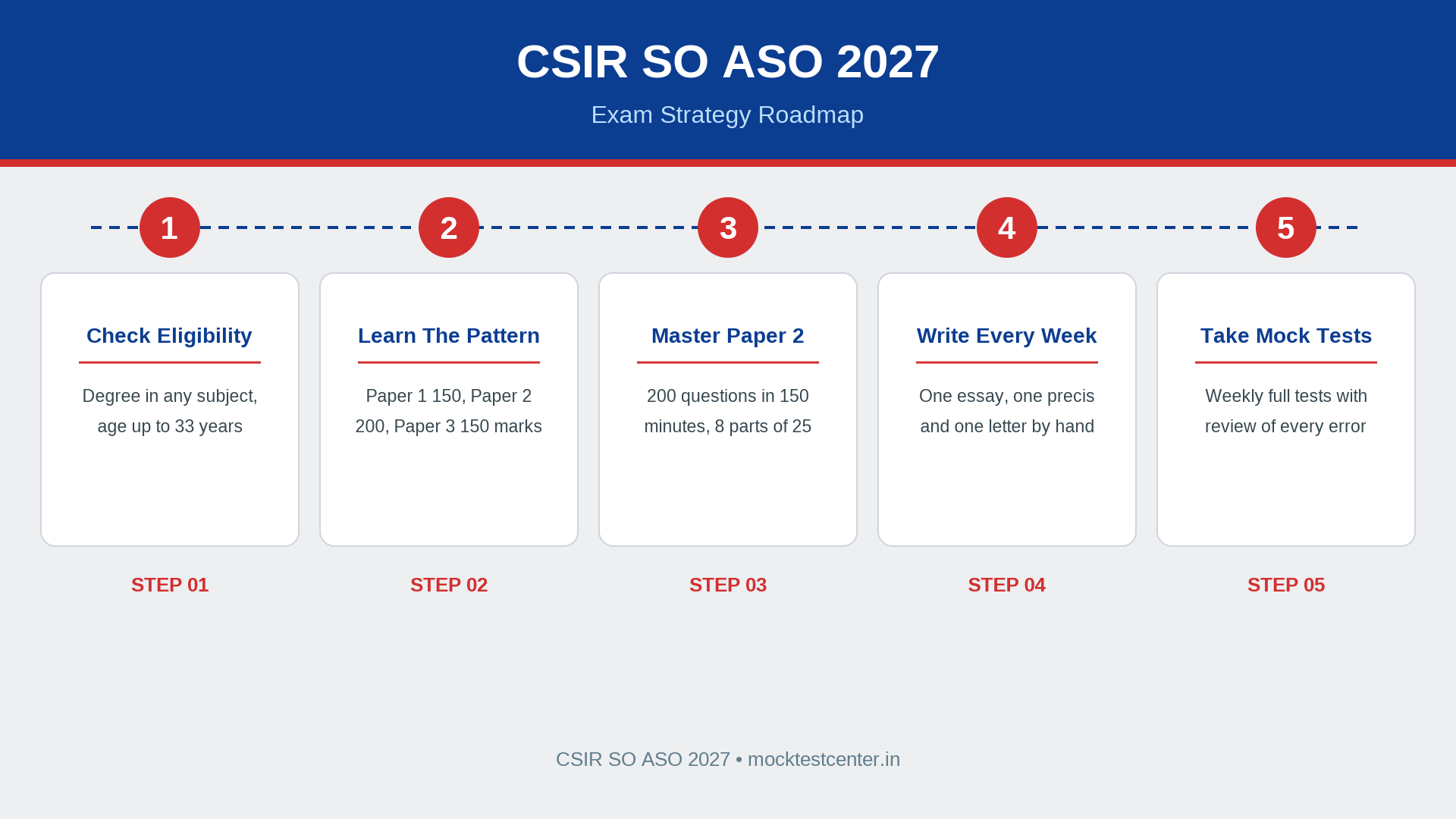
For Paper 1, read a newspaper every day and keep short notes on current events, government schemes, and science news. Revise history and the Constitution from a standard book, and do not leave them for the last month. For English, practise comprehension passages, error spotting, synonyms and antonyms, and idioms. Fifty questions of English can be the easiest fifty marks on the paper for a candidate who reads regularly, and the hardest fifty for a candidate who does not.
For Paper 2, the work is in the eight parts of 25 marks each. Do not skip ethics, management and decision making, because many candidates do, and those 75 marks are the easiest to gain against the field. Arithmetic and reasoning need daily practice, and general science needs revision of school level science.
National geography needs map work and a list of rivers, mountains, soils and crops. Give each part its own time in the week, and test yourself part by part before you test yourself on a full paper.
For Paper 3, write one essay, one precis and one letter every week, by hand, within the time limit. Two hours for 150 marks means you cannot write slowly. The essay needs an opening, a middle in clear steps, and a short ending. The precis needs the main idea in your own words.
The letter needs the right format. A candidate who has never written an essay by hand before the exam will write slowly and will run out of time. A candidate who has written ten essays before the exam will write with a steady hand.
Mock tests are the tool that ties the three parts together. Take a CSIR CASE mock test for Paper 1 and Paper 2 every week, under exam conditions, with a timer and no breaks. After each test, spend as much time on the review as on the test itself.
Note the questions you got wrong, note the questions you skipped, and note the questions where you spent too long. Oliveboard lists 77 tests for this exam, with 6 tests for Paper 1, 6 for Paper 2, 5 descriptive tests for Paper 3 with expert evaluation, and 60 sectional tests. Use the sectional tests to fix one part at a time, and use the full tests to build stamina for a 350 mark sitting.
If you are preparing for CSIR SO ASO 2027 along with another regulatory exam, the overlap helps. The reasoning, English and awareness work for CASE is close to the work for other regulatory exams. The RBI Grade B 2027 mock test page, the SEBI Grade A 2027 mock test page, the NABARD Grade A 2027 mock test page and the IRDAI Assistant Manager 2027 mock test page on this site follow the same pattern of pattern, syllabus, salary and dates, and the preparation habits transfer across them. The descriptive paper is what sets CASE apart, so give it its own time even when the objective papers feel familiar.
Mistakes that cost candidates a year
The first mistake is to trust a tracker page that prints a new CASE notification with 2027 dates. As of 23 November 2026 there is no such notification, and the pages that print one are copies of the 2023 notification with the year changed. A candidate who plans around a fake date will either rush or relax at the wrong time. The only dates that count are the ones on csir.res.in.
The second mistake is to ignore Paper 3 until Stage 1 is cleared. Paper 3 is worth 150 marks, and it is the only paper where writing skill decides the score. A candidate who starts writing practice only after the Stage 1 result has a few weeks at most, and that is not enough to build a habit of writing. Start writing one essay a week from the first month of preparation.
The third mistake is to leave the computer test for ASO candidates to the last day. The test is qualifying, but a fail means the end of the candidature, whatever the written score. Practise typing and basic office software for a short time each week, so the test feels routine on the day.
The fourth mistake is to guess too much in Paper 1 and Paper 2. Each wrong answer costs 0.33 marks, and three wrong answers wipe out one right answer. A candidate who guesses on twenty questions they do not know will lose about five marks after the penalty, and five marks can be the gap between selection and rejection. Answer what you know, mark the doubtful ones for a second pass, and leave the rest.
The fifth mistake is to apply for the wrong stream without thinking. General has the most posts, but it also has the most applicants. Finance and Accounts and Stores and Purchase have fewer posts, but the work suits a candidate with a commerce or accounts background.
Read the three streams, think about the work, and then choose. The stream is part of the post, and it stays with you for years.
What to do next
There is no new CASE notification as of 23 November 2026, so the honest plan for CSIR SO ASO 2027 is to prepare on the CASE 2023 pattern and to watch csir.res.in for the next notice. The pattern, the syllabus, the fee, the age limit and the salary on this page all come from the CASE 2023 notification, advertisement number E-I/RC/2023/1, and they are the best guide to the next cycle until CSIR says otherwise. When the next notification comes out, check the vacancies, the dates, the fee and the age cutoff first, because those are the four things that change from cycle to cycle.
Start with the basics. Check that you hold a university degree and that your age fits the limit of 33 years with the relaxation that applies to you. Read the CASE 2023 notification once in full, because it is 38 pages and it answers most questions a candidate can ask.
Then build a weekly plan that covers Paper 1 reading, Paper 2 practice and Paper 3 writing, and take a mock test every week to see where you stand. A candidate who does that for six months will be ready whenever the next notification arrives, and will not need to rush when the form opens.
Sources
CASE 2023 detailed notification, advertisement E-I/RC/2023/1, hosted by CSIR Institute of Minerals and Materials Technology. All dates, vacancies, fee, age limit, scheme, syllabus, tie rules and evaluation rules on this page come from this document.
Council of Scientific and Industrial Research, official website. The 1 July 2025 notice cancelling ten ASO selections under CASE 2023 is hosted here.
CSIR web notice dated 1 July 2025, cancellation of ten ASO selections under CASE 2023.
Oliveboard CSIR ASO SO mock test page. The count of 77 tests and the split of 6 Paper 1 tests, 6 Paper 2 tests, 5 descriptive tests and 60 sectional tests comes from Oliveboard's own test page for this exam.







