About UPSC IES and ISS Examination 2027 Exam Series
📖 Table of Contents
UPSC IES and ISS Examination 2027
What is this exam
UPSC means the Union Public Service Commission. It holds one combined exam for two services: the Indian Economic Service (IES) and the Indian Statistical Service (ISS). This page covers both services in one package, because UPSC holds them as one exam with one notice. Do not mix up the Indian Economic Service with the Indian Engineering Services, which is a different exam with the same short form.
The Indian Economic Service works on the economy of the country: prices, growth, trade, budgets, and plans. Its officers work in ministries and economic wings of the government. The Indian Statistical Service works on numbers and data: surveys, census work, national accounts, and reports that guide policy.
This page is about the 2027 cycle. The last full cycle was Notice Number 07/2026, dated 11 February 2026, with 44 posts. The 2027 notice has not come yet, so this page uses the 2026 cycle as the base. Always check upsc.gov.in before you apply, because UPSC is the only true source for dates and rules.
Who can apply / Eligibility
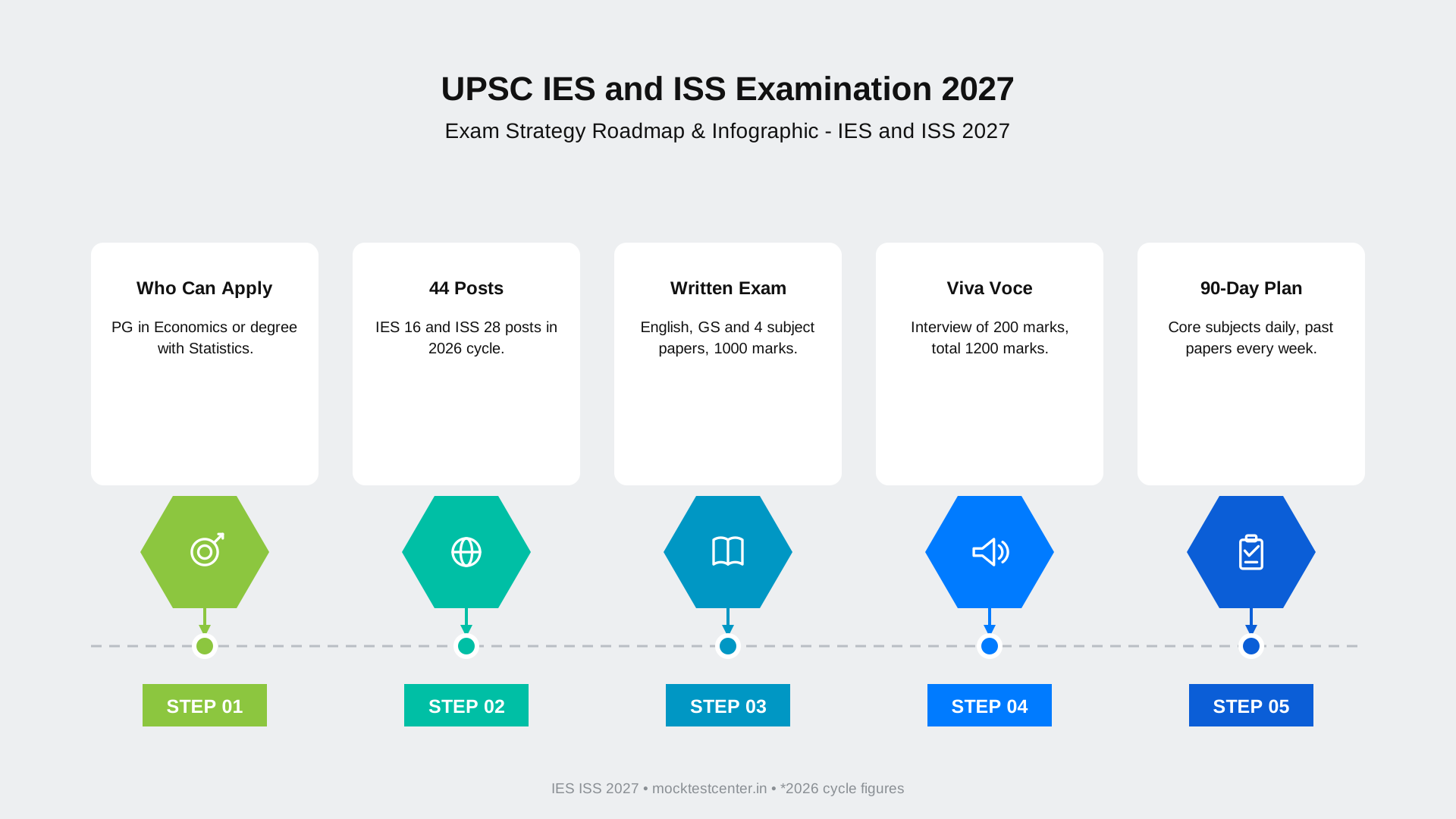
First, your age must be 21 to 30 years as on 1 August of the exam year. For the last cycle that date was 1 August 2026, which means you must be born between 2 August 1996 and 1 August 2005. Age relaxation is given as per the rules: SC and ST get 5 years more, OBC get 3 years more, and PwBD get 10 years more. Ex-servicemen and government servants get relaxation as per the rules.
Second, your education depends on the service you want. For the Indian Economic Service, you need a Post-Graduate degree in Economics, Applied Economics, Business Economics, or Econometrics from a known university. For the Indian Statistical Service, you need a Bachelor degree with Statistics, Mathematical Statistics, or Applied Statistics as a subject, or a Master degree in Statistics, Mathematical Statistics, or Applied Statistics.
Third, you must be an Indian citizen. Subjects of Nepal and Bhutan, Tibetan refugees who came before 1 January 1962, and persons of Indian origin from some countries can also apply with an eligibility certificate. The fee in the 2026 cycle was Rs. 200.
- Age: 21 to 30 years as on 1 August of the exam year (born 2 August 1996 to 1 August 2005 for the 2026 cycle); SC/ST plus 5, OBC plus 3, PwBD plus 10
- Education (IES): Post-Graduate degree in Economics, Applied Economics, Business Economics, or Econometrics
- Education (ISS): Bachelor degree with Statistics as a subject, or Master degree in Statistics
- Fee: Rs. 200 in the 2026 cycle; female, SC, ST, and PwBD exempt
Posts and vacancies
The 2026 notice announced 44 posts: 16 in the Indian Economic Service, including 1 for PwBD, and 28 in the Indian Statistical Service, including 2 for PwBD. The number is liable to change, as the notice says.
For 2027, no vacancy number has been announced yet. Do not believe any website that gives one today. The 2027 notice is awaited, and the calendar says the exam will be held on 18 June 2027 for 3 days. When the notice comes, check the post number on upsc.gov.in.
| Service | Posts (2026 cycle) |
|---|---|
| Indian Economic Service (IES) | 16 (including 1 PwBD) |
| Indian Statistical Service (ISS) | 28 (including 2 PwBD) |
| Total | 44 |
Exam pattern
There are two stages: a written test and a Viva Voce or Personality Test. The written test is 1000 marks and the interview is 200 marks, so the total is 1200 marks. All papers are in English only.
Paper I is General English, descriptive, with 100 marks in 3 hours. Paper II is General Studies, descriptive, with 100 marks in 3 hours. These two papers are the same for IES and ISS candidates.
Then come Papers III to VI, which are different for the two services. For IES, the four papers are General Economics I, II, and III, plus Indian Economics. Each is descriptive, with 200 marks in 3 hours. For ISS, the four papers are Statistics I, II, III, and IV. Statistics I and II are objective, with 200 marks each in 2 hours, and 80 questions each. Statistics III and IV are descriptive, with 200 marks each in 3 hours.
The Viva Voce or Personality Test is 200 marks. There is negative marking in the ISS objective papers, Statistics I and II, as per the notice. The exact fraction of the cut was not verified from the notice PDF in this pass, so this page does not state it as a confirmed fact. There is no negative marking in the descriptive papers.
| Paper | IES | ISS | Marks |
|---|---|---|---|
| Paper I | General English (descriptive) | General English (descriptive) | 100 |
| Paper II | General Studies (descriptive) | General Studies (descriptive) | 100 |
| Papers III–VI | General Economics I–III + Indian Economics | Statistics I–IV | 800 |
| Viva Voce | Personality Test | Personality Test | 200 |
| Total | Written 1000 + Viva 200 | Written 1000 + Viva 200 | 1200 |
Syllabus
General English covers essay writing, precis, and reading. It checks if you can write clear and clean English. General Studies covers current events, polity, history, geography, economy, and science. These two papers are only 200 of the 1000 written marks, but they can change your rank.
For IES, the syllabus covers micro and macro economics, public economics, international economics, and the Indian economy: growth, farming, industry, planning, money, and banking. Read the Economic Survey and the Union Budget every year.
For ISS, the syllabus covers probability, statistical methods, inference, sampling, design of experiments, econometrics, applied statistics, demography, and quality control. The objective papers test speed and accuracy, while the descriptive papers test deep knowledge. Your Post-Graduate notes are the base for both services.
Important dates
The dates below are from the 2026 cycle. The 2027 notice has not come yet, so there are no 2027 dates to give except the calendar dates.
The 2026 notice, Number 07/2026, was dated 11 February 2026. Applications ran from 11 February to 3 March 2026, and the last time was 6:00 PM on the last day. The written exam was held from 19 to 21 June 2026, over 3 days. The written result came out on 4 August 2026, with separate lists for IES and ISS. The Personality Tests were held from 2 to 5 November 2026. The final result was not published as of 6 November 2026.
For 2027, the UPSC calendar says the notice will come on 10 February 2027, the last date will be 2 March 2027, and the exam will be held on 18 June 2027 for 3 days. All dates can change, so check upsc.gov.in often.
| Event | Date |
|---|---|
| 2026 notice (07/2026) | 11 February 2026 |
| 2026 applications | 11 February to 3 March 2026 (6:00 PM) |
| 2026 written exam | 19 to 21 June 2026 (3 days) |
| 2026 written result | 4 August 2026 |
| 2026 Personality Tests | 2 to 5 November 2026 |
| 2027 notification (calendar) | 10 February 2027 |
| 2027 exam (calendar) | 18 June 2027 (3 days) |
Cut-off
The cut-off marks for any recent cycle were not verified when this page was written. This page gives no cut-off figures, and you should not trust any website that gives exact marks today.
Still, you can learn how the cut-off works. The written test is 1000 marks and the viva is 200 marks, so the final merit is out of 1200. UPSC picks a cut-off for the written test to shortlist for the viva, then a final cut-off out of 1200. The two services have separate lists, so the cut-off for IES and ISS can be different in the same year.
As a safe aim, try to score high in Papers III to VI, because they give 800 of the 1000 written marks. For IES, Indian Economics is one full paper, so keep your facts on the Indian economy fresh. For ISS, the two objective papers need speed, so practise 80 questions in 2 hours with a timer. Do not guess blindly in the objective papers, because negative marking applies.
Best books
For General English, practise essay writing, precis, and reading every week. For General Studies, use the NCERT books, a good yearbook, and a daily newspaper. For IES, use standard books on micro and macro economics, public economics, and international economics, plus the Economic Survey and the Union Budget. For ISS, use standard books on probability, inference, sampling, and econometrics.
Solve past year papers of the IES and ISS exam to learn the style of questions. For IES, write long answers with diagrams and data. For ISS, solve objective questions daily and practise the descriptive papers with a timer. Make short notes on key formulae and key facts, and revise them twice a month.
90-day study plan
Days 1 to 30: Build your base. Study your core subject for three hours a day and General Studies and English for one hour a day. Revise formulae and make short notes. Read the newspaper daily and note key economic facts.
Days 31 to 60: Go deep. Take one full mock test every week and check every wrong answer. Start answer writing: write two long answers every week with steps and data. Revise the weak topics in your core subject. Read the Economic Survey summary.
Days 61 to 90: Revise and test. Take a full mock test every two days in the last two weeks, in exam time. Revise your short notes, formulae, and facts. Practise writing answers daily. Do not start any new book now. In the last week, solve the past five years of papers.
How to use mock tests
Mock tests are practice tests that look like the real exam. They are the best tool here, because the written test has six papers over 3 days and stamina decides your rank. Take them in exam-like conditions: 3 hours at one stretch, no pauses, no peeking at answers.
After each mock test, spend one hour on the analysis. Note the questions you got wrong and the ones that took too long. For ISS, aim for high accuracy in the objective papers, because negative marking punishes blind guessing. For IES, check your answers against model answers and add facts and data where you were thin.
If you are also getting ready for other UPSC exams, you can see UPSC CSE Prelims 2027, UPSC Indian Forest Service Examination 2027, UPSC Engineering Services Examination 2027, UPSC CAPF 2027, SSC CGL 2027, SSC CHSL 2027, BPSC Assistant Section Officer 2027, 72nd BPSC Prelims 2027, Indian Army NDA 2027 and Bihar Police Sub Inspector and Sergeant 2027 on this site. Apply only on upsconline.nic.in and check notices on upsc.gov.in.
A last word
The IES and ISS exam is a rare and fine chance for economics and statistics graduates to join Group A service in the central government. The 2026 cycle had 44 posts, and the 2027 exam is set for 18 June 2027 as per the calendar. The pay is Junior Time Scale, Level 10, with a basic of Rs. 56,100.
Do not wait for the 2027 notice to start. The last cycle moved fast from notice to exam in about four months. Prepare now with the 2026 pattern, revise your core subject daily, write long answers every week, and check upsc.gov.in every week. Do not pay any agent, and do not believe any 2027 vacancy number until UPSC publishes it.