About Indian Army NDA 2027 Exam Series
📖 Table of Contents
Indian Army NDA 2027
NDA means National Defence Academy. It is the first step for a school student who wants to become an officer in the Indian Army. You give this exam just after Class 12, and if you pass, you train at Khadakwasla in Pune and then at the Indian Military Academy in Dehradun. At the end you become a Lieutenant in the Indian Army. This page tells you, in simple words, who can apply, what the exam looks like, what to study, and how to plan your next 90 days.
What is this exam
The full name is the National Defence Academy and Naval Academy Examination, or NDA and NA exam. The Union Public Service Commission, called UPSC, holds it twice a year. This page is about the Army wing of NDA only. The Navy and Air Force wings have their own rules, and they need Physics and Mathematics in Class 12.
NDA is the only exam that lets you join the Army as an officer straight after school. You do not need a college degree. You study for three years at NDA in Khadakwasla, Pune, where Army, Navy and Air Force cadets train together. Then Army cadets go to the Indian Military Academy, called IMA, in Dehradun for one more year. After that you are commissioned as a Lieutenant and you start your life as an Army officer.
Who can apply
This exam is for young students who have just finished school, or are about to finish it. You must be an unmarried male or female candidate. Married students cannot apply, and you must promise not to marry until your full training is over. A student who marries during training can be sent home.
You must be an Indian citizen. For the Army wing you must have passed Class 12 in any stream — science, commerce or arts, all are fine. If you are still in Class 12 and your board exam is coming, you can also apply. You only need to show proof that you passed Class 12 when the time comes.
Eligibility
Eligibility means the rules you must meet before you apply. The first rule is age. You must be between 16.5 and 19.5 years old when the course starts. There is no age relaxation for any group — not for SC, ST, OBC or any other category. The exact birth dates for 2027 will be printed only in the notification that comes on 2 December 2026, so check that notice before you apply.
The second rule is education. For the Army wing, Class 12 pass in any stream is enough. You do not need Physics or Mathematics for the Army wing. But if you also want the Air Force or Navy wing, you must have Physics and Mathematics in Class 12. Choose your wing with care when you fill the form.
The third rule is fitness. You must be fit in body and mind. The exact height, chest and eye rules are in the official notice, and they change a little from time to time. This page gives no height or eye numbers, because they are not verified for 2027. Read them in the official notice on upsc.gov.in and check your fitness with a doctor before you apply.
Posts and vacancies
Vacancy means the number of seats. NDA does not give jobs by post name. It gives seats by wing — Army, Navy, Air Force and Naval Academy. The Army wing always has the largest number of seats. In the NDA (II) 2026 cycle there were about 394 seats in total, with about 208 for the Army wing. That is a past number, and it is given here only to show the size of the exam.
For 2027, no vacancy number has been announced yet. The number will be printed in the notification on 2 December 2026 for NDA (I) 2027 and in May 2027 for NDA (II) 2027. Do not trust any site that gives a 2027 vacancy number today, because no such number exists yet.
Exam pattern
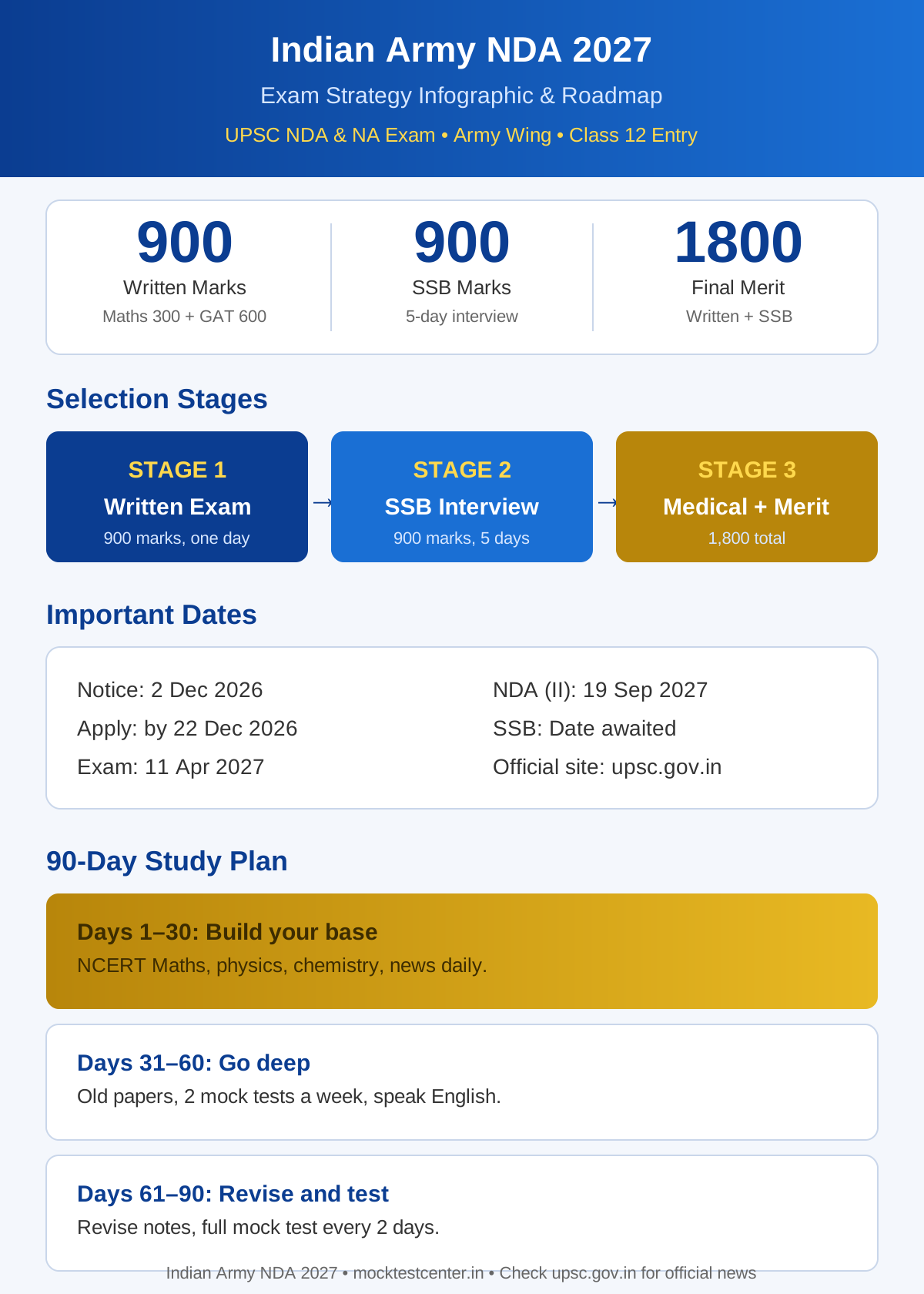
Exam pattern means how the exam is set. The written exam has two papers on the same day. Paper 1 is Mathematics for 300 marks, with 120 questions in 2.5 hours. Paper 2 is the General Ability Test, called GAT, for 600 marks, with 150 questions in 2.5 hours. The total is 900 marks. Both papers have objective questions with four options each.
Wrong answers cost marks. For every wrong answer, one-third of the marks for that question are cut. In Maths that means minus 0.83 marks, and in GAT it means minus 1.33 marks. Questions you leave blank cost nothing. So it is better to leave a question blank than to guess blindly.
| Stage | What happens | Marks / time |
|---|---|---|
| Written Paper 1: Mathematics | 120 objective questions, Class 11–12 level | 300 marks, 2.5 hours |
| Written Paper 2: GAT | 150 objective questions, English + GK | 600 marks, 2.5 hours |
| SSB interview | 5 days: screening, psychology, group tasks, interview | 900 marks |
| Medical test | Full health check | Must pass |
| Final merit | Written + SSB | 1,800 marks |
Syllabus
Syllabus means the list of topics you must study. The full syllabus is in the official notice on upsc.gov.in. The short guide below is in simple words only.
Mathematics covers Class 11 and 12 topics: algebra, trigonometry, geometry, mensuration, statistics and probability. The questions are direct and need fast, correct working. Practise a little Maths every day, because speed comes only from daily practice.
The GAT has two parts. Part A is English for 200 marks: grammar, words, sentence making, reading passages and spotting errors. Part B is General Knowledge for 400 marks: physics, chemistry, general science, history, geography, polity and current events. Physics and chemistry are from Class 11 and 12 level, and they carry a big share, so science students have an edge here.
Important dates
The dates below come from the UPSC Annual Calendar 2027. UPSC can change calendar dates, so the detailed notification is the final word. Check upsc.gov.in every week.
NDA (I) 2027 is the first chance of the year. Its notification comes on 2 December 2026, the last date to apply is 22 December 2026, and the written exam is on 11 April 2027. NDA (II) 2027 follows with a notification on 12 May 2027, a last date of 1 June 2027, and the written exam on 19 September 2027.
| Event | NDA (I) 2027 | NDA (II) 2027 |
|---|---|---|
| Notification | 2 December 2026 | 12 May 2027 |
| Last date to apply | 22 December 2026 | 1 June 2027 |
| Written exam | 11 April 2027 | 19 September 2027 |
| SSB interview | Date awaited | Date awaited |
| Result | Date awaited | Date awaited |
| Course starts | Date awaited | Date awaited |
Cut-off
Cut-off means the lowest marks that can pass a stage. UPSC fixes a cut-off for the written exam, and only students above that line are called for the SSB. Then a final cut-off is fixed on the total of 1,800 marks.
No cut-off is verified for 2027. As a rough guide from past cycles, the written cut-off is often in the range of 340 to 400 out of 900, and the final cut-off is often in the range of 700 to 760 out of 1,800. These are secondary-source ranges from past years only. They are not targets and they are not promises. The real cut-off changes every year with the paper and the number of seats.
Best books
Do not buy ten books for one subject. One good book for each subject is enough. Read it two times and solve its questions.
For Maths, use your Class 11 and 12 NCERT books first, because the paper is set at that level. Then use one good practice book with many solved questions. For English, use one grammar book and read an English newspaper every day. Reading the paper daily builds both your English and your current events at the same time.
For physics and chemistry, your Class 11 and 12 books are the base. For history, geography and polity, use one short notes book and revise it again and again. No exact book title is given here, because no title has been verified for this exam. Ask your teacher or a senior who cleared NDA which books helped them.
90-day study plan
Days 1 to 30: Build your base. Read your Class 11 and 12 Maths, physics and chemistry books again and make short notes. Learn the grammar rules and read the newspaper for 30 minutes each day. Give one small test each week. Do not skip Maths on any day, because Maths needs daily touch.
Days 31 to 60: Go deep. Solve old NDA papers in full, sitting for the whole time like a real exam. Practise GAT questions in one sitting and note your weak topics. Give two mock tests each week and write your mistakes in a diary. Start speaking in English for a few minutes each day, because the SSB interview needs clear speech.
Days 61 to 90: Revise and test. Read your notes again and again. Do not start any new book now. Give a full mock test every two days. In the last week, solve one full paper each day and sleep well. A fresh mind answers faster than a tired mind.
How to use mock tests
Mock tests are practice tests that look like the real exam. They show your weak topics, teach you time control, make you brave, and show your true score. A student who gives many mock tests walks into the real exam hall without fear.
Take mock tests on mocktestcenter.in. Start with one test each week, then two each week, and in the last month, one every two days. Always check your answers after a test and write the right answers in your notes. Sit in a quiet room, keep your phone away, and use a clock. Give the Maths paper and the GAT paper back to back, just like the real exam day.
If you are getting ready for more than one Army entry, you can also look at Indian Army CDS 2027, Indian Army TES 10+2 2027 and Indian Army TGC 2027. For other government exams on this site, see 72nd BPSC Prelims 2027, BPSC TRE 4.0 Teacher Recruitment 2027, BPSC Assistant Engineer 2027, 33rd Bihar Judicial Services 2027, BPSC Assistant Section Officer 2027, BPSC Auditor 2027, BPSC District Statistical Officer 2027 and BPSC Motor Vehicle Inspector 2027. Each page has its own mock tests, study plan and simple notes.
A last word
NDA is the best door for a school student who dreams of the Army uniform. The Army wing needs only Class 12 in any stream, and the age window is 16.5 to 19.5 years. The written exam is on 11 April 2027 for NDA (I), and the notification comes on 2 December 2026.
Start today. Do not wait for the notification. Build your Maths and English daily, read the news, and give mock tests. When the notice comes, read it on upsc.gov.in and apply at once. The uniform is waiting for the student who prepares every day.