About UPSC Engineering Services Examination 2027 Exam Series
📖 Table of Contents
UPSC Engineering Services Examination 2027
What is this exam
UPSC means the Union Public Service Commission. It holds the Engineering Services Examination, which is also called ESE. Do not mix it up with the Indian Economic Service, which is also called IES. This exam picks engineers for Group A and Group B gazetted posts in central government departments like Railways, CPWD, the Central Water Commission, Defence, and Telecom. An ESE officer plans, builds, and runs big public works: roads, bridges, dams, power lines, and phone networks.
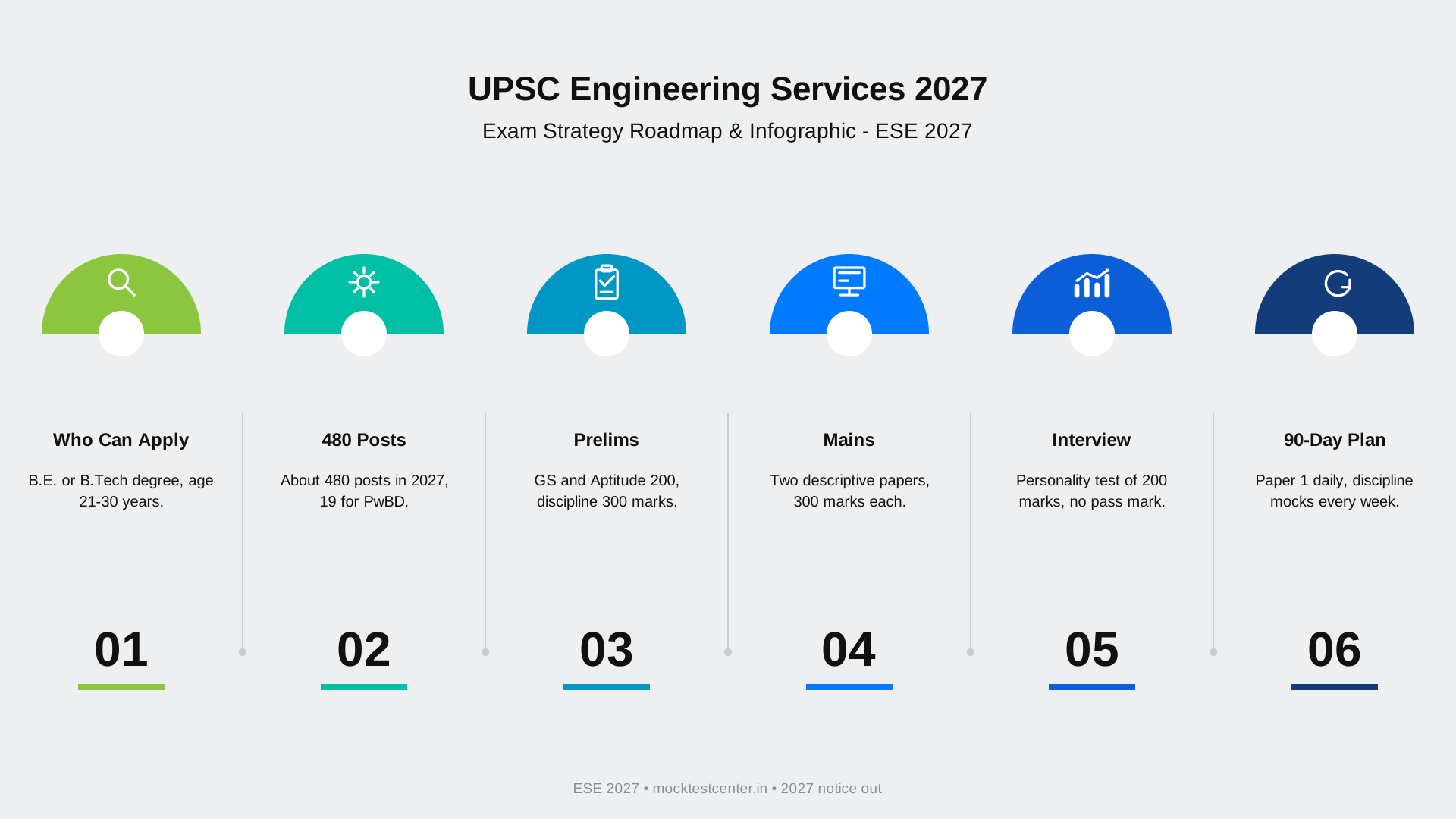
This is a live 2027 cycle. Notice Number 02/2027-ENGG. came out on 16 September 2026, with about 480 posts. Applications closed on 6 October 2026. The Prelims is on 31 January 2027 and the Mains is on 18 June 2027. If you are reading this page, the notice is already out, so check the exact rules on upsc.gov.in and apply on upsconline.nic.in.
There are four streams in this exam: Civil, Mechanical, Electrical, and Electronics and Telecommunication. You pick one stream and all your subject papers are in that stream. The total marks are 1300, and all three stages count for the final merit.
Who can apply / Eligibility
First, your age must be 21 to 30 years. The exact cut-off date is given in Notice Number 02/2027-ENGG., so read it in the notice. Age relaxation is given as per the rules: OBC candidates get 3 years more, SC and ST candidates get 5 years more, and government servants get 5 years more.
Second, you need a degree in Engineering (B.E. or B.Tech or an equal degree) from a known university, in one of the four streams: Civil, Mechanical, Electrical, or Electronics and Telecommunication. Some equal degrees are also allowed, like AMIE and Graduate Membership of IETE or IEI, as listed in the notice. Final year students can also apply. There is no minimum percentage needed.
Third, you must be an Indian citizen. The fee is Rs. 200. Female, SC, ST, and PwBD candidates do not have to pay the fee.
- Age: 21 to 30 years (cut-off date as per Notice No. 02/2027-ENGG.); OBC plus 3, SC/ST plus 5, government servants plus 5
- Education: B.E. or B.Tech in Civil, Mechanical, Electrical, or Electronics and Telecommunication; final year students can apply
- Fee: Rs. 200; female, SC, ST, and PwBD exempt
- Streams: Civil, Mechanical, Electrical, Electronics and Telecommunication
Posts and vacancies
The 2027 notice announced about 480 posts, including 19 for PwBD. The number can change a little, as the notice says it is liable to change. The posts are in many departments, and your stream decides which posts you can get. Civil engineers go to works and water departments, Mechanical engineers to workshops and plants, Electrical engineers to power and railways, and Electronics engineers to telecom and defence.
The last cycle, 2026, had about 474 posts. Its notice was Number 02/2026-ENGG., dated 26 September 2025, and its Prelims was on 8 February 2026. The 2027 number is a little higher, which is good news for this year.
| Item | Detail (2027 cycle) |
|---|---|
| Notice number | 02/2027-ENGG., dated 16 September 2026 |
| Vacancies | About 480, including 19 for PwBD |
| Prelims | 31 January 2027 |
| Mains | 18 June 2027 |
| 2026 vacancies | About 474 |
Exam pattern
There are three stages: Prelims, Mains, and the Personality Test or Interview. All three count for the final merit, which is 1300 marks in all.
Stage one is the Prelims, with two objective papers. Paper I is General Studies and Engineering Aptitude, common to all streams: 100 questions, 200 marks, 2 hours. Paper II is your engineering stream: 150 questions, 300 marks, 3 hours. The total is 500 marks. There is negative marking of one third of a mark for each wrong answer.
Stage two is the Mains, with two descriptive papers in your stream. Paper I is 300 marks in 3 hours, and Paper II is 300 marks in 3 hours. The total is 600 marks. These papers need full written answers with steps, diagrams, and design work, not just ticking boxes.
Stage three is the Personality Test or Interview, with 200 marks. There is no minimum pass mark for the interview. The final merit is Prelims 500 plus Mains 600 plus Interview 200, which makes 1300 marks.
| Stage | Papers | Marks |
|---|---|---|
| Prelims | GS and Engineering Aptitude 200 + Stream Paper 300 | 500 |
| Mains | Stream Paper I 300 + Stream Paper II 300 (descriptive) | 600 |
| Interview | Personality Test | 200 |
| Total | All three stages | 1300 |
Syllabus
Prelims Paper I is common to all streams. It covers current affairs, engineering maths and numbers, general rules of design and drawing, standards and quality, basics of energy and the environment, basics of project work, ethics, and computers and IT. This paper is only 200 marks, but it can change your rank, so do not leave it for the last week.
Prelims Paper II covers the core of your stream. For Civil, it is structural analysis, design of concrete and steel structures, geotech, water resources, transport, and the environment. For Mechanical, it is heat, fluids, strength of materials, theory of machines, and making things. For Electrical, it is circuits, machines, power systems, and control. For Electronics and Telecommunication, it is signals, communication, embedded systems, and control.
The Mains covers the same stream subjects at a higher level, with long written answers. You must show steps, draw clean diagrams, and give full reasons. A good Mains score needs daily writing practice, not just reading.
Important dates
The 2027 notice is out, so these are real dates for this cycle, not guesswork. The notice, Number 02/2027-ENGG., was dated 16 September 2026. Applications ran from 16 September to 6 October 2026, and the last time was 6:00 PM on the last day. The Prelims is on 31 January 2027, and the Mains is on 18 June 2027. The interview will be held after the Mains result, and the final result will follow.
For the 2026 cycle, the notice was dated 26 September 2025, the Prelims was on 8 February 2026, and the Mains written result came out on 24 July 2026. That cycle is over now. Focus on the 2027 dates and check upsc.gov.in for the admit card and result links.
| Event | Date (2027 cycle) |
|---|---|
| Notice (02/2027-ENGG.) | 16 September 2026 |
| Applications | 16 September to 6 October 2026 (6:00 PM) |
| Prelims (Stage-I) | 31 January 2027 |
| Mains (Stage-II) | 18 June 2027 |
| Interview (Stage-III) | After Mains result |
| 2026 Prelims | 8 February 2026 |
Cut-off
The cut-off marks for any recent cycle were not verified from a UPSC PDF when this page was written. This page gives no cut-off figures, and you should not trust any website that gives exact marks today. Some sites give a "safe score" for the 2024 cycle, but that figure was not checked against a UPSC PDF, so it is not used here.
Still, you can learn how the cut-off works. All three stages count: Prelims 500, Mains 600, and Interview 200. UPSC picks a cut-off for the Prelims to shortlist for the Mains, then a cut-off for the Mains to shortlist for the interview, then a final cut-off out of 1300 marks. The Mains has the most marks, so a strong Mains score can lift your rank a lot, even if your Prelims score is only fair.
As a safe aim, try to score high in your stream papers, because they give 900 of the 1300 marks. In the Prelims, do not guess blindly, because one third of a mark is cut for each wrong answer. In the Mains, write full answers with steps, because step marks save you even when the last answer is wrong.
Best books
For Prelims Paper I, use a good book on General Studies and Engineering Aptitude, plus a daily newspaper for current affairs. Revise engineering maths, ethics, and project basics from short notes. For your stream paper, use your B.E. or B.Tech books first. For Civil, use R. S. Khurmi and standard books on structures, geotech, and water. For Mechanical, use R. S. Khurmi and books on heat, fluids, and machines. For Electrical, use standard books on circuits, machines, and power systems. For Electronics, use standard books on signals, communication, and embedded systems.
For the Mains, use the same books but at a deeper level, and solve past year papers with a timer. Buy a good book of past ESE papers with answers, and work through at least ten years of papers. For the interview, read about your stream, your final year project, and current news in your field.
90-day study plan
Days 1 to 30: Build your base. Study your stream subject for four hours a day and Paper I for one hour a day. Revise formulae and make short notes. Solve 30 objective questions a day with a timer. Read the newspaper daily.
Days 31 to 60: Go deep. Take one full Prelims mock test every week and check every wrong answer. Start Mains answer writing: write two long answers every week with steps and diagrams. Revise the weak topics in your stream. Keep your current affairs notes up to date.
Days 61 to 90: Revise and test. Take a full mock test every two days in the last two weeks, in exam time. Revise your short notes and formulae. Practise Mains answers daily. Do not start any new book now. In the last week, solve the past five years of Prelims papers.
How to use mock tests
Mock tests are practice tests that look like the real exam. They are the best tool here, because the Prelims has 250 questions and speed decides your rank. Take them in exam-like conditions: Paper I in 2 hours and Paper II in 3 hours, at one stretch, no pauses, no peeking at answers.
After each mock test, spend one hour on the analysis. Note the questions you got wrong and the ones that took too long. Aim for high accuracy, because negative marking punishes blind guessing. For the Mains, write answers with a timer and check them against model answers. Watch your stream paper scores closely, because they give 900 of the 1300 marks.
If you are also getting ready for other UPSC exams, you can see UPSC CSE Prelims 2027, UPSC Indian Forest Service Examination 2027, UPSC Combined Geo-Scientist Examination 2027, UPSC CAPF 2027, SSC Junior Engineer 2027, SSC CGL 2027, BPSC Assistant Engineer 2027, 72nd BPSC Prelims 2027, Indian Army SSC Tech 2027 and Indian Army TGC 2027 on this site. Apply only on upsconline.nic.in and check notices on upsc.gov.in.
A last word
The Engineering Services Examination is one of the best chances for engineers to join the central government in a Group A post. The 2027 notice is out, with about 480 posts, and the Prelims is on 31 January 2027. The work is real engineering: building, planning, and running public works that people use every day.
Start now if you have not started yet. Revise your stream daily, practise objective questions with a timer, and write Mains answers every week. Do not wait for the admit card to start. Check upsc.gov.in every week for the latest notice. Do not pay any agent, and do not believe any vacancy number other than the one in the official notice.