About Union Bank of India LBO 2027 Exam Series
📖 Table of Contents
- What Union Bank LBO 2027 is
- The 2025-26 cycle in full: 1,500 posts
- Who can apply: the 2025-26 rules
- The exam pattern: the longest LBO paper
- The descriptive paper: letter and essay
- The local language test: the heart of this post
- Interview and the 80:20 merit list
- Pay: what a Local Bank Officer actually takes home
- Union Bank LBO next to PO, Clerk and the other LBOs
- What to study for each section
- A 90 day plan that fits around a job or college
- Mistakes that cost Union Bank LBO candidates a year
- What to check before the next Union Bank notice
Union Bank LBO 2027: Pattern, Salary, Dates
What Union Bank LBO 2027 is
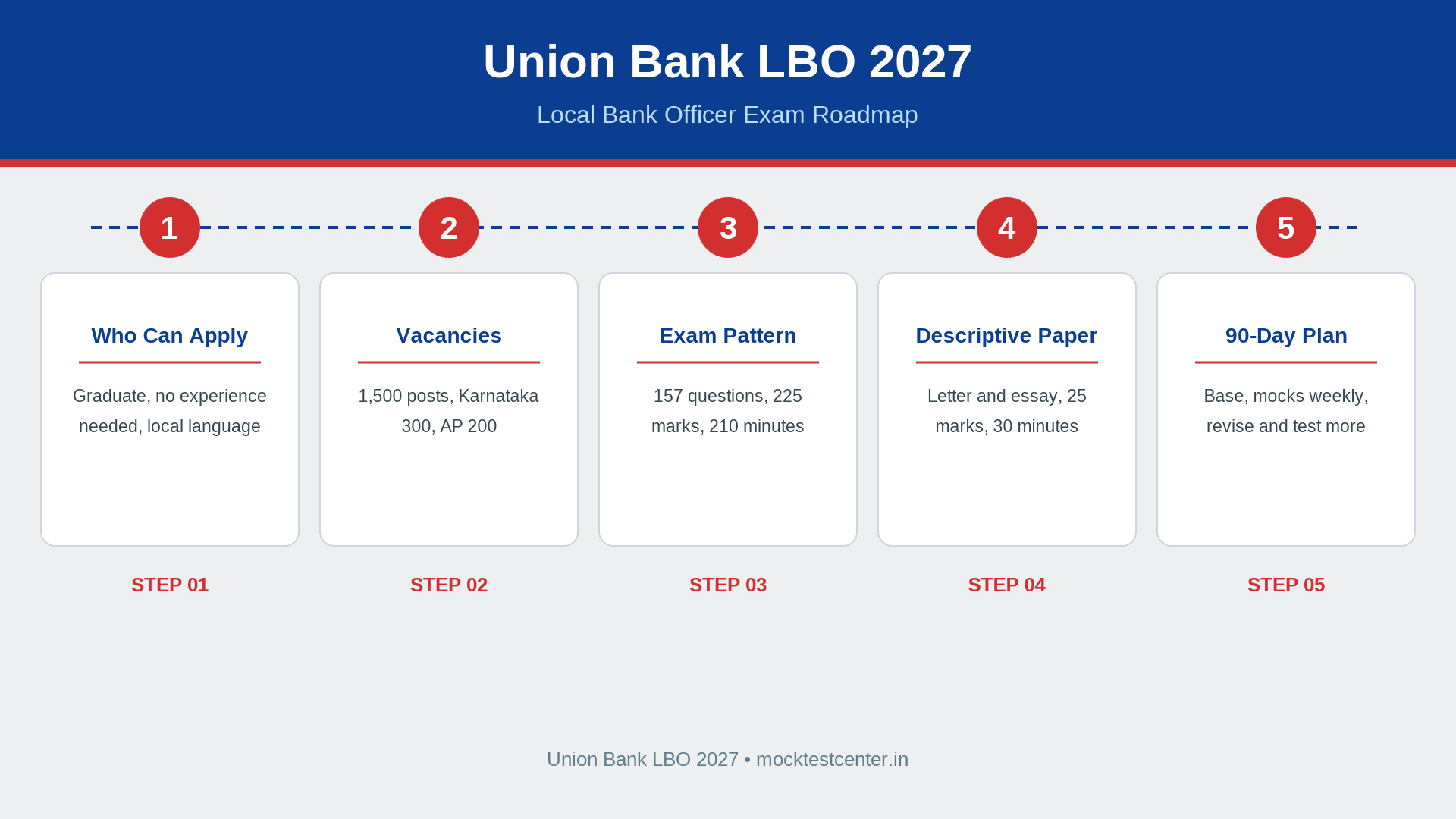
Union Bank LBO 2027 is the Local Bank Officer recruitment of Union Bank of India, one of India's largest public sector banks. A Local Bank Officer is a Junior Management Grade Scale I officer who works in one state, serves customers in the local language of that state, and handles branch banking in the area he or she knows best. The post sits at the same grade as a Probationary Officer, with the same starting basic pay of 48,480 rupees. The difference is the route in and the place of work. A Probationary Officer can be posted anywhere in India. A Local Bank Officer applies for one state, proves skill in that state's language, and works in that state.
One fact must come first, before any pattern or pay figure. Union Bank of India has not released a new Local Bank Officer notification as of 23 November 2026. The latest cycle is the 2025-26 recruitment, notified on 24 October 2024, for 1,500 posts. That cycle is complete: the online test ran from 4 to 8 December 2024, document verification and the language test ran from 17 to 21 March 2025, interviews ran from 2 to 5 April 2025, and the final merit list has been declared. Any site that prints a Union Bank LBO vacancy number or an exam date for a new cycle today is guessing. This page says so plainly, and it builds the rest of the guide from the completed 2025-26 cycle, which is the latest real notice for this post.
Check the official careers page at unionbankofindia.co.in for every notice, because only the official notice is final. The pattern, eligibility rules and pay figures in this article come from the 2025-26 notification and the bank's own result notices. They show what the next Union Bank LBO notice will most likely look like. They are not the next notice. When the real notice comes out, read it first and treat this page as a starting point, not as the final word.
The LBO idea is simple. A bank with branches in every district needs officers who speak the local language, know the local crops and trades, and stay in one area long enough to build trust. Union Bank of India was founded in 1919 and is headquartered in Mumbai, with the tagline Good People to Bank with. Its LBO drive covered only ten states, and all ten are non Hindi speaking states: Andhra Pradesh, Assam, Gujarat, Karnataka, Kerala, Maharashtra, Odisha, Tamil Nadu, Telangana and West Bengal. That list is the point of the post. The bank hires where its local language branches need officers who speak the language of the place.
The 2025-26 cycle in full: 1,500 posts
The notification of 24 October 2024 invited applications for 1,500 Local Bank Officer posts in Junior Management Grade Scale I. Online registration opened the same day and closed on 13 November 2024. The online test ran from 4 to 8 December 2024. The fee was 850 rupees for General, EWS and OBC candidates, and 175 rupees for SC, ST and PwBD candidates, the same fee as every other LBO cycle in the 2025 wave.
The state table is the first thing to read, because the whole recruitment is built around it. Karnataka took the largest share, with 300 posts, followed by Andhra Pradesh, Gujarat, Tamil Nadu and Telangana with 200 each. Kerala and Odisha and West Bengal took 100 each. Assam and Maharashtra took 50 each. The category split is 613 General, 404 OBC, 224 SC, 150 EWS and 109 ST. The bank said the vacancy count was provisional and could change with its requirements, as every notice does. The merit list was drawn state wise and category wise, so a candidate competes only against candidates who applied for the same state and the same category.
The timeline after the test shows how long this recruitment takes. The test ran in the first week of December 2024. The online exam result and the call letters for document verification and the language proficiency test came out on 6 March 2025, three months later. Verification and the language test ran from 17 to 21 March 2025. Interview call letters came out on 27 March 2025, and interviews ran from 2 to 5 April 2025. The final merit list followed. A candidate who applied in October 2024 waited about six months for the final result. Plan for that pace. A new cycle will move at the same speed, and a candidate who expects a result in a month will be disappointed for no reason.
One warning about the dates you will see online. Coaching pages relabel this 2024 cycle as a 2026 cycle, and one social media post claims a new Union Bank LBO drive with a last date of 30 October 2026. No official notice supports that claim. The bank's careers page is the only source that counts. Check it weekly, and treat every other date as a rumour until the bank prints it.
Who can apply: the 2025-26 rules
The 2025-26 notice sets the age at 20 to 30 years as on 1 October 2024. That is one year younger at the bottom than the Bank of Baroda LBO rule, which starts at 21. A candidate who turned 20 before 1 October 2024 could apply here, and could not apply to Bank of Baroda. Relaxation follows government rules: five years for SC and ST, three years for OBC non creamy layer, ten years for persons with benchmark disabilities, with higher limits for ex-servicemen and other protected groups. The cut off date is the whole rule. A candidate born a day late is out, whatever the test score would have been.
Graduation in any discipline from a recognised university is the education rule, and it is the only education rule. Union Bank asks for no experience at all for this post. That is the single biggest difference from the Bank of Baroda LBO, which asks for a year of officer experience, and from the SBI Circle Based Officer post, which asks for two years. A fresh graduate can apply for Union Bank LBO the day the degree certificate arrives. A final year student cannot, because the degree must be complete by the cut off date for educational qualification, which was 13 November 2024 in this cycle.
Local language skill is a hard condition. The candidate must be able to read, write and speak the local language of the applied state. The notice names the language against each state: Telugu for Andhra Pradesh and Telangana, Assamese for Assam, Gujarati for Gujarat, Kannada for Karnataka, Malayalam for Kerala, Marathi for Maharashtra, Odia for Odisha, Tamil for Tamil Nadu and Bengali for West Bengal. Candidates who studied the local language in Class 10 or 12 and can show a mark sheet or certificate are exempt from the language test. Everyone else takes it after the online test, combined with document verification, and must pass it to reach the interview. Keep your Class 10 mark sheet safe. It is the paper that saves you a test.
The notice also says the candidate can apply for one state only. Pick the state whose language is yours, even if it has fewer posts. Maharashtra has 50 posts and Karnataka has 300, but a candidate who speaks Marathi and not Kannada will fail the Karnataka language test at the end. The state with fewer posts and a language you speak beats the state with more posts and a language you cannot write.
The exam pattern: the longest LBO paper
The Union Bank LBO online test is the longest paper in the LBO family. It has 157 questions for 225 marks in three and a half hours, with five sections and a separate timer for each section. The table below is the structure printed in the 2025-26 notification.
| Section, Union Bank LBO 2025-26 | Questions | Marks | Minutes |
|---|---|---|---|
| Reasoning and Computer Aptitude | 45 | 60 | 60 |
| General, Economy and Banking Awareness | 40 | 40 | 35 |
| Data Analysis and Interpretation | 35 | 60 | 45 |
| English Language | 35 | 40 | 40 |
| Objective total | 155 | 200 | 180 |
| English Language, descriptive: letter writing and essay | 2 | 25 | 30 |
| Grand total | 157 | 225 | 210 |
Reasoning and Computer Aptitude gives 45 questions for 60 marks in 60 minutes. It is the largest section by question count and it carries the most marks of any objective section. Puzzles, seating arrangements, syllogisms, coding and decoding, and computer basics share the section. The computer part is what sets this paper apart from the Bank of Baroda paper, which has no computer section. A candidate who has never studied computer basics should spend a week on it, because the questions are factual and easy to learn: hardware, software, networks, MS Office, internet basics and banking technology.
General, Economy and Banking Awareness gives 40 questions for 40 marks in 35 minutes. That is the tightest pace in the paper, under a minute per question. Half of it is current affairs from the last six months, and half is static economy and banking awareness. Government schemes, the Union Budget, RBI monetary policy, major appointments and sports events all appear. Read the business page every morning and keep a notebook of one line per story. Six months of one line a day is about 180 lines, and that notebook covers most of the section.
Data Analysis and Interpretation gives 35 questions for 60 marks in 45 minutes. The marks per question are the highest in the paper. Each question carries more than one mark on average, because the section mixes data sets with single questions, so a single calculation can be worth two marks. This is the section where accuracy pays best and where a wrong answer costs most, because the penalty is one fourth of the marks assigned to the question. A wrong answer on a two mark question costs half a mark. Work the data sets slowly and check the arithmetic before you mark the answer.
English Language gives 35 questions for 40 marks in 40 minutes. Reading comprehension, cloze tests, error spotting and vocabulary carry this section. The medium of the paper is English and Hindi, except for the English section, which is in English only. A wrong answer costs one fourth of the marks assigned to the question, and a blank answer costs nothing. Guess only when you can rule out two options.
The descriptive paper: letter and essay
The descriptive paper is the part of the Union Bank LBO test that no other LBO paper has, and it is the part most candidates ignore until the test day. Two questions, a letter and an essay, for 25 marks in 30 minutes. The letter is usually a formal business letter, the kind a bank officer writes every day: a letter to a customer, a letter to a branch head, a letter to a regulator. The essay is usually a topic from banking, the economy or a social issue. Both are typed on the computer, not written on paper.
Twenty five marks out of 225 looks small, but it is not small in the merit list. The final merit weights the online exam at 80 percent and the interview at 20 percent, so every mark in the online test counts toward four fifths of the final score. A candidate who skips the descriptive paper gives away 25 marks, which is more than the gap between selection and rejection in most states. A candidate who writes two plain, correct, well structured answers banks most of those marks, because the marking rewards structure and clarity more than fancy words.
Prepare for it the way a banker writes, not the way a student writes. Practise one formal letter a week: address, subject line, three short paragraphs, a clear request, a polite close. Practise one essay a week in about 250 words: one line that states the point, three short paragraphs that support it with facts, one line that closes it. Do not memorise essays. The topics change, and a memorised essay that misses the question scores less than a plain essay that answers it. Read one editorial a day and mark the sentence structures you would have written differently. That habit alone lifts both the objective English score and the descriptive score.
One practical detail matters on the test day. The descriptive paper runs after the objective paper, in its own 30 minute slot, and it needs a keyboard. Candidates who type slowly lose marks they know. If you type with two fingers, practise typing for ten minutes a day for a month before the test. Speed is not the goal. A steady 25 words a minute with no backspacing is enough to finish both answers with time to read them once.
The local language test: the heart of this post
The local language test is what makes a Local Bank Officer different from a Probationary Officer, and it is the stage that ends the most runs. The test checks reading, writing and speaking in the local language of the state you applied for. It is qualifying in nature. You do not need a high score. You need to pass, and a fail here ends the selection, whatever your written test score.
Union Bank runs the language test in a particular way. It comes after the online test and before the interview, combined with document verification. The bank's notice of 6 March 2025 listed the call letters for DV and LPT together, and the two ran on the same days, 17 to 21 March 2025. Candidates who studied the local language in Class 10 or 12 and can show a mark sheet or certificate are exempt. Everyone else takes the test. That order matters for preparation. You cannot wait for the online result to start the language work, because the language test follows the result by days, not months. Start it the day you apply.
Start the language work early if you need the test. Read one page of a local newspaper a day, in the local language. Write five lines a day in that language. Speak it with family and colleagues. A month of daily practice is enough to pass a qualifying test if you already speak the language at home. If you do not speak it at all, no amount of last minute study will save you, so do not apply for that state. Pick the state whose language is yours.
Interview and the 80:20 merit list
The personal interview carries 100 marks, with minimum qualifying marks of 40 percent for most candidates and 35 percent for SC, ST, OBC and PwBD candidates. The bank shortlists candidates for interview in the ratio of one post to three candidates, so about 4,500 candidates reached the interview for 1,500 posts. The interview panel asks about your banking knowledge, your home state, the local economy, basic banking and why you want to join Union Bank. A fresh graduate will be asked about the degree subjects and the local economy of the applied state. A working candidate will be asked about the current job. Both should prepare with real detail about their own state: its crops, its industries, its major banks and its schemes.
The final merit list weights the online examination at 80 percent and the interview at 20 percent. At equal marks the older candidate ranks higher. That weight is the same as the Indian Overseas Bank LBO merit, and it means the written test decides the list while the interview confirms it. A candidate who scores 20 marks more than a rival in the online test needs the rival to outscore them by 80 marks in the interview to lose, which almost never happens. Put your energy where the marks are, which is the 225 mark online test.
The bank may also hold a group discussion or screen applications before the interview, at its discretion. The notification keeps that option open. Treat the group discussion as possible and the interview as certain. Document verification runs alongside these stages, and it is where the language exemption bites. The bank will read your Class 10 and 12 mark sheets, your degree certificate and your category certificate, and check them against the rules in the notice. Get the papers right before you apply. If your school board takes weeks to issue a duplicate mark sheet, make that request now, not after the test.
Pay: what a Local Bank Officer actually takes home
A Local Bank Officer starts in Junior Management Grade Scale I with a basic pay of 48,480 rupees a month. The pay scale runs from 48,480 to 85,920 rupees: 48,480 with annual increments of 2,000 rupees seven times to 62,480, then 2,340 rupees twice to 67,160, then 2,680 rupees seven times to 85,920. On top of the basic pay come dearness allowance, house rent allowance, city compensatory allowance, provident fund, pension under NPS, leave fare concession and medical benefits. This scale is the same across Union Bank, Bank of Baroda and Indian Overseas Bank, because it comes from the industry wide settlement for Scale I officers.
The gross monthly pay at the start is reported in the range of 52,000 to 58,000 rupees, depending on the place of posting. A posting in a metro city pays more in house rent allowance and costs more to live in. A posting in a small town pays less and costs less. That range is a reported figure, not a number printed in any LBO notification, so treat it as a guide only. The basic pay of 48,480 rupees is the fixed fact.
Put that pay beside the other bank exams and the picture is fair. The SBI Clerk 2027 exam leads to a clerk post with a starting basic pay of 26,730 rupees, so LBO pays almost twice as much at the start. The IBPS PO 2027 exam and the IBPS RRB PO 2027 exam offer the same Scale I basic pay of 48,480 rupees, so the money is the same and the difference is the route in and the place of work. The RBI Assistant 2027 exam pays a lower basic pay but sits in the central bank.
Two things about the job are worth more than the pay slip. First, an LBO stays in one state, which means a stable posting near home for most of a career. A Probationary Officer can be posted anywhere in India. Second, the local knowledge you bring is a real asset in the branch. You know the crops, the trades, the festivals and the language of the area, and that knowledge turns into business faster than any training can. That head start shows in the first promotion cycle, where performance counts.
Union Bank LBO next to PO, Clerk and the other LBOs
Union Bank runs its LBO drive beside the exams every banking candidate already knows. The Probationary Officer door is for fresh graduates with no experience. The Clerk door is for graduates who want a safe entry with many seats and no interview. The LBO door is for graduates who want an officer post in their home state, in their own language, with no experience needed. The no experience rule is what sets it apart. No other LBO asks so little at the door and offers so much inside.
The SBI PO 2027 exam is the hardest of the group to crack, because it has three stages, a mains paper with a descriptive section, a psychometric test, and a group exercise with an interview. It also has the widest career path, because a PO can rise to the top of the bank. The Clerk exams are the easiest to enter, with a prelims and a mains and no interview, but the pay is lower and the promotion path is longer. The Union Bank LBO exam is the longest written test of the group, at 225 marks in three and a half hours, with a descriptive paper that the other exams do not have in the same form and a language test that the PO and Clerk exams do not have at all.
The other LBO drives use different papers, and the difference matters if you apply to more than one bank. Bank of Baroda ran its LBO drive for 2,482 posts in 2026 with the shortest paper: 120 questions for 120 marks in two hours, but it asks for a year of officer experience. Indian Overseas Bank ran its LBO drive for 400 posts in 2025 and 250 posts in 2026 with a 140 question paper for 200 marks in three hours, and it asks for no experience either. The Bank of Baroda LBO 2027 exam suits a working officer who wants to move banks without moving states. The IOB LBO 2027 exam suits a graduate who wants a smaller, tighter state list. The Union Bank exam suits a fresh graduate with strong writing skills who can handle a long paper and a descriptive section.
A fresh graduate should take the Union Bank LBO exam as the main target when the notice comes, and the PO exam as a second shot. The syllabus overlaps so much that one preparation serves both. The IBPS Clerk 2027 exam and the IBPS RRB Clerk 2027 exam offer clerk posts with many more seats, and the same preparation covers most of their syllabus too. The IBPS SO 2027 exam is a different case, because it needs a specialist degree in IT, law, agriculture, HR or marketing, so it suits a smaller group. The LIC AAO 2027 exam offers another route into banking and insurance, and the same preparation covers most of its syllabus as well. Apply for every exam you are eligible for, and decide when the offers come.
The way to choose is to ask one question. Do you want to work in your home state, in your own language, as a Scale I officer? If yes, LBO is your post, and it deserves your main effort when the notice comes. If no, the PO and Clerk exams are your doors, and they post you where the bank needs you. That is the whole decision. Do not spend a year preparing for a posting you do not want.
What to study for each section
Reasoning and Computer Aptitude needs the largest share of your hours, because it carries 45 questions and 60 marks. Puzzles and seating arrangements; syllogisms; coding and decoding; blood relations; direction sense; ranking; input and output; data sufficiency. Add computer basics: hardware and software, operating systems, networks, MS Office, internet and email, banking technology such as core banking, ATMs and UPI. The computer questions are factual and easy to learn, so a week of reading covers them.
General, Economy and Banking Awareness needs a notebook, not a book. Read the business page every morning and write one line per story. Government schemes, the Union Budget, RBI monetary policy, major appointments and sports events all appear. Six months of one line a day is about 180 lines, and that notebook covers most of the section. Add the economy of your own state, because the LBO paper can ask about local crops, local industries and state schemes. Karnataka candidates should know the coffee and silk economy and the IT industry of Bengaluru. Tamil Nadu candidates should know the textile and automobile industries of their state.
Data Analysis and Interpretation needs practice with real data sets, not theory. Tables, bar charts, line charts, pie charts, caselets, missing data sets and probability. Work one data set a day and check every calculation twice, because a single wrong number can cost two marks in this section. Learn to judge a data set in ten seconds. A data set with five easy questions is worth more than a data set with five hard ones, so pick the easy set first.
English needs a topic list you can tick off. Reading comprehension; cloze tests; error spotting; sentence improvement; para jumbles; fill in the blanks; vocabulary, including synonyms and antonyms. Read one editorial a day and mark the sentence structures you would have written differently. That habit alone lifts the score, because the paper tests the same structures again and again. Add one formal letter and one essay a week for the descriptive paper, and type them on a keyboard, not on paper.
A 90 day plan that fits around a job or college
A fresh graduate or a working candidate cannot study eight hours a day. Two hours a day is realistic, and two hours a day for ninety days is 180 hours, which is enough. The plan below fits around college or branch hours, and it treats the descriptive paper and the local language as real subjects, not afterthoughts. Start it now, before the notice comes out, because the apply window will be about three weeks and the test will follow about three weeks after the last date.
Days 1 to 30 are for the base. Study two hours a day. Cover one Reasoning topic and one Banking Awareness topic each day. Learn computer basics in the first two weeks, one topic a day, until the list is done. Read the news every morning and write five lines in your current affairs notebook, plus two lines on your own state. Read one page of a local newspaper a day, in the local language. Write one formal letter in week two and one essay in week four. Take one mock at the end of week two and one at the end of week four. Do not worry about the score. The first mocks only show you where you stand.
Days 31 to 60 are for speed. Your Union Bank LBO 2027 score will move most in this phase, because the paper gives three and a half hours and a wrong answer costs one fourth of the marks assigned, so speed with accuracy is the whole game. Take two mocks a week now, with the descriptive paper included, typed on a keyboard. After each mock, spend as much time on analysis as you spent on the test. Write down every question you got wrong and why. Was it a concept gap, a silly mistake, or a time problem? Concept gaps go back into your study list. Silly mistakes need a checklist before you submit each section. Time problems need easier questions first and hard ones last.
Days 61 to 90 are for the real thing. Take three mocks a week. Revise your error notebook every second day. Stop learning new topics in the last ten days. New topics in the last week add stress and no marks. In the last three days, take one full mock at the same time as your real test slot, then rest. Sleep matters more than one more chapter in the final week. A candidate who walks into the test hall tired will make the same mistakes a fresh candidate makes, and the long paper punishes tiredness more than a short one does.
If you have less than ninety days, cut the base phase, not the mocks. Ten mocks with full analysis beat thirty days of reading without a single test. The paper rewards candidates who have sat through the three and a half hour sitting many times. It punishes candidates who know the syllabus and have never felt the sectional timer run out on the data section.
Mistakes that cost Union Bank LBO candidates a year
The first mistake Union Bank LBO candidates will make is waiting for the notice to start. The apply window in the 2025-26 cycle was twenty one days, and the test followed about three weeks after the last date. A candidate who starts on the day of the notice has about six weeks. A candidate who starts now has the whole year. The syllabus overlaps with the PO and Clerk exams so much that every hour you spend now counts for those exams too, even if the next LBO notice comes late.
The second mistake is picking the wrong state. A state with more posts looks tempting, but the local language test at the end is real. Karnataka has 300 posts, but a candidate who cannot read and write Kannada will fail at the last stage. Apply for the state whose language you can read, write and speak. Keep your Class 10 mark sheet ready, because it exempts you from the language test.
The third mistake is ignoring the descriptive paper. Two questions for 25 marks look small, but they sit inside the 80 percent weight of the online test in the final merit. A candidate who never practises a letter or an essay walks into the test hall and writes two rushed paragraphs in thirty minutes. A candidate who practised one letter and one essay a week banks most of those marks. The descriptive paper is the easiest 25 marks in the whole recruitment, and the most ignored.
The fourth mistake is rushing the data section. Data Analysis and Interpretation carries 60 marks in 35 questions, and a wrong answer costs one fourth of the marks assigned. A candidate who guesses through a data set can lose two marks on a single question. Work the data sets slowly, check the arithmetic, and skip a data set that looks hard. A skipped question costs nothing. A wrong guess on a two mark question costs half a mark.
The fifth mistake is trusting a coaching date. Pages relabel the 2024 cycle as a 2026 cycle, and social media posts claim new dates with no notice behind them. The bank's careers page is the only source that counts. A candidate who plans around a fake date either misses the real window or wastes months waiting for a notice that never comes. Check unionbankofindia.co.in twice a week and ignore the rest.
What to check before the next Union Bank notice
Keep four things ready. First, your degree certificate, with the dates matching the application form, so you can prove the education rule the day the notice comes out. Second, your Class 10 mark sheet, because it proves your local language skill and can exempt you from the language test. Third, a mock test routine with sectional timers and a typed descriptive paper, so the three and a half hour sitting feels normal by the time the notice comes out. Fourth, a habit of checking unionbankofindia.co.in twice a week, because the LBO notice will appear there first and the apply window will be short.
Start with one Union Bank LBO 2027 mock this week, built on the 2025-26 pattern: 157 questions, 225 marks, three and a half hours, five sections, with a letter and an essay typed at the end. Score it, list your weak section, and give that section thirty minutes a day. That single habit, repeated for ninety days, is what turns a graduate into a Local Bank Officer.