About NHB Assistant Manager 2027 Exam Series
📖 Table of Contents
- What NHB Assistant Manager 2027 is
- What NHB is, and what an Assistant Manager does there
- Where things stand: the 2024, 2023 and 2025 cycles
- Vacancies: few seats, and why that matters
- Who can apply: Generalist and Hindi
- Age limit and fee
- The online test pattern, section by section
- The descriptive paper: a letter and an essay
- Negative marking and the minimums you must clear
- Interview and the 80:20 merit
- Pay: two scales, one post
- NHB next to RBI, NABARD, SEBI, SIDBI and the banks
- What to study for each section
- A 90 day plan that fits around a job or a degree
- Mistakes that cost NHB candidates a year
- What to check before the next notice comes out
NHB Assistant Manager 2027: Scale I Pattern, Salary, Dates
What NHB Assistant Manager 2027 is
NHB Assistant Manager 2027 is the expected recruitment of Scale I officers by the National Housing Bank. The post is Assistant Manager in Scale I, and it is the officer entry point into the apex institution for housing finance in India. NHB refinances the home loans that housing finance companies give to families, and it regulates and supervises those same companies. An Assistant Manager at NHB works on housing finance, in credit, accounts, human resources, legal, information technology or general administration, from the head office in New Delhi.
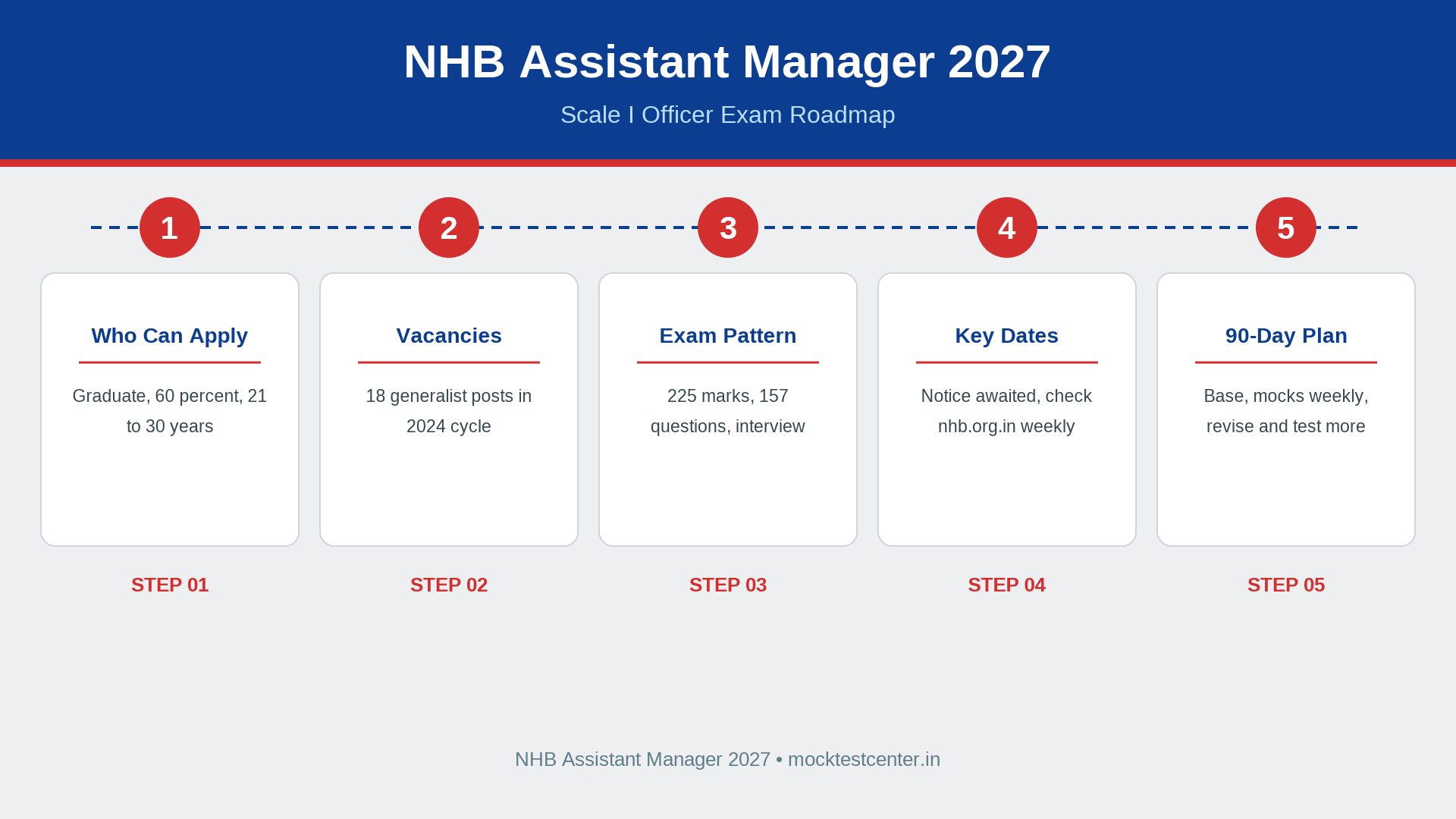
One fact must come first, before any pattern or pay figure. NHB has not released an Assistant Manager (Generalist) notification for 2027. No advertisement number exists, no vacancy count exists, and no apply dates exist for NHB Assistant Manager 2027. The latest completed generalist cycle is the 2024 recruitment, advertised in June 2024 for 48 posts including 18 Assistant Manager (Generalist) posts, with the online examination on 31 August 2024.
A separate 2025 recruitment, advertised in November 2025, offered five specialist Assistant Manager posts, not generalist posts, and its final result has been released. Any site that prints an NHB Assistant Manager 2027 vacancy number or an exam date today is guessing. This page says so plainly, and it builds the rest of the guide from the 2024 and 2023 generalist cycles, which are public in full.
Check the official website at nhb.org.in for every notice, because only the official notice is final. The pattern, eligibility rules and pay figures in this article come from the 2024 advertisement, Advt. NHB/HRMD/Recruitment/2023-24/03, the 2023 advertisement, Advt. NHB/HRMD/Recruitment/2023-24/02, and the scheme of selection published with those notices.
They show what the next NHB Assistant Manager notice will most likely look like. They are not the 2027 notice. When the real notice comes out, read it first and treat this page as a starting point, not as the final word.
The exam is small and irregular, and that shapes everything about it. The 2024 cycle offered 18 generalist Assistant Manager posts inside a 48 post recruitment. The 2023 cycle offered 17 Assistant Manager posts inside a 43 post recruitment. NHB does not publish a recruitment calendar, so nobody can say when the next generalist notice will come. Candidates who wait for the notice to start preparing will find an apply window of about three weeks and a test about six weeks after that. Candidates who prepare now, on the 2024 pattern, will be ready whenever the notice lands.
What NHB is, and what an Assistant Manager does there
NHB is a statutory body set up under the National Housing Bank Act, 1987. It is the apex level institution for housing finance in the country, and it is a wholly owned subsidiary of the Reserve Bank of India. Its head office is in New Delhi. NHB does two jobs at once. It refinances housing loans, which means it lends money to housing finance companies and banks so they can lend to home buyers. And it regulates and supervises housing finance companies, which means it sets rules for them, inspects them, and acts when they break the rules.
That double role makes the work different from a commercial bank. An officer in a public sector bank deals with customers, deposits and branch targets. An officer at NHB deals with housing finance companies, with refinance files, with inspection reports, and with the rules that keep the housing finance market stable. The job is a desk job in New Delhi, with files, data and policy, not a branch job with customers at the counter. Candidates who like reading balance sheets and writing notes will fit it. Candidates who want a customer facing branch job will not.
The regulator connection matters for preparation. The Reserve Bank of India is the parent and the banking regulator. The RBI Grade B 2027 exam is the parent institution's officer exam, and its syllabus overlaps with this one. The IRDAI Assistant Manager 2027 exam is the insurance regulator's exam, and it sits in the same financial regulator family. NHB's own work touches both worlds: the banking world through the RBI, and the housing world through its own rules. Candidates who follow RBI monetary policy and housing finance news will find the general awareness section easier, and they will sound sharper in the interview.
Where things stand: the 2024, 2023 and 2025 cycles
Three recent cycles tell the story of this exam, and they need to be kept separate, because tracker sites mix them up. The 2024 cycle is the latest generalist cycle. The advertisement, Advt. NHB/HRMD/Recruitment/2023-24/03, was released on 25 June 2024.
Online registration ran from 29 June to 19 July 2024. The online examination was held on 31 August 2024, and the call letter was released on 21 August 2024. The recruitment offered 48 posts in total, including 18 Assistant Manager (Generalist) posts, plus senior posts in project finance, credit and economics, and contractual posts such as project finance officers.
The 2023 cycle ran a year earlier. The advertisement, Advt. NHB/HRMD/Recruitment/2023-24/02, was released on 27 September 2023. Online registration ran from 28 September to 18 October 2023. The online examination was held on 23 December 2023. The recruitment offered 43 posts in total, including 17 Assistant Manager Scale I posts in the Generalist and Hindi streams, plus senior posts in project finance, economics and application development.
The 2025 cycle is different in kind. The advertisement, Advt. NHB/HRMD/Recruitment/2025-26/03, was released on 6 November 2025. Online registration ran from 7 November to 28 November 2025.
It offered ten regular and contractual posts, including five Assistant Manager Scale I posts in specialist functions such as Learning and Development and Audit, not generalist posts. Its final result has been released. A generalist candidate should not read the 2025 cycle as the next generalist cycle. It is a specialist drive, and the generalist exam has not been notified since June 2024.
| Cycle | Advertisement | Apply window | Online exam | Assistant Manager posts |
|---|---|---|---|---|
| 2024, latest generalist | NHB/HRMD/Recruitment/2023-24/03 | 29 June to 19 July 2024 | 31 August 2024 | 18, Generalist |
| 2023 | NHB/HRMD/Recruitment/2023-24/02 | 28 September to 18 October 2023 | 23 December 2023 | 17, Generalist and Hindi |
| 2025, specialist | NHB/HRMD/Recruitment/2025-26/03 | 7 to 28 November 2025 | Not an AM generalist test | 5, specialist functions |
Count the gaps in the generalist cycles. About three weeks to apply, then about six weeks from the last date to the test. A candidate who starts on the day of the notice has about two months. A candidate who starts now has the whole year, and the syllabus overlaps with the IBPS PO and RBI Assistant exams so much that every hour spent now counts for those exams too, even if the NHB notice comes late.
Vacancies: few seats, and why that matters
The vacancy table is the first thing a candidate reads, and for NHB it is also the most misleading, because the headline number is never the Assistant Manager number. The 2024 recruitment offered 48 posts in total, but only 18 of them were Assistant Manager (Generalist). The rest were senior posts: a General Manager in Project Finance, an Assistant General Manager in Credit, Deputy Managers in Credit, a Chief Economist, an Application Developer, Senior Project Finance Officers, Project Finance Officers, and a Protocol Officer. The 2023 recruitment offered 43 posts in total, but only 17 of them were Assistant Manager Scale I, in the Generalist and Hindi streams. The rest were senior and specialist posts.
That structure has a consequence. NHB recruits Assistant Managers in small numbers, and it recruits them alongside senior officers, so the Assistant Manager is a small part of a larger drive. Eighteen generalist posts is a small intake, and the competition per seat is high, because every graduate in India with 60 percent marks can apply. The 2025 cycle shows the other side of the same pattern: five specialist Assistant Manager posts, in Learning and Development and Audit, inside a ten post drive. Small numbers are the norm for NHB, not the exception.
Two conflicts in the tracker reports need to be stated plainly. First, the 2024 advertisement number is given as NHB/HRMD/Recruitment/2023-24/03 by most trackers, and as 2023-24/04 by one tracker. Second, the 2024 Assistant Manager (Generalist) count is given as 18 by most trackers, and as 12 in one tracker's table of regular posts. This article uses 18 and advertisement /03, because those are the figures most trackers agree on, and it flags the other figures in the package notes. When the next notice comes, read its vacancy table first, because it is the only figure that counts.
The small intake changes how you should prepare. With 18 seats, the cut off is set by the top 18 candidates, not by a pass mark, and a single mark can decide the list. There is no room for a weak section, because the scheme of selection sets a minimum score in each section of the objective test and a minimum total score, and only candidates who clear both are shortlisted for the interview. Prepare for a high cut off, not for a pass.
Who can apply: Generalist and Hindi
The education rule for the Generalist stream is a percentage rule first and a degree rule second. A bachelor's degree in any discipline with at least 60 percent marks qualifies, or a master's degree in any subject with at least 55 percent marks. SC, ST and PwBD candidates get a 5 percent relaxation, so 55 percent in a bachelor's degree or 50 percent in a master's degree is enough for them. The degree must be from a recognised university, and the result must be declared on or before the date the notice prints. A final year student whose result is not yet out cannot apply, because the notice asks for the mark sheet at the document check.
The Hindi stream has its own rule. A bachelor's degree in Hindi with 60 percent marks qualifies, or a master's degree in Hindi with 55 percent marks, with the same 5 percent relaxation for SC, ST and PwBD candidates. The Hindi stream is small, often one or two posts, and it suits a candidate who studied Hindi at degree level and wants a language post in a financial institution. Do not apply for the Hindi stream with a general degree and a hope that it counts. The notice names the subject, and the document check enforces it.
Two things about the percentage rule deserve attention. First, the 60 percent bar is higher than the bar in most bank exams, where a plain graduation with no minimum percentage is enough. A graduate with 58 percent cannot apply for NHB Assistant Manager, whatever the test score would have been. Second, the master's degree route helps a candidate whose graduation percentage is low. A graduate with 55 percent and a master's degree with 56 percent qualifies under the master's route. If your graduation percentage is below 60, check your master's percentage before you rule yourself out.
No experience is needed for the Assistant Manager (Generalist) post. That is what makes it a fresh graduate exam, unlike the senior posts in the same advertisement, which ask for 10 to 15 years of experience. A fresh graduate with 60 percent marks, aged 21 to 30, can apply on the strength of the degree alone. Computer knowledge is part of the test itself, in the reasoning and general awareness sections, so a working knowledge of computers is assumed, but no certificate is named in the notice.
Age limit and fee
The age rule in the 2024 cycle was 21 to 30 years as on 1 July 2024. The same range applied in the 2023 cycle, with the cut off date printed in that notice. Relaxation follows government rules: 5 years for SC and ST, 3 years for OBC in the non-creamy layer, and 10 years for persons with benchmark disabilities. The next notice will print its own cut off date, and the age is counted on that date, not on the date you apply. A candidate who turns 31 a week before the cut off date is out, and a candidate who turns 21 a week after it is out too. Check the date, not just the range.
The fee in the recent cycles was 850 rupees for General, EWS and OBC candidates, and 175 rupees for SC, ST and PwBD candidates. The 175 rupees is intimation charges only, with no application fee, and the 850 rupees is the application fee including intimation charges. The fee is non-refundable, and it is paid online during registration. Keep the payment receipt, because a failed payment can still show as a pending application, and the notice gives a short window for fee payment. The next notice will print its own fee, and it may change, so do not treat 850 rupees as fixed.
One practical note on the fee. NHB charges the same 850 and 175 rupees as several other financial regulators, and the fee is lower than the 1,000 rupees plus GST that GIC Re charges. It is higher than the 500 rupees that some clerical exams charge. None of that matters. What matters is that the fee is paid before the last date, because an application without a successful fee payment is not an application at all.
The online test pattern, section by section
The online examination has two parts: an objective test and a descriptive test. The objective test carries 200 marks, with 155 questions, in 3 hours, across four sections with separate timing for each section. The descriptive test carries 25 marks, with 2 questions, in 30 minutes, and it starts immediately after the objective test ends. The total for the online examination is 225 marks, and the interview that follows carries 50 marks.
| Section | Questions | Marks | Minutes | Medium |
|---|---|---|---|---|
| Reasoning and Computer Aptitude | 45 | 60 | 60 | English and Hindi |
| General Awareness, with special focus on Economy and Banking, and Computer Knowledge | 50 | 50 | 40 | English and Hindi |
| English Language | 25 | 30 | 35 | English |
| Quantitative Aptitude, with special emphasis on Data analysis and interpretation | 35 | 60 | 45 | English and Hindi |
| Total, objective | 155 | 200 | 180 | |
| Descriptive, English Language: Letter Writing and Essay | 2 | 25 | 30 | English |
| Total, online examination | 157 | 225 | 210 |
Reasoning and Computer Aptitude is the longest section in time, with 60 minutes for 45 questions worth 60 marks. That is 80 seconds per question, which is generous by bank exam standards, and it reflects the computer aptitude half of the section. Verbal reasoning, syllogism, seating arrangements, puzzles, blood relations, directions, coding and decoding, and data sufficiency sit beside computer topics: basic security concepts, binary language coding, computer abbreviations and terminology, keyboard shortcuts, flow charts, logic gates, operating systems, and storage and memory. A candidate who revises only reasoning and skips computers gives away easy marks, because the computer questions are short and factual.
General Awareness is the largest section in questions, with 50 questions for 50 marks in 40 minutes. That is 48 seconds per question, and it is the fastest section in the paper. The focus is the economy and banking, plus computer knowledge, so the questions lean towards the RBI, the Union Budget, government schemes, housing finance, and the banking system, with current affairs from the last six months. Speed matters here more than depth. A candidate who knows the answer in five seconds scores. A candidate who thinks for a minute loses the next question too.
English Language gives 25 questions for 30 marks in 35 minutes. Reading comprehension, cloze tests, para jumbles, fill in the blanks, error spotting, and idioms and phrases carry this section. It is English only, like the descriptive paper, so a candidate weak in English loses marks in two places. Quantitative Aptitude gives 35 questions for 60 marks in 45 minutes, with a special emphasis on data analysis and interpretation. That is the heaviest section by marks per question, and it is where the test is won or lost. Data interpretation sets, simplification, number series, quadratic equations, time and work, and profit and loss share the section, and a data interpretation set done well can add 10 marks in ten minutes.
The descriptive paper: a letter and an essay
The descriptive test is a test of English Language for 25 marks, with two questions in 30 minutes: letter writing and essay writing. Candidates answer by typing on the computer, and the descriptive test starts immediately after the objective test ends, with no break in between. That matters for stamina. After three hours of objective questions, you sit for thirty more minutes and type a letter and an essay, and those 25 marks count in the same total that decides the interview shortlist.
One conflict in the tracker reports needs to be stated plainly. The pattern table in the notices gives the descriptive test as 25 marks with 2 questions, and most trackers agree. One tracker page gives the descriptive test as 50 marks in one place, and 25 marks in its own pattern table. This article uses 25 marks, because that is the figure in the pattern table, and it flags the 50 mark figure in the package notes. When the next notice comes, read its pattern table first, because it is the only figure that counts.
Preparation for the descriptive paper is simple and specific. Write one letter a week, in formal format, on a banking or housing theme: a letter to a bank manager, a letter to an editor on housing loans, or a letter of complaint. Write one essay a week, in about 250 words, on an economy or housing theme: affordable housing, the role of housing finance companies, or the growth of digital banking. Type both, against a thirty minute clock, with the letter first and the essay second, because that is the order the paper sets. A candidate who writes well on paper and types slowly will run out of time on the essay, and the essay carries the larger share of the 25 marks.
Negative marking and the minimums you must clear
Each objective question has five alternative choices, with one right answer. For every wrong answer, one fourth of the marks assigned to that question is deducted as a penalty. If a question is left blank, no marks are deducted. The penalty applies per question, so a wrong answer in the quantitative section, where questions carry more marks, costs more than a wrong answer in the general awareness section, where each question carries one mark. Guess only when you can rule out two options, and leave the rest blank, because a blank costs nothing and a wrong guess costs marks twice: once in the penalty, and once in the time spent on it.
The scheme of selection sets two minimums. Each candidate must obtain a minimum score in each section of the objective test, and also a minimum total score, to be considered for shortlisting for the interview. The minimum aggregate cut off for being shortlisted for the interview is decided by the Bank in relation to the number of vacancies. The roll numbers of shortlisted candidates are published on the NHB website. That means a high total with a failed section does not save you, and a balanced score across all four sections is the only safe path.
The corrected scores from different sessions, if the test is held in more than one session, are normalised using the equi-percentile method, and scores up to two decimal points are taken for the calculations. That is standard practice, and it means a hard shift is not punished and an easy shift is not rewarded. Do not spend time worrying about which shift you get. Spend it on accuracy, because the penalty and the sectional minimums punish guessing far more than a hard paper does.
Interview and the 80:20 merit
Selection for the Assistant Manager post is done through two tiered processes: the online examination and the interview. The interview carries 50 marks, and the minimum qualifying marks in the interview are decided by the Bank. Interviews are conducted at the NHB head office in New Delhi only, according to the scheme of selection, so a shortlisted candidate should plan travel to Delhi and keep the call letter safe. The weightage of the online examination and the interview is 80:20 respectively, and the final selection is made through a merit list prepared by adding the marks secured in the online examination and the interview.
The 80:20 ratio means the online examination decides the list and the interview confirms it. A candidate who scores 180 of 225 in the online test and 35 of 50 in the interview beats a candidate who scores 160 of 225 and 45 of 50, because the online test carries four times the weight. Put your energy where the marks are, which is the 225 mark online examination, and treat the interview as a stage to protect, not a stage to win from behind.
The interview panel asks about NHB, about housing finance, and about you. Why NHB, why housing finance, what a housing finance company does, how refinance works, what the RBI does, and what you studied in your degree. A candidate with a commerce or economics degree should be ready to talk about interest rates, inflation, and the housing market. A candidate with any other degree should be ready to explain why a housing finance institution needs a generalist, and what a generalist does there. Prepare with your own words, because the panel can tell at once whether your answers come from real study or from a guidebook. Read the NHB website before the interview, and know its functions in plain words.
Document verification runs alongside the interview, and it is where the percentage and cut off rules bite. NHB will read your degree certificate, your mark sheets, and your caste or disability certificate, and check them against the cut off date in the notice. A candidate who scored 58 percent in graduation and applied under the 60 percent rule is out, whatever the test score. A candidate whose degree result came after the cut off date is out. Get the papers right before you apply, and keep originals plus scanned copies ready.
Pay: two scales, one post
The pay for an NHB Assistant Manager is the one place where the sources disagree, and the disagreement needs to be stated plainly instead of settled by picking the nicer number. The 2025 recruitment notice gives the Assistant Manager (Scale I) pay as 48,480 to 85,920 rupees, which is the Junior Management Grade Scale I scale used across the public sector banks. Several tracker pages give the Assistant Manager pay as 36,000 to 63,840 rupees, in the scale 36,000 with increments of 1,490 seven times to 46,430, then 1,740 twice to 49,910, then 1,990 seven times to 63,840, with gross emoluments of 60,056.72 rupees. That older scale comes from the 2021 NHB notice, and trackers have carried it forward without updating it.
This article uses the 48,480 to 85,920 rupees scale as the current figure, because it is the figure in the 2025 recruitment notice, and it flags the older 36,000 scale in the package notes. On top of the basic pay come dearness allowance, house rent allowance, city compensatory allowance, provident fund, pension under the New Pension Scheme, leave fare concession and medical benefits, as per the rules of the Bank. The gross monthly pay at the start is not printed in the notice, and this article does not print a gross figure as fact, because the older gross of 60,056.72 rupees belongs to the older scale and cannot be attached to the new one.
Put the pay beside the other exams and the picture is fair. The SBI PO 2027 exam and the IBPS PO 2027 exam offer the same Scale I basic pay of 48,480 rupees, so the money is the same and the difference is the job: a bank branch posting against a New Delhi desk job in housing finance. The LIC AAO 2027 exam pays a higher starting basic, and the NIACL AO 2027 exam pays a starting basic of 50,925 rupees, which is higher than NHB. The money at NHB is standard for a Scale I officer. The attraction is the institution: a small regulator with a focused job, in New Delhi, with a short hierarchy and a specialist career path.
NHB next to RBI, NABARD, SEBI, SIDBI and the banks
The regulator exams form a family, and the right choice depends on your degree and your appetite for a specialist paper. The RBI Grade B 2027 exam is the parent institution's exam, with the highest pay and the hardest paper in the family, and it posts officers in Mumbai. The NABARD Grade A 2027 exam is the agriculture and rural development bank's exam, with a generalist stream and specialist streams, and it posts officers across India. The SEBI Grade A 2027 exam is the securities regulator's exam, with a Phase 1 and Phase 2 pattern and a descriptive paper. The SIDBI Grade A 2027 exam is the small industries bank's exam, with a similar two phase pattern. The IRDAI Assistant Manager 2027 exam is the insurance regulator's exam, with a descriptive paper and an interview, in Hyderabad.
NHB sits in the middle of that family. Its exam is shorter than the RBI and SEBI papers, with one online test and an interview, and its seats are fewer than the bank exams. Its descriptive paper is shorter too, with a letter and an essay in thirty minutes, against the longer descriptive papers of SEBI and IRDAI. If you want the best chance of selection in the regulator family, the bank exams give you more seats. If you want a regulator job with a housing finance focus, in New Delhi, with a paper that a bank PO candidate can prepare for in ninety days, NHB is the most reachable door in the family.
The GIC Assistant Manager 2027 exam is the closest cousin in size, with 110 posts, a descriptive English paper, and a group discussion plus an interview, in a reinsurance company in Mumbai. Its qualifying bar is higher, at 60 percent in each stage, and it asks for a four year service undertaking. NHB asks for no bond, and its selection is an online test plus an interview, with no group discussion. A candidate who wants Mumbai and reinsurance should pick GIC Re. A candidate who wants New Delhi and housing finance should pick NHB. The preparation overlaps so much that one plan serves both.
The way to choose is to ask one question. Do you want a desk job in a small financial institution in New Delhi, working on housing finance, with a small intake and a high cut off? If yes, NHB is your exam, and it deserves your main effort when the notice comes. If no, the bank exams give you more seats and more postings, and the bigger regulators give you higher pay. That is the whole decision. Do not spend a year preparing for a posting you do not want, and do not pick NHB only because the intake is small, because the small intake is what makes the cut off high.
What to study for each section
Reasoning and Computer Aptitude needs two lists, not one. The reasoning list is the standard bank PO list: puzzles, seating arrangements, syllogism, blood relations, coding and decoding, inequalities, direction sense, and data sufficiency. The computer list is shorter and easier: basic security concepts, binary language coding, computer abbreviations and terminology, keyboard shortcuts, flow charts, logic gates, operating systems, and storage and memory. The computer questions are short and factual, and they are easy marks for a candidate who has used a computer daily. Revise them from a basic computer awareness book, not from a deep computer science text, because the paper tests terms, not programming.
General Awareness needs the economy and banking first, and current affairs second. The functions of the Reserve Bank of India, repo rate and reverse repo rate, CRR and SLR, types of accounts and deposits, priority sector lending, KYC norms, digital payment systems such as UPI, NEFT and RTGS, and the basics of loans and housing finance. Add the housing finance companies, the role of NHB, and government housing schemes. Then add six months of current affairs: the Union Budget, RBI monetary policy, major appointments, and the big economic numbers. Read the business page every morning and keep a notebook of one line per story. Six months of one line a day is about 180 lines, and that notebook covers most of the section.
English Language needs a topic list you can tick off. Reading comprehension, cloze tests, error spotting, sentence improvement, para jumbles, fill in the blanks, and vocabulary, including synonyms and antonyms and idioms and phrases. Read one editorial a day and mark the sentence structures you would have written differently. That habit alone lifts the score, because the paper tests the same structures again and again.
Quantitative Aptitude needs speed more than depth, and data interpretation most of all. Data interpretation sets, simplification and approximation, number series, quadratic equations, data sufficiency, time and work, time speed and distance, profit and loss, simple and compound interest, ratio and proportion, and averages. That list looks long. It is the same list as every bank exam, so the books and mocks you already own cover it.
The difference is the weight. Thirty five questions carry 60 marks, so each question carries more than one mark on average, and a data interpretation set done well can add 10 marks in ten minutes. Practise data interpretation every day, with a timer, because it is the section where preparation shows fastest.
The descriptive paper needs typing practice more than writing practice. A letter and an essay in thirty minutes, typed, immediately after three hours of objective questions. Write one letter and one essay a week, typed, in a single thirty minute sitting. Keep the letter to the formal format: sender address, date, receiver address, subject, salutation, body in three short parts, and signature. Keep the essay to about 250 words, with an opening, two points, and a close. Do five timed sittings before the test, and time each one, because the paper gives no extra minute for a slow typist.
A 90 day plan that fits around a job or a degree
Most NHB candidates are working or in a final year degree, so the plan below assumes two hours a day, not eight. Two hours a day for ninety days is 180 hours, which is enough for this exam, because the syllabus overlaps with the bank PO exams and the descriptive paper is short. Start now, before the notice comes out, because the apply window will be about three weeks and the test will follow about six weeks later.
Days 1 to 30 are for the base. Study two hours a day, one hour before work or college, or after it. Cover one reasoning topic and one quantitative topic each day. Read the news every morning and write five lines in your current affairs notebook, plus two lines on housing finance and the RBI.
Type one letter and one essay a week, untimed at first, to build the habit. Take one mock at the end of week two and one at the end of week four. Do not worry about the score. The first mocks only show you where you stand.
Days 31 to 60 are for speed. Your score will move most in this phase, because the paper gives 48 seconds per general awareness question and the quantitative section carries the heaviest marks. Take two mocks a week now, with the descriptive section included and timed. After each mock, spend as much time on analysis as you spent on the test. Write down every question you got wrong and why.
Was it a concept gap, a silly mistake, or a time problem? Concept gaps go back into your study list. Silly mistakes need a checklist before you submit each section. Time problems need easier questions first and hard ones last. Type one timed letter plus one timed essay every week now, in a single thirty minute sitting, exactly like the descriptive paper.
Days 61 to 90 are for the real thing. Take three mocks a week. Revise your error notebook every second day. Stop learning new topics in the last ten days.
New topics in the last week add stress and no marks. In the last three days, take one full mock at the same time as your real test slot, then rest. Sleep matters more than one more chapter in the final week. A candidate who walks into the test hall tired will make the same mistakes a fresh candidate makes, and the degree will not save the score.
If you have less than ninety days, cut the base phase, not the mocks. Ten mocks with full analysis beat thirty days of reading without a single test. The paper rewards candidates who have sat through the three and a half hour sitting many times. It punishes candidates who know the syllabus and have never felt the general awareness timer run out.
Mistakes that cost NHB candidates a year
The first mistake NHB candidates make is waiting for the notice to start. The apply window in the last generalist cycle was three weeks, and the test followed six weeks after the last date. A candidate who starts on the day of the notice has about two months. A candidate who starts now has the whole year. The syllabus overlaps with the PO and regulator exams so much that every hour you spend now counts for those exams too, even if the NHB notice comes late.
The second mistake is reading the wrong vacancy number. Tracker sites print 48 posts for the 2024 cycle and 43 posts for the 2023 cycle, and candidates read those as Assistant Manager posts. Only 18 and 17 of those posts were Assistant Manager posts. A candidate who prepares for a 48 seat exam prepares for a different cut off than a candidate who prepares for an 18 seat exam. Read the post wise table, not the headline, and prepare for the small intake.
The third mistake is ignoring the descriptive paper. Candidates who prepare only for objective tests walk into the descriptive section after three hours and discover they cannot type a letter and an essay in thirty minutes. Twenty five marks decide the shortlist, and a blank essay is a lost shortlist. Type every week from the first month, and treat the descriptive paper as a subject, not an afterthought.
The fourth mistake is skipping the computer topics. The reasoning section is called Reasoning and Computer Aptitude, and the general awareness section includes computer knowledge, so computer questions appear in two sections. Candidates who revise only reasoning and current affairs give away easy marks in both. A basic computer awareness book, read once, covers them.
The fifth mistake is guessing too much. Four wrong answers erase one right answer, and the scheme sets a minimum score in each section. In the general awareness section, where each question carries one mark and the time is 48 seconds per question, ten wild guesses can pull your section score down by two and a half marks. That is often the gap between shortlisting and rejection in a cycle with 18 posts. Guess only when you can rule out two options.
What to check before the next notice comes out
Keep four things ready. First, your degree certificate and mark sheets, with the percentage matching the 60 or 55 percent rule, and your degree result dated before the cut off date the new notice will print. Second, your caste or disability certificate, if you claim relaxation or the lower fee, because the document check asks for it. Third, a mock test routine with the descriptive paper typed and timed, so the three and a half hour sitting feels normal by the time the notice comes out. Fourth, a habit of checking nhb.org.in twice a week, because the notice will appear there first and the apply window will be short.
Start with one NHB Assistant Manager 2027 mock this week, built on the 2024 pattern: 155 objective questions for 200 marks in three hours, plus a typed letter and essay for 25 marks in thirty minutes. Score it section by section, and list your weak section, then give that section thirty minutes a day. That single habit, repeated for ninety days, is what turns a graduate into an Assistant Manager at the National Housing Bank.
Before that first mock, run a five minute check on your own eligibility, because it decides whether the preparation is worth it at all. Confirm your degree and percentage fit the Generalist or the Hindi stream. Check your age against the 21 to 30 rule and the relaxation table if it applies to you. Confirm your degree result date falls before the cut off date the notice prints.
Then check your typing speed with one letter and one essay against a thirty minute clock. If any of those checks fails, fix it first. A candidate who clears the checks and then prepares for ninety days walks into the test knowing the paper, the minimums and the merit, and that is the candidate the merit list is built from.