About IDBI SO 2027 Exam Series
📖 Table of Contents
- What IDBI SO 2027 is
- The exam with no written test
- The latest cycle: 31 posts in July 2026
- The March 2026 cycle: 33 posts, and a different bank need
- The 2024-25 cycles: 86, 31 and 56 posts
- Who can apply: age, degree and experience
- The experience rule that rejects most applications
- Pay: what each grade actually earns
- Selection, stage by stage
- Fee and how to apply
- IDBI SO next to IBPS SO, JAM and Executive
- How to prepare when there is no syllabus
- What to check before the next notice comes out
IDBI SO 2027: Specialist Officer Pattern, Salary, Dates
What IDBI SO 2027 is
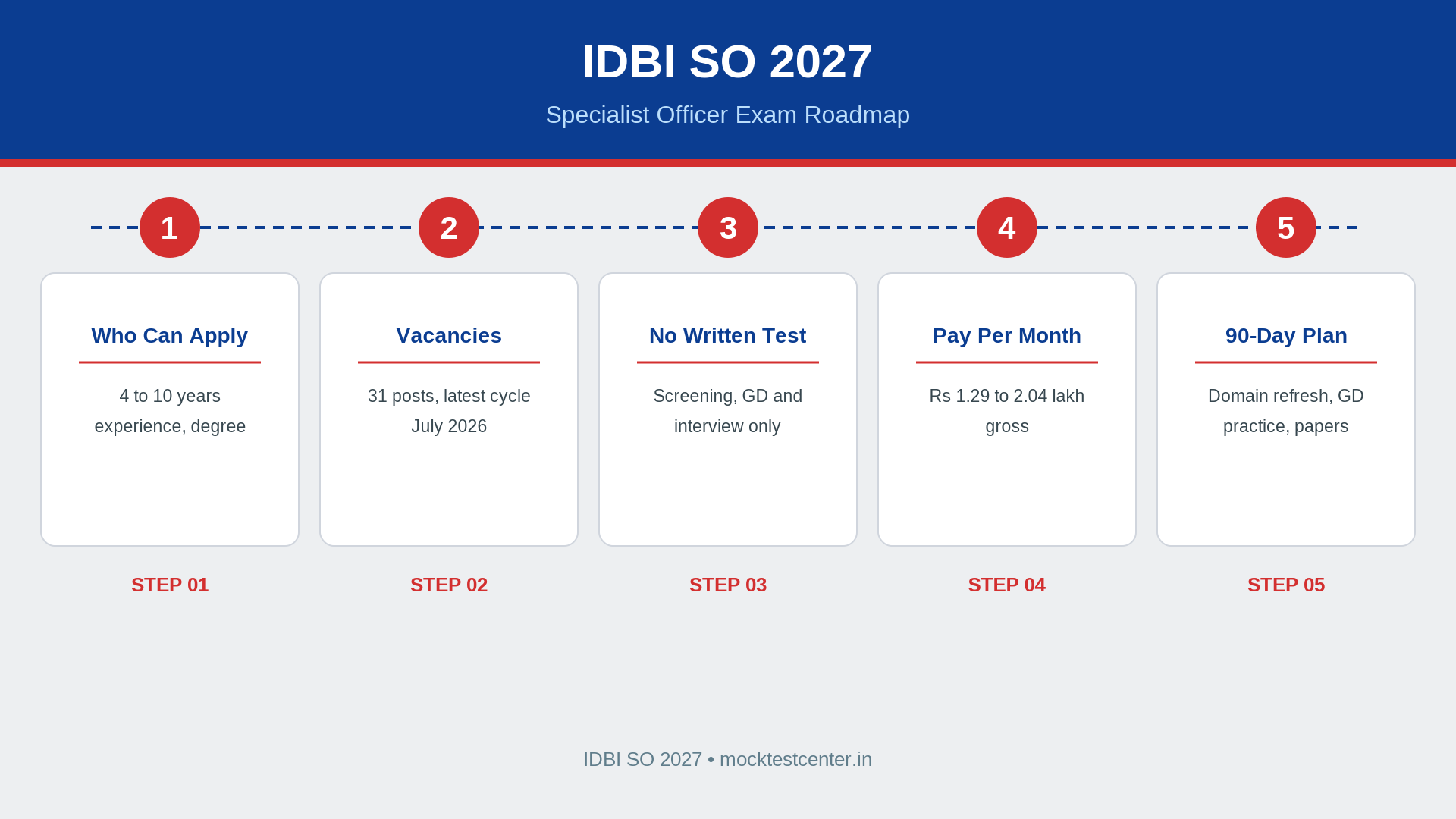
IDBI SO 2027 is the Specialist Officer recruitment of IDBI Bank for experienced professionals. A Specialist Officer, called an SO, is a mid career and senior post for people who already work in banking, IT, audit, law, security or engineering, and who can prove years of that work with papers. Fresh graduates cannot apply. The bank hires at three grades: Manager in Grade B, Assistant General Manager in Grade C, and Deputy General Manager in Grade D. The pay runs from about 1.29 lakh rupees a month gross at Manager grade to about 2.04 lakh rupees a month gross at Deputy General Manager grade in a metro city.
One fact must come first, before any pattern or pay figure. No IDBI SO notice for a 2027 cycle exists as of 23 November 2026. The bank has not released an advertisement number, a vacancy count or apply dates for a new cycle. What exists is the latest completed cycle, Advertisement Number 03/2026-27, which closed on 26 July 2026 with 31 posts. This page says so plainly, and it builds the whole guide from that notice and the three cycles before it, all read from the official IDBI Bank notices. Any site that prints IDBI SO 2027 dates or a vacancy number today is guessing. When the real notice comes out, read it first on idbibank.in and treat this page as a starting point, not as the final word.
IDBI Bank is a full service universal bank with a history that goes back to 1964, when it began as the Industrial Development Bank of India, a development finance institution. It became a commercial bank in 2004. Today it is owned by the Life Insurance Corporation of India and the Government of India, and it runs more than 2,100 branches and 3,700 ATMs, plus an overseas branch in Dubai. The SO recruitment is how the bank buys specialist skill it cannot grow fast enough inside its own ranks: cyber security auditors, core banking engineers, data scientists, law officers, civil engineers for its premises, and security officers from the armed forces.
That is the first thing to get right about this exam. Most bank exams test fresh graduates on maths, English and reasoning. IDBI SO tests working professionals on what they have already done. Your degree gets you through the door. Your experience decides whether you get called. Your interview decides whether you get the job. If you are a fresher with no work experience, this is not your exam. The IDBI JAM 2027 exam and the IDBI Executive 2027 exam are the IDBI doors for fresh graduates, and this article compares them with SO later.
The exam with no written test
Here is the fact that surprises almost every candidate, and it is the fact most tracker pages bury under their vacancy tables. IDBI SO has no written test. There is no online exam, no prelims, no mains, no professional knowledge paper, no syllabus, and no admit card for a test hall. The selection in every recent cycle has been the same four steps: preliminary screening of the application, document verification, a group discussion and or a personal interview, and a pre recruitment medical test. Candidates who search for the IDBI SO exam pattern expect a paper with sections, marks and a syllabus. The notice carries none of those, because the bank tests experience and judgement instead of speed on a paper. The bank shortlists candidates on the strength of their qualification and experience, then meets the shortlisted few face to face.
Read that again, because it changes how you prepare. In the IBPS SO 2027 exam, a candidate with a weak CV can still win on the day, because the prelims paper carries 125 marks and the mains paper carries 60 marks, and the interview comes last. In IDBI SO, there is no day to win on. Your application form is your first paper. The bank reads your degree, your certificates, your years of experience and the exact functional area of that experience, and decides whether you are worth an interview. A strong candidate with sloppy papers can be screened out before anyone meets him. A candidate with ten years in the wrong function can be screened out too, because the notice counts only experience in the notified functional area.
Some tracker pages do list an online test for IDBI SO, usually in the same breath as the vacancy table. That claim comes from copying the pattern of other bank exams onto this one. The official notices say otherwise, and they say it in plain words. The 03/2026-27 notice states that the selection process shall comprise document verification, group discussion and or personal interview, and a pre recruitment medical test. The March 2026 notice, Advertisement Number 8/2025-26, says the same. The 2023-24 notice, Advertisement Number 11/2023-24, says the same. No IDBI SO notice in the last three years has printed an exam pattern, a syllabus, or a test date. This article follows the notices, and it flags the online test claim as wrong wherever it appears.
The absence of a test makes this exam hard in a different way. About 31 to 86 posts open in a cycle, and thousands of experienced professionals apply, because the pay is high and the posts are permanent. The bank can call only a limited number of candidates for the interview, and it says so in the notice. Meeting the minimum age, degree and experience does not entitle anyone to a call. The bank picks the most suitable candidates on overall suitability, and its decision is final. So the real competition is a shortlist built from paper, and then a 20 minute conversation in which a panel of senior bankers tests whether your ten years of experience are real.
That is also why this page is a mock test page for an exam with no test. The mocks here train the part you can train: the domain knowledge the interview panel will probe, the banking awareness a specialist still needs, and the group discussion skill that the first face to face stage rewards. The rest of the preparation is paperwork, and this article gives that paperwork the same attention, because in this exam the paperwork is the exam.
The latest cycle: 31 posts in July 2026
The latest IDBI SO cycle is Advertisement Number 03/2026-27, titled Recruitment of Specialist Officers 2026-27. Online registration opened on 14 July 2026 and closed on 26 July 2026, a window of only 13 days. The cut off date for age, qualification and experience was 1 July 2026. The bank advertised 31 posts across four functional areas and three grades. The table below shows the split exactly as the notice prints it.
| Functional area | Deputy General Manager, Grade D | Assistant General Manager, Grade C | Manager, Grade B | Total |
|---|---|---|---|---|
| Audit, Information System | 0 | 4 | 6 | 10 |
| Infrastructure Management, Premises | 5 | 0 | 3 | 8 |
| Legal | 3 | 0 | 6 | 9 |
| Security Officer | 0 | 0 | 4 | 4 |
| Total | 8 | 4 | 19 | 31 |
Look at the shape of that table before you look at the total. The bank did not hire generalists. It hired ten audit and cyber security specialists, eight civil and electrical engineers for its premises, nine law officers, and four security officers from the armed forces and police. Manager grade took the largest share, 19 of the 31 posts. Deputy General Manager took eight, and Assistant General Manager took only four. A candidate who holds a law degree and four years as a law officer in a bank had six Manager posts to aim at. A candidate with a civil engineering degree and ten years running building projects had five Deputy General Manager posts. A candidate with a general MBA and no specialist function had no post at all in this cycle, whatever his years of experience.
The reservation split in the notice is worth reading too, because it shows how small the open pool is. Of the 31 posts, 15 are unreserved, five are for Scheduled Castes, three for Scheduled Tribes, seven for Other Backward Classes, and one for Economically Weaker Sections. Persons with benchmark disabilities get one orthopaedic post at Grade D and one hearing impairment post at Grade B. The notice states plainly that the vacancies are provisional and may vary with the actual requirement of the bank. The bank can also draw a waitlist, and it can issue offers in phases. It can also choose not to issue offers to waitlisted candidates at all, without giving a reason.
The age limits in this cycle run by grade, not by post. Deputy General Manager needs 35 to 45 years as on 1 July 2026. Assistant General Manager needs 28 to 40 years. Manager needs 25 to 35 years. Relaxation follows government rules: five years for Scheduled Castes and Scheduled Tribes, three years for Other Backward Classes, ten years for persons with benchmark disabilities, and five years for persons affected by the 1984 riots. The relaxation for SC, ST and OBC candidates can be combined with only one of the other categories.
The experience rule is the heart of the notice, and it is strict. A Deputy General Manager needs a minimum of ten years of experience as an officer or equivalent, with at least seven of those years in the notified functional area. An Assistant General Manager needs seven years, with four in the functional area. A Manager needs four years, with two in the functional area. Only full time experience as a permanent employee counts. Contractual work, outsourced payroll, staffing agency work, training, internship, apprenticeship, teaching and graduate trainee stints do not count. Experience below six months in any one organisation does not count either. Every year you claim must be backed by an experience certificate, an offer letter, a relieving letter, or salary slips that show the dates of joining and relieving. The bank runs a detailed background check on the experience, and any mismatch can end the candidature at any stage, even after joining.
The fee in this cycle was 1,050 rupees for General, EWS and OBC candidates, and 250 rupees for SC, ST and PwD candidates, including GST. The fee is non refundable, and the application cannot be withdrawn once made. The probation period is one year from the date of joining, with confirmation ordinarily from the succeeding quarter after the first year. The bank can post a selected candidate anywhere in India, and the candidate is liable to be transferred to any place in India under the bank's rules.
The March 2026 cycle: 33 posts, and a different bank need
Four months before the July cycle, IDBI Bank ran another SO cycle, and comparing the two shows something no tracker page spells out. The bank runs SO recruitment for the gaps it has at that moment, and the gaps change every few months. The March cycle, Advertisement Number 8/2025-26, advertised 33 posts, and its functional areas look nothing like the July cycle.
| Functional area | Deputy General Manager, Grade D | Assistant General Manager, Grade C | Manager, Grade B | Junior Assistant Manager, Grade O | Total |
|---|---|---|---|---|---|
| Audit, Information System | 0 | 2 | 0 | 0 | 2 |
| Risk Management, Information Security | 0 | 2 | 2 | 0 | 4 |
| Information Technology and MIS | 5 | 7 | 7 | 0 | 19 |
| Security Officer | 0 | 0 | 0 | 8 | 8 |
| Total | 5 | 11 | 9 | 8 | 33 |
Online registration for this cycle ran from 25 March 2026 to 8 April 2026, a window of 15 days, with the cut off date for eligibility at 1 March 2026. Nineteen of the 33 posts sat in Information Technology and MIS, covering the bank's Finacle core banking group, network, data analytics, data science, IT infrastructure, full stack development, vendor management, digital lending, artificial intelligence and machine learning, cloud management, financial inclusion and trade finance. That is a technology hiring drive with a banking label on it. A software engineer with seven years in a large IT services company and four years in a banking domain could apply for the Assistant General Manager posts. A network engineer with a CCNA or CCNP certificate had a real opening.
The Security Officer posts in this cycle sat at a different grade from the July cycle, and the difference matters. In March, the eight Security Officer posts were Junior Assistant Manager posts in Grade O, for retired Junior Commissioned Officers from the Army, Navy or Air Force with a minimum of 15 years of regular service, a Class 12 or diploma pass, and an exemplary character entry in the discharge book. The maximum age was 50 years, including all relaxations. The pay was on a cost to company basis of 6.14 lakh to 6.50 lakh rupees a year in a Class A city. In July, the four Security Officer posts were Manager posts in Grade B, for commissioned officers not below the rank of Captain, or police officers of equivalent rank, with four years of commissioned service. Same job title, two different doors, two different ranks, two different pay scales. A retired JCO who applied for the July cycle would have been ineligible, and a serving Captain who applied in March would have found no Manager grade security post at all. Read the grade column first, then the title.
The pay scales in the March notice were the same as in July, but the gross monthly figures printed in March were a little lower: about 1.97 lakh rupees for a Deputy General Manager, about 1.64 lakh for an Assistant General Manager, and about 1.24 lakh for a Manager in a metro city. The July notice prints about 2.04 lakh, 1.69 lakh and 1.29 lakh for the same three grades. The basic pay scales did not change between March and July. The gross figures moved because dearness allowance moved. When you compare pay across cycles, compare the basic pay scale, not the gross figure, because the gross figure is a snapshot of one month.
The March cycle also shows the bank's habit of short windows. Fifteen days to apply, with no extension announced. The July cycle gave 13 days. The 2024 cycles gave 15 days each. A candidate who checks the careers page once a month can miss the whole cycle. A candidate who checks twice a week will not. That is the single cheapest habit in this exam, and it costs nothing.
The 2024-25 cycles: 86, 31 and 56 posts
IDBI Bank ran three SO cycles in the 2023-24 and 2024-25 years, and together they show the range this recruitment can take. The biggest cycle was Advertisement Number 11/2023-24, released in December 2023, with 86 posts: 46 Managers, 39 Assistant General Managers, and a single Deputy General Manager. Applications ran from 9 December to 25 December 2023, only 17 days, with the cut off date at 1 November 2023. The fee was 1,000 rupees for General, EWS and OBC candidates and 200 rupees for SC and ST candidates. The experience ladder was the same as in the later cycles: four years for Manager, seven for Assistant General Manager, and ten for Deputy General Manager. Selection was preliminary screening followed by group discussion and or personal interview, with document verification and a medical test at the end.
Then came Advertisement Number 04/2024-25, the Phase II cycle of 2024-25, with 31 posts across Deputy General Manager, Assistant General Manager and Manager grades. Applications ran from 1 July to 15 July 2024. The bank closed this process on 10 October 2025 with a formal process closure notification on its careers page, which is how the bank ends a cycle when the selection is complete and no further correspondence will be entertained. The grade wise split of those 31 posts was not verified in this pass, so this article does not print it. A vacancy split that cannot be traced to the notice is worse than no split at all.
The third cycle was Advertisement Number 07/2024-25, released on 1 September 2024, with 56 posts. Applications ran from 1 September to 15 September 2024, with the cut off date at 1 September 2024. Most trackers report the split as 25 Assistant General Managers and 31 Managers, and the category table in the majority of reports agrees: 13 unreserved, six SC, two ST, seven OBC and three EWS for Assistant General Manager, and ten unreserved, three SC, three ST, seven OBC and two EWS for Manager. One widely read tracker prints the split the other way round, 31 Assistant General Managers and 25 Managers, in its summary table, while its own category table adds up to 25 and 31. This article follows the majority and the category arithmetic, and it flags the conflict here so that no candidate plans on a swapped number. The fee was 1,000 rupees for General, EWS and OBC and 200 rupees for SC and ST, and the age limits were 28 to 40 years for Assistant General Manager and 25 to 35 years for Manager.
Three lessons come out of these cycles. First, the vacancy count swings widely, from 31 to 86, so no candidate should plan a career on a guessed number. Second, the functional areas swing too. The 2023-24 cycle hired across finance and accounts, risk management and digital banking. The 2024-25 cycles hired for corporate credit, retail banking and IT and MIS. The 2026 cycles hired for audit, legal, premises and security. The bank hires for the hole it has, and the hole moves. Third, the selection shape never changes. Screening, group discussion and or interview, document check, medical test. No cycle in this period added a written test, and no tracker claim of an online test for these cycles traces back to the official notice.
One more fact from the 2024 cycles is worth noting for the pay discussion later. The gross monthly pay printed in the 07/2024-25 cycle was about 1.57 lakh rupees for an Assistant General Manager and about 1.19 lakh for a Manager in a metro city. The same grades print about 1.69 lakh and 1.29 lakh in the July 2026 notice. The basic pay scale is the same in both notices. The gross figure rose because dearness allowance rose over two years. Candidates who compare the two notices and think the bank raised the pay are reading the wrong number.
Who can apply: age, degree and experience
Eligibility for IDBI SO has three parts, and all three are checked against one cut off date printed in the notice. Miss any one of them by a day, and the application fails at screening. The table below gives the ladder for the July 2026 cycle, which is the latest full notice.
| Grade | Age as on cut off date | Minimum experience | Experience in the functional area |
|---|---|---|---|
| Manager, Grade B | 25 to 35 years | 4 years | 2 years |
| Assistant General Manager, Grade C | 28 to 40 years | 7 years | 4 years |
| Deputy General Manager, Grade D | 35 to 45 years | 10 years | 7 years |
The age bands overlap on purpose, so a 36 year old with ten years of experience can apply for Deputy General Manager, and a 36 year old with seven years can apply for Assistant General Manager. The bank lets the experience decide the grade, not just the age. But the bank can also select an applicant in a lower grade than the one applied for, at its sole discretion, depending on the vacancies. A Deputy General Manager applicant can be offered an Assistant General Manager post. That clause cuts both ways. It gives a strong candidate a second chance at a lower grade, and it means the grade you apply for is a request, not a promise.
The degree rule changes with the functional area, and it is specific in a way that surprises candidates used to generalist exams. For Audit and Information System, the notice accepts a BTech or BE in Information Technology, Electronics and Communications, Software Engineering, Electronics, Electrical, Electronics and Electrical, Computer Science or Digital Banking, or a BCA or BSc in Computer Science or IT, or an MSc in IT or Computer Science, an MCA, or an MTech or ME in the same fields. Science graduates with a valid CISA certificate can also apply. For Risk Management and Information Security, the degrees are similar, with BCA and BSc in Computer Science or IT also accepted. For IT and MIS, the notice accepts graduates in Computer Science, Information Technology, Electronics, Electronics and Communications, Electronics and Telecommunications, Artificial Intelligence, Machine Learning, Cloud Computing, Data Science or Data Engineering, with post graduation preferred, and it prefers candidates with 60 percent marks or a CGPA of 6.5 and above, or 55 percent and a CGPA of 6 for SC, ST and PwD candidates.
For Infrastructure Management and Premises, the notice wants a BTech or BE in Civil or Electrical Engineering, or Electrical and Electronics, with a dual specialisation where one of the two is Civil or Electrical. For Legal, the notice wants a graduation in Law from a recognised university. For Security Officer at Manager grade, the notice wants a graduation in any discipline, because the real qualification is four years of commissioned service. The common thread is that the degree must come from a university recognised by the Government of India or its regulatory bodies, and the candidate must hold a valid degree certificate. A final year student cannot apply, because the experience rule needs years of work after the degree anyway.
Certifications help, and the notice names them. For audit and information security posts, the notice prefers CISSP, CISM, CISA, DISA, ISO 27001 Lead Auditor, CEH and GIAC holders. For IT and MIS posts, it prefers Oracle Certified Professional, and certifications in data analytics, SAS, Python, project management, digital banking, IT security and networking such as CCNP and CCNA. A certification cannot replace the experience rule. It can still lift a candidate in the shortlist when two candidates have similar years of work. If you hold one of these certificates, keep it valid as on the cut off date, because the notice checks the validity on that date.
Nationality follows the standard government pattern. Candidates must be citizens of India, or subjects of Nepal or Bhutan, or Tibetan refugees who came to India before 1 January 1962, or persons of Indian origin who migrated from the countries listed in the notice, with a certificate of eligibility from the Government of India where one is needed. A candidate who needs that certificate can be admitted provisionally, but the final selection needs the certificate in hand.
The experience rule that rejects most applications
This section deserves more words than any other in the article, because it is where most IDBI SO applications die, quietly, at the screening stage, with no test to blame. The notice is unusually blunt about what counts as experience, and candidates who skim it pay for the skim.
Only full time experience as a permanent employee counts. Work on contract does not count. Work on an outsourced payroll does not count. Work through a staffing agency, a manpower vendor or a third party does not count. Training, internship, apprenticeship, teaching, graduate trainee stints and retainership do not count. Experience below six months in any one organisation does not count. If you worked for a bank for three years as a permanent officer, that counts. If you worked for the same bank for three years through a vendor on a contract, it does not count, even if you sat at the same desk and did the same job. That distinction ends more applications than any other rule in the notice.
The functional area condition is the second trap. The notice counts only the years spent in the notified functional area, and it counts them separately from total experience. A Manager applicant needs four years of total experience and two years in the functional area. A candidate with six years in retail banking who applies for an Audit and Information System post has six years of total experience and zero years in the functional area, so he fails the rule. A candidate with four years in IT audit and two years in branch banking passes it. Before you apply, write down your career year by year, mark the years that fall inside the notified functional area, and count only those. If the count falls short by even a month, do not apply for that post. Apply for the post whose functional area matches your years, or wait for the next cycle.
The third trap is the paper trail. The experience you claim must be supported by a certificate from the employer, or by an offer letter, a relieving letter, or salary slips that show the date of joining and the date of relieving for each job. The bank checks the declared details against the original documents at the selection stage, and the notice says that failure to produce even one declared document will keep the candidate out of the selection process, with no recourse. The bank also runs a detailed background check on the work experience, and any anomaly is a ground for disqualification or termination, even after selection. Candidates whose past employer takes weeks to issue an experience certificate should request it the day the notice comes out, not the day the interview call comes, because the bank gives a short window for document upload and HR departments in banks move slowly.
The Security Officer posts have their own version of this rule. The March 2026 cycle needs a retired Junior Commissioned Officer with 15 years of regular service and an exemplary character entry in the discharge book. The July 2026 cycle needs a commissioned officer not below Captain, or an equivalent police or paramilitary rank, with four years of commissioned service, and it states plainly that officers whose experience was solely in accounts, administrative or support functions will not be considered. A decorated officer who spent his career in accounts cannot use that career for this post. The bank wants security work, not service in uniform alone.
There is one more clause that candidates miss, and it is the most important sentence in the whole notice for planning purposes. The bank reserves the right to increase, modify or amend any eligibility criteria, to cancel, restrict, curtail or enlarge any part of the recruitment process, and to call only a limited number of candidates for the selection process, at its sole discretion. Meeting the minimum does not entitle anyone to a call. The bank shortlists on qualification, experience and overall suitability. So the question is never whether you meet the minimum. The question is whether your application stands out among hundreds of people who also meet the minimum. A clear, honest, well documented application with the exact functional area experience is the only way to stand out at that stage.
Pay: what each grade actually earns
The pay is the reason this exam draws thousands of experienced applicants for a few dozen posts, so it deserves exact figures from the notice, not rounded claims from tracker pages. The table below uses the July 2026 notice, which is the latest.
| Grade | Basic pay scale, rupees per month | Gross in a metro city, rupees per month, approx |
|---|---|---|
| Manager, Grade B | 64,820 to 93,960 | 1,29,000 |
| Assistant General Manager, Grade C | 85,920 to 1,05,280 | 1,69,000 |
| Deputy General Manager, Grade D | 1,02,300 to 1,20,940 | 2,04,000 |
| Junior Assistant Manager, Security Officer, Grade O | Cost to company 6.14 to 6.50 lakh a year | About 51,000 to 54,000 a month |
The pay scales read as a ladder with annual increments. A Manager starts at 64,820 rupees and rises by 2,340 rupees after one year to 67,160, then by 2,680 rupees ten times to 93,960 over 12 years. An Assistant General Manager starts at 85,920 rupees and rises by 2,680 rupees five times to 99,320, then by 2,980 rupees twice to 1,05,280 over eight years. A Deputy General Manager starts at 1,02,300 rupees and rises by 2,980 rupees four times to 1,14,220, then by 3,360 rupees twice to 1,20,940 over seven years. On top of the basic pay come the allowances, perquisites and benefits that apply to the grade under the bank's rules, and the gross figures in the table include those. New recruits also get performance linked variable pay under the bank's policy, and they are covered under the IDBI Bank New Pension Scheme rules of 2011.
Put those figures beside the other IDBI doors and the gap is stark. A Junior Assistant Manager who joins through the IDBI JAM 2027 route starts on a cost to company of 6.14 lakh to 6.50 lakh rupees a year, which is about 51,000 to 54,000 rupees a month. An IDBI Executive on contract gets a fixed 29,000 rupees a month in the first year and 31,000 in the second, with no dearness allowance, house rent allowance, provident fund or gratuity. A Manager in the SO route starts at a gross of about 1.29 lakh rupees a month, more than double the JAM figure and more than four times the Executive figure, and the post is permanent with a pension scheme. That gap is the whole story of this exam. The bank pays a senior professional's salary, and it asks for a senior professional's record in return.
Put the figures beside the other specialist exam and the picture stays strong. The IBPS SO 2027 exam leads to a Scale I post with a starting basic pay of 48,480 rupees a month. An IDBI SO Manager starts at a basic pay of 64,820 rupees, which is two grades higher, and a Deputy General Manager starts at 1,02,300 rupees, which is more than double the IBPS SO starting basic. The trade off is the seat count. IBPS SO advertised 1,043 posts in its latest cycle. IDBI SO advertised 31. The money is better, the seats are far fewer, and the experience bar is far higher. A candidate who clears the IBPS SO mains and interview with a specialist degree should still apply for IDBI SO if the experience rule fits, because the two exams test different things and the IDBI post pays more from day one.
One caution about the gross figures. They are printed in the notice as approximate, for metro cities, and they move with dearness allowance. A posting in a smaller city pays less in house rent allowance and costs less to live in. The basic pay scale is the fixed fact. The gross figure is a guide to one month in one city. Candidates who quote the gross figure as a salary promise will be disappointed by the first pay slip, and candidates who compare gross figures across years without checking the basic scale will think the pay rose when only the allowance did.
Selection, stage by stage
The selection has four stages, and each one can end the run. The first stage is preliminary screening. The bank reads the application form and checks age, qualification and experience as declared, against the cut off date. Shortlisting is provisional, and the bank can call only a limited number of candidates. The notice is clear that merely applying, or merely meeting the minimum, gives no right to be called. The bank picks on overall suitability, and its decision is final.
The second stage is document verification, and it runs alongside the interview stage. The candidate must produce the originals of every document declared in the form: the Class 10 mark sheet or birth certificate for age, the Class 10 and 12 mark sheets and passing certificates, the graduation and post graduation mark sheets and degree certificates, any professional certificates with validity as on the cut off date, the caste or tribe certificate in Central Government format where claimed, the disability certificate where claimed, and the experience certificates, offer letters, relieving letters and salary slips for every job declared. The caste certificate must tally letter by letter with the Central Government list, must be completely filled including the ordinarily resident clause, and must carry the round seal and signature of the competent authority. A candidate who fails to produce even one declared document is not allowed into the selection process.
The third stage is the group discussion and or the personal interview. The notice says group discussion and or personal interview, which means the bank can run either one or both, and it can change the method at any time without giving a reason. In practice, the interview is the stage that decides. The panel tests domain knowledge, the depth of the claimed experience, and the candidate's judgement on real work problems. A cyber security auditor will be asked about the audits he actually ran, not about textbook definitions. A law officer will be asked about the cases he handled and the recovery tools he used. A civil engineer will be asked about the tenders he floated and the buildings he maintained. The panel can tell within minutes whether the years on the form were spent doing the work or sitting near it.
The fourth stage is the pre recruitment medical test. The final offer goes only to candidates who are medically fit under the bank's medical fitness standards, and the medical reports of shortlisted candidates are strictly confidential and are not shared with the candidate. For the Grade O Security Officer post, the notice adds that the applicant should have had a medical category of Shape 1 or equivalent at the time of discharge from service, and must pass the bank's medical test before joining.
Two clauses in the notice deserve attention because they change how candidates should think about the result. The first is the lower grade clause. The bank can offer a post one grade lower than the one applied for, and it can place a selected candidate in any functional area other than the one advertised, if it finds the candidate suitable. The decision is binding and final. The second is the waitlist clause. The bank can draw a waitlist and consider waitlisted candidates for future requirements, and it can issue offers in phases, but it can also choose not to issue offers to waitlisted candidates at all, without assigning any reason. A candidate on the waitlist should keep working and keep applying elsewhere, not wait for a call that may never come.
Fee and how to apply
The fee for the July 2026 cycle was 1,050 rupees for General, EWS and OBC candidates, and 250 rupees for SC, ST and PwD candidates, including GST. The fee is paid online only, and it is non refundable. The March 2026 cycle used the same two figures, 1,050 and 250 rupees, according to the reports of that cycle. The 2023-24 and 2024-25 cycles charged 1,000 rupees for General, EWS and OBC candidates and 200 rupees for SC and ST candidates. The fee has risen by 50 rupees in the latest cycles, which is a small change, but it is a useful marker. A tracker page that still prints 1,000 and 200 rupees for the next cycle is copying an old notice.
Applying is online only, through the careers page on idbibank.in. The steps are simple, and the traps are in the details. Register with a valid personal email address and mobile number, and keep both active till the end of the recruitment, because the bank sends call letters by email and SMS and takes no responsibility for a message lost to a changed number. Fill the form once, carefully, because the details declared in the form must match the original documents at the selection stage, and no correction, amendment or resubmission is entertained after the form is submitted. Choose one post only. The notice warns that multiple applications by the same candidate for one, all or any position will be rejected outright, and the fee will not be refunded. If multiple applications are made, only the last valid and complete application is retained, and the fee paid for the others is forfeited.
Before you pay, check three things. First, the cut off date. Age, qualification and experience are all measured as on the cut off date printed in the notice, not the date you apply. A candidate who completes four years of experience a week after the cut off date is not eligible for a Manager post in that cycle. Second, the experience certificate. If your current employer issues experience certificates only on request, make the request before you apply, so that you know the dates it will print. A certificate that shows a joining date one month later than the date on your form is a mismatch, and a mismatch ends the run at document verification. Third, the photograph, signature and documents. Keep scanned copies ready in the sizes the portal asks for, and keep the printout of the application till 10 August 2026 in the July cycle pattern, because the bank sets a last date for printing the application after the window closes.
The apply window is short in every cycle: 13 days in July 2026, 15 days in March 2026, 15 days in September 2024, 15 days in July 2024, and 17 days in December 2023. The bank does not extend the window unless it issues a corrigendum on its website, and the notice states that any revision or corrigendum will be hosted on the bank's website only, with no separate communication to applicants. Check the careers page twice a week from January onwards, because the bank has run cycles in March, July, September and December, and no month is safe to ignore.
IDBI SO next to IBPS SO, JAM and Executive
IDBI Bank runs three doors for candidates, and the right door depends on where you stand today. The Specialist Officer door is for experienced professionals at Manager, Assistant General Manager and Deputy General Manager grades. The Junior Assistant Manager door is for fresh graduates who will train through a Post Graduate Diploma in Banking and Finance and then join as Grade O officers. The Executive door is for fresh graduates who will work on contract. The table below puts the three doors side by side.
| Feature | Specialist Officer | Junior Assistant Manager | Executive |
|---|---|---|---|
| Latest cycle posts | 31, July 2026 | 676, May 2025 | 1,000, November 2024 |
| Who can apply | Experienced specialists, 4 to 10 years | Fresh graduates, 60 percent marks | Fresh graduates, any degree |
| Age | 25 to 45 years by grade | 20 to 25 years | 20 to 25 years |
| Written test | None | 200 questions, 200 marks, 2 hours | 200 questions, 200 marks, 2 hours |
| Selection | Screening, GD and or interview, medical | Online test, interview, PGDBF course | Online test, interview, medical |
| Starting pay | About 1.29 lakh a month gross, Manager | 6.14 to 6.50 lakh a year CTC, Grade O | 29,000 a month, first year, contract |
| Nature of post | Permanent, pension scheme | Permanent after PGDBF | Contract, up to 3 years |
The JAM route deserves a closer look, because it is the door most IDBI aspirants actually walk through. The May 2025 JAM cycle advertised 676 posts, with applications from 8 May to 20 May 2025 and an online test on 8 June 2025. The test has 200 questions for 200 marks in two hours, with negative marking of 0.25 per wrong answer, and sectional and overall cut offs. The selected candidates join a Post Graduate Diploma in Banking and Finance: six months of classroom training on a stipend of 5,000 rupees a month, plus two months of internship on a stipend of 15,000 rupees a month, with a programme fee of 3,00,000 rupees plus GST. On completion, they join as Grade O officers on a cost to company of 6.14 lakh to 6.50 lakh rupees a year. A graduate who is 24 years old, has 60 percent marks, and no experience should aim at JAM, not at SO, because SO will screen him out on experience before anyone meets him.
The IBPS SO 2027 exam is the closest cousin to IDBI SO, and the comparison is the one candidates ask about most. IBPS SO hires Specialist Officers for 11 public sector banks at Scale I, with 1,043 posts in its latest cycle. It runs a prelims paper of 150 questions for 125 marks, a mains paper of professional knowledge for 60 marks, and an interview. A fresh specialist graduate with the right degree can apply, because IBPS SO asks for the degree, not for years of experience. An IDBI SO Manager needs four years of experience on top of the degree, and an IDBI SO Deputy General Manager needs ten. The IBPS SO post pays a starting basic of 48,480 rupees. The IDBI SO Manager post pays a starting basic of 64,820 rupees. The choice is between a bigger door with more seats and a smaller door with more pay, and a candidate who qualifies for both should apply for both, because the preparation for the IBPS SO mains paper is the same domain knowledge the IDBI SO interview panel will probe.
The SBI PO 2027 exam is a different kind of door, for fresh graduates who want a generalist officer career with the widest promotion path in Indian banking. It has no experience rule, and it posts officers anywhere in India. A specialist with four years of experience who applies for SBI PO is starting over as a generalist. The same candidate in IDBI SO starts as a Manager. That is the trade, and it is worth thinking about before you spend a year preparing for the wrong door.
Other specialist doors exist for the same kind of candidate, and they are worth knowing because their notices often come out in the same months. The SBI SO 2027 exam hires specialists for the State Bank of India. The GIC Assistant Manager 2027 exam and the UIIC AO 2027 exam hire specialists for general insurers. The NHB Assistant Manager 2027 exam hires for the National Housing Bank. The LIC AAO 2027 exam hires Assistant Administrative Officers for the Life Insurance Corporation. The RBI Grade B 2027 exam hires officers for the Reserve Bank of India. The domain knowledge overlaps across all of them, so one preparation serves many applications, and the candidate who applies widely is the candidate who gets called somewhere.
How to prepare when there is no syllabus
Preparing for an exam with no syllabus feels strange at first, and the strangeness is the point. There is no chapter list to finish and no mock score to chase, so the preparation has to be built from the job itself. Start with the functional area you will apply for, and write down the ten problems you actually solved in the last two years. A cyber security auditor writes down the audits he led, the findings he raised, and the fixes he verified. A law officer writes down the recovery cases he handled, the sections he argued, and the settlements he negotiated. A civil engineer writes down the tenders he floated, the buildings he maintained, and the branch openings he delivered. Those ten stories are your syllabus. The interview panel will ask for them, and the panel can tell a real story from a rehearsed one within two sentences.
Then refresh the domain knowledge around those stories. An IT candidate should revise core banking systems, Finacle in particular, network security, data analytics, cloud basics, and the RBI directions on cyber security and IT governance. An audit candidate should revise the RBI inspection framework, concurrent audit, information system audit standards, and the CISA body of knowledge. A law candidate should revise the SARFAESI Act, the Recovery of Debts and Bankruptcy Act, the Insolvency and Bankruptcy Code, and the RBI directions on wilful defaulters and fraud reporting. A premises engineer should revise tendering rules, CPWD norms, and the maintenance of office buildings and staff quarters. None of this needs a coaching institute. The RBI website and the bank's own annual report cover most of it, and your own work files cover the rest.
Banking awareness still matters, even for a specialist, because the panel will test whether you understand the bank you want to join. Read the IDBI Bank annual report for the latest year. Know the branch count, the deposit and advance figures, the capital adequacy ratio, the gross and net NPA figures, and the bank's digital banking push. Know the repo rate, the reverse repo rate, the CRR and the SLR as they stand today, and know what each one does. Read the RBI monetary policy statement when it comes out, and read one business newspaper every morning. A specialist who cannot discuss the bank's own numbers looks like a candidate who applied by accident.
Group discussion needs practice, because it is a different skill from the interview. The bank can run a group discussion before the interview, and the topics are usually drawn from banking and the economy: digital payments, cyber fraud, the role of public sector banks, financial inclusion, or the future of branch banking. Practise with four or five colleagues, take a topic, speak for two minutes without notes, listen to the others, and then summarise the group's view in one minute. The panel rewards the ability to make a clear point, to listen, and to bring the group to a conclusion. Loudness earns nothing. Candidates who dominate the discussion and candidates who stay silent both fail it.
The documents need the same discipline as the study. Build a folder now, before the notice comes out, with your degree certificates, your Class 10 and 12 mark sheets, your caste certificate if any, your professional certificates with their validity dates, and your experience certificates from every employer, with the joining and relieving dates printed clearly. If any certificate is missing, request it now. If any date on a certificate disagrees with the date on your form, fix the form to match the certificate, because the certificate is the truth the bank will check. A candidate who walks into document verification with a complete folder is already ahead of the candidate who is still waiting for his old employer to reply to an email.
One last piece of preparation is the honest self check. Add up your years in the functional area, and compare the total with the grade you want. If you have three years and eleven months for a Manager post that needs four years, wait for the next cycle, or apply for a post where your years fit. If your experience is contractual and the notice counts only permanent service, do not spend the fee. If your degree is in a branch the notice does not list, do not argue with the notice. The notice is the only authority, and it does not negotiate. A rejected application costs 1,050 rupees and a year of waiting. A skipped cycle costs nothing.
What to check before the next notice comes out
No IDBI SO notice for a new cycle exists as of 23 November 2026, and no date for the next notice has been announced. The bank has run cycles in December 2023, July 2024, September 2024, March 2026 and July 2026, so the gap between cycles has run from two months to eighteen months. The next notice could come in a month or in a year, and no tracker page can tell you which. What you can do is keep four things ready.
First, your papers. Keep the experience certificates, degree certificates and professional certificates in one folder, with the dates matching the appointment letters, so that you can prove the experience rule the day the notice comes out. Second, your stories. Write down the ten problems you solved in your current job, with numbers, because the interview will ask for them and a written list is easier to revise than a memory. Third, your domain knowledge. Read the RBI directions that govern your functional area, and read the IDBI Bank annual report, so that you can discuss the bank's own business. Fourth, your watch. Check idbibank.in twice a week, in the careers section, because the notice will appear there first and the apply window will be about two weeks.
Start with one IDBI SO 2027 mock this week, built on the interview pattern: domain questions from your functional area, banking awareness, and a group discussion topic. Score it strictly, list the questions you could not answer, and spend the next week on those questions. Then repeat. That single habit, repeated for ninety days, is what turns a working professional with a good CV into a Specialist Officer. The test you are preparing for is a conversation with senior bankers about work you have already done. Make sure the work, and the papers that prove it, are ready before the conversation starts.