About ESIC UDC 2027 Exam Series
📖 Table of Contents
- What ESIC UDC 2027 is
- Who can apply for ESIC UDC
- The pay, and what Level 4 means in hand
- The three stages, and which marks count
- The prelims paper, section by section
- The mains paper, and the qualifying marks
- The computer skill test: PowerPoint, Word, Excel
- Dates from the last cycles, and the CRE change
- How to apply for ESIC UDC
- What to study for each section of ESIC UDC 2027
- A 90 day plan that fits around a job or college
- Mistakes that cost candidates a year
- ESIC UDC next to other clerk exams
- What to check before the 2027 notice comes out
ESIC UDC 2027: Upper Division Clerk Pattern, Salary, Dates
What ESIC UDC 2027 is
ESIC UDC 2027 is the next recruitment of Upper Division Clerks by the Employees State Insurance Corporation, known as ESIC. A UDC in ESIC is a Group C ministerial post. The work sits in regional offices, hospitals and dispensaries of ESIC across India. Clerks handle files, claims, cash, correspondence and records that keep the ESI scheme running for insured workers and their families. The post suits graduates who want a central government job with steady hours and a clear path to promotion.
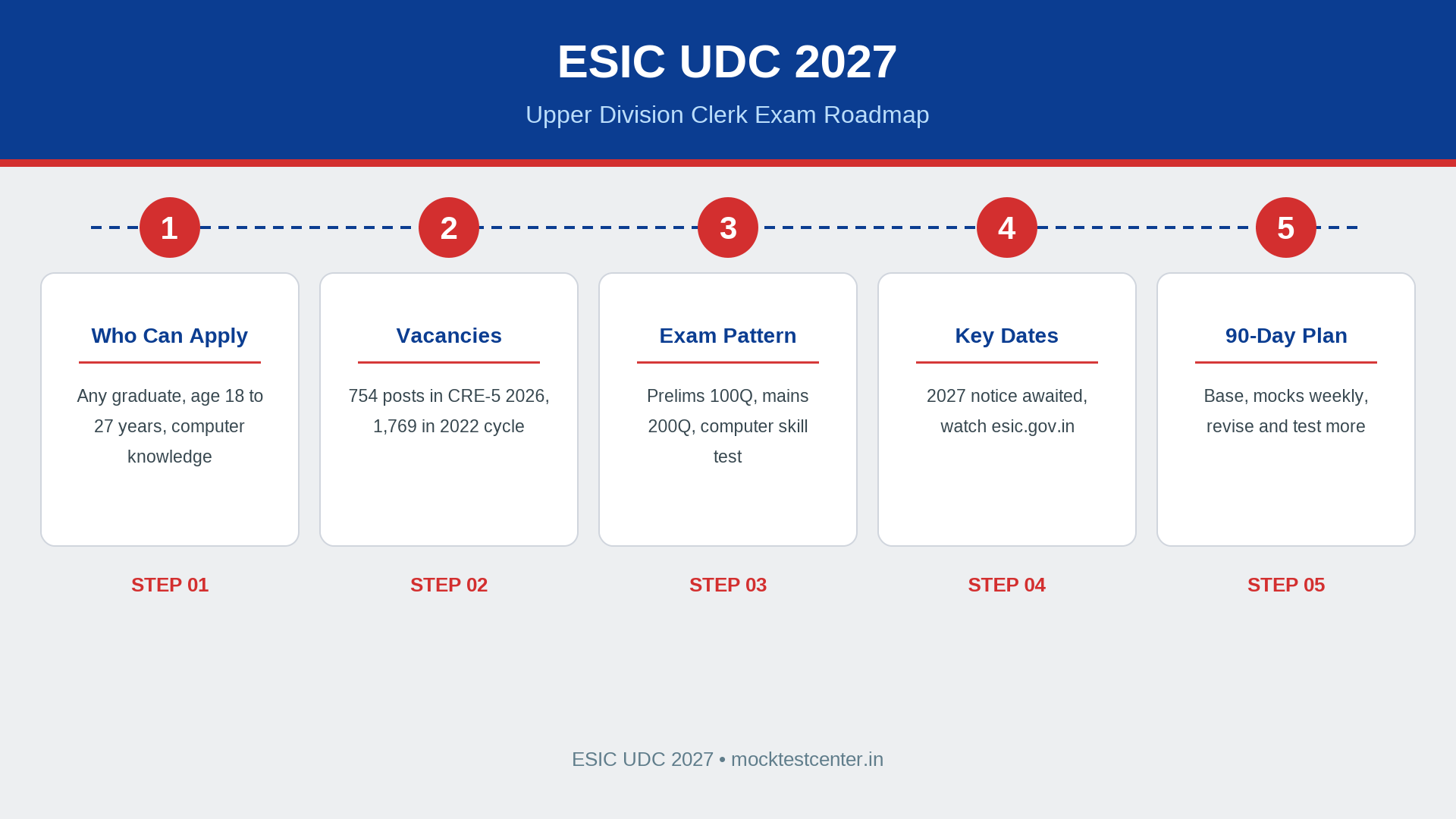
The 2027 notice has not come out yet. No dates for 2027 exist, and any site that prints them is guessing. This page works from the two most recent cycles, and both matter. The last ESIC run cycle came in 2022, with 1,769 UDC posts. The most recent cycle ran through the AIIMS Common Recruitment Examination, called CRE, in 2025 and again in 2026. The 2025 CRE cycle filled 687 UDC posts. The 2026 CRE cycle, called CRE-5, advertised 754 UDC posts. The route for the next cycle will be confirmed only in its own notice, so a candidate should prepare for the ESIC pattern and keep one eye on the CRE route too.
ESIC itself is a statutory body under the Ministry of Labour and Employment. It runs the Employees State Insurance scheme under the ESI Act of 1948, and the scheme gives medical care and cash benefits to insured workers. ESIC runs hospitals, dispensaries and regional offices in almost every state. A UDC works in that network. The job is office work, not field work, and postings follow the region a candidate applies for.
Check the official site esic.gov.in for every notice, because only the official notice is final. Dates, vacancy counts and pay figures in this article come from the 2022 ESIC notification and the CRE notices of 2025 and 2026. They will change for 2027. The pattern, the eligibility rules and the shape of the job have stayed the same across recent cycles, so they are the safest things to plan around.
Who can apply for ESIC UDC
The door is open to any graduate. A degree from a recognised university, in any subject, meets the education rule. ESIC also asks for working knowledge of computers, including the use of office suites and databases. That line matters more than it looks. The third stage of the exam tests PowerPoint, Word and Excel on a computer, so a candidate who has never used them will feel it at the end, not at the start. Learn the basics early.
The age limit in the 2022 cycle was 18 to 27 years as on the closing date for applications, 15 February 2022. The same 18 to 27 band applied in the CRE cycles. Age relaxation follows government rules: five years for SC and ST, three years for OBC, ten years for persons with benchmark disabilities, and five years for ex-servicemen, with extra relaxation for ESIC and government employees as the notice spells out. Expect the 2027 notice to set its own cut off date. Check your age against the date printed in the new notice, not against the date in this article.
There is no limit on attempts in the notice. You can apply in every cycle as long as you meet the age limit. That matters here, because ESIC does not run this exam every year. The gaps between cycles run to years, not months. A candidate who misses one cycle may wait a long time for the next, so each cycle deserves full effort.
One more point about the region. UDC posts are region wise. A candidate applies for one region and the merit list is region wise too. The cut off in Delhi, with 235 posts in 2022, differs from the cut off in a small region with a handful of posts. Pick your region with care. Home state comfort is real, but a region with more posts gives a better chance. The notice lists every region and its posts, so read that table before you fill the form.
The pay, and what Level 4 means in hand
The pay scale for an Upper Division Clerk in the 2022 cycle was Level 4 of the 7th Central Pay Commission, Rs. 25,500 to Rs. 81,100 a month. The starting basic pay is Rs. 25,500. On top of the basic pay come dearness allowance, house rent allowance and transport allowance, as per the rules in force at the time of joining. A UDC in a metro city takes home roughly Rs. 42,000 to Rs. 50,000 a month after the usual allowances, and a UDC in a smaller town takes home less in allowances but spends less on rent too.
Level 4 is a modest start, and candidates should know that before they apply. The SBI Clerk 2027 exam pays a similar starting basic and draws far more candidates. ESIC UDC pays less than the IBPS PO 2027 officer scale, and nobody should expect officer pay from a clerk post. What the post offers instead is stability, fixed hours, medical facilities through the ESI network, and promotion.
Promotion is the part candidates underrate. A UDC can move up to Assistant and then to higher ministerial posts through departmental exams and seniority. The ladder is slow, but it is real, and officers who join young can climb a long way before retirement. A graduate who joins at 22 and serves thirty years will not stay a clerk. That long view is the right way to judge this post.
Put the money in order. Basic pay Rs. 25,500 a month at the start. Pay scale Rs. 25,500 to Rs. 81,100. Allowances on top, as per central government rules. The 8th Pay Commission report is expected around mid 2027, so the pay figures may change after that, but the Level 4 grade is the fact to remember. Check the new notice for the pay it prints.
The three stages, and which marks count
ESIC UDC selection has three stages in the ESIC run pattern. Phase 1 is the preliminary examination. Phase 2 is the main examination. Phase 3 is the computer skill test. Only the main examination marks count for the final merit list. The preliminary examination is qualifying in nature, and the computer skill test is qualifying in nature too. That single fact should shape the whole preparation plan.
The preliminary examination is a speed test. It has 100 questions for 200 marks in 60 minutes. Every question carries 2 marks. Candidates who clear it move to the mains in a ratio of about 1 to 10, which means about ten times the number of vacancies in each category. In 2022, 20,681 candidates moved to the mains from the prelims. The prelims marks do not count for the final list, so a candidate should aim to clear it with a safe margin and save peak energy for the mains.
The main examination is the real test. It has 200 questions for 200 marks in 120 minutes. Every question carries 1 mark. The marks from this stage decide the final merit list. Candidates who clear the mains move to the computer skill test in a ratio of about 1 to 5, which means about five times the number of vacancies in each category. In 2022, 10,222 candidates moved to the skill test from the mains.
The computer skill test carries 50 marks and takes 30 minutes. It has three parts: preparation of two PowerPoint slides for 10 marks, typing matter on MS Word with formatting for 20 marks, and preparation of a table on MS Excel with the use of formulae for 20 marks. There is no negative marking in this stage, and the marks do not count for the final merit list. A candidate only needs to qualify. But a candidate who cannot make a slide or a table can still fail here, after clearing two written tests, and that would be a hard way to lose a year. Practise the three tasks on a real computer.
Negative marking applies in the two written stages. Every wrong answer costs one fourth of the marks assigned to that question. In the prelims that means 0.5 marks per wrong answer, since each question carries 2 marks. In the mains it means 0.25 marks per wrong answer. Guess only when you can rule out at least two options.
The prelims paper, section by section
The prelims paper has four sections, each with 25 questions for 50 marks, and the whole paper runs for 60 minutes. The four sections are General Intelligence and Reasoning, General Awareness, Quantitative Aptitude, and English Comprehension. The paper is bilingual in Hindi and English, except for the English section, which is in English only. There are no separate section timings in the prelims, so a candidate can move between sections as time allows.
| Section, prelims | Questions | Marks |
|---|---|---|
| General Intelligence and Reasoning | 25 | 50 |
| General Awareness | 25 | 50 |
| Quantitative Aptitude | 25 | 50 |
| English Comprehension | 25 | 50 |
| Total | 100 | 200 |
Sixty minutes for 100 questions means 36 seconds per question. That pace is the whole game. Reasoning puzzles and quant questions eat time, so learn to judge a question in five seconds. A skipped question costs nothing. A wrong guess costs half a mark. Start with your strongest section, bank the easy marks, and leave the long puzzles for the end if time is left.
General Awareness in the prelims rewards daily reading. The questions cover current affairs, banking awareness, economy, and static facts about India. ESIC questions also touch labour, health and social security, because that is the world this body works in. Read the news every morning and keep a notebook with one line per big story. Six months of notes beats six days of cramming.
Quantitative Aptitude in the prelims is about speed on easy topics. Simplification, number series, percentages, ratio and proportion, averages, and data interpretation sets carry the marks. Data interpretation sets look long but give several questions from one table, so they pay better per minute than a single puzzle. Practise with a timer from the first week, not the last.
English Comprehension in the prelims covers reading comprehension, cloze test, error spotting, and vocabulary. Read one English editorial every day and note ten new words a week. That habit alone covers vocabulary and comprehension together. Grammar rules help with error spotting, but only if you apply them on questions, not by reading rules alone.
The prelims cut off in 2022 ran high. For Delhi, the UR cut off for the mains shortlist was 165 marks out of 200, and the OBC cut off was 157. For Uttar Pradesh the UR cut off was 164.75. Those numbers tell a plain story. A candidate needs about 80 percent in the prelims to move on in a big region. Treat the prelims as a test you must pass with a margin, not as a formality.
The mains paper, and the qualifying marks
The mains paper has the same four sections, but each section now has 50 questions for 50 marks, and the whole paper runs for 120 minutes. The total is 200 questions for 200 marks. Each question carries 1 mark. The paper is bilingual in Hindi and English, except for the English section. There are no separate section timings in the mains either.
| Section, mains | Questions | Marks |
|---|---|---|
| General Intelligence and Reasoning | 50 | 50 |
| General Awareness | 50 | 50 |
| Quantitative Aptitude | 50 | 50 |
| English Comprehension | 50 | 50 |
| Total | 200 | 200 |
Two hours for 200 questions means 36 seconds per question again, the same pace as the prelims, but now every question carries only 1 mark. The mains rewards accuracy more than speed, because the marks from this paper decide the final list. A candidate who gets 150 right and skips 50 scores 150. A candidate who gets 160 right and 40 wrong scores 150 too, because the wrong answers eat 10 marks. Accuracy is the edge.
The minimum qualifying marks in the mains in 2022 were 45 percent for UR, which is 90 marks out of 200; 40 percent for OBC and EWS, which is 80 marks; 35 percent for SC, ST and ex-servicemen, which is 70 marks; and 30 percent for PwD, which is 60 marks. Qualifying is only the floor. The real cut offs for the skill test shortlist ran far above the floor. For Delhi, the UR cut off was 150.75 marks out of 200. For Tamil Nadu it was 142. For Bihar it was 138. A candidate should target 150 or more in mocks to feel safe in a big region.
General Awareness carries the same weight as the other sections in the mains, and it is the section where a prepared candidate gains the most. Fifty questions in a paper where you either know the answer or you do not. Banking awareness, economy news, government schemes, and current affairs from the last six months carry the most weight. ESIC and labour related news shows up more here than in other clerk exams, because the body works in social security. Read the labour and health pages, not just the front page.
Reasoning in the mains needs the same topics as the prelims, with harder puzzles. Seating arrangements, box puzzles, floor puzzles, syllogisms, coding decoding, blood relations, direction sense, and data interpretation all appear. Puzzles carry the most marks, so give them the most practice time. Start with linear seating and box puzzles. Move to floor puzzles only after the easy types feel fast.
The computer skill test: PowerPoint, Word, Excel
The computer skill test is the stage candidates ignore until it is too late. It carries 50 marks in 30 minutes, it is qualifying only, and it has three parts. The first part asks for two PowerPoint slides, for 10 marks. The second part asks for typing matter on MS Word with formatting, for 20 marks. The third part asks for a table on MS Excel with the use of formulae, for 20 marks. There is no negative marking, and the marks do not count for the final merit list.
Thirty minutes for three tasks is tight. That is ten minutes per task if you split the time evenly, and the Word typing takes the longest. Candidates who type slowly lose marks here without knowing it. Practice typing on a keyboard with a timer. If you type 30 words a minute with clean formatting, you are ready. If you type 15 words a minute, you need practice, not more theory.
The Excel part trips up candidates who have never used formulae. The task asks for a table with formulae, which means SUM, AVERAGE, and simple arithmetic across cells. Learn five formulae and practise them on sample tables. A candidate who knows SUM and AVERAGE finishes the task in five minutes. A candidate who does not know them stares at the screen.
The PowerPoint part is the easiest of the three. Two slides, a title, a few bullet points, and a simple design. Learn to insert a slide, add a title, add bullets, and save the file. That is the whole skill. Two evenings of practice cover it.
One more point. Candidates with benchmark disabilities who cannot type are assessed through an objective type computer test of 50 marks instead, as the notice spells out. Read the notice for that rule if it applies to you. For everyone else, the test is hands on, on a computer, under a timer.
Dates from the last cycles, and the CRE change
The 2027 notice has not come out yet, so the honest picture is the last three cycles. The 2022 cycle is the last full ESIC run cycle. The 2025 and 2026 cycles ran through the AIIMS Common Recruitment Examination, and the pattern changed with the route. Both are worth reading closely.
| Event, 2022 cycle | Date |
|---|---|
| Notification released | 28 December 2021 |
| Applications open | 15 January 2022 |
| Applications close | 15 February 2022 |
| Prelims, Phase 1 | 19 March 2022 |
| Prelims result | 13 April 2022 |
| Mains, Phase 2 | 30 April 2022 |
| Mains result | 16 June 2022 |
| Computer skill test, Phase 3 | 28 August 2022 |
| Final result | 7 November 2022 |
The 2022 cycle moved fast. The apply window lasted one month. The gap between the last date and the prelims was about five weeks. The gap between the prelims and the mains was six weeks. The whole cycle, from notice to final result, took about ten months. That is a normal pace for a big central government recruitment.
The vacancy count in 2022 needs a careful note. The first notices spoke of 3,847 posts in total across UDC, MTS and Stenographer, with 1,735 UDC posts. The revised count stood at 3,882 posts in total, with 1,769 UDC posts, 1,948 MTS posts and 165 Stenographer posts. This article uses the revised count of 1,769 UDC posts, because the later notices and the result lists use it. The difference comes from revisions during the cycle, and a candidate should know that vacancy counts can move after the first notice.
The CRE route changed the game. In the CRE 2025 cycle, ESIC filled 687 UDC posts through a single computer based test, with applications from 12 July to 31 July 2025 and the test on 25 and 26 August 2025. The CRE notice number was 278/2025, dated 11 July 2025. Document verification by ESIC regional offices ran in February 2026. In the CRE-5 cycle of 2026, ESIC advertised 754 UDC posts under Group Code 3, with notice number 93/2026 dated 13 June 2026. The first count was 733 posts, and a corrigendum dated 11 July 2026 raised it to 754. The computer test ran from 25 July 2026, with a retest on 31 August 2026 and a Jaipur centre retest on 7 September 2026. The skill test date for CRE-5 had not been notified as of 7 November 2026.
What does the CRE change mean for a candidate? Two things. First, the exam body changed from ESIC itself to the Examination Section of AIIMS New Delhi, which only conducts the test, while ESIC makes the appointments. Second, the CRE test is a single computer based test followed by a skill test, not the old prelims plus mains pair. The syllabus for the CRE test follows the CRE notice, so a candidate must read that notice when it comes out. The old ESIC pattern in this article is still the best preparation base, because the subjects are the same four, and the skill test still covers PowerPoint, Word and Excel.
Watch esic.gov.in and the AIIMS exams portal for the next notice. The CRE cycles came in July, so summer is the season to watch. Check the recruitments page twice a week. The apply window in the CRE cycles lasted only about three weeks, which is shorter than the old ESIC window, so a late starter loses the cycle before the test even starts.
How to apply for ESIC UDC
Go to the recruitments section of esic.gov.in and open the link for the Upper Division Clerk recruitment. In a CRE cycle, the application runs on the AIIMS exams portal instead, and the ESIC site links to it. Read the full notice before you touch the form. Then register with a working email and mobile number. You will get a registration number and password. Keep them safe. You need them for the admit card later.
Fill the form in one sitting if you can. Keep your degree details, your date of birth as on your Class 10 certificate, and your category certificate number ready. Pick your region with care, because the merit list is region wise and the region cannot be changed later. Upload a photo and signature in the size the notice asks for. A photo that is too large or a signature that is too small gets the form rejected, and ESIC does not chase you to fix it.
Pay the fee online and save the receipt. In the 2022 cycle, the fee was 500 rupees for all other categories, and 250 rupees for SC, ST, PwD, departmental candidates, female candidates and ex-servicemen. The 250 rupee fee was refunded, after deducting bank charges, to candidates who appeared in the Phase 1 examination. Take a print of the final form. Then wait for the admit card, which ESIC releases on its site before the test. The admit card tells you the centre and the reporting time. Reach the centre early. Late entry is refused.
Candidates who also track the IBPS Clerk 2027 exam will find the application steps nearly the same. Government recruitment forms follow one pattern, and once you have filled one carefully, the rest feel familiar. The RBI Assistant 2027 exam follows the same shape too, with its own fee and dates.
What to study for each section of ESIC UDC 2027
Reasoning first. The fifty questions in the mains cover puzzles; seating arrangements; syllogisms; coding decoding; blood relations; direction sense; and data interpretation. Puzzles carry the most marks, so give them the most practice time. Start with linear seating and box puzzles. Move to floor puzzles only after the easy types feel fast. Data interpretation sets look long but give several questions from one table, so they pay better per minute than a single puzzle.
English next. The questions cover reading comprehension; cloze test; error spotting; sentence improvement; and vocabulary. Read one English editorial every day and note ten new words a week. That habit alone covers vocabulary and comprehension together. Grammar rules help with error spotting, but only if you apply them on questions. The English section is in English only, so candidates who study in Hindi medium should give it extra time.
General awareness needs two notebooks. One for banking and economy, one for current affairs, with a third page for labour, health and social security. In the banking notebook, write the repo rate, reverse repo rate, CRR, SLR, bank rate, and the names of the RBI governor and the ESIC Director General, and update them every month. Add the full forms of ESI, EPFO, ESIC, NPA, CBS, KYC, NEFT, RTGS, IMPS, and UPI. In the labour notebook, write the key facts of the ESI Act, the Code on Social Security, and the big labour schemes. ESIC works in social security, so those questions show up more here than in other clerk exams.
Quantitative aptitude needs a topic list you can tick off. Simplification and approximation; number series; quadratic equations; data interpretation; time and work; time speed and distance; profit and loss; simple and compound interest; ratio and proportion; averages; and mensuration. That list looks long. It is the same list as every clerk exam, so the books and mocks you already own cover it. The difference is speed. Thirty six seconds per question means accuracy matters more than speed here. A candidate who gets forty right and ten wrong in the mains scores 37.5. A candidate who gets forty five right and skips five scores 45.
The computer skill test needs its own practice. Learn PowerPoint slides, Word formatting, and Excel formulae as a separate subject, not as an afterthought. Two evenings a week on a real computer cover it in a month. Candidates who skip this part lose easy qualifying marks to candidates who spent two evenings on it, and a fail here ends the run after two written tests.
A 90 day plan that fits around a job or college
Days 1 to 30 are for the base. Study two hours a day if you work or attend college, four hours if you are free. Cover one reasoning topic and one quant topic each day. Read the news every morning and write five lines in your current affairs notebook, plus two lines on labour and social security. Practise PowerPoint, Word and Excel for one hour each week. Take one mock at the end of week two and one at the end of week four. Do not worry about the score. The first mocks only show you where you stand.
Days 31 to 60 are for speed. Your ESIC UDC 2027 score will move most in this phase, because speed under a timer is what the paper actually tests. Take two mocks a week now, with the computer tasks included. After each mock, spend as much time on analysis as you spent on the test. Write down every question you got wrong and why. Was it a concept gap, a silly mistake, or a time problem? Concept gaps go back into your study list. Silly mistakes need a checklist before you submit each section. Time problems need easier questions first and hard ones last.
Days 61 to 90 are for the real thing. Take three mocks a week. Revise your error notebook every second day. Stop learning new topics in the last ten days. New topics in the last week add stress and no marks. In the last three days, take one full mock at the same time as your real test slot, then rest. Sleep matters more than one more chapter in the final week.
If you have less than ninety days, cut the base phase, not the mocks. Ten mocks with full analysis beat thirty days of reading without a single test. The paper rewards candidates who have sat through the two hour sitting many times. It punishes candidates who know the syllabus and have never felt the timer run out. The same rule holds for the SSC GD 2027 exam and the IBPS RRB Clerk 2027 exam, where the pace is just as tight.
Mistakes that cost candidates a year
The first mistake ESIC UDC 2027 candidates make is ignoring the computer skill test. Fifty marks in thirty minutes, qualifying only, and it still ends runs every cycle. Candidates clear the mains and then fail on Excel formulae they never practised. Give the skill test one hour a week from the start.
The second mistake is ignoring one section. The mains has no sectional cut off printed in the notice, but the minimum qualifying marks apply to the total, and a weak section drags the total down. A candidate with 150 marks and balanced sections moves on, while a candidate with 150 marks and a failed section does not exist, because the total is what counts, and a zero in one section means the other three must carry the whole paper. Give your weakest section thirty minutes a day, every day, even when it feels slow.
The third mistake is guessing too much. Four wrong answers erase one right answer in the mains. In a section where you know thirty answers for sure, ten wild guesses can pull your score down by two and a half marks. That is often the gap between selection and rejection in a region with few posts. Guess only when you can rule out two options.
The fourth mistake is skipping mocks. Reading feels like preparation, but the test measures speed under a timer. Candidates who take fewer than ten mocks before the real test are gambling. Take twenty if you can. Analyse every one.
The fifth mistake is picking the wrong region. The merit list is region wise, and the cut off in Delhi sat near 150 out of 200 in the mains in 2022, while smaller regions sat lower. A candidate who applies to Delhi because it is home, without checking the cut off, fights the hardest list in the country. Read the region table in the notice before you choose. The LIC ADO 2027 exam has the same region trap, with zonal lists that differ widely.
ESIC UDC next to other clerk exams
Put ESIC UDC beside the big clerk exams and the trade off becomes clear. The SBI Clerk 2027 exam and the IBPS Clerk 2027 exam lead to bank clerk posts with many more seats, but the work sits in bank branches with public dealing all day. The IBPS RRB Clerk 2027 exam places you in rural banks, which suits candidates who want to work near home. The RBI Assistant 2027 exam pays well and draws heavy competition of its own.
Against officer exams, the comparison is about the entry bar. The SBI PO 2027 exam and the IDBI JAM 2027 exam need the same degree but pay more and test harder, with interviews at the end. The ECGC PO 2027 exam pays far more and offers only 30 seats. ESIC UDC asks for less: a degree, computer knowledge, and three stages with no interview. That is the deal.
The way to choose is to ask one question. Do you want a central government clerk post with fixed hours, medical facilities, and a slow but real promotion ladder, and can you accept Level 4 pay at the start? If yes, ESIC UDC deserves your main effort. If no, the bank clerk exams with more seats fit better. Many candidates apply for both kinds and decide when the offers come. That is a sound plan, because the syllabus overlaps so much that one preparation serves all of them, and the computer skill test is the only extra work.
What to check before the 2027 notice comes out
Keep three things ready. First, your degree certificate and the age calculation as on the closing date of the last cycle, so you can redo it at once when the new cut off date comes out. Second, a mock test routine with a timer plus the computer tasks, so the two hour sitting and the thirty minute skill test both feel normal by the time the notice comes out. Third, a habit of checking esic.gov.in twice a week from June onward, since the CRE cycles came in July.
Start with one ESIC UDC 2027 mock this week, computer tasks included. Score it, list your weak section, and give that section thirty minutes a day. That single habit, repeated for ninety days, is what turns a graduate into an Upper Division Clerk.