About EPFO SSA 2027 Exam Series
📖 Table of Contents
- What EPFO SSA 2027 is
- The 2023 cycle, in numbers
- Who can apply for EPFO SSA
- The pay, and what Level 5 means
- The written test, section by section
- English carries 200 of the 600 marks
- The skill test: 35 words a minute, and it is only qualifying
- How the 2023 result actually played out
- What a Social Security Assistant does all day
- The 2019 cycle, and what changed in 2023
- How to apply when the notice comes out
- A 90 day plan that fits around a job or college
- Mistakes that cost candidates a year
- EPFO SSA next to other government exams
- What to check before the 2027 notice comes out
EPFO SSA 2027: Social Security Assistant Pattern, Salary, Dates
What EPFO SSA 2027 is
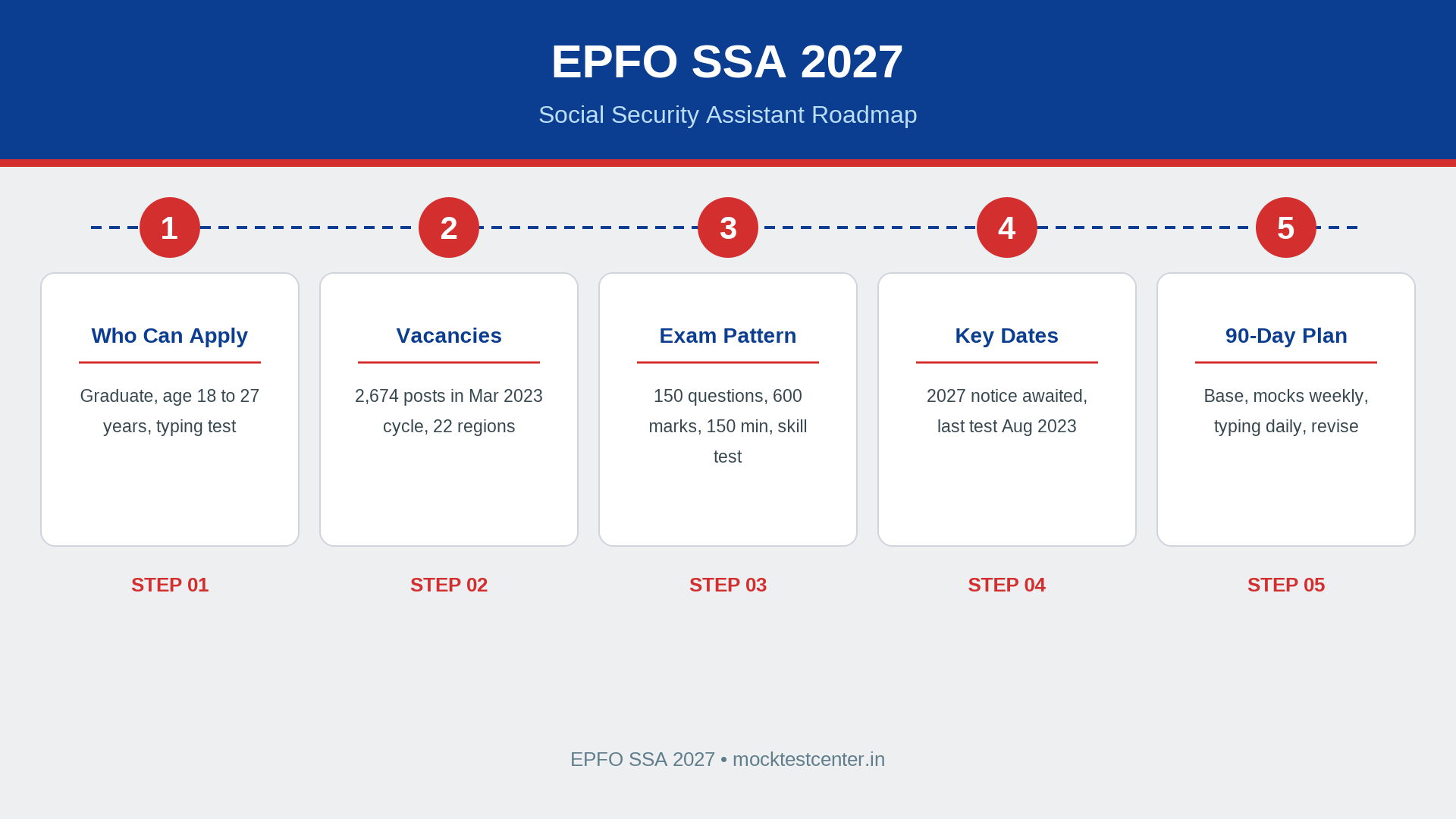
EPFO SSA 2027 is the next recruitment of Social Security Assistants by the Employees Provident Fund Organisation. No notice has come out yet. The last full cycle ran in 2023, and this page works from that cycle. EPFO advertised 2,674 Social Security Assistant posts in March 2023, ran the written test in August 2023, and declared the result in January 2024. Nothing newer exists on the EPFO recruitments page.
That gap is the first thing to grasp. EPFO runs this exam in bursts, not on a fixed calendar. It ran it in 2019 and again in 2023. Four years passed between the two cycles. A candidate who waits for a fixed calendar will wait a long time. A candidate who prepares from the 2023 pattern and watches the official site will be ready whenever the notice lands.
Social Security Assistant is a Group C post. It sits at Level 5 of the pay matrix, with entry pay of Rs 29,200 a month. The work is desk work in EPFO regional offices and the head office in New Delhi. Assistants handle provident fund member accounts and claims, plus pension cases and insurance records. It is a desk job in a government office. The written test looks much like a bank clerk test, but the work itself is provident fund administration, not banking.
Check the official site epfindia.gov.in for every notice, because only the official notice is final. Dates and vacancy counts, plus pay figures in this article, come from the 2023 advertisement and the National Testing Agency notices that followed it. They will change for 2027. The pattern, the eligibility rules, and the shape of the job have stayed close to the 2023 form, so they are the safest things to plan around.
The 2023 cycle, in numbers
EPFO released the advertisement on 24 March 2023 for 2,674 Social Security Assistant posts and 185 Stenographer posts, 2,859 posts in all. Applications ran from 27 March to 26 April 2023, with a correction window on 27 and 28 April. The National Testing Agency ran the Stage I computer based test across four days in August 2023, 18 August and then 21 to 23 August, two shifts a day.
The scale of the cycle tells its own story. A total of 6,46,287 candidates registered for the test. Only 2,46,725 appeared. Of those, 26,777 qualified for Stage II. The Stage II skill test took place on 19 November 2023, with 22,833 candidates appearing. EPFO and NTA declared the result on 3 January 2024, recommending 2,674 candidates.
Two out of every three registered candidates never turned up. That is normal for a large government exam, and it changes the odds. The real competition was 2,46,725 candidates for 2,674 posts, about 92 candidates per seat. Still steep. But it is a different number from the 242 per seat that the registration figure suggests, and a candidate who shows up on test day has already beaten the largest group of all, the group that never arrives.
The result itself had a rough landing. NTA issued a corrigendum on 4 January 2024, correcting the selected category of three candidates. Then, on 12 January 2024, it withdrew that result and issued a modified one. Some reserved category candidates who had used age relaxation had been wrongly shown as General in the selected category. NTA released the cut off marks and score cards of all candidates on 9 February 2024. A waitlist panel was kept for use when EPFO asks for it.
| Event, 2023 cycle | Date |
|---|---|
| Advertisement released | 24 March 2023 |
| Applications open | 27 March 2023 |
| Applications close | 26 April 2023 |
| Correction window | 27 and 28 April 2023 |
| Stage I computer based test | 18 August and 21 to 23 August 2023 |
| Stage II skill test | 19 November 2023 |
| Result declared | 3 January 2024 |
| Modified result | 12 January 2024 |
| Cut offs and score cards | 9 February 2024 |
The category split for the 2,674 posts was 999 for General, 529 for EWS, 514 for OBC, 359 for SC, and 273 for ST. Horizontal reservation sat inside those totals: 139 posts for persons with benchmark disabilities and 478 for ex-servicemen. The largest regions were Maharashtra with 422 posts and Tamil Nadu with Puducherry at 416 posts. West Bengal with Sikkim and Andaman and Nicobar had 220 posts, Karnataka had 204, and Gujarat with Dadra and Nagar Haveli and Daman and Diu had 197. EPFO runs the exam across 22 regions, and a candidate applies for one region and competes inside it.
Who can apply for EPFO SSA
The door is wide. Any graduate can apply. A bachelor degree from a recognised university, held on the closing date of online registration, meets the education rule. Candidates awaiting the result of their final examination should not apply. The notice is firm on that point.
The age limit in the 2023 cycle was 18 to 27 years on the closing date of the online application. Relaxation followed government rules: five years for SC and ST, three years for OBC, ten years for persons with benchmark disabilities in the General category, thirteen years for OBC candidates with disabilities, and fifteen years for SC and ST candidates with disabilities. Ex-servicemen got three years in the General category, six years for OBC, and eight years for SC and ST, after deducting actual military service. Government servants could apply up to 40 years in the General category, 43 years for OBC, and 45 years for SC and ST.
Typing is the second condition, and it catches people out. A candidate needs a speed of 35 words per minute in English or 30 words per minute in Hindi on a computer. That works out to 10,500 key depressions per hour in English and 9,000 in Hindi, at an average of five key depressions per word. The skill test runs for ten minutes. The notice asks for the speed, not a certificate. The test itself proves it.
Nationality follows the standard government form. A citizen of India can apply. So can a subject of Nepal or Bhutan, a Tibetan refugee who came to India before 1 January 1962 to settle permanently, and a person of Indian origin who migrated from specified countries to settle in India. The last three groups need a certificate of eligibility from the Government of India.
EWS candidates should read the income rule with care. EWS means family gross annual income below Rs 8 lakh, with none of the excluded assets, shown by an Income and Asset Certificate valid on the closing date. A certificate that expires before the closing date does not count. Get it fresh, and check the date on it before you upload it.
The pay, and what Level 5 means
The pay for a Social Security Assistant in the 2023 cycle was Level 5 of the pay matrix, Rs 29,200 to 92,300 a month. Entry pay is Rs 29,200. Allowances come on top, as per the rules in force from time to time: dearness allowance, house rent allowance, and transport allowance, with the usual central government benefits. The in hand figure moves with the city of posting, because house rent allowance changes by city class. EPFO does not print an in hand figure in the notice, so this page prints none either.
Level 5 is a step up from the 2019 cycle, when the same post sat at Level 4 with entry pay of Rs 25,500. That change matters. It means the 2023 recruits start about Rs 3,700 a month higher than the 2019 recruits did, and the whole ladder runs higher. A candidate who reads old pages will still see Level 4 quoted for this post. Those pages describe 2019. The 2023 notice says Level 5.
Put the money beside the work. A graduate post with central government allowances, a pension under the National Pension System, and a fixed desk job in a regional office is a steady offer. It pays less than an officer post in a bank or insurer. It also asks for less: one written test and a typing test, with no interview and no descriptive paper. That trade shapes who should chase it. If you want the highest starting pay in government recruitment, look elsewhere. If you want a stable post with a test you can clear on speed and accuracy, this one fits.
Promotion runs up the EPFO ladder. Assistants move to higher posts in the organisation over the years, through departmental exams and seniority. The post is a feeder for the Assistant grade above it, which sits at Level 7. That is a real ladder, not a dead end, and it is one reason the 2023 cycle drew more than six lakh registrations.
The written test, section by section
Stage I is a single computer based test. It has 150 questions for 600 marks, in 150 minutes. Each question carries four marks. Each wrong answer costs one mark, which is one fourth of the marks assigned to the question. There is no sectional timing in the 2023 pattern. The candidate gets two and a half hours for the whole paper and can move between sections as they like.
| Section, Stage I | Questions | Marks |
|---|---|---|
| General Aptitude | 30 | 120 |
| General Knowledge and General Awareness | 30 | 120 |
| Quantitative Ability | 30 | 120 |
| General English with Comprehension | 50 | 200 |
| Computer Literacy | 10 | 40 |
| Total | 150 | 600 |
General Aptitude gives thirty questions for 120 marks. It covers reasoning in its usual forms: puzzles; seating arrangements; syllogisms; coding and decoding; blood relations; direction sense. Thirty questions in a free timing paper means you set your own pace. Puzzles eat time. Learn to judge a puzzle in ten seconds. If the shape is not clear by then, move on and come back.
General Knowledge gives thirty questions for 120 marks. The notice calls it General Knowledge and General Awareness, and the questions range across current affairs; history; geography; polity; economy; science. Six months of current affairs before the test carries the most weight. EPFO runs social security schemes, so questions on labour and pension topics fit the paper, along with provident fund questions. Read the labour pages, not just the front page.
Quantitative Ability gives thirty questions for 120 marks. Simplification; number series; quadratic equations; data interpretation; time and work; time speed and distance; profit and loss; simple and compound interest; ratio and proportion; averages; mensuration. The list is the same as every bank and SSC exam, so the books you already own cover it. The difference is the marks. Four marks per question makes each quant question worth as much as a reasoning question, and a wrong guess costs a full mark.
Computer Literacy gives ten questions for 40 marks. That is the smallest section and the easiest to finish. It covers basic hardware; software; operating systems; memory units; MS Office; internet terms; cyber security basics. Ten questions, and most candidates answer them in five minutes. Two evenings with a computer basics book covers this section. Skipping it throws away 40 marks that other candidates collect for free.
Cut offs apply in two stages: on scores in individual tests and on the total score. That line comes from the notice itself. A high total with a failed section does not save you. Every section needs a minimum score, and the total needs one too. The exact cut offs change with each cycle and with each region, because the competition is region wise. Aim for at least 60 percent in your weakest section in mocks, and never let one section fall below half marks while another soars.
One more point about the paper. The IBPS PO 2027 exam runs sectional timers and a different marks split, so its mocks teach speed under a clock. The EPFO paper runs one clock for the whole test, so its mocks should teach time budgeting instead. Practise deciding, in the first five minutes, how many minutes each section gets. Then stick to the plan.
English carries 200 of the 600 marks
General English with Comprehension is the biggest section in the paper. Fifty questions, 200 marks, one third of the total. No other section comes close. A candidate who treats English as a side subject throws away the exam. A candidate who builds English first has a base of 200 marks to stand on.
The section covers reading comprehension; cloze test; error spotting; sentence improvement; vocabulary. Comprehension passages take the most time. Read the passage once, answer the direct questions first, and leave inference questions for the end if time is left. Cloze tests and error spotting reward daily reading more than last minute grammar rules. Vocabulary grows slowly. Ten new words a week, used in a sentence each, beats a hundred words crammed the night before.
Here is the arithmetic that decides ranks. A candidate who scores 150 out of 200 in English and 60 percent elsewhere lands near 400 out of 600. A candidate who scores 100 in English needs 75 percent elsewhere to reach the same total. English is the cheapest way to climb, because reading skill transfers to every other section that uses words: reasoning instructions, data interpretation questions, and general awareness. It also transfers to the skill test, because fast typing needs fast reading.
Read one English editorial every day. Note the words you do not know, and write each one in a sentence of your own. After a month you will have 40 words that are yours, not borrowed, each one tied to a sentence you wrote yourself rather than a line you copied from a list. After three months you will have 120. That is a vocabulary that stays. That habit alone covers vocabulary and comprehension together. It also feeds the precis and letter skills that other exams test, though this exam does not.
Grammar rules help with error spotting, but only if you apply them on questions. Learn one rule, then solve twenty questions on it the same day. Start with subject verb agreement and tenses. Articles come next, then prepositions and conjunctions. Idiom lists are poor value. They appear rarely, and the marks they carry are small.
The skill test: 35 words a minute, and it is only qualifying
Stage II is a Computer Data Entry Test. It checks speed and accuracy for data entry work. A candidate needs 35 words per minute in English or 30 words per minute in Hindi on a computer. That is 10,500 key depressions per hour in English and 9,000 in Hindi, at an average of five key depressions per word. The test runs for ten minutes.
The skill test is qualifying in nature. The merit list comes from Stage I marks alone, and the skill test only decides whether you stay in the race. That distinction matters more than it looks. Pass it and your Stage I score stands. Fail it and the score means nothing.
Ten minutes at 35 words a minute means 350 words of clean typing. Errors cost speed, because corrections eat time. Practise on the keyboard you will use, with a timer, on passages you have not seen. Typing from a printed page is the closest match to the real test. Typing from memory is easier and teaches the wrong skill.
Most graduates type at 20 to 25 words a minute without practice. Reaching 35 takes about six weeks of daily practice at twenty minutes a day. Start early. A candidate who starts typing practice after the Stage I result has about eight weeks before the skill test, which is enough if the practice is daily. A candidate who starts a week before the test will not make it. The 2023 gap between the written test and the skill test was about three months, from late August to 19 November. Use that gap. Do not waste it.
Choose your language with care. Hindi at 30 words a minute sounds easier than English at 35. It is easier only if you type Hindi every day. Most candidates type English every day. Phones and computers both train English typing, so their English speed runs higher even at the higher bar. Test both speeds on a keyboard before you choose. Pick the faster one, not the one that sounds easier.
How the 2023 result actually played out
The 2023 result is a lesson in reading notices to the end. NTA declared the result on 3 January 2024, recommending 2,674 candidates. A day later, on 4 January, it issued a corrigendum correcting the selected category of three candidates. Eight days later, on 12 January, it withdrew the result and issued a modified one. Reserved category candidates who had used age relaxation had been wrongly shown as General in the selected category. The correction changed the category column, not the merit order, but for the candidates affected, the category column decides the seat.
Cut off marks and score cards came on 9 February 2024. The cut offs run region wise and category wise, so there is no single number to quote for the whole country. Any site that prints one national cut off for EPFO SSA 2023 is guessing or quoting one region without saying so. Check the cut off for your region and your category, and treat it as the only number that matters for you.
The waitlist matters too. NTA kept a panel of waitlisted candidates for use when EPFO asks for it. Candidates who miss the first list by a small margin can still get a call if seats open up through document verification failures or dropouts. Keep your documents ready even after the result. A call can come months later, and a missing certificate at that point costs the seat.
One more number from the cycle deserves attention. Only 26,777 candidates qualified in Stage I out of 2,46,725 who appeared. That is about one in nine. The skill test then took 22,833 of them, and the final list held 2,674. The written test is the filter. The skill test is the gate. Both need respect, but the written test decides who gets to the gate.
What a Social Security Assistant does all day
An SSA works at a desk in an EPFO office. The core work is member accounts. Every worker with a provident fund account has a Universal Account Number, a 12 digit number that stays with the worker across jobs. Assistants process the claims that members file against those accounts: withdrawals, advances, transfers when a worker changes jobs, and settlements when a worker retires.
Pension work is the second strand. EPFO runs the Employees Pension Scheme, which pays a monthly pension to retired members and to families of deceased members. Assistants check service records, verify the pensionable salary and service period, and put the case up for sanction. A wrong figure in a pension case follows the member for life, so the work rewards care over speed.
Insurance work is the third strand. The Employees Deposit Linked Insurance Scheme pays a lump sum to the family of a member who dies in service. Assistants verify the membership and the claim papers, then process the payment. These are not abstract files. Each one is a family waiting for money, and the office measures itself on how fast clean claims move.
The office also handles employer work. Establishments register with EPFO, file monthly returns, and pay contributions. Assistants check the returns, flag short payments, and answer employer queries. Much of the day runs on the EPFO computer systems, which is why the typing test exists. The job is data entry and verification, plus file movement, done on a screen, all day, every day.
Postings sit in regional offices across the country, plus the head office in New Delhi. A candidate applies for one region and, if selected, joins that region. Transfers between regions follow EPFO rules and take time. Choose your region for where you want to live, not for where the cut off looked lowest last time. Cut offs move. Home does not.
The 2019 cycle, and what changed in 2023
EPFO ran the SSA exam in 2019 before it ran it in 2023. The 2019 cycle advertised 2,189 posts. Applications ran from 27 June to 21 July 2019. The preliminary test took place on 31 August and 1 September 2019, followed by a mains test and a skill test. The pay then was Level 4, with entry pay of Rs 25,500 a month.
The 2019 pattern had three phases. Phase I was a preliminary test of 100 questions for 100 marks in 60 minutes, covering English and reasoning, plus numerical aptitude. Phase II was a mains test. Phase III was the computer skill test, with a minimum of 5,000 key depressions per hour for data entry work. The preliminary test was qualifying, and the mains marks decided the merit list.
The 2023 pattern dropped the prelims and mains split. One computer based test of 150 questions for 600 marks replaced both, and the skill test stayed as Stage II. The pay moved from Level 4 to Level 5. The conducting body changed too: NTA ran the 2023 test on behalf of EPFO. The age limit stayed at 18 to 27 years in both cycles.
What does that change mean for 2027? It means the 2019 papers still help for practice, but their pattern does not describe the current exam. A candidate who prepares from 2019 mains papers will practise the wrong marks split. Use the 2019 papers for questions, not for structure. Use the 2023 pattern for structure: 150 questions, 600 marks, 150 minutes, English worth a third.
The four year gap between 2019 and 2023 also says something. EPFO recruits SSAs in bursts, when vacancies pile up, not on a fixed calendar. The 2023 cycle filled 2,674 posts. The next notice will come when the next pile of vacancies needs filling. No one outside EPFO knows when that is. The honest position is that the notice could come in any year, and preparation should not wait for it.
How to apply when the notice comes out
Applications run online only. In 2023 the application portal sat on the NTA recruitment site, linked from epfindia.gov.in. Read the full advertisement before you touch the form. Then register with a working email and mobile number. You will get an application number and password. Keep them safe. You need them for the admit card and the result.
Fill the form in one sitting if you can. Keep your degree details, your date of birth as on your Class 10 certificate, and your category certificate number ready. Choose your region before you start, because the region decides your competition and your posting. Upload a photo and signature in the size the notice asks for. A photo that is too large or a signature that is too small gets the form rejected, and EPFO does not chase you to fix it.
Pay the fee online and save the receipt. In the 2023 cycle the fee was Rs 700 for General and EWS and OBC candidates. SC, ST, PwBD, female candidates, and ex-servicemen paid nothing. The fee is non refundable, and it is payable through online mode only. Any tax or bank transaction charge falls on the candidate.
The correction window is short. In 2023 it ran for two days, 27 and 28 April. Check every field in those two days: name spelling; date of birth; category; region; photo. A wrong region cannot be fixed after the window closes. A wrong category can cost the seat at document verification, even after clearing the test.
Candidates who also track the SBI Clerk 2027 exam will find the application steps nearly the same. Government recruitment forms follow one pattern, and once you have filled one carefully, the rest feel familiar. The difference is the fee rule: many bank exams charge every category, while EPFO charges nothing to SC and ST candidates, nothing to PwBD and female candidates, and nothing to ex-servicemen.
A 90 day plan that fits around a job or college
Days 1 to 30 are for the base. Study two hours a day if you work or attend college, four hours if you are free. Cover one reasoning topic and one quant topic each day. Read the news every morning and write five lines in your current affairs notebook. Practise typing for twenty minutes a day from the first week, not the last. Take one mock at the end of week two and one at the end of week four. Do not worry about the score. The first mocks only show you where you stand.
Days 31 to 60 are for speed. Your EPFO SSA 2027 score will move most in this phase, because the paper gives one clock for 150 questions and no sectional timers. Take two mocks a week now. After each mock, spend as much time on analysis as you spent on the test. Write down every question you got wrong and why. Was it a concept gap, a silly mistake, or a time problem? Concept gaps go back into your study list. Silly mistakes need a checklist before you submit. Time problems need easier questions first and hard ones last.
Days 61 to 90 are for the real thing. Take three mocks a week. Revise your error notebook every second day. Stop learning new topics in the last ten days. New topics in the last week add stress and no marks. In the last three days, take one full mock at the same time as your real test slot, then rest. Sleep matters more than one more chapter in the final week.
English needs a fixed slot every day, not a weekly burst. Thirty minutes of reading and ten questions of grammar, daily, will move the 200 mark section more than any other single habit. Computer literacy needs two evenings in the base phase and a weekly revision after that. General awareness needs a daily five line note, not a monthly magazine binge.
If you have less than ninety days, cut the base phase, not the mocks. Ten mocks with full analysis beat thirty days of reading without a single test. The paper rewards candidates who have sat through the two and a half hour sitting many times. It punishes candidates who know the syllabus and have never felt the single clock run out. Candidates who also prepare for the IBPS Clerk 2027 exam will find the same mock routine works there, with sectional timers added.
Mistakes that cost candidates a year
The first mistake EPFO SSA 2027 candidates make is ignoring the typing test. Stage I decides the merit list, so candidates pour everything into the written test and leave typing for later. Then the skill test arrives, and the typing speed is not there. Six weeks of daily practice fixes it. Six days does not. Start typing in week one.
The second mistake is ignoring one section. Cut offs apply on individual tests and on the total score. A candidate with 450 marks and a failed computer section goes home, while a candidate with 380 marks and balanced sections goes to the skill test. Give your weakest section thirty minutes a day, every day, even when it feels slow. Computer literacy is ten questions. It is the cheapest section to fix.
The third mistake is guessing too much. Four wrong answers erase one right answer, because each wrong answer costs one mark against four marks for a right one. In a section where you know twenty answers for sure, ten wild guesses can pull your score down by ten marks. That is often the gap between selection and rejection in a region with 200 posts. Guess only when you can rule out two options.
The fourth mistake is skipping mocks. Reading feels like preparation, but the test measures speed under one clock. Candidates who take fewer than ten mocks before the real test are gambling. Take twenty if you can. Analyse every one. The analysis matters more than the count.
The fifth mistake is choosing the wrong region. Candidates pick the region with the lowest cut off last time, then find that every other candidate had the same idea. Cut offs move with the applicant pool. Pick the region where you live or where you want to work, and prepare to beat its cut off. Home is a better reason than a number from last year.
EPFO SSA next to other government exams
Put EPFO SSA beside the big exams and the trade off becomes clear. The SBI PO 2027 exam leads to an officer post with a higher starting pay and an interview stage, and it draws lakhs of candidates for more seats. The IBPS RRB PO 2027 exam places you in rural banks, which suits candidates who want to work near home. The RBI Assistant 2027 exam pays well at the start and draws heavy competition of its own, with no interview and a language test after the mains.
Against insurance exams, the comparison is about the work. The LIC AAO 2027 exam offers an officer post in insurance with a much higher starting pay, and its prelims carry no negative marking. The IDBI JAM 2027 exam leads to a Grade O post through a paid course, with many more seats and a lower starting pay than a bank officer post. The ECGC PO 2027 exam pays the highest starting basic in this group and offers the fewest seats, thirty in the last cycle.
EPFO SSA sits in the middle of that map. It pays less than the officer exams and more than most clerk exams, once allowances are counted. It asks for one written test and a typing test, with no interview and no descriptive paper. The IBPS SO 2027 exam needs a specialist degree, so it suits a smaller group. EPFO SSA needs only a degree and typing speed, so it suits almost every graduate.
The way to choose is to ask one question. Do you want a stable central government desk job with a test you can clear on speed and accuracy, and can you accept that the notice comes in bursts rather than every year? If yes, EPFO SSA deserves your main effort. If no, the PO and clerk exams with yearly cycles fit better. Many candidates apply for both kinds and decide when the offers come. That is a sound plan, because the syllabus overlaps so much that one preparation serves all of them, and the typing test is the only extra work.
What to check before the 2027 notice comes out
Keep three things ready. First, your degree certificate and the age calculation as on the closing date of the last cycle, so you can redo it at once when the new closing date comes out. Second, a mock test routine with one clock for 150 questions, so the two and a half hour sitting feels normal by the time the notice comes out. Third, a habit of checking epfindia.gov.in twice a week, plus the NTA recruitment site, from now on.
Start with one EPFO SSA 2027 mock this week, typing practice included. Score it, list your weak section, and give that section thirty minutes a day. That single habit, repeated for ninety days, is what turns a graduate into a Social Security Assistant.