About UPSSSC PET 2027 Exam Series
📖 Table of Contents
UPSSSC PET 2027
What is this exam
PET means the Preliminary Eligibility Test. It is held by the Uttar Pradesh Subordinate Services Selection Commission, or UPSSSC. PET is the first step, or the gateway, for almost all Group B and Group C jobs in the Uttar Pradesh government.
Read this first: PET gives you no job by itself. It only makes you eligible to apply for the mains exams of Group B and Group C posts. If you do not pass PET, you cannot apply for the mains exams of Lekhpal, Junior Assistant, VDO, Stenographer, Junior Engineer, and many other posts.
PET started in 2021. Before PET, each post had its own preliminary exam. Now one PET score opens the door to many mains exams. Your PET score is valid for three years from the date of the result, as per Government Order 316/47-ka-3-2025, dated 28 April 2025. So one good PET score can be used for many recruitments over three years.
The test is held offline, on OMR sheets, in two shifts a day. The paper is in Hindi and English both. Check the official site upsssc.gov.in for every notice, because only the official notice is final.
Who can apply
Any candidate who has passed Class 10, or High School, from a recognised board can apply for PET. You do not need a degree or an intermediate pass to sit for PET. But remember, the mains exam of each post has its own higher qualification, such as 12th pass or a degree. PET only checks your basic eligibility.
You must be a domicile of Uttar Pradesh to claim the benefits of reservation and age relaxation. Candidates from other states can also apply, but they are treated as general category candidates in most cases.
There is no limit on the number of attempts for PET, as long as you are within the age limit.
Eligibility
First, the age limit is 18 to 40 years. The age is counted as on 1 July of the exam year. Age relaxation is given as per the Uttar Pradesh government rules for SC, ST, OBC, PwD, ex-servicemen, and other reserved groups.
Second, the minimum education is a Class 10 pass, or High School, from a board recognised by the government. Candidates who are waiting for their Class 10 result should read the advertisement with care, because the result date rule is given in the notice.
Third, the application fee for PET 2025 was 185 rupees for General and OBC candidates, 95 rupees for SC and ST candidates, and 25 rupees for PwD candidates. The fee is paid online only. The fee for the next cycle will be given in the new advertisement, so check it before you pay.
- Education: Class 10 pass
- Age: 18 to 40 years as on 1 July of the exam year
- Domicile: Uttar Pradesh, for reservation benefits
- Fee (PET 2025): 185 rupees General and OBC, 95 rupees SC and ST, 25 rupees PwD
- Score validity: 3 years from the result date
- Attempts: no fixed limit within the age limit
Posts and vacancies
PET has no vacancies of its own. It is a qualifying test only. There is no post called PET, and no appointment letter comes from PET alone. The vacancies come later, in the mains advertisements of each post.
After PET, the Commission shortlists candidates for the mains exam of each post. The shortlisting is done on the normalised PET score. For most posts, candidates up to 15 times the number of vacancies are called for the mains exam. So if a post has 1,000 vacancies, about 15,000 candidates with the top PET scores are called.
A candidate with a zero score or a negative score in PET is not shortlisted for any mains exam, even if the number of candidates is less than 15 times the vacancies. So every mark matters, and a negative score can close all doors for that cycle.
Exam pattern
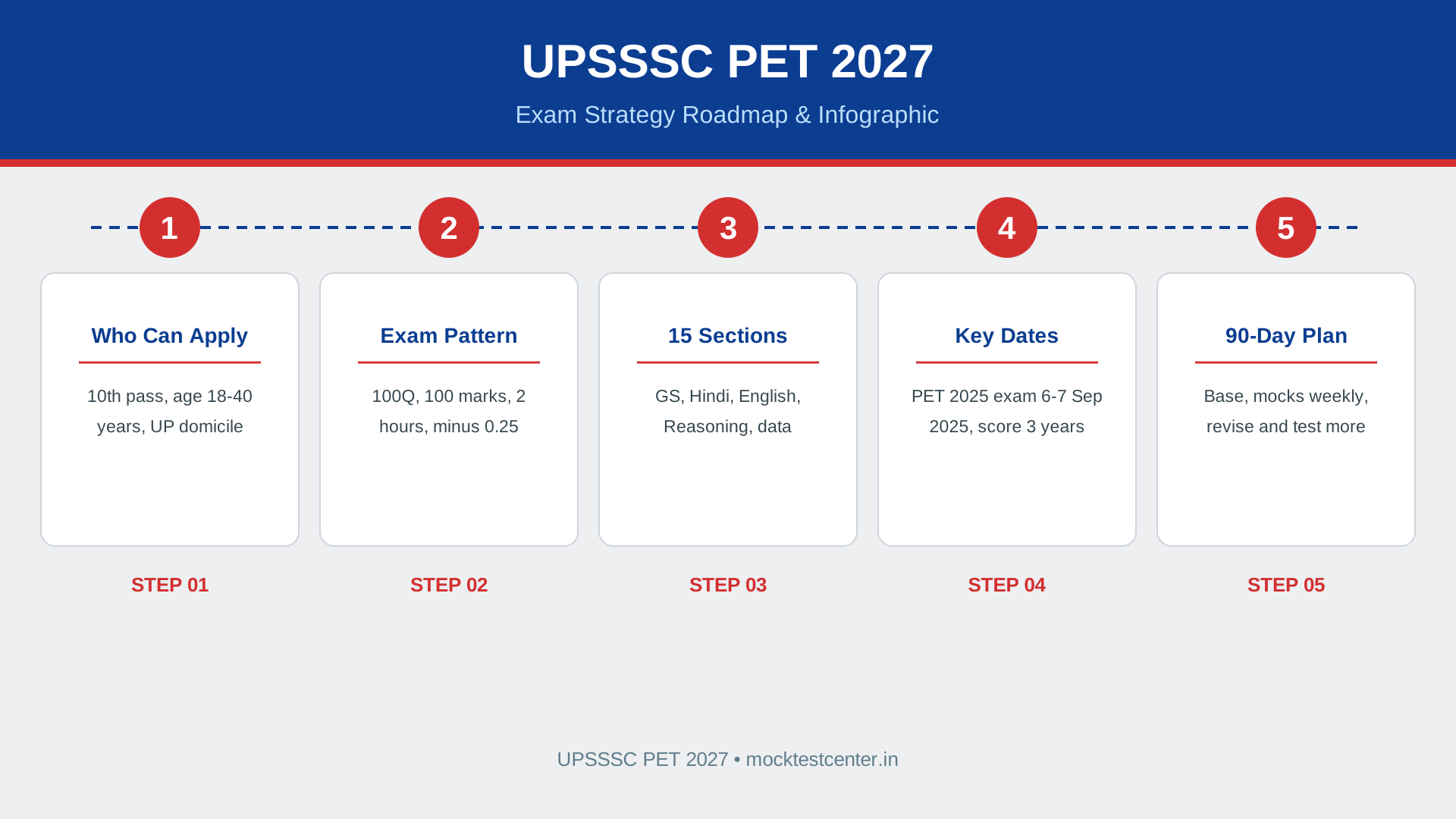
The PET paper has 100 questions for 100 marks. You get 2 hours, or 120 minutes, to finish the paper. Each question carries 1 mark. Each wrong answer cuts 0.25 marks, so four wrong answers take away one full mark. Unanswered questions carry no negative mark.
The paper is held offline, on an OMR sheet, in two shifts a day. The questions are in Hindi and English both. The paper is divided into 15 sections, and the marks are spread across them. Current Affairs and General Awareness carry 10 marks each. Unseen Hindi passages, graph reading, and table reading carry 10 marks each, in two sets of 5 marks each.
The other sections carry 5 marks each: Indian History, Indian National Movement, Geography, Indian Economy, Indian Constitution and Public Administration, General Science, Elementary Arithmetic, General Hindi, General English, and Logic and Reasoning.
Syllabus
The syllabus is fixed by the Commission and is the same for every PET cycle, unless a new advertisement changes it. Indian History covers ancient, medieval, and modern India, with the freedom struggle as a separate section. Geography covers India and the world, with special focus on Uttar Pradesh.
Indian Economy covers basic ideas such as national income, banking, budget, and government schemes. The Constitution section covers the making of the Constitution, fundamental rights, the President, the Parliament, the states, and public administration in Uttar Pradesh.
General Science covers physics, chemistry, and biology at the Class 10 level. Elementary Arithmetic covers number systems, percentage, ratio, average, profit and loss, and simple and compound interest. General Hindi covers grammar, synonyms, antonyms, and idioms, and General English covers basic grammar and vocabulary.
Logic and Reasoning covers series, coding, blood relations, direction sense, and puzzles. Current Affairs covers the news of the last one year, with focus on Uttar Pradesh and India.
Important dates
The dates below are from the PET 2025 cycle, Advertisement 01-Exam/2025. The notification came on 2 May 2025. Applications opened on 14 May 2025 and closed on 17 June 2025. The fee payment and correction window closed on 24 June 2025. The exam was held on 6 and 7 September 2025, in two shifts each day.
The PET 2026 cycle is Advertisement 16-Exam/2026. The notification came on 1 August 2026, applications opened on 3 August 2026 and closed on 1 September 2026, and the exam was held on 1 November 2026. Please note that this exam date of 1 November 2026 comes from a single source, and it has not been checked against a second source, so treat it with care and check upsssc.gov.in.
No dates for the PET 2027 cycle have been announced yet. Do not trust any website that gives a fixed PET 2027 exam date today.
| Event | PET 2025 | PET 2026 |
|---|---|---|
| Advertisement | 01-Exam/2025 | 16-Exam/2026 |
| Notification | 2 May 2025 | 1 Aug 2026 |
| Applications | 14 May to 17 Jun 2025 | 3 Aug to 1 Sep 2026 |
| Exam | 6 to 7 Sep 2025 | 1 Nov 2026 (single-sourced) |
Cut-off
PET has no fixed cut-off marks announced in advance. The shortlisting is done on the normalised PET score, and the cut-off changes with each cycle and each post. The cut-off depends on the number of vacancies in the mains post, the number of candidates, and the difficulty of the paper.
Because the shortlisting is up to 15 times the vacancies, a high PET score matters more than just passing. The Commission publishes the shortlist for each mains exam separately, so there is no single PET cut-off for all posts.
No cut-off marks for PET have been verified in this pass, so this page gives no cut-off figures. Do not trust any website that gives an exact PET cut-off for the next cycle. Aim for the highest score you can, because a higher score keeps more doors open for three years.
Best books
For General Studies, use a standard book such as Lucent General Knowledge, and read a daily newspaper for current affairs. For Uttar Pradesh general knowledge, use a book on UP GK, because many questions come from the history, geography, and culture of Uttar Pradesh.
For Elementary Arithmetic, use a standard book on quantitative aptitude, such as the book by R. S. Aggarwal, and practise at Class 10 level. For Reasoning, use a standard reasoning book and solve puzzles daily. For General Hindi, use a Hindi grammar book, and for General English, use a basic English grammar book.
For the graph and table sections, practise data interpretation from any standard book. For the unseen Hindi passages, read Hindi newspapers and practise one passage a day. One good book per subject, read fully, is better than ten books read in part.
90-day study plan
Days 1 to 30: Build your base. Give two hours a day to General Studies and one hour to Arithmetic and Reasoning. Read the newspaper daily and make short notes on current affairs. Finish one chapter a day and solve at least 30 questions a day.
Days 31 to 60: Go deep and test. Take one full PET mock test every week. Check every wrong answer and note the correct method. Revise your weak chapters twice. Practise graph and table questions daily, because they carry 20 marks.
Days 61 to 90: Revise and test more. Take a full mock test every three days, and in the last two weeks take one every two days. Revise your short notes daily. In the last week, solve only past papers and your error notes.
How to use mock tests
A mock test looks like the real exam. The PET paper is 100 questions in 2 hours, so take each mock test in one stretch, with no pauses, and with the OMR habit of marking answers with care. After each test, spend one hour on analysis. Note the questions you got wrong, and note the questions you guessed.
Track your score in each of the 15 sections separately. If your score in graph and table questions is low, practise data work daily. If your current affairs score is low, read the newspaper with more care. Two or three good tests a week, with full analysis, beat ten tests taken in a rush.
Once you have a PET score, your next step is a mains exam. See the mains pages on this site for the posts PET opens up.
Many PET-qualified candidates also prepare for other mains exams. See UPSSSC Revenue Lekhpal 2027, UPSSSC VDO Gram Vikas Adhikari 2027, UPSSSC Junior Assistant 2027, UPSSSC Stenographer 2027, UPSSSC Junior Engineer 2027, UPSSSC Lower PCS 2027, UPSSSC Combined Intermediate Level 2027, UPSSSC Excise Constable 2027, UPSSSC Mukhya Sevika 2027 and UPSSSC ANM 2027 on this site.
A last word
PET is the gateway to almost every Group B and Group C job in Uttar Pradesh. It gives no job by itself, but without it no mains door opens. Your score is valid for three years, so one strong score can serve many recruitments.
Do not wait for the notification to start. The syllabus is fixed, the pattern is known, and the 15 sections are the same every year. Start now, build your base, and take mock tests every week. Check upsssc.gov.in for the next notification, and keep your documents ready.