
About UPSSSC Lower PCS 2027 Exam Series
📖 Table of Contents
UPSSSC Lower PCS 2027
What is this exam
UPSSSC Lower PCS is the Combined Lower Subordinate Services Examination, at the graduate level, held by the Uttar Pradesh Subordinate Services Selection Commission, or UPSSSC. It fills Group B and Group C posts across many departments of the Uttar Pradesh government, such as supply, revenue, treasury, and other offices. It is one of the biggest graduate level exams in the state, and it is often called the Lower PCS because it is the lower rung of the state subordinate services.
The latest cycle is Advertisement 07-Exam/2026. The notification was issued on 30 March 2026, and a corrigendum on 1 April 2026 confirmed the exam scheme. The mains exam was held on 23 August 2026, and the revised answer key was issued on 13 November 2026. So the written exam of this cycle is already over, and the result is the next step.
Read this warning first. There is a separate exam with a similar name: the Lower PCS at the Intermediate Level, Advertisement 26-Exam/2026, with 1,784 posts, for candidates who have passed Class 12. That is a different exam. This page is only about the Graduate Level exam, Advertisement 07-Exam/2026. Do not mix the two.
Who can apply
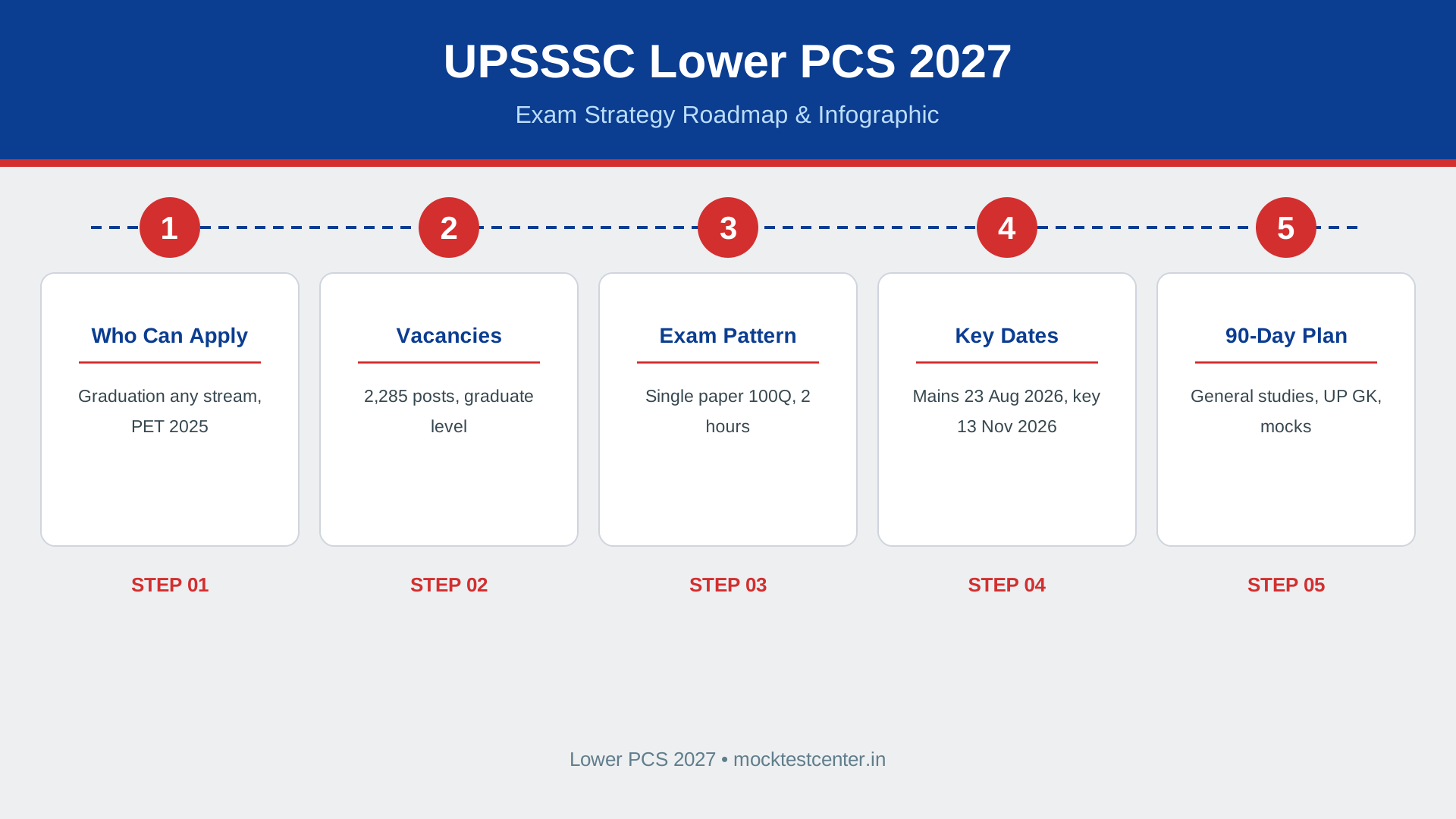
This exam is for graduates. You must hold a Bachelor degree in any stream from a recognised university. There is no rule that the degree must be in a fixed subject, except for a few posts that need extra certificates.
Second, you must have a valid UPSSSC PET 2025 score card. UPSSSC shortlists candidates for the mains exam on the basis of their PET scores. A candidate with no PET score, or with a zero or negative PET score, cannot apply.
Eligibility
First, the education rule: a Bachelor degree in any stream from a recognised university. The degree must be complete on or before the cut off date given in the notification. For the Executive Officer post, you also need an O Level certificate in computers. Read the post wise eligibility table in the advertisement, because a few posts have extra needs.
Second, you must have appeared in UPSSSC PET 2025 and hold a valid score card. Third, the age limit is 18 to 40 years, as on 1 July 2026. The minimum age is 18 years for most posts, and 21 years for some posts. Age relaxation is given to reserved category candidates as per the rules of the Uttar Pradesh government.
Fourth, there is no interview in this selection. The selection is PET, then the mains written exam, then document verification.
- Education: graduation in any stream from a recognised university
- Executive Officer: graduation plus O Level certificate
- PET: valid UPSSSC PET 2025 score card needed
- Age: 18 to 40 years as on 1 July 2026, 21 years minimum for some posts
- Interview: none in this selection
- Posts: Group B and Group C posts across UP departments
Posts and vacancies
The latest cycle, Advertisement 07-Exam/2026, notified 2,285 posts. This page uses 2,285 as the notified figure. There is one point you must know: the answer key notice mentions 2,285 plus 231, which adds up to 2,516. The meaning of the extra 231 posts has not been verified, so this page flags the 2,516 figure as not verified. Do not take 2,516 as final.
The posts are the Combined Lower Subordinate Services, at the graduate level. They cover Group B and Group C posts across many departments of the Uttar Pradesh government. The post wise list is given in the advertisement, and the post wise split is not given here, because it was not verified. Check the official advertisement for the full vacancy table.
| Cycle | Advertisement | Posts |
|---|---|---|
| Latest cycle | 07-Exam/2026 | 2,285 notified |
| Note | Answer key notice mentions 2,285 plus 231 | 2,516 not verified, do not take as final |
Exam pattern
The selection has three stages. First, the PET, which is the screening test. Second, the mains written exam. Third, document verification. There is no interview in this selection.
The mains exam is a single paper. It has 100 questions for 100 marks, and the time is 2 hours. Each wrong answer cuts 0.25 marks. The paper has three parts. Part 1 is General Studies, with 65 questions. Part 2 is Computer and Information Technology, with 15 questions. Part 3 is General Knowledge of Uttar Pradesh, with 20 questions.
Read this carefully, because there is confusion about the pattern. Some sources describe a two stage structure, with a screening test and then a mains exam. The official corrigendum of 1 April 2026 confirms that the mains exam is one single paper of 100 questions. The PET is the screening stage, and the single paper is the mains exam.
The qualifying marks are given as 40 percent for General, OBC and EWS candidates, and 35 percent for SC and ST candidates. This figure comes from a single source and has not been verified against the official advertisement. Check the advertisement for the qualifying marks.
| Part | Subject | Questions |
|---|---|---|
| Part 1 | General Studies | 65 |
| Part 2 | Computer and Information Technology | 15 |
| Part 3 | General Knowledge of Uttar Pradesh | 20 |
| Total | Single paper mains exam | 100 questions, 100 marks, 2 hours |
Syllabus
Part 1, General Studies, has 65 questions, so it is the biggest part of the paper. Study Indian history, with the freedom movement, Indian geography, the Constitution and polity, the Indian economy, general science, and current affairs. Read a good general studies book, and read the newspaper daily.
Part 2 is Computer and Information Technology, with 15 questions. Study computer basics, internet, email, MS Office, and common computer terms at a basic level. This part is scoring, so do not ignore it.
Part 3 is General Knowledge of Uttar Pradesh, with 20 questions. Study the history, geography, culture, rivers, districts, famous places, government schemes, and current affairs of Uttar Pradesh. Use a good Uttar Pradesh general knowledge book, and revise the state schemes and the state budget facts every month.
Important dates
The dates below are from the latest cycle, Advertisement 07-Exam/2026. The notification was issued on 30 March 2026, and the corrigendum confirming the single paper scheme on 1 April 2026. The application window was 29 May to 18 June 2026. The mains exam was held on 23 August 2026, and the revised answer key was issued on 13 November 2026.
The result date and the document verification dates for this cycle have not been announced yet. Do not trust any website that gives a fixed result date today. The next cycle has also not been announced. Check upsssc.gov.in every week for the result and for the next advertisement.
| Event | Date |
|---|---|
| Notification | 30 March 2026 |
| Corrigendum, single paper scheme | 1 April 2026 |
| Applications | 29 May to 18 June 2026 |
| Mains written exam | 23 August 2026 |
| Revised answer key | 13 November 2026 |
Cut-off
No cut-off marks for this mains exam have been verified, so this page gives no cut-off figures. Do not trust any website that gives exact cut-off marks for this exam today.
Here is how the cut-off works. First, UPSSSC shortlists candidates for the mains exam on the basis of PET scores. Then the mains exam marks decide who goes to document verification. Only the top candidates, at about the number of vacancies, go to document verification. The final merit list is made from the mains marks of the candidates who pass document verification.
With 100 questions and negative marking of 0.25, every mark counts. The qualifying marks are given as 40 percent for General, OBC and EWS candidates, and 35 percent for SC and ST candidates, but that figure is single sourced and not verified. Aim well above the qualifying level in mock tests.
Best books
For General Studies, use a standard general studies book, such as the book by Lucent, and read the newspaper daily. For Indian polity, use a standard book on the Constitution, and for Indian history, use a good history book that covers the freedom movement. For geography and economy, use your Class 11 and 12 books.
For Computer and Information Technology, use a basic computer book that covers computer basics, internet, email, and MS Office. For Uttar Pradesh General Knowledge, use a good Uttar Pradesh general knowledge book, and revise the state schemes regularly. Solve past year papers of UPSSSC exams, especially the PET papers and the mains papers of other UPSSSC exams.
Past papers show you the real level of the questions. One good book per subject, read fully, is better than ten books read in part. Make short notes of facts, dates, and scheme names, and revise them every week.
90-day study plan
Days 1 to 30: Build your base. Read the full advertisement syllabus and make a list of all topics. Study General Studies for three hours a day, and give one hour to Uttar Pradesh General Knowledge. Finish Indian history and polity in this phase, because they are the biggest parts of General Studies.
Days 31 to 60: Go deep and test. Finish geography, economy, science, and current affairs. Study Computer basics for 30 minutes a day. Take one full mock test every week, in 2 hours, with no pauses. Check every wrong answer and note the correct method. Revise your weak chapters twice.
Days 61 to 90: Revise and test more. Take a full mock test every three days, and in the last two weeks take one every two days. Revise your short notes daily. In the last week, solve only past papers and your error notes. Keep your documents ready for verification, including your degree certificate and your PET score card.
How to use mock tests
A mock test looks like the real exam. The mains paper is a single paper of 100 questions in 2 hours, with negative marking of 0.25, so take your mock tests in the same way: 100 questions, 2 hours, one stretch, no pauses, no phone. After each test, spend one hour on analysis, and note the questions you got wrong.
Two or three good tests a week, with full analysis, beat ten tests taken in a rush. Also take the PET mock tests, because the PET is the first gate. If you are getting ready for other UPSSSC exams too, see UPSSSC PET 2027, UPSSSC Revenue Lekhpal 2027, UPSSSC VDO Gram Vikas Adhikari 2027, UPSSSC Junior Assistant 2027, UPSSSC Stenographer 2027, UPSSSC Junior Engineer 2027, UPSSSC Auditor and Assistant Accountant, UPSSSC Combined Intermediate Level 2027, UPSSSC Assistant Statistical Officer 2027 and UPSSSC Computer Operator 2027 on this site. The PET and the general knowledge parts are common to many of these exams, so their mock tests also help you.
A last word
UPSSSC Lower PCS is one of the biggest graduate level exams in Uttar Pradesh. The latest cycle has 2,285 posts, and the mains exam was held on 23 August 2026, with the revised answer key issued on 13 November 2026. If you gave the exam, keep your documents ready for verification.
If you are a new candidate, do not wait for the next advertisement to start. Appear in the next PET first, because without a PET score you cannot apply at all. Then study General Studies deeply, and take mock tests every week.







