About RRB Station Master 2027 Exam Series
📖 Table of Contents
RRB Station Master 2027
What is this exam
A Station Master is the officer who runs a railway station. The Station Master controls the movement of trains, looks after signals and points, checks the work of the station staff, and helps passengers. The Railway Recruitment Boards, called RRBs, hold this exam for the Ministry of Railways.
From 2026, Station Master is a separate exam, no longer a post inside the NTPC exam. The latest cycle is CEN 08/2026, with its own notice and post list. Old books and web pages that list Station Master as an NTPC post are now out of date. The post is in Pay Level 6, a safety post in the operating wing of the Railways.
This page is about the 2027 cycle. No 2027 notice has come yet, so it uses the CEN 08/2026 cycle as the base. The 2027 notice is awaited. Check rrb.indianrailways.gov.in every week for the new notice.
Who can apply
The rules below are from the CEN 08/2026 cycle. They are likely to stay the same in 2027, but you must read the new notice when it comes.
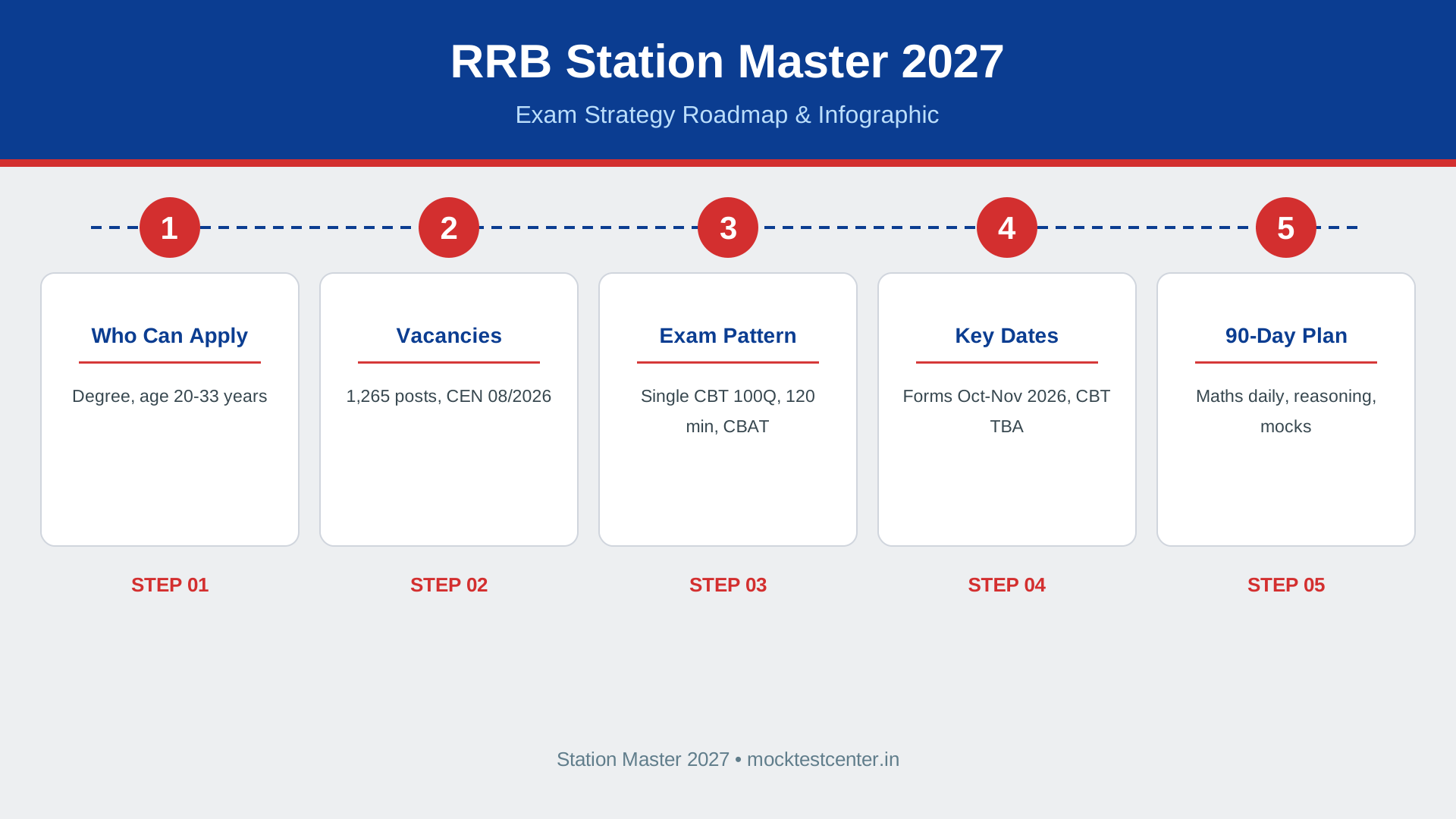
First, you need a degree from a recognised university. The exact degree rule must be read from the detailed CEN, because the research for this page could not open the official PDF. A degree in any subject is the rule as reported, but do not take it as final till you see the new notice.
Eligibility
Second, your age must be 20 to 33 years, as per the Railway Board guideline of 7 October 2026. This age figure is reported from a secondary source, so confirm the exact cut-off date from the detailed CEN before you apply. The age relaxation table for reserved groups is in the CEN.
Third, you must meet the medical standard for the post. The medical standard is reported as A-2, which was the standard for Station Master in the NTPC years, but this too must be confirmed from CEN 08/2026. A-2 is a strict eyesight standard, so get your eyes checked before you apply. Fourth, the fee is Rs. 500 for all candidates, with Rs. 400 refunded after you appear in the CBT. For SC, ST, Ex-Servicemen, PwBD, female, transgender, minority and EBC candidates, the fee is Rs. 250, refunded after you appear in the CBT. The fee to change your form is Rs. 250 per change.
- Education: degree from a recognised university (confirm from the CEN)
- Age: 20 to 33 years as reported (confirm the cut-off date)
- Medical: A-2 as reported (confirm from CEN 08/2026)
- Fee: Rs. 500, or Rs. 250 for listed groups; refund after the CBT
- Form change fee: Rs. 250 per change
Posts and vacancies
The CEN 08/2026 cycle has 1,265 posts of Station Master. The first short notice spoke of about 1,250 posts, and the detailed list of posts by RRB adds up to 1,265. One web page says 1,215, but that is a typing error and must not be used. The RRB-wise list is in the CEN. You can apply to one RRB only, so pick the RRB with care.
For 2027, no vacancy number has been announced yet. Do not believe any website that gives a 2027 post number today. Only the new CEN will give the true number. In the past, Station Master was a post inside NTPC: 615 posts in CEN 06/2025 and 994 posts in CEN 05/2024. From 2026, the post has its own CEN, so the old NTPC numbers are only history now.
| Item | Detail |
|---|---|
| Notice | CEN 08/2026, 26 October 2026 |
| Vacancies | 1,265 (about 1,250 in the first notice) |
| Post | Station Master, Pay Level 6 |
| Separate from NTPC | Yes, from 2026 |
| 2027 vacancies | Not announced yet |
Exam pattern
The CEN 08/2026 pattern has a single-stage CBT, then a CBAT, then document check and medical test. There is no CBT-1 and CBT-2 in this cycle, a big change from the NTPC years, when Station Master had two CBTs. The single CBT is reported as 100 questions in 120 minutes, but this figure must be verified from the detailed CEN PDF before you treat it as final. The research for this page could not open the official PDF, so the question count and the time are given as reported, not as confirmed fact.
The section split of the CBT is also not confirmed. One report says the paper focuses on Quantitative and Analytical Aptitude, with no general knowledge or general science, but that too must be verified from the detailed CEN. This page gives no section-wise table of marks, because no such table has been confirmed.
Every RRB CBT has negative marking of one third of a mark for each wrong answer, and this cycle is no different. The usual RRB pass marks in a CBT are 40 percent for UR and EWS, 30 percent for OBC-NCL and SC, and 25 percent for ST, but confirm the exact pass marks for this post from the CEN. After the CBT comes the Computer Based Aptitude Test, called CBAT. In the NTPC years, CBAT called about eight times the number of posts, needed a minimum T-score of 42 in each test battery, and had no negative marking. The exact CBAT rule for CEN 08/2026 must be read from the new CEN. After CBAT comes document verification, and then the medical test.
| Stage | Detail (as reported, verify from CEN) |
|---|---|
| CBT | Single stage, 100 questions, 120 minutes |
| Negative marking | One third mark cut per wrong answer |
| CBAT | Aptitude test after CBT |
| Document check | After CBAT |
| Medical test | A-2 as reported |
Syllabus
The syllabus follows the CBT, and since the section split is not confirmed, this page gives the likely areas with care, not as a final list. The focus as reported is Quantitative and Analytical Aptitude: maths and the power to think with numbers and logic. Do not spend all your time on general knowledge till the CEN confirms whether it is in the paper at all.
For maths, cover number systems, ratio and proportion, percentage, profit and loss, interest, time and work, speed and distance, averages, and data reading. For analytical aptitude, cover series, coding and decoding, blood relations, direction sense, seating, and puzzles. Practise with a timer, because 120 minutes for 100 questions gives you just over one minute per question.
For CBAT, the test checks aptitude, not book knowledge. It has test batteries that check your power to see, judge, and act fast. You cannot cram for CBAT from a book. Practise sample aptitude tests after you clear the CBT. Read the CEN for the exact CBAT batteries and the pass rule.
Important dates
The dates below are from the CEN 08/2026 cycle. There are no 2027 dates yet.
The first short notice came in late October 2026, around 21 to 24 October. The detailed CEN came on 26 October 2026, and Corrigendum-1 on 27 October 2026. Applications ran from 27 October to 25 November 2026. The last date to pay the fee was 27 November 2026. The window to change the form ran from 28 November to 7 December 2026. The CBT date had not been announced as of 18 November 2026.
| Event | Date |
|---|---|
| Short notice | 21 to 24 October 2026 |
| Detailed CEN | 26 October 2026 |
| Corrigendum-1 | 27 October 2026 |
| Applications | 27 October to 25 November 2026 |
| Last date for fee | 27 November 2026 |
| Form change | 28 November to 7 December 2026 |
| CBT date | Not announced yet |
| 2027 notice | Awaited |
Cut-off
No cut-off marks for this exam have been verified, so this page gives no cut-off figures. Do not trust any website that gives exact cut-off marks for CEN 08/2026 today, because the CBT has not been held yet. Any number you see now is a guess.
Here is how the cut-off works. First, you must clear the pass marks in the CBT. Then the RRB makes a list by marks, and only the top candidates go to CBAT. The CBT marks are normalised across shifts, so no shift is easy or hard by luck. The final list depends on the CBT and CBAT together, as per the rule in the CEN.
Best books
For maths, use a standard book on quantitative aptitude, such as the book by R. S. Aggarwal. Use NCERT maths books from Class 8 to Class 10 to fix your base. For reasoning, use a standard reasoning book and solve puzzles daily. For data reading, practise tables, bar charts, and pie charts from any good aptitude book.
Do not buy ten books for one subject. One good book per subject, read fully, is better than ten books read in part. Solve past year papers of NTPC CBT-1 and CBT-2 for maths and reasoning. But the old NTPC pattern had two CBTs and general awareness too, so do not copy the old paper mix as it is.
For current affairs, keep a light touch till the CEN confirms the paper. Give most of your time to maths and reasoning, the reported focus of this CBT. For CBAT, no book can teach aptitude. Practise with sample tests and stay sharp.
90-day study plan
Days 1 to 30: Build your base. Study maths for two hours a day and reasoning for two hours a day. Finish one chapter a day in each subject and solve at least 50 sums a day. Take one short topic test each week.
Days 31 to 60: Go deep and test. Take one full mock test of 100 questions in 120 minutes every week, in exam-like conditions. Check every wrong answer and write the correct method in a notebook. Revise your weak chapters twice.
Days 61 to 90: Revise and test more. Take a full mock test every three days, and in the last two weeks take one every two days. Revise your short notes and formulae daily. Do not start any new book now. In the last week, solve only past papers and your error notebook.
How to use mock tests
Mock tests are practice tests that look like the real exam. The CBT is reported as 100 questions in 120 minutes, so speed with care decides your rank. Take each mock test in one stretch of 120 minutes, with no pauses and no peeking at answers. After each test, spend one hour on the analysis. Note the questions you got wrong. Aim to attempt most questions with good accuracy, because negative marking punishes blind guessing.
Keep a notebook of your errors and revise it every week. Two or three good tests a week, with full analysis, are worth more than ten tests taken in a rush.
If you are also getting ready for other railway exams, you can see RRB NTPC 2027, RRB Section Controller 2027, RRB Group D Level 1 2027, RRB ALP 2027, RRB JE 2027, RRB Technician 2027, RRB Paramedical 2027, RRB Ministerial and Isolated Categories 2027, RPF Constable 2027 and RRB Station Master 2027 on this site. Apply only on rrbapply.gov.in and check notices on rrb.indianrailways.gov.in.
A last word
Station Master is one of the best Level 6 posts in the Railways, and from 2026 it has its own exam. The paper is single-stage, so a good CBT score puts you close to the post. Start now with maths and reasoning, and do not believe any 2027 vacancy number or cut-off till the RRB publishes it.