About RRB Paramedical 2027 Exam Series
📖 Table of Contents
RRB Paramedical 2027
What is this exam
RRB means Railway Recruitment Board. There are 21 Railway Recruitment Boards in India, and they work for the Ministry of Railways. The RRB Paramedical exam picks health staff for railway hospitals and health units across India. The posts include nurses, pharmacists, lab staff, radiographers, and other health workers.
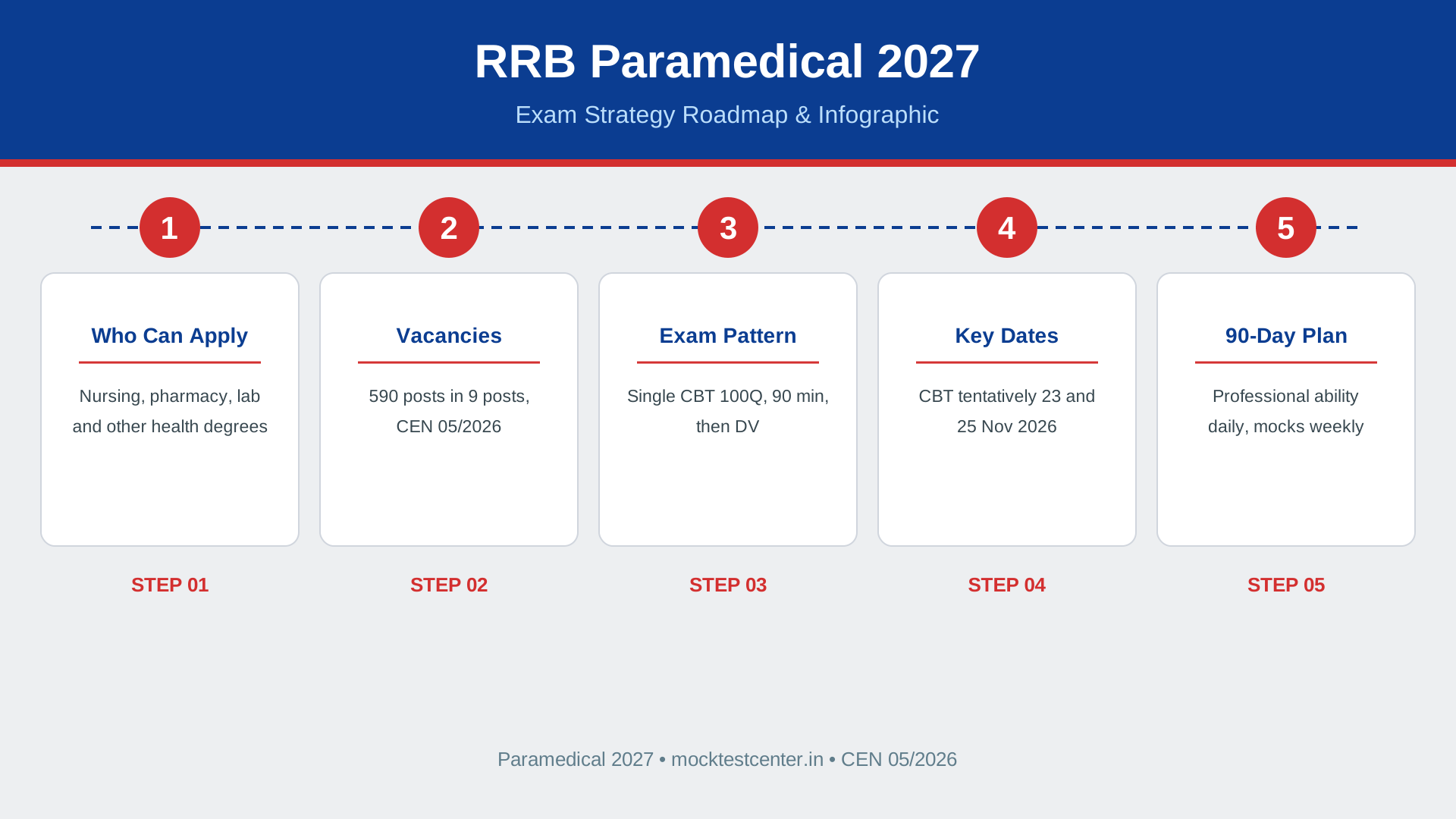
The latest cycle is CEN 05/2026, short for Centralised Employment Notice 05 of 2026. The detailed notice came out on 14 September 2026. It gives 590 posts in 9 posts. The 2027 notice has not come yet, so this page uses the 2026 cycle as the base. Check rrb.indianrailways.gov.in before you apply, and apply only on rrbapply.gov.in.
One name needs care. There is no post called Staff Nurse in this exam. The nursing post is officially called Nursing Superintendent. Many websites still write Staff Nurse, but that is only a common name, not the post name in the notice.
Who can apply
Each post needs its own degree, diploma, or certificate. For Nursing Superintendent, you need a Registered Nurse and Midwife certificate after a three year GNM course, or a B.Sc. in Nursing. For Pharmacist, you need a Bachelor of Pharmacy or a Pharm.D, with registration under the Pharmacy Act, 1948.
For Health and Malaria Inspector Grade II, you need a B.Sc. with Chemistry and a Sanitary Inspector diploma. For Radiographer, you need Class 12 with Physics and Chemistry and a two year radiography diploma. For ECG Technician, you need Class 12 or a science degree with an ECG or cardiology course of at least one year. For Optometrist, you need a B.Sc. in Optometry or an Ophthalmic Technician diploma with registration. For Laboratory Assistant Grade II, you need Class 12 Science and a DMLT, or a B.Sc. in MLT. For Dialysis Technician, you need a B.Sc. and a haemodialysis diploma or two years of training. For Audiologist and Speech Therapist, you need a BASLP degree with Rehabilitation Council of India registration. Your qualification must be held by 14 October 2026 for the 2026 cycle.
Eligibility
Age as on 1 January 2027 differs by post. Nursing Superintendent is 20 to 40 years, Pharmacist is 20 to 35, Audiologist and Speech Therapist is 21 to 30, Dialysis Technician is 20 to 33, Radiographer is 19 to 33, and Health and Malaria Inspector, ECG Technician, Optometrist, and Laboratory Assistant are 18 to 33. SC and ST candidates get 5 years more, OBC-NCL candidates get 3 years more, and PwBD candidates get 10, 13, or 15 years more by category.
Nursing Superintendent, Health and Malaria Inspector, and ECG Technician need C1. Pharmacist needs C2. The other posts need B1. The fee in the 2026 cycle was Rs. 500 for all candidates, and Rs. 250 for SC, ST, Ex-Servicemen, PwBD, female, transgender, minority, and EBC candidates. The fee to change your form is Rs. 250 per chance.
Note one real change. In CEN 03/2025, Pharmacist also accepted Class 12 Science with a Diploma in Pharmacy. In CEN 05/2026, only a Bachelor of Pharmacy or a Pharm.D is accepted. If you hold only a diploma in pharmacy, you cannot apply for Pharmacist in this cycle.
- Nursing Superintendent age: 20 to 40 years as on 1 January 2027
- Pharmacist age: 20 to 35 years; B.Pharma or Pharm.D now needed
- Radiographer age: 19 to 33 years; Dialysis Technician: 20 to 33 years
- Health and Malaria Inspector, ECG, Optometrist, Lab Assistant: 18 to 33 years
- Fee: Rs. 500, or Rs. 250 for reserved groups
- Medical: C1 for Nursing, Health and Malaria Inspector, ECG; C2 for Pharmacist; B1 for others
Posts and vacancies
The 2026 cycle has 590 posts in 9 posts. Nursing Superintendent is Level 7 at Rs. 44,900 a month, Pharmacist is Level 5 at Rs. 29,200, Health and Malaria Inspector Grade II is Level 6 at Rs. 35,400, Laboratory Assistant Grade II is Level 3 at Rs. 21,700, and ECG Technician is Level 4 at Rs. 25,500.
Pay figures for the other posts are standard 7th Pay Commission amounts for their levels, from secondary sources, so check them in the CEN. Posts from the 2024 cycle that are not in this cycle are Dietitian, Physiotherapist, Dental Hygienist, Laboratory Superintendent, Clinical Psychologist, Perfusionist, Occupational Therapist, Cath Lab Technician, Cardiac Technician, Speech Therapist as a standalone post, and Field Worker.
| Post | Posts (CEN 05/2026) | Pay level |
|---|---|---|
| Nursing Superintendent | 365 | Level 7 |
| Pharmacist (Entry Grade) | 118 | Level 5 |
| Health and Malaria Inspector Gr II | 43 | Level 6 |
| Laboratory Assistant Gr II | 31 | Level 3 |
| Radiographer / X-Ray Technician | 25 | Level 5 |
| ECG Technician | 4 | Level 4 |
| Optometrist | 2 | Level 4 |
| Dialysis Technician | 1 | Level 6 |
| Audiologist and Speech Therapist | 1 | Level 6 |
| Total | 590 | — |
Exam pattern
There is a single computer based test. There is no second test and no interview. The test has 100 questions for 100 marks, and you get 90 minutes. Each wrong answer takes away one third of a mark.
The test has four parts. Professional Ability has 70 marks, and it is post specific, which means a nurse gets nursing questions and a pharmacist gets pharmacy questions. General Awareness has 10 marks. General Arithmetic and Reasoning has 10 marks. General Science has 10 marks.
The qualifying marks are 40 percent for UR and EWS, 30 percent for OBC and SC, and 25 percent for ST. For PwBD candidates, the cut can be relaxed by 2 marks if there is a shortage of PwBD candidates. After the test, candidates are called for document verification at a one to one ratio, which means one candidate per post, based on the test merit. Then comes the medical test. The final list is made on the test merit only.
| Part | Marks |
|---|---|
| Professional Ability (post specific) | 70 |
| General Awareness | 10 |
| General Arithmetic and Reasoning | 10 |
| General Science | 10 |
| Total | 100 (90 minutes) |
Syllabus
Professional Ability has 70 marks, so it decides your rank. It is different for each post, and the full topic list is in the CEN annexures. For Nursing Superintendent, it covers Medical Surgical Nursing, Obstetrics and Gynaecology, Paediatrics, Pharmacology, and Community Health Nursing. For Pharmacist, it covers pharmaceutics and pharmacology. For the other posts, it covers their own work, like sanitation for Health and Malaria Inspector and lab methods for Laboratory Assistant.
The common parts have 30 marks in total. General Awareness covers current events, Indian Railways, science, and general facts. General Arithmetic and Reasoning covers number systems, ratio, percentage, time and work, coding, series, and analogy. General Science covers Physics, Chemistry, and Life Sciences up to Class 10 level.
Important dates
The dates below are from the 2026 cycle, CEN 05/2026. The 2027 notice has not come yet, so there are no 2027 dates to give. The detailed notice came out on 14 September 2026. Applications ran from 15 September to 14 October 2026. The fee could be paid till 16 October 2026. The form could be changed from 17 to 26 October 2026.
The computer based test is tentatively fixed for 23 and 25 November 2026, as per a schedule notice dated 18 October 2026. The exam city details were released on 14 November 2026. The result, document verification, and medical test were not announced as of 18 November 2026. Check rrb.indianrailways.gov.in every week.
| Event | Date (CEN 05/2026) |
|---|---|
| Detailed notice | 14 September 2026 |
| Applications | 15 September to 14 October 2026 |
| Fee last date | 16 October 2026 |
| Form change window | 17 to 26 October 2026 |
| CBT (tentative) | 23 and 25 November 2026 |
| Exam city details | 14 November 2026 |
| Result | Not announced yet |
Cut-off
The cut-off marks for the 2026 cycle were not out when this page was written. This page gives no cut-off figures, and you should not trust any website that gives exact marks today. The cut-off depends on the number of posts, the number of people who sit for the test, the level of the paper, and the normalisation of scores across shifts.
The last cycle, CEN 03/2025, had 434 posts in 7 posts. Its test was held from 11 to 13 March 2026, and its result and cut-off came out on 29 May 2026. As a safe aim, try to score well above the qualifying marks of 40 percent for UR and EWS, because the real cut-off for a post is always higher than the qualifying mark.
Best books
For Nursing Superintendent, use your GNM or B.Sc. Nursing books first. A good book on Medical Surgical Nursing, a book on Obstetrics and Gynaecology, and a book on Community Health Nursing cover most of the 70 marks. For Pharmacist, use your B.Pharma books on pharmaceutics and pharmacology, and a book of pharmacy MCQs for practice. For Health and Malaria Inspector, use a book on public health and sanitation. For Laboratory Assistant, use your DMLT notes and a book on lab methods.
For the common parts, use your Class 9 and 10 NCERT science books for General Science. For Arithmetic and Reasoning, use a standard book with solved examples and practise daily. For General Awareness, read a daily newspaper and a monthly current affairs magazine.
90-day study plan
Days 1 to 30: Build your base. Study your Professional Ability subject for two hours a day. This is your main subject, so give it the most time. Study General Science for one hour a day and Arithmetic and Reasoning for one hour a day. Read General Awareness for 30 minutes a day.
Days 31 to 60: Go deep. Take one full mock test every week in 90 minutes. Check every wrong answer and write down why you got it wrong. Start a notebook of weak topics and revise it twice a week.
Days 61 to 90: Revise and test. Take a full mock test every two days in the last two weeks. Revise your short notes, drug names, normal values, and science facts.
How to use mock tests
Mock tests are practice tests that look like the real exam. The test has 100 questions in 90 minutes, and 70 of them are from your professional subject. Take mock tests in exam like conditions: 90 minutes at one stretch, no pauses, no peeking at answers, and no phone.
Note the questions you got wrong, the ones that took too long, and the topics where you lose marks. Aim to attempt at least 85 questions with good accuracy, because negative marking punishes blind guessing. Your Professional Ability score decides a lot, because it has 70 marks, so build that part first.
If you are also getting ready for other Railway exams, you can see RRB NTPC 2027, RRB Group D Level 1 2027, RRB ALP 2027, RRB JE 2027, RRB Technician 2027, RRB Station Master 2027, RRB Section Controller 2027, RPF Constable 2027, SSC GD 2027 and SSC CGL 2027 on this site. Apply only on rrbapply.gov.in.
A last word
The RRB Paramedical exam is a good chance for health workers to join Indian Railways. There is only one test, and there is no interview, so your marks decide everything. The 2026 cycle gave 590 posts in 9 posts, and the test is tentatively fixed for 23 and 25 November 2026. The 2027 notice is awaited. Do not wait for the notice to start. Start now with the 2026 pattern, build your professional subject first, take mock tests every week, and check rrb.indianrailways.gov.in every week.