About RRB Group D Level 1 2027 Exam Series
📖 Table of Contents
RRB Group D Level 1 2027
What is this exam
RRB Group D is the common name for the recruitment of various posts in Level 1 of the 7th Central Pay Commission pay matrix in Indian Railways. It is the largest railway recruitment for young people who have passed Class 10. The Railway Recruitment Boards, called RRBs, hold the computer based test. The Railway Recruitment Cells, called RRCs, of the zonal railways and production units run the physical test, the document check, and the medical test. The physical test is run by the RRCs, not by the RRBs.
The posts are entry level posts in Level 1, with an initial pay of Rs. 18,000 per month. The work is hands on work on tracks, in stations, in sheds, and in workshops. If you want a stable government job in the railways soon after Class 10, this is the main exam for you.
This page is about the 2027 cycle. The latest cycle is Centralised Employment Notice Number 09/2025, published on 31 January 2026, with 22,195 posts. The 2027 notice has not come yet, so this page uses the CEN 09/2025 cycle as the base. Always check rrb.indianrailways.gov.in and rrbapply.gov.in before you apply.
Who can apply
This exam is for young men and women who have passed Class 10 from a recognised board. You can also apply if you hold an ITI certificate or a National Apprenticeship Certificate, called NAC, granted by the National Council for Vocational Training.
Eligibility
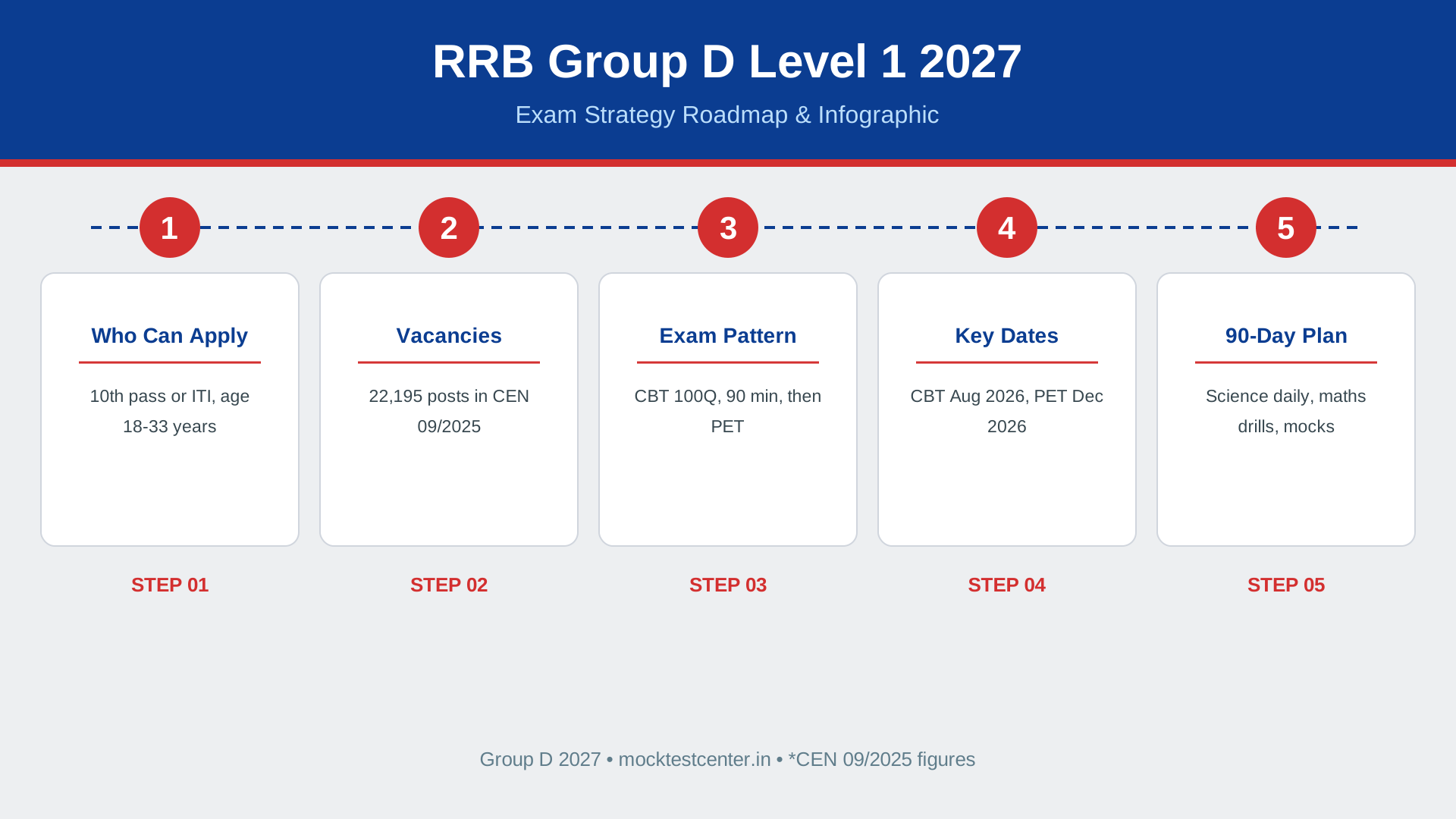
The rules below are from CEN 09/2025, and they are likely to stay the same in 2027. First, your education must be a Class 10 pass, or ITI, or an equivalent qualification, or a National Apprenticeship Certificate granted by NCVT, held on or before the closing date of applications.
Second, your age must be 18 to 33 years as on 1 January 2026. For the general and EWS groups, this means you must have been born between 2 January 1993 and 1 January 2008. Age relaxation is given as follows: OBC Non Creamy Layer gets 3 years, SC and ST get 5 years, ex-servicemen get 3, 6, or 8 years after their service is taken off, and persons with benchmark disabilities get 10, 13, or 15 years. Serving railway staff, widowed or divorced women, and Course Completed Act Apprentices also get age relaxation as per the notice.
Third, you must meet the medical standard of the post. Pointsman B needs A-2, Assistant Track Machine needs A-3, workshop posts need C-1, and most other posts need B-1. LASIK surgery bars you from A-2 and A-3 posts. The fee was Rs. 500 for all candidates, of which Rs. 400 is refunded, less bank charges, if you appear in the test. For SC, ST, ex-servicemen, PwBD, female, transgender, minority, and EBC candidates, the fee was Rs. 250, refunded on appearing. The fee to change your form was Rs. 250 per change.
- Education: Class 10 pass, ITI, or NAC, held by the closing date
- Age: 18 to 33 years as on 1 January 2026; relaxation as per rules
- Medical: A-2 for Pointsman B, A-3 for Assistant Track Machine, C-1 for workshop posts, B-1 for the rest
- Fee: Rs. 500 for all, Rs. 250 for reserved groups
Posts and vacancies
The latest cycle, CEN 09/2025, announced 22,195 posts in Level 1, with an initial pay of Rs. 18,000. There are 14 post categories in the notice. The largest share is Track Maintainer Grade IV, with 11,032 posts, which is about half of all the posts. Pointsman B is next, with 5,053 posts. The rest are Assistant posts in many trades and shops.
The table below gives the post wise figures as reported from the notice. This table must be checked against Annexure B of CEN 09/2025 before publishing, because the full 14 category split needs a direct check of the official annexure. The figures below are secondary sourced, and the workshop category figures in particular need that check. Do not treat this table as final until Annexure B has been read. For 2027, no vacancy number has been announced yet. Do not believe any website that gives a 2027 vacancy number today. The 2027 notice is awaited. The earlier cycle, CEN 08/2024, had 32,438 posts.
| Post | Posts |
|---|---|
| Track Maintainer Grade IV | 11,032 |
| Pointsman B | 5,053 |
| Assistant (S and T) | 1,509 |
| Assistant (Carriage and Wagon) | 1,000 |
| Assistant (TRD) | 800 |
| Assistant Operations (Electrical) | 604 |
| Assistant (Bridge) | 600 |
| Assistant (Track Machine) | 597 |
| Assistant (TL and AC) | 500 |
| Assistant (P.Way) | 300 |
| Assistant Loco Shed (Electrical) | 200 |
| Total (14 categories, CEN 09/2025) | 22,195 |
Exam pattern
There are four stages: the computer based test, the physical efficiency test, the document verification, and the medical test. The computer based test is Stage 1. It has 100 questions for 100 marks, and you get 90 minutes. Each wrong answer takes away one third of a mark. The qualifying marks are 40 percent for UR and EWS, 30 percent for OBC Non Creamy Layer, 30 percent for SC, and 30 percent for ST. Scores are normalised across shifts.
Stage 2 is the physical efficiency test, called PET, which is qualifying only and gives no marks. About three times the number of posts are called for the PET. Men must lift and carry 35 kg for 100 metres in 2 minutes in one chance, and then run 1,000 metres in 4 minutes 15 seconds. Women must lift and carry 20 kg for 100 metres in 2 minutes, and then run 1,000 metres in 5 minutes 40 seconds. Persons with benchmark disabilities, ex-servicemen, and Course Completed Act Apprentices are exempt from the PET. Then comes document verification and the medical test, both run by the RRCs.
| Stage | Test | Detail |
|---|---|---|
| 1 | Computer based test | 100 questions, 100 marks, 90 minutes, 1/3 negative marking |
| 2 | Physical efficiency test | Qualifying only, run by RRCs, 3 times the posts called |
| 3 | Document verification | Run by RRCs |
| 4 | Medical test | Run by RRCs, as per post standard |
Syllabus
The syllabus has four parts, all at Class 10 level. General Science covers Physics, Chemistry, and Life Sciences. Know the basic laws of motion, light, sound, heat, and current, and the common acids, bases, salts, and metals. Life Sciences covers the human body, plants, food, disease, and the environment.
Mathematics covers number systems, percentages, ratios, averages, simple and compound interest, profit and loss, time and work, time speed and distance, mensuration, algebra, geometry, and data interpretation. Reasoning covers analogies, series, coding, blood relations, directions, and puzzles. General Awareness covers history, geography, polity, economy, sports, awards, and recent news, with a focus on railways and government schemes.
Important dates
The dates below are from the CEN 09/2025 cycle. The 2027 notice has not come yet. The detailed CEN was published on 31 January 2026. Applications ran from 31 January to 9 March 2026, after the last date was extended from 2 March by Corrigendum 4. About 52,39,760 applications were received. The computer based test was held from 3 to 25 August 2026. Answer key objections ran from 7 to 17 September 2026, at Rs. 50 per question.
The computer based test result and the PET shortlist were declared on 12 November 2026, with 42,909 candidates shortlisted for the PET. The PET was expected in December 2026.
| Event | Date |
|---|---|
| CEN 09/2025 published | 31 January 2026 |
| Applications | 31 January to 9 March 2026 |
| Computer based test | 3 to 25 August 2026 |
| Answer key objections | 7 to 17 September 2026 |
| CBT result and PET shortlist | 12 November 2026, 42,909 shortlisted |
| PET | Expected December 2026, RRCs to announce |
| 2027 notice | Awaited |
Cut-off
The cut-off marks for the CEN 09/2025 cycle were not verified when this page was written. This page gives no cut-off figures, and you should not trust any website that gives exact marks today. The final cut-off depends on the posts, the candidates, the paper, and normalisation.
What you can use as a safe aim is the qualifying mark. You must score at least 40 percent if you are UR or EWS, and 30 percent if you are OBC Non Creamy Layer, SC, or ST, only to pass the computer based test. But passing is not enough, because only about three times the number of posts are called for the PET. In the last cycle, 42,909 candidates were shortlisted from more than 52 lakh applicants. So aim far above the qualifying mark.
Best books
For General Science, use the NCERT books for Classes 9 and 10 for Physics, Chemistry, and Biology, and revise them twice. For Mathematics, use a standard book on quantitative aptitude, such as the one by R. S. Aggarwal, and practise every chapter with a timer. Solve past year papers of RRB Group D and RRB NTPC for Reasoning.
For General Awareness and Current Affairs, read a daily newspaper and make short notes on railway news, government schemes, awards, sports, and important days. A monthly current affairs booklet and the Lucent general knowledge book are useful for static facts. Pick one good book per subject, finish it fully, and revise it again and again.
90-day study plan
Days 1 to 30: Build your base. Study General Science for two hours a day and Mathematics for two hours a day. Learn the NCERT science chapters and the basic maths formulas. Read the newspaper daily. Start light running daily, because the PET needs real fitness.
Days 31 to 60: Go deep. Take one full mock test every week and check every wrong answer. Revise your science notes and maths short cuts. Practise General Awareness from your notes. Build up your running to 1,000 metres at a good pace, and practise carrying weight in a safe way.
Days 61 to 90: Revise and test. Take a full mock test every two days in the last two weeks. Revise your short notes and formulas. Do not start any new book now.
How to use mock tests
Mock tests are practice tests that look like the real exam. The computer based test has 100 questions in 90 minutes, so speed decides your rank. Take them in exam like conditions: 90 minutes at one stretch, no pauses, no peeking at answers. After each mock test, spend one hour on the analysis. Note the questions you got wrong, the ones that took too long, and the science facts you missed. Aim to attempt at least 90 questions with good accuracy, because negative marking punishes blind guessing. Give more time to your weakest part in the next week.
If you are also getting ready for other railway exams, you can see RRB NTPC 2027, RRB ALP 2027, RRB JE 2027, RRB Technician 2027, RRB Paramedical 2027, RRB Ministerial and Isolated Categories 2027, RRB Station Master 2027, RRB Section Controller 2027, RPF Constable 2027 and SSC GD 2027 on this site. Apply only on rrbapply.gov.in and check notices on rrb.indianrailways.gov.in.
A last word
RRB Group D is the biggest door into Indian Railways for Class 10 pass youth. The posts are many, the work is real, and the job is stable for life. Do not wait for the 2027 notice to start. The last cycle moved fast from notice to exam in about six months. Build your science base now, practise maths daily, keep your body fit for the PET, and check rrb.indianrailways.gov.in every week.