About MP ANM GNM 2027 Exam Series
📖 Table of Contents
- MP ANM GNM 2027 at a glance
- Two tests, never one combined test
- The 2026 rule change that ended the entrance tests
- What MP ANM GNM 2027 admission looks like
- Who can apply for ANM in 2027
- Who can apply for GNM in 2027
- The old ANMTST paper, 100 questions in 2 hours
- The old GNMTST paper, and the two open conflicts
- Seats and reservation, what is known and what is not
- Counselling step by step, the part that decides admission now
- Cut offs that matter now, the 2026 merit closing lines
- Do not confuse admission with recruitment
- Subject by subject preparation for the old papers
- A 90 day plan that fits the real admission
- Five mistakes that cost ANM and GNM candidates a seat
- Where the two courses lead after the diploma
- Sources
MP ANM GNM 2027: Complete Admission Guide
The Madhya Pradesh Employees Selection Board, MPESB, used to run two separate entrance tests for nursing diplomas in the state. One test admitted girls to the Auxiliary Nurse Midwifery course, ANM, and the other admitted girls to the General Nursing and Midwifery course, GNM. This MP ANM GNM 2027 guide covers both courses in one place, because most candidates compare the two before they choose, and because the two tests shared the same board, the same 100 question paper shape, and the same counselling authority.
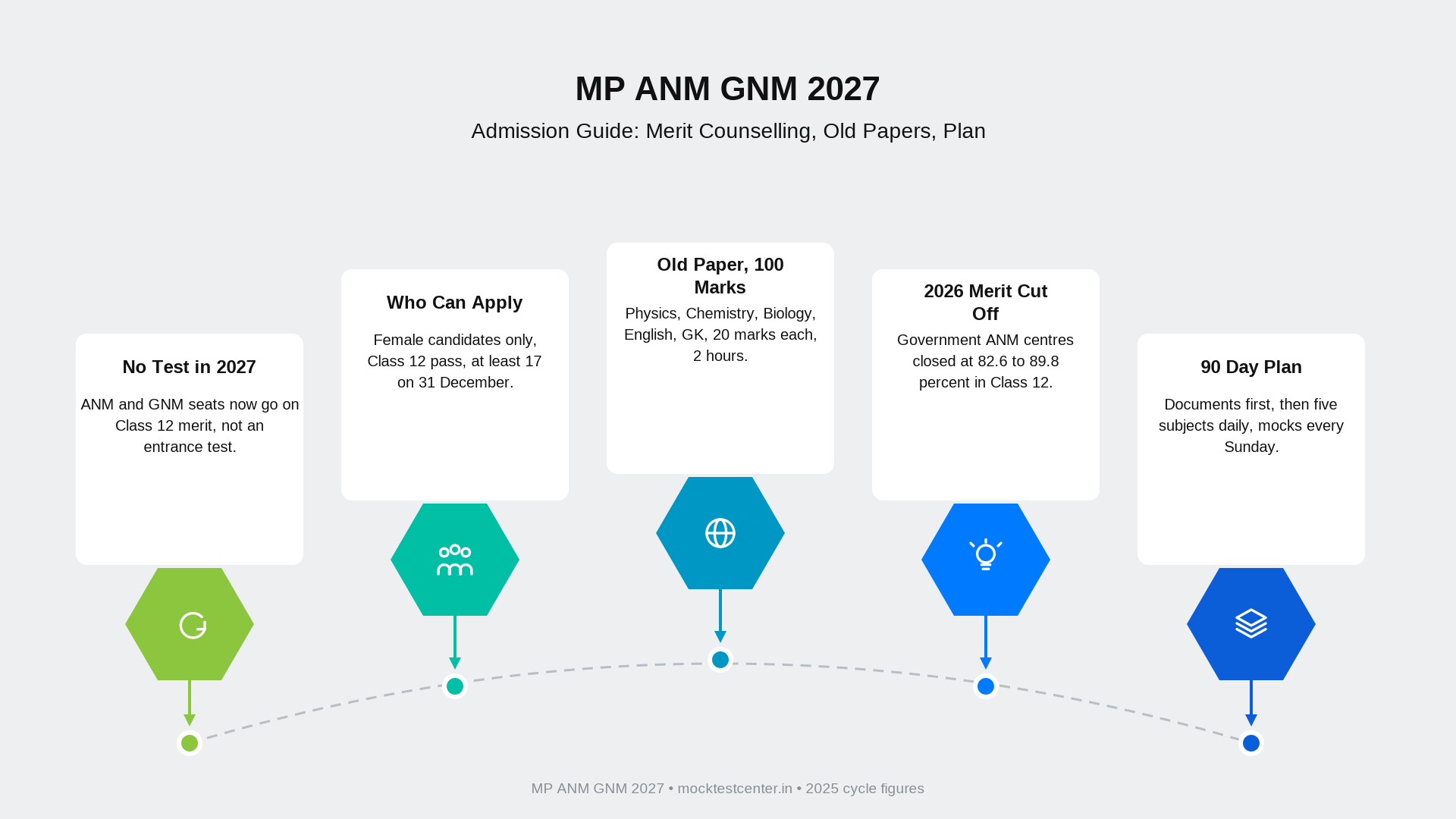
Readers who search for MP ANM GNM 2027 need one fact before anything else. The entrance tests are gone. A Gazette notification of 11 May 2026 amended the Madhya Pradesh Nursing Educational Institutions Admission Rules, 2024, and under the amended rules the Pre Nursing Selection Test, PNST, for B.Sc Nursing is the only nursing entrance examination left in the state. ANM seats and GNM seats are now filled on Class 12 merit through online counselling run by the Madhya Pradesh Nurses Registration Council, MPNRC, on the DME MPOnline portal. No ANMTST was held in 2026, and no GNMTST was held in 2026 either, as far as any published record shows. The last ANMTST was held on 18 June 2025, and the last combined PNST and GNMTST round ran from 24 June to 27 June 2025.
That change makes this MP ANM GNM 2027 guide more useful, because most pages on the internet still describe the old tests as if they were still running, and a candidate who follows a stale page can wait for an application form that never opens. This MP ANM GNM 2027 guide records the old papers in full, because the old 100 question papers are still the best practice material for PNST, which tests the same five subjects, and because the 2027 admission will still be decided by a merit list, a choice filling round, and a document check. The only thing that changed is the ranking. Your Class 12 percentage is now the entrance test.
The second fact that trips up candidates is the name of the game. ANM and GNM admission is not a government job recruitment. No salary is offered, no appointment letter is issued, and no vacancy count in the job sense exists. Admission buys a seat in a training course, and the course leads to a diploma, registration with the nursing council, and then eligibility for staff nurse and ANM job tests such as MPESB Group 5 and the National Health Mission contract posts. Candidates who confuse admission with recruitment apply in the wrong place and miss the counselling window. This MP ANM GNM 2027 guide keeps the two apart throughout.
MP ANM GNM 2027 at a glance
| Detail | ANM, 2027 admission | GNM, 2027 admission |
|---|---|---|
| Full course name | Auxiliary Nurse Midwifery, 2 year diploma | General Nursing and Midwifery, 3 year diploma |
| Old entrance test | ANM Training Selection Test, ANMTST | GNM Training Selection Test, GNMTST |
| Last test held | 18 June 2025 | 24 June to 27 June 2025, with PNST |
| Test in 2026 | Not held, merit counselling instead | Not held, merit counselling instead |
| Admission route 2027 | Class 12 merit, MPNRC counselling, expected August 2027 | Class 12 merit, MPNRC counselling, expected August 2027 |
| Who can apply | Female candidates only, Class 12 pass, at least 17 years old on 31 December of the admission year | Female candidates only, Class 12 with Physics, Chemistry and Biology |
| Old paper | 100 questions, 100 marks, 2 hours, no negative marking | 100 questions, 100 marks, 2 hours, negative marking disputed |
| Old fee, 2025 | Rs 460 general, Rs 260 reserved | Rs 460 general, Rs 260 reserved, per the admit card trackers |
| Counselling body | MPNRC with the Directorate of Medical Education, DME | MPNRC with the Directorate of Medical Education, DME |
| Counselling portal | dme.mponline.gov.in | dme.mponline.gov.in |
| Official board site | esb.mp.gov.in, for old papers and PNST | esb.mp.gov.in, for old papers and PNST |
Read the table as the skeleton and the rest of this MP ANM GNM 2027 guide as the flesh. The 2027 dates are expected months drawn from the 2026 counselling, because no 2027 notice has been issued yet. The old test facts belong to the 2025 cycles, and every one of them is flagged by source in the package notes, because the official rulebooks were not readable directly from this machine and the trackers disagree on several points.
Two tests, never one combined test
Search results often lump ANM and GNM together, and some pages even call them one combined MPESB test. That is wrong, and the error matters, because the two courses differ in length, in eligibility, and in what happens after the diploma. ANMTST was a standalone test for the ANM course alone. GNMTST was a separate test for the GNM course, and in 2025 it was run together with PNST, the B.Sc Nursing test, under one application window, not under one paper. A candidate applied for GNMTST or for PNST, and the two tests had different eligibility rules and different seat matrices.
ANM is the shorter course. It runs for 2 years and trains a female health worker for community health, maternal care, child care, immunisation, and basic care at primary health centres and sub centres. The training happens in government Female Health Worker training centres attached to district hospitals, and in private nursing institutions approved by the council. The ANM diploma is the entry ticket to ANM posts in the National Health Mission and in state health services, and to further study in GNM for candidates who want to move up.
GNM is the longer course. It runs for 3 years, with a 6 month internship at many colleges, and it trains a staff nurse for hospital wards, operation theatres, emergency care, and community postings. One college page records its GNM course as 3 years and 6 months in total, which is the same 3 year course plus the internship counted inside the duration, so candidates should read the duration line of their own college rather than assume a single figure. The GNM diploma, with registration, is the qualification for staff nurse posts in government hospitals, and it is also the base qualification for Post Basic B.Sc Nursing later.
The two courses also differ in who they take. ANM admission under the amended 2026 rules needs only a Class 12 pass, with no minimum percentage and no science stream condition in the rule text, and candidates from a state recognised State Open School and from NIOS are eligible. GNM admission needs Class 12 with Physics, Chemistry and Biology, and the trackers record a minimum percentage that ANM no longer carries. The eligibility sections later in this guide give the exact figures and the conflicts between the trackers, because a candidate who reads only one source can be turned away at the document check for a rule that no longer exists.
Both courses admit female candidates only. That rule is stated in the amended admission rules for ANM, and every tracker records it for both tests. Male candidates cannot apply for ANM or GNM admission in Madhya Pradesh, and no relaxation of that rule appears in any source. Male candidates who want a nursing career in the state look to B.Sc Nursing through PNST, where the eligibility rules are separate, or to paramedical courses outside nursing.
The 2026 rule change that ended the entrance tests
The change arrived quietly, in a Gazette notification dated 11 May 2026, and it rewrote the admission rules for the whole state. The Madhya Pradesh Nursing Educational Institutions Admission Rules, 2024, were amended so that the only nursing entrance examination in the state is PNST, conducted by MPESB for B.Sc Nursing. ANM and GNM seats are filled on a merit list of Class 12 percentage. The amendment also rewrote the merit rules for ANM, and the MPNRC counselling that followed in August and September 2026 ran entirely on those rules.
The 2026 ANM counselling shows how the new system works in practice. Registration on the DME MPOnline portal ran on 25 and 26 August 2026. The state merit list followed, and Round 1 seat allotment came on 5 September 2026. The final round allotment was published on 19 September 2026, with reporting to the allotted institution by 22 September 2026. Candidates who already held a seat could opt for an upgrade against vacancies before the final round. If seats were still vacant after the last round, the rules allowed one more round with fresh registration, and candidates who already held a seat could not take part in it.
PNST, by contrast, did run in 2026, and its dates prove that the board kept the one test the rules kept. Registration for PNST 2026 ran from 9 June to 23 June 2026. The admit card came on 3 July 2026. The exam ran from 10 July to 13 July 2026. The result was declared on 7 August 2026, the DME merit list came on 27 August 2026, and the final round merit list came on 11 September 2026. A candidate who wants a nursing entrance test in Madhya Pradesh in 2027 should therefore look at PNST, not at ANMTST or GNMTST, and should prepare on the five subject paper that PNST and the old ANMTST shared.
No GNMTST 2026 examination appears in any published record found for this guide. College pages written before the rule change still list GNMTST 2026 dates as tentative, June 2026 for the exam and August 2026 for the result, and one college page still says its GNM admission is through the MP GNMTST state level entrance exam. Those pages are stale. The AglaSem admission page, updated in October 2026, states plainly that ANM and GNM seats go on Class 12 merit under the amended rules, and the 2026 state nursing counselling covered B.Sc Nursing, GNM, ANM, M.Sc Nursing and Post Basic B.Sc Nursing together in one extended final round that closed on 12 November 2026, with reporting extended to 15 November 2026. That single counselling is the system now.
The honest caveat is that rules can change again. Nothing has been announced for 2027, and a test would need a fresh notification to return. Candidates should check the MPNRC counselling portal and esb.mp.gov.in in the months before August 2027, and should treat any page that promises an ANMTST or GNMTST 2027 exam date as a guess until the board or the council prints it.
What MP ANM GNM 2027 admission looks like
No 2027 notice has been issued yet, and the dates in this section are expected months based on the 2026 counselling, not announced dates. Registration for the 2027-28 session is expected in August 2027 on the DME MPOnline portal, the state merit list is expected in August 2027, Round 1 allotment is expected in September 2027, and the final round allotment is expected in September 2027. Those are the months the 2026 cycle used, and the 2027 cycle is expected to follow the same route unless the rules change again.
The steps are simple, and the simplicity is the trap. Create a profile on the DME MPOnline portal in the MPNRC Nursing Admission Counselling section when registration opens, and fill in the Class 12 marks, category, and other details inside the notified window. Check the common rank and the state rank in the state merit list when it is published. Fill and lock the choices of institutions in the choice filling window, in true order of preference, because the computer allotment matches rank against locked choices and a careless order wastes a good rank. Download the allotment letter, report to the allotted institution for document verification, and pay the fee at that institution by the given date.
The counselling registration fee for 2027-28 will be given in the schedule when it is published, and this guide does not guess it. The 2026 portal also offered a Forgot Password option for candidates who lost their login details, so candidates should keep the application number and password safe from the day of registration. The merit list is a PDF on the portal, with no individual scorecard, and it shows the common rank, the state rank, the Class 12 percentage, the application number, the candidate name, the date of birth, the eligible category, and the domicile for each candidate.
One practical point decides many admissions. The merit list ranks candidates only on Class 12 percentage, so a candidate cannot improve her rank after the board results are out. The work that matters for 2027 is already done in the Class 12 examination hall, and the work that remains is administrative: register on time, fill choices carefully, keep documents ready, and report on the date printed on the allotment letter. A candidate who misses the registration window by a day has no test to fall back on.
Who can apply for ANM in 2027
The amended rules are short, and their shortness is good news for many candidates. A candidate can apply for ANM admission in 2027 if she has passed Class 12, if she is a female candidate, and if she is at least 17 years old on or before 31 December of the admission year. Candidates from a state recognised State Open School and from NIOS are also eligible. The amended rules list no minimum Class 12 percentage for ANM, and they list no maximum age.
That last point needs care, because the old rulebook said something else, and old pages still print the old rule. Careers360, writing about the 2026 test before the rule change, recorded a minimum age of 17 years on 31 December of the admission year and a maximum age of 35 years for ANM, plus a Class 12 pass in the science stream with Physics, Chemistry and Biology at 45 percent marks, 40 percent for reserved category candidates. The 2025 rulebook summary on SarkariResult records only that the candidate must have passed or be appearing in the Class 12 examination with the PCB stream, with no percentage and no maximum age stated. The AglaSem page, which quotes the amended 2026 rules directly, says the amended rules list no minimum Class 12 percentage for ANM. This guide follows the amended rules, because they are the rules in force, and it records the old figures here so that a reader who meets them on another page knows where they came from.
The practical meaning is plain. A girl who passed Class 12 in any stream can apply for ANM in 2027, and her rank will come from her percentage alone. A girl with 89 percent in the arts stream outranks a girl with 82 percent in the science stream, because the merit list counts percentage and nothing else. That is a sharp break from the test years, when Physics, Chemistry and Biology decided the rank, and it changes who should apply. Girls who never took science in Class 12, and who were shut out of ANMTST, are now in the race.
Two more conditions from the old test years still matter as background, even though they are not in the amended eligibility text quoted here. Reservation for ASHA workers applied to 25 percent of the total seats sanctioned in government ANM training under the old rules, and married women could also apply. Candidates who claim an ASHA seat or any other reserved seat should check the 2027 counselling schedule for the current reservation table, because the schedule, not this guide, is the authority on seats.
Documents decide admission at the end, whatever the eligibility line says. The old application asked for a colour photograph, a signature, a handwritten undertaking, the Class 10 marksheet, the Class 12 marksheet, a domicile certificate issued by the Madhya Pradesh government, a caste certificate issued by the Sub Divisional Officer where required, and an EWS certificate issued by the Madhya Pradesh government where required. The MP Online helpdesk number printed on the old pages was 0755 6720200. Candidates should keep every one of those documents ready before registration opens, because the choice filling window is short and a missing certificate cannot be made in a day.
Who can apply for GNM in 2027
GNM keeps the science condition that ANM dropped. A candidate must have passed Class 12 in the 10 plus 2 system with Physics, Chemistry and Biology from a recognised board, and must be a female candidate. The minimum age is 17 years, and the trackers disagree on the reference date and on the maximum age, so this guide prints both versions and says which one it follows.
CollegeDekho, writing on the 2025 GNMTST and PNST cycle, records the GNM age as 17 years minimum and 27 years maximum as on 1 July 2025, with a 5 year relaxation for SC, ST and OBC categories, and the GNM qualification as Class 12 with at least 40 percent marks, Physics, Chemistry and Biology as core subjects, with a 5 percent relaxation for the reserved category. Careers360, writing on the 2026 cycle before the rule change, records the GNM qualification as Class 12 with Physics, Chemistry and Biology at a minimum of 45 percent for the general category and 40 percent for reserved categories, and the age as at least 17 years old as of 31 December in the year of admission, with no maximum age stated. The two sources therefore disagree on the minimum percentage, 40 percent against 45 percent, and on the age reference date, 1 July against 31 December, and on whether a maximum age exists at all.
This MP ANM GNM 2027 guide uses the CollegeDekho figures, 40 percent minimum with a 5 percent relaxation, and age 17 to 27 as on 1 July of the admission year, because CollegeDekho prints a full GNM column beside the PNST column and its figures match the shape of a state nursing rulebook, while Careers360 prints the same 45 percent figure for both ANM and GNM and looks like a carried over line. That is a judgement call, and the upload pre check should confirm the GNM percentage and the age reference date against the 2027 counselling schedule before this package goes live. A candidate sitting on 41 percent should not be told she is out, and a candidate of 28 should not be told she is in, on the strength of one tracker.
English matters for GNM in a way it does not for ANM. One college page records that a GNM candidate must have passed English as a compulsory subject in the qualifying examination, and the PNST column beside the GNM column in the same tracker makes English a core subject for B.Sc Nursing. A GNM candidate who passed Class 12 without English should check the schedule before registering, because the document check will ask for the English mark.
Medical fitness is a condition for both courses. CollegeDekho records that all students must be medically fit for GNM and for PNST, and the document list for the old application included a medical fitness certificate and a state domicile certificate issued by a district medical board of Madhya Pradesh. Candidates should get the fitness certificate from a government hospital, not a private clinic, and should keep the domicile certificate ready, because the reserved category fee and the reserved seats both turn on Madhya Pradesh domicile.
The old ANMTST paper, 100 questions in 2 hours
The last ANMTST, held on 18 June 2025, is the paper this guide uses as the practice model, and its pattern is one of the best verified facts in this package. The test was held offline, in pen and paper format, with 100 multiple choice questions carrying 1 mark each, for a total of 100 marks, in 2 hours. There was no negative marking. The subjects were Physics, Chemistry, Biology, General English, and General Knowledge, 20 questions and 20 marks each, all at Class 12 level.
| Subject | Questions | Marks |
|---|---|---|
| Physics | 20 | 20 |
| Chemistry | 20 | 20 |
| Biology | 20 | 20 |
| General English | 20 | 20 |
| General Knowledge | 20 | 20 |
| Total | 100 | 100 |
Three trackers agree on that table without a single dissent, Careers360, ToppersExam, and AglaSem, which adds that the 2024 and 2025 papers both had the same five subjects in the same 20 mark split. The 2024 paper ran from 2 September to 6 September 2024 in 10 shifts, and the 2025 paper ran on 18 June 2025 in 2 shifts. MPESB has published both question books on its website, and the 2024 book carries answers while the 2025 book is the question book alone. Those two books, plus the 2016 papers the board also publishes, are the practice set for this package, and the mock tests on this site follow the same five subject split.
The 2025 cycle dates are also well verified, and they show how short the window was. Applications ran from 15 May to 29 May 2025, with the fee payable by 29 May 2025. The correction window closed on 3 June 2025. The admit card came on 12 June 2025, six days before the test. The exam started on 18 June 2025. The whole cycle, from the first application to the test, lasted barely five weeks, and a candidate who found the notice late had about two weeks to apply.
The fee for the 2025 test is a point of conflict that this guide settles by weight of evidence. SarkariResult, MyCoaching, AdmitCards, SarkariJobers, and OTRForm all record Rs 460 for the general category and other state candidates, and Rs 260 for the MP reserved category, payable through the MP Online kiosk in cash or by debit card, credit card, net banking, or UPI. Careers360 records Rs 400 for general and Rs 200 for SC, ST, OBC, PwD and EWS, with portal charges of Rs 60 through a kiosk and Rs 20 through a registered citizen user. The 460 and 260 figures appear on the pages that reproduce the 2025 notice line by line, while the 400 and 200 figures appear on a page written before the 2025 notice, so this MP ANM GNM 2027 guide uses Rs 460 and Rs 260 and flags the 400 and 200 figures as stale. The portal charges of Rs 60 and Rs 20 are consistent across the sources.
The test ran in 9 cities, and candidates could choose 4 of them in order of preference. The list was Bhopal, Indore, Jabalpur, Gwalior, Ujjain, Sagar, Satna, Rewa, and Ratlam. That list appears identically on SarkariResult, Careers360, and the other 2025 pages, and it is the same 9 city list used for the PNST and GNMTST round. The exact centre and its address appeared only on the admit card, so no candidate knew the venue until the card arrived.
Qualifying in the old test did not mean a fixed mark. The board set a minimum qualifying percentile, and Careers360 records it as the 50th percentile for the general and EWS categories, the 45th percentile for PwD candidates in the general category, and the 40th percentile for SC, ST and OBC candidates. A percentile ranks a candidate against the other candidates. The same score could qualify in one year and fail in the next. The merit list that followed showed the state rank, the ANMTST rank, the name and roll number, the total proportionate marks, and the total percentile for each candidate.
The old GNMTST paper, and the two open conflicts
The GNMTST paper is harder to pin down than the ANMTST paper, and this guide says so plainly rather than smoothing the gap. Every source agrees on the frame: 100 multiple choice questions, 100 marks, 1 mark per question, 2 hours, in English and Hindi. The sources disagree on the mode, on the subject split, and on negative marking, and those three disagreements change how a candidate should practise.
On mode, Careers360 says the GNMTST exam is conducted online, while CollegeDekho says the 2025 GNMTST and PNST exams were conducted from 24 June to 27 June 2025 in a pen and paper format, and Scroll, reporting the admit card, says the exams would be held on 24 June 2025 in two shifts from 10.30 AM to 12.30 PM and from 3 PM to 5 PM. The pen and paper account fits the shift timings and the four day window, and the online label on the Careers360 page reads like a carried over line from an earlier year, so this guide treats the 2025 test as offline. The 2024 ANMTST ran in 10 shifts over five days, which also fits an offline test with limited centres, not a computer test.
On subjects, CollegeDekho lists the GNMTST subjects as General Knowledge, Biology, Mathematics, and English, with no Physics and no Chemistry, while its PNST column lists General Knowledge, Biology, Physics, Chemistry, Mathematics, and English. Careers360 gives no subject split for GNMTST at all, only the 100 question total, and the college pages that describe GNM admission say the test consists of 100 multiple choice questions covering Physics, Chemistry, Biology, English, and General Knowledge, which is the ANMTST split, not a GNM split. No source prints a GNMTST question count per subject, so this guide does not invent one. The MP ANM GNM 2027 mock tests on this site follow the verified shared core, Physics, Chemistry, Biology, English, and General Knowledge, because that is the split the board used for ANMTST and for PNST, and because a GNM candidate who masters those five subjects is covered whichever split the old paper used. The Mathematics claim in CollegeDekho is flagged here as unverified, and a candidate who wants certainty should work the old GNMTST question book on the board website.
On negative marking, the conflict is direct. Careers360 records the GNMTST marking as plus 1 for each correct answer with no negative marking. CollegeDekho records the GNMTST marking as 1 mark for each correct answer and 0.25 marks deducted for each incorrect response, while its PNST column records no marks deducted for incorrect responses. One of the two is wrong, and this guide cannot settle it from the sources available, because no rulebook was readable directly. The ANMTST side is clean, with no negative marking on every source, and the PNST side is clean too, with no negative marking on CollegeDekho. Only GNMTST carries the 0.25 claim, from a single tracker. Candidates using this MP ANM GNM 2027 package should practise as if a wrong answer costs a quarter mark on the GNM paper, because that is the cautious reading, and should confirm the rule against the official notification at the upload pre check.
The 2025 combined cycle dates are well verified. Applications for PNST and GNMTST ran from 19 May to 2 June 2025, with the correction window open to 7 June 2025. The admit card date is a small conflict: CollegeDekho says 20 June 2025, MyCoaching says 18 June 2025, and Scroll, reporting on the day the cards came out, does not give a date in the text retrieved. The exam ran from 24 June to 27 June 2025, and the result was released on 25 July 2025. The merit list was expected in August 2025 and counselling was expected to start in September 2025.
The fee for the combined 2025 cycle is a three way conflict. Scroll, reporting at the time of registration, says Rs 400 for the general category and Rs 200 for reserved categories. CollegeDekho says Rs 500 for the unreserved category and Rs 250 for SC, ST, PwD and OBC. MyCoaching, reproducing the admit card notice, says Rs 460 for general and other states and Rs 260 for the MP reserved category. The 460 and 260 figures match the ANMTST 2025 fee exactly, and the ANMTST fee is the best verified fee in this package, so this guide uses Rs 460 and Rs 260 for GNMTST 2025 as well, and flags the 400 and 200 figures and the 500 and 250 figures as conflicting tracker readings. The upload pre check should confirm the fee against the official notification.
Seats and reservation, what is known and what is not
No verified total seat count for ANM admission in Madhya Pradesh was found for this MP ANM GNM 2027 guide, and this guide does not invent one. The seat matrix for ANM is published college by college on the counselling portal in each round, and the total moves with the number of approved training centres. A page that prints a single ANM seat total for the state without a source is guessing, and candidates should not plan on it.
For GNM and B.Sc Nursing together, CollegeDekho prints a total of 1,040 seats for the 2025 GNMTST and PNST round, and then prints a category table that does not add up to that total. The table gives 283 unreserved seats, 168 SC seats at 16 percent, 210 ST seats at 20 percent, 105 EWS seats at 10 percent, and 284 OBC seats, which sum to 1,050, ten more than the headline total. One of the two figures is wrong by ten seats, and this guide prints both and flags the gap rather than silently fixing it. The PwD reservation is recorded as 5 percent in each category, and the table also notes women students and ex servicemen as per state regulations, without numbers.
The reservation percentages themselves are consistent across the sources and worth learning. SC holds 16 percent, ST holds 20 percent, EWS holds 10 percent, and OBC holds the largest single block in the table at 284 seats. The ST share is high because Madhya Pradesh has large tribal districts, and the OBC block is large because the category is large in the state. A general category candidate competes for 283 of the 1,040 seats in that table, which is just over a quarter, and the competition for those seats is the sharpest in the round.
The ANM reservation that is verified is the ASHA reservation. Under the old rules, 25 percent of the total seats sanctioned in government ANM training went to ASHA workers. That is a large block, and it explains why government FHW training centres are hard to get for a general candidate. The 2027 counselling schedule will carry the current reservation table, and MP ANM GNM 2027 candidates should read it before filling choices, because a seat that looks open in the general list may be reserved in the schedule.
Seat allotment in the merit system follows a simple computer match. The system takes the merit rank, walks down the locked choices in the order the candidate gave them, and allots the first seat that is still free in the candidate category. A candidate who locks a popular government centre first and a private college second will get the private college only if the government centre is full by her rank. A candidate who locks only one centre and misses it gets nothing in that round, even with a good rank. The lesson is to lock a full list, in true preference order, with safe choices at the bottom.
Counselling step by step, the part that decides admission now
Counselling is conducted by the Madhya Pradesh Nurses Registration Council, Bhopal, with the Directorate of Medical Education, and it runs on the DME MPOnline portal. The steps below follow the 2026 ANM counselling as recorded by AglaSem and the 2026 state nursing counselling as recorded by the campus trackers, and they are the steps a 2027 candidate should expect.
Registration opens first, and it is online only. Create a profile with the basic details, then log in with the application number and password. Fill in the Class 12 marks, the category, and the other details, and complete the registration inside the notified window. In 2026 the ANM registration ran on 25 and 26 August, which is two days only, so a candidate who waits for a reminder will miss it. The portal also offered a Forgot Password option, which is worth noting only because candidates do lose passwords in a two day window.
The state merit list comes next, as a PDF on the portal. It shows the common rank, the state rank, the Class 12 percentage, the application number, the candidate name, the date of birth, the eligible category, and the domicile. There is no individual scorecard. A candidate who cannot find her name should check the spelling of her name and the application number first, and then check whether she registered in the right course section, because ANM and GNM have separate counselling sections on the same portal.
Choice filling follows the merit list. Fill and lock the choices of institutions in the window given, in true order of preference. The 2026 ANM cycle ran Round 1 allotment on 5 September and the final round allotment on 19 September, with reporting by 22 September. The extended final round for all nursing courses in 2026 ran later, with provisional allotment lists on 28 October, reporting first due on 12 November at 6 PM, and then extended to 15 November at 5 PM by an MPNRC circular dated 12 November. That extension shows that late rounds do happen, and that a candidate who misses Round 1 should stay in the process for the later rounds.
Allotment is followed by reporting. Download the allotment letter, report to the allotted institution for document verification, and pay the fee at that institution by the given date. The institution admission committee checks the documents and issues the admission order online. If seats are still vacant after the last round, the rules allow one more round with fresh registration, and candidates who already hold a seat cannot take part in it. That rule matters for a candidate who holds a private college seat and hopes for a government seat in a later round: the upgrade option before the final round is the route, not a fresh registration.
The documents for verification are the same list the old application asked for, and candidates should carry originals plus photocopies. Class 10 marksheet, Class 12 marksheet, domicile certificate, caste certificate where claimed, EWS certificate where claimed, medical fitness certificate, photograph, signature, and the allotment letter itself. A missing caste certificate at this stage ends the chance, and the seat goes to the next candidate in the list.
Cut offs that matter now, the 2026 merit closing lines
Under a merit system, the cut off is a Class 12 percentage, not a test score, and the 2026 final round closing list is the most useful document a 2027 candidate can read. For an unreserved general seat in a government FHW training centre, the 2026 final round closed between 82.6 percent and 89.8 percent in Class 12, from the official final round opening and closing list of 19 September 2026.
The centre by centre figures show how steep the climb is. FHW Training Centre at the District Hospital in Mandla closed at 89.8 percent, with a closing common rank of 15. Shahdol closed at 88.6 percent, rank 29. Tikari in Betul closed at 87.4 percent, rank 46. Dhar closed at 84.4 percent, rank 101. J.S.R. Itarsi closed at 84.2 percent, rank 107. Panna closed at 83.8 percent, rank 114. Shivpuri closed at 83.8 percent, rank 117. Sehore closed at 83.6 percent, rank 140. Morena closed at 83.4 percent, rank 144. Ashoknagar closed at 83.2 percent, rank 147. Burhanpur closed at 83 percent, rank 164. Tikamgarh closed at 82.8 percent, rank 165. Barwani closed at 82.6 percent, rank 174.
Reserved categories closed lower, and the Ashoknagar centre shows the gap in one place. The unreserved seat closed at 83.2 percent, rank 147. The OBC seat closed at 83 percent, rank 155. The EWS seat closed at 80 percent, rank 345. The SC seat closed at 78 percent, rank 493. The ST seat closed at 74 percent, rank 853. A candidate with 80 percent in Class 12 is therefore out of the race for a government centre in the unreserved list, and in the race for the same centre under the EWS list, and comfortably in under the ST list. Category changes the target by nine percentage points at a single centre.
Private institutions closed lower than government centres, and the other category codes are in the full list on the portal. Cut offs change every year with the number of applicants and the number of seats, so a 2027 candidate should treat the 2026 figures as a target, not a promise. The practical target is simple: a general candidate who wants a government FHW centre should aim for 85 percent or more in Class 12, and a candidate below 80 percent should plan her choices around private institutions and the later rounds.
The old test qualifying percentiles are still worth knowing, because they show how the board thought about merit before the rule change. The general and EWS qualifying line was the 50th percentile, the PwD line in the general category was the 45th percentile, and the SC, ST and OBC line was the 40th percentile. Those lines are dead for ANM and GNM admission now, but they live on in PNST, and a candidate who also sits PNST will meet them there.
Do not confuse admission with recruitment
Three different MPESB and NHM processes carry the ANM and GNM names, and they are easy to confuse. This guide covers admission to the ANM and GNM courses. The other two processes are job recruitments, and they need a diploma already in hand.
The first job process is the MPESB Group 5 Staff Nurse, Paramedical and Other Equivalent Posts Combined Recruitment Test. The 2026 cycle filled 291 posts, with applications from 13 March to 27 March 2026 and the exam from 15 April 2026 onwards in two shifts. One tracker records the application start as 16 March 2026, which conflicts with the 13 March date, and the exam pattern is a single online paper of 100 marks in 2 hours, with 25 marks of general subjects and 75 marks of technical subject, and 0.25 marks deducted for each wrong answer. Staff Nurse posts in that test need a GNM diploma or a B.Sc Nursing degree with registration, and ANM posts in the earlier Group 5 cycles needed an ANM course plus registration. The age was 18 to 40 years as on 1 January 2026, with the upper limit at 45 for reserved categories, and the fee was Rs 500 for unreserved and Rs 250 for reserved candidates. The result came on 10 June 2026.
The second job process is the National Health Mission, NHM, contract recruitment for Staff Nurse and ANM posts in the Health and Family Welfare Department. One tracker page records 5,215 Staff Nurse posts and 2,551 ANM posts in one cycle, with applications from 1 June to 22 June 2025, an age of 21 to 40 years, a written exam of 100 questions for 100 marks in 120 minutes with 0.25 negative marking, and a salary of Rs 20,000 for Staff Nurse and Rs 12,000 for ANM. Another page on the same site records 5,835 posts in total, with 620 ANM, 2,664 Staff Nurse, and 2,551 Lab Technician posts, which does not match the first page. Both pages are stale and internally inconsistent, and this guide prints the figures only to warn readers, not as facts to rely on. The NHM posts are contract posts, not permanent government posts, and the selection includes a written exam and document verification.
The distinction matters for planning. A girl who has just passed Class 12 should apply for ANM or GNM admission, not for a Group 5 or NHM post, because she holds no diploma yet. A girl who holds an ANM diploma should apply for ANM job posts, and a girl who holds a GNM diploma should apply for staff nurse posts. The MP ANM GNM 2027 mock tests on this site serve the admission stage, and the old 100 question papers are the practice material for that stage. Job stage preparation needs the technical syllabus of the diploma itself, which is a different book.
Subject by subject preparation for the old papers
Physics carries 20 marks in the ANMTST paper, and it is the subject that scares arts stream candidates most, which is exactly why the merit system helps them now. For PNST preparation, and for any candidate who still wants to practise the old paper, Physics at Class 12 level means units and dimensions, motion, laws of motion, work and energy, gravitation, properties of matter, heat, wave motion, light, reflection and refraction, lenses and mirrors, current electricity, magnetism, and the Bohr model of the atom. The NCERT Class 11 and 12 books cover the whole list, and a candidate who works the NCERT examples and the board questions from the last five years has seen most of what the paper can ask.
Chemistry carries 20 marks, and it rewards memory more than calculation. Structure of atoms, chemical bonds, solutions, solid state, thermodynamics, chemical kinetics, electrochemistry, Faraday laws, organic chemistry basics, and the chemistry of everyday life recur in the paper. Candidates should learn the NCERT reactions by writing them out, not by reading them, because a reaction that is only read is forgotten in the hall. The periodic table, the common reagents, and the named reactions deserve a separate notebook.
Biology carries 20 marks, and it is the heaviest subject in the paper for a nursing candidate, because it is also the subject of the course itself. Cell structure, five kingdom classification, plant and animal physiology, human anatomy, genetics, evolution, ecology, biodiversity, and the role of plants in human welfare form the core. A candidate who knows Biology well has a head start not only in the test but in the first year of the course, where the same topics return in nursing form. Read the NCERT Biology books cover to cover, and then read them again, because the paper asks from the lines between the diagrams as often as from the diagrams themselves.
General English carries 20 marks, and it is the easiest 20 marks in the paper for a candidate who reads English daily. Reading comprehension, articles and determiners, prefixes and suffixes, vocabulary, tenses, voices, prepositions and phrasal verbs, narration, common errors, and types of sentence fill the section. The English here is school level, not competitive exam level, and a Class 12 pass candidate who reads English daily clears it. The trap is neglect. Candidates who focus on science and leave English to the last week lose marks in the section where marks come cheapest.
General Knowledge carries 20 marks, and it is the section where a state candidate gains on an outsider. Current affairs of national and international importance from the six months before the exam, the history and geography of Madhya Pradesh, its districts and headquarters, its rivers and dams, its national parks and sanctuaries, and the schemes of the state government recur in the paper. A daily newspaper habit covers the current half, and a state yearbook covers the static half. Candidates should also learn the health schemes by name, because a nursing paper asks about health programmes more than a general paper does.
Mathematics appears in the CollegeDekho GNMTST subject list and not in the ANMTST list, and it is flagged here as unverified. If a GNM candidate wants cover against that claim, the topics to practise are percentages, ratios, averages, profit and loss, simple and compound interest, time and work, speed and distance, and basic mensuration, all at Class 10 level. Fifty questions a day from these topics, timed, builds the speed the paper needs. A calculator habit is the enemy here, because the exam hall has no calculator and the clock has no mercy.
A 90 day plan that fits the real admission
Start with the truth that the ranking is already fixed for 2027 candidates whose Class 12 results are out. No study plan can raise a Class 12 percentage that is already printed. The plan below is therefore two plans in one: a short plan for the counselling itself, and a longer plan for PNST, which is the one nursing entrance test that still exists, and for the first year of the course that follows admission.
Give the first two weeks of the MP ANM GNM 2027 plan to documents and choices. Collect the Class 10 marksheet, the Class 12 marksheet, the domicile certificate, the caste or EWS certificate where claimed, the medical fitness certificate, a photograph, and a signature, and check that the name and date of birth match across every document. A mismatch between the marksheet and the domicile certificate is the commonest reason a seat is lost at verification. Then list the institutions in true preference order, government FHW training centres first for ANM, government nursing schools first for GNM, and private colleges after them, with a safe choice at the bottom of the list that will still be free at your rank.
Give the next month to the five subjects, one hour each a day, with Biology first. Physics and Chemistry need daily contact, English needs daily reading, and General Knowledge needs a daily newspaper. Solve one full 100 question paper every Sunday on the real clock, 2 hours, no breaks, and review every wrong answer the same day. The review matters more than the score. A mock test without review teaches nothing, and a mock test with a careful review teaches the paper. Track the score by subject, not by total, because the total hides the weak subject. A total of 70 with 4 in Physics means the next month belongs to Physics, not to more Biology.
Keep the last month for revision and for the counselling window itself. Revisit the Biology diagrams, the Chemistry reactions, the Physics formulas, the English vocabulary lists, and the state facts. Sit a full mock test in the morning shift timing, 10.30 AM to 12.30 PM, because that was the morning shift of the 2025 round. Watch the DME MPOnline portal every day from the start of August, because the registration window in 2026 lasted two days, and a candidate who checks weekly can miss it entirely. Register on the first day, fill choices on the first day, and lock them before the window closes.
After admission, the plan changes. The first year of ANM covers community health, maternal and child care, nutrition, immunisation, and basic nursing procedures, and the first year of GNM covers anatomy, physiology, microbiology, and the foundations of nursing. A candidate who used the 90 days to learn Biology properly will find the first year familiar, and a candidate who only crammed for a test will find it foreign. The study that wins admission under the merit system is the study that also survives the course, and that is the study worth doing.
Five mistakes that cost ANM and GNM candidates a seat
The first mistake in MP ANM GNM 2027 is waiting for an entrance test that no longer exists. Pages across the internet still promise an ANMTST 2027 exam date and a GNMTST 2027 application form, and some of them were written before the Gazette notification of 11 May 2026. A candidate who waits for those forms will wait past the counselling registration, which is expected in August 2027, and will have no seat to claim. Check the MPNRC counselling portal, not a tracker page, for the 2027 dates.
The second mistake is locking too few choices. The computer allotment gives a candidate the first free seat in her locked list, in the order she locked it, and a candidate who locks only one or two popular government centres gets nothing if both are full by her rank. Lock a full list, in true preference order, with safe choices at the bottom. A private college seat in Round 1 is better than no seat in any round, and the upgrade option before the final round is the route to a better seat.
The third mistake is a document mismatch. The name on the Class 12 marksheet, the domicile certificate, and the caste certificate must match, letter by letter, and the date of birth must match across all of them. The verification committee at the allotted institution checks the documents and issues the admission order online, and a mismatch sends the seat to the next candidate. Check every document in July, while there is still time to get a correction, not in September, when the reporting date is already printed.
The fourth mistake is choosing the wrong course for the wrong reason. ANM is shorter and easier to enter, and GNM is longer and opens staff nurse posts. A candidate who wants a hospital job should choose GNM, even though it needs science in Class 12 and a higher percentage, and a candidate who wants community health work close to home should choose ANM. A candidate who chooses ANM only because it is easier, and then discovers that staff nurse posts need GNM, has lost three years. Read the course outcomes before locking choices, not after reporting.
The fifth mistake is trusting a single tracker for a fee, a date, or a pattern. This MP ANM GNM 2027 guide found three different fees for the same 2025 cycle, two different admit card dates, two different minimum percentages for GNM, and a seat table that sums to ten more than its own headline. Every one of those conflicts came from tracker pages, and the official rulebooks were not readable directly when this guide was built. Check the counselling schedule and the board website for the figure that decides your application, and treat any single page as a lead, not a fact.
Where the two courses lead after the diploma
An ANM diploma leads to work as a female health worker, an auxiliary nurse midwife, in primary health centres, sub centres, community health centres, and the National Health Mission. The work is community work first and hospital work second: antenatal care, immunisation sessions, family planning counselling, nutrition advice, and the first line of care for mothers and children in a village. ANM diploma holders can apply for ANM contract posts under NHM, and for state health department posts when they are advertised, and they can move up to GNM later for a wider set of posts.
A GNM diploma leads to work as a staff nurse in government hospitals, medical colleges, district hospitals, and private hospitals, with registration with the Madhya Pradesh Nurses Registration Council as the licence to practise. Staff nurse posts in the MPESB Group 5 recruitment need a GNM diploma or a B.Sc Nursing degree with registration, and the 2026 Group 5 cycle filled 291 posts on that basis. GNM holders can also go on to Post Basic B.Sc Nursing, which opens teaching and senior nursing posts, and to M.Sc Nursing after that.
Pay at the start is modest, and candidates should know it before they choose. NHM contract posts recorded in the trackers pay about Rs 12,000 a month for ANM and about Rs 20,000 a month for Staff Nurse, and those are contract figures, not permanent government scales. Permanent staff nurse posts in the state pay on the regular pay matrix with allowances, and the exact scale sits in the recruitment notification for the post, not in the admission notice for the course. The course opens the door to the job tests, and the salary depends on the job test that follows it.
The longer view is better than the first pay slip. Nursing is one of the few diplomas in Madhya Pradesh where a Class 12 pass girl can enter a government service line, gain a registration, and then climb by further study while working. ANM to GNM to Post Basic B.Sc is a real ladder, and each rung opens a new set of posts. The candidates who do best are the ones who see the diploma as the first rung, not the last, and who keep studying after admission instead of stopping at the allotment letter.
Sources
AglaSem: MP ANMTST 2027, no test, ANM admission on Class 12 merit, Gazette notification of 11 May 2026, last ANMTST 18 June 2025, 2026 counselling 25 and 26 August, Round 1 on 5 September, final round on 19 September 2026, closing percentages 82.6 to 89.8, old papers 2024 and 2025
Careers360: MP ANMTST 2026, 100 questions, 100 marks, 2 hours, offline, Physics Chemistry Biology English General Knowledge 20 each, no negative marking, fee Rs 400 and Rs 200, age 17 to 35, 45 percent PCB, ASHA reservation 25 percent, qualifying percentile 50, 45 and 40
Careers360: MP GNMTST Admissions 2026, online mode, 100 questions, 100 marks, 2 hours, no negative marking, fee Rs 400 and Rs 200, Class 12 PCB 45 percent general and 40 percent reserved, age at least 17 on 31 December, tie break by age then Biology Chemistry Physics English
Careers360: MP PNST 2026, registration 9 to 23 June 2026, admit card 3 July 2026, exam 10 July 2026, result 7 August 2026
CollegeDekho: MP GNMTST and PNST 2025, exam 24 to 27 June 2025, pen and paper, apply 19 May to 2 June 2025, correction to 7 June 2025, admit card 20 June 2025, result 25 July 2025, 1,040 seats, fee Rs 500 and Rs 250, GNM age 17 to 27 as on 1 July 2025, GNM 40 percent PCB, GNMTST negative marking 0.25, seat matrix 283, 168, 210, 105 and 284
Scroll: MP PNST and GNMTST 2025, registration closes 2 June 2025, exam 24 June 2025 in two shifts 10.30 AM to 12.30 PM and 3 PM to 5 PM, fee Rs 400 and Rs 200, admit card released June 2025
SarkariResult: MPESB ANM Training Selection Test ANMTST 2025, apply 15 to 29 May 2025, correction 3 June 2025, exam from 18 June 2025, admit card 12 June 2025, fee Rs 460 and Rs 260, age minimum 17 on 31 December 2025, 9 exam cities
MyCoaching: MPESB PNST and GNMTST Admit Card 2025, apply 19 May to 2 June 2025, admit card 18 June 2025, exam 24 to 27 June 2025, fee Rs 460 and Rs 260
GovtJobLink: MPESB Group 5 Paramedical Staff Nurse 2026, 291 posts, apply 13 March to 27 March 2026, exam from 15 April 2026, pattern 25 general and 75 technical, negative marking 0.25, fee Rs 500 and Rs 250, age 18 to 40 as on 1 January 2026
CampusReality: MP State Nursing Extended Final Round 2026, reporting extended from 12 November to 15 November 2026, courses B.Sc Nursing, GNM, ANM, M.Sc Nursing and Post Basic B.Sc Nursing
GovtJobOnline: MP NHM Staff Nurse and ANM Recruitment 2026, 5,215 Staff Nurse and 2,551 ANM posts in one page and 5,835 posts in another, age 21 to 40, exam 100 questions in 120 minutes, negative marking 0.25, salary Rs 20,000 and Rs 12,000