
About CAIIB Human Resources Management 2027 Exam Series
📖 Table of Contents
- CAIIB in one page
- Who can sit for CAIIB
- The HRM syllabus, module by module
- Module A: Human Resource Management
- Module B: Building an HR strategy
- Module C: Motivation and skill development
- Module D: Personnel management and industrial relations
- Module E: Emerging scenario in HRM
- How the paper is marked
- Why 48 in 100 bankers pick HRM
- What HRM looks like inside a bank
- What the pass is worth
- A 90 day plan around branch hours
- Mistakes that cost marks
- Using mock tests the right way
- If you are preparing for more than one exam
- Sources
CAIIB Human Resources Management 2027: Elective Paper Guide
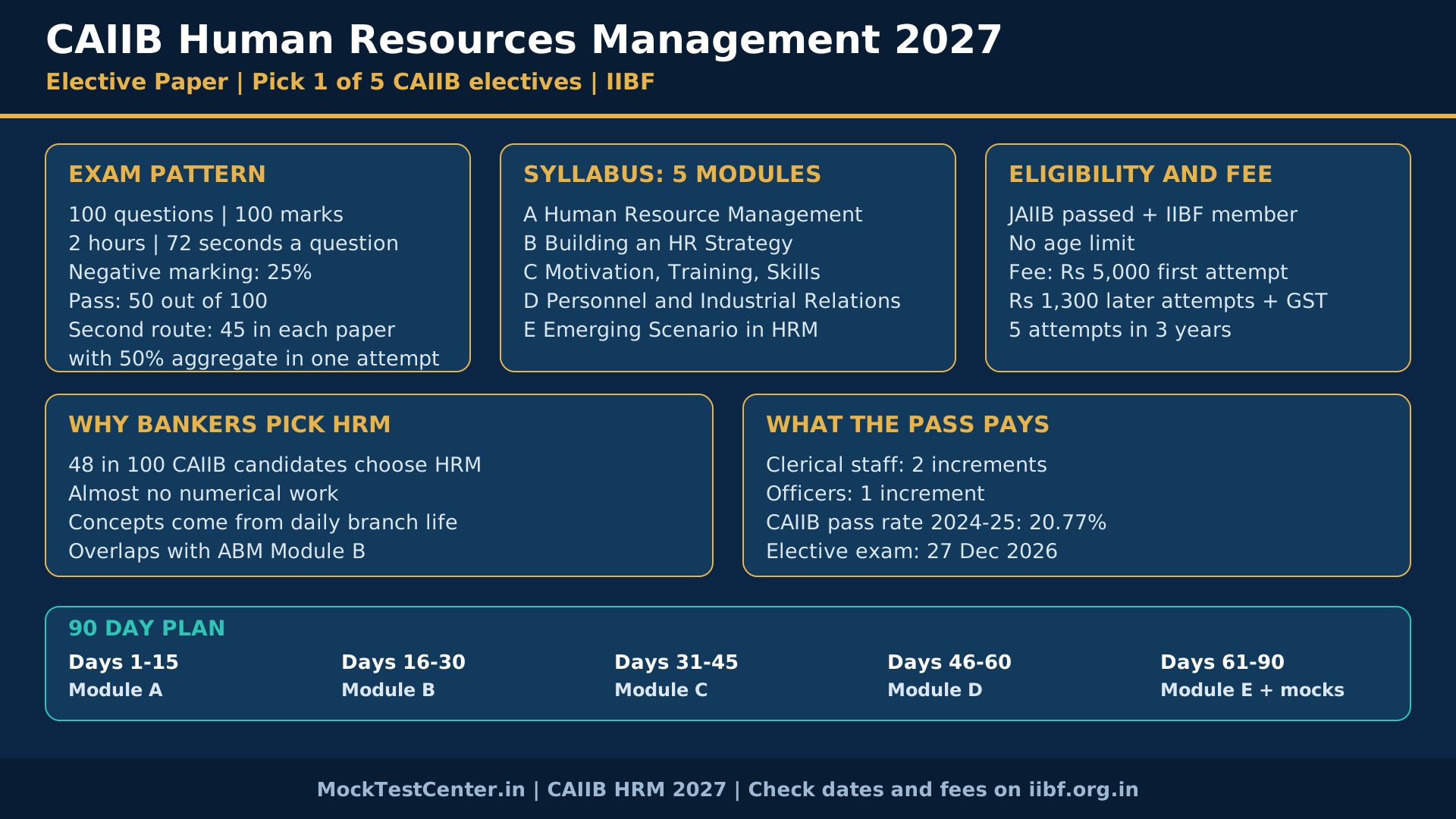
Human Resources Management is one of five electives in CAIIB, and you pick only one of them. The paper carries 100 questions for 100 marks, runs for two hours, and has negative marking of 25 percent of the marks of the question. You pass with 50 marks out of 100. That single sentence covers the whole pattern, and the rest of this guide covers the part that decides your result: the syllabus, the way IIBF asks questions, and a study plan that fits around branch work.
CAIIB stands for Certified Associate of the Indian Institute of Bankers. The Indian Institute of Banking and Finance runs it twice a year for bankers who have already cleared JAIIB. The December 2026 cycle ran from 6 December to 27 December 2026, with the elective paper on 27 December 2026. The 2027 schedule has not been announced as of 19 November 2026, so no 2027 date appears in this guide.
When IIBF releases the 2027 notification, check the dates on the IIBF website before you fix your plan.
This guide treats HRM as a working subject, not a memory test. You manage people every day in a branch or a back office. The paper asks whether you can name the idea behind what you already do, and whether you can apply it to a case IIBF puts in front of you.
CAIIB in one page
CAIIB has five papers. Four are compulsory for every candidate. The fifth is your elective, and Human Resources Management is one of the five choices. The table below shows the full structure.
| Paper | Name | Questions | Marks | Time |
|---|---|---|---|---|
| Compulsory 1 | Advanced Bank Management | 100 | 100 | 2 hours |
| Compulsory 2 | Bank Financial Management | 100 | 100 | 2 hours |
| Compulsory 3 | Advanced Business and Financial Management | 100 | 100 | 2 hours |
| Compulsory 4 | Banking Regulations and Business Laws | 100 | 100 | 2 hours |
| Elective, pick one | Human Resources Management | 100 | 100 | 2 hours |
The other four electives are Rural Banking and Information Technology and Digital Banking. Risk Management and Central Banking complete the set. You register for one elective only. A second elective adds nothing to your CAIIB result, and IIBF does not ask you to clear more than one.
Pick the paper that matches your daily work and your comfort with theory, then give it your full attention.
Every CAIIB paper follows the same pattern. Each paper has 100 objective questions, each worth one mark, with two hours on the clock. That gives you about 72 seconds per question. The exam runs online at IIBF notified centres.
The medium is English or Hindi, and you choose it at registration, and the questions appear in that language.
JAIIB sits below CAIIB in the same IIBF ladder. JAIIB has four papers: Indian Economy and Indian Financial System; Principles and Practices of Banking; Accounting and Financial Management for Bankers; Retail Banking and Wealth Management. The November 2026 JAIIB papers ran on 1 November, then on 22 November, then on 28 November and on 29 November 2026. You must clear JAIIB before you can register for CAIIB, and that order never changes.
Who can sit for CAIIB
Two conditions decide eligibility. You must have passed JAIIB or Part 1 of the Associate Examination, and you must hold IIBF membership with your subscription paid up to date. IIBF runs these exams for working bankers in member banks, so membership is part of the entry rule, not an optional extra. If your subscription has lapsed, renew it before registration opens, because a lapsed membership can block your form.
There is no age limit for CAIIB. A clerk in the first year of service and a chief manager with twenty years behind the counter sit the same paper under the same rules. That matters for HRM in particular, because the paper rewards work experience. A branch head who has handled transfers and leave, plus appraisals and a difficult conversation with a staff member, already knows half the syllabus from life.
The exam asks for the names and the frameworks behind those experiences.
Registration happens separately for every cycle. For the December 2026 cycle, registration ran from 13 September 2026, with the last date extended to 8 October 2026. Some trackers print 1 October 2026 as the last date, and that earlier date was the original close before the extension. The lesson is plain: read the IIBF notification for the cycle you want, and do not trust a date copied from an older page.
Fees follow the same rule. Trackers that quote the IIBF fee notice put the CAIIB first attempt at Rs 5,000 plus GST, with later attempts at Rs 1,300 plus GST. Confirm the amount in the notification for your cycle, because IIBF revises fees from time to time.
IIBF gives a candidate five attempts to clear CAIIB within three years from the date of first registration, whichever ends first. The older rule of four attempts in two years no longer applies. That change matters for planning. You can spread five papers across cycles if branch work leaves you short of time, but the three year clock keeps running from your first registration, so a slow start still needs a finish date in view.
The HRM syllabus, module by module
The HRM elective has five modules, labelled A to E. They move from basic ideas to strategy, then to motivation and training, then to personnel work and industrial relations, and finally to new trends. IIBF publishes the module list, and coaching trackers that quote the IIBF syllabus agree on the five module titles. No official weightage per module has been published, so treat every module as capable of producing questions.
A plan that skips Module E because it looks new is a plan that gives away marks.
Module A: Human Resource Management
Module A builds the base. It opens with the fundamentals of HRM: what human resource management means, how it differs from human resource development, how an HR department is structured, what HR professionals do, and how HR grew in India. IIBF likes to test the HRM and HRD distinction, so learn it as a pair. HRM covers the full system of managing people, from hiring to exit.
HRD covers the learning and growth side of that system. A question can offer four close definitions and ask which one describes HRD, and the only safe answer is the one you have read word by word.
Organisational behaviour sits inside Module A, and it is the largest idea block in the paper. It covers how people behave at work, how groups form and work, what makes a team effective, and how leaders change outcomes. Leadership gets real attention here. The syllabus names contemporary approaches to leadership and transformational leadership, so read leadership as styles with names, not as a general idea.
Benchmarking and quality circles appear in the same block, along with Six Sigma, and they connect HR to quality work in a bank. A quality circle in a branch is a small group of staff who meet to solve work problems, and Six Sigma is a method for cutting defects in a process. The exam can ask what each one does, and the answer is one line if you have read the definition.
Stress management and business etiquette also sit in Module A. Stress at work is a serious exam topic because banks run on targets and audits, plus the pressure of customer service. Learn the sources of stress and its signs, plus the ways organisations reduce it. Business etiquette covers conduct at work: how staff speak to customers, how they write, and how they behave in meetings.
These look like soft topics, and that is exactly why candidates skip them. IIBF does not skip them.
Organisational change is the third block in Module A. It covers the change agent, how to manage change, John Kotter's eight step model, and responsibility charting. Kotter's model is a favourite of question setters because it has a fixed order: create urgency, build a coalition, form a vision, communicate it, remove obstacles, create short term wins, build on the change, and anchor it in culture. Learn the eight steps in order, because a question can shuffle them and ask which step comes third.
Responsibility charting assigns who does a task, who approves it, who is consulted and who is informed, and it shows up in questions about roles during a change.
Module A closes with HRM in Indian banks and knowledge management. The bank block covers the old role of HR in banks, what branches now expect from HR, and the problems HR faces as banking changes. Core banking changed HR work because one system now holds every account, and staff need new skills to use it. Knowledge management covers how a bank stores what its people know: databases, HR information systems, and the habit of writing down what experienced staff carry in their heads.
When a senior officer retires, the bank loses knowledge unless someone has recorded it, and the syllabus treats that loss as an HR problem.
Module B: Building an HR strategy
Module B moves HR from daily work to strategy. It starts with HR as a strategic player: how HR helps form business strategy, how it creates value, how it executes strategy, and how factor analysis supports decisions. The idea is simple to state and easy to get wrong in an exam. An HR department that only files leave applications is an admin office.
An HR department that plans hiring around the bank's branch expansion is a strategic partner. IIBF asks you to tell the difference.
The CEO and team block covers talent management and succession planning, plus the HR audit. Talent management means finding people with rare skills, then keeping them and giving them work that grows them. Succession planning means naming who can step into a key post when the current holder retires or moves. Banks need succession plans because a branch without a head for three months loses business and morale.
HR audit checks whether HR policies work as written: it reviews hiring and training, plus pay and exits, against the bank's own rules. Learn what an audit covers, because a question can list four activities and ask which one belongs to HR audit.
Communication gets its own block in Module B, and it deserves slow reading. It covers types of communication, barriers that block it, and how HR makes it work. A message fails when the sender is unclear, when the channel is wrong, or when the receiver is distracted. Downward communication carries orders from senior officers.
Upward communication carries problems from the branch to the head office. Lateral communication moves between officers at the same level. The exam tests these directions by giving a small case and asking which direction the message travelled.
HR functions form the practical heart of Module B. HR planning forecasts how many people the bank will need and what skills they must carry. Recruitment fills those needs from inside the bank or from outside it. Technology changed both: job portals and online tests now handle work that once needed paper files and weeks of waiting, and HR software does the same.
Social media policy appears here too, because a staff member's post can damage a bank's name in an hour. Compensation covers pay and benefits, and the syllabus links pay to retention. Attrition is the rate at which staff leave, and employee risk assessment asks HR to spot the risks that come with people: fraud and error, plus absence and burnout.
Performance management closes Module B, and it is one of the most tested areas in the whole paper. It covers the performance management system and appraisal methods. It also covers 360 degree appraisal, competency mapping and key result areas. A 360 degree appraisal collects views from the boss and peers, plus juniors and the officer herself, instead of relying on one boss alone.
Competency mapping lists the skills a job needs and checks them against the skills the officer holds. Key result areas are the few results that decide whether a year went well. Learn the appraisal methods by name: rating scales, critical incidents, behaviourally anchored scales, management by objectives and assessment centres. The exam can ask which method fits a given case, and the case will point at one method if you know what each one does.
Module C: Motivation and skill development
Module C is the module most candidates enjoy, and it is also the module where overconfidence costs marks. It opens with the learning process: how adults learn, what blocks learning, and how behaviour changes after training. Adult learning differs from school learning. An adult brings experience to the class, wants to know why a topic matters, and learns by doing.
A question can describe a training room and ask which learning principle the trainer ignored, and the answer will be one of the principles you skipped while reading.
Employee motivation is the centre of Module C. The syllabus names motivation theories, and IIBF tests them by name. Maslow's hierarchy runs from basic needs to self actualisation, and a question can ask which need sits at a given level. Herzberg splits job factors into hygiene factors and motivators: pay and work conditions stop dissatisfaction.
Recognition and growth create satisfaction. Other theories in the syllabus include goal theory and the work of Steven Reiss on human motives. Job enrichment adds depth to a job by giving the officer more responsibility and variety, while job satisfaction measures how content staff feel with their work. Learn each theory as a name, a core idea and one bank example.
A theory without an example is hard to recall under exam pressure.
Employee development follows motivation. It covers training against development: training teaches a skill for the current job, while development prepares a person for future roles. Training needs analysis finds the gap between the skill a job needs and the skill the officer holds. Banks run training for a reason, and that reason is usually visible in the branch: a new product, a new system, or a rise in errors.
The syllabus gives training a clear role in banking, and the exam can ask why a bank trains staff after a system change. The answer is that the system changed the job, and the job now needs a skill the staff does not yet hold.
Training methodology closes Module C. It covers learning organisations, types of training, career development, soft skills, return on training investment and best practices. A learning organisation is one where staff keep learning as part of daily work, not only in classrooms. Types of training include on the job training and classroom training.
E learning and simulation are two more types. Soft skills cover communication and teamwork, plus customer handling. Banks test them because a polite officer keeps a customer while a rude one loses the account. Return on training investment asks whether the money spent on training came back as better work.
If training cost a lakh and errors fell by a value above that, the training paid for itself. IIBF can frame that as a small case with numbers, and the working is simple once you know the idea.
Module D: Personnel management and industrial relations
Module D is the most law heavy module in the paper, and it is the one candidates fear most. It opens with industrial relations and the Industrial Relations Code 2020, which brought together older labour laws into one code. The syllabus also names labour laws in general, so read the major acts by name and purpose. A question can ask which law governs a given situation.
The answer is the act that covers that situation. Do not try to memorise sections. Learn what each act does and who it protects.
Trade unions and collective bargaining form the second block. A trade union is a body of workers that speaks for them in talks with management. Registration of a union follows a legal process, and the syllabus expects you to know that unions have rules for formation and recognition. Collective bargaining is the talk between a union and management that ends in an agreement on pay, hours and conditions.
Banks have a long history of bipartite talks, and the exam can ask what collective bargaining settles. The answer is the terms of employment. Talk settles them, rather than an order.
Employee discipline and grievance redressal follow. Discipline covers the rules of conduct, the enquiry process, and the penalties for breach. A domestic enquiry is the formal process a bank follows before it punishes an officer, and the syllabus treats fairness in that process as a testable idea. Fraud and vigilance appear here, because banks lose money when staff break rules.
Grievance redressal is the route a staff member uses to raise a complaint: a grievance committee and a hearing, ending in a written decision. Conflict management sits beside it, with the causes of conflict and its phases, plus the ways to resolve it. A conflict between two officers in a branch is a case the exam can describe in three lines, and the right answer names the resolution method that fits the case.
Workers participation in management gets its own block, with the Indian banking experience as the example. The idea is that staff who help make decisions accept those decisions more readily. Banks have used joint committees and staff councils for this purpose, and the syllabus asks you to know how participation works in practice. The POSH Act 2013 appears in this module as well.
It is the law against sexual harassment of women at the workplace, and every bank must have an internal committee to hear complaints. Learn its full name and its purpose, because the exam can ask both in one question.
Diversity closes the module. Banks employ staff from every part of India, and a branch team can hold five languages and three generations. The syllabus treats diversity as a fact to manage, not a slogan to repeat. A diverse team needs clear rules and fair treatment, plus a manager who listens.
That is a practical point, and the exam tests it with cases about teams, not with definitions alone.
Module E: Emerging scenario in HRM
Module E covers what changed in HR after the old books were written. Employee engagement opens it: how banks keep staff interested in work, what Generation Y expects from a job, and how work from home and hybrid models changed the office. A hybrid model splits the week between home and office, and it raised new HR questions about supervision and trust, plus data safety. New employment models appear here too, including contract staff and gig style work.
The exam can ask what engagement means, and the answer is the energy and commitment staff bring to work, not the number of hours they sit at a desk.
Organisational culture and creativity follow. Culture is the shared way of doing things in a bank: how officers speak to customers, how they treat juniors, and what behaviour gets rewarded. Creative leadership means a leader who lets staff try new ways of working. Ethical culture means a bank where staff report wrongdoing because they trust the system.
These ideas connect to the governance topics in the compulsory papers, so a candidate who reads Module E alongside the Banking Regulations paper will see the same ideas from two sides.
Corporate sustainability and green HRM form the third block. Sustainable HRM means managing people in a way that lasts: fair pay and safe work, plus skills that stay useful. Green HR practices in banking include paperless work, energy saving in branches, and lending that favours clean projects. The block is short in the syllabus, and a few questions at most will come from it, but those questions are easy marks for a candidate who has read the block once.
HR analytics and AI based HR solutions follow. HR analytics means using staff data to answer HR questions: which branches lose staff fastest, which training cuts errors, and which hiring source gives the best officers. AI in HR covers screening of applications, chatbots that answer staff questions, and tools that flag attrition risk. HR entrepreneurship appears in the same block, and it means treating HR as a business inside the bank, with services and costs, plus results.
The exam tests these topics with definitions and small cases, so learn what each tool does rather than how it is built.
Crisis management in VUCA and BANI scenarios closes the module. VUCA stands for four words: volatile, uncertain, complex, ambiguous. BANI stands for four more: brittle, anxious, nonlinear, incomprehensible. Both describe a world where plans break.
A bank faces a crisis when a system fails, a fraud breaks, or a pandemic closes branches. HR has a role in every crisis: it tells staff what to do, it protects their safety, and it keeps essential work running. Business ethics and corporate governance close Module E, along with corporate social responsibility, and they tie the paper back to the wider CAIIB course. A bank that treats staff fairly and keeps clean books is practising the same values in HR and in governance.
How the paper is marked
The marking rule punishes blind guessing. Each question carries one mark, and a wrong answer costs a quarter mark under the negative marking rule of 25 percent. Attempt a question when you can rule out at least two options, and leave the ones you know nothing about. A guess that lands right adds a mark, but three wrong guesses wipe that mark out.
A wrong guess costs a quarter mark, so answer the questions you know first, then return to the ones you are unsure about only when you can rule out at least two options.
| Item | Detail |
|---|---|
| Questions | 100 objective questions |
| Marks | 100, one mark per question |
| Time | 2 hours |
| Negative marking | 25 percent of the marks of the question |
| Pass mark | 50 out of 100 in the paper |
| Second way to pass | 45 in each paper with 50 percent aggregate in one attempt |
| Medium | English or Hindi, chosen at registration |
| Mode | Online at IIBF notified centres |
The pass rule has two routes, and candidates should know both. The direct route is 50 marks in each paper. The second route applies when you attempt several papers in one cycle: you pass if you score at least 45 in every paper you attempted and your total across those papers reaches 50 percent. A paper below 45 fails on its own, whatever your total.
So a candidate who scores 48 in HRM and 52 in the other papers of the same attempt can still clear the set, while a candidate who scores 44 in HRM cannot, even with high scores elsewhere.
Time is the real test in this paper. Two hours for 100 questions gives about 72 seconds each, and HRM questions are wordy. A case based question can run to five lines before it asks anything. Read the question first, then read the case.
That order saves a second reading, and a second reading is what eats the clock. If a question takes more than two minutes, mark it, then move on. You can return to it after the easy marks are safe.
Why 48 in 100 bankers pick HRM
An analysis of the IIBF Annual Report 2024-25 found that 48 in 100 CAIIB candidates chose Human Resources Management as their elective. That makes HRM the most picked elective by a wide margin. The reasons are easy to see. The paper has almost no numerical work, the concepts come from daily branch life, and several topics overlap with Module B of the compulsory Advanced Bank Management paper.
A candidate who has already read HR for ABM starts HRM with a head start.
Coaching trackers agree with the numbers. Oliveboard calls HRM the easiest elective, with simple concepts and a predictable question pattern. Guidely reports the same view, and adds that HRM has zero maths and many questions drawn from common work situations. The paper suits HR staff, branch managers who lead large teams, and officers with a management background.
If your day already involves appraisals and leave, plus transfers and team talks, HRM asks you to name what you do.
The easy tag hides a trap, and the trap is worth naming. HRM questions are application based, and the language is dense. Two options can look right until you read the third word of each. Candidates who treat the paper as light reading walk in confident and walk out short of 50.
The CAIIB HRM paper rewards structured revision of named models and definitions, and it punishes a casual read. That is the counterpoint to the popularity figures: the paper is popular because it is accessible, and it fails candidates who confuse accessible with effortless.
The wider CAIIB pass rate sets the context. The same analysis of the IIBF Annual Report 2024-25 put the CAIIB pass rate at 20.77 percent for 2024-25, with 13,953 candidates passing out of more than 67,000 who appeared. The rate nearly doubled from 10.23 percent in 2023-24. Enrolment stood at 89,179.
Those figures cover the whole CAIIB exam, not HRM alone, and IIBF does not publish a pass rate per elective. Still, the message is clear: four in five candidates do not clear CAIIB in a given year, and the elective is the paper you control most directly. Pick it with care and prepare it with the same rigour as the compulsory papers.
Your job should shape the choice more than the popularity figures. An officer in the IT department may score higher in Information Technology and Digital Banking, even though fewer candidates pick it. A rural branch officer may score higher in Rural Banking. HRM suits officers whose work is people work.
If your branch day is mostly credit files and balance sheets, the CAIIB Human Resources Management 2027 paper still works, but you will learn it from books rather than from memory, and your plan should allow for that.
What HRM looks like inside a bank
HR planning in a bank starts with a simple question: how many officers will we need next year, and with what skills. A bank that opens fifty branches needs branch heads, cash officers and credit officers, plus clerks, and it needs them trained before the doors open. HR planning forecasts that need, and recruitment fills it. Internal recruitment moves an existing officer into a new post, which is fast and rewards experience.
External recruitment brings in fresh graduates through exams, which is slow and brings new ideas. Banks use both, and the exam can ask which method fits a given need.
Training in a bank never stops, because products keep changing and systems keep changing. A new loan product needs product training. A core banking upgrade needs system training. A rise in customer complaints needs behaviour training.
The bank measures training by results: fewer errors and faster service, plus better audit scores. A training programme that changes nothing on the job has failed, whatever the feedback forms say.
Performance appraisal decides promotions and increments, so staff watch it closely. A good appraisal is fair and timely, and it rests on evidence. A bad appraisal is late and vague, and it rests on one incident. The 360 degree method tries to fix the single boss problem by collecting views from several sides.
Competency mapping tries to fix the vagueness problem by listing the skills a job needs before the appraisal starts. Both methods appear in the exam because both are in use in banks.
Industrial relations in a bank run on talk. Management and unions meet and argue, then settle. The bipartite system in banking has settled pay and conditions through talks for decades, and the exam treats collective bargaining as the normal way of settling terms. Discipline runs beside it.
A bank that ignores a fraud loses money and trust, so enquiry matters, and vigilance matters too. A bank that punishes without a fair enquiry loses in court, so process matters too. The paper asks you to hold both ideas at once.
What the pass is worth
Money is the first reason most bankers sit for CAIIB, and IIBF candidates should know the figures before they pay the fee. Clearing CAIIB brings two extra increments for clerical staff and one extra increment for officers, and the increment stays in the pay for the rest of service. Trackers that quote bank pay scales put the value of a CAIIB increment at about Rs 4,000 a month for a probationary officer and about Rs 2,680 a month for a clerk, though the exact amount depends on the bank and the pay scale in force. The count of increments is the settled fact; the rupee value varies by bank, so treat the rupee figures as a guide rather than a promise.
JAIIB brings one increment on its own, and CAIIB adds to it. Together the two qualifications lift basic pay in a way that compounds across a career, because every later increment and every promotion calculation starts from a higher base. That is why bankers who are short of time still find a way to sit for these exams. The fee for a CAIIB first attempt is Rs 5,000 plus GST, and later attempts cost Rs 1,300 plus GST, as quoted by trackers from the IIBF fee notice.
The fee is small beside the lifetime value of the increments, and it is not refundable, so register only when you intend to sit.
Promotion is the second reason. Clearing CAIIB leaves your scale unchanged on its own. Banks still weigh it in promotion interviews and internal exams. An officer with CAIIB shows the bank that she has studied banking beyond her daily work, and that counts when a promotion panel compares two officers with the same years of service.
The HRM paper adds a third benefit for future branch heads: it teaches the people skills that a promotion demands. A scale 2 officer who cannot handle a team will struggle, whatever her credit knowledge.
A 90 day plan around branch hours
Ninety days is enough for HRM if you study every day, and the plan below assumes two hours a day on working days and four hours on Sundays. Branch work will break the plan some days, so the plan builds in catch up time. Do not restart the plan after a missed day. Pick up where you left off and use the catch up slots to close the gap.
Days 1 to 15 cover Module A. Read the fundamentals, organisational behaviour and change, plus HR in banks. Make a one page note per topic with the definition and the names, plus one example. Kotter's eight steps and the leadership styles need a full page each.
Test yourself at the end of each topic with ten questions from a mock test or a question bank. If you score below seven, reread the topic the same evening.
Days 16 to 30 cover Module B. Strategy, talent, succession, communication, HR functions, performance management: these need slow reading because the terms are close together. Appraisal methods and competency mapping deserve a table of your own. Put the method name in one column, what it does in the next, and when to use it in the third.
Write the table by hand once. The act of writing fixes the differences in memory better than reading them twice.
Days 31 to 45 cover Module C. Motivation theories need a separate page per theory, with the name of the thinker, the core idea, and a bank example. Maslow and Herzberg will produce questions on their own, so give them two days each. Training topics are easier, and a single read with notes is enough for most of them.
End the block with a full mock test on Modules A to C and note every wrong answer in a small book.
Days 46 to 60 cover Module D. Labour law and industrial relations need a different method: read the act, write its purpose in one line and write one case where it applies. Do the same for trade unions and collective bargaining, plus discipline and grievance, with POSH as well. The law block rewards exact reading, so do not rush it.
A wrong answer in Module D usually comes from mixing up two acts, and the one line purpose note is what stops the mix up.
Days 61 to 75 cover Module E and the first full revision. New trends read fast, but the terms are new, so make notes for VUCA and BANI, plus green HRM and HR analytics. Then revise Modules A and B from your notes only, without opening the book. Revision from notes shows what you have actually kept.
Anything you cannot recall from notes goes back into the book for a second read.
Days 76 to 90 are for mock tests and final revision. Take a full 100 question mock test every second day, in two hours, without a break. Score it the same evening and read the explanation for every wrong answer. Spend the days between tests on your weak module.
In the last week, revise the wrong answer book and the one page notes, and take one final mock test three days before the exam. The day before the exam is for light revision only. A tired mind answers worse than a rested one.
Mistakes that cost marks
The first mistake is treating HRM as a reading paper. Reading without testing feels like progress, and it is not. The exam asks you to pick one option out of four, and that needs recall under pressure. A candidate who has read a chapter twice but never tested herself will hesitate on the exact word that separates two options.
Test after every topic, and test again after a week.
The second mistake is skipping Module D because the law looks dull. Labour law questions are among the most predictable in the paper, because the acts have fixed purposes. A candidate who skips the module gives away those marks to every candidate who read it once. Read it slowly, write the one line purpose for each act, and the module will pay for the time.
The third mistake is learning theories without names. A question can ask who proposed a theory, and "the motivation chap" is not an answer. Learn Maslow and Herzberg by name, along with Kotter and Reiss, with one line each on what they said. Names are cheap marks.
The fourth mistake is ignoring the case based questions. IIBF frames many HRM questions as a small story from a branch, then asks what the officer should do. The story points at one concept if you know the concepts. A candidate who only memorised definitions will read the story and see no concept in it.
Practise with case questions in mock tests, and after each one, name the concept the case tested.
The fifth mistake is poor time use in the exam hall. Some candidates spend five minutes on one hard question and then rush the last twenty. The paper carries negative marking of 25 percent, so a hard question you guess wrong costs a quarter mark, while a hard question you solve is worth the same one mark as an easy one. Answer the easy ones first, mark the hard ones, and return to them with the time that is left.
The sixth mistake is choosing HRM for the wrong reason. A candidate who picks HRM only because friends call it easy, while her own work is in credit or forex, may find the paper less easy than the stories promised. The paper is easy for officers whose daily work is people work. For others it is a theory paper like any other, and it needs the same ninety days.
Using mock tests the right way
A CAIIB HRM mock test is a rehearsal, not a scorecard. Take it in exam conditions: two hours, with no phone and no book, and no break in between. Score it at once, then spend as long on review as you spent on the test. The review is where learning happens.
For each wrong answer, write the right answer, the reason it is right, and the topic it came from. That note goes into the wrong answer book, and the book is what you revise in the last week.
Track your score by module, not only as a total. A total of 62 can hide a Module D score of 4 out of 20, and that hidden weakness will cost you in the real exam. When a module scores low twice in a row, stop taking full tests and go back to the book for that module. A full test after a weak module test tells you nothing new.
Take at least eight full CAIIB Human Resources Management 2027 mock tests before the exam, and space them out. Two tests in one day teach less than two tests in one week, because the gap gives your memory time to settle. The last mock test should happen three days before the exam, not the night before. The night before is for sleep and for the one page notes, nothing more.
If you are preparing for more than one exam
Many CAIIB candidates are also preparing for a recruitment exam, and the two preparations can help each other. The banking awareness you build for SBI PO 2027, SBI Clerk 2027, IBPS PO 2027 and IBPS Clerk 2027 overlaps with the banking knowledge CAIIB expects, and the reasoning practice from RBI Grade B 2027 and NABARD Grade A 2027, plus SEBI Grade A 2027, keeps your mind sharp for objective papers. Officers who teach juniors often use UGC NET Paper 1 2027 material for teaching method, and those eyeing state services pair CAIIB with UPPSC PCS 2027 and UP Police Sub Inspector 2027 preparation. The point is simple: one mock test habit serves every exam you sit, so keep the habit even when the exam changes.
Sources
Indian Institute of Banking and Finance, official website, for the CAIIB and JAIIB exam structure and eligibility, plus notifications. Oliveboard CAIIB syllabus page, for the module wise syllabus of the HRM elective and the exam pattern. Adda247 CAIIB exam page, for the December 2026 dates and fee, plus pass criteria. EduTap CAIIB guide, for the attempt limit and pass rule, plus increment counts.
PW CAIIB pass percentage analysis, for the 2024-25 pass rate and the HRM elective share, drawn from the IIBF Annual Report 2024-25. Finploy and Bankersadda JAIIB November 2026 pages, for the JAIIB paper dates. Oliveboard elective guide, for the comparison of CAIIB electives and the HRM difficulty view. Guidely CAIIB elective page, for the HRM ease and scoring view.







