About Bihar Polytechnic DCECE 2027 Exam Series
📖 Table of Contents
- Bihar Polytechnic DCECE 2027 at a glance
- An entrance exam, not a job
- Three papers, three doors
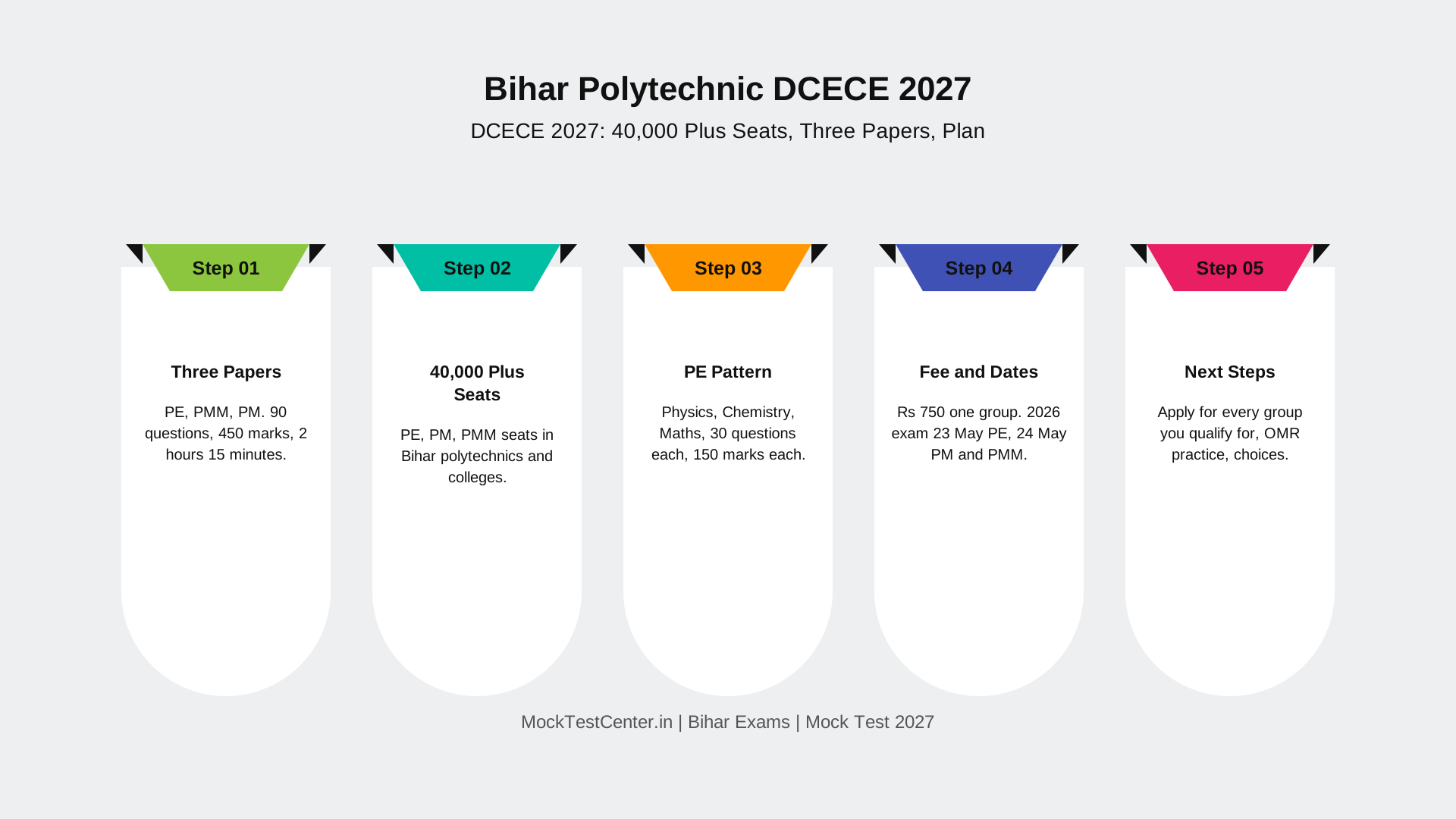
- PE paper: 90 questions, 450 marks
- PM and PMM papers: same marks, different mix
- Who can apply, group by group
- Fee: pay by the group
- Dates: the 2026 cycle, and the 2027 wait
- Counselling: rank decides, choices decide the rest
- Seats, colleges, numbers that disagree
- A 90 day plan that fits the real paper
- Mistakes that cost candidates the seat
- Sources
Bihar Polytechnic DCECE 2027: Complete Exam Guide
Bihar Polytechnic DCECE 2027 is an entrance exam, and that single fact clears up most of the confusion around it. The Diploma Certificate Entrance Competitive Examination fills seats in diploma and certificate courses. It hires nobody. It pays no salary. It opens the door to a three year engineering diploma or a para medical diploma in a Bihar polytechnic, and the career comes after the course, not before it. Candidates who search for DCECE vacancies, DCECE salary, or DCECE age relaxation for government jobs are reading the wrong exam, and this guide starts by saying so, because the wrong first assumption wastes the whole preparation.
The Bihar Combined Entrance Competitive Examination Board, BCECE Board, runs DCECE once a year from Patna. The 2026 cycle ran on 23 May for the Polytechnic Engineering paper and on 24 May for the Para Medical papers. Applications ran from 19 March to 21 April 2026. Counselling ran in two rounds plus a mop up round, with the mop up allotment out on 11 August 2026. No 2027 notice had been published as of 21 November 2026, so every date, fee, pattern in this guide comes from the 2026 prospectus, and the guide marks each one as 2026 until the 2027 prospectus appears.
Three papers sit under one name. PE covers Polytechnic Engineering, the diploma after Class 10. PMM covers Para Medical at matric level, the Dresser course after Class 10. PM covers Para Medical at intermediate level, pharmacy, GNM nursing, ANM nursing, laboratory, X-ray, operation theatre, dental courses after Class 12. A candidate applies for the groups she qualifies for, pays by the number of groups, and sits only the papers of those groups. Picking the wrong group is the most common application error, and it is also the most expensive one, because the fee does not come back.
Bihar Polytechnic DCECE 2027 at a glance
| Detail | Bihar Polytechnic DCECE, the last verified cycle |
|---|---|
| Conducting body | Bihar Combined Entrance Competitive Examination Board, BCECE Board, Patna |
| Full name | Diploma Certificate Entrance Competitive Examination |
| What it is | Entrance exam for diploma and certificate courses, not a job recruitment |
| Course groups | PE, PMM, PM |
| Seats | 40,000 plus across PE, PM, PMM |
| Application window, 2026 | 19 March to 21 April 2026, online |
| Fee payment last date, 2026 | 22 April 2026 |
| Correction window, 2026 | 23 to 24 April 2026 |
| Admit card, 2026 | 15 May 2026 |
| Exam dates, 2026 | PE 23 May 2026; PM, PMM 24 May 2026 |
| Pattern | 90 questions, 450 marks, 2 hours 15 minutes, OMR sheet, Hindi, English |
| Fee, one group | Rs 750 for General, BC, EBC; Rs 480 for SC, ST, disabled quota |
| Counselling, 2026 | Online, two rounds plus mop up, mop up allotment 11 August 2026 |
| Official website | bceceboard.bihar.gov.in |
| 2027 notice | Not published as of 21 November 2026 |
An entrance exam, not a job
The confusion is easy to understand. DCECE pages sit beside job pages in every search result, and tracker sites list it with a salary field marked not applicable, an age limit table, and a vacancy count that is really a seat count. A Class 10 student who reads those pages can spend weeks preparing for a government job that does not exist. The picture is simpler. DCECE buys a seat in a classroom. The diploma that follows buys the job.
That seat is worth real money and real time. A government polytechnic diploma in Bihar costs far less than a private engineering college, and it leads to junior engineer posts, technician posts, lateral entry into BTech second year through the DECE lateral entry exam. The para medical diplomas lead to pharmacy, nursing, laboratory, X-ray work in government and private hospitals. The entrance exam is the gate, and the gate is wide, with 40,000 plus seats across the three groups, but the good branches in the good colleges fill fast, and rank decides who gets them.
About 1.5 lakh candidates appear for the PE paper every year, according to Shiksha, and that number puts the competition in perspective. Forty thousand seats against 1.5 lakh PE applicants alone means roughly one seat for every four PE candidates, before counting PM and PMM applicants. The odds beat most government job exams by a wide margin, and still the top branches, Civil, Mechanical, Electrical, Electronics, Computer Science, close at ranks that demand serious preparation. A candidate who treats DCECE as a casual formality lands in a branch she did not want, in a college far from home, or in the mop up round with whatever seats remain.
Three papers, three doors
PE is the engineering door. It takes Class 10 pass candidates into three year diploma courses in Civil, Mechanical, Electrical, Electronics, Computer Science, other engineering branches in government polytechnics and in recognised private polytechnics. There is no age limit for PE, which makes it the most open door of the three, and also the most crowded, with the largest applicant pool and the largest seat pool.
PMM is the smallest door. It takes Class 10 pass candidates with Science and English into the Dresser course, a para medical certificate course at matric level. The age band runs 15 to 30 years as on 31 December of the admission year. PMM carries the fewest seats of the three groups, and tracker pages rarely discuss it in detail, which is a shame, because a Dresser certificate leads directly to work in hospitals and clinics, and the paper is the easiest of the three to prepare for, since it sits at Class 10 level across the board.
PM is the intermediate door, and it holds the most variety. It takes Class 12 Science candidates into Diploma in Pharmacy, GNM nursing, ANM nursing, laboratory technology, X-ray technology, operation theatre technology, dental courses, other para medical diplomas. GNM and ANM nursing under PM admit women only. The age band runs 17 to 32 years, with women going up to 35 years for the nursing courses. PM also fills half the seats in recognised non government para medical institutions, which makes it the route into private nursing and pharmacy colleges too.
| Group | Courses | Entry level | Age as on 31 December 2026 |
|---|---|---|---|
| PE | Engineering diploma | Class 10 pass | No limit |
| PMM | Dresser | Class 10 with Science, English | 15 to 30 years |
| PM | Pharmacy, GNM, ANM, laboratory, X-ray, operation theatre, dental | Class 12 Science | 17 to 32 years, women up to 35 for nursing |
Candidates may apply for one group, two groups, or all three, if they meet the eligibility for each. The fee rises with each group, and the papers sit on separate days where the schedule allows, PE on 23 May 2026 and PM with PMM on 24 May 2026 in the last cycle. A Class 10 candidate who qualifies for PE and PMM can sit both. A Class 12 Science candidate who qualifies for PM can add PE only if she also meets the PE rule, which she does, since PE needs only a Class 10 pass. The smart move is to apply for every group you qualify for, because each paper is a separate rank list and a separate chance at a seat.
PE paper: 90 questions, 450 marks
The PE paper is the simplest pattern in the whole exam, and its simplicity hides its difficulty. Three subjects, 30 questions each, 5 marks a question, 90 questions, 450 marks, 2 hours 15 minutes. Physics, Chemistry, Mathematics. All at Class 10 level. The paper runs offline on an OMR sheet, in Hindi, English. The candidate marks answers with a blue or black ball point pen.
| Subject | Questions | Marks |
|---|---|---|
| Physics | 30 | 150 |
| Chemistry | 30 | 150 |
| Mathematics | 30 | 150 |
| Total | 90 | 450 |
Five marks a question changes the maths of the paper completely. A single question is worth more than one percent of the total, and a careless error in Mathematics costs as much as a full correct answer in another subject would gain. Speed matters less than accuracy here, because 90 questions in 135 minutes gives 90 seconds a question, a generous budget by entrance exam standards. The candidates who lose ranks are the ones who rush, not the ones who run out of time.
Mathematics decides the PE merit list more than any other subject, and the tie break rule proves it. When two candidates tie on total marks, the board looks at Mathematics marks first, then Physics, then the older candidate wins. A candidate who scores high in Mathematics holds two advantages at once, a high total and a strong tie break. Physics comes second in the tie break, and Chemistry, for all its 150 marks, counts for nothing in a tie. Spend the most time where the tie break points.
Class 10 level sounds easy until the paper asks it. The PE syllabus covers the Bihar School Examination Board Class 10 syllabus in Physics, Chemistry, Mathematics. The questions test understanding rather than memory. Numerical problems in Physics and Chemistry need working, not recall. The OMR format means no step marks, so a small arithmetic slip loses all 5 marks. Practise with the Class 10 textbook open beside you for the first month, then close it and practise from memory, because the exam hall offers no textbook.
PM and PMM papers: same marks, different mix
The PM paper also carries 90 questions for 450 marks in 2 hours 15 minutes, but the mix is wider. General Science, Physics, Chemistry, Biology, carries 25 questions for 125 marks. Numerical Aptitude carries 15 questions for 75 marks. Hindi carries 15 questions for 75 marks. English carries 15 questions for 75 marks. General Knowledge carries 20 questions for 100 marks. Hindi, English, General Knowledge sit at intermediate level, while General Science and Numerical Aptitude sit at Class 10 level.
| Subject, PM paper | Questions | Marks |
|---|---|---|
| General Science, Physics, Chemistry, Biology | 25 | 125 |
| Numerical Aptitude | 15 | 75 |
| Hindi | 15 | 75 |
| English | 15 | 75 |
| General Knowledge | 20 | 100 |
| Total | 90 | 450 |
The PMM paper also carries 90 questions for 450 marks in 2 hours 15 minutes, and its mix is the widest of the three. Physics carries 20 questions for 100 marks. Chemistry carries 20 questions for 100 marks. Mathematics, Biology, Hindi, English, General Knowledge carry 10 questions each, 50 questions for 250 marks between them. The whole paper sits at Class 10 level, which makes PMM the most approachable paper for a candidate fresh out of Class 10.
| Subject, PMM paper | Questions | Marks |
|---|---|---|
| Physics | 20 | 100 |
| Chemistry | 20 | 100 |
| Mathematics | 10 | 50 |
| Biology | 10 | 50 |
| Hindi | 10 | 50 |
| English | 10 | 50 |
| General Knowledge | 10 | 50 |
| Total | 90 | 450 |
Tie breaks differ by group, and they reward different strengths. PMM ties break on Biology first, then Chemistry, then age. PM ties break on General Science first, then Numerical Aptitude, then age. A PMM candidate who treats Biology as a 50 mark afterthought loses the tie break to a candidate who gave it a full week. A PM candidate who skips Numerical Aptitude loses the same way. Read the tie break for your group before you plan your revision, because it tells you where the board thinks the real test lies.
One fact needs a flag rather than a confident statement. Tracker pages report no negative marking in DCECE, and the 2026 prospectus summaries read for this guide leave the negative marking rule unstated for these three papers. An unstated rule is very different from a confirmed zero. The BCECE degree exam, a different test from the same board, deducts 1 mark per wrong answer, and candidates who confuse the two exams carry the wrong rule into the hall. Until the 2027 prospectus states the rule in print, treat the marking as unconfirmed and answer with care, and check the prospectus the day it appears.
Who can apply, group by group
PE asks the least. A pass in Matric, Class 10, or an equivalent exam from the Bihar School Examination Committee or a recognised board, and the candidate is in. Candidates appearing in the Class 10 exam in the admission year may apply, and they must show a pass result by the counselling or merit list stage. There is no age limit for PE, which opens the door to older candidates, working candidates, candidates returning to study after a gap.
PMM asks a little more. Class 10 pass with Science and English as subjects, from a recognised board. Appearing candidates may apply on the same condition as PE, pass result before counselling. Age runs 15 to 30 years as on 31 December of the admission year, 31 December 2026 in the last cycle. A candidate younger than 15 or older than 30 cannot apply for PMM, even with the right subjects.
PM splits by course, and the split is where applications go wrong. Diploma in Pharmacy needs Intermediate Science with Physics, Chemistry, English, plus Mathematics or Biology. GNM and ANM nursing need Class 12 with at least 40 percent marks and English, and admit women only. Other para medical and dental courses need Class 12 Science with Physics, Chemistry, Biology, English. Age runs 17 to 32 years, with women going up to 35 years for the nursing courses. A candidate with 39 percent in Class 12 cannot apply for GNM, even with Biology, and a male candidate cannot apply for GNM or ANM at all.
| Group and course | Qualification | Age |
|---|---|---|
| PE, engineering diploma | Matric, Class 10, Bihar School Examination Committee or equivalent | No limit |
| PMM, Dresser | Class 10 with Science, English | 15 to 30 years |
| PM, Diploma in Pharmacy | Intermediate Science, Physics, Chemistry, English, Mathematics or Biology | 17 to 32 years |
| PM, GNM, ANM nursing, women only | Class 12 with at least 40 percent marks, English | Up to 35 years |
| PM, other para medical, dental | Class 12 Science, Physics, Chemistry, Biology, English | 17 to 32 years |
Domicile rules shape the whole admission. Only Indian citizens qualify, and the candidate, parent, or spouse must be a Bihar native, a registered refugee in Bihar, or a Bihar, central government, or United Nations employee posted in Bihar. Candidates from outside Bihar who meet none of those conditions cannot claim a Bihar seat through DCECE. Reservation applies to Bihar residents, and the 2026 prospectus fixed the shares as SC 16 percent, ST 1 percent, EBC 18 percent, BC 12 percent, reserved category girls 3 percent, EWS 10 percent, 40 percent unreserved, with 5 percent of seats for persons with disabilities and one seat per branch in each polytechnic for children of Bihar serving or ex servicemen.
Selected candidates undergo a medical examination for a separate fee, and government women polytechnics admit women only. Those two lines sit quietly in the prospectus, and both have ended candidacies. A candidate with a medical condition that bars a branch should know before counselling, not after allotment, and a male candidate who lists a women only polytechnic in his choices wastes a choice that could have gone to a college that would admit him.
Fee: pay by the group
The fee table is short, and it rewards a candidate who counts groups before paying. One course group costs Rs 750 for General, BC, EBC candidates. SC, ST, disabled quota candidates pay Rs 480. Two course groups cost Rs 850 and Rs 530. Three course groups cost Rs 950 and Rs 630. Payment runs online through debit card, credit card, net banking, UPI, other online methods, and in 2026 the fee payment last date ran one day past the application last date, 22 April against 21 April.
| Course groups | General, BC, EBC | SC, ST, disabled quota |
|---|---|---|
| One group | Rs 750 | Rs 480 |
| Two groups | Rs 850 | Rs 530 |
| Three groups | Rs 950 | Rs 630 |
The step up between groups is small, Rs 100 for the second group and Rs 100 more for the third in the General category, which makes applying for every group you qualify for the cheapest insurance in the whole process. A candidate who applies for PE only, then discovers her PM rank would have won a pharmacy seat, cannot go back and pay the extra Rs 100. The form closes, and the chance closes with it.
Dates: the 2026 cycle, and the 2027 wait
The 2026 cycle ran on a tight spring calendar. Registration opened 19 March 2026 and closed 21 April 2026. Fee payment ran till 22 April 2026. The correction window ran 23 to 24 April 2026. Admit cards came out 15 May 2026. The PE paper ran 23 May 2026. The PM and PMM papers ran 24 May 2026. Results followed in June 2026, and counselling ran through the summer, with the mop up round allotment out on 11 August 2026. From form to final allotment, the cycle took about five months.
| Event, 2026 cycle | Date |
|---|---|
| Registration opens | 19 March 2026 |
| Registration closes | 21 April 2026 |
| Fee payment last date | 22 April 2026 |
| Correction window | 23 to 24 April 2026 |
| Admit card | 15 May 2026 |
| PE exam | 23 May 2026 |
| PM and PMM exam | 24 May 2026 |
| Result | June 2026 |
| Mop up allotment | 11 August 2026 |
No 2027 notice had been published as of 21 November 2026. College Chalo, which read the 2026 prospectus directly, states the 2027 dates plainly as not announced, and Shiksha lists the 2027 application window only as tentative, March to April 2027, with the result tentative in June 2027. Those tentative dates follow the 2026 rhythm, and the rhythm is a reasonable guide, but it is not a date. Any page that prints a firm 2027 exam date today is guessing, and a candidate who plans travel or leave around a guessed date will regret it.
The practical move is to watch bceceboard.bihar.gov.in from February 2027 onward, and to keep the Class 10 or Class 12 documents ready before the form opens. The 2026 window lasted five weeks, which sounds generous until the portal slows in the final days, as it does every year. A candidate who files in the first week gets time to fix a photograph rejection, a payment failure, or a wrong group selection through the correction window. A candidate who files on the last day gets none of that.
Counselling: rank decides, choices decide the rest
DCECE selection runs on merit lists made group wise and category wise from the marks in that group paper, and seats fill by merit cum option counselling, online or offline. The board releases a seat matrix for all participating colleges, candidates register for counselling, fill choices. The board allots seats by rank and by the order of choices. The result comes as a rank card, downloaded from the board portal with roll number and date of birth, and the board does not send it by post or mail.
The 2026 counselling ran in two rounds plus a mop up round, and the mop up round matters more than candidates expect. Round one allots the best ranks their top choices. Round two fills the seats freed by candidates who did not report. The mop up round fills what remains, and the board publishes its opening and closing ranks. In 2026 the mop up allotment for PE came out on 11 August. A candidate with a middling rank who fills choices carelessly in round one can end the process with nothing, while a candidate with the same rank who fills 30 careful choices across rounds walks away with a seat.
Choice filling is the skill nobody teaches and everybody needs. List branches in the order you want them, not the order your friends want them. Mix top colleges with safe colleges, and include colleges in districts you can actually live in. A seat in a far district that you never join is worse than no seat, because it blocks the mop up round for you and for the candidate behind you. Check the seat matrix the day it appears, and check the previous year closing ranks for your category, because the matrix and the closing ranks together tell you which choices are real and which are wishes.
One rule in the prospectus surprises first timers every year. On the OMR sheet, candidates must copy the passage printed on its back in their own handwriting with a blue or black ball point pen, and sign in Hindi and English. Otherwise the answer sheet is cancelled. That is a harsh rule for a small lapse, and it has cancelled sheets before. Practise it in mocks, copy the passage, sign twice, treat it as part of the paper, not as an afterthought. The exam centre is printed on the admit card, and the board does not change an allotted centre, so check the centre the day the admit card appears and plan travel the same day.
Seats, colleges, numbers that disagree
Seat totals for DCECE disagree across tracker pages, and this guide reports the disagreement instead of hiding it. Shiksha puts the 2026 counselling at 40,000 plus seats across PE, PM, PMM. India Job Today puts the total at 41,045 seats, with PE above 20,000, PM above 12,000, and PMM above 9,000. Jobs Gyan puts PE alone at 16,170 seats, with 750 of those in Government Women Polytechnics. Those numbers cannot all be exact, and the difference comes from counting, government seats against private seats, and different dates of counting, before or after the seat matrix revision.
What holds across every source is the shape. PE holds the most seats by far, roughly half the total. PM holds the next share, and PMM holds the smallest. Government polytechnics run the PE courses, with private polytechnics alongside them, and the para medical courses run in government and recognised private institutions, with DCECE filling half the seats in the recognised private para medical institutions. The 2027 seat matrix will fix the exact numbers, and it appears with the counselling notice, not with the exam notice, so candidates should not expect a firm seat count before the exam.
Branch choice inside PE deserves more thought than most candidates give it. Civil, Mechanical, Electrical, Electronics, Computer Science fill first in government polytechnics, and the closing ranks for those branches in Patna, Muzaffarpur, Darbhanga, Gaya, Bhagalpur colleges run far ahead of the closing ranks for newer branches. A candidate who wants a core branch and holds a middling rank faces a real choice, a core branch in a distant college against a newer branch in a nearby college. There is no right answer, only a trade, and the trade should be made with the closing ranks in hand, not with family pressure alone.
Do not confuse DCECE with the other BCECE Board exams that share the same website. BCECE, without the D, is the degree level test for first year professional courses like physiotherapy, occupational therapy, BSc Nursing, pharmacy, agriculture, horticulture, with 400 mark subject papers and 1 mark deducted per wrong answer. BCECE lateral entry and DECE lateral entry are separate tests for diploma holders and for Class 12 vocational or ITI trained candidates. ITICAT is the ITI admission test. Each has its own prospectus, its own dates, and its own pattern, and a candidate who downloads the wrong prospectus prepares for the wrong paper.
A 90 day plan that fits the real paper
Ninety days is enough for a Class 10 or Class 12 student who studies four hours a day, and the plan below splits by group, because the three papers reward different work. The first month belongs to the syllabus, the second to practice, the third to mocks and to the weak spots the mocks expose.
PE candidates should give Mathematics the first two weeks, Physics the third week, Chemistry the fourth. Mathematics needs daily problem solving, not reading. The Class 10 textbook exercises, done twice, cover more of the paper than any guidebook. Physics needs the numerical problems worked by hand, with units checked, because a unit error loses all 5 marks on the OMR sheet. Chemistry needs the reactions, the periodic table trends, and the everyday chemistry of acids, bases, metals, carbon compounds, learned as a set rather than as scattered facts.
PM candidates should give General Science the first ten days, then Numerical Aptitude, Hindi, English, General Knowledge in rotation. General Knowledge needs Bihar first, the state, its districts, its rivers, its history, its government schemes, because a state paper asks state questions, and then India, the Constitution, national programmes, current affairs of the last year. Hindi and English need grammar and comprehension practice, not literature. The 15 questions in each reward a candidate who reads the passage carefully rather than a candidate who memorised rules.
PMM candidates should give Physics and Chemistry the first two weeks, then Biology, Mathematics, Hindi, English, General Knowledge in the next two. Biology carries the tie break, so it gets more time than its 10 questions suggest, and the Class 10 life processes, control, reproduction, heredity chapters deserve a slow read with diagrams redrawn from memory. General Knowledge gets 30 minutes a day from the start, because it is the subject most candidates leave to the last week, and the last week is too late for it.
Days 31 to 60 belong to practice papers. One full paper a week in the first month of practice, then two a week, always 90 questions in 2 hours 15 minutes on an OMR style sheet, with the passage copied on the back and both signatures practised, so the exam day routine is already a habit. Score strictly, review every wrong answer the same evening, and keep a notebook of the facts missed, one line each. The notebook becomes the revision source for the final week.
Days 61 to 90 belong to speed and to the weak subjects. Two mocks a week, timed strictly, with the last 15 minutes for review of marked questions. The weak subjects from the mock analysis get one hour a day, and the strong subjects get only the notebook. In the final week, stop learning new material. Re read the notebook, re read the programme schedules, re read the Class 10 formulae, and sleep properly. A candidate who crams new chapters in the final three days arrives tired and scores less than a candidate who revised what she already knew.
Mistakes that cost candidates the seat
The first mistake is applying for the wrong group, or for only one group when two were open. A Class 12 Science candidate who applies for PM only, and skips PE, throws away a second rank list that costs Rs 100 extra. A Class 10 candidate who applies for PM, which needs Class 12, wastes the fee and the paper. Read the eligibility table for your group before you pay, and apply for every group you qualify for.
The second mistake is the OMR passage. Copy the passage on the back of the answer sheet in your own handwriting, sign in Hindi and English, or the sheet is cancelled. It sounds too small to matter, and it has cancelled sheets. Practise it in every mock until it is automatic.
The third mistake is treating DCECE as a job exam. Candidates who prepare general knowledge and reasoning for a job paper, and skip Class 10 Mathematics and Physics, fail the PE paper they actually face. The paper follows the Class 10 syllabus, and the textbook is the syllabus. Open it first.
The fourth mistake is filling choices carelessly in counselling. A candidate who lists only five top colleges, and holds a middling rank, can finish counselling with nothing, while the same rank with 30 careful choices across colleges and branches wins a seat. Fill many choices, mix top colleges with safe colleges, and include districts you can live in.
The fifth mistake is trusting a tracker page for dates. The 2027 notice is not out, and the tentative dates on tracker pages are guesses built on the 2026 rhythm. The BCECE Board website is the only source for dates. Check it from February 2027 onward, download the prospectus the day it appears, and read the negative marking rule, the seat matrix, and the tie break for your group in print before you plan anything around them.
The sixth mistake is waiting for the notification to start. The syllabus is the Class 10 or Class 12 course the candidate already studied, and revision beats fresh learning every time, but only if it starts early. Start with Mathematics and Physics for PE, with General Science for PM, with Biology for PMM, keep a wrong answer notebook, and take timed mocks from the first month. When the notification comes, you will file the form on day one and sit the paper with the routine already in place, while the candidates who waited are still deciding which group to apply for.
Sources
DCECE, PE, PMM, PM 2026 prospectus, Bihar Combined Entrance Competitive Examination Board, on bceceboard.bihar.gov.in. College Chalo read the prospectus directly and checked it on 5 October 2026. College Chalo page on DCECE 2027 covers the 2027 status, the 2026 dates, the three paper patterns, eligibility, age, domicile, reservation, fee, tie breaks, the OMR handwriting rule. Shiksha page on DCECE Exam 2026 covers the PE, PM, PMM patterns, the 40,000 plus seats, the two round plus mop up counselling, the mop up allotment of 11 August 2026, the tentative 2027 dates. Majhi Naukri page on Bihar DCECE Polytechnic 2026 covers the 2026 dates, fee, age limits, eligibility, PE, PM, PMM patterns. India Job Today page on DCECE Bihar Polytechnic Online Form 2026 covers the 41,045 seat figure and the group wise seat split. Jobs Gyan page on Bihar Polytechnic DECE Admission Notification 2026 covers the PE seat figure of 16,170 and the fee table. All pages read November 2026.