About Bihar Panchayat Secretary 2027 Exam Series
📖 Table of Contents
- The numbers that decide this exam
- What a Panchayat Secretary actually does all day
- Who can apply for the post
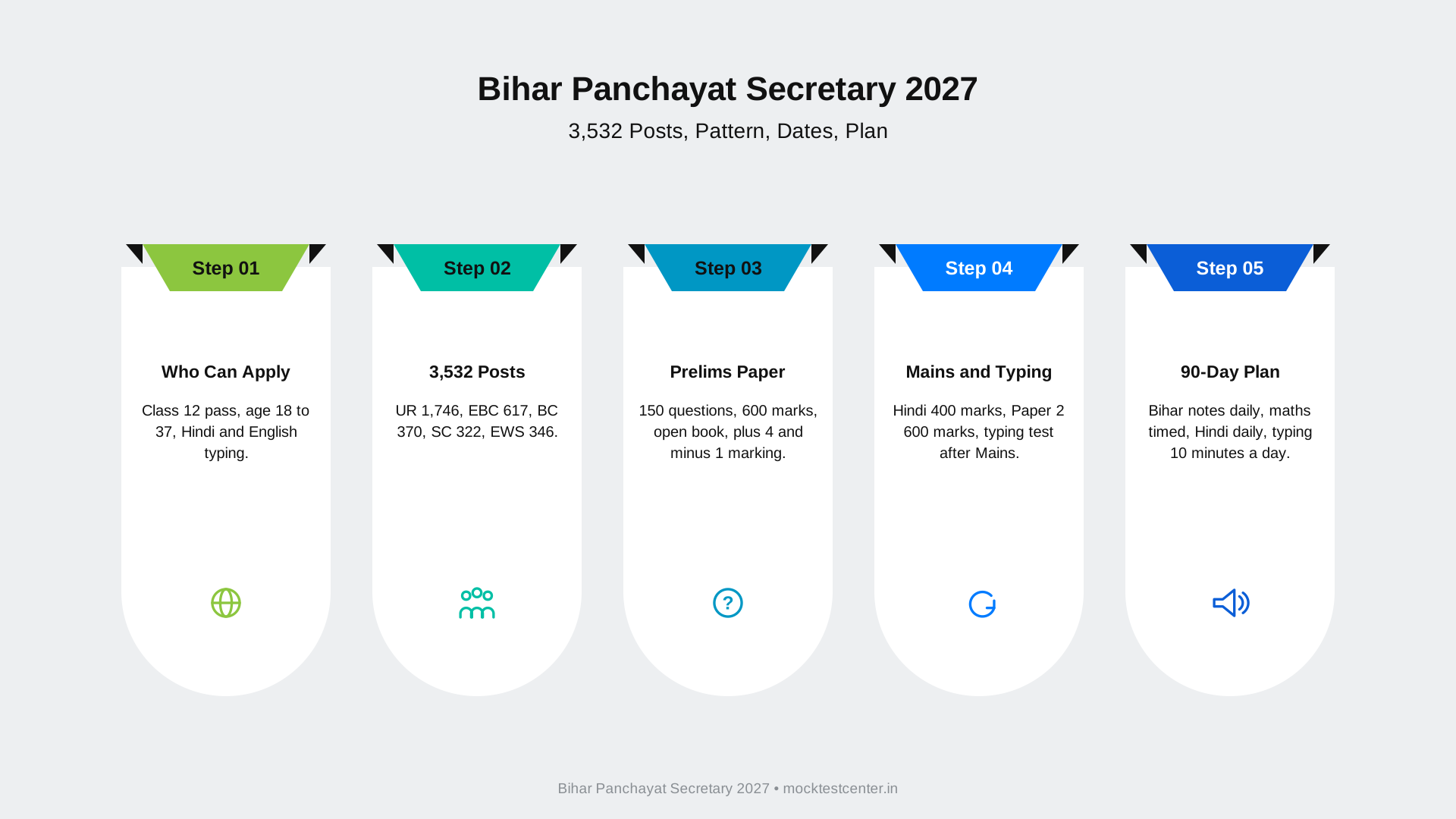
- The 3,532 posts, category by category
- How the selection works, stage by stage
- The Prelims paper in full
- The Mains papers
- The typing test nobody should leave for last
- Syllabus, subject by subject
- Panchayati Raj is the section that separates toppers
- Do not mix this post up with two lookalikes
- A 90 day plan that fits the marking scheme
- Mistakes that cost 4 marks at a time
- Cut offs and qualifying marks, what we know and what we do not
- How to apply and what the fee covers
- What happens after selection
- Sources
Bihar Panchayat Secretary 2027: Complete Exam Guide
The Bihar Panchayat Secretary 2027 recruitment is the biggest chance in years for a Class 12 pass candidate in Bihar to land a state government job. The Bihar Staff Selection Commission, known as BSSC, is filling 3,532 Panchayat Secretary posts in the Panchayati Raj Department through the Second Inter Level Combined Competitive Examination. The advertisement number is 02/23 (A). Applications opened on 15 October 2025 and the last date was extended twice, finally closing on 16 February 2026 for the whole Inter Level examination. If you passed Intermediate and you can type in Hindi and English on a computer, this post was built for you.
Three facts make this exam different from the other Bihar exams that crowd the notice boards. First, the qualification is only Intermediate, so graduates compete on the same paper as Class 12 pass candidates and the syllabus stays at school level. Second, the paper is open book in the Preliminary stage, which sounds easy until you sit in the hall with three textbooks and 150 questions in 135 minutes. Third, every question carries 4 marks and every wrong answer costs 1 mark, so a single careless guess costs the same as a full correct answer in most other exams. This guide walks through the post and the pattern and the syllabus, plus a 90 day plan, using only figures that trace back to the advertisement or to the Commission site. Where a figure could not be verified, the guide says so in plain words.
The numbers that decide this exam
Before the syllabus, before the books, before the plan, learn the numbers. A candidate who knows the marking scheme prepares differently from one who only knows the subject list. The table below holds the figures that matter most, and every one of them is explained in the sections that follow.
| Item | Detail |
|---|---|
| Recruiting body | Bihar Staff Selection Commission (BSSC) |
| Post | Panchayat Secretary (Panchayat Sachiv) |
| Department | Panchayati Raj Department, Government of Bihar |
| Total posts | 3,532 |
| Advertisement | 02/23 (A), Second Inter Level Combined Competitive Examination |
| Qualification | Intermediate (Class 12) pass; Hindi and English typing on computer |
| Age as on 1 August 2025 | 18 to 37 years, with relaxation for reserved categories |
| Pay scale | Rs 21,700 to Rs 69,100 per month |
| Application fee | Rs 100 for all categories |
| Applications opened | 15 October 2025 |
| Last date to apply | 16 February 2026 (extended, whole Inter Level examination) |
| Prelims paper | 150 questions, 600 marks, 2 hours 15 minutes |
| Marking | 4 marks for a correct answer, minus 1 mark for a wrong answer |
| Mains papers | Paper 1 Hindi, 100 questions, 400 marks; Paper 2, 150 questions, 600 marks |
| Final stage | Typing and computer test after Mains, then document verification |
| Official website | bssc.bihar.gov.in, applications at onlinebssc.com |
Two numbers in that table deserve a second look. The first is 3,532. That is the Panchayat Secretary share of a much larger Inter Level examination. The whole Second Inter Level examination covers 25,311 posts across Bihar government departments after a notice dated 29 January 2026 added 819 posts to the earlier total of 24,492. Panchayat Secretary is the single largest block of posts that needs only Intermediate, which is why the competition for it will be fierce even though the qualification bar is low. The second number is 4. Four marks per question means the paper rewards accuracy far more than speed, and the minus 1 penalty means a guess is expensive. Keep both numbers in mind while you read the rest of this guide.
What a Panchayat Secretary actually does all day
A Panchayat Secretary is the officer in charge of a Gram Panchayat office. Section 32 of the Bihar Panchayat Raj Act, 2006 says there shall be a Panchayat Secretary in every Gram Panchayat, and that the Secretary shall be in charge of the office and shall perform the duties and exercise the powers given by the Act and the rules made under it. In plain words, the Mukhiya is elected and leads the panchayat, while the Secretary is the government servant who keeps the whole machine running.
The daily work is paper and people. The Secretary maintains the panchayat records, the registers, the resolutions passed in meetings, the beneficiary lists and the asset records. When a villager applies for a scheme, the file passes through the Secretary. When a meeting of the Gram Sabha is called, the Secretary prepares the agenda and writes the minutes. When money comes for a scheme, the Secretary keeps the accounts that the auditors will check later. Bihar has 8,463 Gram Panchayats across 534 blocks in 38 districts, so the scale of this work is enormous, and a Secretary posted in one panchayat serves a population that often runs into thousands.
The post also carries real responsibility in rural employment and development work. The Panchayat Secretary is involved in the implementation of schemes that reach the village, including employment guarantee work and the maintenance of job cards and muster rolls. The Secretary coordinates with the block office and the district Panchayati Raj officer, and the reports that go upward from the village start on the Secretary desk. Candidates who picture this job as a quiet desk in a village office should correct that picture now. It is a desk that faces the public every day, in a language the public speaks, and the work is judged by records that must be right.
The posting is in a Gram Panchayat anywhere in Bihar, and the Secretary works under the Panchayati Raj Department. The pay scale is Rs 21,700 to Rs 69,100 per month, which places the post in the lower rung of the state pay matrix but with the security and allowances of a Bihar government job, plus its pension structure. For a candidate who has just finished Class 12, that combination of security and village level authority is the real attraction, and it explains why lakhs of applications arrive for these 3,532 posts.
Who can apply for the post
The eligibility rules are short, and that is part of the appeal. The educational qualification is Intermediate, which means Class 12 or an equivalent qualification from a recognised board. The qualification must be complete by the last date of the application. There is no requirement of a graduation degree, no demand for a diploma and no experience condition. A candidate who finished school and wants a government job can apply the same year.
One condition catches many candidates by surprise, so read it twice. The advertisement asks for knowledge of Hindi and English typing on a computer. This is not a line to tick without thinking. Candidates who clear the Mains examination must take a typing and computer test, and the details of that test are announced by the Commission after the written examination. A candidate who prepares only for the written paper and ignores the keyboard will reach the last stage and stall there. Start typing practice in Hindi and English from the first week of preparation, ten minutes a day. The last stage will then feel routine.
The age limit is 18 to 37 years as on 1 August 2025 for the unreserved category. Relaxation follows the Bihar government rules. Candidates from the Backward Class and Extremely Backward Class categories and women candidates get 3 years of relaxation. Candidates from the Scheduled Caste and Scheduled Tribe categories get 5 years. Persons with disabilities get 10 years of relaxation over the prescribed upper age limit. Reservation benefits apply only to permanent residents of Bihar, so a candidate from another state can apply but cannot claim Bihar reservation.
| Category | Maximum age |
|---|---|
| Unreserved, male | 37 years |
| Unreserved, female | 40 years |
| Backward Class and Extremely Backward Class (both sexes) | 40 years |
| Scheduled Caste and Scheduled Tribe (both sexes) | 42 years |
| Persons with disabilities, all categories | 10 years over the prescribed upper age limit |
There is no limit on the number of attempts. A candidate who does not clear the examination in one cycle can apply again in the next, as long as the age limit allows. That rule matters because the Inter Level examination does not come every year, and the gap between cycles can be long. The current cycle is the Second Inter Level Combined Competitive Examination, and the previous cycle took years to complete, so candidates should treat this attempt as the one that counts.
The 3,532 posts, category by category
The advertisement divides the 3,532 posts among the categories. The breakup is given below, and the figures add up exactly to the total, which is a good check that the table is complete. Unreserved candidates get the largest share at 1,746 posts. Extremely Backward Class candidates get 617 posts. Backward Class candidates get 370 posts, with a further 111 posts reserved for Backward Class women. Scheduled Caste candidates get 322 posts. Economically Weaker Section candidates get 346 posts. Scheduled Tribe candidates get 20 posts.
| Category | Posts |
|---|---|
| Unreserved | 1,746 |
| Extremely Backward Class | 617 |
| Backward Class | 370 |
| Economically Weaker Section | 346 |
| Scheduled Caste | 322 |
| Backward Class women | 111 |
| Scheduled Tribe | 20 |
| Total | 3,532 |
The small number of Scheduled Tribe posts deserves a note. Bihar has a small Scheduled Tribe population, so the share is small, and the competition inside that category will still be sharp because the total number of applicants is large. The large Unreserved share means that even general category candidates have a genuine chance, which is not true in every Bihar examination. The EBC share of 617 posts is also large, and EBC candidates form a big part of the applicant pool in Bihar, so the EBC cut off will be closely watched.
One more figure belongs here. The 3,532 Panchayat Secretary posts sit inside the Second Inter Level examination total of 25,311 posts. The other posts in the same examination include Lower Division Clerk and Revenue Staff, among other Group C posts in various departments. A candidate applies for the examination and gives a preference order for the posts, and the final allotment follows the merit list and the preference. Panchayat Secretary is the post most Intermediate pass candidates put at the top of that list, because it carries a village level posting and a clear job profile, while a clerk post can mean a desk in any department.
How the selection works, stage by stage
The selection has three stages, and each stage has a different job. The Preliminary examination screens the crowd. The Mains examination decides the merit list. The typing and computer test checks a skill the written papers cannot check. Document verification comes at the end, and a candidate who fails it loses the post even after clearing every paper. Understand the job of each stage and you will stop preparing for all of them in the same way.
The Preliminary examination is held when more than 40,000 applications are received, which is certain for this cycle, and it can be held in more than one phase if the number of applications is very large. Results are then prepared by normalisation, which adjusts scores across phases so that no phase is easier or harder than another. Candidates equal to five times the category wise vacancies are chosen for the Mains examination. Five times 3,532 is 17,660, so roughly seventeen thousand candidates will reach the Mains stage. That sounds like a lot until you compare it with the number of applicants, which will run into lakhs.
The Preliminary marks do not count in the final merit list. The advertisement does not say in so many words that Prelims marks are carried forward, and the notification summaries that track this examination state plainly that Prelims is a screening test. Treat the Prelims as a door. You must pass through it, but your score on the other side starts from zero. That has a practical consequence. A candidate who scores very high in Prelims and then relaxes before Mains is making the most common mistake in this examination. The Mains paper is a fresh race.
The Mains examination is held under a separate advertisement, and the Commission takes the order of preference for the posts from candidates at that stage. The Mains papers decide the merit list, and the merit list decides who gets Panchayat Secretary and who gets another post in the same examination. The typing and computer test follows for candidates who pass the Mains. The Commission has not stated whether the typing test is only qualifying, and it announces the details after the written examination, so candidates should prepare for it as a test that must be passed.
One more rule helps candidates who already work on contract in the same post. Duly engaged contract workers get a weightage of up to 5 marks for each year of satisfactory contract service on the same post, up to a maximum of 25 marks, in both the Preliminary and the Mains examination. This weightage is a real advantage for a small group, and it is written into the advertisement. A fresh candidate can set that rule aside, and still the weightage explains why the cut off can move in ways that surprise first timers.
The Prelims paper in full
The BSSC Panchayat Secretary exam pattern for Prelims is a single objective paper of 150 multiple choice questions, worth 600 marks, to be finished in 2 hours and 15 minutes. The paper has three parts, each of 50 questions and 200 marks. Part one is General Studies. Part two is General Science and Mathematics. Part three is Comprehension and Mental Ability. The paper is set in Hindi and English, and if the two versions of a question differ, the English version is treated as correct. That last rule is easy to miss and it matters for Hindi medium candidates, because the English wording is the final word in a dispute.
| Part | Subject | Questions | Marks |
|---|---|---|---|
| A | General Studies | 50 | 200 |
| B | General Science and Mathematics | 50 | 200 |
| C | Comprehension and Mental Ability | 50 | 200 |
| Total | 150 | 600 |
The marking scheme is the heart of this paper. Each correct answer earns 4 marks. Each wrong answer loses 1 mark. An unattempted question earns nothing and loses nothing. The duration is 135 minutes for 150 questions, which is 54 seconds per question. That is not a lot of time, and it is the reason the open book rule is misunderstood. The Preliminary examination is conducted with books. A candidate may carry three textbooks into the hall, one for each section, one each for General Studies, one for Mathematics and one for General Science. A candidate who has never practised with books in the hall will spend the whole paper searching pages. A candidate who has practised will know exactly which book holds which topic and will open it only for the questions that need it.
Work out the arithmetic before you decide how many questions to attempt. Suppose you attempt 120 questions and get 90 right and 30 wrong. Your score is 90 times 4, which is 360, minus 30, which is 330. Suppose another candidate attempts only 100 questions and gets 85 right and 15 wrong. That score is 340 minus 15, which is 325. The first candidate attempted more and still scored only 5 marks more. Now suppose the first candidate had left 10 of those wrong answers alone. The score would have been 360 minus 20, which is 340. Ten guesses cost 10 marks. In a paper where the cut off is decided by a few marks, ten guesses can decide whether your name is on the Mains list. The rule is simple. Answer what you know, mark what you can narrow to two options, then leave the rest alone.
Minimum qualifying marks for the written examination are set by category, and the exact figures are fixed by the Commission. This guide does not print a qualifying mark table because the verified figures for this cycle could not be confirmed from the advertisement summaries available at the time of writing, and a wrong qualifying mark is worse than no figure at all. Check the advertisement on bssc.bihar.gov.in for the category wise qualifying marks before you set your target score. As a working target, aim for 380 to 400 marks out of 600 in Prelims, which means roughly 100 correct answers with very few wrong ones, and adjust the target when the official qualifying marks are in front of you.
The Mains papers
The BSSC Panchayat Secretary exam pattern for Mains has two papers, each of 2 hours and 15 minutes. Paper 1 is Hindi language, with 100 questions and 400 marks. Paper 2 covers General Studies, General Science, Mathematics and Mental Ability, with 150 questions and 600 marks. The marking is the same as Prelims, 4 marks for a correct answer and minus 1 for a wrong answer. The total for Mains is 250 questions and 1,000 marks, and this total decides the merit list.
| Paper | Subject | Questions | Marks | Duration |
|---|---|---|---|---|
| 1 | Hindi language | 100 | 400 | 2 hours 15 minutes |
| 2 | General Studies, Science, Maths, Mental Ability | 150 | 600 | 2 hours 15 minutes |
| Total | 250 | 1,000 |
Paper 1 is where many candidates lose the examination without realising it. Hindi is the language of official work in Bihar, and the paper tests grammar, comprehension and vocabulary at a level that punishes a candidate who has read Hindi only in school textbooks years ago. The paper is set in Hindi, while Paper 2 is bilingual. Candidates who score well in General Studies but neglect Hindi find that Paper 1 pulls their total down by 50 or 60 marks, and in a merit list decided by single marks, that gap is hard to close. Give Hindi a fixed slot in the daily plan from the first week, not from the last month.
Paper 2 is wider than the Prelims paper and deeper in the same subjects. The General Studies portion grows to include more Bihar specific material. The science and mathematics portions ask for application rather than recall, and the reasoning portion asks for speed under the same 54 seconds per question. The Mains syllabus for Paper 2 is not printed in full in the advertisement, and the Commission publishes the separate Mains advertisement with its own details. Candidates should therefore prepare the Prelims syllabus thoroughly and then extend it, rather than waiting for the Mains advertisement to start studying the same subjects at a deeper level.
The typing test nobody should leave for last
After the Mains examination, candidates who pass must take a typing and computer test. The advertisement says the Commission will give the details of this test after the written examination, and it has not stated whether the test is only qualifying. Treat that gap as advice in itself. Prepare for it as a test you must pass, and prepare early.
The qualification already demands knowledge of Hindi and English typing on a computer, so the test is a check on a condition the candidate accepted at the time of application. A Panchayat Secretary types letters and notices, with beneficiary lists and reports, in Hindi and English every day, and the department cannot post a Secretary who cannot type. Ten minutes of typing practice a day, five days a week, from the start of preparation will build a speed that no crash course in the last week can match. Practise Hindi typing on a standard keyboard layout and English typing on the same keyboard, and practise typing from a printed passage rather than from memory, because the test will give you a passage to type.
Computer knowledge also matters beyond typing. The syllabus for the written papers includes basic computer knowledge in the general awareness area, and the daily work of a Secretary involves the computer for records and reports. A candidate who is comfortable with a computer will also be faster at online mock tests, which is how most preparation happens now. If you do not own a computer, use a cyber cafe or a relative computer twice a week and keep the practice regular.
Syllabus, subject by subject
The syllabus for the Preliminary examination is printed in the advertisement, and the subjects are General Studies, General Science, Mathematics and Mental Ability. The Mains examination adds a full Hindi paper. The topics below follow the advertisement syllabus and the subject lists that the Commission and the standard guides publish for this examination.
General Studies covers current affairs; scientific aspects of everyday life; history; geography; economics; general polity; culture; currency; five year plans; the contribution of Bihar in the national movement; Bihar general knowledge and static general knowledge. The Bihar portion is large, and it is the portion where a Bihar candidate should outscore a candidate from outside the state. Bihar history runs from the Magadh Empire and Nalanda University through the medieval period of Sher Shah Suri to the freedom movement, including the Champaran Satyagraha and the Quit India movement. Bihar geography covers the Ganga and Gandak plains, the Son river, the Kaimur range and the districts. Bihar culture covers festivals like Chhath Puja and the Sonepur Mela, and the state schemes that the government runs now.
General Science covers everyday science, with physics and chemistry at school level, plus biology. The questions ask how things work rather than asking for definitions from a textbook. Mathematics covers number systems; computations with whole numbers and decimals, with fractions; fundamental arithmetic operations; percentage; ratio and proportion; profit and loss; average; interest; time and work; time speed and distance; data interpretation. The level is Class 10 mathematics, but the speed demanded is high, so practice must be timed from the start.
Reasoning and Mental Ability covers analogy; space orientation; Venn diagrams; classification; pattern; number series; critical thinking; problem solving; word building; coding and decoding; emotional intelligence. This section is the most scoring for a candidate who practises daily, because the question types repeat with small changes and a practised candidate recognises the pattern in seconds. It is also the section where a candidate who has never practised reasoning loses the most time, because each question feels new.
Hindi, for the Mains Paper 1, covers grammar; comprehension; vocabulary including synonyms and antonyms; sentence correction; fill in the blanks; sandhi; samasa; kaal; karak; muhavare and lokoktiyan; letter and report writing. The standard preparation is the Hindi grammar of Classes 9 and 10, revised properly rather than skimmed, plus daily reading of a Hindi newspaper to build comprehension speed.
Panchayati Raj is the section that separates toppers
Every candidate studies General Studies. Far fewer study Panchayati Raj properly, and that is why it decides the merit list. The Panchayat Secretary examination is, at heart, an examination about the village government, and the paper rewards the candidate who understands how that government works. The Constitution, the Bihar Act and the village institutions belong at the centre of your preparation.
The 73rd Constitutional Amendment Act of 1992 gave Panchayati Raj a place in the Constitution through Part IX, and the Eleventh Schedule lists the subjects that panchayats handle. The amendment created a three tier system, gave panchayats a five year term, reserved seats for Scheduled Castes and Scheduled Tribes in proportion to population, reserved not less than one third of seats for women, and set up State Election Commissions and State Finance Commissions. Bihar went past the constitutional floor on women reservation, reserving half the seats for women, and that single fact appears in question papers again and again.
Bihar had a Panchayat Raj Act of its own in 1947, passed a fresh Act in 1993 to match the amendment, and replaced that with the Bihar Panchayat Raj Act, 2006, which governs the system today. The three tiers in Bihar are the Gram Panchayat at the village level, headed by the Mukhiya with the Up Mukhiya as deputy, the Panchayat Samiti at the block level, headed by the Pramukh with the Up Pramukh as deputy, and the Zila Parishad at the district level, headed by the Adhyaksha with the Up Adhyaksha as deputy. The Gram Sabha is the body of all voters registered in the village, and it approves the annual plan and the beneficiary lists and takes the social audit of work done.
Bihar has one institution that other states do not have, and it is the most asked topic in this chapter. The Gram Kachahari is a village court at the same level as the Gram Panchayat, headed by the Sarpanch with the Up Sarpanch as deputy, and it settles petty disputes between villagers. A Nyaya Mitra and a Nyay Sachiv assist it with the law and the record. It may impose a fine in the small matters listed in the Act, while serious offences go to the regular courts. A panchayat election in Bihar fills six kinds of posts at one go: ward member and Mukhiya of the Gram Panchayat; Panch and Sarpanch of the Gram Kachahari; member of the Panchayat Samiti and member of the Zila Parishad. The Mukhiya and the Sarpanch are elected directly by the voters, while the Pramukh and the Adhyaksha are chosen by the elected members from among themselves.
For the examination, learn the numbers that attach to these institutions. The 73rd Amendment is 1992. Part IX is the Panchayati Raj part of the Constitution. The Eleventh Schedule lists 29 subjects. The Bihar Panchayat Raj Act is 2006. Bihar reserves 50 percent of panchayat seats for women. The Gram Kachahari is the judicial body and the Gram Panchayat is the executive body, and the Secretary belongs to the Gram Panchayat side. A candidate who can state those facts without hesitation will answer the Panchayati Raj questions in seconds, and those seconds are then available for the mathematics questions that need them.
Do not mix this post up with two lookalikes
The name Panchayat Secretary causes confusion, and the confusion costs candidates their preparation. Two other posts sound almost the same and are completely different, and this section draws the line clearly so that no reader prepares for the wrong examination.
The first lookalike is the Gram Kachahari Sachiv of Bihar. The Gram Kachahari is the village court, and its Sachiv works on the judicial side, keeping the record of the village court under the Sarpanch. The Panchayat Secretary works on the executive side, in charge of the Gram Panchayat office under the Mukhiya. The two posts belong to two different bodies that happen to sit in the same village. The Gram Kachahari Sachiv is recruited separately, with its own eligibility and its own examination, and the figures in this guide do not apply to it. If a coaching advertisement or a tracker page mixes the two posts, trust the advertisement number instead. This guide follows Advertisement 02/23 (A) of BSSC, and that advertisement is for Panchayat Secretary in the Panchayati Raj Department.
The second lookalike is the Gram Panchayat Adhikari of Uttar Pradesh, recruited by the Uttar Pradesh Subordinate Services Selection Commission, known as UPSSSC. The name is close and the work is similar. The state is different. The UP examination has its own advertisement, its own eligibility, its own syllabus and its own pay scale, and none of the Bihar figures in this guide apply to it. Candidates who search the internet for Panchayat Secretary and land on a UP page should check the state name in the first line before reading further. The same warning applies to the Panchayat Secretary posts of other states. Each state recruits its own, and the Bihar post is the one this guide covers.
There is a third confusion inside Bihar itself, and it is worth a line. Some tracker pages describe the Panchayat Secretary as a BPSC post that needs graduation and pays at Level 4. That description belongs to a different understanding of the post, and it conflicts with the advertisement for this cycle, which is a BSSC Inter Level post that needs Intermediate and pays Rs 21,700 to Rs 69,100. The advertisement is the authority, and this guide follows the advertisement. When a source disagrees with the advertisement, the advertisement wins.
A 90 day plan that fits the marking scheme
A plan that ignores the marking scheme is a list of good intentions. This plan follows the BSSC Panchayat Secretary exam pattern and is built around the numbers of the paper, 150 questions, 600 marks, 4 marks for a correct answer, minus 1 for a wrong answer, and three sections of equal weight. The plan assumes 90 days and four to five hours of study a day, and it can be stretched or squeezed to fit the time a candidate actually has.
Days 1 to 30 build the base. Study General Studies for two hours a day, with one hour for Bihar history and geography, with culture alongside, and one hour for national subjects and current affairs. Study mathematics for one hour a day, starting with percentage and ratio and proportion and profit and loss and average and interest, because those topics appear in every paper. Study reasoning for 45 minutes a day, starting with analogy and series and coding decoding, because those types repeat. Study Hindi grammar for 30 minutes a day, starting with sandhi and samasa and kaal. Practise Hindi and English typing for ten minutes a day. Take one mock test of 50 questions at the end of each week, untimed, to check understanding rather than speed.
Days 31 to 60 add depth and speed. General Studies continues, but the Bihar portion now gets a separate notebook, with the three tiers, the 73rd Amendment, the Bihar Panchayat Raj Act 2006, the Gram Kachahari, the reservation figures and the state schemes written in your own words. Mathematics moves to time and work and time speed and distance, plus data interpretation, with every set timed. Reasoning moves to Venn diagrams and critical thinking, plus problem solving, with 20 questions a day. Hindi moves to comprehension passages and vocabulary, with one passage a day. Typing practice continues. Take one full mock test of 150 questions every Sunday, timed at 2 hours and 15 minutes. Spend Monday morning on the analysis. The analysis matters more than the score. For every wrong answer, write down whether it was a knowledge gap, a reading error or a guess, and count the three kinds separately.
Days 61 to 90 are for revision and examination practice. Stop reading new books. Revise the Bihar notebook twice, revise the mathematics formulae once a week, and revise the Hindi grammar notes once a week. Take two full mock tests a week, and practise at least two of them with the three textbooks open, exactly as the hall allows, so that you learn which book to open and when. In the last ten days, take a mock test every alternate day and spend the days between on revision only. In the last three days, revise the Panchayati Raj notes and the Bihar facts and the formulae. Stop studying new current affairs. Sleep properly the night before the paper, because a tired candidate guesses more, and every guess costs a mark.
The open book rule needs its own paragraph in the plan, because it is the most misunderstood part of this examination. Three textbooks are allowed, one each for General Studies, Mathematics and General Science, and a candidate who has not decided in advance which book covers which topic will waste the paper searching. Choose the three books in the first week and mark the important pages with tabs. Use the same three books in every mock test. Do not carry a new book to the hall. The books are a safety net for the questions you half know, not a replacement for study. If you open a book for more than 20 questions, you have not prepared, and the clock will punish you for it.
Mistakes that cost 4 marks at a time
The first mistake is guessing. A wrong answer loses 1 mark, but it also loses the 4 marks the correct answer would have earned, so the swing on a guessed question is 5 marks against the candidate who leaves it alone. Candidates who attempt all 150 questions because a blank feels like a defeat are the ones who fall below the cut off by a handful of marks. Attempt what you know, attempt what you can narrow to two options, and leave the rest blank without regret.
The second mistake is ignoring Hindi. Paper 1 of Mains is 400 marks of Hindi, and it is the paper that candidates prepare for last. A candidate who scores 300 out of 600 in Paper 2 and 200 out of 400 in Paper 1 has 500 out of 1,000. A candidate who scores the same 300 in Paper 2 and 280 in Paper 1 has 580, and that gap of 80 marks is larger than the gap between selection and rejection in most categories. Hindi carries two fifths of the Mains total, so give it a main subject slot from the first week.
The third mistake is preparing for the wrong post. Candidates who read a UP Gram Panchayat Adhikari syllabus or a Gram Kachahari Sachiv notice and apply it to the Bihar examination waste weeks on the wrong pattern. Check the advertisement number on every source you use. If it does not say BSSC Advertisement 02/23 (A), Second Inter Level Combined Competitive Examination, it is not this examination.
The fourth mistake is trusting a single tracker page for dates. The examination date for the Preliminary stage had not been verified from an official source at the time this guide was written, and several tracker pages print dates that disagree with each other. One tracker page lists June to July 2026 for Prelims and September 2026 for Mains, but those dates are predictions from a coaching site, not a Commission notice, and they should not be used to plan leave or travel. The only reliable source for the examination date is the Commission site, bssc.bihar.gov.in, and the admit card, which the Commission issues before the paper. Check the site every week and plan around the admit card, not around a tracker page.
The fifth mistake is leaving typing for the end. The typing and computer test comes after Mains, and candidates who reach it without practice fail a test that a few minutes a day would have made easy. Typing is a physical skill, and physical skills need repetition over weeks. Start in week one.
Cut offs and qualifying marks, what we know and what we do not
Cut off marks for this cycle do not exist yet, because the Preliminary examination has not been held, and any page that prints a cut off for the 2027 cycle is printing a guess. The honest statement is that the cut off will depend on the number of applicants, the difficulty of the paper and the category wise vacancies, and it will be known only after the result. Candidates should not plan around a cut off printed on a tracker page.
What can be said is that the shortlist for Mains is five times the category wise vacancies, so about 17,660 candidates will reach Mains from the whole applicant pool. That ratio tells you the scale of the task. If five lakh candidates apply, one in about 28 reaches Mains. If ten lakh apply, one in about 56 reaches Mains. Either way, the Prelims paper must be attempted with discipline, because the difference between rank 17,660 and rank 20,000 will be a few marks.
The minimum qualifying marks for the written examination are set by category, and the figures are fixed by the Commission in the advertisement. This guide does not print them because the verified figures could not be confirmed from the advertisement summaries available at the time of writing. That gap is flagged here rather than filled with a number from a tracker page. Read the advertisement on bssc.bihar.gov.in and note the qualifying marks for your category, then set your target 40 to 50 marks above that figure, because qualifying is not the same as selection.
How to apply and what the fee covers
Applications for this cycle were made online on the Commission portal, onlinebssc.com, with the main Commission site at bssc.bihar.gov.in. The application window opened on 15 October 2025. The last date for registration was first 13 January 2026, then extended to 29 January 2026, and the last date for completing the online application was 31 January 2026. A later notice dated 29 January 2026 extended the whole Inter Level examination further, with the last date for fee payment 13 February 2026 and the last date for final submission 16 February 2026. The fee was Rs 100 for all categories, payable online. The BSSC helpline for technical support is 0612-2227728.
The fee figure needs a note, because older pages quote a different fee. Some tracker pages for the earlier Inter Level examination quote Rs 540 for unreserved candidates and lower fees for other categories. The reports for this cycle, including the Patrika report and the other news reports from January 2026, state Rs 100 for all categories. This guide uses Rs 100, and flags the Rs 540 figure as belonging to an earlier cycle. A candidate applying in a future cycle should check the fee in the new advertisement, because the fee can change between cycles.
For the 2027 cycle, no new advertisement had been issued at the time this guide was written, and no fresh application window had opened. The 2027 branding on this page follows the site practice of targeting the examination year, while the facts describe the live cycle under Advertisement 02/23 (A), which opened in October 2025. Candidates should not wait for a new advertisement to start preparation, because the syllabus and pattern of the Inter Level examination change slowly, and the preparation described in this guide applies to the next cycle as well. When a new advertisement appears, check it against this guide and update the dates and the fee, plus the vacancy figure.
What happens after selection
A selected candidate is posted as Panchayat Secretary in a Gram Panchayat in Bihar, under the Panchayati Raj Department. The pay scale is Rs 21,700 to Rs 69,100 per month, with the allowances that Bihar government servants receive. The work is the work described at the start of this guide: records and meetings, with schemes and accounts, plus coordination with the block and district offices. The post is a Group C post in the state government, and the career path runs through seniority and departmental examinations, though the exact promotion ladder is fixed by the department rules and is not described in the recruitment advertisement.
The first months in the post are the hardest, because the Secretary must learn the registers, the scheme rules and the village in the same weeks. A candidate who prepared for this examination by learning the Panchayati Raj system properly will find the first months easier than a candidate who only memorised facts for the paper. The Act, the tiers, the Gram Sabha and the Gram Kachahari stay useful after the result, because they describe the daily working of the office, and the Secretary who knows them earns the trust of the Mukhiya and the villagers faster.
Start the preparation now, with the pattern in front of you and the marking scheme in mind. Learn the Bihar facts that other candidates skip. Practise mathematics and reasoning against the clock. Give Hindi its due share and type a little every day. The post is 3,532 strong and the qualification is Intermediate. The paper is winnable by a candidate who prepares with discipline rather than with panic.
Sources
Patrika, Panchayat Secretary Recruitment, Opportunity for 12th Pass Youth, January 2026, on patrika.com. Naukrinama, Bihar Staff Selection Commission Recruitment for Panchayat Secretary 2026, on naukrinama.com. OBNews, BSSC Vacancy 2026, Over 3,500 Panchayat Secretary Posts Open in Bihar, on obnews.co. KKN Live, Bihar Panchayat Secretary Recruitment 2026, BSSC Invites Applications for 3532 Posts, on kknlive.com. Bihar Job Info, Bihar Panchayat Sachiv Vacancy 2025, on biharjobinfo.com. GovtJobsAlert, BSSC Inter Level Recruitment 2025, Vacancy Increased to 25,311, Last Date Extended, on govtjobsalert.in. Testbook, BSSC Panchayat Sachiv Syllabus and Exam Pattern, on testbook.com. Testbook, BSSC Inter Level Syllabus 2026 and Exam Pattern, on testbook.com. Adda247, BSSC Inter Level Syllabus 2026, Exam Pattern for Prelims and Mains, on adda247.com. ExamAtlas, BSSC Inter Level Exam Pattern 2026, on examatlas.com. Pariksha Saathi, BSSC Inter Level Syllabus and Exam Pattern, on parikshasaathi.com. GK24, Panchayati Raj in Bihar, on gk24.in. Indian Kanoon, Section 32 in the Bihar Panchayat Raj Act, 2006, on indiankanoon.org. ToppersExam, Bihar Panchayat Sachiv Recruitment 2025 for 3532 Posts, on toppersexam.com.