
About WBPSC Miscellaneous Services 2027 Exam Series
📖 Table of Contents
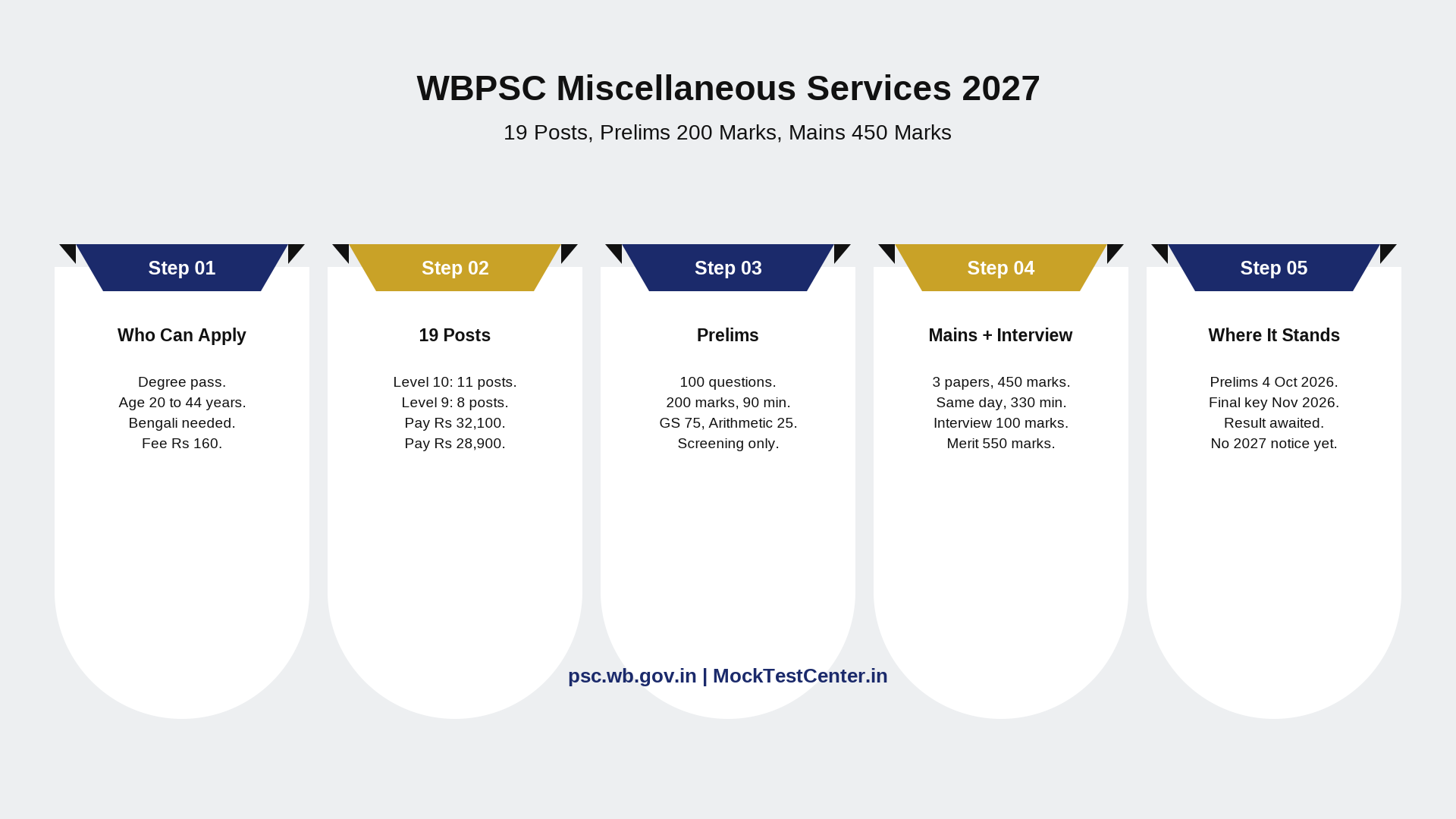
- WBPSC Miscellaneous Services 2027 at a glance
- The live cycle is Advertisement Number 13/2024
- No vacancy number has been published, and the guesses do not agree
- The 19 posts in two pay levels
- The three stages in order
- The WBPSC Miscellaneous Services exam pattern: the preliminary paper in full
- The mains: three papers, 450 marks, one day
- The personality test and the final merit
- Who can apply, what it costs, and the age rule
- The 2023 cycle, the last one that finished its papers
- A preparation plan that fits the numbers
- The mistakes that cost candidates a year
- Sources
WBPSC Miscellaneous Services 2027: Complete Exam Guide
The WBPSC Miscellaneous Services 2027 page on this site follows the live cycle of the Miscellaneous Services Recruitment Examination, and the live cycle is the 2024 cycle under Advertisement Number 13/2024. The Public Service Commission, West Bengal, known as WBPSC, published the detailed advertisement for that cycle on 25 April 2026. Applications ran from 30 April to 9 June 2026, and the Preliminary Examination was held on 4 October 2026 at 26 centres across West Bengal. The WBPSC Miscellaneous Services 2027 page carries the 2027 year because this site groups examination pages by that year. No separate 2027 notification has been published as of 23 November 2026. Anyone preparing now is preparing for the cycle that is already running, and the next notification will follow the same three stage shape unless the Commission changes it.
This examination is unusual in one respect that catches first time applicants by surprise. It is a single recruitment that fills 19 different services and posts in one go. A candidate does not apply for Revenue Inspector or Block Welfare Officer separately. One form, one preliminary paper, one set of mains papers, and one personality test decide the whole list. The Commission then allots services on merit and on the order of preference the candidate records in the choice sheet. That single fact shapes everything about preparation. The paper tests broad awareness and clear drafting, not depth in one subject, because the posts spread across revenue, welfare, audit, labour, correctional services, agriculture marketing, and child development.
The second fact that shapes preparation is the gap between the preliminary paper and the final merit. The preliminary paper carries 200 marks and decides only who reaches the mains. It does not count in the final merit at all. The final merit rests on the 450 mark mains and the 100 mark personality test, a total of 550 marks. A candidate who tops the preliminary paper and then writes weak descriptive answers in the mains still loses the race. The plan in this guide spends words in that proportion. The preliminary paper gets its full treatment, and the mains papers get more.
WBPSC Miscellaneous Services 2027 at a glance
| Detail | What the record shows |
|---|---|
| Conducting body | Public Service Commission, West Bengal (WBPSC) |
| Examination | Miscellaneous Services Recruitment Examination |
| Live cycle | 2024 cycle, Advertisement Number 13/2024 |
| Detailed advertisement | 25 April 2026 |
| Applications | 30 April to 9 June 2026 |
| Preliminary examination | 4 October 2026, 12 noon to 1:30 pm |
| Preliminary result | Not announced as of 23 November 2026 |
| Vacancies | Not announced, to be announced later |
| Posts covered | 19 services and posts, Pay Level 9 and Pay Level 10 |
| Education | Degree from a recognised university |
| Age | 20 to 44 years as on 1 January 2024 |
| Fee | Rs 160, SC and ST of West Bengal and PwBD exempted |
| Stages | Preliminary, Final written, Personality Test |
| Final merit | Mains 450 marks plus Personality Test 100 marks |
| Official website | psc.wb.gov.in |
Two rows in that table deserve a second look before anything else. The vacancy row says the number has not been announced, and the preliminary result row says the result has not been announced. Both are true as of 23 November 2026, and both are the kind of blank that tracker sites love to fill with a guess. This guide does not guess. The sections below say exactly what is known, what is still open, and where the two conflict.
The live cycle is Advertisement Number 13/2024
The detailed advertisement for the Miscellaneous Services Recruitment Examination, 2024 came out on 25 April 2026 under Advertisement Number 13/2024. That date surprises people who expect a 2024 examination to have been advertised in 2024. The advertisement number carries the examination year, 2024, and the publication date fell in April 2026 because the cycle itself ran late. The 2023 cycle was still moving through its final stages when this advertisement appeared. The 2023 cycle held its mains on 31 August 2025 and published its final result on 14 October 2026, and its personality tests run from 25 November to 31 December 2026. Two cycles of the same examination are therefore running at the same time in late 2026, one at the personality test and one waiting for its preliminary result. Candidates who mix the two cycles up will read the wrong dates, so keep the advertisement numbers apart. 11/2023 is the cycle at the personality test. 13/2024 is the cycle waiting for its preliminary result.
Applications for 13/2024 opened on 30 April 2026. The first deadline was 20 May 2026, and the Commission extended it to 9 June 2026 by an announcement dated 20 May 2026. The edit window ran from 22 May to 28 May 2026 in the original schedule, and tracker pages report a later correction window in June 2026, with dates that differ from one page to another. The exact correction dates are recorded as a conflict in the package notes for this page. The fee was Rs 160 for general candidates, with SC and ST candidates of West Bengal and persons with benchmark disabilities exempted. Payment could be made online with a convenience fee and GST, or at a bank counter with a service charge of Rs 17.
The preliminary examination was held on 4 October 2026, a Sunday, in a single shift from 12 noon to 1:30 pm at 26 centres across West Bengal. The e-admit cards were available from 22 September 2026. The Commission published the provisional answer key on 5 October 2026, one day after the paper, and took objections from 6 to 8 October 2026. The final answer key followed on 6 November 2026 according to one tracker page that checked the official notices, while another page dates the final key notice to 7 November 2026 under notice reference 1250-PSC/CON(Q). The two dates differ by a day and both point to the same notice, so this guide records the difference rather than picking one silently. The preliminary result had not been announced as of 23 November 2026. The final examination and the personality test for this cycle have no dates yet, and they cannot have dates until the preliminary result is out.
One more detail from the advertisement matters for anyone who applies next time. The Commission revised the upper age limit for this cycle in the announcement of 20 May 2026. The age limit for 13/2024 is 20 to 44 years as on 1 January 2024. The 2023 cycle had set the limit at 20 to 39 years as on 1 January 2023. The five year rise in the upper limit is the largest single change between the two cycles, and it is the reason some older graduates who missed the 2023 cycle could apply in 2024. Anyone who copies the 2023 age limit into a plan for the next cycle will get it wrong.
No vacancy number has been published, and the guesses do not agree
The detailed advertisement for 13/2024 states that the number of vacancies will be announced later. No vacancy figure appears in the notification, and no official corrigendum with a figure had been published as of 23 November 2026. That is the whole story on vacancies for the live cycle, and it is worth saying plainly because the number is the first thing most candidates search for. Tracker pages that show a figure for this cycle are either carrying a figure from an older cycle or inventing one. The task brief for this page suggested around 155 posts, and that figure could not be verified from any source read during research. It does not appear in the advertisement summary, in the result pages for the 2023 cycle, or in any tracker page for 13/2024. This guide does not use it.
The vacancy question has a practical side that candidates miss. The Commission asks every candidate who reaches the personality test to file a choice sheet, a running order of preference across all 19 services and posts, and the Commission warns that a service left out of the preference list cannot be allotted even if the candidate would otherwise qualify for it. The choice sheet for the 2023 cycle also carries a note that the preference will not be considered for filling non joining vacancies. The lesson is simple. When the vacancy figure does arrive, read it with the post list beside it, and mark a preference for every service rather than only the famous ones. Revenue Inspector and Block Welfare Officer draw the most attention, and the quieter posts in audit and labour services still carry the same pay level and the same security.
The 2023 cycle gives a sense of scale even without a vacancy figure for 2024. A total of 2,54,394 candidates appeared for the 2023 preliminary paper on 15 September 2024, and 10,229 were shortlisted for the mains. That is roughly one candidate in 25 going through. The Commission then called 2,834 candidates for the personality test after the mains. The funnel is steep at the first stage and steep again at the second, which is why the preparation plan in this guide treats the preliminary paper as a gate to clear with margin, not as a paper to top.
The 19 posts in two pay levels
The examination fills 19 services and posts. Eleven of them sit in Pay Level 10, with a scale of Rs 32,100 to Rs 82,900. Eight sit in Pay Level 9, with a scale of Rs 28,900 to Rs 74,500. Allowances follow the West Bengal Services (Revision of Pay and Allowances) Rules, 2019. Appointments are made on a temporary basis at first. The table below lists the posts as they appear in the advertisement, grouped by pay level.
| Pay level | Posts |
|---|---|
| Level 10, Rs 32,100 to Rs 82,900 | Assistant Child Development Project Officer; Disaster Management Officer and Block Disaster Management Officer; Block Youth Officer, Municipal Youth Officer and Borough Youth Officer; Block Welfare Officer and Welfare Officer; Inspector, Backward Classes Welfare; Assistant Agricultural Marketing Officer (Administrative); Assistant Programme Officer; Controller of Correctional Services; Inspector of Agricultural Income Tax; Consumer Welfare Officer; Savings Development Officer |
| Level 9, Rs 28,900 to Rs 74,500 | Posts in West Bengal Subordinate Labour Service; Auditor of Co-operative Societies; Assistant Auditor, Board of Revenue; Extension Officer, Mass Education Extension; Lady Extension Officer, Mass Education Extension; Assistant Controller of Correctional Services; Investigating Inspector; Revenue Inspector |
A few posts in that list are easy to confuse with lookalikes in other recruitments. The Revenue Inspector here is a WBPSC Miscellaneous post, not a post under the West Bengal Police Recruitment Board and not a post under the Staff Selection Commission. The Assistant Auditor, Board of Revenue, is different from the Auditor of Co-operative Societies, and both are different from the audit posts that appear in the West Bengal Audit and Accounts Service. The Inspector of Agricultural Income Tax is a tax inspection post, not a commercial tax post. The Controller of Correctional Services and the Assistant Controller of Correctional Services are two separate posts at two different pay levels, and the choice sheet treats them as two separate preferences. Candidates who prepare for the wrong lookalike post waste weeks on the wrong syllabus.
The spread of departments is the reason the syllabus stays broad. A Block Welfare Officer works with welfare schemes in a block. An Assistant Child Development Project Officer works with child development projects. A Disaster Management Officer works with disaster preparedness at the block level. An Auditor of Co-operative Societies audits cooperative societies. No single degree subject covers all of that, so the Commission tests general studies, arithmetic, English drafting, and one Indian language instead. The degree requirement is a degree from a recognised university or its equivalent, with no subject condition. That open eligibility is part of why the applicant count runs into lakhs.
The three stages in order
Selection runs in three stages, and each stage has a different job. The preliminary examination is an objective screening test. It carries 200 marks and its only job is to decide who reaches the mains. The final examination is a conventional written examination of three papers, carrying 450 marks in all, and its job is to rank candidates on drafting and knowledge. The personality test carries 100 marks and its job is to test suitability for service, including knowledge of Bengali for candidates whose mother tongue is neither Bengali nor Nepali. The final merit is built from the 450 marks of the final examination and the 100 marks of the personality test, a total of 550 marks. The preliminary marks are left out of the merit entirely.
The qualifying marks for the final examination and the personality test together are set as an aggregate percentage. Unreserved, EWS and Meritorious Sportsperson candidates need 40 percent in aggregate. OBC candidates need 38 percent. SC candidates need 35 percent. ST and PwBD candidates need 30 percent. These are aggregate qualifying marks across the final examination and the personality test, not per paper cut offs. The preliminary cut off is separate, and the 2023 cycle shows how high it can run. The general category cut off for the 2023 preliminary paper was 145 out of 200, which is 72.5 percent of the paper. A candidate who treats the preliminary paper as a formality will not survive it.
The order of stages matters for planning. Descriptive writing cannot be built in the weeks between the preliminary result and the mains, because the mains papers ask for report drafting, translation, and precis, which are skills that need months of practice. The candidates who do well are the ones who start the mains writing practice while they are still preparing for the preliminary paper. The preparation plan at the end of this guide is built on that order.
The WBPSC Miscellaneous Services exam pattern: the preliminary paper in full
The preliminary examination is one objective paper of 100 questions for 200 marks, held in 90 minutes. General Studies carries 75 questions for 150 marks, and Arithmetic carries 25 questions for 50 marks. Each question carries 2 marks. The paper is bilingual, in English and Bengali. The timing in the live cycle was 12 noon to 1:30 pm, which confirms the 90 minute duration. One tracker page describes the 13/2024 preliminary paper as running from 12 noon to 2:30 pm, which would be 150 minutes, but that conflicts with the exam calendar entry for the same cycle, with the 2023 cycle timing, and with the paper structure itself. This guide uses 90 minutes.
| Section | Questions | Marks |
|---|---|---|
| General Studies | 75 | 150 |
| Arithmetic | 25 | 50 |
| Total | 100 | 200 |
Negative marking is the one point in the preliminary pattern where the sources disagree, and the disagreement is worth recording in full. The answer key pages for the 13/2024 cycle state that there is no negative marking, with a correct answer worth plus 2 marks, a wrong answer worth 0, and an unattempted question worth 0. CareerPower, RojgarPulse and Result91 all report the same scheme. One Testbook page contradicts itself on the same point, giving no negative marking in its calculation steps and then answering yes to the question whether negative marking exists. An older syllabus page for the 2023 cycle reports a deduction of half a mark per wrong answer. The weight of the reporting for the live cycle points to no negative marking, and the final answer key notice is the document that settles it, but a candidate should still read the marking instruction printed on the question booklet on the day. If the booklet says something different from every tracker page, the booklet wins.
The General Studies syllabus is not published as a detailed list by the Commission. The Commission states that questions are set on the basis of the syllabus of the Madhyamik Examination of the West Bengal Board of Secondary Education. In practice the questions cover Indian history with an emphasis on Bengal, physical geography of India with the rivers, soils and districts of Bengal, the Indian Constitution, the Indian economy including industry and banking, school level science in physics, chemistry and biology, current events, sports, awards, and the culture of Bengal including books, dance forms and singers. The Arithmetic syllabus covers numbers and divisibility, factors and multiples, fractions, simplification, percentages, ratios, mixtures, averages, discount and marked price, interest, pipes and cisterns, work, speed, streams, area and volume. The arithmetic section is only a quarter of the paper, but it is the section where a prepared candidate can bank full marks, because every arithmetic question has one right answer and no judgement is involved.
The 2023 preliminary paper shows the scale of the competition. It was held on 15 September 2024 from 12 noon to 1:30 pm. A total of 2,54,394 candidates appeared. The result came on 16 July 2025, almost ten months later, and 10,229 candidates were shortlisted for the mains. The score cards followed on 24 July 2025. The general category cut off was 145 out of 200. Those numbers carry a blunt message. The paper is short, the questions are worth 2 marks each, and the cut off sits above 70 percent. Speed matters as much as knowledge, because 100 questions in 90 minutes leaves 54 seconds per question, and the arithmetic questions need working time.
The mains: three papers, 450 marks, one day
The final examination is a conventional written examination of three papers, all held on the same day, and this is the part of the WBPSC Miscellaneous Services exam pattern that decides the merit. Paper 1 is English, for 150 marks, in 90 minutes. Paper 2 is Bengali, Hindi, Urdu, Nepali or Santali, for 150 marks, in 90 minutes. Paper 3 is General Studies and Arithmetic, for 150 marks, in 150 minutes. The three papers add to 450 marks and 330 minutes of writing in a single day. That is the hardest fact in the whole examination. Five and a half hours of descriptive writing, with a language paper on each side of a general studies paper, tests stamina as much as knowledge.
| Paper | Subject | Marks | Duration |
|---|---|---|---|
| Paper 1 | English | 150 | 90 minutes |
| Paper 2 | Bengali, Hindi, Urdu, Nepali or Santali | 150 | 90 minutes |
| Paper 3 | General Studies 100, Arithmetic 50 | 150 | 150 minutes |
| Total | 450 | 330 minutes |
Paper 1, English, asks for drafting of a report from points or materials supplied, translation from Bengali, Hindi, Urdu, Nepali or Santali into English, condensing of a prose passage into a summary or precis, and correct use of words, correction of sentences, use of common phrases, synonyms and antonyms. Paper 2, in the Indian language the candidate chooses, asks for the same four things in reverse: drafting of a report, translation from English into the chosen language, condensing of a prose passage, and grammar. The two language papers together carry 300 of the 450 mains marks, which is two thirds of the written score. A candidate who is strong in general studies and weak in drafting will lose the examination in these two papers, not in Paper 3.
Paper 3 splits into Group A, General Studies, for 100 marks, and Group B, Arithmetic, for 50 marks. Answers for Group A may be given in English, Bengali or Nepali, and answers for Group B in English or Bengali, with all answers in one group in the same language. The General Studies part of Paper 3 goes deeper than the preliminary paper, because the answers are descriptive and the examiner can see the reasoning. The Arithmetic part is conventional, with worked answers rather than options to tick. The mains for the 2023 cycle were held on 31 August 2025, a Sunday, with all three papers on the same day, and the final result came on 14 October 2026.
The language papers punish two habits. The first is translation done word by word, which produces English that no reader would write and Bengali that no reader would speak. Translation in this examination rewards the candidate who reads the whole passage, holds its meaning, and then writes it fresh in the other language. The second is report drafting without a structure. A report needs a heading, a short introduction that states the facts, a body that arranges the points in order, and a closing line that states what is asked for. Candidates who write a report as a single block of text lose marks that a simple structure would have kept. The preparation plan below gives these two skills a fixed weekly slot from the first month.
The personality test and the final merit
The personality test carries 100 marks and is the last stage. The Commission called 2,834 candidates for the personality test in the 2023 cycle, after the mains result of 14 October 2026. The cut off marks in the final examination, out of 450, were 237 for unreserved, 222 for OBC, 202 for EWS, 201 for meritorious sportspersons, 188 for SC, 182 for ST, 135 for PwBD unreserved, and 118 for PwBD SC. Those cut offs show how much of the mains score a candidate needs before the interview even starts. The unreserved cut off of 237 out of 450 is 52.7 percent of the written paper.
The personality test for the 2023 cycle runs in Phase 1 from 25 November to 31 December 2026. The Commission issued the schedule under an important announcement numbered 406 PSC/Con, dated 10 November 2026, and the e-call letters were available from 18 November 2026. Candidates must submit their documents as a single colour scanned PDF by email, with the submission window depending on the personality test date. Candidates with a test date from 25 to 27 November 2026 submit from 11 to 18 November 2026, candidates with a test date from 30 November to 4 December 2026 submit from 13 to 20 November 2026, and candidates with a test date from 7 to 31 December 2026 submit from 24 November to 1 December 2026. The documents go to a dedicated email address given in the notice, and the Commission has warned that the choice sheet must be completed with care, because a service left without a preference cannot be allotted.
Knowledge of Bengali is tested in the personality test for candidates whose mother tongue is neither Bengali nor Nepali. The ability to read, write and speak Bengali is essential for every post, and it is not required for candidates whose mother tongue is Nepali, under a Finance Department notification dated 2 March 2016. Candidates whose mother tongue is neither Bengali nor Nepali must show knowledge of Bengali during the personality test. This rule has ended the attempt of more than one candidate who cleared the written papers and then could not show working Bengali at the interview, so it belongs in the plan from the start rather than as a last minute worry.
Who can apply, what it costs, and the age rule
The education condition is a degree from a recognised university or its equivalent, and the candidate must hold it by the closing date of application. For the 13/2024 cycle the closing date was 9 June 2026 after the extension. There is no subject condition and no minimum percentage. The age condition for 13/2024 is not below 20 years and not above 44 years as on 1 January 2024, which means born not earlier than 2 January 1980 and not later than 1 January 2004. Relaxation applies under the rules for SC, ST, OBC and PwBD candidates of West Bengal. The 2023 cycle had set the limit at 20 to 39 years as on 1 January 2023, with SC and ST relaxation of five years, OBC relaxation of three years, and PwBD up to 45 years. The upper limit changed between the cycles, so the age rule must always be read from the advertisement for the cycle in hand, never copied from the last one.
The fee for 13/2024 was Rs 160 for general candidates. SC and ST candidates of West Bengal and persons with benchmark disabilities were exempted. Online payment carried a convenience fee and GST, and payment at a bank counter carried a service charge of Rs 17. The Commission forbids more than one application from the same candidate, and a second application is liable to cancellation. The application is made online only, through the Commission website at psc.wb.gov.in, after a one time registration.
Two conditions in the advertisement catch applicants who read it in a hurry. The first is the Bengali condition described above, which is essential for every post except for Nepali mother tongue candidates. The second is the qualification date. The degree must be held by the closing date of application, and a candidate in the final year of graduation who will get the degree after that date is not eligible for that cycle. The Commission states the rule plainly in the advertisement, and no request after the closing date changes it.
The 2023 cycle, the last one that finished its papers
The 2023 cycle under Advertisement Number 11/2023 is the last cycle that has finished its written papers, and it is the best guide to how the Commission actually runs this examination, including how long each stage takes. The notification came on 3 October 2023. Applications ran from 5 October to 2 November 2023. The preliminary examination was held on 15 September 2024, almost a year after the notification. The preliminary result came on 16 July 2025, ten months after the paper, with 10,229 candidates shortlisted out of 2,54,394 who appeared. The score cards came on 24 July 2025. The mains were held on 31 August 2025. The final result came on 14 October 2026, with 2,834 candidates called for the personality test. The personality test runs from 25 November to 31 December 2026. From notification to personality test, the cycle spans more than three years.
That timeline is the single most useful fact in this guide for a candidate deciding whether to prepare. The examination rewards patience as much as study, because a candidate who starts preparing after the notification is already a year behind the candidate who started before it. The gap between the preliminary paper and its result was ten months in the 2023 cycle, and the gap between the mains and the final result was more than thirteen months. Candidates who stop studying during those gaps lose the thread of the mains writing practice and the language practice, and they pay for it when the next stage is suddenly announced. The plan below keeps a light weekly routine running through the waiting months for exactly that reason.
The 2023 cycle also shows the cut offs in full. The preliminary general cut off was 145 out of 200. The mains cut offs, out of 450, were 237 for unreserved, 222 for OBC, 202 for EWS, 201 for meritorious sportspersons, 188 for SC, 182 for ST, 135 for PwBD unreserved, and 118 for PwBD SC. The gap between the unreserved and SC mains cut offs is 49 marks, which is more than ten percent of the paper. Category cut offs move with the paper and the applicant pool, so these figures are a guide to the scale of the competition, not a target to aim at. A candidate who aims at the last cut off will miss it when the paper turns easy.
A preparation plan that fits the numbers
The plan below runs for six months, and it assumes the candidate starts before any notification. It splits the week into four blocks: General Studies, Arithmetic, language drafting, and revision with mock tests. The split follows the marks. The preliminary paper is 75 percent General Studies and 25 percent Arithmetic, while the mains are 300 marks of language papers and 150 marks of General Studies with Arithmetic. Language drafting therefore gets the largest single block from the first month, because it carries the most mains marks and it is the slowest skill to build.
General Studies preparation starts with the Madhyamik level base that the Commission itself names. History, geography, polity, economy and science at the school level come first, and only then does the candidate add current events and Bengal specific material. Bengal carries extra weight in this paper. The rivers, soils and districts of Bengal, the culture of Bengal, and the history of Bengal inside Indian history appear year after year. A notebook that keeps Bengal facts separate from all India facts saves time in revision, because the paper rewards a candidate who can answer a Bengal question without thinking twice. Current events need a daily habit, not a monthly rush. Fifteen minutes a day with a newspaper, with one line noted for each item that could become a question, builds a stronger base than a month of reading compilations at the end.
Arithmetic preparation is a daily habit of 30 minutes, not a weekend block. The syllabus is fixed and short, and the questions repeat their shapes. Percentages, ratios, averages, interest, work, speed, area and volume cover most of the 25 questions. The candidate should work with a timer from the start, because 25 arithmetic questions inside a 90 minute paper leave no room for slow working. A mock test every Sunday, taken in one sitting of 90 minutes with the full 100 questions, builds the habit of finishing the paper. The score to watch is not the total but the split: General Studies correct, Arithmetic correct, and questions left unattempted. The unattempted count matters even with no negative marking, because every unattempted question is two marks left on the table.
Language drafting gets two sessions a week from the first month. One session is report drafting, alternating between English and the chosen Indian language. The candidate takes a set of points, writes a report of about 250 words with a heading, an introduction, a body in order, and a closing line, and then reads it aloud to catch awkward sentences. The other session is translation and precis, alternating direction each week. Translation practice should use real passages from newspapers, not made up sentences, because the examination passages come from real prose. Precis practice should aim at one third of the original length, keeping every essential fact and dropping every example. After three months, the candidate adds a full mains day once a month: three papers in one day, in order, with the real durations. The first full mains day is tiring, and that is the point. The examination itself is five and a half hours of writing, and stamina is built by doing it, not by reading about it.
Revision in the last month drops new material entirely. The candidate revises the Bengal notebook, the arithmetic formulae, and the report formats, and takes two mock tests a week under the real timing. The last week is for the admit card, the centre, and sleep. No new book in the last week has ever helped a candidate, and several have hurt one.
The mistakes that cost candidates a year
The first mistake is preparing only for the preliminary paper. The preliminary paper is a gate, and the mains are the race. Candidates who spend six months on objective questions and then discover that they cannot draft a report in 90 minutes have wasted the six months. Language drafting must start in the first month, even while the preliminary paper is the nearer target.
The second mistake is ignoring Paper 2, the Indian language paper. Candidates who studied in English medium often treat the language paper as a formality, and then lose 150 marks to poor translation and weak grammar. The language paper carries the same marks as the English paper, and it is the paper where a Bengali medium candidate can outscore an English medium candidate by a wide margin. The choice of language for Paper 2 should be the language the candidate writes best, not the language that looks most impressive.
The third mistake is reading the vacancy figure from a tracker page and then deciding whether to apply. The 13/2024 advertisement states that the vacancy number will be announced later, and no figure had been published as of 23 November 2026. A candidate who waits for the figure waits for nothing, and a candidate who applies on the basis of a guessed figure applies on false information. The decision to apply should rest on eligibility and on the posts, not on a number that does not exist yet.
The fourth mistake is mixing the two live cycles. The 2023 cycle and the 2024 cycle run side by side in late 2026, and their dates, cut offs and age limits are all different. The 2023 cycle has an age limit of 20 to 39 years, a preliminary cut off of 145 for general, and a personality test running to 31 December 2026. The 2024 cycle has an age limit of 20 to 44 years, a preliminary paper held on 4 October 2026, and no result yet. Reading the 2023 dates as the 2024 dates, or the other way round, produces a plan that is wrong in every detail. The advertisement number is the check. 11/2023 and 13/2024 are different examinations for every practical purpose.
The fifth mistake is leaving the choice sheet to the last minute. The Commission asks personality test candidates to record a running order of preference across all 19 services and posts, and it warns that a service left without a preference cannot be allotted. Candidates who fill the sheet in a hurry mark only the famous posts and leave the rest blank, and then discover that their rank would have fetched a post they left blank. The preference order should be decided during preparation, with the pay level, the department, and the place of posting weighed for each of the 19 posts, so that the sheet is filled with a clear head.
The sixth mistake is stopping study during the long gaps between stages. The 2023 cycle took ten months from the preliminary paper to its result, and more than thirteen months from the mains to the final result. Candidates who stop during those gaps return to the next stage cold, and the language papers punish a cold return more than any other paper. A light weekly routine, one report and one translation a week, keeps the skill alive through the waiting months at almost no cost.
Sources
Public Service Commission, West Bengal, Miscellaneous Services Recruitment Examination 2023, Advertisement Number 11/2023, notification 3 October 2023, applications 5 October to 2 November 2023, fee Rs 160, age 20 to 39 years as on 1 January 2023, 19 services and posts, Pay Level 10 Rs 32,100 to Rs 82,900 and Pay Level 9 Rs 28,900 to Rs 74,500, preliminary paper 100 questions for 200 marks in 90 minutes, mains three papers for 450 marks, personality test 100 marks, official website psc.wb.gov.in. SarkariJob, WBPSC Misc Services Personality Test Schedule 2026, Advertisement Number 11/2023, preliminary result 16 July 2025, final written examination 31 August 2025, personality test list and cut off 14 October 2026, Phase 1 personality test schedule released 6 November 2026, personality test 25 November to 31 December 2026, e-call letter download from 18 November 2026, age 20 to 39 years as on 1 January 2023, fee Rs 160 general, SC and ST of West Bengal and PwBD no fee, pay Level 10 Rs 32,100 to Rs 82,900 and Level 9 Rs 28,900 to Rs 74,500, preliminary paper 100 questions 200 marks in 1 hour 30 minutes, Paper 1 English 150 marks in 1 hour 30 minutes, Paper 2 language 150 marks in 1 hour 30 minutes, Paper 3 General Studies 100 and Arithmetic 50 for 150 marks in 2 hours 30 minutes, personality test 100 marks, qualifying marks in aggregate UR, EWS and MSP 40 percent, OBC 38 percent, SC 35 percent, ST and PwBD 30 percent, candidates called for personality test 2,834, final examination cut off out of 450 UR 237, OBC 222, EWS 202, MSP 201, SC 188, ST 182, PwBD UR 135, PwBD SC 118. Adda247, WBPSC Miscellaneous Prelims Result 2025, preliminary examination 15 September 2024, preliminary result 16 July 2025, score card 24 July 2025, 10,229 candidates shortlisted for the mains, general cut off 145 out of 200. InfoEazy, WBPSC Miscellaneous Result 2025, preliminary examination 15 September 2024, result 16 July 2025, 10,229 shortlisted out of 2,54,394 candidates who appeared. CareerPower, WBPSC Miscellaneous Final Result 2026, final result 14 October 2026, mains examination date 31 August 2025, final cut off UR 237, EWS 202, OBC 222, SC 188, ST 182, PwBD UR 135, PwBD SC 118, MSP 201. WBCSMadeEasy, WBPSC Miscellaneous Services 2023 Choice Sheet, document submission periods 11 to 18 November 2026 for personality tests on 25 to 27 November 2026, 13 to 20 November 2026 for tests on 30 November to 4 December 2026, 24 November to 1 December 2026 for tests on 7 to 31 December 2026, single PDF to the Commission email address, preference must be marked for all services and posts, choice not considered for non joining vacancies. SarkariResult, WBPSC Miscellaneous Services 2023 Personality Test Phase 1 Call Letter, important announcement 406 PSC/Con dated 10 November 2026, e-call letter download from 18 November 2026, personality test 25 November to 31 December 2026, document verification by single PDF email. DefenceJobsInIndia, WBPSC Miscellaneous 13/2024 notification, detailed notification 25 April 2026, Advertisement Number 13/2024, applications from 30 April 2026, last date to apply 20 May 2026, fee table, Pay Level 9 and 10 posts. NaukriConnect, West Bengal Miscellaneous Services 2024, notification 23 December 2024, applications 30 April to 9 June 2026, examination date 4 October 2026, correction 12 to 18 June 2026. EasyQuizzz, WBPSC Miscellaneous Services Recruitment Examination 2024, Advertisement Number 13/2024, applications opened 30 April 2026, original deadline 20 May 2026 extended to 9 June 2026 by announcement dated 20 May 2026, vacancies to be announced later, admit card announcement 3 September 2026, upper age limit revised by the 20 May 2026 announcement. CareerPower, WBPSC Miscellaneous Exam Date 2026, examination date notice 3 September 2026, preliminary examination 4 October 2026, admit card 22 September 2026, notification 25 April 2026, applications 30 April to 9 June 2026 extended, result expected November 2026. Testbook, WBPSC Miscellaneous Recruitment 2026, Advertisement Number 13/2024, notification 25 April 2026, applications 30 April to 20 May 2026, admit card 22 September 2026, examination 4 October 2026 from 12 noon to 1:30 pm, fee Rs 160 plus convenience fee, Pay Level 10 Rs 32,100 to Rs 82,900 and Level 9 Rs 28,900 to Rs 74,500, selection by preliminary, final written and personality test. PadhoDost, WBPSC Miscellaneous Exam Date, last checked 2 November 2026, preliminary examination 4 October 2026 from 12 noon to 1:30 pm at 26 centres, provisional answer key 5 October 2026, final answer key 6 November 2026, preliminary result not announced, vacancies not published, revised detailed advertisement 20 May 2026 says vacancies will be announced later, age 20 to 44 years as on 1 January 2024. CareerPower, WBPSC Miscellaneous Answer Key 2026, provisional answer key 5 October 2026, objections 6 to 8 October 2026, correct answer plus 2 marks, incorrect answer 0, no negative marking. RojgarPulse, WBPSC Miscellaneous Answer Key 2026, provisional answer key 5 October 2026, objections 6 to 8 October 2026, 100 questions, 200 marks, negative marking no, correct plus 2, incorrect 0, unattempted 0. Result91, WBPSC Miscellaneous Services Final Answer Key 2026, final answer key 7 November 2026 under notice 1250-PSC/CON(Q), examination 4 October 2026, 100 questions, 200 marks, no deduction for incorrect or unattempted questions. ExamSyllabusHub, WBPSC Miscellaneous syllabus, updated 26 October 2026, preliminary paper 100 questions for 200 marks, General Studies 75 questions for 150 marks, Arithmetic 25 questions for 50 marks, 1 hour 30 minutes, mains three papers for 450 marks, personality test 100 marks, wrong answers attract a deduction of half a mark per wrong answer in recent reports. WBPSCUpSC, WBPSC Miscellaneous Exam Syllabus, preliminary paper 100 questions, General Studies 75, Arithmetic 25, total 200 marks, 1 hour 30 minutes, English and Bengali, final examination Paper 1 English 150 marks in 1 hour 30 minutes, Paper 2 Bengali, Hindi, Urdu, Nepali or Santali 150 marks in 1 hour 30 minutes, Paper 3 General Studies 100 and Arithmetic 50 for 150 marks in 2 hours 30 minutes, all three papers on the same day, questions set on the basis of the Madhyamik syllabus of the West Bengal Board of Secondary Education, Bengali knowledge tested at the personality test for candidates whose mother tongue is neither Bengali nor Nepali. SSCAdda, WBPSC Miscellaneous Recruitment 2023, notification 3 October 2023, applications 5 October to 2 November 2023, selection by preliminary, mains and personality test, preliminary General Studies 150 marks and Arithmetic 50 marks for 200 marks. JagranJosh, WBPSC Recruitment 2023 notification, Miscellaneous Services Recruitment Examination 2023, applications 5 October to 2 November 2023, vacancies not declared, degree from a recognised university, selection by preliminary, final and personality test, official website wbpsc.gov.in. SarkariPariksha, WBPSC Miscellaneous Service 2020, preliminary paper 100 questions, 200 marks, 90 minutes, General Studies 75 for 150 marks, Arithmetic 25 for 50 marks, 2024 cycle Advertisement Number 13/2024 for 19 designations, age 20 to 39 years as on 1 January 2024, Pay Level 10 Rs 32,100 to Rs 82,900 and Level 9 Rs 28,900 to Rs 74,500.







