
About WBPSC Clerkship 2027 Exam Series
📖 Table of Contents
- WBPSC Clerkship 2027 at a glance
- Three cycles, and why the 2019 label misleads
- The posts, and where they sit
- Who can apply: Madhyamik, computer, typing, age
- The fee, and how the application worked
- The three stages, and what each one decides
- Part I in full: the WBPSC Clerkship exam pattern for the objective paper
- Part II in full: the descriptive paper
- The computer and typing test
- Qualifying marks, merit, tie break
- What to study, paper by paper
- Pay, and the career after selection
- The 2023 cycle, still running
- The 2019 cycle, the last one that finished
- A preparation plan that fits the three stages
- Mistakes that cost candidates the examination
- Where the 2024 cycle stands now
- Sources
WBPSC Clerkship 2027: Complete Exam Guide
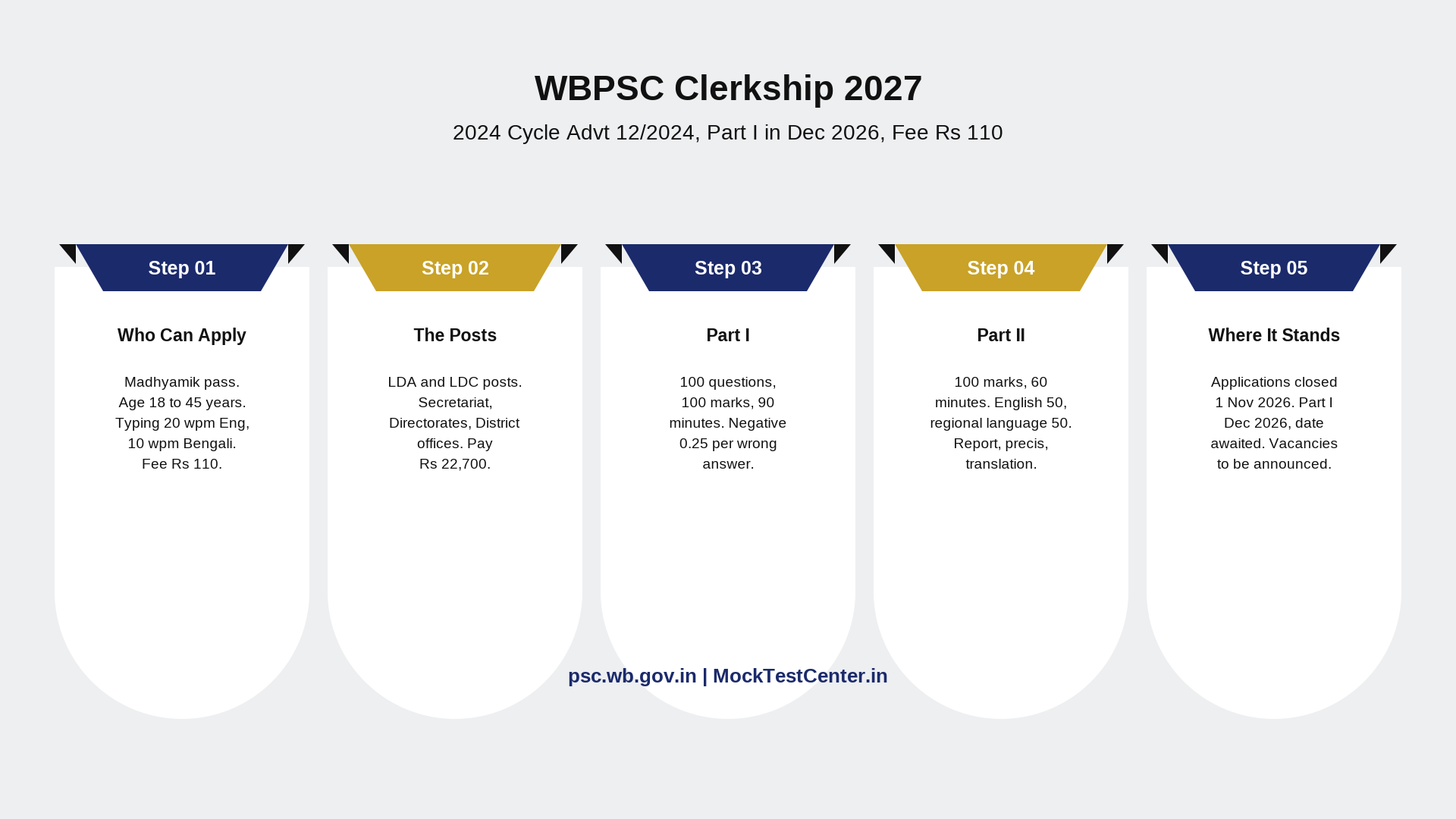
WBPSC Clerkship 2027 on this page follows the live cycle of the Clerkship Examination, and the live cycle is the 2024 examination under Advertisement Number 12/2024. The West Bengal Public Service Commission, known as WBPSC, published the detailed advertisement on 6 October 2026. Applications ran from 6 October to 26 October 2026, and the commission extended the closing date to 1 November 2026 by a notice dated 25 October 2026.
The edit window moved to 3 to 8 November 2026. Part I is tentatively scheduled for December 2026, and the commission has not announced an exact date as of 23 November 2026. No separate 2027 notification has been published as of 23 November 2026, so this guide anchors on the 2024 cycle and on the 2023 and 2019 cycles that ran before it, and says so wherever a 2027 figure would otherwise be guessed.
One fact about this examination surprises candidates who last looked at it years ago. The Clerkship Examination runs in three stages. Part I is an objective paper of 100 marks. Part II is a descriptive paper of 100 marks.
A computer and typing test follows, and it is qualifying only. The final merit comes from Part I and Part II together, out of 200 marks, and only for candidates who pass the typing test. A candidate who tops Part I and fails the typing test takes no post. A candidate who writes well in Part II and ignores typing practice loses the same way. This guide spends as many words on the typing test as on the written papers, because the typing test ends attempts that the papers do not.
The second surprise is the age limit. The 2019 cycle capped age at 40 years. The 2024 cycle caps it at 45 years as on 1 January 2024.
A candidate born between 2 January 1979 and 1 January 2006 can apply. That five year rise opens the examination to candidates who aged out of the 2019 cycle, and it is the biggest single change between the two advertisements. The education rule did not change. A Madhyamik pass still opens the door, with elementary computer knowledge and a typing speed of 20 words per minute in English or 10 words per minute in Bengali.
WBPSC Clerkship 2027 at a glance
| Detail | WBPSC Clerkship 2027, as run in the 2024 cycle |
|---|---|
| Conducting body | West Bengal Public Service Commission (WBPSC), Kolkata, website psc.wb.gov.in |
| Exam | Clerkship Examination for Lower Division Assistant, Lower Division Clerk and similar posts |
| Live cycle | 2024 examination, Advertisement Number 12/2024, detailed advertisement 6 October 2026 |
| Posts in live cycle | Number of vacancies to be announced later by the commission |
| Applications | 6 October to 1 November 2026, extended from 26 October 2026, edit window 3 to 8 November 2026, closed |
| Fee | Rs 110 plus service charges, exempt for SC and ST candidates of West Bengal and PwBD candidates with 40 percent or more disability |
| Education | Madhyamik pass from the West Bengal Board of Secondary Education or its equivalent, plus elementary computer knowledge and typing |
| Age limit | 18 to 45 years as on 1 January 2024, born between 2 January 1979 and 1 January 2006 |
| Part I | Objective, 100 questions, 100 marks, 90 minutes, negative marking 0.25 per wrong answer, tentatively December 2026 |
| Part II | Descriptive, 100 marks, 60 minutes, Group A English 50 marks and Group B regional language 50 marks, date to be announced |
| Typing test | Qualifying only, 20 words per minute in English or 10 words per minute in Bengali, marks do not count for merit |
| Final merit | Part I plus Part II out of 200 marks, only for candidates who pass the typing test |
| Pay scale | Pay Level 6, Rs 22,700 to Rs 58,500 per month under ROPA 2019, plus dearness allowance, medical allowance, house rent allowance |
| Last finished cycle | 2019 examination, Advertisement Number 05/2019, 7,227 vacancies, result notice 30 September 2021 |
| 2027 notification | Not published as of 23 November 2026 |
Three cycles, and why the 2019 label misleads
Tracker pages still call the Clerkship Examination a 2019 recruitment, and the label misleads in two ways. The 2019 cycle did not run its examination in 2019. Its Part I took place on 25 January 2020 and its Part II on 27 September 2020. Its result notice came out on 30 September 2021, more than two years after the advertisement. A candidate who reads 2019 as the exam year prepares from a calendar that never existed.
The label misleads a second way. Two newer cycles exist. The 2023 cycle under Advertisement Number 13/2023 ran its Part I on 16 and 17 November 2024 in four sessions. Its result on 15 October 2025 qualified 89,821 candidates for Part II.
Its Part II examination date notice came out on 4 November 2025 and its admit card notice on 10 December 2025. The Part II result had not been announced as of the latest WBPSC news, which says it will be announced soon. The 2024 cycle under Advertisement Number 12/2024 is the live cycle, with applications closed on 1 November 2026 and Part I tentatively set for December 2026. A candidate who prepares from the 2019 advertisement alone misses the age change, the new vacancy position and the current calendar.
The three cycles share one pattern. Part I stays an objective paper of 100 marks in 90 minutes, with English 30, General Studies 40 and Arithmetic 30. Part II stays a descriptive paper of 100 marks in 60 minutes, with Group A English 50 and Group B regional language 50.
The typing test stays qualifying only at 20 words per minute in English or 10 words per minute in Bengali. The pattern did not change across the three advertisements, so the 2019 and 2023 papers remain the best model for the 2024 Part I. What changed is the age limit, the fee position and the vacancy count, and this guide labels each figure with the cycle it belongs to.
The posts, and where they sit
The Clerkship Examination recruits Lower Division Assistants, Lower Division Clerks, similar posts in the Secretariat, Directorates, District offices, regional offices including Kolkata, under the rule making power of the Government of West Bengal. The work is clerical. A Lower Division Clerk handles files, drafts, records, correspondence in a government office. The post sits at the entry level of the state clerical service, and it is the post a Madhyamik pass candidate can enter without a degree.
The commission does not publish the vacancy number in advance. The 2024 advertisement states that the number of vacancies will be announced later, and that the exact number and the reservation wise distribution will be determined from the vacancies the Government of West Bengal reports. All appointments are initially made on a temporary basis.
A candidate who sees a firm vacancy total for the 2024 cycle on a tracker page is reading a guess. This guide prints no invented total. It prints the 7,227 vacancies of the finished 2019 cycle, with the category split, and it prints the 2024 position as the advertisement states it.
While applying, a candidate must indicate the order of preference for vacancies across three wings. The Secretariat Departments usually post in Kolkata. The Directorates post across the state. The regional offices including District offices post in one particular district or in Kolkata.
The preference order matters, because the allotment follows it. A candidate who wants Kolkata should rank the Secretariat first. A candidate who wants a home district should rank the regional offices of that district first. The form asks for the preference once, and the allotment follows the list written there.
Who can apply: Madhyamik, computer, typing, age
The education rule is short and it is the reason this examination draws lakhs of candidates. A candidate needs a pass in the Madhyamik examination of the West Bengal Board of Secondary Education or its equivalent. No degree is needed. No minimum percentage is stated. A candidate who passed Madhyamik in any year stands on the same footing as a candidate who passed it last year, as long as the age rule is met.
Two skills sit beside the Madhyamik pass. A candidate needs elementary knowledge of computer operation, and the ability to type on a computer at 20 words per minute in English or 10 words per minute in Bengali. The candidate chooses English or Bengali typing in the online application form.
The typing test comes after Part I and Part II, and only candidates who qualify in both written parts take it. The test is practical, run on a computer, and it is qualifying only. A candidate who cannot type at the required speed should practise daily from the start of preparation, because typing speed builds slowly and cannot be rushed in the weeks between the Part II result and the typing test.
Age runs from 18 to 45 years as on 1 January 2024, which means a date of birth between 2 January 1979 and 1 January 2006. Only the age in the Madhyamik or equivalent certificate is accepted. Relaxation applies to West Bengal candidates only. SC and ST candidates get 5 years.
OBC candidates of the non creamy layer get 3 years. PwBD candidates get an upper limit up to 45 years. The 45 year cap is the new figure. The 2019 cycle capped age at 40 years, and the 2024 cycle raised it by five years. A candidate aged 41 to 45 who could not apply in 2019 can apply in 2024, and that change alone widens the field.
One more language condition applies at the typing stage. Candidates whose mother tongue is not Bengali or Nepali are also tested on Bengali at that stage. Average or poor performance can lead to cancellation. Candidates who take Hindi, Urdu, Nepali or Santali in place of Bengali in Group B of Part II must pass a departmental examination in Bengali during probation before they are confirmed. Bengali is tested twice in this recruitment, once in the written paper and once at the typing stage.
The fee, and how the application worked
The 2024 cycle charged Rs 110 plus service charges for General, EWS, OBC candidates of West Bengal. SC and ST candidates of West Bengal paid nothing. PwBD candidates with 40 percent or more disability paid nothing. The fee was payable online by 26 October 2026, later extended with the closing date to 1 November 2026. The 2019 cycle charged the same Rs 110, so the fee did not change across the cycles.
Applications ran online only, through the WBPSC application portal linked from psc.wb.gov.in. A candidate had to enrol first under the commission one time enrolment scheme, then submit the application through the same website. The window opened on 6 October 2026 at the publication of the detailed advertisement and closed on 1 November 2026 at 3:30 pm, extended from 26 October 2026 by the notice of 25 October 2026, Number 351/PSC(I).
The edit window, first set for 28 October to 1 November 2026, moved to 3 to 8 November 2026. The window has closed, and no fresh application is possible for the 2024 cycle. A candidate who missed it waits for the next advertisement.
The three stages, and what each one decides
The WBPSC Clerkship selection runs in three stages, and each stage decides a different thing. Part I screens the field. Only a limited number of candidates who reach the qualifying mark are called to Part II. Part II tests descriptive writing. The two written parts together decide the merit, out of 200 marks.
The computer and typing test then decides who stays on the list. It carries no marks, but a candidate who fails it leaves the merit list whatever the written score. The design is simple. The papers rank the candidates. The typing test removes the candidates who cannot do the job the post needs.
The 2023 cycle shows how the funnel narrows. Part I ran on 16 and 17 November 2024 in four sessions. The result on 15 October 2025 qualified 89,821 candidates for Part II. That number is large, and it shows the scale of the field.
Part II follows, then the typing test, then the final merit list. The 2019 cycle shows the same funnel at the end. Its revised result notice of 30 September 2021 listed 55,056 candidates as provisionally qualified on the basis of Part I and Part II, and the shortlisting for the typing test ran in order of merit subject to the availability of vacancies. Mere enlistment did not guarantee selection, because the typing test still stood between the list and the appointment.
Part I in full: the WBPSC Clerkship exam pattern for the objective paper
The WBPSC Clerkship exam pattern for Part I is an objective paper of 100 questions and 100 marks, run in 1 hour 30 minutes on an OMR sheet. Three subjects share the paper. English carries 30 questions and 30 marks. General Studies carries 40 questions and 40 marks.
Arithmetic carries 30 questions and 30 marks. Each correct answer carries 1 mark. Each wrong answer costs 0.25 marks. Four wrong answers cancel one correct answer, so blind guessing loses marks fast. A question left unanswered costs nothing, which means a candidate should leave a question blank rather than guess at random.
| Subject | Questions | Marks |
|---|---|---|
| English | 30 | 30 |
| General Studies | 40 | 40 |
| Arithmetic | 30 | 30 |
| Total | 100 | 100 |
The standard of the questions is Madhyamik level, the level of the Class 10 examination of the West Bengal Board of Secondary Education. English tests vocabulary, grammar, sentence structure, synonyms, antonyms, correct usage of words. General Studies tests everyday observation and everyday science, current events, issues mainly about India, basic Indian History and basic Indian Geography. Arithmetic tests divisibility, fractions, decimals, recurring decimals, simplification, HCF, LCM, partnership, average, ratio, proportion, percentage, simple interest, profit, loss, time, distance, area of rectangles and squares. The syllabus is short, and it is printed in the advertisement, so a candidate who covers it fully has covered the paper.
Speed decides Part I as much as knowledge. One hundred questions in 90 minutes allow 54 seconds per question. Arithmetic questions take longer than English questions, so a candidate who spends two minutes on one sum loses the time for three English questions. The order of attempt matters.
English first, then General Studies, then Arithmetic works for most candidates, because it banks the quick marks before the slow sums. A candidate who starts with Arithmetic risks leaving English questions unattempted, and unattempted questions earn nothing. Timed mocks fix the order. A candidate who practises the paper under 90 minutes learns the pace, and a candidate who practises without a timer never does.
Part I marks are added to Part II marks for the final merit list, so Part I counts in the total after screening. Its marks stay in the final merit. A candidate who scores 80 in Part I and 60 in Part II stands at 140 out of 200.
A candidate who scores 60 in Part I and 80 in Part II stands at the same 140. The two parts weigh equally, and a weak Part I cannot be hidden by a strong Part II beyond the total. The qualifying mark for Part I decides who reaches Part II, and the Part I score then stays in the total.
Part II in full: the descriptive paper
Part II is a descriptive paper of 100 marks, run in 1 hour. Two groups share the hour. Group A is English, worth 50 marks. Group B is Bengali, Hindi, Urdu, Nepali or Santali, one language chosen by the candidate, worth 50 marks.
Each group asks for three tasks. The candidate drafts a report from points or material supplied. The candidate writes a summary or precis of a prose passage. The candidate translates, from the regional language into English in Group A, and from English into the chosen language in Group B. No negative marking is stated for Part II, because the answers are written and checked by examiners.
| Group | Language | Marks | Tasks |
|---|---|---|---|
| Group A | English | 50 | Report drafting, summary or precis, translation into English |
| Group B | Bengali, Hindi, Urdu, Nepali or Santali | 50 | Report drafting, summary or precis, translation into the chosen language |
| Total | 100 | 60 minutes |
One hour for two groups and six tasks is tight. A candidate gets about ten minutes per task, and the report drafting takes the longest. The paper punishes the candidate who writes long. A report should use the points supplied and stop.
A precis should cut the passage to a third and keep the sense. A translation should stay close to the original and keep the tone. A candidate who practises each task under timed conditions learns the length. A candidate who practises without a timer writes too much in the first task and runs out of time in the last.
One rule in Part II catches candidates who do not read the advertisement. If a candidate writes a name or roll number, or puts any identifying mark in an answer script, 10 percent of the full marks of that paper is cut. The rule exists so that examiners cannot identify a candidate from the script.
A candidate should write nothing on the script except the answers. All answers in one paper must be written in one language only. A candidate who mixes languages in a paper loses marks for it.
The computer and typing test
The computer and typing test is the third stage, and it is qualifying only. Candidates who qualify in Part I and Part II take it. The test is practical, run on a computer.
It checks elementary knowledge of computer operation and the ability to type at 20 words per minute in English or 10 words per minute in Bengali. The marks do not count for merit. The candidate chose English or Bengali typing in the online application form, and the test follows that choice.
The speed sounds low until a candidate tries it under test conditions. Twenty words per minute in English means typing a passage accurately at a steady pace for the full test, with errors counted against the speed. Ten words per minute in Bengali means the same in Bengali script, which is slower for candidates who rarely type in Bengali.
A candidate who types with two fingers will struggle. A candidate who practises for fifteen minutes a day for three months will clear it. The test has no fixed duration stated in the advertisement, and the commission runs it after the Part II result.
Two conditions sit beside the speed. Candidates whose mother tongue is not Bengali or Nepali are also tested on Bengali at this stage, and average or poor performance can lead to cancellation. Candidates who take Hindi, Urdu, Nepali or Santali in place of Bengali in Group B of Part II must pass a departmental examination in Bengali during probation before they are confirmed. The message is plain. The post needs Bengali, and the commission tests it at every stage where it can.
Qualifying marks, merit, tie break
The minimum aggregate needed from Part I plus Part II together out of 200 marks differs by category. Unreserved, EWS, MSP candidates need 40 percent. OBC A, B candidates need 38 percent. SC candidates need 35 percent.
ST, PwBD, ex servicemen candidates need 30 percent. The commission may lower these for reserved categories if many posts stay unfilled. The percentages are the floor, not the cut off. The actual cut off depends on the number of vacancies and the scores of the candidates, and it runs above the floor when the field is large.
| Category | Minimum aggregate, Part I plus Part II |
|---|---|
| Unreserved, EWS, MSP | 40 percent |
| OBC A, B | 38 percent |
| SC | 35 percent |
| ST, PwBD, Ex Servicemen | 30 percent |
The final merit list is prepared from the combined marks of Part I and Part II, but only for candidates who pass the computer and typing test. The list runs in descending order of merit, and the shortlisting for the typing test runs in the same order, subject to the availability of vacancies. The tie break order, as the scheme states it, is higher total in English plus the Group B language, then higher English marks, then the older candidate.
The 2019 result notice states the same rule in the form of the paper: higher marks in Part II first, then higher marks in English in Part II, then higher age. The two versions agree in substance. The older candidate wins a tie, which is one more reason the age rule matters.
The 2019 Part I cut offs show the standard the objective paper demands, as tracker pages report them. The unreserved cut off stood at 65.00 marks out of 100. OBC A stood at 43.00 and OBC B at 56.33.
Those figures come from a tracker page, not from the official result notice read for this guide, and the full category list was not available in the sources read, so this guide prints them as reported and flags them. The 2023 Part I cut offs, reported the same way, stood at 49 for General, 48 for OBC A, OBC B, 47 for SC, 29 for ST. The two cycles differ widely, which shows how much the cut off moves with the paper and the field. A candidate should aim well above the qualifying floor, not at it.
What to study, paper by paper
Part I needs three subjects at Madhyamik level, and the syllabus fits on one page. English needs vocabulary, grammar, sentence structure, synonyms, antonyms, correct usage. A candidate who reads a Madhyamik English grammar book and practises one set a day covers it. General Studies needs everyday science, current events mainly about India, basic Indian History and basic Indian Geography.
A candidate who reads the news daily and revises a monthly compilation covers the current events half, and a Madhyamik level history and geography book covers the rest. Arithmetic needs the listed topics, and each one needs practice, not reading. Divisibility, fractions, decimals, simplification, HCF, LCM, partnership, average, ratio, proportion, percentage, simple interest, profit, loss, time, distance, area of rectangles and squares. A candidate who solves twenty sums a day for three months will answer the Arithmetic section in time. A candidate who reads the formulae and never solves a sum will not.
Part II needs writing, and writing needs practice in both languages. Group A needs a report drafted from given points, a summary or precis of a prose passage, and a translation from the regional language into English. Group B needs the same three tasks in the chosen language, with translation from English into that language. The standard is Madhyamik level, so the language is plain and the tasks are short. A candidate should write one report, one precis, one translation a week in each language, under timed conditions, and check the length against the paper.
The report should stay close to the points supplied. The precis should keep the sense of the passage in a third of the words. The translation should stay close to the original. A candidate who writes regularly in both languages will finish the hour. A candidate who writes only in English will struggle in Group B, and the 50 marks there will decide the total.
Previous year papers show the standard better than any guide. The 2019 Part I paper ran on 25 January 2020 in two shifts, forenoon from 10:00 am to 11:30 am and afternoon from 2:00 pm to 3:30 pm. The 2023 Part I paper ran on 16 and 17 November 2024 in four sessions.
The commission published the provisional answer key for Session I on 26 December 2024, the revised answer key on 20 February 2025 and the final answer key on 16 May 2025. A candidate who works those papers under timed conditions learns the standard, the length, the traps. A candidate who only reads the syllabus never learns the pace.
Pay, and the career after selection
A Lower Division Assistant or Lower Division Clerk in the 2024 cycle is paid at Pay Level 6, Rs 22,700 to Rs 58,500 per month under the West Bengal Services (Revision of Pay and Allowance) Rules, 2019, plus dearness allowance, medical allowance, house rent allowance as per rules. The 2019 advertisement carried the old scale, Pay Band 2 of Rs 5,400 to Rs 25,200 plus grade pay of Rs 2,600, besides dearness allowance, medical allowance, house rent allowance. The Level 6 figure is the current one, and a candidate should use it. The old scale appears on tracker pages that copied the 2019 advertisement, and it should not be quoted for the 2024 cycle.
Appointments are initially made on a temporary basis, and the post carries the usual allowances of a West Bengal government office. The clerical ladder runs upward from Lower Division to Upper Division posts under the state service rules, and the commission advertisement does not print the promotion schedule, so this guide does not claim a timeline for it. The value of the post is the security of a state government job that needs only a Madhyamik pass to enter, with a pay level that rises with service. That is the reason the field runs into lakhs, and the reason the cut off runs above the qualifying floor.
The 2023 cycle, still running
The 2023 cycle under Advertisement Number 13/2023 is the cycle that sits between the finished 2019 cycle and the live 2024 cycle, and it is still running. The indicative advertisement came out on 14 October 2023 and the detailed advertisement with the scheme and syllabus on 4 December 2023. Part I ran on 16 and 17 November 2024 in four sessions, at centres in Kolkata and district towns, with 26 centre codes in the advertisement. The commission published the provisional answer key for Session I on 26 December 2024, with an objection window from 30 December 2024 to 5 January 2025, the revised answer key on 20 February 2025, with an objection window from 21 to 27 February 2025, and the final answer key on 16 May 2025.
The Part I result came out on 15 October 2025, with the roll numbers of 89,821 candidates qualified for Part II and the category wise cut off marks. The reported cut offs stood at 49 for General, 48 for OBC A, OBC B, 47 for SC, 29 for ST. The commission published a notice on viewing Part I OMR sheets on 29 October 2025, and extended the viewing date to 17 November 2025.
The Part II examination date and centre list notice came out on 4 November 2025, and the Part II examination time and admit card notice on 10 December 2025. The Part II result had not been announced as of the latest WBPSC news read for this guide, which says it will be announced soon. The typing test and the final merit list follow the Part II result.
The 2023 cycle matters for a 2024 candidate in two ways. Its Part I paper is the most recent paper, and its answer keys show the standard the commission sets. Its calendar shows how long a Clerkship cycle runs. The advertisement came out in October 2023, the Part I paper ran in November 2024, and the Part II result is still awaited in late 2026. A candidate who enters the 2024 cycle should expect the same kind of calendar, with Part I in December 2026 and the later stages running into 2027 and beyond.
The 2019 cycle, the last one that finished
The 2019 cycle under Advertisement Number 05/2019 is the last Clerkship cycle that ran from advertisement to result, and its numbers are the hard numbers a candidate can plan around. The advertisement came out in February 2019. Applications ran from 22 February to 25 March 2019, with the last date for fee payment offline on 26 March 2019.
The fee was Rs 110. The age limit was 18 to 40 years. The pay was Pay Band 2, Rs 5,400 to Rs 25,200 plus grade pay of Rs 2,600. The number of vacancies was announced later, as the advertisement said it would be.
Part I took place on 25 January 2020, in two shifts, forenoon from 10:00 am to 11:30 am and afternoon from 2:00 pm to 3:30 pm. The answer key came out on 5 February 2020. The list of candidates qualified for Part II, with the marks of the last qualified candidate in each category, came out on 24 July 2020.
Part II took place on 27 September 2020. The result notice of 30 September 2021 then published a revised list of 55,056 candidates provisionally qualified on the basis of Part I and Part II, after a revisit of the entire tabulation process, as a very special case not to be treated as a precedent. The notice also published the category wise vacancies, and the shortlisting for the typing test ran in order of merit subject to the availability of vacancies.
The vacancy table in that notice is the most detailed Clerkship vacancy table the commission has published. The total stood at 7,227 posts. Unreserved carried 2,971. SC carried 1,406. ST carried 430. OBC A carried 716 and OBC B carried 505.
PH categories carried 120 for low vision, 89 for locomotor disability and cerebral palsy, and 109 for hearing impairment. MSP carried 186. SC candidates under the locomotor disability category carried 60. Ex servicemen carried 476, and ex servicemen from SC carried 159. The twelve numbers add to 7,227. A candidate who wants the scale of this recruitment should use that table. It is the only Clerkship vacancy table with a verified total in the sources read for this guide.
A preparation plan that fits the three stages
The plan starts with typing, because typing is the stage candidates leave too late. Fifteen minutes a day on a computer, every day, builds the speed. Type in the language chosen in the application, English at 20 words per minute or Bengali at 10 words per minute.
Type passages, not single words, and check the errors. A candidate who starts typing practice in the first week of preparation will clear the test. A candidate who starts after the Part II result will not, because speed does not build in weeks.
The second part of the plan is Part I, and it needs daily sets. English needs one set a day from a Madhyamik grammar book. General Studies needs daily news reading and a monthly revision, plus a Madhyamik history and geography book.
Arithmetic needs twenty sums a day, timed, from the listed topics. The three subjects together take about two hours a day. A candidate who does two hours a day for four months covers the Part I syllabus twice. A candidate who reads the syllabus and never solves a set covers nothing.
The third part of the plan is Part II, and it needs weekly writing in both languages. Write one report, one precis, one translation a week in English, and the same three tasks a week in the chosen regional language. Time each task. A report should take about ten minutes.
A precis should take about ten minutes. A translation should take about ten minutes. Six tasks in an hour is the pace of the paper, and weekly practice builds it. A candidate who writes only in English will lose the 50 marks of Group B, and the total will show it.
Mock tests earn their place after the base is built. Part I mocks run for 90 minutes with 100 questions, and the review after each mock matters more than the score. Check the wrong answers, the slow sums and the questions skipped that could have been answered.
Part II mocks run for 60 minutes with six tasks, and the review checks the length of each answer against the paper. A mock taken without review wastes the time it took. A mock reviewed properly changes the next score. The 2019 and 2023 papers are the best mocks, because they are the commission own papers at the commission own standard.
Mistakes that cost candidates the examination
The first mistake is preparing for the wrong cycle. Tracker pages still call this a 2019 recruitment, and a candidate who prepares from the 2019 advertisement alone misses the age change from 40 to 45 years, the new vacancy position and the current calendar. Read the advertisement number. The live cycle is 12/2024, and it is the cycle that counts.
The second mistake is ignoring the typing test. The test carries no marks, so candidates treat it as unimportant. It is the stage that ends attempts.
A candidate who tops the written papers and fails the typing test takes no post. Fifteen minutes a day from the first week closes the gap. No practice at all opens it.
The third mistake is guessing blindly in Part I. Four wrong answers cancel one correct answer at a 0.25 penalty. A candidate who guesses on twenty questions and gets five right loses five marks net. A candidate who leaves those twenty blank loses nothing. Attempt a question only when two options can be eliminated, and leave the rest.
The fourth mistake is writing too much in Part II. One hour holds six tasks, and a long report in Group A eats the time for Group B. A report should use the points supplied and stop.
A precis should cut the passage to a third. A translation should stay close to the original. Length is not a mark. Precision is.
The fifth mistake is trusting a vacancy total from a tracker page. The 2024 advertisement states that the number of vacancies will be announced later. A page that prints a firm number for the 2024 cycle is guessing, and a candidate who plans around a guessed number plans around nothing. The hard number is the 7,227 vacancies of the 2019 cycle. No other Clerkship vacancy total exists in the sources read for this guide.
The sixth mistake is writing a name, a roll number or any identifying mark on a Part II script. The advertisement cuts 10 percent of the full marks of that paper for it. The rule is printed in the scheme, and the examiners apply it. A candidate should write nothing on the script except the answers, and all answers in one paper in one language only.
Where the 2024 cycle stands now
The 2024 cycle stands between the application window and Part I. Applications closed on 1 November 2026, extended from 26 October 2026, and the edit window ran from 3 to 8 November 2026. Part I is tentatively scheduled for December 2026, and the commission has not announced an exact date as of 23 November 2026.
Candidates who applied should check psc.wb.gov.in for the Part I date and the admit card notice, and should keep preparing Part I under timed conditions while they wait. Candidates who did not apply should watch for the next advertisement, which will carry its own dates and fee, and should start the typing practice and the Part I base in the meantime. The next advertisement is the next chance, and the preparation for it starts now.
Sources
PadhoDost, WBPSC Clerkship Syllabus and Exam Pattern, from the official Public Service Commission, West Bengal documents, last checked 2 November 2026, Part I English 30, General Studies 40, Arithmetic 30, total 100 questions and 100 marks in 1 hour 30 minutes, negative marking 0.25 per wrong answer, Part I marks added to Part II marks for the final merit list, Part II Group A English 50 marks and Group B regional language 50 marks, total 100 marks in 1 hour, no negative marking stated for Part II, 10 percent cut for an identifying mark, minimum aggregate UR, EWS, MSP 40 percent, OBC A, B 38 percent, SC 35 percent, ST, PwBD, Ex Servicemen 30 percent, tie break higher total in English plus the Group B language, then higher English marks, then the older candidate, typing 20 words per minute in English or 10 words per minute in Bengali, qualifying only, 2023 cycle Part I in four sessions over two days in November 2024: 16 and 17 November, Part I result 15 October 2025 with 89,821 candidates qualified for Part II, Part II examination date and centre list notice 4 November 2025, Part II examination time and admit card notice 10 December 2025, detailed Advertisement Number 12/2024 Clerkship Examination 2024 dated 6 October 2026, closing date extended to 1 November 2026 and edit window moved to 3 to 8 November 2026 by notice Number 351/PSC(I) dated 25 October 2026, indicative Advertisement Number 13/2023 dated 14 October 2023, detailed Advertisement Number 13/2023 dated 4 December 2023, Part I result notice 15 October 2025, 2019 list of candidates qualified for Part II dated 24 July 2020, 2019 result notice with category wise vacancies dated 30 September 2021. Study4India, WBPSC Clerkship Recruitment 2026, Advertisement Number 12/2024, notification 6 October 2026, applications 6 October to 26 October 2026, Part I tentatively December 2026, age 18 to 45 years as on 1 January 2024, Pay Level 6 Rs 22,700 to Rs 58,500, posting preference across Secretariat Departments, Directorates, regional offices including District offices. FreeJobAlert, WBPSC Clerkship Edit Window 2026, last date extended from 26 October to 1 November 2026 by the announcement dated 25 October 2026, edit window rescheduled to 3 to 8 November 2026, vacancies to be announced, age 18 to 45 years as on 1 January 2024. ParikshaIndex, WBPSC Clerkship 2024, applications closed 1 November 2026, Part I tentatively December 2026, age 18 to 45 years on 1 January 2024, born between 2 January 1979 and 1 January 2006. SC and ST of West Bengal get 5 years relaxation, OBC non creamy layer 3 years, PwBD upper limit up to 45 years, Madhyamik or equivalent plus elementary computer knowledge and typing at 20 words per minute in English or 10 words per minute in Bengali. MySarkariNaukri, WBPSC Clerkship Recruitment 2026, Advertisement Number 12/2024, applications 6 October to 26 October 2026 up to 3:30 pm, fee Rs 110 plus service charges for General, EWS, OBC, exempt for SC and ST of West Bengal and PwBD with 40 percent or more disability, age 18 to 45 years as on 1 January 2024, pay Rs 22,700 to Rs 58,500 Level 6, vacancies to be announced later. SarkariNaukriExams, WBPSC Clerkship Exam Date 2020, Clerkship Examination 2019 Advertisement Number 05/2019, applications 22 February to 25 March 2019, Part I examination 25 January 2020, Part I result 25 July 2020, age 18 to 40 years, fee Rs 110, Madhyamik pass plus elementary computer knowledge and typing at 20 words per minute in English or 10 words per minute in Bengali.
Scribd, WBPSC Clerkship Examination 2019, Advertisement Number 05/2019, applications from 11:30 am on 22 February 2019, closing date 25 March 2019, fee offline to 26 March 2019, examination in two stages, Part I objective, Part II conventional written. Computer operation and typing are judged after Part I and Part II, centres in Kolkata and 26 district towns, pay Pay Band 2 Rs 5,400 to Rs 25,200 plus grade pay Rs 2,600, number of vacancies to be announced later. Public Service Commission, West Bengal, notice Number 71-Con/PSC dated 30 September 2021, list of 55,056 candidates provisionally qualified on the basis of Part I and Part II of the Clerkship Examination 2019, Advertisement Number 05/2019, category wise vacancies UR 2971, SC 1406, ST 430, OBC A 716, OBC B 505, PH low vision 120, PH locomotor disability 89, PH hearing impairment 109, MSP 186, SC locomotor disability 60, Ex Servicemen 476, Ex Servicemen SC 159, total 7227, tie break higher marks in Part II, higher marks in English in Part II, higher age. CareerNews TuteeHub, WBPSC Clerkship 2019 results, Part I examination 25 January 2020 from 10:00 am to 11:30 am and 2:00 pm to 3:30 pm, answer key 5 February 2020, Part II examination 27 September 2020, Part I English 30, General Studies 40, Arithmetic 30, Part II Group A English and Group B regional language. CourseVidya, WBPSC Clerkship Preparation, Part I negative marking 0.25, English 30, Arithmetic 30, General Studies 40, total 100 in 90 minutes, Part II Group A English 50 and Group B regional language 50, total 100 in 60 minutes, typing 20 words per minute in English or 10 words per minute in Bengali, final merit from Part I plus Part II out of 200, 2019 Part I qualifying cut off UR 65.00, OBC A 43.00, OBC B 56.33. Haldere Academy, WBPSC Clerkship Examination Complete Guide, updated according to Advertisement Number 13/2023, Part I 100 marks in 90 minutes with negative marking 0.25, Part II 100 marks in 60 minutes, Group A English 50 and Group B regional language 50, typing 20 words per minute in English or 10 words per minute in Bengali, Level 6 Rs 22,700 to Rs 58,500 under ROPA 2019, qualifying marks UR, EWS, MSP 40 percent, OBC A, B 38 percent, SC 35 percent, ST, PwBD, Ex Servicemen 30 percent, 10 percent deduction for an identifying mark. StudyRiser, WBPSC Clerkship Result 2023 Out, Part I result 15 October 2025, 89,821 candidates qualified for Part II, Part I examination 16 and 17 November 2024, cut off General 49, OBC A and OBC B 48, SC 47, ST 29, Part II 100 marks in 60 minutes with Group A English 50 and Group B regional language 50, final merit from Part I plus Part II for candidates who clear the typing test.







