About WBCS 2027 Exam Series
📖 Table of Contents
- WBCS 2027 at a glance
- Why one exam carries three different years
- The four groups and the services inside them
- Who can apply: degree, Bengali, age
- The fee, and how the application works
- The three stages, and what each one decides
- The Preliminary paper in full
- The Main examination in full
- The Personality Test
- The revised scheme from the 2025 examination, and the argument around it
- What to study, paper by paper
- Pay, and the career after selection
- The 2023 cycle, the last one that finished
- A preparation plan that fits the real calendar
- Mistakes that cost candidates the examination
- Where the 2024 cycle stands now
- Sources
WBCS 2027: Complete Exam Guide
WBCS 2027 on this page follows the live cycle of the West Bengal Civil Service (Executive) etc. Examination, and the live cycle is the 2024 examination under Advertisement Number 08/2024. The West Bengal Public Service Commission, known as WBPSC, published the detailed advertisement on 14 November 2025. Applications ran from 18 November to 17 December 2025.
The Preliminary Examination took place on 14 June 2026. WBPSC published the provisional answer key on 24 June 2026 and the final answer key on 27 August 2026. The Preliminary result had not been declared as of October 2026. No separate 2027 notification has been published as of 23 November 2026, so this guide anchors on the 2024 cycle and on the 2023 cycle that finished before it, and says so wherever a 2027 figure would otherwise be guessed.
One fact about this examination surprises first time candidates, and it shapes everything else in this guide. WBPSC does not publish post wise vacancy numbers in the WBCS advertisement. The 2024 advertisement lists the services in four groups and asks candidates to give group and service preferences, but it states no total number of posts.
Vacancies come from the number of posts the state government reports, and the commission announces them later. Any page that prints a firm vacancy total for the 2024 cycle is guessing. This guide gives no invented total. It gives the group wise list of services, the number of candidates the 2023 cycle recommended, and the exact point in the calendar where the 2024 cycle stands.
The examination fills services in all four groups of the Government of West Bengal through one common process. Group A holds the West Bengal Civil Service (Executive) itself, the service that leads to Deputy Magistrate, Block Development Officer and Sub Divisional Officer posts. Group B holds the West Bengal Police Service. Group C and Group D hold the allied services that run the districts, the revenue offices, the correctional homes and the development blocks. One Preliminary paper screens the field.
Six compulsory Main papers plus optional papers for Group A and B decide the written merit. A Personality Test closes the process. The whole cycle runs long. The 2023 cycle began with its Preliminary Examination on 16 December 2023 and published its final result on 27 January 2026, more than two years later. A candidate who enters the 2024 cycle should plan for that kind of calendar.
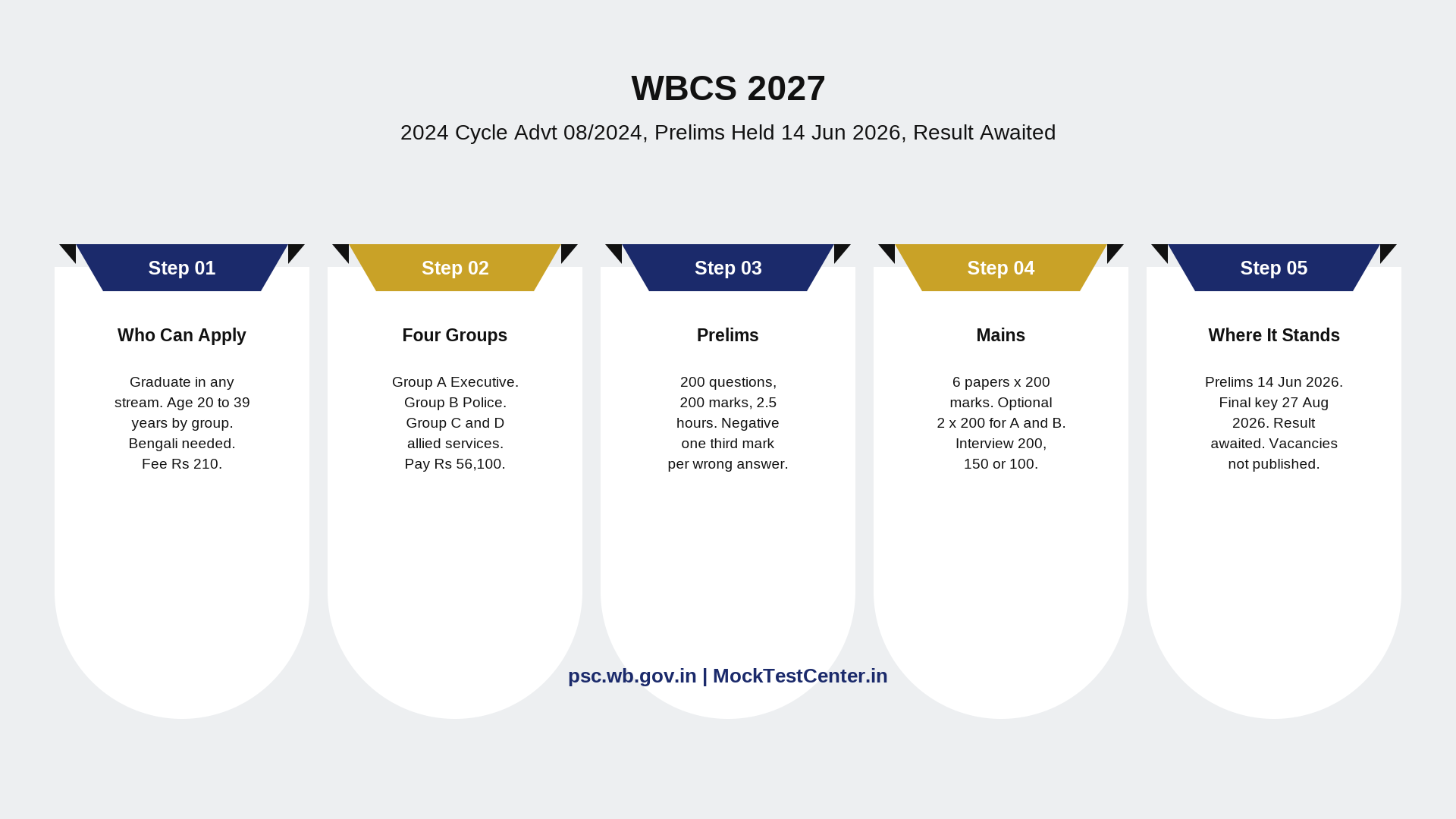
WBCS 2027 at a glance
| Detail | WBCS 2027, as run in the 2024 cycle |
|---|---|
| Conducting body | West Bengal Public Service Commission (WBPSC), Kolkata, website psc.wb.gov.in |
| Exam | West Bengal Civil Service (Executive) etc. Examination, Groups A to D services |
| Live cycle | 2024 examination, Advertisement Number 08/2024, detailed advertisement 14 November 2025 |
| Posts in live cycle | Post wise vacancy numbers not published by WBPSC in the advertisement |
| Applications | 18 November to 17 December 2025, closed, edit window ran to early January 2026 |
| Fee | Rs 210 plus service charges, exempt for SC and ST candidates of West Bengal and PwBD candidates with 40 percent or more disability |
| Education | Bachelor degree in any discipline from a recognised university, plus ability to read and write Bengali, and to speak it |
| Age limit | Group A and C 21 to 36 years, Group B 20 to 36 years, Group D 21 to 39 years, counted as on 1 January 2024 |
| Preliminary exam | 14 June 2026, 200 questions, 200 marks, 2 hours 30 minutes, negative marking one third of a mark per wrong answer, screening only |
| Main exam | Six compulsory papers of 200 marks each, plus two optional papers of 200 marks each for Group A and B only, date to be announced |
| Personality Test | Group A and B 200 marks, Group C 150 marks, Group D 100 marks |
| Total marks | Group A and B 1800, Group C 1350, Group D 1300, Main papers plus Personality Test |
| Pay scale | Group A and B Level 16, Rs 56,100 to Rs 1,44,300, Group C Level 14, Group D Level 10 |
| Last finished cycle | 2023 examination, Advertisement Number 01/2023, final result 27 January 2026, 131 candidates recommended for Group A and B |
| 2027 notification | Not published as of 23 November 2026 |
Why one exam carries three different years
Search results call the live cycle by three different years in the same week. All three labels point at the same recruitment, Advertisement Number 08/2024. The examination carries the year 2024 in its official name. The detailed advertisement came out in November 2025. The Preliminary Examination took place in June 2026.
A tracker page that labels it by the advertisement year says 2024. A page that labels it by the notification year says 2025. A page that labels it by the exam year says 2026. The advertisement number settles the confusion. A page that leaves out 08/2024 may describe a different cycle.
The application dates carry the same kind of confusion, and this guide records it rather than hiding it. Testbook and Testkart put the application window at 18 November to 17 December 2025, with a correction window running to early January 2026. Physics Wallah puts the closing date at 9 December 2025 with an edit window from 12 to 18 December 2025.
The two versions agree on the opening date and on the month. They disagree on the closing date by eight days. This guide uses 17 December 2025, the date the Testbook table and the Testkart dates table both carry, and flags the 9 December 2025 date as a conflict. The window has closed either way, so the conflict changes nothing for a candidate who missed it, and it changes nothing for a candidate preparing for the Main examination.
The Preliminary Examination date is not in dispute. WBPSC held it on 14 June 2026, from 12 noon to 2:30 pm. The commission published the provisional answer key on 24 June 2026 and the final answer key on 27 August 2026.
Testkart records the result as awaited as of October 2026, and Testbook records the admit cards as released on 4 June 2026 with the exam on 14 June 2026. The Main examination schedule follows the Preliminary result, and WBPSC had not announced it as of October 2026. A candidate who sat the Preliminary paper waits for the result. A candidate who plans to sit the next cycle watches for the next advertisement, not for a Main examination date.
The four groups and the services inside them
WBPSC fills 19 posts through this examination, spread across four groups. The candidate gives group and service preferences in the application form, and the commission allots services by final merit and by those preferences. A wrong preference order can cost a candidate a better service, because the allotment follows the list the candidate wrote. The groups matter before the first paper, not after the result.
Group A carries the services most candidates aim for. The West Bengal Civil Service (Executive) sits at the head of the list, with the Assistant Commissioner of Revenue in the integrated West Bengal Revenue Service, the West Bengal Co-operative Service, the West Bengal Employment Service except the post of Employment Officer (Technical), the West Bengal Labour Service, and the West Bengal Food and Supplies Service. An Executive officer usually starts as a Deputy Magistrate and Deputy Collector or as a Block Development Officer. The path runs through Sub Divisional Officer and Additional District Magistrate to senior posts in state departments, and Executive officers become eligible for promotion to the Indian Administrative Service through the state quota.
Group B holds one service, the West Bengal Police Service. A Group B officer starts as a Deputy Superintendent of Police and moves through Additional Superintendent of Police to Superintendent of Police. Group B is the only group a candidate aged 20 can enter, because its lower age limit is 20 years while every other group starts at 21 years. That single year opens the examination to candidates who finished graduation early, and it is the reason the age table needs reading group by group.
Group C holds the middle layer of the district administration. The list includes the Joint Block Development Officer, the Assistant Commercial Tax Officer, the Superintendent of a District Correctional Home or Deputy Superintendent of a Central Correctional Home, the Deputy Assistant Director of Consumer Affairs, the West Bengal Junior Social Welfare Service, the West Bengal Subordinate Land Revenue Service Grade I, the Assistant Canal Revenue Officer, and other posts the advertisement lists. Group D holds the Inspector of Co-operative Societies, the Panchayat Development Officer, the Rehabilitation Officer and the Block Welfare Officer. Group C and Group D candidates sit the same six compulsory Main papers as Group A and B, but they sit no optional papers and they face a shorter Personality Test.
The 2023 cycle shows how few of these posts open in a year. WBPSC recommended 115 candidates for Group A services and 16 candidates for the West Bengal Police Service in the final result published on 27 January 2026, a total of 131. The Group A recommendation of 115 matched the reported vacancies exactly, category by category, with 48 unreserved, 11 EWS, 12 OBC A, 8 OBC B, 23 SC, 6 ST, 7 PwBD posts.
The final result covered Group A and B only. Group C and D results for the 2023 cycle had not appeared in the sources read for this guide, so this guide does not claim a total for them. The 131 figure is the hard number a candidate can plan around, and it shows the scale of the competition. Nearly five thousand candidates cleared the 2023 Preliminary Examination, 257 reached the Personality Test, and 131 took a Group A or B post.
Who can apply: degree, Bengali, age
The education rule is short. A candidate needs a bachelor degree in any discipline from a university recognised by law in India. The degree must be complete by the cut off date the advertisement fixes.
No subject restriction applies, and no minimum percentage applies. A graduate in any stream stands on the same footing as a graduate in any other stream at the application stage. The optional subject choice later rewards a graduation subject, but the eligibility rule itself does not.
The language rule catches more candidates than the degree rule. A candidate must be able to read and write Bengali, and to speak it. The condition does not apply to a candidate whose mother tongue is Nepali and who comes from the hill areas the rules specify. The language papers in the Main examination test the rule in practice, because Paper I asks for letter writing, report drafting, plus precis writing and composition, with translation in Bengali, Hindi, Urdu, Nepali or Santali, and the commission expects the standard of a graduate. A candidate who speaks Bengali at home but has never written a formal letter in it should treat Paper I as a paper to practise, not a paper to wing.
Age is counted as on 1 January of the examination year, and the limits differ by group. Group A and Group C run from 21 to 36 years. Group B runs from 20 to 36 years. Group D runs from 21 to 39 years. The 2024 cycle counts age as on 1 January 2024, so a candidate born after 1 January 2003 cannot apply for Group A, C or D in that cycle, while a candidate born in 2003 who has turned 20 can apply for Group B alone.
Relaxation applies to candidates of West Bengal only. SC and ST candidates get 5 years. OBC A and B candidates get 3 years. PwBD and ex servicemen get relaxation under West Bengal government rules. A candidate from another state takes the general limits with no relaxation, and pays the fee even in a category that West Bengal exempts.
The fee, and how the application works
The 2024 cycle charged Rs 210 plus service charges. General and EWS candidates paid it, as did OBC candidates. SC and ST candidates of West Bengal paid nothing. PwBD candidates of West Bengal with 40 percent or more disability paid nothing.
Candidates of other states in the SC, ST or OBC categories paid the full Rs 210 plus service charges. The fee is not refundable and cannot be adjusted against any other examination. The amount is small next to the preparation cost, but the exemption rule matters for the candidates it covers, and the other state rule surprises candidates who assume their home state certificate travels with them. It does not.
Applications run online only, through the WBPSC application portal linked from psc.wb.gov.in. The process follows the commission one time registration scheme. A candidate registers with a valid mobile number and email ID, fills in personal and educational details, and category details, then picks group and service preferences, uploads a photograph and signature in the format the advertisement fixes, and pays the fee online.
The submitted form should be downloaded and kept until the final result, because the commission asks for it at later stages. The 2024 window opened on 18 November 2025 and closed in mid December 2025, with an edit window running to early January 2026. The window has closed, and no fresh application is possible for the 2024 cycle.
The three stages, and what each one decides
The WBCS selection runs in three stages, and each stage decides a different thing. The Preliminary Examination screens the field. Its marks do not count in the final merit. A candidate who tops the Preliminary paper and fails a Main paper still fails.
The Main examination decides the written merit. Its marks count in full. The Personality Test adds the interview marks to the Main marks, and the commission prepares the final merit from that sum. Services follow rank and preference. The design rewards the candidate who treats the Preliminary paper as a gate and the Main papers as the examination itself.
The Preliminary paper calls a limited number of candidates to the Main examination. The 2023 cycle qualified 4,960 candidates from the Preliminary Examination held on 16 December 2023. The Main examination ran on 16 to 18 and 20 August 2024.
The Main result qualified 257 candidates for the Personality Test. The final result recommended 131 candidates for Group A and B services. The funnel narrows hard at every stage, and the Main papers do most of the narrowing. A candidate who spends the whole preparation on the Preliminary paper arrives at the Main examination unready, because the Main papers ask for descriptive writing and translation, plus arithmetic, reasoning at a level the objective Preliminary paper never tests.
The Preliminary paper in full
The WBCS exam pattern for the Preliminary stage is one objective paper of 200 questions and 200 marks, run in 2 hours 30 minutes. Eight subjects carry 25 marks each. Every question carries 1 mark. The paper runs on an OMR sheet, and the commission deducts one third of a mark for each wrong answer.
A question left unanswered carries no penalty. Three wrong guesses cancel one correct answer, so a candidate who guesses blindly loses marks fast, and a candidate who leaves a question blank loses nothing. The arithmetic of the paper is simple. Two hundred questions in 150 minutes allow 45 seconds per question, and the paper rewards the candidate who moves on from a stuck question instead of burning two minutes on it.
| Subject | Questions | Marks |
|---|---|---|
| English Composition | 25 | 25 |
| General Science | 25 | 25 |
| Current Events of National and International Importance | 25 | 25 |
| History of India | 25 | 25 |
| Geography of India with special reference to West Bengal | 25 | 25 |
| Indian Polity and Economy | 25 | 25 |
| Indian National Movement | 25 | 25 |
| General Mental Ability | 25 | 25 |
| Total | 200 | 200 |
No subject in that table can be skipped. Each one carries an eighth of the paper, so a weak subject costs the same as a strong subject earns. Geography carries a West Bengal reference, and the National Movement section rewards Bengal role in the freedom struggle, so state specific study earns marks in two sections at once.
Current events cover national and international importance, and the science section stays at the everyday science level a graduate is expected to know. English composition tests grammar and vocabulary rather than literature. General Mental Ability tests series and coding questions with analogies, plus basic arithmetic. A candidate who builds NCERT level basics first, then adds West Bengal facts and a daily current affairs habit, covers the whole paper without a separate book for each section.
The Preliminary paper is qualifying in nature, and the commission does not always publish category wise cut off marks alongside the qualified list. Figures for past years that circulate on tracker pages are often estimates. The 2023 Preliminary paper qualified 4,960 candidates, and that number is the official figure from the result notice.
Cut offs change every year with the difficulty of the paper, the number of vacancies and the number of applicants. A candidate should treat any past figure as a rough benchmark and aim for a clear margin above it. The safest target is a score that would clear the paper even in a hard year, not a score that clears it only in an easy one.
The Main examination in full
The WBCS exam pattern for the Main stage makes it the examination that decides the merit, and it is longer and harder than the Preliminary paper by a wide margin. Six compulsory papers of 200 marks each apply to every group. Group A and B candidates add two optional papers of 200 marks each, taking their written total to 1,600 marks. Group C and D candidates sit the six compulsory papers only, for a written total of 1,200 marks.
Every paper runs for 3 hours. Papers I and II are descriptive. Papers III to VI are objective, answered on OMR sheets. The optional papers are descriptive, at honours degree standard except for Law, Medical Science, Engineering subjects, which follow the LLB, MBBS or BE degree standards of recognised Indian universities.
| Paper | Subject | Type | Marks |
|---|---|---|---|
| Paper I | Bengali, Hindi, Urdu, Nepali or Santali | Descriptive | 200 |
| Paper II | English | Descriptive | 200 |
| Paper III | General Studies I: Indian History with emphasis on the National Movement, and Geography of India with reference to West Bengal | Objective | 200 |
| Paper IV | General Studies II: Science, technological advancements, environment, general knowledge, current affairs | Objective | 200 |
| Paper V | The Constitution of India and the Indian Economy, including the role and functions of the Reserve Bank of India | Objective | 200 |
| Paper VI | Arithmetic and Test of Reasoning | Objective | 200 |
| Optional Paper I and II | One optional subject for Group A and B only | Descriptive | 200 each |
Papers I and II test language the way an administrator uses it. Each one asks for letter writing within 150 words, drafting of a report within 200 words, plus precis writing and composition, with translation. Paper I runs in Bengali, Hindi, Urdu, Nepali or Santali, with translation from English into the chosen language.
Paper II runs in English, with translation from the chosen language into English. The word limits are strict, and a candidate who writes 300 words where the paper asks for 150 loses marks for the extra words as surely as for a wrong answer. Practise under the word limit, not above it.
Paper III joins history and geography in one paper, with the National Movement and West Bengal geography carrying the weight. Paper IV joins science, technology, environment, general knowledge, with current affairs alongside. Paper V joins the Constitution and the Indian Economy, including the role and functions of the Reserve Bank of India, so a candidate needs both polity and economics in one sitting. Paper VI joins arithmetic at Madhyamik standard with a test of reasoning that covers data adequacy, logical reasoning, argument building, diagram based conclusions, letter series, number series, mathematical puzzles, data inference, symbol interpretation, odd man out, perception, non verbal thinking. The four objective papers reward the speed and accuracy built for the Preliminary paper, and they punish the candidate who reads slowly.
The optional subject list runs to 38 subjects. Bengali, Hindi, Sanskrit, English, Pali, Arabic, Persian, French, Urdu, Santali, Nepali, Comparative Literature cover languages and literature. Agriculture, Animal Husbandry, Veterinary Science, Anthropology, Botany, Chemistry, Civil Engineering, Commerce, Accountancy, Computer Science, Economics, Electrical Engineering, Geography, Geology, History, Law, Mathematics, Management, Mechanical Engineering, Medical Science, Philosophy, Physiology, Physics, Political Science, Psychology, Sociology, Statistics, Zoology cover the rest.
A Group A or B candidate picks one subject and sits two papers in it. The choice should follow graduation or genuine interest, because two descriptive papers at honours standard punish a subject picked for fashion. The optional papers carry 400 marks, more than a fifth of the Group A and B total, so the choice moves the final rank.
| Group | Main written marks | Personality Test marks | Total marks |
|---|---|---|---|
| Group A | 1600 | 200 | 1800 |
| Group B | 1600 | 200 | 1800 |
| Group C | 1200 | 150 | 1350 |
| Group D | 1200 | 100 | 1300 |
The totals table shows why Group A and B candidates carry a heavier load and a bigger reward. Their written total runs 400 marks higher than Group C and D, and their interview runs 50 to 100 marks higher. The final merit for Group A and B runs out of 1800, for Group C out of 1350, for Group D out of 1300.
The 2023 final cut offs show the standard that total demands. The last recommended Group A candidate in the unreserved category scored 1115.17 out of 1800. The EWS cut off stood at 1001.5, OBC A at 1095.5, OBC B at 1090.25, SC at 1007 and ST at 945.5. Those are the marks a candidate must beat, and they are the marks the Main papers and the interview together must produce.
The Personality Test
The Personality Test is an interview, and the commission calls candidates for it in order of Main examination merit. The questions cover topics of wide interest. The board tests mental acuity and the ability to put ideas across clearly and logically. It weighs intellectual and moral integrity, leadership potential, diversity of interests. The marks differ by group.
Group A and B carry 200 marks. Group C carries 150 marks. Group D carries 100 marks. The interview adds to the Main marks, so a strong interview lifts a borderline candidate and a weak interview drops one. The 2023 cycle called 257 candidates for the Personality Test after the Main examination, and 131 of them took Group A or B posts. The interview decides nearly half the final list.
Preparation for the interview starts with the Main examination itself, because the board asks about the subjects the candidate studied and the services the candidate chose. A candidate who picked the West Bengal Police Service should expect questions on policing and law and order in the district. A candidate who picked the Executive service should expect questions on revenue and development, and the block.
Current affairs from the months before the interview matter more than current affairs from a year earlier. The board also reads the detailed application form, so the hobbies, the graduation subject and the home district written there can all come up as questions. A candidate who writes a hobby on the form should know enough about it to talk for five minutes.
The revised scheme from the 2025 examination, and the argument around it
The 2024 cycle runs on the old scheme, and the next cycle may not. WBPSC has notified a revised scheme and syllabus that applies from the WBCS (Executive) etc. Examination, 2025. The revision rests on two state government notifications, Number 361-PAR(WBCS)/1D-179/21 dated 15 March 2023 and Number 1060-PAR(WBCS)/1D-179/21 dated 24 July 2024. The new scheme changes the examination in three ways, and each change matters for preparation.
First, the Preliminary Examination splits into two papers. General Studies Paper I stays an objective paper of 200 marks, with English Composition, General Science, Current Events, History of India, Geography with special reference to West Bengal, Indian Polity, Economy, Indian National Movement, Environmental Ecology, Biodiversity, Climate Change. Inside the paper the weights change.
Polity and Economy carry 40 marks, Environment carries 40 marks, and the rest carry 20 marks each. General Studies Paper II is a qualifying paper on aptitude, with comprehension, communication skills, interpersonal skills, logical reasoning, analytical ability. A minimum of 33 percent is required to pass it. A candidate who fails Paper II does not move to the Main examination, whatever the Paper I score.
Second, the Main examination becomes fully descriptive, with ten written papers instead of six compulsory papers plus optionals. Two qualifying language papers open the Main examination, Paper A in Bengali or Nepali and Paper B in English, each of 300 marks with a 30 percent minimum in each, and only the candidates who qualify in both have their merit papers evaluated. The merit papers run to 250 marks each: Paper I English Essay, Paper II Tradition and Culture of Bengal, Paper III General Studies I covering History and Geography, Paper IV General Studies II covering Polity and International Relations, and further General Studies papers, plus two optional papers of 250 marks each for Group A and B only. The Tradition and Culture of Bengal paper is new, and it is the paper no old book covers.
Third, the Personality Test stays, with the same group wise marks as the old scheme. The total changes with the papers, so a candidate comparing an old total with a new total compares two different examinations.
One coaching page reports that the state government withdrew the change. Apti Plus published a page on 21 June 2025, updated on 7 July 2026, headed WBCS to Follow Old Syllabus, which says the government withdrew its previous notification proposing changes to the examination pattern and declared that the current format will remain in effect for the time being. The same page says WBPSC proposed the update in September of the previous year for implementation from 2025, and then prints the old pattern in full. That claim conflicts with the Testkart guide, updated in October 2026, which says the revised scheme applies from the 2025 examination and the 2024 cycle continues under the old scheme, and with the Josh Studies page, which prints the revised scheme with the two notification numbers and dates.
This guide cannot settle the conflict from the sources read, because no official withdrawal notification number appears in the Apti Plus page. The safe rule for a candidate is simple. Prepare for the cycle named in the advertisement you apply under, and read the scheme printed in that advertisement, not the scheme on a coaching page. The 2024 cycle ran on the old scheme, and its Preliminary paper of 14 June 2026 was a single paper of 200 marks, which proves the old scheme governed that cycle. The 2025 examination has no advertisement as of 23 November 2026, so no candidate can yet know which scheme its advertisement will print.
What to study, paper by paper
The Preliminary syllabus rewards breadth before depth. History means ancient India, medieval India, modern India, the revolt of 1857, the Gandhian phase, Bengal role in the freedom struggle. Geography means the physical, economic, social geography of India, rivers, soils, agriculture, the resources of West Bengal. Polity and economy mean the Constitution, Parliament, the judiciary, Panchayati Raj, planning, the budget, banking.
Science means everyday science at graduate level. English means grammar and vocabulary. Mental ability means series and coding questions with analogies, plus basic arithmetic. Current affairs mean national and international events, with West Bengal news carrying extra weight because the state appears in geography, history, the Main papers too.
The Main syllabus rewards depth in the same subjects plus writing. The language papers need weekly practice in letter writing, report drafting, plus precis writing and composition, with translation, in both English and the chosen Indian language. The General Studies papers need the Preliminary subjects studied again at a deeper level, with science, technology, environment, the Reserve Bank of India added. The arithmetic paper needs Madhyamik level arithmetic practised to speed, because 200 marks of arithmetic and reasoning in 3 hours punish a candidate who works slowly. The optional subject needs honours level study in one subject, started early, because two descriptive papers cannot be prepared in the weeks between the Preliminary result and the Main examination.
Books matter less than the order of study. NCERT level books build the base for history, geography, polity, economy. A standard West Bengal handbook adds the state facts that the Preliminary geography section and the Main history paper both test.
A monthly current affairs compilation, revised every month rather than read once, covers the current events section and the Main General Studies II paper at the same time. Previous year papers show the standard of each paper better than any guide, and the 2023 and 2024 Preliminary papers are the closest model to the next Preliminary paper. A candidate who finishes the base, then works previous papers under timed conditions, then patches the weak sections the papers expose, prepares in the order the examination rewards.
Pay, and the career after selection
Group A and B posts start at Pay Level 16, with a pay scale of Rs 56,100 to Rs 1,44,300 per month under the West Bengal Services (Revision of Pay and Allowance) Rules, 2019. Group C posts sit at Level 14, with a scale of Rs 39,900 to Rs 1,02,800. Group D posts sit at Level 10, with a scale of Rs 32,100 to Rs 82,900.
On top of basic pay, officers receive dearness allowance at the state rate, house rent allowance based on the place of posting, medical benefits, travel benefits. The gross monthly figure that tracker pages print, Rs 80,000 to Rs 95,000 for Group A and B and Rs 45,000 to Rs 55,000 for Group D, is an estimate, not an official figure, because in hand pay varies with posting and deductions. This guide prints the official pay scales and labels the gross figures as estimates.
The career matters more than the first pay slip. A West Bengal Civil Service (Executive) officer starts as a Deputy Magistrate and Deputy Collector or as a Block Development Officer. The path runs through Sub Divisional Officer and Additional District Magistrate to Joint Secretary and Special Secretary posts in state departments, and Executive officers become eligible for promotion to the Indian Administrative Service through the state quota.
A West Bengal Police Service officer starts as a Deputy Superintendent of Police and moves through Additional Superintendent of Police to Superintendent of Police. Group C and D officers move up their own ladders in the district administration, the revenue offices and the development departments. The examination is hard because the career it opens is long, and the long career is the reason candidates sit it more than once.
The 2023 cycle, the last one that finished
The 2023 cycle is the last WBCS cycle that ran from Preliminary paper to final result, and its calendar shows how long the process takes. The Preliminary Examination took place on 16 December 2023 across centres in the state. The answer key came out on 23 December 2023, with an objection window from 30 December 2023 to 5 January 2024. The Preliminary result qualified 4,960 candidates for the Main examination.
The Main examination ran on 16 to 18 and 20 August 2024. The Main result qualified 257 candidates for the Personality Test. The final result for Group A and B services came out on 27 January 2026, recommending 115 candidates for Group A services and 16 for the West Bengal Police Service, a total of 131. The whole cycle ran for more than two years from the Preliminary paper to the final result.
The 2023 final cut offs give the standard the next cycle must beat. For Group A, the last recommended candidate scored 1115.17 in the unreserved category, 1001.5 in EWS, 1095.5 in OBC A, 1090.25 in OBC B, 1007 in SC and 945.5 in ST, out of 1800 marks. The PwBD cut offs ran lower, with the lowest at 652.83.
The Group A vacancies matched the recommendations exactly, 115 posts filled by 115 candidates, which means no Group A post stayed vacant in the categories reported. A candidate who scores near the unreserved cut off of 1115 needs strong Main papers and a strong interview together, because neither stage alone reaches that total. The Preliminary paper qualified nearly five thousand candidates, and the Main papers cut that number to 257. The Main papers, not the Preliminary paper, decide who becomes an officer.
A preparation plan that fits the real calendar
The plan starts with a decision, not a book list. A candidate aiming for Group A or B must pick the optional subject first, because two descriptive papers at honours standard take the longest to prepare and cannot be rushed after the Preliminary result. Pick the graduation subject if it appears in the list of 38, or a subject you enjoy if it does not.
A subject picked for fashion fails in the second paper, when the questions go deep. Start the optional subject alongside the Preliminary preparation, one hour a day, and keep it running through the whole preparation. The optional papers carry 400 marks, and they are the papers most candidates leave too late.
The second decision is the order of the papers. The Preliminary paper comes first in the calendar, so it gets the first months, but the Main papers get the parallel work. Build the base in history, geography, polity, economy, science, mental ability from NCERT level books, with West Bengal facts kept in separate notes.
Read current affairs for 30 to 40 minutes a day, and revise with monthly notes, because the Preliminary current events section and the Main General Studies II paper draw on the same reading. Practise English and mental ability every day in short sets, because those sections reward regular practice more than long reading sessions. Write one letter, precis or translation a week in both English and the chosen Indian language, because the language papers punish the candidate who writes for the first time in the examination hall.
Mock tests earn their place after the base is built, not before. The WBCS exam pattern tests speed as much as knowledge, with 200 questions in 150 minutes and a one third penalty for each wrong answer. Full length timed mocks fix the order in which a candidate attempts the eight sections and teach the decision of when to skip a question. After each mock, review the wrong answers, the slow questions and the questions skipped that could have been answered.
A mock taken without review wastes the time it took. A mock reviewed properly changes the next score. The same rule holds for the Main papers. Write one descriptive answer a week under timed conditions, and check it against the word limit and the marking pattern, not against a model answer alone.
Revision needs a calendar of its own. The gap between the Preliminary result and the Main examination is short, and the Main papers need the Preliminary subjects studied again at a deeper level. Keep notes short enough to revise in the gap.
A notebook that takes a month to read is a notebook that will not be read. Keep the West Bengal notes separate, because the state facts appear in the Preliminary geography section, the Main history paper, the interview. Keep the current affairs notes monthly, because a single pile of clippings cannot be revised. The candidate who revises three times beats the candidate who reads once and forgets.
Mistakes that cost candidates the examination
The first mistake is preparing for the wrong cycle. Tracker pages mix labels from the 2023, 2024, 2025 cycles. A candidate who studies the revised scheme for a cycle that runs on the old scheme wastes months.
Read the advertisement number. The live cycle is 08/2024, and it runs on the old scheme. The revised scheme applies from the 2025 examination, and its status carries the withdrawal claim this guide flags. A candidate who applies under a future advertisement should read the scheme printed in that advertisement and prepare from it.
The second mistake is treating the Preliminary paper as the examination. The Preliminary marks do not count in the final merit. A candidate who scores high in the Preliminary paper and has no descriptive writing practice fails the Main papers. The Main papers carry 1,200 to 1,600 marks, and they decide the rank. Spend the preparation in proportion to the marks, not in proportion to the calendar order.
The third mistake is skipping the language papers. Papers I and II carry 400 marks together, and they test writing under word limits. A candidate who has never written a precis or a report in Bengali or English under timed conditions loses marks that no amount of General Studies knowledge recovers. One letter, precis or translation a week from the start of preparation closes the gap.
The fourth mistake is guessing blindly in the Preliminary paper, where the WBCS exam pattern punishes it. Three wrong answers cancel one correct answer at a one third penalty. A candidate who guesses on twenty questions and gets five right loses five marks net.
A candidate who leaves those twenty blank loses nothing. Attempt a question only when two options can be eliminated, and leave the rest. The same discipline applies in the objective Main papers, where the same penalty structure punishes the same habit.
The fifth mistake is choosing preferences carelessly. The application form asks for group and service preferences, and the allotment follows the list the candidate wrote. A candidate who ranks a lower service above a higher one by accident takes the lower service. Read the group list, rank the services in the order you want, and check the form before submitting. The preference order cannot be changed after the result.
The sixth mistake is trusting a vacancy total from a tracker page. WBPSC does not publish post wise vacancy numbers in the WBCS advertisement, and the 2024 cycle has no published total. A page that prints a firm number for the 2024 cycle is guessing, and a candidate who plans around a guessed number plans around nothing.
The hard numbers are the 131 recommendations of the 2023 cycle and the 4,960 Preliminary qualifiers of that cycle. Those numbers show the scale. No other vacancy number for the live cycle exists as of 23 November 2026.
Where the 2024 cycle stands now
The 2024 cycle stands between the Preliminary paper and the Main examination. The Preliminary Examination took place on 14 June 2026. The provisional answer key came out on 24 June 2026 and the final answer key on 27 August 2026. The Preliminary result had not been declared as of October 2026.
The Main examination date follows the result, and WBPSC had not announced it as of October 2026. Candidates who sat the Preliminary paper should check psc.wb.gov.in for the result notice and for the Main examination programme, and should keep preparing the Main papers while they wait, because the gap between the result and the Main examination will be short. Candidates who did not apply in the 2024 cycle should watch for the next advertisement, which will carry its own scheme, its own dates and its own fee, and should prepare the base subjects and the optional subject in the meantime. The next advertisement is the next chance, and the preparation for it starts now.
Sources
Testkart, WBCS Examination guide, current cycle WBCS (Exe.) etc. Examination 2024 under Advertisement Number 08/2024, Preliminary Examination held 14 June 2026 from 12 noon to 2:30 pm, provisional answer key 24 June 2026, final answer key 27 August 2026, result awaited as of October 2026, revised scheme from the 2025 examination, fee Rs 210 plus service charges, age Group A and C 21 to 36 years, Group B 20 to 36 years, Group D 21 to 39 years as on 1 January 2024, Preliminary paper 200 questions and 200 marks in 2 hours 30 minutes with one third negative marking, Main examination six compulsory papers of 200 marks each plus two optional papers for Group A and B, Personality Test Group A and B 200 marks, Group C 150 marks, Group D 100 marks, totals 1800, 1800, 1350, 1300. Group A and B Pay Level 16 Rs 56,100 to Rs 1,44,300, post wise vacancy numbers not published. Physics Wallah, WBCS Notification 2025, notification live 14 November 2025, applications 18 November to 9 December 2025, edit window 12 to 18 December 2025, Preliminary Examination tentatively March 2026, age Group A and C 21 to 36 years, Group B 20 to 36 years, Group D 21 to 39 years, salary Rs 56,100 to Rs 1,44,300. Testbook, WBCS Exam Date 2026 page, Advertisement Number 08/2024, notification 14 November 2025, applications 18 November to 17 December 2025, correction 22 December 2025 to 5 January 2026, Preliminary admit cards released 4 June 2026, Preliminary Examination 14 June 2026, fee Rs 210, age 20 to 36 years general statement. FromCampus, WBCS (Executive) Examination 2025 Notification, age Group A and C 21 to 36 years, Group B 20 to 36 years, Group D 21 to 39 years, Preliminary paper eight subjects of 25 marks each, Main examination six compulsory papers of 200 marks each plus two optional papers of 200 marks each, Personality Test Group A and B 200 marks, Group C 150 marks, Group D 100 marks, pay Group A and B Level 16 Rs 56,100 to Rs 1,44,300, Group C Level 14 Rs 39,900 to Rs 1,02,800, Group D Level 10 Rs 32,100 to Rs 82,900.
Josh Studies, WBCS 2025 New Syllabus and Exam Pattern, revised scheme notifications Number 361-PAR(WBCS)/1D-179/21 dated 15 March 2023 and Number 1060-PAR(WBCS)/1D-179/21 dated 24 July 2024, new pattern applicable from WBCS (Exe.) 2025 onwards, two paper Preliminary Examination with General Studies Paper II qualifying at 33 percent, Main examination ten written papers with qualifying language papers at 30 percent each, Paper II Tradition and Culture of Bengal, optional papers for Group A and B only. Apti Plus, WBCS to Follow Old Syllabus, official notification released, published 21 June 2025 and updated 7 July 2026, state government withdrew the previous notification proposing changes to the examination pattern, current format to remain in effect for the time being, old pattern printed in full with Preliminary paper 200 questions and 200 marks in 2 hours 30 minutes, Main examination six compulsory papers and two optional papers of 200 marks each, Personality Test Group A and B 200 marks, Group C 150 marks, Group D 100 marks, totals 1800, 1800, 1350, 1300, optional subject list of 38 subjects. Rice Education, WBCS Examination Overview, selection stages Preliminary, Main, Personality Test, age Group A and C 21 to 36 years, Group B 20 to 36 years, Group D 21 to 39 years, Preliminary paper 200 marks in 2 hours 30 minutes, Main examination six compulsory papers of 200 marks each and one optional subject of two papers of 200 marks each for Group A and B, Personality Test Group A and B 200 marks, Group C 150 marks, Group D 100 marks, total marks 1800, 1800, 1350, 1300, pay Level 16 Rs 56,100 to Rs 1,44,300, career path Deputy Magistrate and Deputy Collector or Block Development Officer to Sub Divisional Officer, Additional District Magistrate and Indian Administrative Service promotion. Apti Plus, WBCS Final Result 2023, Group A, B merit list, final result published 27 January 2026, Advertisement Number 01/2023, Main Examination 16 to 18 and 20 August 2024, 131 candidates recommended, Group A 115 and Group B 16, Group A reported vacancies 115, Group A final cut off unreserved 1115.17, EWS 1001.5, OBC A 1095.5, OBC B 1090.25, SC 1007, ST 945.5. Telegraph India, WBCS Prelims Result 2023, Preliminary Examination 16 December 2023, answer key 23 December 2023, objection window 30 December 2023 to 5 January 2024, 4,960 candidates qualified for the Main examination. Telegraph India, WBPSC WBCS Mains Result, Main Examination 2023 under Advertisement Number 1/2023, 257 candidates qualified for the Personality Test. Moneycontrol, WBCS Final Result Released for Group A and B Posts, final result 27 January 2026, 131 candidates recommended, Group A 115 and Group B 16, Advertisement Number 01/2023.