About UP Police Head Operator 2027 Exam Series
📖 Table of Contents
- Has the 2027 notification come out?
- What a Head Operator actually does
- Head Operator, Assistant Operator, Computer Operator: do not mix them up
- The 936 posts, and who got how many
- Who can apply
- The UP Police Head Operator 2027 written exam: four general subjects, no technical paper
- General Hindi, 100 marks
- Science and General Knowledge, 100 marks
- Numerical and Mental Ability, 100 marks
- Mental Aptitude, IQ and Reasoning, 100 marks
- The 50 percent rule that decides everything
- Negative marking: what we do not know
- The physical tests: height, chest, and the run
- What happens after the written exam
- Pay and the career ahead
- How the last cycle actually ran, date by date
- A 90 day plan that fits a diploma holder
- Mistakes that cost diploma holders this exam
- Other exams worth a look while you wait
- Where to check, and what to do next
- Sources
UP Police Head Operator 2027: Radio Cadre Exam Guide
The UP Police Head Operator 2027 notification has not come out yet. As of 19 November 2026, the Uttar Pradesh Police Recruitment and Promotion Board has published no fresh advertisement for Head Operator in the Police Radio Cadre, and the last cycle remains the 2022 advertisement, number PRPB 3(34)/2020. That cycle offered 936 posts, drew 76,516 applications, held its written exam on 30 and 31 January 2024, declared its final result on 27 June 2025, and saw appointment letters handed out on 28 April 2026. So the 2027 cycle is a waiting game right now, and the sound move is to prepare on the last pattern while watching the Board website for the new notice.
This UP Police Head Operator 2027 guide covers the whole exam on that basis. You will find what the job really involves, how it differs from Assistant Operator and Computer Operator, the exact vacancy split, the diploma branches that count, the age limits, the written exam paper by paper, the 50 percent rule that decides who moves ahead, the physical tests, the pay, a 90 day plan, and the mistakes that sink diploma holders. Every number here comes from the last notification as reported by Jagran Josh, Testbook, Scroll, the Board, or from the Chief Minister's office and the news agency ANI. Where sources disagree, this guide says so instead of picking the neater number.
Has the 2027 notification come out?
No. A check of the Board website on 19 November 2026 found no new Head Operator advertisement, and the 2022 cycle remains the latest one on record. The Board runs this exam in cycles rather than every year, so a gap after the 2022 cycle surprises nobody who has followed it. The written exam of the last cycle took place in January 2024, more than two years after applications closed, and the final result came in June 2025. Gaps like that are normal here.
There is one reason for hope in 2027. In April 2026 the Chief Minister said more than 81,000 police posts would be filled in the 2026 to 27 cycle, and the official statement named radio assistant operators and Computer Operator Grade A among the posts. Head Operator was not named in that list, so The 81,000 figure is not a Head Operator vacancy count.
The statement shows the Board is hiring at scale, and the radio cadre is part of that push. The Head Operator number will only be known when the new advertisement appears.
Do not trust any date you see on a coaching poster or a social media post until the Board publishes it. The only two places that count are the Board website at uppbpb.gov.in and the UP Police website at uppolice.gov.in. The notification normally appears on the Board site first, with the apply link and the full pattern, including the fee, in one PDF.
What a Head Operator actually does
A Head Operator works in the Police Telecommunication Department, which most people still call the radio cadre. The job is to keep police wireless communication running. That means operating the radio station, passing messages between the control room and field units and logging every transmission, while keeping the equipment in working order. When a district control room sends an alert about a vehicle or a suspect, it travels over the network these operators run.
The post carries the word Head for a reason. A Head Operator supervises junior operators, checks their work, and takes charge of a radio station shift. An Assistant Operator sits at the set and operates it.
A Head Operator runs the station. That difference shows up in the pay, in the age limit, and in the qualification. The Board asks for a three year engineering diploma for this post and only 12th pass with Physics and Maths for Assistant Operator, because the Head Operator is expected to understand the equipment, not just use it.
The advertisement covers two titles under one vacancy count: Head Operator and Head Operator (Mechanical). The mechanical side looks after the hardware, the generators, the vehicle mounted sets, and the workshop side of the radio network. The regular Head Operator side looks after operation and traffic.
Both sit in the same cadre, draw the same pay, and go through the same written exam and physical tests. The Board does not split the 936 posts between the two titles in the vacancy table, so treat them as one recruitment with two work streams inside it.
This is a uniformed police post, not a desk job in a government office. Selected candidates go through police training, wear the uniform, and work shifts, including nights. The radio room never closes.
Festivals and elections are the busiest times, and emergencies run the network hardest. That is when it matters most. Anyone who wants fixed office hours should look at Computer Operator instead, which is a different cadre with no physical test and no running.
Head Operator, Assistant Operator, Computer Operator: do not mix them up
Three technical posts in UP Police get mixed up in almost every coaching video, and the mix up costs people their application. The table below puts the three side by side, using the last notifications for each post.
| Point | Head Operator | Assistant Operator | Computer Operator Grade A |
|---|---|---|---|
| Cadre | Police Radio Cadre, Telecommunication Department | Police Radio Cadre, Telecommunication Department | Police Computer Centre, separate computer cadre |
| Qualification | Three year engineering diploma | 12th pass with Physics and Maths | 12th with Physics and Maths plus O level certificate or diploma in Computer Science, IT or Electronics |
| Age as on 1 July | 20 to 28 years | 18 to 22 years | 18 to 28 years |
| Pay level | Level 6, Rs 35,400 to Rs 1,12,400 | Level 4, Rs 25,500 to Rs 81,100 | Level 4, Rs 25,500 to Rs 81,100 |
| Physical test | Yes, height and chest check plus the run | Yes, height and chest check plus the run | No physical test |
| Written exam | 400 marks, four general subjects | 400 marks, four general subjects | 200 marks, with a large computer science section |
| Last vacancies | 936 in the 2022 cycle | 44 in the 2025 cycle, 1,374 in the 2022 cycle | 1,352 in the 2025 to 26 cycle |
The first thing the table shows is that Head Operator and Assistant Operator belong to the same family, while Computer Operator belongs to another one altogether. The radio cadre posts share a selection process, a physical standard, and a written exam shape. Computer Operator is recruited by the same Board, but it follows the computer staff service rules of 2011, works at the Police Computer Centre, and its selection is a written exam followed by document verification only.
The second thing is the pay gap. Head Operator sits at Level 6 with a starting basic pay of Rs 35,400. Assistant Operator and Computer Operator Grade A both sit at Level 4 with a starting basic pay of Rs 25,500.
That gap of Rs 9,900 a month at the entry point is the return on the three year diploma. It is also why the competition for Head Operator is sharper: 76,516 people applied for 936 posts in the last cycle, about 82 applicants for each post.
The third thing is the age window. Head Operator takes candidates from 20 to 28 years, Assistant Operator only from 18 to 22 years. A diploma holder who is 24 cannot apply for Assistant Operator at all, but sits right in the middle of the Head Operator window.
A 12th pass candidate who is 19 can apply for Assistant Operator and Computer Operator, but not for Head Operator, because the diploma is missing. Check the window before you check anything else, because it settles the question in seconds.
Assistant Operator deserves a note of its own. The 2022 cycle offered 1,374 Assistant Operator posts alongside the 936 Head Operator posts, and the two recruitments ran together as one radio cadre drive of 2,430 posts, with 120 Workshop Staff posts making up the rest. Then, in December 2025, the Board advertised just 44 Assistant Operator posts under advertisement number 03(2)/2023.
Small top up cycles like that one are easy to miss, and they close fast. If you hold a diploma, you may still apply for Assistant Operator as a backup, since a diploma covers the 12th pass requirement in practice, but the Board notification is the final word on that point, and you should read it before paying the fee.
Computer Operator is the live comparison right now. Its 2025 to 26 notification, advertisement number 21/2025, offered 1,352 Grade A posts, opened applications on 16 December 2025, and closed them on 15 January 2026. That is a fresh, running recruitment while Head Operator waits for its next notice.
If you hold a diploma in Computer Science, IT or Electronics and an O level certificate, you can apply for both posts when their windows open. If you hold a diploma in Mechanical or Electrical only, Computer Operator is closed to you, because its qualification list names computer related branches and the O level route. Head Operator takes all six branches, which is one more reason diploma holders in Mechanical and Electrical watch this post more than any other.
The 936 posts, and who got how many
The last cycle advertised 936 Head Operator posts. The category split was 379 for Unreserved, 252 for OBC, 195 for SC, 92 for EWS, 18 for ST. Those five numbers add to 936 exactly. The OBC figure is the one to note: at 252 posts it is more than a quarter of the total, and it is larger than the SC figure, which surprises candidates who assume the SC share is always the bigger one in UP recruitments.
| Category | Posts |
|---|---|
| Unreserved | 379 |
| OBC | 252 |
| SC | 195 |
| EWS | 92 |
| ST | 18 |
| Total | 936 |
The 2027 vacancy count is not known, and anyone quoting one is guessing. The Board has not published a requisition figure for Head Operator. What can be said is that the radio cadre had a large pending stock when the 2022 cycle was advertised, and the 2022 cycle took more than three years from notification to appointment letters.
A new cycle will carry its own number, and the category split will follow the reservation rules in force on the date of the advertisement. Apply only on the number in the PDF, never on a number in a video thumbnail.
The application fee in the last cycle was Rs 400 for every category, and it was non refundable. General, OBC, SC and ST candidates all paid the same amount. That is unusual enough to mention, because most UP recruitments charge less for reserved categories.
Do not assume the fee stays at Rs 400. The Board revises it from time to time, and the new advertisement will state the figure.
Who can apply
The education rule is short and strict. You need a three year engineering diploma in Electronics, Telecommunication, Electrical, Computer Science, IT, or Mechanical, from a recognised university or board. Testbook's summary of the notification adds Instrumentation engineering to that list.
The notification itself, as reported by Jagran Josh and Scroll, names the six branches above. If your diploma is in Instrumentation, or in a branch with a close name like Electronics and Communication, check the new notification word by word before you apply, because the Board decides eligibility on the exact branch name, not on what looks close enough.
Two points about the diploma catch people out. First, a BTech degree does not automatically replace the diploma in the Board's eyes unless the notification says so. The rule asks for a diploma, and higher qualifications are not always accepted as a substitute in UP Police recruitments.
Second, a diploma still in progress does not count. You must hold the diploma on the date the notification fixes, which is usually the last date of application. Final year students who expect their result after that date should wait for the next cycle rather than risk rejection at document verification.
The age rule in the last cycle was 20 to 28 years as on 1 July 2022. The lower limit matters as much as the upper one. A candidate who was 19 on that date could not apply, even with a diploma in hand, because diploma courses finish early for some students.
The upper limit carried five years of relaxation for SC, ST, OBC candidates, taking their ceiling to 33 years, and three years for ex servicemen after deducting the service period. Those relaxation figures come from Testbook's summary of the notification. The new advertisement will restate them, and it may change the cut off date to 1 July of the new cycle year, so do not carry the 2022 date forward.
Nationality follows the standard UP Police rule. You must be an Indian citizen, or a Tibetan refugee who migrated to India before 1 January 1962, or a person of Indian origin from Pakistan, Myanmar, Sri Lanka, Kenya, Uganda, or the United Republic of Tanzania who has settled in India. In practice, almost every applicant is an Indian citizen, and the other categories rarely come up. The rule is still worth a line here because it appears in the notification, and a candidate who falls under it needs to have the papers ready at verification.
Three preferred qualifications give an edge in a tie. An O level computer certificate from DOEACC, now NIELIT, helps. An NCC B certificate helps. Two years of service in the Territorial Army helps.
None of these is required to apply. They matter only when two candidates score the same marks and the Board has to pick one. If you hold an NCC B certificate from your diploma years, keep it safe. It costs nothing to have it in the file, and it can decide a tie that nothing else can.
Women can apply. The post is open to male and female candidates, with separate physical standards and separate running distances. The female height bar is 152 cm for General, OBC, SC candidates and 147 cm for ST candidates, with a minimum weight of 40 kg.
The running test for women is 2.4 km in 16 minutes. The written exam, the diploma rule, and the age rule are the same for everyone.
The UP Police Head Operator 2027 written exam: four general subjects, no technical paper
Here is the fact most coaching pages get wrong, and it is the most useful fact in this guide. The Head Operator written exam has no technical paper. There is no section on electronics, no section on telecommunication, and no section on circuits.
The diploma is the technical filter. The exam itself tests four general subjects, and a diploma holder who ignores them because the post sounds technical will fail.
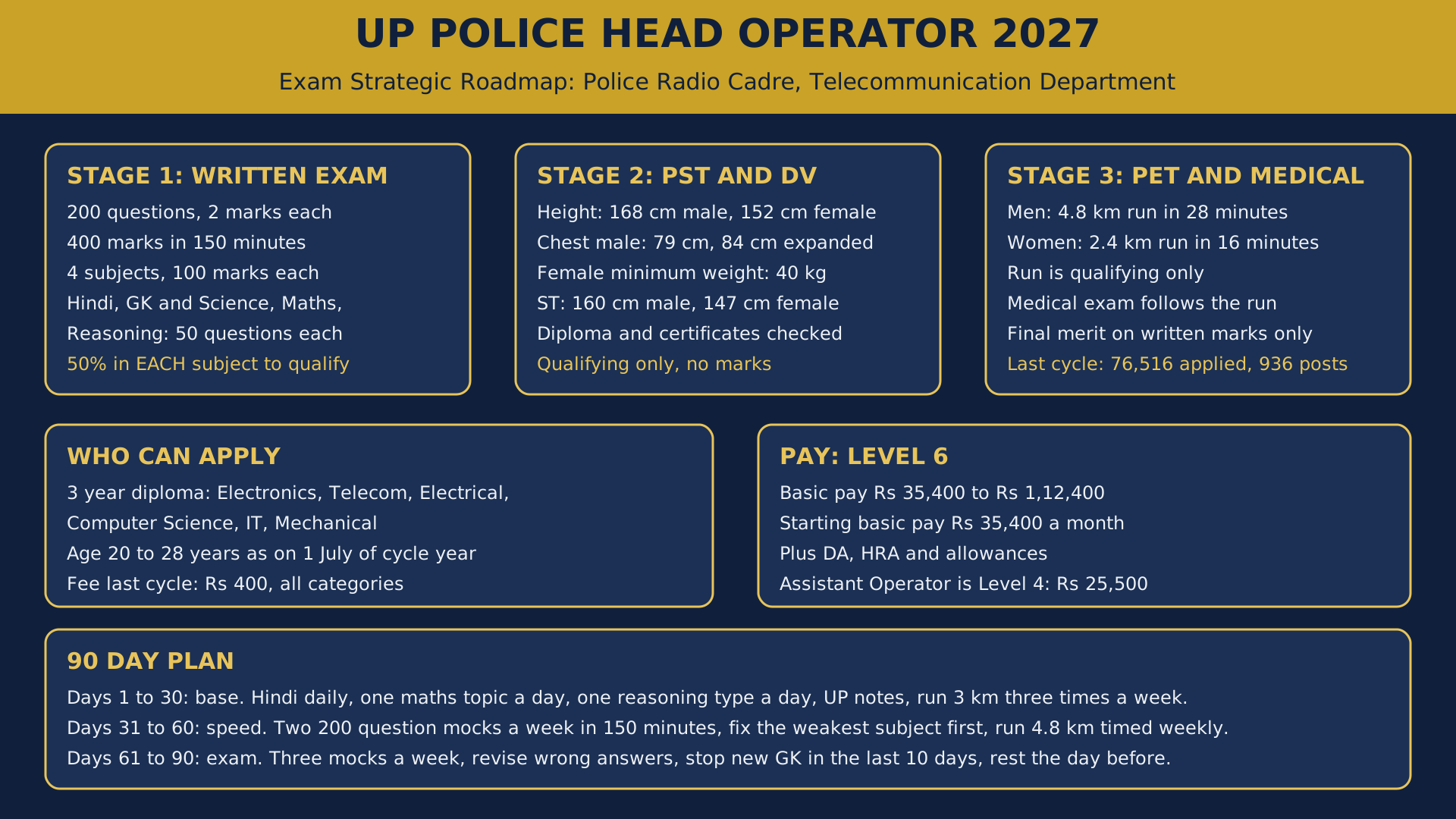
The paper is an online objective test of 200 questions, each worth 2 marks, for a total of 400 marks, in 150 minutes. That gives you 45 seconds per question. The four subjects carry 100 marks each, with 50 questions in each subject.
The subjects are General Hindi; Science and General Knowledge; Numerical and Mental Ability; and Mental Aptitude, IQ and Reasoning. The pattern is the same for Head Operator and Assistant Operator, which is why the two posts can share a preparation plan for the written stage.
| Subject | Questions | Marks |
|---|---|---|
| General Hindi | 50 | 100 |
| Science and General Knowledge | 50 | 100 |
| Numerical and Mental Ability | 50 | 100 |
| Mental Aptitude, IQ and Reasoning | 50 | 100 |
| Total | 200 | 400 |
One naming confusion needs a line. Some coaching summaries label the first subject General English and list English grammar topics under it. The notification pattern, as reported by Jagran Josh, lists General Hindi. The Board's exam for UP Police posts is conducted in Hindi, and the language paper is Hindi.
This guide follows the notification pattern and calls the first subject General Hindi. If the new advertisement says something else, the advertisement wins, and this guide will be wrong on that one word. That is a fair warning to put in writing.
General Hindi, 100 marks
Hindi carries a full quarter of the paper, and it is the subject diploma holders neglect most. The syllabus covers Hindi grammar and vocabulary. It includes synonyms and antonyms; one word substitutions; idioms and phrases; error spotting; sentence correction; and comprehension passages.
A candidate who studied in a Hindi medium school has a head start here, and a candidate who studied in English medium through a diploma course often does not. The fix is simple and dull: read Hindi every day, work through previous year papers of UP Police exams, and learn the standard idioms and one word substitutions that repeat across cycles. There is no shortcut, and there is no need for one either, because the syllabus is stable and the questions repeat their shapes.
Hindi also decides the 50 percent rule more often than any other subject. A candidate who scores 80 in reasoning and 40 in Hindi fails the paper, even with a strong total. The Board checks each subject on its own rather than averaging them.
Treat Hindi as a gate. It needs the same daily slot as maths and reasoning.
Science and General Knowledge, 100 marks
This is the broadest subject, and the one where a diploma actually helps a little. The science half covers general science at the 10th and 12th level: physics, chemistry, biology, with everyday applications. A diploma holder in Electronics or Electrical will find the physics questions familiar.
The general knowledge half covers Indian history, geography, polity, the Constitution, the economy, art, culture, sports, books, authors, important days, dates, and current events of national and international importance, with a clear tilt toward Uttar Pradesh. Questions on UP, its rivers, its districts, its history, its government schemes appear in every cycle.
Current affairs need a boundary, or they will eat the whole preparation. Cover the 12 months before the exam date, and give extra weight to UP government news, police related news, and national awards and appointments. A monthly current affairs note, revised twice, beats a daily newspaper habit that never gets revised.
The science half rewards revision even more, because the same concepts return in different words. Learn the concept once, and the question answers itself whichever way it is asked.
Numerical and Mental Ability, 100 marks
This is the maths paper, and it is long. The syllabus runs through simplification and approximation, number series, LCM, HCF, ratio and proportion, percentage, profit, loss, simple and compound interest, time, work, distance, trains, boats, streams, pipes, cisterns, averages, ages, mensuration, volumes, areas, mixtures, allegations, permutations, combinations, probability, quadratic equations, number and age problems. That list looks long on the page, and it is long in the book too, but the questions are school level. The test is speed, not depth.
Speed comes from practice sets under a timer, not from reading theory. Work 50 questions in 40 minutes, mark the ones that took more than a minute, and learn the short method for exactly those types. Most candidates lose this paper in the last 20 questions, because they spent too long on the first 20.
A mock test that reports time per question is worth more than a book that reports only marks. Use it every week from the second month onward.
Mental Aptitude, IQ and Reasoning, 100 marks
The reasoning paper covers analogies, similarities, differences, space visualisation, problem solving, analysis, judgment, decision making, visual memory, discrimination, observation, relationship concepts, arithmetical reasoning, verbal classification, figure classification, arithmetical number series, coding, decoding in its usual forms. It is the most scoring subject for most candidates, because the questions have a right answer that can be found, not remembered. A candidate who is weak in GK can still score high here, and that matters, because the 50 percent rule applies to each subject and reasoning is the easiest place to bank a safe margin above 50.
Reasoning also rewards a calm head in the exam hall. The questions look simple, and the wrong option often looks right for five seconds. Practice with the clock running, and build the habit of reading the question twice before touching the options. That habit alone is worth several marks in a 200 question paper, where the difference between selection and rejection can be a single question.
The 50 percent rule that decides everything
The written exam has a qualifying line that most candidates learn too late. You must score at least 50 percent in each subject. That means 50 marks out of 100 in Hindi, 50 in Science and GK, 50 in Numerical and Mental Ability, and 50 in Reasoning.
A total of 300 out of 400 means nothing if one subject sits at 48. The Board will not call you for document verification, and your total will not save you.
This rule changes how you should prepare. It rewards balance and punishes a lopsided plan. A candidate who scores 90 in reasoning, 85 in maths, 70 in GK, and 45 in Hindi has a total of 290 and a failed paper.
A candidate who scores 65 in every subject has a total of 260 and a pass. The second candidate is weaker on paper and stronger where it counts. Build your plan around the weakest subject first, and give it the first hour of the day, not the last.
The rule also changes how you should attempt the paper. With 200 questions in 150 minutes, you will face questions you cannot solve. Skip them and move on, because the marks you lose by skipping one hard question are fewer than the marks you lose by spending three minutes on it and missing three easy ones later.
But skipping is not the same as ignoring a subject. If you are weak in Hindi, skipping Hindi questions is the fastest way to fall below 50. Attempt every question you can solve in your weakest subject first, and keep the hard questions of your strongest subject for the end.
Cut off marks sit on top of this rule, and they are a separate matter. The Board declares category wise cut off marks after the written exam, and only candidates who clear both the 50 percent line in each subject and the cut off for their category move ahead. The Board has not published a final cut off list for the last cycle in the sources checked for this guide, so no cut off number is quoted here.
Do not trust a cut off figure from a coaching site unless it links to a Board PDF. Prepare for a score well above 50 in each subject, and the cut off will take care of itself.
Negative marking: what we do not know
Negative marking is the one point on which the sources flatly disagree, and this guide will not pretend otherwise. Testbook, which tracks the notification closely, says there is no information on negative marking yet, and its cut off page repeats that no details on negative marking were given. A coaching syllabus site states there is no negative marking.
Another coaching page claims a deduction of one fourth of a mark per wrong answer. Those three claims cannot all be right.
The 2022 notification, as summarised by the most careful trackers, did not state a negative marking rule. The public summaries simply do not carry one. The exam was held online, with 200 questions of 2 marks each, and candidates who sat it have reported different things since.
Until the new advertisement states the rule in print, the safe way to attempt the paper is to answer questions you are sure about, attempt questions you can narrow to two options, and leave questions you know nothing about. That strategy holds whether the penalty is zero or a quarter mark, and it keeps you above the 50 percent line in each subject, which is the line that matters most.
One more number needs the same care. Some low quality pages say the paper has 150 questions. That figure does not fit the pattern.
Four subjects of 50 questions each make 200 questions, and 200 questions of 2 marks each make 400 marks. The 150 question claim appears on pages that also mix up the exam with other UP Police papers. This guide uses 200 questions, and it flags the 150 figure here so a reader who meets it elsewhere knows it has been seen and set aside.
The physical tests: height, chest, and the run
Clearing the written exam gets you to the physical stage, and the physical stage is a pass or fail gate. It carries no marks, but it ends the run for anyone who fails it. The stage has two parts: the Physical Standard Test, which measures the body, and the Physical Efficiency Test, which is the run.
| Standard | Male, General, OBC, SC | Male, ST | Female, General, OBC, SC | Female, ST |
|---|---|---|---|---|
| Height | 168 cm | 160 cm | 152 cm | 147 cm |
| Chest, unexpanded | 79 cm | 77 cm | Not applicable | Not applicable |
| Chest, expanded | 84 cm | 82 cm | Not applicable | Not applicable |
| Weight | Not specified | Not specified | 40 kg minimum | 40 kg minimum |
| Run | 4.8 km in 28 minutes | 4.8 km in 28 minutes | 2.4 km in 16 minutes | 2.4 km in 16 minutes |
Height is measured with a digital sensor, and there is no rounding in your favour. A candidate who measures 167.9 cm against a 168 cm bar fails the standard. There is no appeal on the ground that the bar was close.
Check your height on a proper stadiometer before you apply, not on a wall marking at home. If you are near the line, know it early.
The chest rule needs a full line because it is the one candidates misunderstand. The male chest must measure at least 79 cm unexpanded and at least 84 cm on expansion, for General, OBC and SC candidates, and 77 cm and 82 cm for ST candidates. The 5 cm expansion is a requirement on its own, not a bonus.
A chest of 85 cm that expands to 88 cm fails, because the expansion is only 3 cm. Breathing exercises and chest expansion work help, and they cost nothing, so start them the day you start studying, not the week before the test.
The run is 4.8 km in 28 minutes for men and 2.4 km in 16 minutes for women. That is a pace of about 5 minutes 50 seconds per kilometre for men, and 6 minutes 40 seconds per kilometre for women. It is a steady run, not a sprint, and a candidate who can jog 5 km without stopping will usually finish inside the time.
The trap is the gap between the written exam and the physical test. Candidates stop running while they wait for the result, then get a call letter with two weeks to prepare. Run three times a week from the start of your preparation, and the call letter will be a formality instead of a panic.
One caution on the running time. Some pages quote 25 minutes for men and 14 minutes for women. Those figures belong to the UP Police Constable PET, not to Head Operator.
The Head Operator notification gives 28 minutes and 16 minutes, and Testbook, Jagran Josh, and the exam pattern summaries all agree on those two numbers. Do not train to the constable time by mistake, and do not relax because 28 minutes sounds easy. Train to finish 4.8 km in 25 minutes, and the test day will feel comfortable.
What happens after the written exam
The selection process has four stages after the application: the online written exam, document verification with the Physical Standard Test, the Physical Efficiency Test, and the medical exam, followed by the final merit list. The written exam is the only stage that carries marks. Everything after it is qualifying.
Document verification is the stage where good candidates lose their seat over paper. Bring the diploma in original, with all semester mark sheets, 10th certificates, 12th certificates, the caste certificate if you claim reservation, the domicile certificate, the identity proof used in the application. A caste certificate in the wrong format, or one issued after the date the notification fixes, can end a candidature that survived the exam and the run. Get the certificates made early, in the exact format the notification asks for, and check the dates on them.
The medical exam follows the physical test. It checks vision, hearing, general fitness to police standards. Colour blindness and major physical defects are the usual causes of rejection.
If you wear glasses, know your power and check it against the standard in the notification when it comes out. The medical standard for the radio cadre is not published in the summaries used for this guide, so no vision figure is quoted here. The new advertisement will carry it, and that is the only source that counts.
The final merit list is drawn from the written exam marks of candidates who clear every later stage. The physical tests add no marks, so the written score is the whole of the merit. That is why the written exam deserves the bulk of your time.
A candidate who scores 320 in the written exam and passes the run will rank above a candidate who scores 280 and runs faster. The run only decides whether you stay in the race. The written score decides where you finish.
Pay and the career ahead
A Head Operator draws Pay Matrix Level 6, with a basic pay of Rs 35,400 to Rs 1,12,400 under the Seventh Pay Commission. The starting basic pay is Rs 35,400 a month. Allowances sit on top of that: dearness allowance, house rent allowance, and other allowances as per UP government rules. Coaching summaries put the starting gross salary at around Rs 45,000 to Rs 50,000 a month, depending on the place of posting.
That gross figure is an estimate, not a number from the notification, and it moves with the dearness allowance rate, which the government revises twice a year. Do not plan a household budget on it. Plan on the basic pay, and treat the allowances as a variable on top.
The annual package, on the same basis, runs from about Rs 4.32 lakh to about Rs 13.50 lakh across the full pay scale. That range covers a whole career, from the first month to the last increment, so it tells you little about the first year. The first year figure that matters is the starting basic pay of Rs 35,400, and the fact that it rises with annual increments and with promotion.
Promotion in the radio cadre follows the usual police path. An Assistant Operator can rise to Head Operator through departmental process, and a Head Operator can rise further to supervisory posts in the telecommunication wing. The exact ladder depends on service rules and vacancies, and no promotion timetable is promised in the notification. What is certain is the starting point: Level 6 is a strong entry for a diploma holder, two levels above the Level 4 entry of Assistant Operator and Computer Operator Grade A, and that gap stays with you through the career, because each promotion builds on the level you start from.
The probation period is not stated in the notification summaries used for this guide. Testbook notes the same gap. Do not quote a probation figure from a coaching site. The new advertisement or the appointment letter will state it, and until then it is not published anywhere reliable.
How the last cycle actually ran, date by date
The last cycle is worth reading as a timeline, because it shows how slow this recruitment moves, and how much patience it asks for. The notification came out in January 2022. Applications opened on 20 January 2022 and were to close on 28 February 2022, then the last date was extended to 15 March 2022.
One tracker puts the extended date at 22 March 2022, and this guide flags that disagreement here. The 15 March date comes from Testbook and from the result tracking pages, and it is the one this guide uses.
Then came the long wait. The written exam was held on 30 and 31 January 2024, two full years after applications closed. A total of 76,516 applications had been received against 936 vacancies. Document verification and the physical standards test ran in the spring of 2025, and the physical efficiency test ran in May 2025.
The final result came on 27 June 2025. Appointment letters were distributed on 28 April 2026, at an event in Lucknow where the Chief Minister handed letters to the 936 selected Head Operators and Head Operators (Mechanical) of the Telecommunication Department. That is four years and three months from notification to appointment.
Two lessons follow from that timeline. First, apply the moment the window opens, because the window is short and the wait is long, and a missed date cannot be fixed later. Second, do not stop your life for the result. Candidates who kept studying, kept working, or kept preparing for the next exam were fine.
Candidates who waited at home for two years were not. The Board will move at its own speed. Your job is to be ready when it moves.
The 44 post Assistant Operator cycle of December 2025 is a useful contrast. It moved on a separate advertisement, number 03(2)/2023, with its own dates. Small cycles like that one show the Board does fill radio cadre gaps between the big drives. Watch the Board site every week, not just when a big notification is expected, because a 44 post notice can appear with little noise and close before most candidates hear about it.
A 90 day plan that fits a diploma holder
Ninety days is enough if the days are full and the plan gives the weak subject the most time. This UP Police Head Operator 2027 plan assumes three to four hours a day, with running on alternate days. If you have six hours, add a second mock test each week and a second revision round. If you have two hours, cut the reading and keep the practice sets, because practice sets are what move the score.
Days 1 to 30 are for the base. Cover the Hindi grammar syllabus end to end, and start a daily list of 20 idioms and 20 one word substitutions. In maths, work through one topic a day from the syllabus list, with 30 questions per topic. In reasoning, learn one type a day and practise it the same evening.
In GK and science, read one standard source for UP history, geography, polity, and make short notes that fit on one page per topic. Run 3 km three times a week at an easy pace, and add breathing exercises for chest expansion on the same days. Take one mock test at the end of week 2, not to score high but to find the weakest subject. Then give that subject the first hour every day.
Days 31 to 60 are for speed. Start two mock tests a week, each of 200 questions in 150 minutes, in one sitting, with no breaks and no phone. Review every wrong answer the same day, and write the reason for the mistake in one line: concept, silly error, time, or guess. If one reason repeats, fix that reason, not the subject. In Hindi, move to comprehension passages and error spotting sets.
In maths, stop reading theory and work only mixed sets with a timer. In GK, revise the notes from the first month and add current affairs for the last six months. Push the run to 4.8 km, and time it once a week. The target is to finish inside 28 minutes without a final sprint that leaves you unable to walk.
Days 61 to 90 are for the exam. Take three mock tests a week, and spend the day after each test on revision only. Rework every question you got wrong in the last 30 days. Revise the Hindi idioms and substitutions list twice. Revise the UP notes twice.
Stop learning new GK topics in the last ten days, because new material that is half learned pushes out old material that was solid. In the last week, take two full mocks, sleep on time, and run lightly. The day before the exam, do one short revision of formulas and Hindi rules, then stop. A tired mind loses more marks in 150 minutes than a fresh mind gains from one more chapter.
The running plan deserves its own line, because it is the part most study plans forget. Run on Monday, Wednesday, Friday, or Tuesday, Thursday, Saturday, and keep Sunday free. Start with 3 km, add 500 metres a week, and reach 5 km by week 6.
Once a week, run the full 4.8 km against the clock. Walk the rest of the day. If your weight is above the healthy range for your height, fix the food first, because extra weight costs minutes on the run and nothing else in this exam costs as much.
Mistakes that cost diploma holders this exam
The first mistake is the technical trap. A diploma holder assumes the exam tests electronics, so the diploma notes stay open and the Hindi book stays shut. Then the paper arrives with 50 Hindi questions, 50 GK questions, and no electronics at all.
The diploma got you into the hall. It will not get you out of it with a pass. Study the four subjects on the paper, not the four subjects on your diploma.
The second mistake is the 50 percent blind spot. Candidates track their total mock score and ignore the subject scores. A total of 280 with Hindi at 42 is a fail, and the mock report says so on the same page as the total.
Read the subject split after every mock, and move study hours to the subject below 55 until it rises. The total will follow.
The third mistake is applying for the wrong post. A Mechanical diploma holder applies for Computer Operator Grade A, because a friend said it has no physical test, and gets rejected at verification because the branch list does not include Mechanical. A 19 year old diploma holder applies for Head Operator and gets rejected on age.
A 12th pass candidate with Physics and Maths applies for Head Operator and gets rejected on qualification. Read the eligibility table in the notification before you pay Rs 400. The fee is non refundable, and the rejection letter comes months later.
The fourth mistake is trusting a vacancy number from a video. The 2027 vacancy count does not exist yet, and the 936 figure belongs to the 2022 cycle. A thumbnail that says 2,000 posts for Head Operator 2027 is guessing, and the guess will be wrong. The only number that matters is the one in the Board PDF, and it will appear on uppbpb.gov.in when the Board is ready.
The fifth mistake is stopping the run. Candidates train for the written exam for a year, pass it, then discover they cannot run 4.8 km in 28 minutes. The PET is qualifying, which makes it easy to dismiss, and it is a hard gate, which makes it fatal to dismiss.
Three runs a week from day one is enough. Zero runs a week until the result is not.
Other exams worth a look while you wait
While the Head Operator notification is pending, several related recruitments are live or expected, and they suit the same candidate profile. The UP Police Constable 2027 drive is the largest of them, and its written exam shares the Hindi, GK, maths, reasoning base with this paper. The UP Police Sub Inspector 2027 exam needs a graduation degree, so diploma holders should check that condition first.
The UP Police ASI 2027, UP Police Jail Warder 2027, and UP Police Fireman 2027 posts each carry their own physical standards and their own papers, and all three reward the same running base. The UP Police Computer Operator 2027 cycle is the closest technical cousin, and it suits diploma holders in Computer Science, IT, Electronics who also hold an O level certificate.
Outside UP Police, the Air Force offers two routes that fit a diploma holder. Agniveer Vayu 2027 takes science stream candidates into the Air Force for a four year term, and AFCAT 2027 is the officer entry route for graduates. Both are worth a look, and both need the same maths and reasoning base. On the police side in other states, the Bihar Police Constable 2027 recruitment is a large drive with its own pattern, and the SSC Delhi Police Head Constable AWO TPO 2027 post is the closest match of all, because the AWO and TPO trades are wireless and telecom work in Delhi Police, the same kind of radio job in a different force.
Where to check, and what to do next
Check the Board website every week. The address is uppbpb.gov.in, and the notification will appear there with the advertisement number, the dates, the fee, the full pattern. The UP Police website at uppolice.gov.in carries department news and the telecommunication wing pages.
Those two sites are the only sources that can confirm a date, a vacancy count, or a rule change. Everything else is a report about those sites, and reports get things wrong.
If you hold a three year diploma in one of the six branches and you are between 20 and 28, start now. Work Hindi first, because it is the subject that fails diploma holders. Run three times a week, because the run is the gate that no amount of study can open at the last minute.
Take a mock test every week, read the subject split, and fix the weakest subject before the strongest one. When the UP Police Head Operator 2027 notification comes, you will need a few days to apply, not a few months to prepare. That is the whole plan, and it fits in one line: be ready before the Board moves, because the Board will not wait for you to get ready.
Sources
UP Police Head Operator Recruitment 2022 notification, advertisement number PRPB 3(34)/2020, as reported by Jagran Josh, with 936 posts, applications from 20 January to 28 February 2022, age 20 to 28 years, and a three year engineering diploma in Electronics, Telecommunication, Electrical, Computer Science, IT or Mechanical. UP Police Recruitment 2022 for 2,430 radio cadre posts, 936 Head Operator, 1,374 Assistant Operator and 120 Workshop Staff, with the four subject written exam of 400 marks in 150 minutes and 50 percent qualifying marks in each subject, as reported by Jagran Josh. UP Police Head Operator page on Testbook, with 76,516 applications against 936 posts, the category split of 379 Unreserved, 92 EWS, 252 OBC, 195 SC, 18 ST, the written exam on 30 and 31 January 2024, the fee of Rs 400, the physical standards, the age relaxation of five years for SC, ST and OBC candidates, and the pay scale of Rs 35,400 to Rs 1,12,400 at Level 6. UP Police Bharti 2022 report on Scroll, with the Head Operator notification, the age limit of 20 to 28 years as on 1 July 2022, and the diploma branches. Chief Minister's statement of April 2026 on more than 81,000 police posts in 2026 to 27, including radio assistant operators and Computer Operator Grade A, as reported by Business Standard and ThePrint.
Appointment letters to 936 selected Head Operators and Head Operators (Mechanical) on 28 April 2026, as reported by ANI through Awaz the Voice. UP Police Computer Operator Recruitment 2025 to 26, advertisement number 21/2025, 1,352 Grade A posts, applications from 16 December 2025 to 15 January 2026, Level 4 pay of Rs 25,500 to Rs 81,100, as reported by Adda247. UP Police Assistant Operator Recruitment 2025, 44 posts, advertisement number 03(2)/2023, 12th pass with Physics and Maths, age 18 to 22, Level 4 pay, as reported by Adda247 and Rojgar Pedia. Final result of the Head Operator cycle on 27 June 2025, as reported by SarkariMint. No new Head Operator notification as of 19 November 2026, checked on uppbpb.gov.in.