About UP Police ASI 2027 Exam Series
📖 Table of Contents
- The name trap: there is no ASI Confidential post
- Has the 2027 notification come out?
- Vacancies: what the last three cycles actually offered
- Who can apply: Clerk needs typing, Accounts needs commerce
- Age 21 to 28, and the one date that decides it
- The written exam: 200 questions and the 35 percent rule
- Syllabus, paper by paper
- General Hindi and Computer Knowledge
- General Awareness and Current Affairs
- Numerical and Mental Ability Test
- Mental Aptitude, IQ and Reasoning Test
- Physical standards: measured, not run
- The typing test is where this exam is won or lost
- Pay: Level 5, and what lands in hand
- What an ASI Clerk and an ASI Accounts officer do all day
- Promotion: ASI to SI to Inspector
- A 90 day plan that respects the typing test
- Five mistakes that cost candidates this exam
- How to apply when the notice lands
- Sources
UP Police ASI 2027: Clerk and Accounts Exam Guide
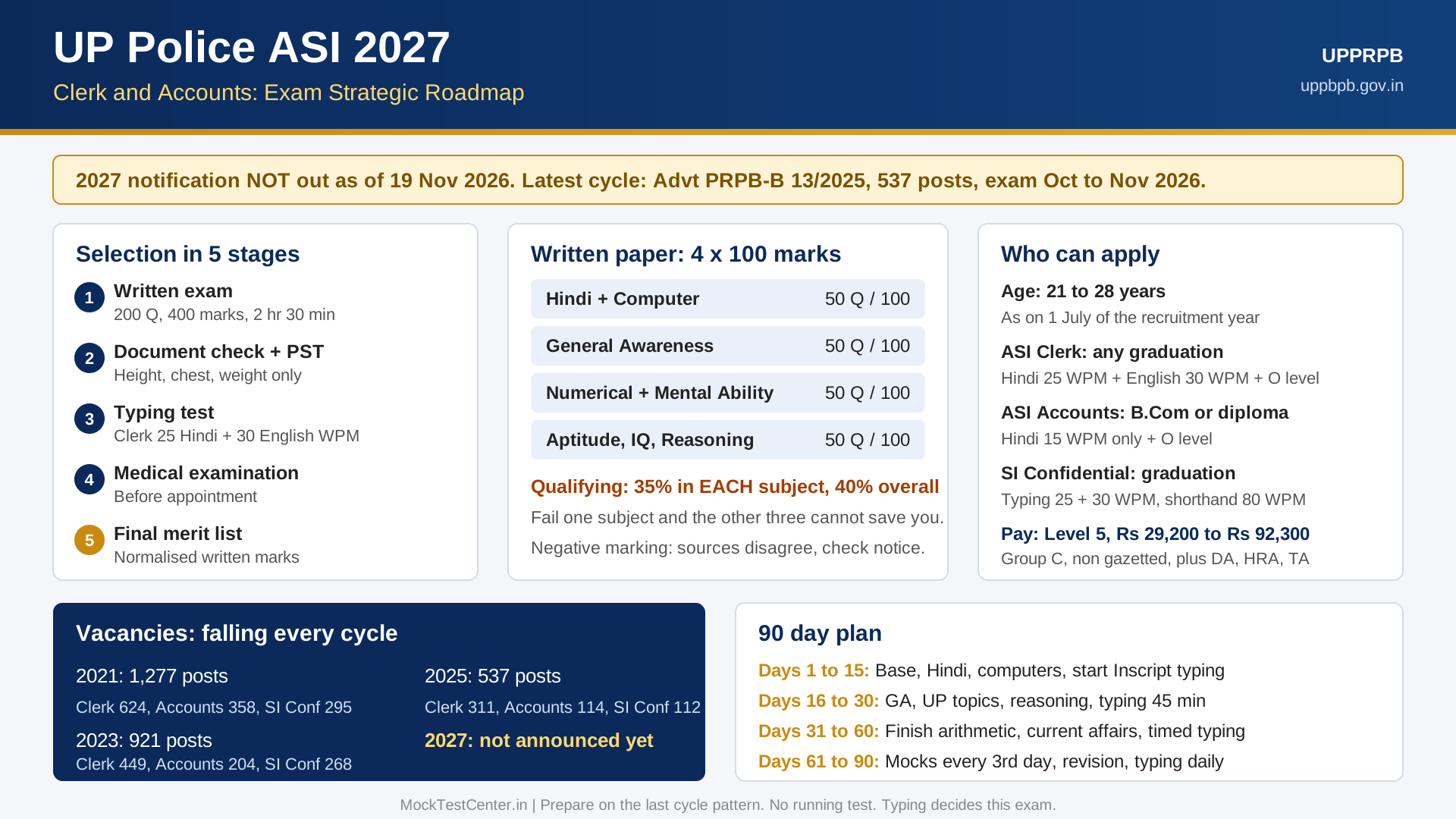
The UP Police ASI 2027 notification has not come out yet. As of 19 November 2026, the Uttar Pradesh Police Recruitment and Promotion Board has published no fresh advertisement for Assistant Sub Inspector (Clerk) or Assistant Sub Inspector (Accounts), and the latest cycle on record remains Advertisement Number PRPB-B 13/2025. That cycle offered 537 posts across three ministerial posts.
Applications closed on 19 January 2026, and the written exam was scheduled for October and November 2026. So the 2027 cycle is a waiting game right now, and the smart move is to prepare on the pattern of the last two cycles while watching the Board website for the new notice.
This UP Police ASI 2027 guide covers both ASI streams on that basis. You will find the vacancy history and the exact difference between the Clerk and Accounts posts. It also covers the education and typing conditions that decide eligibility before the written exam even starts, plus the 200 question paper, the physical standards, the pay, the daily work and a 90 day plan.
Every number here comes from the 2025 notification as reported by CareerPower and Adda247, the 2023 cycle syllabus record kept by NexRojgar, or the 2021 notification as reported by Scroll and The Indian Express. Where sources disagree, this guide says so instead of picking the neater number.
The name trap: there is no ASI Confidential post
Search for this exam and half the pages you meet will list three ASI streams. They will list ASI Confidential alongside ASI Clerk and ASI Accounts. That list is wrong, and it has misled candidates for years.
The Confidential stream sits one rank higher. It is Sub Inspector (Confidential), a Level 6 post with a pay scale of Rs 35,400 to Rs 1,12,400. The ASI rank carries two streams only.
ASI Clerk, called ASI Ministerial in the 2025 notification, handles office work. ASI Accounts handles police accounts and cash work. Both sit in Level 5 with a pay scale of Rs 29,200 to Rs 92,300.
All three posts travel in one notification. The Board advertises them together, runs one common written exam for them, and then splits candidates by post at the skill test. That shared notification is why coaching sites merge the three names into one list. The merge causes real damage.
A candidate who prepares for ASI Confidential spends months on Hindi shorthand at 80 words per minute, a test that applies only to the SI Confidential post. A candidate who aims for ASI Accounts and skips commerce revision walks into a paper that still tests numerical ability hard. Know which post you want before you open a book.
The 2025 cycle shows the split plainly. Of 537 posts, 112 went to SI Confidential, 311 to ASI Clerk and 114 to ASI Accounts. Clerk is the big post in this recruitment.
Accounts is the small one, and its commerce degree condition shrinks the applicant pool further. That matters for your odds, and this guide treats the two ASI streams as separate targets from here on.
If the uniformed SI post interests you more than desk work, the UP Police Sub Inspector 2027 guide covers the civil police SI exam, which runs on a different pattern with a running test. This guide stays with the ministerial posts.
Has the 2027 notification come out?
No. A check of the Board website at uppbpb.gov.in on 19 November 2026 found no new notification for these posts, and no coaching site or newspaper has reported one either. The pages that rank for UP Police ASI 2027 today recycle old vacancy figures under a 2027 headline.
One widely copied page still shows the 2021 figures of 1,329 posts and calls them the 2027 vacancies. Another shows the 2025 cycle dates with the year changed. Neither is a notification.
The Board runs this recruitment in cycles rather than every year, so a gap surprises nobody who has followed it. Look at the recent record. The 2021 cycle opened applications on 1 May 2021 and declared its final result on 31 December 2022.
The 2023 cycle held its written exam on 2 November 2025 and published its final result in March 2026. The 2025 cycle opened on 20 December 2025 and set its written exam for October and November 2026. Three cycles in five years, each with its own advertisement number and its own vacancy count.
That spacing shapes how you should read the calendar. The 2025 cycle exam had not yet happened when this guide was written in November 2026. A fresh 2027 notification can only follow after that cycle moves further along, and the Board has given no date for it. Any date you see on a poster or a social media post before the Board publishes it is a guess.
When the notice lands, one document will carry the vacancy count. It will also carry the age calculation date and the fee. The syllabus and the exam calendar sit in the same document.
Read that document end to end before you fill the form, because the notification overrules every guide on the internet, including this one. The only two places that count are the Board website at uppbpb.gov.in and the UP Police website at uppolice.gov.in.
Vacancies: what the last three cycles actually offered
Vacancy counts in this recruitment swing hard from cycle to cycle, and that swing decides how many candidates get in. The table below gives the three recent cycles side by side.
| Cycle | Total posts | SI Confidential | ASI Clerk | ASI Accounts |
|---|---|---|---|---|
| 2021 | 1,277 at notification, later raised to 1,329 | 295 | 624 | 358 |
| 2023 | 921 | 268 | 449 | 204 |
| 2025 (Advt PRPB-B 13/2025) | 537 | 112 | 311 | 114 |
Two things stand out. First, the total has fallen in every cycle, from 1,277 to 921 to 537. Second, the Clerk post has stayed the largest ASI share each time.
If the UP Police ASI 2027 cycle follows the same direction, expect a modest number again, and expect Clerk to carry most of it. That is a reading of the trend, not a prediction. The Board can always add posts, and the 2021 cycle itself grew after notification.
The 2021 growth deserves a note because sources report it differently. Scroll and The Indian Express reported 1,277 posts at notification, split as 295 SI Confidential, 624 ASI Clerk, 358 ASI Accounts. Several other sites later reported a revised total of 1,329 posts. Their stream splits for the revised total do not agree with each other.
One puts SI Confidential at 317 and Clerk at 644. Another keeps the original splits and still claims 1,329. This guide uses the notified 1,277 figure with its clean split, and records the 1,329 revision as reported but not reconciled.
The 2025 cycle category split is clean and worth keeping. For SI Confidential the 112 posts divided as 49 Unreserved, 10 EWS, 29 EBC, 23 SC, 1 ST. For ASI Clerk the 311 posts divided as 128 Unreserved, 30 EWS, 83 EBC, 64 SC, 6 ST.
For ASI Accounts the 114 posts divided as 50 Unreserved, 10 EWS, 30 EBC, 23 SC, 1 ST. EBC here means the Other Backward Classes category as the Board lists it in this notification.
One more figure from the 2023 cycle record. Its notification stated that the Board would prepare no separate waiting list. Candidates tied on marks were ranked by the notified tie breaking rules instead.
If the 2027 notification keeps that rule, there is no second chance after the merit list. Your written score has to clear the line on its own.
Who can apply: Clerk needs typing, Accounts needs commerce
Eligibility for these posts has three layers, and candidates usually check only the first one. The degree gets you through the door. The typing speed and the computer certificate decide whether you stay inside. All three conditions must hold on the last date of application, and the skill test checks the typing claim in person later.
For ASI Clerk, the Board asks for a bachelor degree from a university established by law in India, or an equivalent qualification recognised by the government. On top of the degree, you need Hindi typing at 25 words per minute and English typing at 30 words per minute, plus a pass in the O level examination in computers from NIELIT, the National Institute of Electronics and Information Technology, or an equivalent qualification recognised by the government. The Hindi typing test runs on the Unicode Inscript keyboard layout. That last detail matters more than it looks, and this guide returns to it in the typing section.
For ASI Accounts, the degree condition changes. You need a bachelor degree in Commerce from a university established by law in India, or a Master Diploma in Accountancy, or an equivalent qualification recognised by the government. A plain BA or BSc does not qualify for this post, whatever your marks.
The typing condition is lighter. Hindi typing at 15 words per minute on the Unicode Inscript keyboard is enough, and there is no English typing test for Accounts. The O level computer certificate is still required.
For SI Confidential, the degree condition matches the Clerk post, a bachelor degree in any stream. The skill bar is the highest of the three. Hindi typing at 25 words per minute, English typing at 30 words per minute, and Hindi shorthand dictation at 80 words per minute, plus the O level certificate. Only SI Confidential candidates who clear the typing test go on to the shorthand test.
The O level condition catches more candidates than any other rule. Many graduates assume a computer subject in their degree covers it. It does not, unless the government recognises that qualification as equivalent to the NIELIT O level.
The O level is a specific certificate course from NIELIT, and it takes months to complete. If you do not hold it yet, start it now, while the 2027 notification is still unwritten. Waiting for the notice to appear before enrolling is the single most common way candidates lose a cycle they could have won.
One more condition hides in the fine print of past notifications. Candidates apply for one post only in this recruitment. You cannot apply for both Clerk and Accounts and pick later.
The choice happens at the form, and the typing and degree conditions follow from it. Pick the post that fits the certificates you already hold, not the post with more vacancies.
Age 21 to 28, and the one date that decides it
The age window for all three posts is 21 to 28 years. In the 2025 cycle the Board fixed the calculation date as 1 July 2025. That meant a candidate had to be born on or after 1 July 1997 and on or before 1 July 2004.
The 2021 cycle used 1 July 2021 as its date, and the 2023 cycle used 1 July 2023. The pattern is steady. The Board picks 1 July of the recruitment year, and the eight year window slides with it.
Age relaxation follows Uttar Pradesh government rules for reserved categories, and the notification states the exact relaxations for each category. This guide does not list relaxation years from memory, because the figures change between notifications and a wrong number here would cost someone a form. Read the relaxation table in the 2027 notification itself.
Do the arithmetic early. If you turn 29 before 1 July of the recruitment year, this exam is closed to you. If you turn 21 after that date, you are too young for this cycle and the next one is yours.
The window is narrow, eight years, and for a graduate who finishes college at 21 or 22 it allows only a few attempts. That is why the typing and O level preparation cannot wait for the notification.
The written exam: 200 questions and the 35 percent rule
One UP Police ASI 2027 written exam serves all three posts. It carries 200 objective questions for 400 marks, with a composite time of 2 hours 30 minutes. Each question carries 2 marks. The paper splits into four subjects of 50 questions and 100 marks each.
| Subject | Questions | Marks |
|---|---|---|
| General Hindi and Computer Knowledge | 50 | 100 |
| General Awareness and Current Affairs | 50 | 100 |
| Numerical and Mental Ability Test | 50 | 100 |
| Mental Aptitude, IQ and Reasoning Test | 50 | 100 |
The qualifying rule is the part candidates underestimate. You need at least 35 percent normalised marks in each of the four subjects, and at least 40 percent normalised marks in the whole paper. Fail one subject and the other three cannot save you.
A candidate who scores 80 in reasoning and 30 in Hindi is out, while a candidate who scores 45 in every subject moves on. The exam rewards balance across four papers, not brilliance in one.
Normalisation matters too. When the exam runs in more than one shift or on different dates with different question papers, the Board applies its notified normalisation procedure, and merit rests on normalised marks rather than raw marks. The 2023 cycle ran as an online computer based test on 2 November 2025.
The 2025 cycle notification describes an offline OMR based exam. The mode has changed between cycles, so treat the mode in the 2027 notification as the final word.
Negative marking is the one point where sources flatly disagree, and this guide will not pretend otherwise. One detailed pattern summary puts the penalty at minus 0.5 marks per wrong answer. The NexRojgar syllabus record, which follows the 2023 notification closely, states that the notification does not separately prescribe a conventional negative marking rule, and tells candidates to follow the instructions on their question paper.
Both cannot be right for the same cycle, and the honest position is that the 2027 notification and the question paper instructions will settle it. Do not build a guessing strategy on either claim until you have read the notice.
The paper is bilingual in Hindi and English, except for the General Hindi part, which is naturally in Hindi. That helps candidates who think in Hindi and read English slowly, but it does not help anyone who has ignored one language entirely. Hindi carries a full 100 marks through its own section, and English appears inside the typing test as well.
Syllabus, paper by paper
The syllabus below follows the 2023 cycle record, which is the most complete subject wise list available. The Board may revise topics for 2027, but the shape has held steady across cycles, and it is the best base for preparation today.
General Hindi and Computer Knowledge
This paper pairs two different skills in one 100 mark block, and candidates usually prepare for only one of them. The Hindi half covers the Hindi alphabet and basic grammar; Tatsam and Tadbhav words; synonyms; antonyms; words with several meanings; one word substitutions; correction of wrong sentences; gender; number; case; pronoun; adjective; verb; tense; voice; indeclinable words; prefixes; suffixes; Sandhi and Samas; punctuation; idioms and proverbs; Rasa; Chhand; Alankar; unseen passage and comprehension; famous Hindi poets and writers with their works; awards linked to the Hindi language.
The computer half is broader than most candidates expect. It covers basic computer fundamentals; the history and future of computers; algorithms; flowcharts and number systems; operating systems and basic Windows concepts; common computer abbreviations; Microsoft Office applications; basic use of the internet; keyboard shortcut keys; computer communication and internet technology; programming languages; network technology applications; web design; software and hardware functions; networking; the World Wide Web and web browsers; IT tools and business systems; multimedia; artificial intelligence; mobile computing and green computing; banking and e-commerce applications.
Two facts about this paper decide how to study it. The computer half overlaps with the O level syllabus, so candidates who hold the O level certificate already know part of it. And the Hindi half is the only section where a strong school level Hindi student can score heavily with revision alone, because the topics are fixed and repeatable year after year.
General Awareness and Current Affairs
This is the widest paper of the four. It covers general science; the history of India and the freedom struggle; the Indian Constitution; the Indian economy and culture; Indian agriculture; commerce and trade; population; environment; urbanisation; the geography of India and the world with natural resources; the education system of Uttar Pradesh; the culture and social practices of Uttar Pradesh; the revenue system of Uttar Pradesh; the police and general administrative system of Uttar Pradesh; human rights; internal security and terrorism; India and its neighbours.
The current affairs half tracks national and international events; national and international organisations; demonetisation and its impact; cybercrime; the merger of the Railway Budget with the General Budget; the Indus Waters Treaty; the Olympics and major sporting events; the Goods and Services Tax; awards and honours; countries; capitals; currencies; important national and international days; research and discoveries; books and authors; basic information and communication technology; social media communication; internet banking; digital payments; digital wallets.
The Uttar Pradesh specific topics deserve extra time. The syllabus names the state revenue, police and administrative system directly, and it names the education, culture and social practices of the state too. A candidate who knows the national picture and skips the state picture gives away easy marks. The UP Police Constable 2027 paper tests the same state topics, and its candidates face the same trap.
Numerical and Mental Ability Test
This paper splits into arithmetic and mental ability. The arithmetic list is long and familiar. Number system and simplification; decimals and fractions; highest common factor and lowest common multiple; ratio and proportion; percentage; profit and loss; discount; simple and compound interest; partnership; average; time and work; time and distance; tables and graphs; mensuration; arithmetic calculations and analytical functions; miscellaneous numerical problems.
The mental ability half tests logic rather than calculation. Logical diagrams; symbol relationship interpretation; perception test; word formation test; letter and number series; word and alphabet analogy; common sense test; direction sense test; logical interpretation of data; forcefulness of arguments; determining implied meanings.
Speed decides this paper. Fifty questions in a shared 150 minutes means the arithmetic has to move fast, and the mental ability questions punish candidates who read each one twice. Timed practice is the only way to build that pace. Reading theory without a timer teaches the method and hides the speed problem until exam day.
Mental Aptitude, IQ and Reasoning Test
The last paper tests attitude as much as ability, and it is the one coaching material covers worst. The mental aptitude list names public interest; law and order; communal harmony; crime control; rule of law; adaptability; professional information at a basic level; the police system; contemporary police issues and law and order; interest in the profession; mental toughness; sensitivity towards minorities and underprivileged groups; gender sensitivity.
The IQ half is standard reasoning. Relationship and analogy test; identifying the dissimilar item; series completion test; coding and decoding; direction sense test; blood relations; alphabet based problems; time sequence test; Venn diagrams and chart based tests; mathematical ability test; arranging items in order. The reasoning list adds analogies; similarities and differences; space visualisation; problem solving; analysis and judgement; decision making; visual memory; discrimination and observation; relationships and concepts; arithmetical reasoning; verbal and figure classification; arithmetical number series; abstract ideas; symbols and their relationships.
The attitude questions have no formula. They ask what a police officer should do when the law and the crowd disagree. Candidates who read the syllabus line on rule of law and then answer from instinct usually do fine. Candidates who try to memorise model answers for attitude questions usually do not, because the situations keep changing.
Physical standards: measured, not run
Here is the fact that surprises most candidates. This recruitment has no running test. The ministerial posts are desk posts, and the Board tests the body by measurement only.
Candidates who clear the written exam go through document verification and a Physical Standard Test, and that test measures height, chest and weight against fixed numbers. There is no race, no long jump, no physical efficiency test of any kind.
| Category | Male height | Male chest | Female height | Female weight |
|---|---|---|---|---|
| General, EBC and SC | 163 cm | 77 cm unexpanded, 82 cm expanded | 150 cm | 40 kg minimum |
| ST | 156 cm | 75 cm unexpanded, 80 cm expanded | 145 cm | 40 kg minimum |
Male candidates need a minimum chest expansion of 5 centimetres. The 2025 cycle summary published by CareerPower lists the ST expanded chest as 88 cm, which breaks the 5 cm expansion rule and looks like a printing error against the 80 cm figure in the 2023 cycle record. This guide uses 80 cm and flags the 88 cm figure as suspect.
Do not confuse this PST with the constable or SI physical tests. The UP Police Fireman 2027 exam and the civil police SI exam both include running and endurance events, because those are field posts. The ministerial PST is a gate, not a contest.
It eliminates candidates who fall short of the measurements, and it gives no marks to anyone. Your preparation time belongs to the written paper and the typing test, not to a running track.
The typing test is where this exam is won or lost
Ask a selected ASI Clerk what decided the result and the answer is usually the typing test, not the written paper. The written paper has a qualifying line. The typing test has a speed line, and speed cannot be built in a month.
| Post | Hindi typing | English typing | Hindi shorthand |
|---|---|---|---|
| ASI Clerk | 25 words per minute | 30 words per minute | Not required |
| ASI Accounts | 15 words per minute | Not required | Not required |
| SI Confidential | 25 words per minute | 30 words per minute | 80 words per minute |
The Hindi typing test runs on the Unicode Inscript keyboard layout. That sentence decides the preparation method. A candidate who practises on a phonetic or transliteration keyboard builds speed that does not transfer, because the Inscript layout puts Hindi letters in fixed positions that have nothing to do with their sound.
The first weeks on Inscript feel slow and clumsy. The keys sit under different fingers than a Roman keyboard, and the matras take time to find. That slowness passes with daily practice, and it passes only with daily practice.
The speeds themselves tell a story. ASI Accounts needs 15 words per minute in Hindi only. That is the gentlest skill bar in this recruitment, and it is one reason commerce graduates should look hard at the Accounts post even though it has fewer vacancies. ASI Clerk needs 25 in Hindi and 30 in English.
English at 30 words per minute is faster than it sounds, because the test counts correct words, and errors eat speed. SI Confidential adds Hindi shorthand at 80 words per minute, a skill that takes a year or more to build from zero. Anyone who wants the Confidential post and cannot already write shorthand should count the months with care before choosing it.
The typing test is qualifying in nature. Its marks stay out of the final merit list, which misleads candidates into treating it as a minor stage. Qualifying means pass or fail, and fail ends the attempt whatever the written score. The final merit list uses normalised written marks among candidates who qualify every stage, so the typing test acts as a filter after the written paper, not as a score booster.
Two practical points follow. First, practise typing from the first week of preparation, in parallel with the written subjects, not after the written result. Second, check four details in the skill test notice the Board issues for each cycle: keyboard layout; test duration; transcription rules; error limits.
Those details change, and the notification summary does not always carry them. Candidates who also handle computer work in other police exams will find the UP Police Computer Operator 2027 guide useful for comparison, and the UP Police Head Operator 2027 post carries its own technical test.
Pay: Level 5, and what lands in hand
Both ASI posts sit in Pay Level 5 under the 7th Pay Commission, with a scale of Rs 29,200 to Rs 92,300, a pay band of Rs 5,200 to Rs 20,200 and a grade pay of Rs 2,800. The posts are Group C and non gazetted. SI Confidential sits one level higher, in Level 6, with a scale of Rs 35,400 to Rs 1,12,400 and a grade pay of Rs 4,200.
The basic pay is only part of the monthly figure. Selected candidates also receive Dearness Allowance, House Rent Allowance and Travel Allowance as per government rules, plus medical benefits and pension benefits. Coaching estimates put the in hand monthly figure for a new ASI at roughly Rs 35,000 to Rs 45,000, including allowances. Treat that range as an estimate from coaching sources, not a Board figure, because the in hand amount moves with the posting place, the Dearness Allowance rate and the deductions.
Pay progression in government service runs on annual increments inside the level, plus Dearness Allowance revisions and promotion to the next level. An ASI who stays in service moves up the Level 5 scale year by year, and the first promotion carries the officer into the SI scale. The money is steady rather than spectacular, and candidates who join for the salary alone will find the desk work long. Candidates who join for the stability and the uniform will find the same desk work acceptable.
What an ASI Clerk and an ASI Accounts officer do all day
The job is office work inside the police system, and that sentence hides how much of policing runs on paper. An ASI Clerk works in the district police office, the range office, or a headquarters branch.
The day runs on files and letters and registers. Data entry and record keeping fill the rest of it. Dak comes in and gets marked and filed.
Letters go out to courts, to other departments and to senior officers. Service records of constables and officers pass through the clerk desk. Leave applications; transfer papers; pension papers; enquiry files. All of them need someone who can keep them moving without losing them.
An ASI Accounts officer works with money. Salary bills; travelling allowance bills; contingent expenditure; budget heads; cash book entries; audit replies. These form the core of the work.
The officer checks bills against rules, keeps the cash book clean, prepares statements for the drawing and disbursing officer, and answers audit objections when they come. A wrong entry in an accounts register is harder to fix than a wrong entry in a general file, because money leaves a trail that auditors follow years later.
Both posts keep the officer inside the police department without the field duties of a constable or a civil SI. There are no night patrols, no crime scene visits and no law and order bandobast as a rule. The trade is the opposite one.
The work is routine, the hours are office hours with exceptions during special drives, and the public never sees the officer. Candidates who want action should look at the UP Police Jail Warder 2027 post or the constable exam instead. Candidates who want a stable government desk job inside a uniformed department will find this one fits.
The Confidential post is different again. An SI Confidential handles secret and confidential correspondence. The officer takes dictation from senior officers.
Typing confidential letters and keeping sensitive records fills the rest of the day. The shorthand skill exists for that work, and the posting carries a level of trust the other two posts lack, which is also why the Confidential post pays a level higher.
Promotion: ASI to SI to Inspector
The career path runs upward through the ranks, on seniority and departmental examinations. An ASI can move to Sub Inspector, and from there to Inspector, with further promotion based on seniority and performance. The ministerial cadre has its own promotion channel, separate from the field cadre, and the pace depends on vacancies in the higher post and the officer service record.
No fixed number of years guarantees the first promotion, and this guide states no such number, because the Board and the department do not publish one. What the record does show is the shape of the path. The ASI rank is the entry point of the ministerial cadre.
The SI rank is the common first promotion. Inspector follows for officers who complete the service and departmental conditions. Candidates who join young, at 21 or 22, have the longest runway on that path, and the age window of 21 to 28 makes an early start possible.
Departmental examinations matter here. Promotion in the police department is not only a matter of waiting. Officers who clear the departmental tests move faster than officers who wait for seniority alone.
A new ASI who treats the first years as study years builds the base for those tests. The study covers three things: the police manuals; the accounts rules; the office procedures. The same files that fill the desk in the first year become the syllabus of the promotion exam later.
A 90 day plan that respects the typing test
Ninety days is enough for the UP Police ASI 2027 exam if the typing practice starts on day one and the four written subjects share the time fairly. The plan below assumes three to four hours of study a day plus one hour of typing. Adjust the hours to your day, but keep the order.
Days 1 to 15 go to the base. Cover Hindi grammar from the syllabus list, one topic a day, with a short revision the next morning. Start computer fundamentals alongside, one chapter a day: operating systems, MS Office, the internet.
Start Inscript typing on day one, 30 minutes a day, learning the key positions before chasing speed. Begin arithmetic with four topics that feed every other question: number system; simplification; percentage; ratio.
Days 16 to 30 add the second layer. Move to general awareness: the Constitution; modern history; UP specific administration. Read one topic a day and note dates and names in a small book.
Keep Hindi and computer revision running in short daily slots. Push typing to 45 minutes a day and start short English typing passages. Start reasoning with three topics: series; coding and decoding; blood relations.
Days 31 to 60 are the long middle. Finish the arithmetic list: time and work; time and distance; profit and loss; interest; mensuration. Cover the current affairs of the last six months in weekly batches, not in one sitting.
Work through the mental aptitude topics, reading each one and writing a one line answer for the situations they describe. Typing moves to one hour a day with timed passages, and the target is 20 words per minute in Hindi by day 60 for Clerk candidates, 12 for Accounts candidates.
Days 61 to 75 turn to tests. Take one full mock of 200 questions in 150 minutes every third day, and spend the day after each mock on the wrong answers only. The mock habit matters more than the mock score.
It teaches the 35 percent rule in practice, because a mock shows which subject sits below the line. Typing becomes timed tests twice a week, with error counting. Revise three lists the mocks keep exposing: Hindi literature names; computer abbreviations; UP administration facts.
Days 76 to 90 are revision and speed. No new topics. Rework the arithmetic formulas from a single page of notes. Rework the Hindi grammar rules the same way.
Read the current affairs notes once more. Take two mocks a week and keep the typing hour every day. The last three days are for rest and light revision, not for new material. A tired candidate types slower and reads questions twice, and this exam punishes both.
One warning about the plan. It gives equal weight to all four subjects because the qualifying rule gives equal weight to all four. A candidate who loves reasoning and gives it half the day will score 90 there and 25 in Hindi, and the 25 ends the attempt. In this exam, balance is the qualifying rule itself.
Five mistakes that cost candidates this exam
The first mistake is leaving typing till after the written result. The Board gives weeks between the written result and the skill test, and a candidate who starts typing then has to build from zero to 25 words per minute in that gap. It rarely works. The typing test has ended more attempts in this recruitment than any written subject.
The second mistake is skipping the O level certificate. Candidates read the degree condition, confirm their graduation, and never read the next line. The O level takes months, and the notification gives weeks. Start it before the notice appears or accept that the cycle may pass without you.
The third mistake is choosing the wrong post. A commerce graduate who applies for Clerk because it has 311 posts instead of 114 gives up the smaller applicant pool of Accounts and takes on the English typing test as well. A non commerce graduate who applies for Accounts because the Hindi speed is only 15 words per minute fails the degree condition at document verification. Match the post to your certificates.
The fourth mistake is ignoring one subject. The 35 percent rule per subject is the quietest killer in this exam. Candidates who score well overall and fail Hindi by a few marks never appear in any merit list, and they rarely understand why until someone explains the sectional rule to them. Check every mock subject by subject.
The fifth mistake is trusting vacancy figures from pages that call old cycles new. The 1,329 figure belongs to the 2021 cycle. The 921 figure belongs to the 2023 cycle.
The 537 figure belongs to the 2025 cycle. None of them is the 2027 figure, because the 2027 figure does not exist yet. Prepare for UP Police ASI 2027 on the pattern, not on a borrowed number.
How to apply when the notice lands
UP Police ASI 2027 applications will run online through the Board portal, and the 2025 cycle used a One Time Registration before the form itself. Candidates created the registration with Aadhaar or DigiLocker. After login they filled personal details and educational qualifications and address details. Supporting documents went up in the formats the notification specified.
The fee followed, paid online through net banking, debit card, UPI or credit card. In the 2025 cycle the fee was Rs 500 for general category candidates, including EWS and EBC. SC and ST candidates paid Rs 400. The 2021 cycle charged a flat Rs 400, so the fee has changed between cycles and the 2027 notice will state its own figure.
Keep the documents ready before the form opens. Keep these ready: graduation degree or provisional certificate; NIELIT O level certificate; caste or category certificate where applicable; domicile certificate; a photo and a signature in the sizes the notice specifies; typing speed certificates where the notification asks for them. A form that waits for a missing certificate is a form that misses the last date.
Read the notification PDF in full before paying the fee, because the fee does not come back. Check the post name and the age date. Check the typing conditions and the category split.
Then fill the form slowly and preview it before you download a copy after submission. The Board website at uppbpb.gov.in carries the notice and the form link when the cycle opens.
For candidates weighing other uniformed options alongside this one, the Agniveer Vayu 2027 and AFCAT 2027 guides cover the Air Force routes, the Bihar Police Constable 2027 guide covers the neighbouring state police constable exam, and the SSC GD 2027 guide covers the central forces constable exam. Each runs on its own calendar, and none of them asks for a typing test at the ASI speeds.
Sources
Vacancy counts and dates for the 2025 cycle, Advertisement Number PRPB-B 13/2025, come from CareerPower and Adda247, reporting the Board notification on uppbpb.gov.in. Eligibility rules and typing speeds come from the same reports. The 2023 cycle syllabus and qualifying marks come from the NexRojgar record of the official notification. The same record gives the normalisation rule and the selection stages.
The 2021 cycle vacancy count of 1,277 posts and its stream split come from Scroll and The Indian Express, reporting the Board notification. The 2021 revised total of 1,329 posts comes from Entri and other sites, with its stream split unreconciled. The official Board website is uppbpb.gov.in and the UP Police website is uppolice.gov.in. No 2027 notification existed as of 19 November 2026.