
About Punjab Junior Engineer 2027 Exam Series
📖 Table of Contents
- Punjab Junior Engineer 2027 at a glance
- One advertisement, four form windows, and a moving exam date
- Who can apply for Punjab Junior Engineer
- PSSSB JE exam pattern: what the paper looks like
- The Civil paper: where the 80 marks actually sit
- Mechanical and Electrical: smaller fields, same paper shape
- The 40 general marks most engineers ignore
- The money question
- What a Junior Engineer actually does all day
- A 90 day plan that fits the real paper
- Mistakes that cost candidates marks
- Where to check next
- Sources
Punjab Junior Engineer 2027: Complete Exam Guide
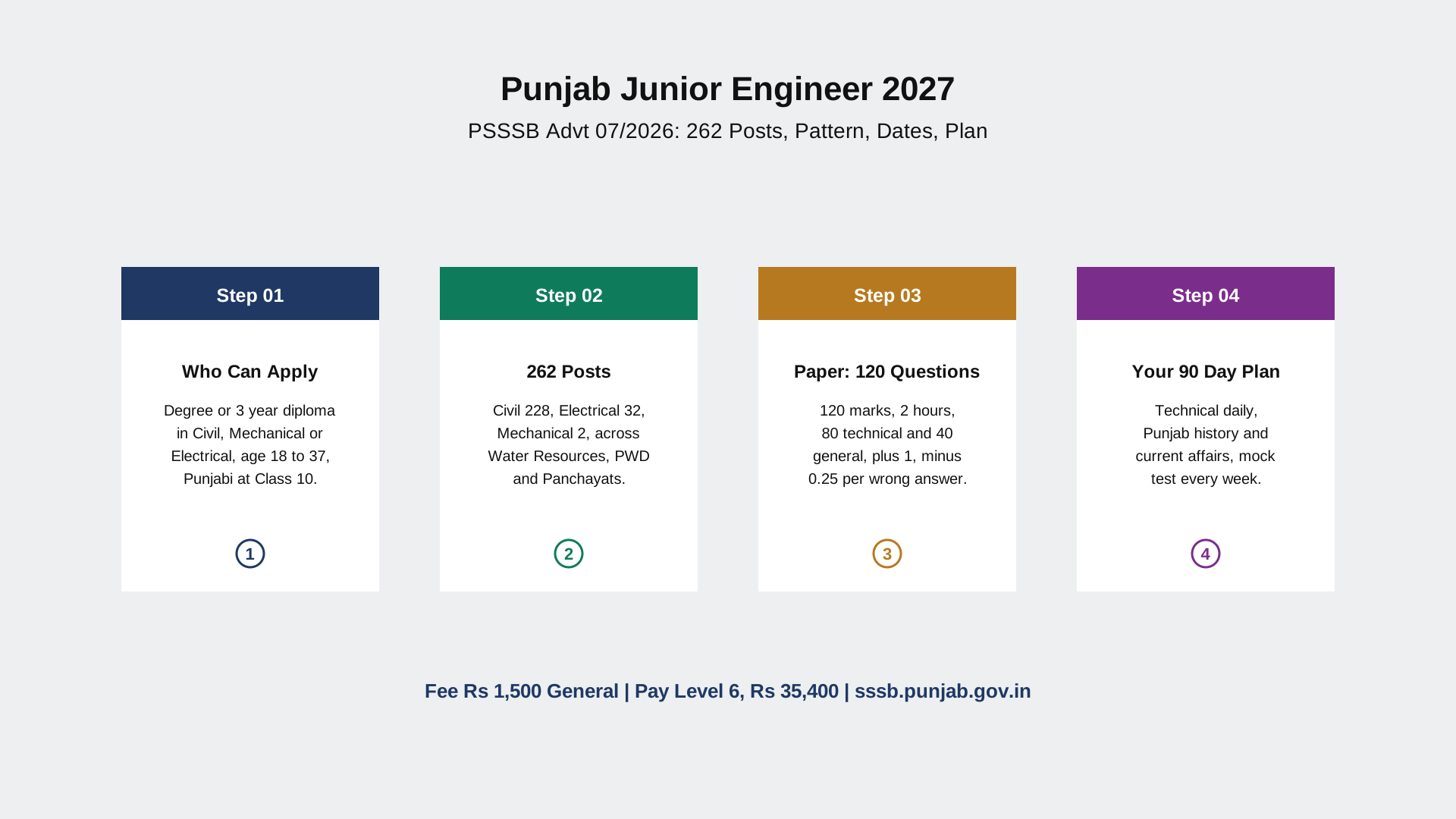
The Punjab Junior Engineer 2027 cycle is really the Punjab Junior Engineer 2026 cycle, still running. The Punjab Subordinate Services Selection Board, known as PSSSB, advertised 158 Junior Engineer posts on 13 March 2026 under Advertisement Number 07 of 2026. The board then reopened the form three times and raised the posts to 262 in a corrigendum dated 11 November 2026. As of 21 November 2026, no separate 2027 advertisement has been published, so this guide anchors on Advertisement 07 of 2026 and says plainly where the dates are still moving.
That matters because the numbers changed while the form was open. The first notice listed 158 posts. The corrigendum of 11 November 2026 raised the total to 262 after fresh requisitions came in from the Water Resources Department, the Public Works Department (Buildings and Roads) and the Rural Development and Panchayats Department. The final split is 228 Civil, 32 Electrical and 2 Mechanical posts. Eighty three of the 262 posts are reserved for women. If you saw the figure 158 in an old post, it is out of date. If you saw 262, it is the revised figure.
The exam itself is a single written paper of 120 multiple choice questions for 120 marks, to be finished in 2 hours. Eighty questions test your engineering subject. Forty questions test general knowledge, Punjab history and culture, reasoning, Punjabi, English and computers. Each right answer earns 1 mark. Each wrong answer costs 0.25 marks. There is no interview. Selection runs through the written exam, document verification and a medical examination.
The entry ticket is a degree or a three year diploma in Civil, Mechanical or Electrical Engineering from a recognised institute. You also need Punjabi at matriculation level, which is Class 10. The age limit is 18 to 37 years as on 1 January 2026, with relaxation for reserved categories under Punjab government rules. The starting basic pay is Rs 35,400 a month at Pay Level 6.
Punjab Junior Engineer 2027 at a glance
| Detail | Punjab Junior Engineer 2027, as last advertised |
|---|---|
| Conducting body | Punjab Subordinate Services Selection Board (PSSSB) |
| Post | Junior Engineer (Civil, Mechanical, Electrical), Group B |
| Advertisement | Advertisement Number 07 of 2026, notified 13 March 2026 |
| Total posts | 262, revised from 158 by a corrigendum on 11 November 2026 |
| Post split | Civil 228, Electrical 32, Mechanical 2 |
| Departments | Water Resources, Public Works (Buildings and Roads), Rural Development and Panchayats, Local Government and other departments |
| Advertisement for 2027 cycle | Not published as of 21 November 2026; this guide anchors on Advertisement 07 of 2026 |
| Education | Degree or three year diploma in the relevant engineering discipline, plus Punjabi at matriculation level |
| Age limit | 18 to 37 years as on 1 January 2026, with relaxation per Punjab government rules |
| Fee | Rs 1,500 for General, Rs 750 for SC and BC, Rs 500 for EWS, ex-servicemen and persons with disabilities |
| Exam | Objective written paper, 120 questions, 120 marks, 2 hours |
| Marking | 1 mark for a right answer, 0.25 marks cut for a wrong answer, no cut for an unattempted question |
| Pay | Pay Level 6, starting basic pay Rs 35,400 a month |
| Selection | Written examination, document verification, medical examination |
| Official website | sssb.punjab.gov.in |
One advertisement, four form windows, and a moving exam date
Advertisement 07 of 2026 opened on 13 March 2026 and first closed on 6 April 2026. That should have been the end of the form filling. It was not. The board reopened applications from 1 September to 15 September 2026, then again from 12 October to 27 October 2026, and then a third time from 11 November to 17 November 2026. The third reopening came with the corrigendum that raised the posts from 158 to 262. Each reopening was for the same advertisement. Nobody who had already applied needed to apply again.
The exam date moved with the form windows. In September 2026, Adda247 reported a computer based test on 18 October 2026 for all three disciplines. That date did not hold. Testbook later reported that the examination had been put on hold because of ongoing legal proceedings. The newest reports, from Quick Sarkari and Sarkari Network in November 2026, put the written exam on 6 and 12 December 2026. This guide uses 6 and 12 December 2026 as the latest reported dates and flags the change, because a candidate who plans around 18 October 2026 would be planning around a date that has already passed.
There is one more date fact worth keeping straight. The 2025 cycle ran on Advertisements 15 and 16 of 2025, with 157 posts, and its forms closed in January 2026. Some job portals still mix the two cycles up and call the 157 post drive a 2026 recruitment. Advertisement 07 of 2026 is the live cycle. The 157 post drive belongs to the previous round, and its pattern was the same 120 question paper.
PSPCL deserves a line of its own here, because many candidates search for it in the same breath. Punjab State Power Corporation Limited recruits its own Junior Engineers through separate advertisements, and its pattern and dates are different from the PSSSB drive. This package covers the PSSSB drive only. If you are preparing for PSPCL, check the PSPCL notice on its own site and keep the two drives separate in your planning.
Who can apply for Punjab Junior Engineer
The education rule is simple and it is also the rule that rejects the most forms. You need a degree in Civil, Mechanical or Electrical Engineering, or a three year diploma in the same discipline, from a recognised institute. A diploma in a different branch does not count for a Civil post, and a degree in a different branch does not count either. Higher qualification holders are eligible. A B.E. or B.Tech holder in the relevant discipline can apply, and so can an M.Tech holder, as long as the basic degree or diploma requirement is met in the same discipline.
The second condition catches out of state candidates. You must have passed Punjabi at matriculation level, which means Class 10. Candidates from other states can apply under the General category, but only if they meet this Punjabi condition. There is no way around it in the notice. If you studied outside Punjab and never took Punjabi at Class 10, read this clause in the advertisement before you pay the fee.
The age limit is 18 to 37 years as on 1 January 2026. The relaxations reported for this cycle are 42 years for SC and BC candidates of Punjab, 45 years for Punjab government employees, 47 years for persons with disabilities and 40 years for widows and divorcees. Ex-servicemen get relaxation under the Punjab government rules, with their service period deducted from their age. These relaxations apply to Punjab domicile candidates in the reserved categories. An out of state candidate in a reserved category is treated as General for age and fee purposes in most PSSSB drives, so check the notice before assuming a relaxation applies to you.
Two documents decide whether your form survives verification. The first is the diploma or degree certificate in the right discipline. The second is the Class 10 certificate showing Punjabi. Keep both ready as scanned copies in the size the portal asks for, and keep the originals ready for document verification. A candidate who clears the written exam and then fails document verification loses the seat, and that happens every cycle.
PSSSB JE exam pattern: what the paper looks like
The PSSSB JE exam pattern is a single objective paper. It has 120 questions and 120 marks, and the clock gives you 2 hours. That works out to one minute per question, which sounds comfortable until you meet a long surveying numerical in the technical section. The paper splits into two parts. Part A carries 40 questions on general subjects. Part B carries 80 questions on your engineering discipline. Every question carries 1 mark. A wrong answer costs 0.25 marks. A question you leave blank costs nothing.
The order of the two parts matters more than most candidates think. In the Adda247 reporting of the 2026 pattern, Part A is the general section and Part B is the technical section. Some older trackers print the split the other way round, with the technical section first. The counts are the same either way, 80 technical and 40 general, so your preparation does not change. What changes is only the order in which the questions appear on the screen or the OMR sheet.
One wording conflict needs a flag. Adda247 calls the 2026 exam a computer based test. At least one other tracker describes the same paper as OMR based and offline. The board has run PSSSB papers in both modes across different recruitments, and the notice for Advertisement 07 of 2026 is the document that settles it. Prepare for a computer screen, but practise marking answers on paper too, because the habit of solving on paper transfers to either mode and the habit of solving in your head does not.
The negative marking shapes the whole strategy. With a 0.25 cut, four wrong answers wipe out one right answer. That is a mild penalty by Indian exam standards, and it means blind guessing is a losing habit while educated guessing pays. If you can remove two options with confidence, attempt the question. If you cannot remove even one option, leave it blank. The candidates who finish near the top are usually the ones who attempted 105 to 115 questions with high accuracy, not the ones who attempted all 120.
| Part | Subjects | Questions | Marks |
|---|---|---|---|
| Part A | General knowledge, current affairs, Punjab history and culture, reasoning and mental ability, Punjabi, English, ICT | 40 | 40 |
| Part B | Technical subject, Civil or Mechanical or Electrical as per the post applied for | 80 | 80 |
| Total | Objective paper | 120 | 120 |
There is no sectional cut off reported for this paper, and no separate qualifying paper inside it. The merit list is made from the total score in the written exam. That is good news for a candidate whose technical section is strong, because the 80 technical marks can carry a weak general section. It is also a warning, because the 40 general marks are the cheapest marks in the paper and the candidates who ignore them give away the margin that decides the merit list.
The Civil paper: where the 80 marks actually sit
Civil carries 228 of the 262 posts, so most readers of this guide are Civil candidates, and the Civil paper deserves the most space. The technical section draws on the diploma and degree syllabus in Civil Engineering. The subjects below are the ones that recur in PSSSB papers and in the previous year papers of the 2025 cycle. The official syllabus PDF attached to Advertisement 07 of 2026 is the final authority, and any topic in this section that is missing from that PDF should be dropped from your plan.
Surveying is the backbone of the Civil paper. Expect questions on chain surveying, compass surveying, levelling, contouring, theodolite work, curves and modern instruments such as the total station and GPS. Numericals on reduced levels, errors in chaining and the area of a traverse appear often, and they reward a candidate who has actually solved fifty such problems rather than one who has only read the definitions. Keep a formula sheet for surveying and revise it every week, because these marks are the most predictable in the paper.
Strength of materials and structural analysis come next. Bending moment and shear force diagrams, stress and strain, torsion, deflection of beams, columns and trusses are the standard fare. These questions test whether you can work a problem to a number, not whether you can recite a definition. Practise drawing the bending moment diagram for a beam with an overhang and a point load until you can do it in under two minutes. That single skill covers several questions a year.
Reinforced concrete and steel structures carry a large share of the paper. Limit state design, singly and doubly reinforced beams, slabs, columns, footings, shear and bond, and the design of steel tension members, compression members and beams are the core topics. The Indian Standard codes matter here. Questions often turn on a single clause, such as the minimum reinforcement percentage or the effective length factor, so read the code provisions for the topics you study instead of memorising numbers from a guide book.
Geotechnical engineering, fluid mechanics and irrigation fill out the paper. Soil classification, bearing capacity, compaction, consolidation and shear strength on the geotech side, and Bernoulli applications, open channel flow, pumps and turbines on the fluid side, are regulars. Irrigation questions cover canals, duty and delta, cross drainage works and water logging, which matters in Punjab because the state runs one of the largest canal networks in the country and the Water Resources Department is the biggest recruiter in this drive.
Highways, environmental engineering and estimating round off the technical section. Highway geometric design, pavement materials and traffic studies, water supply and treatment, sewage treatment and solid waste on the environment side, and rate analysis, valuation and quantity estimation on the estimating side, all appear. Estimating questions are often the easiest marks in the technical section, because they need only a clear head and a formula, and candidates who skip the subject leave those marks on the table.
Mechanical and Electrical: smaller fields, same paper shape
Mechanical has only 2 posts in the revised vacancy list, and Electrical has 32. That changes the competition, not the preparation. The paper shape is the same, 80 technical questions and 40 general questions, and the merit list for each discipline is drawn separately. A Mechanical candidate competes only with Mechanical candidates, so the tiny vacancy count leaves the paper the same difficulty while making the cut off less forgiving, because two posts leave no room for a bad day.
The Mechanical technical section draws on thermodynamics, fluid mechanics, heat transfer, theory of machines, machine design, manufacturing processes, industrial engineering and refrigeration and air conditioning. Strength of materials overlaps with the Civil paper, and candidates who prepare both papers sometimes share notes on that subject. The manufacturing questions are the most factual part of the paper, while thermodynamics and machine design are the most numerical, so split your time between reading and solving in proportion to that split.
The Electrical technical section draws on electrical circuits, machines, power systems, measurements, control systems, power electronics and digital electronics. DC and AC machines, transformers, transmission and distribution, and protection are the heavy topics. As with Civil, the official syllabus PDF is the authority. Electrical candidates should also expect a few questions on basic electronics and instrumentation, which are easy marks if you have revised the diploma level formulae and costly ones if you have not.
One warning applies to both small disciplines. Some trackers swap the Mechanical and Electrical vacancy counts and print Mechanical 32 and Electrical 2. Two sources, Quick Sarkari and Testkart, print Mechanical 2 and Electrical 32, and the Adda247 category table that seems to show Mechanical 32 is headed for a table whose departments match the Electrical allocation. This guide uses Mechanical 2 and Electrical 32 and flags the swap, because a candidate who prepares for the wrong discipline count can misjudge the competition badly.
The 40 general marks most engineers ignore
Part A is worth one third of the paper, and it is the section where engineers lose the exam. The 40 questions cover general knowledge, current affairs, Punjab history and culture, reasoning and mental ability, Punjabi, English and information and communication technology. None of it needs an engineering degree. All of it needs steady daily work, which is exactly what a candidate buried in structural analysis tends to skip.
Punjab history and culture is the highest value subject in Part A, because it is specific to this exam and most candidates outside Punjab have never studied it. The Sikh Gurus, the Punjab freedom movement, folk culture, festivals, rivers and districts, and the formation of the present day state are the recurring areas. A candidate who spends two weeks on Punjab history can pick up marks that a candidate from another state cannot reach by general reading, and that gap often decides the merit list.
General knowledge and current affairs need a different habit. Read a daily current affairs digest and a monthly compilation, and keep a notebook of Punjab specific news alongside national news. The board asks about schemes, appointments, awards and sports from the last year, and the questions are factual rather than analytical. A notebook with one line per event, revised weekly, beats a thick magazine read once and forgotten.
Reasoning and mental ability, Punjabi, English and computers make up the rest. Reasoning covers series, coding, analogy, directions, blood relations and data interpretation, and it is best prepared by timed practice rather than by reading theory. Punjabi covers grammar, spelling and idioms at matriculation level, and it rewards a native speaker who revises the standard grammar topics instead of assuming the language will take care of itself. English covers grammar, vocabulary, synonyms and antonyms, and error spotting. Computers cover basics, networks, the internet and MS Office. None of these four subjects is hard. Together they are worth more than a whole technical subject, and that is the point.
The money question
The pay is Pay Level 6, with a starting basic pay of Rs 35,400 a month. That figure is reported consistently across Adda247, Testbook, Daily Job Alert and Sarkari Jobs for Advertisement 07 of 2026. Dearness allowance, house rent allowance and other allowances under Punjab government rules come on top of the basic pay, and the exact in hand figure depends on the place of posting. A JE posted in a district headquarters will draw a different house rent allowance from one posted in a small town, and the notice does not fix a single in hand number.
The fee is Rs 1,500 for General category candidates, Rs 750 for SC and BC candidates of Punjab, and Rs 500 for EWS, ex-servicemen and persons with disabilities. The fee is paid online and it is non refundable. One tracker, Utility Vaults, prints the older PSSSB fee of Rs 1,000 for General and Rs 250 for SC, BC and EWS. That is the standard fee for several other PSSSB posts, and it does not match the JE notice. The JE specific trackers agree on Rs 1,500, Rs 750 and Rs 500, and this guide uses those figures while flagging the older fee as a conflict.
The probation and service conditions follow the Punjab government rules for Group B posts. A JE holds a regular government post, which is part of why the competition is stiff. The departments in this drive are the ones that build and maintain Punjab roads, canals and village works, so the posting can be anywhere in the state and transfers are a normal part of the service. Candidates who apply only for a posting near home should think again, because the department decides the posting and the first posting is rarely a choice.
What a Junior Engineer actually does all day
A JE in the Water Resources Department works on canals, distributaries, drains and water courses. The day starts with a site visit and ends with a measurement book. You measure work done by contractors, check it against the estimate, record it and prepare bills. You also supervise maintenance of canal banks, regulators and outlets, and you report water logging and breaches during the monsoon. The job needs a surveyor eye and a clerk hand in equal measure, and the officers who do well are the ones who keep their measurement books clean.
A JE in the Public Works Department, Buildings and Roads, works on roads and government buildings. You prepare estimates, supervise laying and compaction, check material quality and keep the quality control records. Road work in Punjab runs through the year, and the winter months are the busiest for bituminous work. A JE who cannot read a drawing and a JE who cannot write a clear site report will both struggle, and the two skills are worth building before you join, not after.
A JE in the Rural Development and Panchayats Department works on village roads, drains, ponds, panchayat ghars and rural water supply. The scale of each work is smaller than a PWD road, but the number of works is larger and the public contact is closer. You deal with sarpanches, block officers and villagers directly, and a part of the job is explaining why a work is delayed or why a measurement does not match a claim. Patience is a job skill here, and the candidates who understand that settle in faster.
The Local Government Department posts, which cover the Mechanical and Electrical JEs, are different again. A Mechanical JE works on municipal machinery, water supply pumps and workshop equipment. An Electrical JE works on street lighting, municipal buildings and electrical installations. Both roles need hands on troubleshooting, and both involve public complaints that arrive at odd hours. The technical paper tests your theory, but the job tests whether you can find a fault at 9 in the evening and fix it by morning.
A 90 day plan that fits the real paper
Ninety days is enough if the plan respects the 80 to 40 split and the one minute per question pace. The plan below assumes you have already covered the diploma syllabus once and need revision and practice, not a first reading. If you are starting from zero in a technical subject, add thirty days to the front of the plan and cut the general section to one hour a day until the technical base is built.
Days 1 to 30 belong to the technical section. Study two technical subjects a week, solve fifty numericals per subject and keep a formula sheet that grows every day. Surveying and strength of materials first, then reinforced concrete and steel, then geotech and fluid mechanics, then highways, environment and estimating. End each week with a 40 question technical test under timed conditions. The goal of this month is accuracy on familiar questions, not coverage of every topic in the syllabus.
Days 31 to 60 add the general section and the first full mocks. Give the technical section three hours a day and the general section two hours a day. Punjab history gets one hour of the general time, current affairs and general knowledge get thirty minutes, and reasoning, Punjabi, English and computers share the remaining thirty minutes. Take one full 120 question mock every Sunday, in 2 hours, with the same negative marking. Score it with the 0.25 cut applied, and write down the five questions you got wrong for the wrong reason rather than the five you got wrong for lack of knowledge.
Days 61 to 90 are for mocks, revision and speed. Take two full mocks a week and spend the days between them on the weak subjects the mocks expose. Revise the formula sheet every morning and the current affairs notebook every evening. In the last ten days, stop learning new topics. A new topic in the last ten days costs more marks than it earns, because it takes revision time away from topics you already know. The last mock should be three days before the exam, and the day before the exam should be light revision only, with the admit card, identity proof and directions to the centre checked in advance.
One habit ties the whole plan together. Solve every mock on paper first, then mark the answers. The paper gives you a minute per question, and the candidates who lose time are the ones who solve in their heads and then cannot check their work. A rough sheet with a clear working is faster than a clean head with a doubtful answer, and it is the difference between finishing the paper and guessing the last ten questions.
Mistakes that cost candidates marks
The first mistake is preparing only for the technical section. Eighty marks feel like the whole exam, and the forty general marks feel like a bonus, but the merit list is made from 120 marks and the general section is where the list is decided. A candidate who scores 60 in technical and 15 in general finishes behind a candidate who scores 55 in technical and 30 in general, and the second candidate spent less time on the harder subject. Give Part A its full share of the day from the first week.
The second mistake is trusting a single tracker site for dates. This cycle reopened three times, the exam date moved from October to December, and the posts rose from 158 to 262. Every one of those changes appeared first on the PSSSB site and only later on the trackers, and some trackers never updated at all. Check sssb.punjab.gov.in once a week from the day you apply, and treat any date you read elsewhere as unconfirmed until the board notice says the same thing.
The third mistake is paying the fee before reading the Punjabi condition. The notice requires Punjabi at matriculation level, and the fee is non refundable. A candidate who applies without that qualification loses the fee and the form. Read the eligibility clause in full, including the fine print on domicile and category certificates, before you open the payment page.
The fourth mistake is guessing on every question. The 0.25 cut is mild, but it adds up. Twenty blind guesses with a one in four hit rate give you five right and fifteen wrong, which is 5 marks gained and 3.75 marks lost, a net gain of 1.25 marks for twenty questions. The same twenty questions left blank cost nothing and save ten minutes for questions you can actually solve. Guess only when you can remove at least two options.
The fifth mistake is ignoring the previous cycle paper. The 2025 cycle used the same 120 question pattern, and its paper is the closest thing to a blueprint for this one. Solve it under timed conditions, study the section split, and note which technical topics carried the most questions. A candidate who has solved one real PSSSB paper walks into the hall knowing the shape of the questions, and that knowledge is worth more than another week of reading.
Where to check next
Everything in this guide comes from the sources listed below, and the PSSSB website is the only place that can confirm a date or a corrigendum. Check sssb.punjab.gov.in for the notice, the syllabus PDF, the admit card and the answer key. The answer key matters more than most candidates think, because PSSSB has invited objections to provisional keys in past cycles, and a candidate who checks the key can sometimes gain a mark that changes the merit list.
Do not wait for a 2027 advertisement before you start. No 2027 notice has been published as of 21 November 2026, and the live cycle is Advertisement 07 of 2026 with its exam reported for 6 and 12 December 2026. If a fresh 2027 notice appears, it will almost certainly keep the same 120 question pattern, the same fee structure and the same eligibility rules, because PSSSB has used that pattern for both the 2025 and 2026 cycles. Prepare for the pattern, watch the board site for the notice, and let the notice change your dates rather than your preparation.
Sources
Adda247, PSSSB JE Exam Date 2026 Out, CBT Exam Scheduled on 18 October, page crawled 18 September 2026, Advertisement Number 07 of 2026, 262 vacancies, notification 13 March 2026, applications 13 March to 6 April 2026, reopened 11 to 15 September 2026, exam pattern 120 questions for 120 marks in 2 hours, Part A 40 general questions, Part B 80 technical questions, negative marking 0.25, age 18 to 37 years as on 1 January 2026, Pay Level 6 with basic pay Rs 35,400.
Quick Sarkari, Punjab PSSSB JE Recruitment 2026, Vacancies Increased To 262, Apply Online Again Till 17 November, Exam On 6 and 12 December, corrigendum of 11 November 2026 raising posts from 158 to 262, Civil 228, Mechanical 2, Electrical 32, applications reopened 11 to 17 November 2026, fee Rs 1,500 General, Rs 750 SC and BC, Rs 500 EWS, ex-servicemen and persons with disabilities.
Testbook, PSSSB JE Recruitment 2026, Exam Date, 262 Vacancies and Application Reopened, applications reopened 12 to 27 October 2026, examination put on hold because of ongoing legal proceedings, notification 13 March 2026, Pay Level 6 with starting salary Rs 35,400.
The Times of India, PSSSB Junior Engineer recruitment 2026, Registration window closes tomorrow for 157 posts, Advertisements 15 and 16 of 2025, Civil 147, Mechanical 9, Electrical 1, written exam 120 questions in 2 hours, 1 mark each, 0.25 cut, 80 engineering questions and 40 general questions, basic pay Rs 35,400.
Government Daily Jobs, PSSSB Junior Engineer Recruitment 2025, 157 Junior Engineer vacancies, Advertisements 15 and 16 of 2025, notification 21 December 2025, applications 22 December 2025 to 28 December 2025, written exam 120 questions, 2 hours, 0.25 negative marking.
Sarkari Jobs, PSSSB JE Recruitment 2026, Applications Reopen for 158 Junior Engineer Vacancies, Advertisement Number 07 of 2026, applications reopened 1 to 15 September 2026, Pay Level 6 with initial pay Rs 35,400.
Daily Job Alert, PSSSB JE Recruitment 2026, Eligibility, Salary and Apply Online, Advertisement Number 07 of 2026, applications 13 March to 6 April 2026, age 18 to 37 years as on 1 January 2026, SC and BC up to 42 years, fee Rs 1,500 General, Rs 750 SC and BC, Rs 500 ESM, EWS, PWD and LDESM, Pay Level 6 with starting pay Rs 35,400.
Sarkari Network, PSSSB 07 of 2026 Junior Engineer Form Re-Open, 262 posts, notification 13 March 2026, form reopened 11 to 17 November 2026, fee last date 17 November 2026, exam date 6 and 12 December 2026, fee General Rs 1,500, SC and BC Rs 750, EWS and ex-servicemen Rs 500, Pay Level 6, Rs 35,400.







