
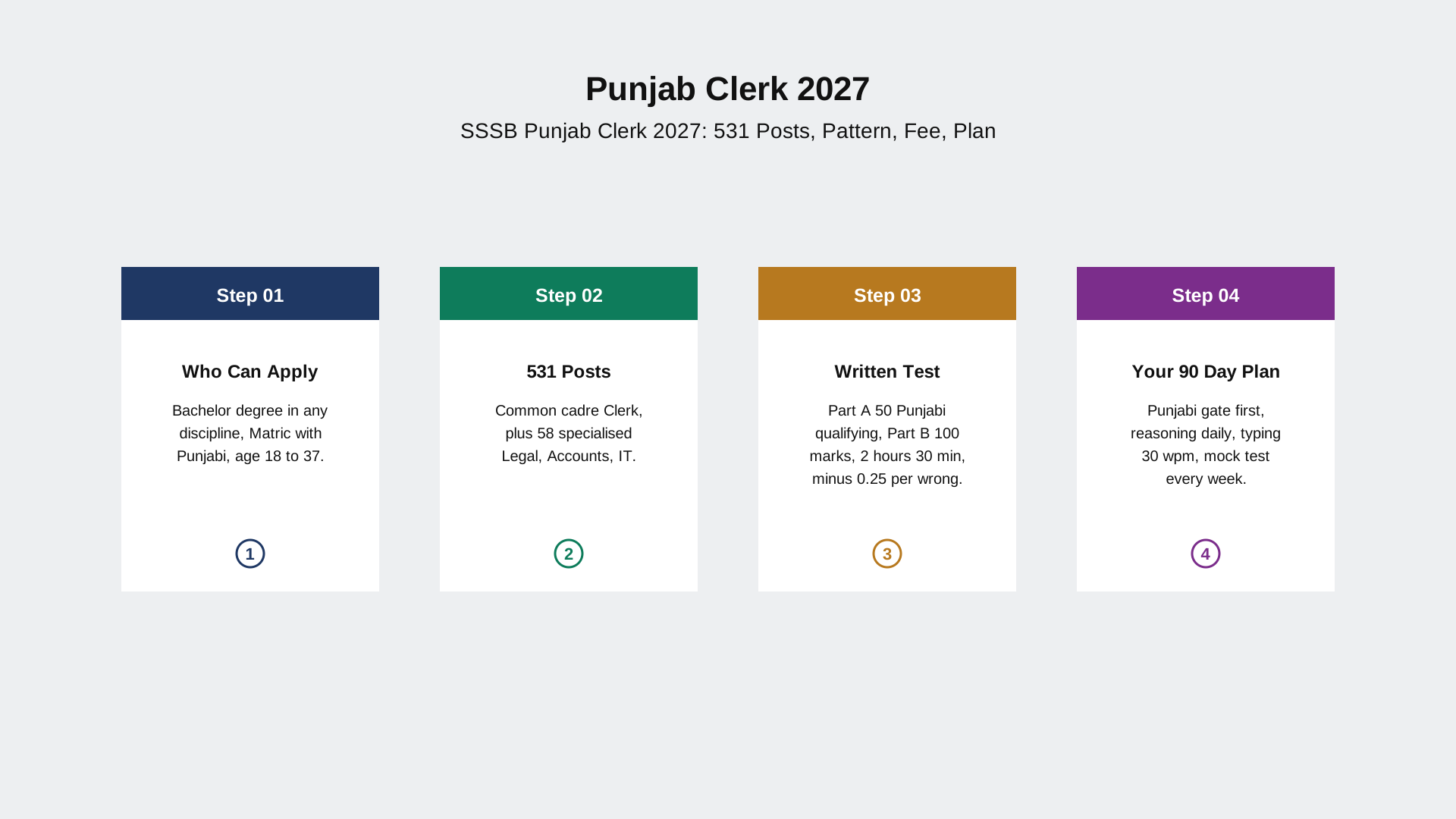
About Punjab Clerk 2027 Exam Series
📖 Table of Contents
- Punjab Clerk 2027 at a glance
- Two advertisements, one post
- Who can apply for Punjab Clerk
- Fee, pay and job profile
- Punjab Clerk exam pattern
- Punjab Clerk syllabus, subject by subject
- The typing test decides more than the written test
- Clerk-cum-Data Entry Operator and the older cycles
- How the cut off behaves
- A 90 day plan that fits around typing practice
- Mistakes that cost seats every year
- Documents to keep ready
- Sources
Punjab Clerk 2027: Complete Exam Guide
The Punjab Clerk 2027 cycle is the biggest clerk opening Punjab has seen in years. The Subordinate Services Selection Board, known as SSSB Punjab or PSSSB, advertised 531 Clerk posts for the common cadre under Advertisement Number 02 of 2026. Applications first opened on 13 February 2026, the window reopened from 25 August to 7 September 2026, and the written test was held on 11 October 2026. A second advertisement, Number 12 of 2026, added 58 specialised clerk posts in law, accounts and information technology, with applications running from 25 September to 19 October 2026.
No fresh 2027 advertisement has been published as of 21 November 2026. This guide uses the name Punjab Clerk 2027 because that is the cycle candidates are searching for, and it anchors every fact on the 2026 advertisements that are already on record. The pattern, the fee, the age limit and the typing test in those advertisements are the best map for the next round, and this guide says plainly wherever a figure comes from an older cycle.
A clerk post in a Punjab government department pays Rs 19,900 a month at the start, with allowances on top. The work sits at the centre of how a department runs. Files move, records are kept, letters go out, data gets entered, and the public gets answers. It is office work with a fixed routine, a pensionable career, and a posting inside Punjab. That mix explains why more than a lakh candidates chase a few hundred seats every time the board opens applications.
Punjab Clerk 2027 at a glance
| Detail | Punjab Clerk 2027, as last advertised |
|---|---|
| Conducting body | Subordinate Services Selection Board, Punjab (SSSB Punjab, also called PSSSB) |
| Post | Clerk, Common Cadre (Group C), plus specialised Clerk Legal, Clerk Accounts and Clerk IT |
| Main advertisement | Advt No. 02 of 2026, 531 Clerk posts |
| Second advertisement | Advt No. 12 of 2026, 58 specialised clerk posts |
| Official website | sssb.punjab.gov.in |
| Age limit | 18 to 37 years as on 1 January 2026 |
| Education | Bachelor degree in any discipline, Matriculation with Punjabi, computer course or DOEACC O level |
| Starting pay | Rs 19,900 a month |
| Fee | Rs 1,000 general, Rs 250 SC BC EWS, Rs 200 ex-servicemen and dependents, Rs 500 physically handicapped |
| Written test | Part A Punjabi qualifying 50 marks, Part B merit paper 100 marks, 2 hours 30 minutes in one sitting |
| Typing test | Qualifying, Punjabi and English, 30 words a minute, 10 minutes each |
| Selection | Written test, typing test, document verification |
Two advertisements, one post
The 531 post drive under Advt No. 02 of 2026 spread its seats across 29 departments and offices. The Excise and Taxation Department took the largest share, with 145 posts in its field offices and 5 more at head office. The Punjab State Agricultural Marketing Board, the Mandi Board, followed with 90 posts. District commissioner offices across the state took most of the rest, with Gurdaspur at 36, Barnala at 24, Moga at 21, Rupnagar and Faridkot at 16 each, and smaller numbers in Mansa, Malerkotla, Shaheed Bhagat Singh Nagar and other districts. The Revenue, Rehabilitation and Disaster Management Department took 25 posts, the Forest and Wildlife Preservation Department took 18, and the Directorate of Defence Services Welfare took 17.
That spread matters for a candidate. A clerk in a district commissioner office handles a different daily load from a clerk in the Mandi Board or the Excise Department, yet the test is the same for all of them. The board runs one common test and one common merit list, and postings follow the merit order and the choices candidates make at counselling. A candidate who only wants a posting near home should read the department wise vacancy table in the notification before applying, because the choice of department is made at the start and it shapes where the job lands.
The first application window for Advt No. 02 of 2026 ran from 13 February 2026. The closing date is reported as 6 March 2026 in the official plan quoted by syllabus trackers, while one large portal records 13 March 2026. This guide uses 6 March 2026 and flags the 13 March date as unverified, because the plan attached to the advertisement is the stronger source. The board then reopened the window from 25 August to 7 September 2026 through a corrigendum dated 21 August 2026, and candidates who had already applied did not need to apply again. A correction window ran from 14 to 16 September 2026, up to 5 pm on the last day.
The written test for Advt No. 02 of 2026 was held on 11 October 2026. The board released the provisional answer key on 12 October 2026. That speed tells a candidate something useful about how the board works now. Answer keys come out within a day, objections are invited quickly, and the result follows soon after. A candidate who waits for the result to start typing practice has already lost weeks, because the typing test comes next and it needs daily practice that cannot be rushed in a fortnight.
Advt No. 12 of 2026 is a smaller drive with a sharper edge. It advertised 58 specialised clerk posts: 13 Clerk Legal, 34 Clerk Accounts and 11 Clerk IT, spread across the Directorate of Employment Generation, Skill Development and Training, the Excise and Taxation Department, the Labour Commissioner office, the Civil Aviation Department, the Directorate of Cultural Affairs, Archaeology and Museums, the Dairy Development Department and the Directorate of Defence Services Welfare. The same advertisement also carried 3 Driver posts, 6 Translator posts and 1 Field Artist post, taking its total to 70 posts. Applications ran from 25 September to 19 October 2026, and a correction window ran from 2 to 4 November 2026.
One tracker page splits the 58 clerk posts as 11 Legal, 34 Accounts and 12 IT. That split adds up to 57, which cannot be right, so this guide uses the department wise table that adds up cleanly to 58. The lesson is a small one and it applies to the whole exam. When two tracker pages disagree, the table that adds up wins, and the official PDF on sssb.punjab.gov.in settles the argument.
Who can apply for Punjab Clerk
The education bar for the common cadre Clerk post is a bachelor degree in any discipline from a recognised university. There is no demand for a particular subject, which is why graduates from arts, science and commerce all sit the same paper. Two extra conditions sit beside the degree. The candidate must have passed Punjabi as a subject at Matriculation level, and must hold a computer qualification, either a 120 hour course in personal computer or information technology office productivity or desktop publishing from a government recognised or ISO 9001 certified institution, or a DOEACC O level certificate or its equivalent.
The specialised posts add their own degrees on top of that base. Clerk Legal needs a law degree. Clerk Accounts needs graduation with statistics, mathematics or accounts, with the Punjabi and commerce conditions as the notification sets them. Clerk IT needs graduation or a BTech in computer science or information technology, or a BCA or PGDCA, or a related engineering qualification as the notification prescribes. A candidate who applies for a specialised post with a general degree will be rejected at document verification, even if the written test score is high, so the degree check has to happen before the form is filled, not after the result.
The age limit in the 2026 advertisements is 18 to 37 years as on 1 January 2026. Relaxation follows Punjab government rules for reserved categories, ex-servicemen and government employees, and the notification carries the full table. A candidate who turns 37 in the middle of the year still fits, because the cut off date is 1 January, not the date of the form. A candidate who is 17 on that date does not fit, even by a few weeks, and no request changes that.
Punjab domicile matters for reservation and fee concession. The benefit of relaxation in age, fee concession and reservation goes to residents of Punjab, and candidates from other states apply under the unreserved category. A candidate who claims a reserved category without a Punjab domicile certificate will find the claim struck down at verification. The certificate, the caste certificate and the Punjabi pass certificate should be in hand before the form opens, because the correction window does not fix a missing document.
Fee, pay and job profile
The application fee in the 2026 advertisements is Rs 1,000 for general category candidates, including sports and freedom fighter categories. SC, BC and EWS candidates pay Rs 250. Ex-servicemen and their dependents pay Rs 200. Physically handicapped candidates pay Rs 500. The fee is paid online and it is not refunded. A candidate should keep the payment receipt until the whole process ends, because a failed payment that looks successful on screen is one of the most common reasons a form is treated as incomplete.
The starting pay is Rs 19,900 a month. Allowances follow Punjab government rules for the post, and the pay rises with increments and with promotion to senior clerk and superintendent grades over a career. The post is Group C, which means the appointment is a regular government job with the service rules of the department, not a contract engagement. That is a real difference from some other Punjab recruitments that run on fixed honorarium, and it is one reason the competition is so stiff.
A clerk in a Punjab department spends the day on files, registers, correspondence and data entry. The work needs accuracy more than speed, though speed matters at the typing test. A file that goes to the wrong desk costs the department days, and a wrong entry in a register can take months to fix. The test mirrors that. It rewards a candidate who reads a question twice, who can type without looking at the keyboard, and who knows enough Punjabi to draft a note in the language the office actually uses.
Punjab Clerk exam pattern
The Punjab Clerk written test has two parts in one sitting of 2 hours 30 minutes. Part A is a qualifying test of Punjabi language at Matriculation standard. Part B is the merit paper. Only candidates who clear Part A have their Part B answer sheets evaluated, so Part A is a gate, not a warm up. A candidate who scores 95 in Part B and 24 in Part A goes home, because the gate closed before the merit paper was even read.
Part A carries 50 questions for 50 marks, all in Punjabi. A candidate needs 50 percent, which is 25 marks out of 50, to pass it. There is no negative marking in Part A, so every question should be attempted. The syllabus covers the life and works of the Sikh Gurus, antonyms and synonyms, idioms and proverbs, parts of speech, prefixes and suffixes, change of number and gender, punctuation, correction of words and sentences, and the correct Punjabi form of English words. It is Matriculation standard, which means a candidate who studied Punjabi at school has already met most of it once, and the work now is revision, not fresh learning.
Part B carries 100 questions for 100 marks, with one mark for each right answer and a cut of 0.25 marks for each wrong answer. The six subjects in Part B are fixed, and the marks are fixed too, which makes planning simple. General knowledge and current affairs carry 25 marks. Punjab history and culture carry 17 marks. Logical reasoning and mental ability carry 25 marks. Punjabi carries 13 marks. English carries 12 marks. Information and communication technology carries 8 marks. The total is 100, and the table below lays it out.
| Part | Subject | Questions | Marks |
|---|---|---|---|
| Part A, qualifying | Punjabi, Matriculation standard | 50 | 50 |
| Part B | General knowledge and current affairs | 25 | 25 |
| Part B | Punjab history and culture | 17 | 17 |
| Part B | Logical reasoning and mental ability | 25 | 25 |
| Part B | Punjabi | 13 | 13 |
| Part B | English | 12 | 12 |
| Part B | Information and communication technology | 8 | 8 |
| Total | Part A plus Part B | 150 | 150 |
Merit is based only on Part B marks, for candidates who qualify in Part A and in the typing test. If two candidates score equal marks, the board breaks the tie by preferring the older candidate, then the candidate with the higher educational percentage, then the candidate with higher Matriculation marks. The tie rule rewards a candidate who keeps every mark sheet safe, because the second and third tie breakers are decided on paper, not in the exam hall.
Negative marking changes how a candidate should attempt Part B. A blind guess costs 0.25 marks, so four wrong guesses wipe out one right answer. A candidate who is sure of 70 questions and guesses 30 at random will lose about 5 marks on the guesses alone, which is often the gap between selection and rejection. The rule that works is simple. Attempt every question you can narrow to two options, skip the ones where all four options look new, and never leave Part A blank, because Part A has no penalty at all.
Punjab Clerk syllabus, subject by subject
General knowledge and current affairs carry 25 marks, the joint largest share in Part B. The syllabus lists political issues, environmental issues, current affairs, and science and technology, at national and international level. A candidate should follow the news daily for six months before the test, with a notebook for schemes, appointments, awards, summits and sports results. Static general knowledge needs a standard book, and Lucent's General Knowledge is the one most Punjab candidates use. The two halves feed each other. A current affairs question about a new scheme is easier when the static base already explains the ministry behind it.
Punjab history and culture carry 17 marks, and this is the section where a Punjab candidate should outscore everyone else. The syllabus covers Punjab history from the medieval period, the Sikh Gurus and their works, the freedom struggle in Punjab, folk culture, festivals, dance and music, and the geography of the state. Arihant's Punjab General Knowledge is the standard book here, and it should be read twice, once for the story and once for the facts. Dates of battles, names of rivers, the five rivers and their tributaries, and the districts and their headquarters all appear regularly. A candidate who grew up in Punjab knows half of this from daily life, and the job is to turn that familiarity into exact answers.
Logical reasoning and mental ability carry 25 marks, and the split inside the section is worth knowing. Logical reasoning, analytical and mental ability carry 17 marks. Basic numerical skills, numbers, magnitudes, percentages and numerical relation carry 4 marks. Data analysis, graphic presentation, charts, tables and spreadsheets carry 4 marks. R. S. Aggarwal's Quantitative Aptitude covers the numerical half, and any standard reasoning book covers the rest. The trick with reasoning is practice under time pressure, because the questions are easy when solved slowly and hard when the clock is running. Ten questions a day for three months beats a hundred questions in one weekend.
Punjabi in Part B carries 13 marks, and it is different from Part A. Part A tests Punjabi at Matriculation level as a qualifying gate, while Part B tests it as a scoring subject with correct and incorrect usage, spelling, prefixes and suffixes, synonyms and antonyms, nouns, pronouns and verb types, gender and number, proverbs and idioms, translation from English to Punjabi, and one word substitution. A candidate who reads Punjabi newspapers will find this section friendly, because the idioms and the translation questions come from living language, not from a grammar list.
English carries 12 marks, and the syllabus is the familiar list: basic grammar, subject and verb agreement, adjectives and adverbs, synonyms and antonyms, one word substitution, fill in the blanks, correction in sentences, idioms and their meanings, spell checks, articles, prepositions, direct and indirect speech, and active and passive voice. S. P. Bakshi's Objective General English is the book most candidates carry. Twelve marks look small, yet they decide ranks, because English is the section where a prepared candidate scores full marks and an unprepared one scores four.
Information and communication technology carries 8 marks, the smallest share, and the easiest marks in the paper for a candidate who uses a computer daily. The syllabus covers basics of computers, networks and the internet, and office productivity tools such as Word, spreadsheets and PowerPoint. Arihant's Objective Computer Awareness covers it. Eight marks take about two weeks of study, which makes ICT the best return on time in the whole syllabus, and the worst section to leave for the last week.
Clerk IT candidates face a different Part B. Their paper keeps the two part shape and the 2 hour 30 minute duration, but the merit paper gives 60 marks to the subject syllabus and the rest to the general subjects. The subject syllabus covers fundamentals of computers, networks and the internet, email, office productivity tools, operating system structure and architecture, types of operating systems, process management, concurrency control and memory management. A general clerk candidate who applies for Clerk IT by mistake will find 60 marks of computer science waiting, so the choice of post has to match the degree.
The typing test decides more than the written test
The typing test is qualifying, which makes candidates treat it as a formality, and that is exactly how it eliminates people. Candidates who clear the written test are called for a typing test in Punjabi and in English. Each language gets 10 minutes. The pass mark is a gross speed of at least 30 words a minute, with no more than 8 percent mistakes. The test is held on computer, and the Punjabi test uses the Raavi font with the Inscript keyboard layout. A candidate who types Punjabi in another font at home will find the exam keyboard feels foreign, because the key positions are different.
Thirty words a minute sounds slow until it is measured on a timer. Most candidates who type with two fingers reach 15 to 20 words a minute, and they make mistakes when they try to go faster. The gap from 20 to 30 words a minute takes about eight weeks of daily practice, thirty minutes a day, on the right keyboard layout. The practice has to be in Raavi for Punjabi and in a standard English layout for English, on a desktop keyboard, not on a phone. A candidate who starts typing practice only after the written result has about three weeks, and three weeks is not enough to rebuild finger habits.
The typing test carries no marks toward merit, and that fact hides its power. A candidate who scores the highest marks in Part B and fails the typing test is out, while a candidate with a lower Part B score who passes the typing test moves on to document verification. The written test selects the list, the typing test cuts the list, and the cut falls on candidates who prepared for only one of the two. The plan in this guide puts typing practice in week one, beside the first chapter of general knowledge, so that the two skills grow together.
Document verification is the last stage. Original certificates are checked, and the list includes the degree, the Matriculation certificate showing Punjabi as a subject, the computer course certificate, the caste or category certificate, the domicile certificate, and the age proof. A candidate who clears the written test and the typing test and then fails verification loses the seat to the next person on the list. The certificates should be collected and checked months before the test, because a university that takes six weeks to issue a degree will not hurry for one candidate.
Clerk-cum-Data Entry Operator and the older cycles
The name Punjab Clerk 2027 covers more than the common cadre post, because the board has run clerk posts under several names. The one candidates ask about most is Clerk-cum-Data Entry Operator, written as Clerk-cum-DEO. The most recent DEO cycle was Advt No. 12 of 2024, which advertised 26 posts in total, including 20 Clerk-cum-Data Entry Operator posts and 3 Data Entry Operator posts, with the rest going to librarian and other posts. The notification came out on 30 July 2024, applications closed on 19 August 2024, and the provisional answer key for Clerk-cum-DEO came out on 15 September 2024. The qualification was graduation with Punjabi and English typewriting and knowledge of computers, the age limit was 18 to 37 years as on 1 January 2024, and the pay was Rs 19,900.
An older DEO cycle ran under Advt No. 03 of 2022, as part of a large clerk recruitment that covered 1,200 Clerk and Legal Clerk posts across Advt No. 02, 03 and 15 of 2022, plus 735 Clerk, IT and Accounts Clerk posts under Advt No. 15 of 2022. One tracker records the Clerk-cum-DEO written test on 25 June 2023, while another records it on 4 December 2022. The two dates conflict, and this guide flags the conflict rather than picking one silently. The official plan for Advt No. 03 of 2022 set a 120 question paper for 120 marks over 2 hours, with a cut of one fourth of a mark for each wrong answer, and a syllabus of general studies with no technical subject. That paper shape is older than the 2026 pattern, and a candidate preparing for the next round should follow the 2026 pattern first, because the board has moved to the Part A plus Part B shape.
Going further back, the 2016 cycle advertised 2,200 Clerk, Steno Typist and Stenographer posts, including 1,759 Clerk posts and 6 Clerk-cum-DEO posts, with an age limit of 18 to 37 years as on 1 January 2016. The scale of that drive shows how the board works in waves. A big year fills thousands of posts, then several quiet years follow, then a new wave opens. The 2026 wave, with 531 common cadre posts plus 58 specialised posts, is the current wave, and candidates who miss it wait for the next one, which has no fixed date.
A separate small drive also ran in 2025 and 2026 for 98 Clerk posts under a board advertisement, with applications closing on 28 January 2026 and the same fee structure of Rs 1,000 for general, Rs 250 for SC, BC and EWS, Rs 200 for ex-servicemen and Rs 500 for physically handicapped candidates. Small drives like that one fill specific offices, and they are easy to miss because they carry no big number in the headline. A candidate should check sssb.punjab.gov.in every week, not only when a big advertisement is in the news, because the small drives close fast and they are real seats.
How the cut off behaves
The board publishes cut off marks category wise with the result, and the cut off moves every year with the number of applicants, the difficulty of the paper, and the number of seats. No fixed score guarantees selection, and any coaching centre that quotes a safe score for the next cycle is guessing. The honest way to read the cut off is to look at what it rewards. Part B is 100 marks, and the top of the merit list usually sits in the high 80s, while the last selected candidate in the general category usually sits in the high 60s or low 70s. A candidate who scores 75 in Part B with a clean attempt record is in the fight, and a candidate who scores 60 needs a very easy paper or a reserved category to get through.
Negative marking is the hidden hand in the cut off. Two candidates can attempt the same number of questions and finish ten marks apart, because one of them guessed and the other left blanks. The mock tests in this guide's plan are there to teach that judgement. A mock test that is taken and never analysed is wasted time, because the score tells nothing and the error list tells everything. After every mock, a candidate should write down each wrong answer, the reason it went wrong, and the rule that fixes it. That list becomes the revision notes for the last week.
Previous year papers are the best predictor of the next paper, because the board repeats its style even when it changes its questions. The 2022 and 2023 papers show the same six subject mix, the same weight on Punjab history, and the same style of reasoning questions. A candidate who solves three previous papers under timed conditions learns more about the exam than a candidate who reads three new books. The papers are on the board website and on tracker sites, and the answer keys let a candidate check the score against the official key.
A 90 day plan that fits around typing practice
Ninety days is enough for this exam if the days are used in order. The plan below assumes three hours a day, with typing practice on top, and it is built for a candidate starting from zero. A candidate who already knows the syllabus can compress the first month into three weeks, but the typing practice cannot be compressed, because fingers learn slowly.
Days 1 to 30 build the base. General knowledge takes one hour a day, with a standard book and a daily current affairs note. Punjab history and culture take 45 minutes a day, with one chapter at a time and a map beside the book. Reasoning takes 45 minutes a day, ten questions a day, timed from the first week. English and ICT share 30 minutes a day, alternating. Punjabi takes 30 minutes a day, with idioms and proverbs learned five at a time. Typing practice takes 30 minutes a day, 15 minutes in Punjabi on the Raavi layout and 15 minutes in English. By day 30, the candidate should have finished the first reading of every subject and should be typing at 20 words a minute.
Days 31 to 60 turn knowledge into marks. The second reading of every subject runs beside one mock test every week, taken on a Sunday under exam conditions, with the full 2 hours 30 minutes and no breaks. Each mock is analysed the same day, and the weak subject gets an extra hour the next day. Current affairs notes are revised weekly, and the candidate starts a mistake notebook that holds every error from every mock. Typing practice rises to 40 minutes a day, and the target is 25 words a minute with fewer than 8 percent mistakes. By day 60, the candidate should know which two subjects leak the most marks, and those two subjects should own the extra hour.
Days 61 to 90 are for revision and speed. No new book is opened. The mistake notebook is read every morning. One mock test is taken every four days, and the last mock is taken seven days before the real test, not the day before. Punjabi Part A gets a full revision in the last two weeks, because the gate closes on candidates who ignore it. Typing practice stays daily, and the target is 32 words a minute, two above the pass mark, so that exam nerves have room to cost a little speed. The day before the test is for documents, admit card, travel, and sleep, not for study.
Mistakes that cost seats every year
The first mistake is applying for the wrong post. A general graduate who applies for Clerk Accounts or Clerk IT without the right degree clears the test and fails verification, and the seat goes to someone else. The second mistake is ignoring Part A. Candidates spend months on general knowledge and leave Punjabi for the last week, then score 24 out of 50 and watch their Part B paper go unread. The third mistake is ignoring typing until the result. Thirty words a minute in two languages cannot be built in three weeks, and the typing test has no mercy for a high Part B score.
The fourth mistake is guessing in Part B. Four wrong answers erase one right answer, and a candidate who guesses twenty questions loses five marks, which is often the whole gap between the last selected candidate and the first rejected one. The fifth mistake is trusting a single tracker site for dates. Application windows, correction windows and exam dates change through corrigenda, and only sssb.punjab.gov.in carries the corrigendum. The sixth mistake is a careless form. A wrong spelling of a name, a wrong category, or a photograph that does not match the size in the notification can all end a candidature before the test begins.
The seventh mistake is studying without mock tests. A candidate who knows the syllabus but has never sat for 2 hours 30 minutes will slow down in the last half hour, when the reasoning questions need the most care. The eighth mistake is the opposite, taking mock tests without analysis. A mock test score is a number, and numbers do not teach. The error list teaches, and only the candidate who reads it improves. The ninth mistake is buying too many books. One book per subject, read twice, beats five books read once, because the exam rewards depth in a fixed syllabus, not breadth across every book in the market.
Documents to keep ready
The form asks for details that must match the certificates exactly, so the certificates come first. Keep the degree and all mark sheets, the Matriculation certificate showing Punjabi as a subject, the computer course certificate or DOEACC O level certificate, the caste certificate if claiming reservation, the Punjab domicile certificate, the age proof, a recent passport photograph in the size the notification asks for, and a scanned signature. Keep five copies of the photograph, because the board asks for copies at later stages too, and a photograph taken a year ago that looks different from the candidate can cause trouble at verification.
Check the spelling of the name on every certificate before the form opens. If the degree spells the name one way and the Matriculation certificate spells it another way, get an affidavit or a correction early, because the correction window in the form does not fix a mismatch between two certificates. Check the date of birth on the Matriculation certificate, because that date is the age proof, and a wrong date there is the hardest error to fix in a hurry.
Sources
Testbook, PSSSB Clerk 2026 Recruitment, Exam Date, Application Dates, Notification PDF, Advt No. 02 of 2026 with 531 Clerk posts, Advt No. 12 of 2026 with 58 specialised clerk posts, fee table, exam held 11 October 2026, provisional answer key 12 October 2026. Testbook, Punjab SSSB Recruitment 2026 Notification Out, Apply Online For 70 Vacancies For Clerk, Driver, Field Artist and Translator, Advt No. 12 of 2026, applications 25 September to 19 October 2026, age 18 to 37 years, pay Rs 19,900. Adda247, PSSSB Clerk Recruitment 2026 Out For 531 Posts, Last Date To Apply Online, Advt No. 02 of 2026, correction window 14 to 16 September 2026, fee Rs 1,000 general, Rs 250 SC BC EWS, Rs 200 ex-servicemen, Rs 500 physically handicapped. AspirantDesk, PSSSB Clerk Syllabus 2026 Topic List, Plan of Written Examination of Advt 02 of 2026, Part A 50 marks Punjabi qualifying, Part B 100 marks with subject wise marks, typing test 30 words a minute with no more than 8 percent mistakes, 120 hour computer course or DOEACC O level. MakeMyExam, PSSSB Clerk 2026 Exam Pattern and Syllabus, Part A 50 questions, Part B 100 questions, 2 hours 30 minutes, negative marking 0.25 in Part B only. NDTV Education, Punjab SSSB Recruitment 2026, Apply Online From September 25, Check Details, Advt No. 12 of 2026, last date 19 October 2026, fee table. GovtJobGuru, PSSSB Operator Recruitment 2024, 26 Clerk-cum-DEO, DEO, Librarian and Other posts, Advt No. 12 of 2024, notification 30 July 2024, last date 19 August 2024, Clerk-cum-DEO 20 posts, provisional answer key 15 September 2024. CareerPower, PSSSB Clerk Exam Date 2022 Out for 735 Clerk, IT and Accounts Clerk, 1,200 Clerk and Legal Clerk posts across Advt No. 02, 03 and 15 of 2022, exam dates for Clerk IT, Clerk Accounts and Clerk-cum-DEO. House of Aspirants, PSSSB Clerk cum DEO 2027 Syllabus and Exam Pattern, Advt No. 03 of 2022, written test 25 June 2023, 120 question plan, no 2027 notification yet. Subordinate Services Selection Board Punjab, official website sssb.punjab.gov.in, advertisement PDFs for Advt No. 02 of 2026 and Advt No. 12 of 2026.







