About OPSC OJS 2027 Exam Series
📖 Table of Contents
- OPSC OJS 2027 in numbers
- Who can apply for OPSC OJS 2027
- The 78 posts, category by category
- How the exam actually works
- Syllabus, subject by subject
- Fee, refund and how to apply
- Pay and what a Civil Judge does
- The previous cycles, in full
- How to prepare while the dates are suspended
- Three mistakes that cost marks
- Sources
OPSC OJS 2027: Complete Exam Guide
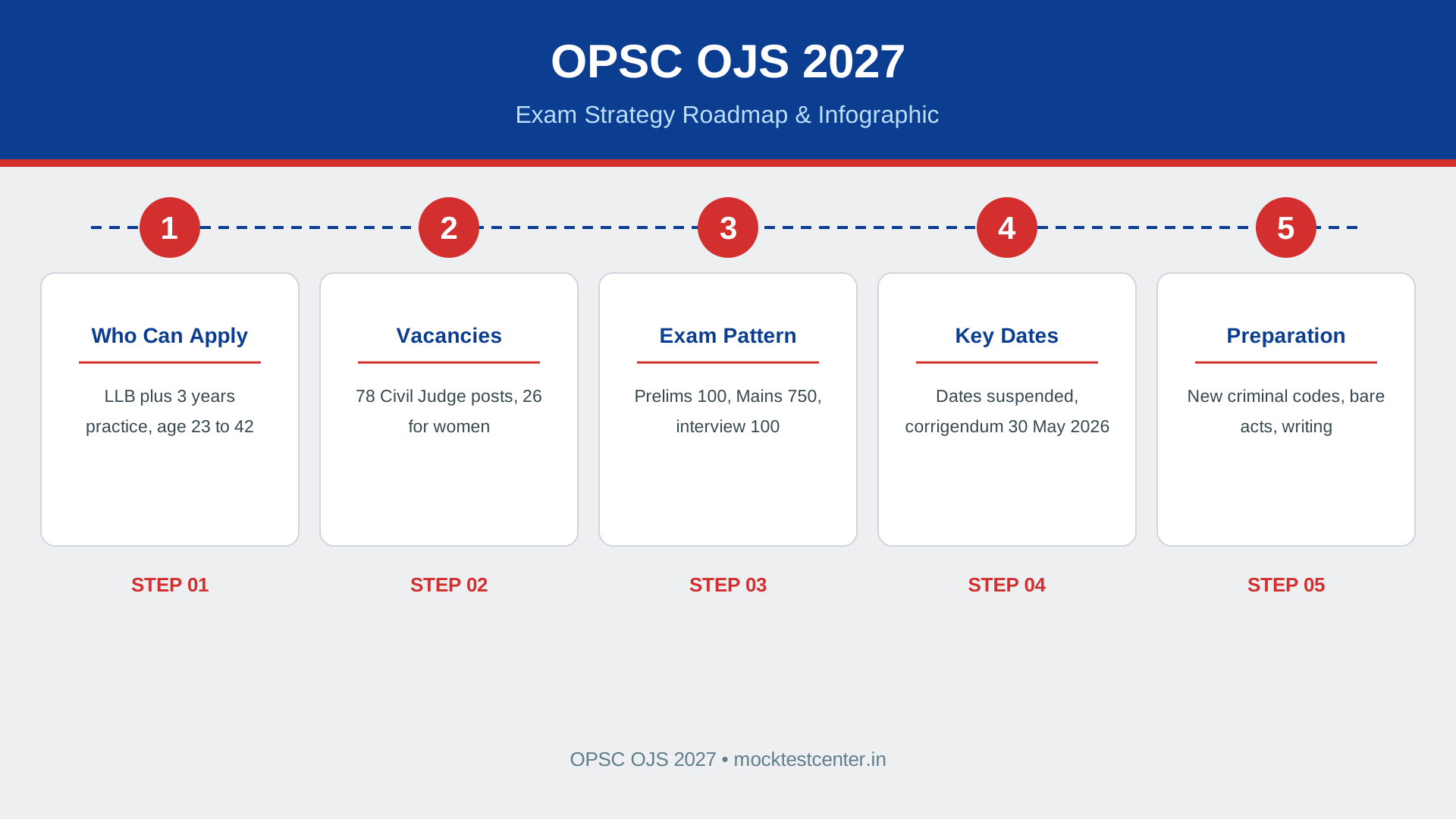
OPSC OJS 2027 is a live judicial recruitment with no exam date. The Odisha Public Service Commission issued Advertisement No. 02 of 2026-27 on 30 April 2026 for 78 Civil Judge (Junior Division) posts in the Odisha Judicial Service, 2025, with 26 posts reserved for women. Applications opened on 8 May 2026 and were to close on 8 June 2026, with the Preliminary Examination fixed for 5 July 2026. Then the Commission issued a corrigendum on 30 May 2026 that extended the last date for applications until further instruction and dropped the Preliminary Examination fixed for 5 July 2026. As of late October 2026 no new dates had been announced. This guide states the position as it stands: the recruitment is open and unfinished, the dates are suspended, and the preparation still has a fixed shape, because the pattern, the syllabus and the eligibility rules in the notification have not changed.
That suspended state is the first thing to understand about this cycle. Many pages still show 5 July 2026 as the Prelims date, because they were written before the corrigendum and never updated. Do not plan around that date. The Commission will announce fresh dates, and the announcement will come on the OPSC website. Until then the work is the same work it always was: the bare acts, the new criminal codes, the Constitution and the procedural laws, plus a Mains that tests your English and your ability to write law in full sentences. OPSC OJS 2027 is a three stage selection: a 100 mark Preliminary screening, a 750 mark Main written examination, and a 100 mark interview. Final merit comes from the Mains plus the interview. If you are an advocate with three years at the Bar and you can read, write and speak Odia, this is the direct route into the Odisha judiciary.
OPSC OJS 2027 in numbers
| Item | Detail |
|---|---|
| Conducting body | Odisha Public Service Commission (OPSC), Cuttack, for the Law Department, Government of Odisha |
| Post | Civil Judge (Junior Division), Odisha Judicial Service, 2025 |
| Current notification | Advertisement No. 02 of 2026-27, notice No. 2387/PSC, dated 30 April 2026 |
| Posts in the current cycle | 78, with 26 reserved for women |
| Application window as notified | 8 May 2026 to 8 June 2026, up to 5:00 PM, online only |
| Corrigendum | 30 May 2026: last date extended until further instruction, Preliminary Examination of 5 July 2026 dropped, new dates not announced as of late October 2026 |
| Age counted on | 1 April 2025, 23 to 42 years |
| Fee | Rs 700 for UR and others, exempt for SC, ST and PwD, refunded to candidates who appear in the Preliminary Examination |
| Selection | Preliminary Examination of 100 marks, Main Examination of 750 marks, Interview of 100 marks |
| Pay | Rs 77,840 to Rs 1,36,520 per month, plus dearness and other allowances |
| Previous cycle | OJS 2023, Advertisement No. 30 of 2023-24, 34 posts, final result March 2025, 33 candidates recommended |
The corrigendum deserves a plain reading. The Commission did not cancel the recruitment. It extended the application deadline without fixing a new last date and it removed the Preliminary Examination date. That combination usually means the Commission needs more time, either for the application process or for the examination schedule, and it will issue a fresh notice when the dates are set. Candidates who already applied stay applied. Candidates who have not applied should watch the OPSC website and keep their documents ready, because a fresh last date can come with a short window. Do not treat the open-ended deadline as a reason to wait. The preparation does not depend on the date, and the candidates who use this gap well will be the ones who clear the Prelims when it is finally held.
The post count is the other headline. Seventy eight posts is more than double the 34 posts of the 2023 cycle, and it is the largest OJS intake in recent years. The 2022 cycle had 57 posts. A bigger intake does not make the examination easy, because the eligibility bar is narrow: a law degree plus three years of practice as an advocate. The pool is small by design, and the competition is among working advocates rather than fresh graduates. That changes the character of the preparation. Your rivals know the courts, and many of them have been appearing in them for years.
Who can apply for OPSC OJS 2027
Eligibility for a judicial service examination is stricter than for most government posts, and it turns on a single date: 1 April 2025. Every condition below is measured against that date, and the Commission will check it at document verification.
You must hold a graduate degree in law from a recognised university or an institution recognised by the government. That is the LLB, and it must be complete. You must also have at least three years of practice as an advocate on 1 April 2025. The practice must be real practice at the Bar, and you will need to prove it with enrolment and practice records. Time spent as a law clerk or research assistant to any judge, judicial officer or constitutional authority counts towards the three years, which helps candidates who worked in chambers or in a judge's office before enrolling fully into practice.
You must be able to read, write and speak Odia, and the notification asks for an Odia certificate at Middle English School standard, which is Class VII standard. Odisha advocates will usually hold this from school. Advocates who studied and practised outside Odisha should check their certificates now, because the Odia condition is a hard filter and the Commission applies it at the application stage.
You must be a citizen of India. The age limits are 23 years at the minimum and 42 years at the maximum, both counted on 1 April 2025. The date of birth window is not earlier than 2 April 1983 and not later than 1 April 2002. Age relaxation runs as follows: SC, ST, SEBC, women, ex-servicemen and SSCO defence personnel get five years more; persons with benchmark disabilities get ten years more, over and above the category relaxation; and law clerks and research assistants get seven years more. Only one relaxation is admissible if you qualify under more than one head, and it is the one that helps you most. Work out your own limit from your date of birth and your category, and do not apply on a guess.
One point of care: the three years of practice is counted on 1 April 2025, not on the date you apply. An advocate who completed three years of practice in, say, September 2025 does not qualify for this cycle, because the cut off date had already passed. The Commission fixed the date in the notification and it will not move it. If you fall short by a few months, this cycle is not yours, and the next OJS cycle is the one to aim for.
The 78 posts, category by category
| Category | Posts | Women |
|---|---|---|
| Unreserved (UR) | 35 | 12 |
| Socially and Educationally Backward Classes (SEBC) | 9 | 3 |
| Scheduled Castes (SC) | 13 | 4 |
| Scheduled Tribes (ST) | 18 | 6 |
| Persons with Benchmark Disabilities (horizontal) | 3 | 1 |
| Total | 78 | 26 |
One post in three is reserved for women, 26 of 78. The women split runs 12 in UR, 4 in SC, 6 in ST, 3 in SEBC and 1 in the PwBD quota, which adds to 26. The three PwBD seats are horizontal, covering blindness and low vision, orthopaedic disability, and deafness and hard of hearing, and they sit inside the category totals rather than on top of them. The total stays at 78.
The category split is unusual for a judicial service in one respect: ST has 18 posts, more than SC with 13, which reflects the reservation roster for this cycle rather than any general rule. UR has 35 posts, the largest block, and SEBC has only 9. Do not read a strategy into these numbers. The applicant pool per category is what sets the cut off, and the Commission does not publish those counts. Apply in the category you belong to, with the certificate ready, and put your effort into the papers.
Civil Judges in the Junior Division are posted across the district and sub-divisional courts of Odisha. The post is a Class I gazetted judicial post, and the career line runs from Junior Division to Senior Division and on to the Higher Judicial Service. That is a long career with real authority, and it is why the examination asks for three years at the Bar before you may even apply. The Commission wants advocates who have seen a courtroom from the counsel's table before they sit on the bench.
How the exam actually works
Selection runs in three parts under the Odisha Superior Judicial Service and Odisha Judicial Service Rules, 2007, as amended: the Preliminary Written Examination, the Main Written Examination and the Interview. The Preliminary is a screening test. Its marks do not count in the final merit. The Main Examination and the Interview decide the rank.
| Stage | Papers | Marks | Duration | Nature |
|---|---|---|---|---|
| Preliminary | One objective paper, 100 questions | 100 | 1 hour 30 minutes | Screening only, OMR based |
| Main | Two compulsory papers plus three optional papers | 750 | 2 hours 30 minutes each | Descriptive, merit counting |
| Interview | Viva voce | 100 | As scheduled | Merit counting, 40 percent qualifying minimum |
The Preliminary Examination is 100 objective questions of one mark each, answered on an OMR sheet in 90 minutes. Negative marking is 0.25 marks per wrong answer, so four wrong answers erase one correct answer. The subjects are the Constitution, the Code of Civil Procedure, the Code of Criminal Procedure with the Bharatiya Nagarik Suraksha Sanhita 2023, the Evidence Act with the Bharatiya Sakshya Adhiniyam 2023, the Indian Penal Code with the Bharatiya Nyaya Sanhita 2023, the Limitation Act, the Transfer of Property Act, the Contract Act, the law of succession, the Specific Relief Act and the Domestic Violence Act 2005. The qualifying marks are 40 percent for most candidates and 35 percent for SC, ST and PwBD candidates. The examination centres named in the notification are Balasore, Berhampur, Bhubaneswar, Cuttack, Jeypore and Sambalpur, and candidates choose two zones for the Preliminary on a first come first served basis.
The Main Examination has two compulsory papers and three optional papers, each of 150 marks and two and a half hours. The compulsory papers are General English and Procedural Laws. The optional papers come from a list of five subjects: Crime and Torts, Personal Laws, Law of Property, Law of Contract, and Jurisprudence and Constitution. You pick three of the five. The total is 750 marks. To reach the interview you need 45 percent in aggregate and 33 percent in each paper, with 40 percent aggregate and 30 percent per paper for PwBD candidates. The Commission calls candidates for interview in a ratio of one to three against the vacancies, so about 234 candidates will face the interview for 78 posts.
The interview carries 100 marks, and you must secure at least 40 percent in it for your name to enter the merit list. That is a real bar, not a formality. A candidate can clear the Mains and still miss the list by scoring under 40 in the interview. Final merit is built on the Main Examination plus the Interview, a total of 850 marks, with the Preliminary left out entirely. The structure rewards the candidate who writes well and speaks well, not the candidate who only answers multiple choice questions well.
Two features of this pattern deserve attention. First, the new criminal codes are in the syllabus alongside the old codes. The notification names the Bharatiya Nyaya Sanhita, the Bharatiya Nagarik Suraksha Sanhita and the Bharatiya Sakshya Adhiniyam of 2023, and the examination will test them. Candidates who revised only the Indian Penal Code, the Code of Criminal Procedure and the Evidence Act are preparing for the last cycle, not this one. Second, the Mains is descriptive, and descriptive papers punish the candidate who knows the law but cannot write it in order. Practise writing full answers under time pressure, because the examination gives you two and a half hours per paper and expects structured answers, not notes.
Syllabus, subject by subject
The Preliminary syllabus is broad and law heavy. The Constitution section covers the meaning of the Constitution, its sources and constitutional history, citizenship, the Preamble, fundamental rights and duties, the directive principles, the Union government and its administration, federalism, centre-state relations, the President, the Prime Minister and the Council of Ministers, the Cabinet and the Central Secretariat, the Lok Sabha and the Rajya Sabha, and the state government with the Governor, the Chief Minister, the Council of Ministers and the state secretariat. That is a large block, and it is the block that most candidates already know from their LLB, which is exactly why it is also the block where careless errors decide the screening.
The procedural laws in the Prelims are the Code of Civil Procedure 1908, the Code of Criminal Procedure 1973 as now read with the Bharatiya Nagarik Suraksha Sanhita 2023, and the Evidence Act 1872 as now read with the Bharatiya Sakshya Adhiniyam 2023. The substantive laws are the Indian Penal Code as now read with the Bharatiya Nyaya Sanhita 2023, the Limitation Act, the Transfer of Property Act, the Contract Act, the succession laws under the Indian Succession Act and the Hindu Succession Act, the Specific Relief Act and the Domestic Violence Act 2005. The pattern to notice is that every old code now has a new code beside it, and the examination will test both the continuity and the change. Learn the new section numbers where they differ, and learn what the new codes kept unchanged, because both kinds of questions appear.
The Main Examination tests the same law in a different form. Paper 1, General English, asks for translation and retranslation of ten lines each, a short essay of about 150 words, a precis of 300 words, and one passage of about 500 words with five questions. It is a paper about precision in English, and it is where advocates who write daily have an edge over advocates who only argue orally. Paper 2, Procedural Laws, covers the Code of Criminal Procedure 1973, the Code of Civil Procedure 1908 and the Indian Evidence Act 1872, tested descriptively, which means you must state the provision, apply it to a fact situation, and reach a conclusion, not merely recognise the right answer from four options.
The three optional papers are where you choose your ground. Crime and Torts suits candidates who practise criminal law. Personal Laws suits candidates who practise family law. Law of Property, Law of Contract, and Jurisprudence and Constitution each suit a different practice profile. Pick the three subjects you know best from your own practice, not the three that a guide calls scoring, because a descriptive paper rewards depth and punishes a candidate who picked a subject from a list. Your daily work at the Bar is the best guide to your optional papers.
Fee, refund and how to apply
The application fee is Rs 700 for general and other categories, and SC, ST and PwD candidates are exempted. Payment is online only, through net banking, card, UPI or wallet, and an application without the fee, except for exempt categories, is rejected as incomplete. The fee is refunded to candidates who actually appear in the Preliminary Examination, which matches the refund rule OPSC applies in its other recruitments. Keep your payment receipt and your bank details safe, because the refund follows the payment trail.
Applications are accepted only through the OPSC e-Chayan portal. Register or log in with your One Time Registration credentials, open the Civil Judge advertisement, and start a fresh application. Fill in your personal details, your educational qualification, your category and your practice experience, and check every entry before you submit. Upload your photograph, your signature, your LLB certificate and mark sheets, your Odia certificate, your caste or category proof and your PwBD certificate where applicable. Choose two zones for the Preliminary Examination on a first come first served basis, submit the form, and save the acknowledgement.
Two practical warnings follow from the corrigendum. First, if you applied before 30 May 2026, do not apply again when the fresh dates come out, unless the Commission expressly asks for fresh applications. A duplicate application is the easiest way to get your candidature rejected. Second, if you have not applied yet, keep the documents ready and check the OPSC website at least twice a week. The fresh last date will come with a notice, and the window may be short, because the Commission will want to move quickly once it fixes the new schedule.
Pay and what a Civil Judge does
The pay scale for a Civil Judge in the Junior Division is Rs 77,840 to Rs 1,36,520 per month, plus dearness allowance and other allowances sanctioned by the Government of Odisha from time to time. The entry basic pay is Rs 77,840, and the maximum basic in the scale is Rs 1,36,520. Allowances include the usual dearness allowance, house rent allowance, a judicial allowance and other admissible perks under Odisha rules. In hand pay at entry typically lands between about Rs 95,000 and Rs 1,05,000 a month once dearness and house rent allowances are added, which is among the strongest entry packages for a state judicial service in eastern India. Pension follows the contributory pension scheme, or NPS, for those joining on or after 1 January 2005.
The work is the work of a judge in the district judiciary. A Civil Judge in the Junior Division hears civil cases and criminal cases within jurisdiction, records evidence, passes orders and judgments, and manages a court. The posting can be in any district or sub-divisional court in Odisha. The career runs upward to Senior Division and then to the Higher Judicial Service, which is the district judge cadre. It is a career of authority and of public trust, and the selection process is long and demanding because the post demands both legal knowledge and judgment.
Compare this with the other judicial examinations before you commit. The Union Public Service Commission and the state civil services lead to executive posts. The judicial service leads to the bench, and it asks for three years at the Bar first. If you are an advocate who wants to judge cases rather than argue them, this is the examination. If you are still building your practice and have not completed three years, the time to prepare is now, so that you are ready for the next cycle rather than rushed into it.
The previous cycles, in full
The cycle before this one was OJS 2023, run on Advertisement No. 30 of 2023-24 for 34 Civil Judge posts, with 11 reserved for women. The notification came on 20 March 2024, applications ran from 20 March to 20 April 2024, and the Preliminary Examination was held on 22 June 2024. The Prelims result was declared on 2 August 2024. About 680 candidates appeared in the Main Examination in November 2024. The final result came in March 2025, with the Commission recommending 33 candidates in order of merit, including 24 women as reported by one newspaper and 23 women as reported by another, and the topper was Somesh Ranabijuli, followed by Arunima Pati and Payel Atta. Eight women featured in the top ten. Thirty three recommendations against 34 posts is a near full selection, and the women in the list outnumbered the reserved quota by a wide margin, which says something about who is actually clearing this examination.
The cycle before that was OJS 2022, notified on 7 February 2023, for 57 posts with 18 reserved for women. The Preliminary Examination was held on 21 May 2023 from 10:00 AM to 11:30 AM, the Main Examination ran from 3 to 7 September 2023, the viva voce ran from 18 to 22 December 2023, and the final result on 27 December 2023 recommended 55 candidates, including 39 women. The topper was Sushrita Mishra, with Nilisha Pattnayak second and Ananya Mishra third. Fifty five recommendations against 57 posts, with 39 women in the list, repeats the pattern of the 2023 cycle: women candidates are clearing this examination in numbers well above their reservation.
Three lessons follow from those two cycles. First, the Preliminary Examination is the great filter, and it is held about three months after the notification in both cycles. Second, the Main Examination follows about two to three months after the Prelims result, and the interview follows about three months after the Mains. The whole cycle from notification to final result took about nine to twelve months in both cases. Third, the final selection is nearly full in both cycles, which means the Commission is not setting the bar to leave posts empty. If you clear the Mains and the interview, the post is there.
How to prepare while the dates are suspended
A suspended date is not a holiday. It is a longer runway, and the candidates who use it will be the ones who clear the Prelims when the Commission finally fixes it. The preparation below assumes you have a law degree and three years of practice, so it starts from the law you already know rather than from zero.
Start with the new criminal codes, because that is where this cycle differs from the last two. Read the Bharatiya Nyaya Sanhita, the Bharatiya Nagarik Suraksha Sanhita and the Bharatiya Sakshya Adhiniyam alongside the codes they replaced, and note the changes in section numbers, in definitions and in procedure. Make a table of the old section and the new section for the provisions that appear most often in practice, and revise it weekly. The Prelims will test the new codes, and the Mains will expect you to cite them.
Then build the Prelims base. One hundred questions in ninety minutes leaves 54 seconds per question, so the Prelims rewards recognition, not reflection. Revise the Constitution, the procedural laws and the substantive laws in short daily sets, 50 questions a day, and mark every error with the provision it turned on. The qualifying bar is 40 percent for most candidates, but the real bar is the shortlist for the Mains, which the Commission draws on Prelims marks, so aim well above 40 percent and treat 60 percent as your working target.
Then build the Mains hand. Descriptive papers are won by writing, not by reading. Write one full answer a day, in the two and a half hour pattern, and cover the General English paper once a week: a translation, a precis, a short essay and a comprehension passage. For the optional papers, write answers in the three subjects you have chosen, and keep your notes short enough to revise in a day. The interview needs 40 percent to enter the merit list, so practise speaking about the law as well: explain a provision aloud, give a reasoned view on a current legal development, and answer questions about your own practice without notes.
Keep a simple weekly rhythm while the dates are open. Five days of law, one day of writing practice, one day of revision and mocks. When the Commission announces the new Prelims date, switch to a countdown plan: six weeks of intensive Prelims revision, then the Mains pattern after the Prelims result. Do not wait for the announcement to start, because the announcement will give you weeks, not months.
Three mistakes that cost marks
The first mistake is revising only the old codes. The Indian Penal Code, the Code of Criminal Procedure and the Evidence Act still matter, because the new codes carry much of their content forward, but the examination for this cycle names the new codes in its syllabus. A candidate who cannot cite the Bharatiya Nyaya Sanhita will lose marks in the Prelims and will look out of date in the Mains. Learn both, and learn the mapping between them.
The second mistake is treating the Prelims as a formality. The qualifying bar is 40 percent, which looks low, but the Prelims is also the shortlist for the Mains, and the shortlist is drawn on marks. A candidate who scores 41 percent passes the bar and still misses the Mains. Aim for a score that puts you comfortably inside the shortlist, and test yourself under the real time limit, because 54 seconds per question is tighter than it looks on paper.
The third mistake is neglecting the General English paper in the Mains. It is 150 marks, one fifth of the Mains total, and it tests translation, precis, essay and comprehension. Advocates who argue in English every day often assume they will pass it without preparation, and then lose marks on precis and translation, which are skills, not general ability. Practise them weekly, and treat the English paper as a scoring paper rather than a formality.
Sources
Advertisement No. 02 of 2026-27, notice No. 2387/PSC, Odisha Public Service Commission, dated 30 April 2026, as reproduced by GovtJobsAlert and CareerPower, and the OPSC corrigendum of 30 May 2026 as tracked by Law Maker, which checked the position against the Commission on 4 November 2026 and confirmed that no new dates had been announced as of late October 2026. OPSC OJS examination pattern and syllabus under the Odisha Superior Judicial Service and Odisha Judicial Service Rules, 2007, as reproduced by GovtJobsAlert and Testbook. OJS 2023 final result, Advertisement No. 30 of 2023-24, as reported by the New Indian Express and Odisha TV in March 2025, and OJS 2022 final result of 27 December 2023 as reported by StudyIQ, Adda247 and the Telegraph. The official OPSC website is opsc.gov.in, and candidates should check the notification and the corrigendum there before applying.