
About MP Agriculture Extension Officer 2027 Exam Series
📖 Table of Contents
- MP Agriculture Extension Officer 2027 at a glance
- 2,784 posts, and the 2,377 figure that appeared later
- Who can apply: an agriculture or horticulture degree, and nothing else counts
- The age rule, 18 to 40 as on 1 January 2026
- The fee, Rs 500 and Rs 250, and the correction charge that two trackers price differently
- The pattern, 200 questions in 3 hours, with a quarter mark gone for a wrong answer
- Part A, seven general subjects for 100 marks
- Part B, ten agriculture units for 100 marks
- Qualifying marks, normalisation and the waiting list
- Exam dates that moved twice, admit card and answer key
- Exam cities, 11 across the state, four choices on the form
- How selection works, and what document verification checks
- Pay, Rs 25,300 to Rs 80,500, and the probation stipend
- What an Agriculture Extension Officer actually does all day
- The OBC reservation case that split the vacancy table in two
- How this post sits beside Patwari, Group 4 and MPPSC
- Subject by subject preparation
- A 90 day plan that fits the real paper
- Five mistakes that cost AEO candidates marks
- Sources
MP Agriculture Extension Officer 2027: Complete Exam Guide
The MP Agriculture Extension Officer 2027 recruitment is the Group 2 Sub Group 1 Krishi Vistar Adhikari test run by the Madhya Pradesh Employees Selection Board. The board advertised 2,784 posts in the Directorate of Farmer Welfare and Agriculture Development, and the whole selection rests on one computer based test of 200 questions. This guide works from the 2026 cycle, the live cycle, and records every date, fee and pattern detail the trackers quoting the rulebook agree on, plus the two places where they disagree.
Krishi Vistar Adhikari is the Hindi name for the post, and Rural Agriculture Extension Officer, shortened to RAEO, is the other name the same recruitment travels under. Both names point at the same Group 2 Sub Group 1 test, the same 2,784 posts and the same rulebook dated 2 July 2026. Candidates who search under either name are preparing for the same paper.
The first thing to settle is the year in the title. The recruitment itself is the 2026 cycle, notified in July 2026, with the written test held in September 2026 and the provisional answer key out on 21 September 2026. The page carries the 2027 label because this is the mock test page for the next cycle, and the next notification will follow the same rulebook shape. Everything dated in this guide belongs to the 2026 cycle unless the text says otherwise.
One more correction belongs up front. The lead for this package pointed at the board calendar for September 2026. The notification itself is dated 2 July 2026, applications ran from 3 July to 17 July 2026, and the exam was first set for 2 August 2026. The September date in the calendar lead was the revised exam month, not the notification month. The 2,784 figure in the lead is right, and it is confirmed by the Free Press Journal, FreeJobAlert, PW Live, CareerPower, JagranJosh and several other independent trackers, all quoting the same rulebook.
MP Agriculture Extension Officer 2027 at a glance
| Detail | 2026 cycle, the live cycle |
|---|---|
| Conducting body | Madhya Pradesh Employees Selection Board, Bhopal, earlier called MPPEB or PEB |
| Exam name | Group 2 Sub Group 1 Krishi Vistar Adhikari Recruitment Test 2026 |
| Post | Agriculture Extension Officer, also called Rural Agriculture Extension Officer and Krishi Vistar Adhikari, Post Code 01 |
| Department | Directorate of Farmer Welfare and Agriculture Development, Madhya Pradesh |
| Posts | 2,784, direct recruitment, Executive post, Class III |
| Notification | Rulebook released 2 July 2026 |
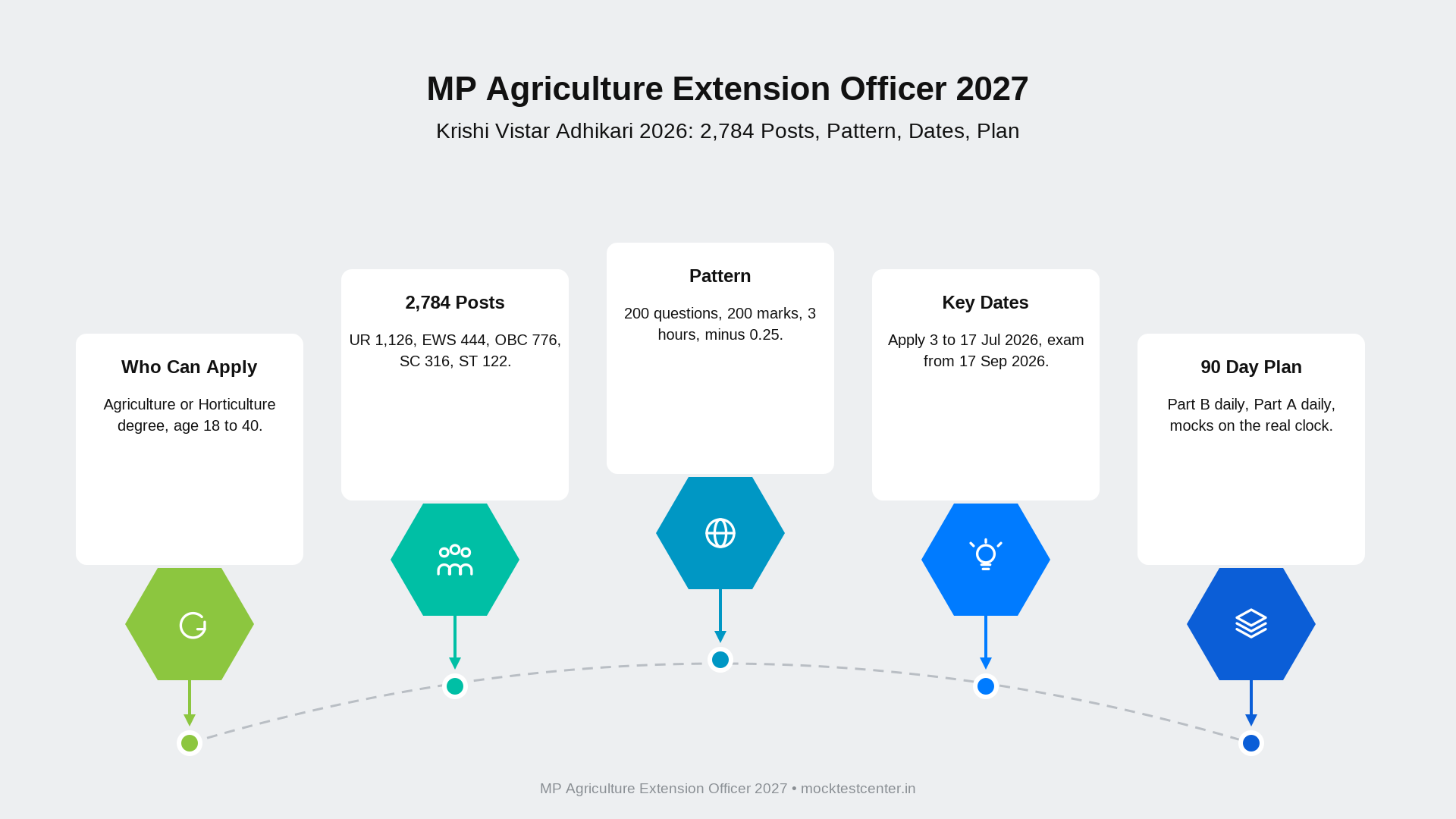
| Application window | 3 July to 17 July 2026, corrections to 22 July 2026 |
| Exam | First set for 2 August 2026, held 17 September 2026, with some trackers recording 17 and 18 September |
| Admit card | 10 September 2026 |
| Answer key | Provisional key 21 September 2026, objections 21 to 24 September 2026 |
| Result | Not declared as of 23 November 2026 |
| Pattern | One computer based paper, 200 questions, 200 marks, 3 hours, negative marking 0.25 per wrong answer |
| Qualification | Bachelor degree in Agriculture or Horticulture, completed before applying |
| Age | 18 to 40 years as on 1 January 2026, upper limit 45 for eligible Madhya Pradesh categories |
| Fee | Rs 500 unreserved, Rs 250 for MP domicile SC, ST, OBC, EWS and PwD candidates |
| Pay | Rs 25,300 to Rs 80,500, with a stipend during the three year probation |
| Selection | Written test, then document verification by the department, no interview |
| Official website | esb.mp.gov.in |
2,784 posts, and the 2,377 figure that appeared later
The notification figure is 2,784 posts. The split is Unreserved 1,126, EWS 444, OBC 776, SC 316 and ST 122, and the five numbers add to 2,784 exactly. The Free Press Journal reported the same total on the day the notification came out, and FreeJobAlert, PW Live, CareerPower, JagranJosh, SarkariExam and the answer key trackers all print the same split. That is as close to settled as a tracker sourced figure gets.
One tracker disagrees, and the disagreement is recent enough to matter. Testbook, in a page updated on 30 October 2026, reports a revised total of 2,377 vacancies, with EWS cut from 444 to 37 and every other category unchanged. The arithmetic checks out, 1,126 plus 37 plus 776 plus 316 plus 122 comes to 2,377, so the change is a single category revision rather than a typing slip. No other tracker carries the revised figure, and Testbook itself still describes the exam as held from 17 September onwards for the same recruitment. This guide keeps 2,784 as the notification figure and flags the 2,377 revision as a single source claim that the upload pre-check should settle against the board website before the next cycle is advertised.
The horizontal reservation inside the 2,784 is worth knowing because it decides who actually gets called. Women hold 35 percent of the posts horizontally, ex-servicemen hold 10 percent, and 168 posts are reserved for Divyangjan candidates, 42 each for visual, hearing, locomotor and multiple disability categories. The category table FreeJobAlert prints from the rulebook shows the split in full. Unreserved has 528 open posts, 260 for women, 76 for ex-servicemen in the open list, 38 for ex-servicemen women, 150 for contract employees in the open list and 74 for contract employee women, which adds to 1,126. EWS has 208 open, 102 women, 30 ex-servicemen open, 14 ex-servicemen women, 60 contract open and 30 contract women, which adds to 444.
SC has 148 open, 74 women, 22 ex-servicemen open, 10 ex-servicemen women, 42 contract open and 20 contract women, which adds to 316. ST has 58 open, 28 women, 8 ex-servicemen open, 4 ex-servicemen women, 16 contract open and 8 contract women, which adds to 122. OBC has 364 open, 180 women, 50 ex-servicemen open, 26 ex-servicemen women, 104 contract open and 52 contract women, which adds to 776.
Contract employees get a visible share of every category, and the rulebook gives them age relaxation up to 55 years under the applicable rules. A candidate claiming the contract quota needs a certificate showing at least five years of continuous samvida service. Bonus marks certificates, such as the NCC C certificate, are also collected with the form, and the rulebook treats them as part of the application record.
The size of this recruitment is what makes it different from the usual MPESB graduate tests. Group 2 Sub Group 3, for comparison, advertised 339 graduate posts in 2025. The Agriculture Extension Officer test advertised more than eight times that number in a single post, which is why agriculture graduates across the state treated July 2026 as a once in several years opening. The 2,784 posts also explain the two shift pattern and the 11 exam cities, because no single shift in a handful of centres could seat that many candidates.
Who can apply: an agriculture or horticulture degree, and nothing else counts
The educational qualification is narrow, and that narrowness is the whole point of the post. A candidate needs a Bachelor degree in Agriculture or a Bachelor degree in Horticulture from a recognised university. No other graduation qualifies, not even a science degree with agriculture as one subject, and not even a diploma in agriculture. The rulebook, as quoted by FreeJobAlert, Testbook, PW Live and CareerPower, names only those two degrees.
The degree must be fully complete on or before the date of submitting the online application. Final year students and result awaited candidates are not eligible, and the form asks for the marksheet number, the marks obtained and the maximum marks of the qualifying degree. A candidate who finished the degree after the application date cannot be considered, even if the result arrived before the exam.
Two conditions sit beside the degree and catch candidates who read only the qualification line. Live registration in an Employment Office of Madhya Pradesh is mandatory for every applicant, and Aadhaar registration is mandatory too, with Aadhaar biometrics unlocked at the time of verification at the exam centre. A candidate whose Aadhaar biometrics are locked is denied entry, and the rulebook is blunt about that.
The rulebook also carries two eligibility bars that surprise first time applicants. A candidate with more than two children, where one child was born on or after 26 January 2001, is not eligible for appointment. A candidate who married before the legal age, 18 years for women and 21 years for men, is not eligible either. These are standard Madhya Pradesh service rules, and they apply here because the post is a state government appointment.
Three groups of candidates face a special condition. Candidates from the Baiga, Sahariya and Bharia special primitive tribes do not get any exam exemption for this post, because it is an Executive post, and they must apply online and appear in the exam as ST candidates. Candidates who are not domiciles of Madhya Pradesh can apply only against Unreserved open posts, and they get no fee concession, no reservation and no age relaxation. Nepal citizens may be eligible subject to the certificate required under the MP Civil Services Recruitment Rules of 1961, and the candidate must be an Indian citizen in the ordinary case.
The documents collected with the form show how seriously the board takes identity. A recent colour photograph on a white background, not older than three months, with the candidate name and the date of the photograph printed on it and both ears clearly visible. A scanned signature, with short signatures, signatures in capital letters and multiple signatures all rejected. A handwriting sample of two lines in the candidate own handwriting in the prescribed format. Class 8, 10 or 12 marksheet as proof of date of birth. Caste or category certificate from the competent Madhya Pradesh authority where applicable, disability certificate where applicable, contract service certificate where applicable, and bonus mark certificates where applicable.
The age rule, 18 to 40 as on 1 January 2026
The age is calculated as on 1 January 2026. The minimum age is 18 years for every candidate, and the maximum age is 40 years for unreserved candidates. Madhya Pradesh domicile SC, ST and OBC candidates get relaxation up to 45 years. Women candidates of Madhya Pradesh, reserved and unreserved, get relaxation up to 45 years. Madhya Pradesh government, corporation and board employees, Home Guards and Divyangjan candidates also get relaxation up to 45 years. Contract samvida employees and Rule 14 priority categories can go up to 55 years under the applicable relaxation rules.
EWS candidates get no age relaxation, and the maximum stays at 40 years for them. That detail matters because EWS candidates do get the 10 percent relaxation in qualifying marks, down to 40 percent, so the two relaxations do not travel together. A candidate who assumes EWS status helps on age as well will misjudge eligibility by five years.
The cut off date is one of the few facts on which the trackers agree completely. Testbook, PW Live, FreeJobAlert and CareerPower all print 1 January 2026, and none of them prints an alternative date. That agreement is worth noting because the Group 4 package in this same set had two competing cut off dates, 1 January 2024 against 1 January 2025, and the Agriculture Extension Officer cycle has no such split.
The fee, Rs 500 and Rs 250, and the correction charge that two trackers price differently
The application fee is Rs 500 for unreserved candidates and Rs 250 for SC, ST, OBC, EWS and Divyangjan candidates who are domiciles of Madhya Pradesh. Direct recruitment backlog posts carry no fee. The fee is paid online through credit card, debit card, net banking or at an authorised MP Online kiosk, and the portal charge sits on top of the fee.
The portal charge is Rs 60 if the form is filled through a kiosk and Rs 20 if it is filled through a registered citizen user login. Those two numbers are agreed by Testbook and FreeJobAlert, and they match the standard MP Online charges seen in other MPESB cycles in this set.
The correction fee is where the trackers part company. Testbook prints a correction fee of Rs 60. FreeJobAlert prints Rs 20 per correction plus a portal fee of Rs 40 for each correction made during the correction window. The two figures describe the same window, 3 July to 22 July 2026, and they cannot both be the full charge. This guide records both and flags the conflict for the upload pre-check, because a candidate reading either page alone would pay the wrong amount in mind and budget wrongly.
The objection fee is separate from the correction fee and is agreed by the trackers that mention it. Objections against questions can be filed online within three days of the objection link going live, at Rs 150 per question. There is no provision for re-evaluation or re-totalling after the result is declared, so the objection window is the only route for challenging a question or an answer.
The pattern, 200 questions in 3 hours, with a quarter mark gone for a wrong answer
The written test is a single computer based paper of 200 objective questions for 200 marks, to be solved in 3 hours. Part A carries 100 marks and Part B carries 100 marks. Each correct answer earns 1 mark. Each wrong answer loses 0.25 marks, as per clause 3.8 of the official rulebook quoted by FreeJobAlert and confirmed by the Testbook syllabus page. The questions are objective type with four options each, in Hindi and English medium.
The negative marking is the single most important strategic fact in this paper. A candidate who attempts all 200 questions blindly loses a quarter mark on every wrong one, and with 200 questions on the paper the penalty adds up fast. The qualifying marks make the penalty sharper still. Unreserved candidates need 50 percent, and SC, ST, OBC, EWS and Divyangjan candidates need 40 percent after the 10 percent relaxation. A candidate sitting near the qualifying line cannot afford careless guesses in the second half of the paper.
One tracker disagrees on the pattern, and it disagrees on almost every element at once. SarkariPrep prints a 2 hour duration, 100 questions, 100 marks, offline mode and a subject table that belongs to a different MPESB test. Every other tracker, FreeJobAlert, Testbook, PW Live, CareerPower, Adda247 and the answer key pages, prints 3 hours, 200 questions, 200 marks and computer based mode, with shift timings of 9 AM to 12 PM and 2.30 PM to 5.30 PM. This guide follows the majority and flags the SarkariPrep page as an outlier that appears to carry an older or different exam pattern.
The two shifts are fixed in the rulebook. The first shift reports between 7 AM and 8 AM, reads instructions from 8.50 AM to 9 AM and answers from 9 AM to 12 PM. The second shift reports between 12.30 PM and 1.30 PM, reads instructions from 2.20 PM to 2.30 PM and answers from 2.30 PM to 5.30 PM.
Candidates arriving after the reporting time are not allowed to enter the exam centre, and candidates cannot leave the hall before the exam ends.
After the exam, candidates must confirm the raw score, the number of correct answers, displayed on the computer screen before submitting. That on screen confirmation is part of the board process, and it is the candidate last chance to check the count before the paper closes.
Part A, seven general subjects for 100 marks
Part A covers general subjects for 100 marks. The seven subjects are General Knowledge, General Hindi, General English, General Mathematics, General Logical Ability, General Science and General Computer Knowledge. The rulebook gives the subjects and the total for the part, and none of the trackers prints a per subject mark split for Part A. That absence is itself a fact worth stating, because several tracker pages for other MPESB tests do print subject marks, and a candidate who finds a Part A split for this test on some page is reading a number the rulebook trackers do not support.
General Knowledge in this paper leans on current affairs of national and international level, Indian history, geography, polity, economy, literature, heritage, tourism, famous books and authors, inventions and discoveries, famous places, rivers, lakes and seas, and sports. Madhya Pradesh general knowledge sits inside the same subject, and it carries weight because the post is a state field post and the board tests knowledge of the state the officer will work in.
General Hindi covers word formation, sandhi and its division, samas, prefix and suffix, word types including tatsam, tadbhav, deshaj and foreign words, noun, pronoun, adjective, verb and indeclinable, synonyms, antonyms, word pair meaning differences, one word substitution, similar sounding words with different meanings, correct word choice, related vocabulary, word purity, grammatical categories including case, gender, number, person, tense, mood, aspect and voice, sentence formation, sentence correction, punctuation, idioms and proverbs, and administrative and general technical vocabulary.
General English covers articles and determiners, tenses and sequence of tenses, active and passive voice, direct and indirect narration, prepositions, synonyms and antonyms, comprehension of a passage, idioms and phrases, and letter writing in official, demi official, circular and notice forms. The English in this paper is functional rather than literary, and it tests whether a candidate can read an official passage and write an official letter.
General Mathematics covers arithmetic, percentage, profit and loss, ratio and proportion, average, time and work, and the number system. General Logical Ability covers logical reasoning, analytical ability, coding and decoding, series, analogy, blood relations, direction sense and puzzles. General Science covers physics, chemistry, biology and everyday science. General Computer Knowledge covers computer fundamentals, MS Office, internet, operating systems and computer applications.
Part A is half the paper, and it is the half that decides the merit order between two agriculture graduates with similar subject knowledge. An agriculture graduate who treats Part A as a formality loses the paper in the general section, because 100 marks is too large a block to recover from Part B alone. The preparation section later in this guide gives Part A a full half of the study week for that reason.
Part B, ten agriculture units for 100 marks
Part B is the subject paper, 100 marks of Agriculture and Horticulture, divided into ten units. The units are General Agriculture, Agronomy, Soil Science, Soil and Water Conservation, Plant Physiology, Crop Improvement, Horticulture, Plant Protection, Agricultural Economics and Agricultural Extension Education. The rulebook lists the units and their topics, and the trackers that quote it agree on all ten.
General Agriculture covers agriculture and its importance in the national economy. Agronomy covers the major crops of Madhya Pradesh, agro techniques of major field crops, farming systems and sustainable agriculture, introductory agro meteorology, and agro climatic and agro ecological zones. Soil Science covers soil composition and its role in crop production, physical, chemical and biological properties of soil, essential plant nutrients with their functions and dynamics, integrated nutrient management, and problem soils and their management. Soil and Water Conservation covers watershed management.
Plant Physiology covers absorption, translocation and metabolism of nutrients, photosynthesis and respiration, growth and development, and growth regulators. Crop Improvement covers elements of genetics and plant breeding as applied to crop improvement. Horticulture covers the package of practices for important fruits, vegetables, spices and flowering plants, nursery management and propagation methods, physiological disorders and their management, and post harvest management and value addition.
Plant Protection covers important insect pests and diseases and their management, integrated pest and disease management, spray equipment selection and maintenance, rodent management, and pesticide safety precautions. Agricultural Economics covers principles of economics applied to agriculture, farm planning and resource management, farming systems, marketing of agricultural produce and regulated markets in Madhya Pradesh including e-Choupal, and pricing of agricultural produce. Agricultural Extension Education covers the philosophy, objectives and principles of extension, extension organisations at state, district and block levels, communication methods, the role of farmers organisations, the role and importance of training, and important rural development programmes in India.
Two units deserve a second look because they connect directly to the job. Agricultural Extension Education covers the daily work of the post, and the board tests it as a full unit rather than a footnote. Agricultural Economics includes e-Choupal and regulated markets in Madhya Pradesh by name, which means the paper tests the marketing system the officer will actually use in the field, not economics in the abstract.
The degree syllabus and the Part B syllabus overlap heavily, and that overlap is a gift to a candidate who studied the degree properly. A BSc Agriculture graduate has already covered agronomy, soil science, plant physiology, crop improvement, horticulture, plant protection and agricultural economics across four years. The preparation task is revision and exam practice, not fresh learning, and the 90 day plan below is built on that fact.
Qualifying marks, normalisation and the waiting list
The qualifying marks are 50 percent for unreserved candidates and 40 percent for SC, ST, OBC, EWS and Divyangjan candidates. The 40 percent figure already includes the 10 percent relaxation, and EWS candidates get the relaxation in qualifying marks even though they get no age relaxation. A candidate who scores below the qualifying mark for the category cannot enter the merit list, however many posts are vacant.
Because the exam runs in two shifts, the board normalises the scores. The technique named in the rulebook is the Normalised Equi-Percentile scaling technique, usually shortened to NEP. Two shifts of the same paper are never exactly equal in difficulty, and normalisation is how the board compares a candidate from the morning shift with a candidate from the afternoon shift on one scale. A raw score of 120 in a hard shift can rank above a raw score of 125 in an easy shift after normalisation, and candidates who compare raw scores across shifts are comparing the wrong numbers.
The merit list is prepared post wise, and a waiting list of 15 percent of the total posts remains valid for one year or until the next exam result, whichever comes earlier. Fifteen percent of 2,784 is about 418 candidates, so the waiting list is large enough to matter. A candidate ranked just below the last selected name still has a real chance of appointment within the year.
Appointment orders are to be issued within a maximum of three months from the date of the selection list, according to the rulebook summary. Document verification is done by the Farmer Welfare and Agriculture Development Department, not by the board, and the board role ends with the merit list. Eligibility in the online exam is purely provisional, and certificates are verified by the department during the appointment process. Any wrong information or impersonation leads to cancellation of candidature, and impersonation cases also invite an FIR and legal action.
Exam dates that moved twice, admit card and answer key
The timeline of this cycle is a lesson in reading notices twice. The rulebook came out on 2 July 2026. Applications ran from 3 July to 17 July 2026, with corrections open to 22 July 2026. The exam was first set for 2 August 2026, a Sunday, and the Free Press Journal, PW Live and the early tracker pages all print that date.
The exam did not happen on 2 August. CareerPower records that the exam was earlier scheduled to start on 5 August 2026, which conflicts with the 2 August date in the other trackers and is itself a sign of how many revisions the schedule went through. Adda247 records a revised date from 15 September 2026.
The exam was finally held from 17 September 2026, and CareerPower and the answer key tracker moschool record the exam on 17 and 18 September 2026, while FreeJobAlert, iSathi, JagranJosh and SarkariExam record 17 September 2026 alone. This guide states the exam as held from 17 September 2026, with 17 and 18 September recorded by two trackers, and flags the one day against two day difference for the upload pre-check.
The admit card came out on 10 September 2026, a week before the exam, and candidates downloaded it from esb.mp.gov.in using the application number and date of birth. The provisional answer key and the response sheet came out on 21 September 2026, and objections were open from 21 to 24 September 2026 through the objection tracker on the board website. The result had not been declared as of 23 November 2026, when the trackers still showed the result status as notified soon.
Candidates who appeared should check the board website for the result rather than any tracker date, because no tracker prints a result date.
The helpdesk numbers printed with the notification are the MP Online helpdesk at 0755-6720200 and the MPESB toll free number 18002337899. Those numbers belong to the application stage, and the board website carries the later stage links, including the objection tracker that delivered the answer key.
Exam cities, 11 across the state, four choices on the form
Applicants must select four exam city preferences while filling the online form. Exam centres are allotted randomly, subject to seat availability, and the board decision on centre allotment is final. The written exam is proposed to be held in 11 cities: Bhopal, Indore, Jabalpur, Khandwa, Neemuch, Ratlam, Rewa, Sagar, Satna, Sidhi and Ujjain.
The four preference system matters because the centre is not chosen by the candidate, only ranked. A candidate who lists four cities in one corner of the state and gets none of them has no appeal, because the allotment is random within availability. The sensible approach is to list the nearest city first and then the next nearest workable cities, rather than listing four distant cities in the hope of a preferred centre.
The 11 city list is shorter than the 13 city list used for the Group 4 test in this same set, which also included Balaghat and Gwalior. The difference comes from the two rulebooks. FreeJobAlert prints the 11 cities from the AEO rulebook and the Group 4 trackers print 13 cities from their own rulebook. A candidate who prepared for the Group 4 centres should not carry that list into this exam.
On the exam day the candidate carries the admit card, called the Test Admit Card or TAC, downloaded from esb.mp.gov.in, with Part 2 entries duly filled, plus an original photo ID, Voter ID, PAN Card, Aadhaar Card, Driving Licence or Passport. An e-Aadhaar printout is valid only if verified by UIDAI. A black ballpoint pen is also carried. Mobile phones, calculators, log tables, digital watches, sunglasses, whitener and all electronic devices are strictly prohibited inside the exam hall, and violations are treated as Unfair Means cases.
How selection works, and what document verification checks
Selection has two stages and no more. The first stage is the online written exam of 200 marks. The second stage is document verification by the department. There is no interview and no physical test for this post, and any tracker page that lists an interview for the Agriculture Extension Officer is carrying a line from a different recruitment. Testbook lists the stages as the written exam, the minimum qualifying marks, the merit and waiting list, document verification and final appointment with probation, which is the same two stage shape with the administrative steps spelled out.
Document verification checks the degree, the marksheet numbers entered in the form, the date of birth proof, the caste or category certificate, the disability certificate where claimed, the contract service certificate where claimed, the live employment registration, the Aadhaar record and the photograph and signature record. The department verifies the certificates, not the board, and a mismatch between the form and the certificate at this stage ends the candidature even after a merit list rank.
Travel expense reimbursement for eligible Madhya Pradesh domicile SC, ST, OBC and PwD candidates is paid by the department through e-payment, and the candidate submits bank details in Proforma 1 with the required enclosures. That is a small detail, but it shows the department, not the board, handles the candidate after the exam.
Pay, Rs 25,300 to Rs 80,500, and the probation stipend
Selected candidates are appointed in the pay scale of Rs 25,300 to Rs 80,500 as a Class III post. One tracker, Careers360, prints Rs 23,500 to Rs 80,500, and that lower figure is flagged here as a single source error, because FreeJobAlert, Testbook, PW Live, CareerPower and JagranJosh all print Rs 25,300 as the minimum.
The probation period changes what actually lands in the bank. Under the Madhya Pradesh General Administration Department circular dated 12 December 2019, a stipend is paid during probation instead of the full pay scale. The first year pays 70 percent of the minimum of the pay scale, approximately Rs 17,710 per month. The second year pays 80 percent, approximately Rs 20,240 per month. The third year pays 90 percent, approximately Rs 22,770 per month. After successful completion of the probation period, the regular pay in the scale of Rs 25,300 to Rs 80,500, along with admissible allowances, is paid.
The three year probation is long by the standards of clerical posts, and a candidate who budgets on the full scale from month one will be disappointed for three years. The stipend is still a secure government income, and it rises every year by design, but the honest figure for year one is Rs 17,710, not Rs 25,300.
What an Agriculture Extension Officer actually does all day
The post sits in the Directorate of Farmer Welfare and Agriculture Development, and the officer works at the block level with farmers, not behind a desk in Bhopal. The core work is extension, which means carrying new farming practice from the research station to the field and carrying the farmer problem back to the research station. That two way movement is the whole job, and it is why Agricultural Extension Education is a full unit in Part B.
A week in the post includes village visits, demonstrations of new seed varieties and crop practices, soil health card work, advice on fertiliser and pesticide use, pest and disease identification in standing crops, horticulture guidance for fruit and vegetable growers, and record keeping on sowing, irrigation and harvest in the block. The officer also implements government agricultural schemes, explains subsidy and insurance provisions to farmers, and helps organise training programmes and field days. The e-Choupal and regulated market system in the syllabus is part of the same work, because the officer is often the person a farmer asks first about where to sell and at what price.
The job needs the degree for a practical reason. A farmer who asks why leaves are yellowing in a wheat field needs an answer that separates nutrient deficiency from disease from water stress, and a wrong answer costs a season. The Part B units map onto those questions directly, which is why the board tests soil science, plant physiology, plant protection and agronomy rather than general agriculture alone.
The posting is rural by definition, and a candidate who wants a city posting should not apply. The officer lives in the block, travels to villages daily, and works through the sowing and harvest seasons when the workload peaks. The trade is security and a clear pay scale against rural living and field travel, and candidates should make that trade with open eyes before the exam rather than after the appointment letter.
The OBC reservation case that split the vacancy table in two
The vacancy table carries a legal footnote that a candidate should understand before reading the OBC number. The 27 percent OBC reservation matter is sub judice in the High Court, and the rulebook therefore publishes a main table of 2,410 posts with OBC at 14 percent and a provisional table of 374 posts. The two tables together come to 2,784 posts.
The split matters for the OBC candidate most of all. The main table gives OBC 14 percent, and the provisional table holds the remaining OBC posts until the court decides. A candidate who reads only the headline OBC figure of 776 should know that part of it sits in the provisional table, and the final OBC count follows the court outcome. The UR, EWS, SC and ST figures are not affected by the case in the same way.
This is not the only MPESB recruitment with a court linked vacancy table, and it is not a reason to skip the exam. It is a reason to read the rulebook table rather than the headline number, and to keep watching the board website for the court related notice that will settle the provisional 374 posts.
How this post sits beside Patwari, Group 4 and MPPSC
Three comparisons help a candidate place this exam in the Madhya Pradesh map. The first is Patwari, the Group 2 Sub Group 4 combined test, which advertised 2,306 posts in total, 200 Patwari posts plus 2,106 other posts. Patwari is a revenue post with a general paper and a different field role, and it takes graduates of any subject. The Agriculture Extension Officer test takes only agriculture and horticulture graduates, and its paper is half subject specific. A candidate with an agriculture degree can apply for both, but the preparation overlaps only in Part A.
The second comparison is Group 4, the Class 12 level clerical test with 966 posts, 100 questions and no negative marking. Group 4 is a desk job test with a general paper only. The Agriculture Extension Officer test is a graduate level technical test with 200 questions, a subject paper and a quarter mark penalty. The two tests share the board, the fee structure and the MP Online portal, and almost nothing else.
The third comparison is MPPSC, the State Service Exam for officer posts, which is a different service altogether, with prelims, mains and interview. An agriculture graduate aiming for the agriculture department should treat the Extension Officer post as the direct route and MPPSC as the longer route, because the Extension Officer test needs no interview and the selection is decided by one paper.
The practical point is that the Agriculture Extension Officer paper rewards the degree. A candidate who spent four years on agronomy, soil science and plant protection starts this paper ahead of any generalist, and the 100 marks of Part B are where that advantage is cashed in. The generalist who tries this paper without the degree cannot even apply, which makes the competition narrower than the 2,784 posts suggest.
Subject by subject preparation
General Knowledge needs a daily habit rather than a book finished in a week. Read Madhya Pradesh current affairs alongside national current affairs, because the board tests the state the officer will serve. Keep a notebook for MP facts, the major crops by district, the irrigation projects, the agriculture schemes and the regulated markets, and revise it weekly. History, geography, polity and economy need the standard notes, and sports, books, authors, inventions and famous places need short lists revised often.
General Hindi needs grammar practice more than reading. Sandhi, samas, prefix and suffix, synonyms, antonyms, one word substitution and sentence correction are all rule based, and a candidate who practises 20 questions a day for a month will see the score move. Administrative vocabulary deserves a separate list, because the paper tests the words an officer will actually write in office notes.
General English needs the same treatment. Articles, tenses, active and passive voice, direct and indirect narration, prepositions, synonyms and antonyms, and a weekly comprehension passage will cover the section. Letter writing needs practice in the official, demi official, circular and notice forms, because a candidate who has never written one will lose easy marks on format alone.
General Mathematics is arithmetic at school level, and speed is the skill. Percentage, profit and loss, ratio and proportion, average, time and work and the number system are all solved by method, not by memory, so timed practice matters more than theory. A candidate who solves 30 questions a day with a timer will finish this section inside the paper time.
General Logical Ability is the section where practice beats study. Coding and decoding, series, analogy, blood relations, direction sense and puzzles all improve with volume, and the questions are short enough to practise in small batches through the day. General Science needs the standard physics, chemistry and biology notes plus everyday science, and General Computer Knowledge needs fundamentals, MS Office, internet, operating systems and applications, all of which a graduate who has used a computer daily already knows in part.
Part B preparation starts from the degree notes, not from a new book. Agronomy, soil science, plant physiology, crop improvement, horticulture, plant protection, agricultural economics and extension education are all degree subjects, and the graduate notes are the best source. The revision task is to turn four years of notes into exam answers, which means short notes per unit, diagrams for soil and plant processes, and lists for pests, diseases, varieties and nutrient functions. The Madhya Pradesh specific facts need a separate pass, because the paper names MP crops, MP agro climatic zones and MP regulated markets, and a national level note will miss those questions.
A 90 day plan that fits the real paper
Days 1 to 30 belong to Part B revision. Cover one unit every three days, starting with agronomy, soil science and plant protection, because those three units carry the most questions in a typical agriculture paper. Write short notes as you go, and end each unit with 50 practice questions. Keep one hour a day for Part A, rotating General Knowledge, Hindi and Mathematics, so the general half does not go cold while the subject half is revised.
Days 31 to 60 belong to balance. Give Part B two hours a day and Part A two hours a day, and add a full mock test every Sunday on the real clock, 200 questions in 3 hours, with the 0.25 penalty applied in scoring. Score the mock strictly, and spend Monday fixing the weakest subject rather than starting a new chapter. By day 60 the candidate should know the exact score in each of the seven Part A subjects and each of the ten Part B units, and the remaining month should be spent on the weakest three.
Days 61 to 90 belong to mocks and revision. Take two mocks a week, then three in the final fortnight, and revise only from short notes and the mock error log in the last ten days. Do not start a new book in the last fortnight. Do not start a new unit in the last week. The final three days are for the short notes, the MP facts notebook and one light mock, so the candidate reaches the exam hall fresh rather than exhausted.
Mock tests deserve a word of their own, because the penalty changes how a mock should be taken. A mock without the 0.25 deduction teaches the wrong lesson, and a mock taken in pieces teaches the wrong stamina. Take every mock in one sitting of 3 hours, apply the penalty, and record the score separately for Part A and Part B. A candidate whose Part B score is strong and whose Part A score is weak should move study hours to Part A, because the paper is won in the half the candidate neglects.
Five mistakes that cost AEO candidates marks
The first mistake is applying with an incomplete degree. Final year students cannot apply, and the form asks for the marksheet number and marks, so a candidate who applies on hope will be rejected at verification after clearing the exam. Check the degree completion date before the form, not after the result.
The second mistake is ignoring the employment registration. Live registration in a Madhya Pradesh Employment Office is mandatory, and a candidate who discovers this after the window closes has no way back. Register early, keep the registration live, and carry the proof to verification.
The third mistake is guessing blindly in a paper with a quarter mark penalty. The 2026 paper had 200 questions, and a candidate who guessed 40 questions at random lost about 7.5 marks net after the penalty, because roughly 30 of those guesses were wrong. Attempt the questions you know, mark the ones you can narrow to two options, and leave the pure guesses alone unless the qualifying line demands a risk.
The fourth mistake is preparing only Part B. The agriculture graduate loves the subject half and neglects the general half, and the result is a strong Part B score and a weak total. Part A is 100 marks, half the paper, and the merit list is decided on the total. Give Part A half the week from day one.
The fifth mistake is trusting a single tracker page for dates. This cycle moved its exam date twice, from 2 August to a September date, and different trackers printed different revised dates. Candidates who tracked only one page prepared for the wrong week. Check the board website, esb.mp.gov.in, for every date that matters, and treat tracker dates as leads until the board confirms them.
Sources
Free Press Journal: MPESB announces 2,784 vacancies for Agricultural Extension Officer posts, applications 3 to 17 July 2026, exam from 2 August 2026, fee Rs 500 and Rs 250
FreeJobAlert: MPESB Krishi Vistar Adhikari Recruitment 2026, 2,784 posts with full category and horizontal split, rulebook 2 July 2026, pattern 200 questions 200 marks 3 hours, negative marking 0.25 under clause 3.8, qualifying marks 50 percent and 40 percent, pay Rs 25,300 to Rs 80,500, probation stipend 70, 80 and 90 percent, 11 exam cities, OBC main table 2,410 plus provisional 374
Testbook: MP RAEO Recruitment 2026, revised total 2,377 with EWS 37, fee Rs 500 and Rs 250, correction fee Rs 60, age as on 1 January 2026, employment registration, syllabus Part A and Part B, qualifying marks 50 percent and 40 percent, exam from 17 September 2026, answer key 21 September 2026
PW Live: MP RAEO Application Form 2026, 2,784 posts, apply 3 to 17 July 2026, exam from 2 August 2026, degree in Agriculture or Horticulture, age 18 to 40 as on 1 January 2026, pay Rs 25,300 to Rs 80,500
CareerPower: MP RAEO Exam Date 2026, exam 17 and 18 September 2026, earlier scheduled from 5 August 2026, 2,784 posts, graduation in Agriculture or Horticulture, age 18 to 40, salary Rs 25,300 to Rs 80,500, selection by online exam and document verification
Adda247: MP RAEO Recruitment 2026, 2,784 posts, apply 3 to 17 July 2026, exam from 15 September 2026, Bachelor degree in Agriculture or equivalent, age 18 to 40, pattern 200 questions 200 marks 3 hours
JagranJosh: MPESB AEO Answer Key 2026, exam 17 September 2026, provisional key 21 September 2026, objections 21 to 24 September 2026, 2,784 vacancies
SarkariExam: MPESB Krishi Vistar Adhikari Answer Key 2026, exam 17 September 2026, admit card 10 September 2026, answer key 21 September 2026, 2,784 posts
Careers360: MPESB Krishi Vistar Adhikari Recruitment 2026, 2,784 posts, graduation in Agriculture and Horticulture, age 18 to 40, salary printed as Rs 23,500 to Rs 80,500, noted as a conflict
SarkariPrep: MP Gramin Krishi Vistar Adhikari Bharti 2026, 2 hour duration, 100 questions, offline mode, noted as an outlier against the majority pattern
moschool: MPESB AEO Answer Key 2026, exam 17 and 18 September 2026, answer key 21 September 2026, objections 21 to 24 September 2026, 2,784 vacancies







