
About Maharashtra Talathi 2027 Exam Series
📖 Table of Contents
- Maharashtra Talathi 2027 at a glance
- The 1,840 posts, and the corrigendum trail that built them
- Who can apply, and the conditions that catch people out
- The prelims paper, one hour that filters everything
- The mains papers, where 400 marks decide the merit
- The 2023 cycle, told as history
- What changed between 2023 and 2026
- Pay, posting and the job itself
- How to prepare, in the order that matters
- Mistakes that end attempts
- Where to check, and what this guide does not claim
- Sources
Maharashtra Talathi 2027: Complete Exam Guide
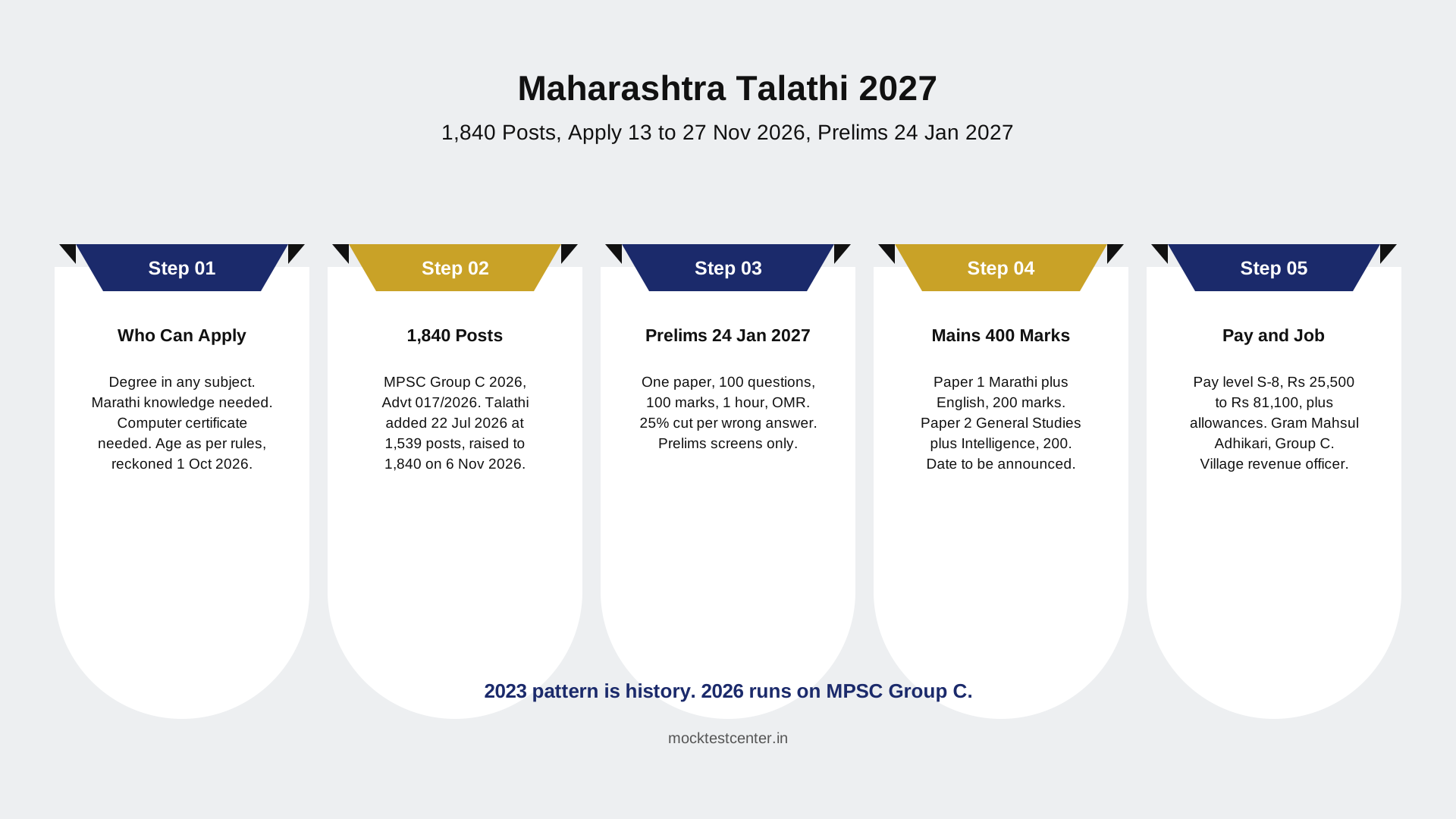
Maharashtra Talathi 2027 runs through the Maharashtra Public Service Commission, and the live cycle is the Maharashtra Group-C Services Combined Preliminary Examination 2026. The Commission published Advertisement Number 017/2026 on 25 June 2026, added the Talathi post to it on 22 July 2026 with 1,539 posts, and raised the Talathi count to 1,840 posts in a corrigendum dated 6 November 2026. Applications run from 13 to 27 November 2026. The preliminary examination is scheduled for 24 January 2027. No separate Talathi advertisement from the Revenue Department exists for 2026, and no separate 2027 notification has been published as of 22 November 2026, so this guide anchors on the MPSC Group C cycle and says so wherever a 2027 figure would otherwise be guessed.
That change of conductor matters more than any single date in this guide. In 2023 the Revenue Department ran its own Talathi recruitment with one online test of 200 marks and no negative marking. In 2026 the post sits inside the MPSC Group C combined examination, which has two stages, a prelims paper of 100 marks with negative marking of 25 percent, and a mains examination of 400 marks. A candidate who prepares from the 2023 pattern will practise the wrong paper. A candidate who trusts a tracker page that still shows the 2023 pattern, or the prelims dates that the Commission has already replaced twice, will turn up on the wrong day. This guide follows the corrigendum trail date by date so the reader can see which figures are current and which ones belong to history.
The post itself kept its old name in daily use and gained a new official name on paper. A Revenue and Forest Department resolution dated 14 October 2024 renamed the Talathi cadre Gram Mahsul Adhikari, which means village revenue officer. MPSC documents now write Gram Mahsul Adhikari (Talathi). The pay did not change with the name. The post stays in Group C on pay level S-8, Rs 25,500 to Rs 81,100, plus dearness allowance and other allowances. The work stays at the village level, where the Talathi keeps the village land record and collects land revenue, and that village level posting is the reason the post draws lakhs of applications in every cycle.
Maharashtra Talathi 2027 at a glance
| Detail | Maharashtra Talathi 2027, as run in the MPSC Group C 2026 cycle |
|---|---|
| Conducting body | Maharashtra Public Service Commission (MPSC) |
| Exam | Maharashtra Group-C Services Combined Preliminary Examination 2026, Advertisement Number 017/2026 dated 25 June 2026 |
| Post | Gram Mahsul Adhikari (Talathi), Group C, Revenue and Forest Department |
| Posts in live cycle | 1,840 Talathi posts, inside a combined examination of 16,717 posts across 27 cadres |
| Applications | 13 to 27 November 2026, from 2 pm on 13 November to 11.59 pm on 27 November, fee by 30 November 2026 |
| Prelims | 24 January 2027, one paper, 100 questions, 100 marks, 1 hour, OMR sheets, 37 district centres |
| Mains | Date to be announced separately, two papers, 400 marks in all |
| Negative marking | 25 percent of a question marks deducted for each wrong answer in the prelims |
| Education | Degree in any discipline from a statutory university, Marathi knowledge, computer certificate |
| Age limit | As per the recruitment rules, age reckoning date 1 October 2026 for the November window |
| Fee for prelims | Rs 394 for open category, Rs 294 for backward classes, EWS and orphans, Rs 44 for ex-servicemen |
| Pay | Pay level S-8, Rs 25,500 to Rs 81,100, plus allowances |
| 2027 notification | Not published as of 22 November 2026 |
The 1,840 posts, and the corrigendum trail that built them
The Talathi count in the live cycle changed three times in five months, and each change came through a separate MPSC document. The original advertisement of 25 June 2026 covered only 2,619 posts in five cadres, and Talathi was absent from it. The five cadres were Industry Inspector, Technical Assistant, Tax Assistant, Assistant Motor Vehicle Inspector and Clerk-Typist. A candidate who read only that first advertisement would have found no Talathi post at all.
A corrigendum dated 16 July 2026 changed the shape of the examination before Talathi joined it. The prelims moved from computer based testing to offline OMR sheets. The prelims date moved from 27 September to 25 October 2026. The mains examination was set for 27 December 2026. That mains date later fell away when the prelims moved again, and it should be treated as dead. The 6 November 2026 corrigendum says the Commission will announce the mains date separately.
The Talathi post entered the examination through a corrigendum dated 22 July 2026. It added 1,539 posts of Gram Mahsul Adhikari (Talathi), Group C, under various appointing authorities in the Revenue and Forest Department. With other new cadres added the same day, 3,088 posts joined the examination and the total rose to 5,707. The post had arrived, but the count was still far from final.
On 1 August 2026 the Commission announced that there is no separate Talathi examination. All cadres share one combined prelims paper, and most cadres, including Talathi, Clerk-Typist and Tax Assistant, will share one combined mains examination. Candidates who had already applied would be considered for every cadre their stated qualification makes them eligible for, without applying again. That announcement ended the idea of a Talathi only paper. From that day the Talathi candidate and the Clerk-Typist candidate sat the same prelims paper.
A corrigendum dated 5 August 2026 extended the last date to apply to 10 August 2026 and the online fee deadline to 13 August 2026. It fixed 10 August 2026 as the age reckoning date for the Talathi post at that time. It also set out the rules for Talathi posts in PESA scheduled areas, which this guide covers in the eligibility section.
On 9 September 2026 the Commission moved the prelims again, from 25 October 2026 to 3 January 2027, citing the availability of examination sub-centres in districts, the State Services mains examination, the festival season, other recruiting bodies examinations and the winter session of the legislature. The prelims would be held at all district centres, with centres, admit cards and timings to be posted on the Commission website later.
The largest change came on 6 November 2026. A corrigendum raised the total of the examination from 5,707 posts to 16,717 posts, an addition of 11,010 posts, and raised the Talathi count from 1,539 to 1,840. It reopened applications from 2 pm on 13 November to 11.59 pm on 27 November 2026, with the fee payable by 30 November 2026, and moved the prelims from 3 January to 24 January 2027. A second corrigendum the same day added 21 new cadres to the examination scheme. A further corrigendum on 20 November 2026 renamed the Assistant Agriculture Officer cadre Krushi Sevak, Group C, and left the application window and the examination date unchanged.
The Talathi share of the combined examination is now 1,840 of 16,717 posts. Clerk-Typist carries 3,966 posts and Staff Nurse carries 3,911 posts, so Talathi ranks third among the cadres by size. The reservation wise split of the posts appears in Appendix 1 of the 6 November corrigendum. The district wise split of the Talathi posts has not been published yet, and MPSC says it will issue it by corrigendum before the prelims result. The advertisement itself says post numbers can change according to the requisitions of the government, so 1,840 should be read as the current figure rather than a promise.
Two stale figures still circulate on tracker sites and both deserve a clear warning. Some pages still show the prelims on 25 October 2026 or on 3 January 2027. Both dates were replaced, first by the 9 September corrigendum and then by the 6 November corrigendum, and the current date is 24 January 2027. Some pages show post counts of 2,019 or figures above 4,644 for the 2026 cycle. The official figure is 1,840 under the 6 November corrigendum, with 1,539 before it. The 4,644 figure belongs to the 2023 cycle and has no place in the 2026 count.
Who can apply, and the conditions that catch people out
The education rule is short. A candidate needs a degree in any discipline from a statutory university. The 22 July 2026 corrigendum states the rule in those words, and there is no restriction on the subject of the degree. Final year candidates can sit the prelims, but they must have passed their degree by the last date of applying for the mains examination. A candidate who clears the prelims in the final year and then fails the degree loses the attempt at the mains stage, so the final year route carries a real risk.
Two further conditions sit beside the degree and both are easy to miss. The candidate must know Marathi, and the candidate must hold a computer handling certificate as prescribed by the Information Technology Department resolution of 4 February 2013 and later orders. Many candidates call this the MS-CIT requirement, and the resolution lists which certificates count. The certificate is needed for appointment, and a candidate who leaves it to the last week may find the course takes longer than the time left. The smart move is to hold the certificate before the mains examination rather than after the result.
The age rule for Talathi is stated differently from the age rules of most examinations, and the difference matters. MPSC documents say the limit for the Talathi post applies as per the recruitment rules, and they do not print separate Talathi figures. The 5 August 2026 corrigendum fixed 10 August 2026 as the age reckoning date for the applications of that window. Appendix 4 of the 6 November 2026 corrigendum gives 1 October 2026 as the age reckoning date for Talathi for the applications in the 13 to 27 November window. The one year relaxation of the upper age limit under the General Administration Department resolution of 5 November 2026 applies to this examination.
For the other graduate level cadres in the same advertisement, the upper limit is 38 years for open category candidates and 43 years for backward classes, orphans and economically weaker sections. Those figures come from the same advertisement and they give a fair guide to the range, but they are not the Talathi figure. A candidate near the upper edge should run the eligibility check inside the mpsconline account, which applies the Talathi rule directly, rather than trust a tracker page that prints 38 or 43 as the Talathi limit. The 2023 cycle used 19 to 38 years for open category candidates and 19 to 43 years for backward classes, and those 2023 figures are the ones most tracker pages still repeat.
The PESA rule is separate and it decides a small set of posts on its own terms. Talathi posts in PESA scheduled areas will be filled from local Scheduled Tribe candidates. Posts are currently available for the PESA area of Chandrapur district. A candidate can claim one if the candidate, the spouse, the parents or the grandparents have lived continuously in that district scheduled area since 26 January 1950, backed by a residence certificate from the Integrated Tribal Development Project office. The 5 August 2026 corrigendum says the PESA residence certificate, and the certificate issued through the district soldiers welfare office for ex-servicemen disabled in service or families of deceased or disabled ex-servicemen, must be dated before 25 October 2026. The 9 September 2026 corrigendum does not say whether that date moved with the examination, so a candidate who claims under either certificate should confirm the position with MPSC before the window closes.
Indian citizenship is required, and the application runs only on mpsconline.gov.in. MPSC has only two official sites, mpsc.gov.in for advertisements and notices and mpsconline.gov.in for applications and admit cards, and government resolutions sit at gr.maharashtra.gov.in. A link that asks a candidate to apply or pay on any other site is not official. In 2023 a bogus Talathi recruitment advertisement went viral on WhatsApp, and a senior official said the government had issued no such advertisement. The same warning applies in 2026, and it applies twice over because the examination now runs through MPSC rather than the Revenue Department.
The fee for the prelims is Rs 394 for open category candidates, Rs 294 for backward classes, EWS and orphans, and Rs 44 for ex-servicemen. The fee for the mains examination is Rs 544, Rs 344 and Rs 44 for the same groups. Bank charges and taxes sit on top of those figures. Fees are paid only online through mpsconline, by debit or credit card, net banking or UPI, and the challan option was withdrawn for this examination. Candidates who applied by 10 August 2026 do not apply again. Those candidates log in between 13 and 27 November, open Advertisement 017/2026 under My Account, click Recheck Eligibility, choose the cadres and submit, with no extra fee. Options cannot be changed later, so the choice of cadres deserves a careful read before submission.
The prelims paper, one hour that filters everything
The Maharashtra Talathi 2027 prelims is a single General Ability Test paper with 100 questions for 100 marks in 1 hour. The Talathi exam pattern for 2026 differs from the 2023 pattern in time, marking and stages. The standard is degree level. The paper is objective multiple choice, in Marathi and English, and in this cycle it runs on OMR sheets at 37 district centres. The prelims only screens candidates for the mains examination, and its marks do not count in the final selection. Keep that fact in mind when planning study hours, because a prelims topper and a candidate who clears the cut off by one mark start the mains on equal footing.
The marking rule is the sharpest change from 2023. A quarter, 25 percent, of a question marks is deducted for each wrong answer. Marking more than one option counts as wrong. Unanswered questions carry no penalty. The 2023 examination had no negative marking at all, so candidates who practised on 2023 papers learned to attempt every question. That habit now costs marks. In a 100 question paper with 25 percent negative marking, four wrong answers erase one correct answer, and a candidate who guesses across twenty questions can lose five marks to the penalty alone.
Speed is the second pressure in the paper. One hundred questions in 60 minutes allows 36 seconds per question on average. That is less than half the time the 2023 paper allowed, since the 2023 paper gave 100 questions in 2 hours. A candidate who spends two minutes on a single hard question has already borrowed time from three other questions. The mock test habit that pays off fastest is the habit of answering or skipping within half a minute and moving on, then returning only if time remains. The paper rewards fast, accurate reading far more than deep knowledge of any one topic.
The syllabus for the prelims covers history, geography, economy, current affairs, polity, general science, arithmetic and an intelligence test. History means modern India, with emphasis on the history of Maharashtra. Geography carries a special focus on Maharashtra, covering the earth, world regions, climate, latitude and longitude, soil types, rainfall, major crops, cities, rivers and industries of the state. Economy covers the Indian economy, national income, agriculture, industry, foreign trade, banking, population, poverty and unemployment, monetary and fiscal policy, and government finance including the budget, accounts and audit. Current affairs cover the world and India including Maharashtra. Polity, general science across physics, chemistry, zoology, botany and hygiene, arithmetic across addition, subtraction, multiplication, division, decimals, fractions and percentages, and an intelligence test that checks how quickly and accurately a candidate can think complete the paper.
One caution belongs on the syllabus. The 6 November 2026 corrigendum says the syllabus of 15 November 2022 applies to this examination. The outline above is taken from the MPSC syllabus page of 9 October 2024, and a candidate should check the applicable syllabus on mpsc.gov.in before locking a timetable. The MPSC scheme of 20 May 2026 for the combined mains examination predates the addition of the Talathi post, and the Commission said on 1 August 2026 that a detailed revised scheme will be posted on its website. Until that revised scheme appears, the mains pattern in this guide should be read as the best available statement rather than the final word.
Admit cards are usually available in the mpsconline account seven days before the examination. At the examination the candidate needs at least one original photo identity document, such as Aadhaar, voter identity card, passport, PAN card or a smart card driving licence, plus a photocopy of it. The habit of checking the MPSC advertisements page every week from application to result is the cheapest insurance against a moved date, because this cycle has already moved the prelims date three times.
The mains papers, where 400 marks decide the merit
The mains examination carries 400 marks across two papers, and both papers run for 1 hour each. The Talathi exam pattern for the mains puts language first and general studies second, and the two papers together decide the merit list. Paper 1 covers language. It has Marathi with 50 questions for 100 marks at Class 12 level, and English with 50 questions for 100 marks at degree level, inside a single hour. Paper 2 covers General Studies and Intelligence Test, with 100 questions for 200 marks at degree level, also inside a single hour. The two papers together make 400 marks, and those marks decide the merit list.
The split inside Paper 1 deserves attention because it reverses the usual weight of the two languages. Marathi carries half the paper at Class 12 level, and English carries the other half at degree level. A candidate who reads Marathi fluently but writes English slowly will feel the pressure in the second half of the hour. A candidate from outside Maharashtra who reads English well but struggles with Marathi grammar will feel it in the first half. The paper tests both languages in the same hour, so preparation must cover both rather than leaning on the stronger one.
Paper 2 is the wider paper. It covers general studies and an intelligence test at degree level, with 100 questions for 200 marks in 1 hour. That is the same speed pressure as the prelims, 36 seconds per question, but with twice the marks per question. The mains examination is usually held at six centres, Amravati, Chhatrapati Sambhajinagar, Navi Mumbai, Nagpur, Nashik and Pune, against the 37 district centres of the prelims, so a candidate who clears the prelims should expect travel to a divisional centre for the mains.
One conflict in the reported mains pattern needs a clear flag. A tracker page that covers the Talathi syllabus under the Group C scheme reports Paper 1 as Marathi with about 60 questions and English with about 40 questions. The MPSC based guide used in this article reports 50 questions in each language. The total for Paper 1 is 100 questions either way, and the marks total 200 either way, but the split matters for preparation time. A candidate should confirm the split from the revised scheme on mpsc.gov.in when it appears, and should not build a timetable on the 60 and 40 split alone.
The mains date is the one large unknown left in the live cycle. The 27 December 2026 date announced in July 2026 fell before the rescheduled prelims, since the prelims now falls on 24 January 2027. The 6 November 2026 corrigendum says MPSC will announce the mains date separately. A candidate should treat any tracker page that still shows 27 December 2026 as out of date. The gap between the prelims and the mains is the real mains preparation window, and it starts on 25 January 2027 for every candidate who clears the prelims.
The 2023 cycle, told as history
The 2023 cycle is the freshest completed map of Talathi recruitment, and its scale explains why the post matters so much in Maharashtra. The Revenue and Forest Department published the notification on 23 June 2023 for 4,644 Talathi posts. Applications ran from 26 June to 17 July 2023. One tracker page reports that the window reopened from 22 to 25 July 2023, and this guide flags that reopening as tracker reported rather than confirmed from the department notice.
The 4,644 posts split across six divisions, and the split shows where the vacancies sat. Nashik division carried 985 posts, Aurangabad division carried 939 posts, Pune division carried 887 posts, Konkan division carried 838 posts, Nagpur division carried 707 posts, and Amravati division carried 288 posts. The six division figures add to 4,644. A candidate in 2023 applied for only one district, and the selection was district wise, so the division a candidate chose decided the competition the candidate faced. Nashik and Aurangabad together held more than 40 percent of the posts.
The Land Records Department held the examination through TCS. The examination ran from 17 August to 14 September 2023 in 57 sessions, according to eSakal. Some tracker pages give the end date as 12 September 2023, and the two dates differ by two days. The 14 September date comes from eSakal reporting at the time, and this guide uses it while flagging the 12 September figure as the competing tracker date. The number of candidates tells the scale of the cycle. A total of 10,41,713 people applied and 8,64,960 took the examination. That is about 224 applicants for each post, and about 186 candidates appearing for each post. District wise selection lists and waiting lists came out in January 2024.
The 2023 paper was a single online test of 100 questions for 200 marks in 2 hours. Each question carried 2 marks. The four subjects carried equal weight, with 25 questions and 50 marks each: Marathi language, English language, general knowledge, and an intelligence test covering mental ability and arithmetic. There was no negative marking. The general knowledge syllabus covered history, geography, the Constitution of India, general science, current affairs, the Right to Information Act 2005, information technology and computer related questions, and other general topics. English grammar covered synonyms, antonyms, spelling, punctuation, tense, voice, narration, articles and question tags. Marathi grammar covered sentence structure, word meanings, usage, compounds, synonyms and antonyms.
Eligibility in 2023 matched the 2026 rule on the degree and differed on the details. A candidate needed graduation in any stream from a recognised university, plus MS-CIT or an equivalent qualification, plus fluency in reading, writing and speaking Marathi. The age limit was 19 to 38 years for open category candidates and 19 to 43 years for backward class candidates. The fee was Rs 1,000 for the general category and Rs 900 for backward classes. The pay was already Rs 25,500 to Rs 81,100 per month, the same S-8 scale that applies in 2026. Selection ran through the written examination followed by document verification, with no interview stage.
The 2023 cycle also carries a warning about fake news. A bogus Talathi recruitment advertisement went viral on WhatsApp during the cycle, and a senior official said the government had issued no such advertisement. The fake advertisement problem returned in later cycles, and it is the reason this guide names the only two official MPSC sites and the only official application portal. A candidate who applies through a link forwarded on WhatsApp risks paying a stranger for a post that does not exist.
What changed between 2023 and 2026
Five changes separate the two cycles, and each one changes preparation. First, the conductor changed. The Revenue Department ran the 2023 recruitment directly, and the Land Records Department held the examination through TCS. MPSC runs the 2026 recruitment inside the Group C combined examination. The Talathi candidate now competes in a common prelims paper with candidates for Clerk-Typist, Staff Nurse and twenty four other cadres, and the Talathi post is one line in a combined merit process rather than a standalone recruitment.
Second, the examination changed from one stage to two stages. The 2023 cycle had a single online test of 200 marks followed by document verification. The 2026 cycle has a prelims paper of 100 marks that only screens, followed by a mains examination of 400 marks that decides the merit. A candidate who prepares only for a single 200 mark paper will arrive at the prelims underprepared for speed and at the mains unprepared for the language papers.
Third, negative marking arrived. The 2023 paper had none, and candidates could attempt every question without cost. The 2026 prelims deducts 25 percent of a question marks for each wrong answer. The change punishes blind guessing and rewards the discipline of leaving a question blank when two or more options look equally likely. Mock tests for 2026 must carry the penalty, because a mock test without negative marking trains the wrong instinct.
Fourth, the fee fell sharply. The 2023 fee was Rs 1,000 for general category candidates and Rs 900 for backward classes. The 2026 prelims fee is Rs 394 for open category candidates, Rs 294 for backward classes, EWS and orphans, and Rs 44 for ex-servicemen. The mains fee is Rs 544, Rs 344 and Rs 44 for the same groups. The lower fee removes one barrier, and the separate mains fee means a candidate pays the second fee only after clearing the prelims.
Fifth, the name changed while the pay stayed put. The Revenue and Forest Department resolution of 14 October 2024 renamed the cadre Gram Mahsul Adhikari, and MPSC documents now carry that name with Talathi in brackets. The resolution says the new name does not change the pay scale or the group, and no demand for higher pay based on the renaming will be considered. The post remains Group C on pay level S-8 at Rs 25,500 to Rs 81,100. The name on the hall ticket will read Gram Mahsul Adhikari (Talathi), and a candidate who searches only for Talathi in the MPSC advertisement list may miss the entry.
The post count also fell by more than half, from 4,644 in 2023 to 1,840 in 2026. The competition per post will therefore be tighter in 2026 than it was in 2023, even though the combined examination draws candidates across 27 cadres. The 2023 ratio of 224 applicants per post is the last measured figure, and the 2026 ratio will be known only after the application window closes on 27 November 2026. A candidate should expect the same order of competition and plan accordingly.
Pay, posting and the job itself
The pay for a Talathi sits on pay level S-8 of the Seventh Pay Commission, Rs 25,500 to Rs 81,100 per month, plus dearness allowance and other allowances as per the rules. The starting basic pay is Rs 25,500, and the scale rises with annual increments and service. The allowances add a real sum on top of the basic pay, and the exact monthly figure depends on the posting, since house rent allowance and other allowances vary by place. The 2023 cycle carried the same scale, so the pay has been stable across the two cycles.
The posting is at the village level, and that is the defining fact of the job. The Talathi is the village revenue officer for a group of villages, known as a saza, and keeps the village land record. The record includes the 7/12 extract, which shows the holder of a piece of agricultural land, and the Talathi issues extracts and certificates from it. The Talathi also collects land revenue, inspects crops, reports on land use, and assists in revenue administration during elections, surveys and relief work. The work is field work rather than desk work, and the officer walks the villages of the saza rather than sitting in a district office.
Promotion runs through the revenue hierarchy, and a Talathi can rise to higher revenue posts with service and departmental examinations. This guide does not publish a promotion timeline, because the department does not publish one in the recruitment advertisement, and any tracker page promotion chart should be read as indicative rather than official. The transferable nature of the post also deserves a plain statement. Postings move across villages and talukas, and the first posting is rarely the home village. A candidate who joins for a posting near home should understand that the service does not work that way.
The district wise split of the 1,840 posts has not been published yet, and it matters more for a Talathi candidate than for most other Group C candidates. In 2023 the candidate applied for one district and the selection was district wise, so the district decided the competition. In 2026 the district wise split will be issued by corrigendum before the prelims result, according to MPSC, and a candidate should read that corrigendum when it appears rather than assume the 2023 division figures still apply. Nashik held the largest block in 2023 with 985 posts, and Amravati held the smallest with 288 posts, but those figures belong to the last cycle.
How to prepare, in the order that matters
Preparation should follow the weight of the marks and the speed of the papers, not the order in which the stages fall. The mains carries 400 marks and decides the merit, so the mains papers deserve the largest share of study time from the start. The prelims deserves enough time to clear the cut off safely, and no more. A candidate who spends three months on prelims facts and then discovers the Marathi and English language papers in the last fortnight will fail the mains on language speed rather than knowledge.
For the prelims, the single most useful habit is timed practice at the real speed. One hundred questions in 60 minutes means 36 seconds per question, and that speed cannot be built by reading notes. A candidate should take full length mock tests of 100 questions in 1 hour with the 25 percent penalty applied, and should review every wrong answer for the reason it went wrong. The review matters more than the score. A candidate who repeats the same error in arithmetic or in Marathi grammar across five mocks has found the topic that needs a week of work.
Maharashtra focused study carries the highest value in the prelims. History with emphasis on Maharashtra, geography with special focus on the state, and current affairs covering Maharashtra schemes, appointments and the state budget appear across the paper. A candidate should read one solid book on Maharashtra history and one on Maharashtra geography and economy, then revise them three times rather than reading three books once. Current affairs should cover the twelve months before the examination, with a focus on the state government.
For the mains, the language paper deserves two sessions a week from the start. Marathi at Class 12 level and English at degree level, fifty questions each inside one hour, test speed as much as knowledge. A candidate should practise Marathi grammar and English grammar in timed sets of fifty questions, and should track the time per question rather than the score alone. The general studies and intelligence paper of Paper 2 needs the same timed treatment, since it gives 100 questions in 1 hour with two marks per question.
Mock tests for Maharashtra Talathi 2027 should copy the real conditions exactly. Prelims mocks should run 100 questions in 1 hour on an OMR style sheet, with the 25 percent penalty enforced and unanswered questions carrying no penalty. Mains mocks should run Paper 1 and Paper 2 back to back in their one hour slots, so that language speed and general studies speed are both tested under pressure. A candidate who has never practised at 36 seconds per question will run out of time in the real paper, and the last ten questions will go unanswered.
Revision should be planned backwards from 24 January 2027 for the prelims. The last thirty days before the prelims should carry no new book and no new topic. They should carry revision of notes, previous year papers, and full length mocks with error analysis. The gap between the prelims and the mains is the real mains preparation window, and it starts the day after the prelims. Candidates who wait for the prelims result before starting mains language practice waste most of that window.
Mistakes that end attempts
The first mistake in Maharashtra Talathi 2027 is preparing from the 2023 Talathi exam pattern. The 2023 paper gave 100 questions in 2 hours with no negative marking and four subjects at 25 questions each. The 2026 prelims gives 100 questions in 1 hour with a 25 percent penalty. Books and guides printed for the 2023 cycle still circulate, and their pattern pages are wrong for the 2026 cycle. Check the advertisement number on the cover of any guide. The live cycle is Advertisement Number 017/2026, and the Talathi post joined it through the corrigenda of 22 July and 6 November 2026.
The second mistake is trusting a tracker page for dates. The prelims date for this cycle was first 27 September 2026, then 25 October 2026, then 3 January 2027, and now 24 January 2027. Each move came through a corrigendum, and each move left stale dates on tracker pages. The MPSC advertisements page on mpsc.gov.in is the only source that settles a date. A candidate who books travel for 3 January 2027 will arrive three weeks early and miss the examination.
The third mistake is missing the options window. Candidates who applied by 10 August 2026 do not apply again. Instead, those candidates log in between 13 and 27 November 2026, open Advertisement 017/2026 under My Account, click Recheck Eligibility, choose the cadres and submit. Options cannot be changed later, and a candidate who skips the window may find the Talathi cadre missing from the application. New candidates must apply in the same window and pay the fee by 30 November 2026. The window is fifteen days long, and the last day will carry the heaviest server load.
The fourth mistake is guessing across the whole prelims paper. The 25 percent penalty means four wrong answers erase one correct answer, and a candidate who marks every question will lose marks on the questions left to chance. The right habit is to answer what is known, leave what is unknown, and return only if time remains. Unanswered questions carry no penalty, so a blank is cheaper than a guess.
The fifth mistake is ignoring the computer certificate and the Marathi condition until after the result. The computer handling certificate under the Information Technology Department resolution of 4 February 2013 is needed for appointment, and Marathi knowledge is a condition of the post. A candidate who clears the mains and then discovers the certificate course takes weeks has turned a selection into a delay. The certificate should be in hand before the mains examination.
The sixth mistake is paying on a site that is not mpsconline.gov.in. Fees are paid only online through mpsconline, and the challan option was withdrawn for this examination. A link that asks a candidate to pay on any other site, or to pay a person who promises the job, is not official. The National Cyber Crime Reporting Portal at cybercrime.gov.in and helpline 1930 cover fake recruitment advertisements and money fraud, and the Aaple Sarkar grievance system at grievances.maharashtra.gov.in covers other government grievances.
Where to check, and what this guide does not claim
Every date, post count and fee in this guide comes from the sources listed below. The official websites are mpsc.gov.in for advertisements, notices and corrigenda, and mpsconline.gov.in for applications, admit cards and fee payment. Government resolutions sit at gr.maharashtra.gov.in. The Revenue Department portal at mahabhumi.gov.in carried the 2023 recruitment, and the Land Records Department held the 2023 examination through TCS. A candidate who checks the MPSC advertisements page once a week from application to result will never miss a corrigendum.
This guide does not publish a 2027 notification, because none exists as of 22 November 2026. It does not publish a 2027 vacancy count, a 2027 application window, or a 2027 fee. The page title carries 2027 because the preliminary examination falls on 24 January 2027 and the final selection concludes in 2027, and because this site groups its examination pages by that year. When the next notification appears, the figures in this guide will need updating, and the first place to check is the advertisement number on the MPSC website.
This guide also does not publish a mains date, because MPSC has not announced one. The 27 December 2026 date from the July 2026 corrigendum fell before the rescheduled prelims and should be treated as dead. The mains scheme in this guide follows the MPSC scheme of 20 May 2026 for the combined mains examination, which predates the addition of the Talathi post, and the Commission has said a detailed revised scheme will be posted on its website. The mock tests on this page follow the pattern of the live cycle: 100 questions and 100 marks in 1 hour for the prelims with a 25 percent penalty, and two mains papers totalling 400 marks.
One more caution belongs here. Several tracker sites still show the 2023 pattern, the old prelims dates, and post counts that mix the 2023 and 2026 cycles. The 2023 cycle had 4,644 posts, a 200 mark paper, no negative marking and a fee of Rs 1,000. The 2026 cycle has 1,840 Talathi posts inside a combined examination of 16,717 posts, a 100 mark prelims with a 25 percent penalty, a 400 mark mains examination and a prelims fee of Rs 394. The two cycles share the post name and the pay scale, and little else. A candidate who keeps the two cycles separate in the mind will prepare for the right paper.
Sources
MPSC, Maharashtra Group-C Services Combined Preliminary Examination 2026, Advertisement Number 017/2026 dated 25 June 2026, on mpsc.gov.in. MPSC corrigendum dated 16 July 2026, OMR sheets, prelims moved to 25 October 2026, mains set for 27 December 2026. MPSC corrigendum dated 22 July 2026, 1,539 Gram Mahsul Adhikari (Talathi) posts added, total 5,707. MPSC announcement dated 1 August 2026, no separate Talathi examination, one combined prelims and one combined mains. MPSC corrigendum dated 5 August 2026, last date extended to 10 August 2026, age reckoning date 10 August 2026, PESA rules. MPSC corrigendum dated 9 September 2026, prelims moved to 3 January 2027. MPSC corrigendum dated 6 November 2026, total raised from 5,707 to 16,717 posts, Talathi raised from 1,539 to 1,840, applications 13 to 27 November 2026, prelims moved to 24 January 2027. MPSC corrigendum dated 20 November 2026, Assistant Agriculture Officer renamed Krushi Sevak, window and exam date unchanged. MyMaharashtra, Talathi Bharti 2026, 1,840 posts, apply 13 to 27 November, prelims 24 January 2027, updated 7 November 2026, with the full corrigendum trail, fees Rs 394 and Rs 294 and Rs 44 for prelims, pay level S-8 Rs 25,500 to Rs 81,100, and the 2023 cycle figures. AglaSem News, MPSC Group C 2026, 16,717 posts, prelims on 24 January 2027, Talathi 1,840 posts, source MPSC corrigendum dated 6 November 2026. Dex99, MPSC Group C Recruitment 2026, 16,717 posts, Advertisement Number 017/2026, Talathi 1,840 posts, degree needed. ExamSyllabusHub, Talathi Syllabus and Exam Pattern, Group C prelims 100 questions and 100 marks in 1 hour, mains two papers of 200 marks each, negative marking 25 percent. Jagran Josh, Maharashtra Talathi Recruitment 2023, 4,644 vacancies, notification 23 June 2023, applications 26 June to 17 July 2023, exam 17 August to 12 September 2023, age 19 to 38 years and 19 to 43 years for backward classes, degree plus MS-CIT plus Marathi, pattern 100 questions and 200 marks. India TV News, Talathi Bharti 2023, 4,644 posts, graduation degree and MS-CIT, age 19 to 38 years, salary Rs 25,500 to Rs 81,100, fee Rs 1,000 and Rs 900, exam 17 August to 12 September 2023. Government Daily Jobs, Maharashtra Talathi Recruitment 2023, 4,644 posts, notification 23 June 2023, exam 17 August to 12 September 2023, division split Nashik 985, Aurangabad 939, Konkan 838, Amravati 288, Nagpur 707, Pune 887. JobsGyan, Maharashtra Talathi Recruitment 2023, age 19 to 43 years, salary Rs 25,500 to Rs 81,100, fee Rs 1,000 and Rs 900, pattern 25 questions each in Marathi, English, general knowledge and intellectual test, no negative marking, 2 hours. Revenue and Forest Department, Government Resolution dated 14 October 2024, Talathi cadre renamed Gram Mahsul Adhikari, pay level S-8 Rs 25,500 to Rs 81,100, as reported by MyMaharashtra.







